

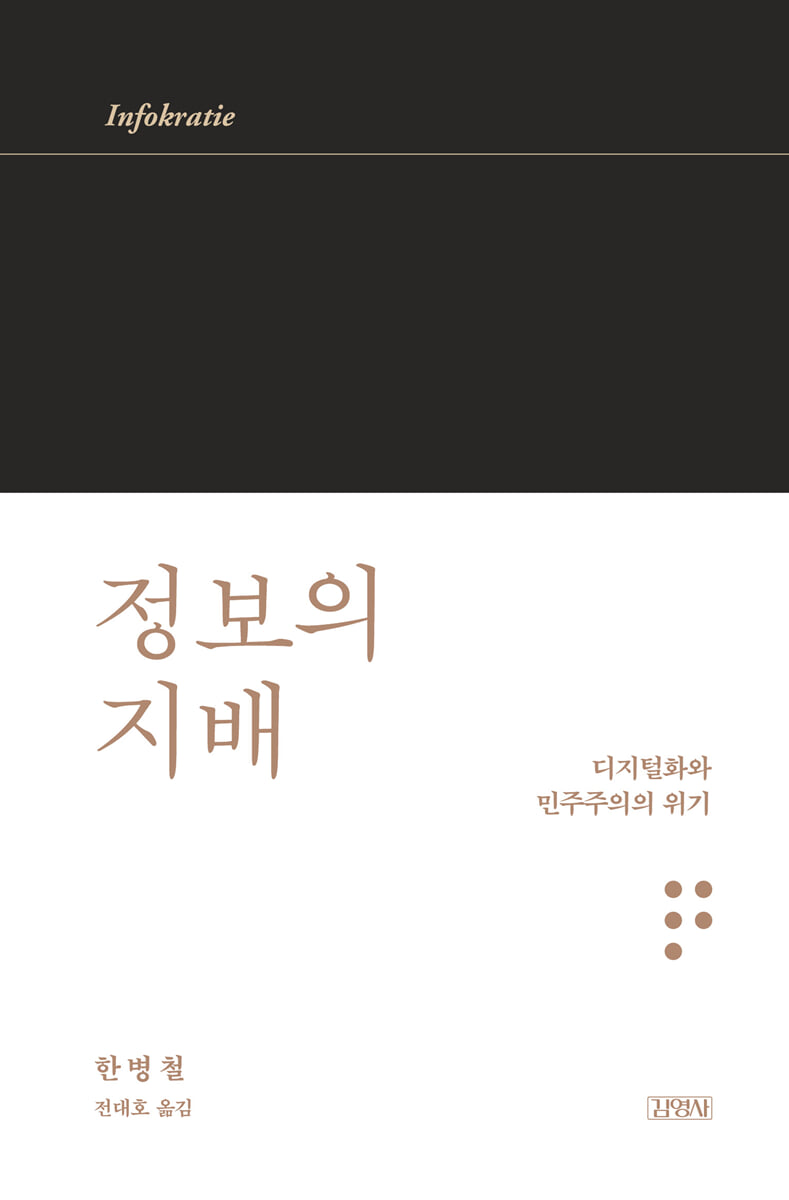
Dominance of information
 |
Description
Book Introduction
How does digitalization threaten democracy?
A portrait of the information society drawn through meticulous observation of phenomena and language.
Conspiracy theories that reinforce racism and identity politics, elections that have become information wars, big data without a grand narrative, social bots and comment armies that spread incitement and hatred, memes that exhibit viral characteristics… The relentless digitalization is already engulfing even the realm of politics and creating massive cracks in the democratic process.
In this book, which describes the crisis facing democracy today, Han Byung-chul finds the crisis in the digital structural changes of the public sphere.
He calls this crisis 'infocracy' and analyzes it in relation to the information system, a new form of domination.
A portrait of the information society drawn through meticulous observation of phenomena and language.
Conspiracy theories that reinforce racism and identity politics, elections that have become information wars, big data without a grand narrative, social bots and comment armies that spread incitement and hatred, memes that exhibit viral characteristics… The relentless digitalization is already engulfing even the realm of politics and creating massive cracks in the democratic process.
In this book, which describes the crisis facing democracy today, Han Byung-chul finds the crisis in the digital structural changes of the public sphere.
He calls this crisis 'infocracy' and analyzes it in relation to the information system, a new form of domination.
- You can preview some of the book's contents.
Preview
index
Information system
Infocracy
The end of communication
digital rationality
Crisis of Truth
main
Infocracy
The end of communication
digital rationality
Crisis of Truth
main
Detailed image

Into the book
“What is truly free is not people, but information.
The paradox of the information society is that people are trapped in information.
People chain themselves by communicating and producing information.
The digital prison is transparent.
"
--- p.15
“Big data and artificial intelligence allow the information system to influence our behavior at a level below the threshold of consciousness.
Thus, the information system takes control of the precognitive, impulsive, and emotional layers of behavior that precede conscious action.
“The psychopolitics of the information system, driven by data, intervenes in our behavior in ways we are not aware of.”
--- p.23
“The crisis of democracy begins already at the cognitive level.
Information has a very short shelf life.
Information is not temporally stable.
Because information thrives on the excitement of surprises.
Because of this temporal instability, information fragments perception.
Information plunges reality into the 'vertigo of eternal presentness'.
It is impossible to stay around information forever.
Thus, information perturbs the cognitive system.
“The acceleration obsession inherent in information drives out time-intensive cognitive practices like knowing, experiencing, and realizing.”
--- p.35
“The meme wars show that digital communication increasingly favors the visual over the textual.
As you know, pictures are faster than text.
Discourse and truth are not viral.
The intensification of visualization in communication also hinders democratic discourse.
Because the screen picture does not argue or justify.
Democracy is slow, breathless, and boring.
Therefore, the viral spread of information, or infodemic, severely undermines democratic processes.
There is no way to insert arguments and justifications into tweets or memes that spread and multiply at the speed of a virus.”
--- pp.43~44
“In the post-factual universe of the digital race, speech no longer carries any factual relevance.
Therefore, the statement has no rationality.
Speech is neither criticizable nor necessarily justifiable.
But those who confess to believing that statement gain a sense of belonging.
In short, discourse is replaced by belief and confession.
Now, outside each racial zone, there are only enemies, others to defeat.”
--- p.58
“AI calculates without justifying.
Algorithms take the place of arguments.
Arguments are improved in the course of discourse.
On the other hand, algorithms are continuously optimized in a mechanical process.
This allows the algorithm to correct its own errors.
Digital rationality replaces discursive learning with machine learning.
“That’s how the algorithm mimics the argument.”
--- p.65
“The end of the grand narrative that postmodernism leads is completed in the information society.
The story bursts with information.
Information is the enemy of story.
Big data is the antithesis of grand narratives.
Big data tells us nothing.
Digital is 'numerique' in French (also means 'numerisch', translator's note).
“The numerical and the narrative, the countable and the narrable, belong to two fundamentally different orders.”
--- p.93
“In a pandemic crisis, pure numbers like ‘case numbers’ or ‘incidence rates’ fundamentally heighten anxiety.
Because pure numbers don't explain anything.
Mere counting of numbers evokes a desire for story.
That's why pandemic crises are a breeding ground for conspiracy theories.
“Conspiracy theories eliminate the unbearable uncertainty and instability of a total explanation or a total lie.”
The paradox of the information society is that people are trapped in information.
People chain themselves by communicating and producing information.
The digital prison is transparent.
"
--- p.15
“Big data and artificial intelligence allow the information system to influence our behavior at a level below the threshold of consciousness.
Thus, the information system takes control of the precognitive, impulsive, and emotional layers of behavior that precede conscious action.
“The psychopolitics of the information system, driven by data, intervenes in our behavior in ways we are not aware of.”
--- p.23
“The crisis of democracy begins already at the cognitive level.
Information has a very short shelf life.
Information is not temporally stable.
Because information thrives on the excitement of surprises.
Because of this temporal instability, information fragments perception.
Information plunges reality into the 'vertigo of eternal presentness'.
It is impossible to stay around information forever.
Thus, information perturbs the cognitive system.
“The acceleration obsession inherent in information drives out time-intensive cognitive practices like knowing, experiencing, and realizing.”
--- p.35
“The meme wars show that digital communication increasingly favors the visual over the textual.
As you know, pictures are faster than text.
Discourse and truth are not viral.
The intensification of visualization in communication also hinders democratic discourse.
Because the screen picture does not argue or justify.
Democracy is slow, breathless, and boring.
Therefore, the viral spread of information, or infodemic, severely undermines democratic processes.
There is no way to insert arguments and justifications into tweets or memes that spread and multiply at the speed of a virus.”
--- pp.43~44
“In the post-factual universe of the digital race, speech no longer carries any factual relevance.
Therefore, the statement has no rationality.
Speech is neither criticizable nor necessarily justifiable.
But those who confess to believing that statement gain a sense of belonging.
In short, discourse is replaced by belief and confession.
Now, outside each racial zone, there are only enemies, others to defeat.”
--- p.58
“AI calculates without justifying.
Algorithms take the place of arguments.
Arguments are improved in the course of discourse.
On the other hand, algorithms are continuously optimized in a mechanical process.
This allows the algorithm to correct its own errors.
Digital rationality replaces discursive learning with machine learning.
“That’s how the algorithm mimics the argument.”
--- p.65
“The end of the grand narrative that postmodernism leads is completed in the information society.
The story bursts with information.
Information is the enemy of story.
Big data is the antithesis of grand narratives.
Big data tells us nothing.
Digital is 'numerique' in French (also means 'numerisch', translator's note).
“The numerical and the narrative, the countable and the narrable, belong to two fundamentally different orders.”
--- p.93
“In a pandemic crisis, pure numbers like ‘case numbers’ or ‘incidence rates’ fundamentally heighten anxiety.
Because pure numbers don't explain anything.
Mere counting of numbers evokes a desire for story.
That's why pandemic crises are a breeding ground for conspiracy theories.
“Conspiracy theories eliminate the unbearable uncertainty and instability of a total explanation or a total lie.”
--- p.94
Publisher's Review
“The truth will be a brief episode of the past.”
A detailed account of how the information system undermines democracy.
“The digitalization of our daily lives is progressing without a hitch.
This change is fundamentally altering our perception, our relationship with the world, and our communal lives.
We are intoxicated and confused by communication and information.
The tsunami of information exerts destructive power.
Before we know it, the tsunami has engulfed the political sphere, causing enormous confusion and obstacles to the democratic process.
“Democracy is degenerating into infocracy.” (p. 27)
The book "The Dominance of Information," which contains a social portrait drawn by German philosopher Han Byung-chul using "information" as a keyword, has been published.
From works such as “Transparent Society” and “Psychopolitics” to his most recent work, “The Disappearance of Things,” he has explored the “phenomenology of information” and presented a sharp critique of digital civilization.
In this book, Han Byung-chul finally places the concept of "information" at the center and reveals what the information we deal with or are a part of at every moment actually does, and in particular, how it is creating a huge crack in the democratic process.
We examine conspiracy theories that reinforce racism and identity politics, elections that have become information wars, big data that calculates without telling, social bots and comment units that spread incitement and hatred, and memes that exhibit viral properties.
'Infocracy', the subject of the book and the original German title, is a new concept discovered and used by the author, and refers to a new form of governance that is replacing democracy within the information system.
Originally, books played a central role in forming the political public sphere of democracy, but after the emergence of mass media, the dominant form transformed into telecracy and theatercracy, and from there, it took on the form of a modified infocracy.
So, this could also be said to be a book about the politics of information.
The author presents a sharp perspective on today's reality through the theories of Rousseau, Nietzsche, Benjamin, Foucault, Arendt, Shoshana Zuboff, and Harry Frankfort, as well as Habermas's theory on the structural changes of the public sphere and communicative acts.
How the information system divides our senses and perceptions
What does it have to do with democracy?
Today's information system differs in many ways from the disciplinary system that governed industrial capitalism.
While the subordinate subjects of a biopolitical disciplinary system are obedient and docile to oppressive power, the subordinate subjects of a psychopolitical information system “think of themselves as free, authentic, and creative” (p. 10).
“Everyone is an active transmitter.
Everyone is always producing and consuming information.
“Now, the intoxication of communication, which has taken on an addictive and even compulsive form, traps people in a new state of immaturity.” (p. 34)
The information we receive through smartphones, the Internet, and social media is subconsciously altering our perception of the world, and this change is destroying the foundations of communication, discourse, politics, and democratic processes.
“Information is not temporally stable.
Because information thrives on the excitement of surprises.
Because of this temporal instability, information fragments perception.” (p. 35) Furthermore, this characteristic of information is a major cause of the spread of conspiracy theories and fake news, which are total lies that question the very existence of truth, and this leads to the strengthening of racism and identity politics.
In the information system, ‘discourse’ that is constructed over a long period of time and ‘story’ that creates temporal continuity are gradually losing their place.
But this process does not only disrupt temporal continuity.
An argument has communicative rationality only when it can be refuted, and only when there are voices from others can my opinion be given discursive validity, but the information system erases the possibility of refutation and the existence of others.
In the absence of the political process of discourse and assertions of validity, management through mechanical calculation remains.
“Politics is being replaced by data-driven systems management.
“Socially important decisions are made through big data and artificial intelligence.” (p. 69) However, information has no ‘direction-setting power.’
“Truth is more than just the correctness or incorrectness of information” (p. 91).
Truth cannot be found with artificial intelligence that possesses arithmetical rationality rather than communicative rationality.
In this age of artificial intelligence, where humans feel powerless before Chat GPT, how can we reclaim what we've lost? The author explores the relationship between democracy and the fading "impulse, will, and courage toward truth" and the "ability to listen." He finds a clue.
What message do these two opposing concepts and unfamiliar metaphors convey?
Philosophical thought that shines uniquely in dialectical argument and literary form
As in his previous works, the author sets up two opposing concepts related to a phenomenon and, through comparison and contrast, masterfully captures aspects of the phenomenon that we have not yet noticed. Through metaphors such as metonymy and synecdoche, descriptions, and terminological analysis, he provides insight into phenomena that we have felt directly or indirectly but have found difficult to verbalize.
The oppositions presented in this book include disciplinary society and information society, isolation and connection, biopolitics and psychopolitics, discourse and information, politics and management, justification and calculation, politicians and experts (computer scientists), communicative rationality and digital rationality, stories and numbers, grand narratives and big data, opinions and identity, actions and consumption, hands and fingers, etc. In the process of slowly looking at these concepts and their phenomena, truths that we were not aware of are revealed.
Of course, this does not mean that the two opposing concepts are absolutely distinct and separate. Readers, as they read the book, can use this concept as a tool to consider what persists amidst change and difference.
A detailed account of how the information system undermines democracy.
“The digitalization of our daily lives is progressing without a hitch.
This change is fundamentally altering our perception, our relationship with the world, and our communal lives.
We are intoxicated and confused by communication and information.
The tsunami of information exerts destructive power.
Before we know it, the tsunami has engulfed the political sphere, causing enormous confusion and obstacles to the democratic process.
“Democracy is degenerating into infocracy.” (p. 27)
The book "The Dominance of Information," which contains a social portrait drawn by German philosopher Han Byung-chul using "information" as a keyword, has been published.
From works such as “Transparent Society” and “Psychopolitics” to his most recent work, “The Disappearance of Things,” he has explored the “phenomenology of information” and presented a sharp critique of digital civilization.
In this book, Han Byung-chul finally places the concept of "information" at the center and reveals what the information we deal with or are a part of at every moment actually does, and in particular, how it is creating a huge crack in the democratic process.
We examine conspiracy theories that reinforce racism and identity politics, elections that have become information wars, big data that calculates without telling, social bots and comment units that spread incitement and hatred, and memes that exhibit viral properties.
'Infocracy', the subject of the book and the original German title, is a new concept discovered and used by the author, and refers to a new form of governance that is replacing democracy within the information system.
Originally, books played a central role in forming the political public sphere of democracy, but after the emergence of mass media, the dominant form transformed into telecracy and theatercracy, and from there, it took on the form of a modified infocracy.
So, this could also be said to be a book about the politics of information.
The author presents a sharp perspective on today's reality through the theories of Rousseau, Nietzsche, Benjamin, Foucault, Arendt, Shoshana Zuboff, and Harry Frankfort, as well as Habermas's theory on the structural changes of the public sphere and communicative acts.
How the information system divides our senses and perceptions
What does it have to do with democracy?
Today's information system differs in many ways from the disciplinary system that governed industrial capitalism.
While the subordinate subjects of a biopolitical disciplinary system are obedient and docile to oppressive power, the subordinate subjects of a psychopolitical information system “think of themselves as free, authentic, and creative” (p. 10).
“Everyone is an active transmitter.
Everyone is always producing and consuming information.
“Now, the intoxication of communication, which has taken on an addictive and even compulsive form, traps people in a new state of immaturity.” (p. 34)
The information we receive through smartphones, the Internet, and social media is subconsciously altering our perception of the world, and this change is destroying the foundations of communication, discourse, politics, and democratic processes.
“Information is not temporally stable.
Because information thrives on the excitement of surprises.
Because of this temporal instability, information fragments perception.” (p. 35) Furthermore, this characteristic of information is a major cause of the spread of conspiracy theories and fake news, which are total lies that question the very existence of truth, and this leads to the strengthening of racism and identity politics.
In the information system, ‘discourse’ that is constructed over a long period of time and ‘story’ that creates temporal continuity are gradually losing their place.
But this process does not only disrupt temporal continuity.
An argument has communicative rationality only when it can be refuted, and only when there are voices from others can my opinion be given discursive validity, but the information system erases the possibility of refutation and the existence of others.
In the absence of the political process of discourse and assertions of validity, management through mechanical calculation remains.
“Politics is being replaced by data-driven systems management.
“Socially important decisions are made through big data and artificial intelligence.” (p. 69) However, information has no ‘direction-setting power.’
“Truth is more than just the correctness or incorrectness of information” (p. 91).
Truth cannot be found with artificial intelligence that possesses arithmetical rationality rather than communicative rationality.
In this age of artificial intelligence, where humans feel powerless before Chat GPT, how can we reclaim what we've lost? The author explores the relationship between democracy and the fading "impulse, will, and courage toward truth" and the "ability to listen." He finds a clue.
What message do these two opposing concepts and unfamiliar metaphors convey?
Philosophical thought that shines uniquely in dialectical argument and literary form
As in his previous works, the author sets up two opposing concepts related to a phenomenon and, through comparison and contrast, masterfully captures aspects of the phenomenon that we have not yet noticed. Through metaphors such as metonymy and synecdoche, descriptions, and terminological analysis, he provides insight into phenomena that we have felt directly or indirectly but have found difficult to verbalize.
The oppositions presented in this book include disciplinary society and information society, isolation and connection, biopolitics and psychopolitics, discourse and information, politics and management, justification and calculation, politicians and experts (computer scientists), communicative rationality and digital rationality, stories and numbers, grand narratives and big data, opinions and identity, actions and consumption, hands and fingers, etc. In the process of slowly looking at these concepts and their phenomena, truths that we were not aware of are revealed.
Of course, this does not mean that the two opposing concepts are absolutely distinct and separate. Readers, as they read the book, can use this concept as a tool to consider what persists amidst change and difference.
GOODS SPECIFICS
- Date of issue: February 27, 2023
- Format: Hardcover book binding method guide
- Page count, weight, size: 106 pages | 230g | 124*190*10mm
- ISBN13: 9788934951445
- ISBN10: 8934951443
You may also like
카테고리
korean


korean

![GQ KOREA Mark (Monthly): December [2025]](http://librairie.coreenne.fr/cdn/shop/files/8ef265dbbfbf186523ed75ba7319009d.jpg?v=1765340328&width=3840)


