

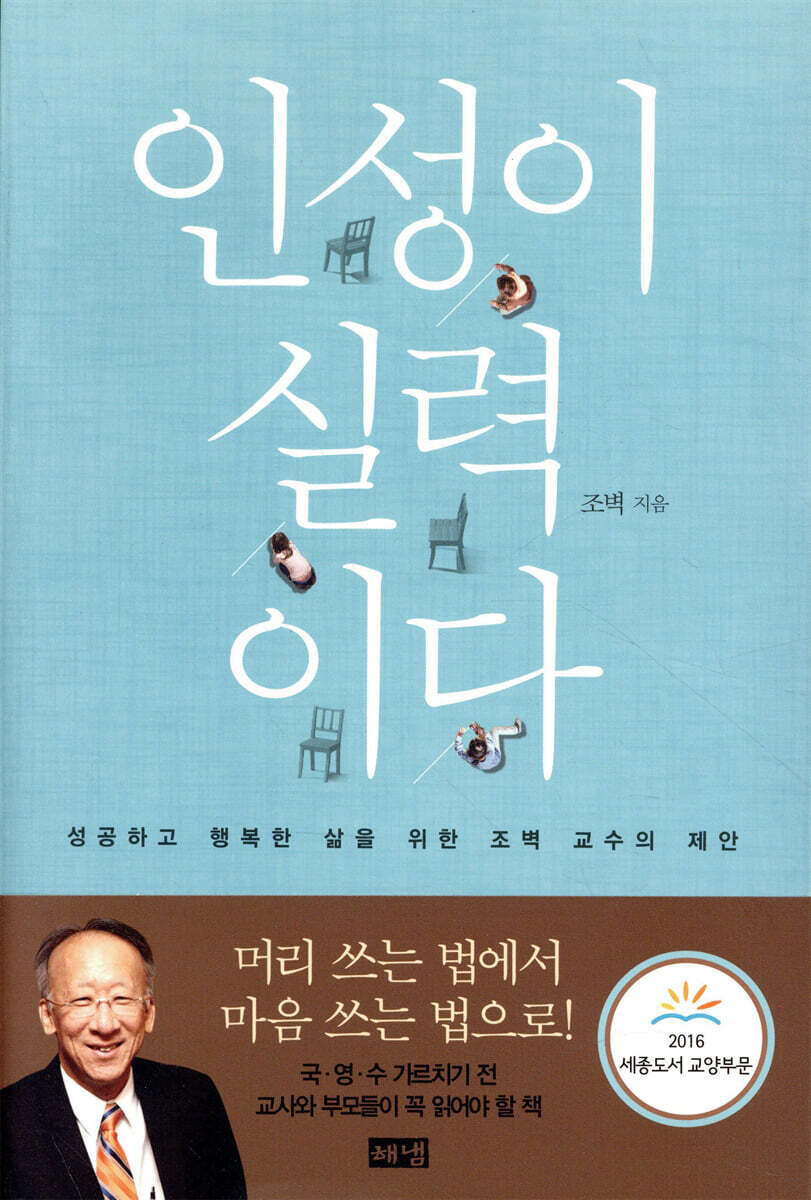
Character is ability
 |
Description
Book Introduction
Professor Cho Byeok presents the goals of character education as the 'Three Rules' and the implementation strategies as the 'Six Practices' so that teachers and parents can independently review, design, and practice character education at school and at home.
The three rules are 'self-regulation, relationship regulation, and public interest regulation', meaning 'regulating oneself on an individual level, coordinating with others in relationships, and lastly coordinating for the public interest.'
When these three abilities are properly exercised, desirable behaviors emerge, and teaching the skills of coordinating these three abilities is the task of character education.
The six specific behavioral standards for character education are 'autonomy, rationality, positivity, emotional coaching, position, and adulthood.'
It's about specific ways to love yourself and others and become the master of your own life.
This book, consisting of four parts, explains in Part 1 why character should be recognized as a skill and why efforts should be made to achieve it, based on the historical, cultural, and academic backgrounds.
In Part 2, the direction in which character education should proceed is proven through scientific research results.
Part 3 presents the six principles of character education, supported by extensive longitudinal research, to demonstrate the specific forms of desirable behavior that character education aims for.
Part 4 contains methods of character education that adults should first show to children in communities such as home, school, and society.
The three rules are 'self-regulation, relationship regulation, and public interest regulation', meaning 'regulating oneself on an individual level, coordinating with others in relationships, and lastly coordinating for the public interest.'
When these three abilities are properly exercised, desirable behaviors emerge, and teaching the skills of coordinating these three abilities is the task of character education.
The six specific behavioral standards for character education are 'autonomy, rationality, positivity, emotional coaching, position, and adulthood.'
It's about specific ways to love yourself and others and become the master of your own life.
This book, consisting of four parts, explains in Part 1 why character should be recognized as a skill and why efforts should be made to achieve it, based on the historical, cultural, and academic backgrounds.
In Part 2, the direction in which character education should proceed is proven through scientific research results.
Part 3 presents the six principles of character education, supported by extensive longitudinal research, to demonstrate the specific forms of desirable behavior that character education aims for.
Part 4 contains methods of character education that adults should first show to children in communities such as home, school, and society.
- You can preview some of the book's contents.
Preview
index
Prologue: For the Hope of Character Education in the Republic of Korea
Part 1: In the Age of Global Creativity, Character is True Ability
Chapter 1: Why Character Education is a Hot Topic
Chapter 2: Living Character Education Follows the Times
Chapter 3: Character is the Key to Success
Chapter 4: The Three Rules of Character Education: Self-regulation, Relationship Regulation, and Public Interest Regulation
Chapter 5: Physical Safety and Psychological Stability Come First
Chapter 6: Fundamental Obstacles to Character Education
Part 2: The Right Direction of Character Education Through Scientific Principles
Chapter 7: Academic Background of American Character Education
Chapter 8: Where Do Children's Problem Behaviors Come From?
Chapter 9: The Purpose of Character Education: "Living Happily with Others"
Chapter 10: Our country has valued relationships since ancient times
Chapter 11: Why Emotions Are Important in Character Education
Chapter 12: Why Animal-Like Behavior Occurs
Chapter 13: Character can be cultivated through long-term study.
Chapter 14: Focus on your child's feelings, not their behavior.
Chapter 15: Why We Obsess Over Actions Instead of Feelings
Part 3: What is Desirable Behavior?
Chapter 16, "Six Conducts," the specific standards for practicing human nature.
Chapter 17: Autonomy: "Choose Yourself"
Chapter 18: Rationality: Harmonizing Emotion and Reason
Chapter 19: Positivity: "Nevertheless, I See a Bright Future"
Chapter 20: Emotional Coaching: Expressing Your Emotions and Empathizing with Others
Chapter 21: "Innovate by focusing on something bigger than yourself."
Chapter 22: "Exercising Leadership Through Sharing and Giving"
Part 4: How to Teach Character
Chapter 23: How to Make the Flower of "Humanity" Bloom
Chapter 24: Community Character Education to be Practiced Together at Home, School, and Society
Chapter 25: Detox, Healing, and Life Coaching: A Personality Recovery Program
Chapter 26: Analyzing and Redesigning Existing Character Education Methods
Epilogue: Become Your Child's Best Mentor
Acknowledgements
Part 1: In the Age of Global Creativity, Character is True Ability
Chapter 1: Why Character Education is a Hot Topic
Chapter 2: Living Character Education Follows the Times
Chapter 3: Character is the Key to Success
Chapter 4: The Three Rules of Character Education: Self-regulation, Relationship Regulation, and Public Interest Regulation
Chapter 5: Physical Safety and Psychological Stability Come First
Chapter 6: Fundamental Obstacles to Character Education
Part 2: The Right Direction of Character Education Through Scientific Principles
Chapter 7: Academic Background of American Character Education
Chapter 8: Where Do Children's Problem Behaviors Come From?
Chapter 9: The Purpose of Character Education: "Living Happily with Others"
Chapter 10: Our country has valued relationships since ancient times
Chapter 11: Why Emotions Are Important in Character Education
Chapter 12: Why Animal-Like Behavior Occurs
Chapter 13: Character can be cultivated through long-term study.
Chapter 14: Focus on your child's feelings, not their behavior.
Chapter 15: Why We Obsess Over Actions Instead of Feelings
Part 3: What is Desirable Behavior?
Chapter 16, "Six Conducts," the specific standards for practicing human nature.
Chapter 17: Autonomy: "Choose Yourself"
Chapter 18: Rationality: Harmonizing Emotion and Reason
Chapter 19: Positivity: "Nevertheless, I See a Bright Future"
Chapter 20: Emotional Coaching: Expressing Your Emotions and Empathizing with Others
Chapter 21: "Innovate by focusing on something bigger than yourself."
Chapter 22: "Exercising Leadership Through Sharing and Giving"
Part 4: How to Teach Character
Chapter 23: How to Make the Flower of "Humanity" Bloom
Chapter 24: Community Character Education to be Practiced Together at Home, School, and Society
Chapter 25: Detox, Healing, and Life Coaching: A Personality Recovery Program
Chapter 26: Analyzing and Redesigning Existing Character Education Methods
Epilogue: Become Your Child's Best Mentor
Acknowledgements
Into the book
Be your child's best mentor.
Character education is the education that turns children into adults.
What teachers must impart is wisdom before knowledge.
Knowledge can be obtained at any time from books and the Internet, but wisdom is only passed down from person to person.
First, an adult must show his or her adult self.
First, a person who has lived and become an adult is called a 'teacher'.
Parents and teachers are the best mentors to show their children what it means to be mature.
There's a reason we have to do these difficult things.
Korea is now facing a major limitation.
The education we have had so far has been upward education.
There is no idea of what to do when you go up, no vision, no goals.
“Study hard and you will be able to give to others.” This common encouragement from adults to children is incredibly pitiful.
This is a statement that encourages extreme selfishness.
Now, we need education that moves forward, into the future, rather than just upward.
To move forward, we must choose adventure over complacency, challenge over giving up, and give over taking.
Instead of climbing higher to eat the fruit of the tree that others have planted, we must move forward and plant new trees.
So, we must make it possible for those who follow us to obtain more abundant fruit.
Rather than education for social advancement stained by competition, zero-sum games, and winner-take-all, character education is necessary to practice future-creating education that opens a new world through cooperation and sharing.
Discover the desirable behaviors and practices we should be demonstrating to children at school, at home, and in society!
"Character is true ability." This is something I've been emphasizing at every opportunity for over a decade.
Character is not a personality, it is a skill.
It is not something you are born with, it is something you learn.
Temporary
It is not an act of kindness, but a habit that persists.
Character is the ability that enables us to study and work, and in the future, character will become even more essential for leadership.
We need to invest in character and place character within the realm of ability.
Of course, a good personality has value in itself.
However, there is a separate reason why we emphasize character by using the word “ability.”
If you don't emphasize character as ability, the choices will be divided into character or Korean, English, and math.
This is because most people are worried that in that binary choice, they will choose Korean, English, and math, which are considered skills that will lead to success when they go out into society.
But character is not an either/or proposition.
Since both studying and character are abilities, you can't give up on either one.
---From "Chapter 3: Character is the Key to Success"
Korea has one of the highest divorce rates in the world.
But divorce isn't something where you live together on good terms and then one day shake hands and say, "Let's break up from now on."
If a couple gets divorced, it means they fought for 5 or 10 years, not 1 or 2 years.
You may have fought in front of your children, exchanged harsh words, and even thrown punches.
The poison that parents pour on each other is inevitably passed on to their children.
In Korea, where divorce and the destruction of families are just beginning, it is still unclear what negative effects and harms will follow.
But we can foresee our future by looking at the United States, where the breakdown of families occurred 30 years before Korea.
American society is in great pain right now.
I was seriously ill.
Yet, Korea is busy benchmarking that society.
As long as we continue to imitate the West, it is highly likely that Korea will become a seriously ill society in 30 years.
Because Korea is a rapidly changing society, it could become a sick country like the United States in 10 years.
The next 10 years are the 'golden time'.
Within 10 years, we must resolve issues that threaten humanity, such as low birth rates, divorce, and suicide.
---From "Chapter 6: Fundamental Obstacles to Character Education"
They use foul language as if it were nothing, commit gang rape, and even force their juniors to have sex with them.
When I see children doing this, it really seems like the devil exists.
How could all these good children be so hideous when they are born?
When people are overly stressed, they become escapist or aggressive.
This is not only due to violence, but also to poor learning and dropping out of school.
In fact, the cause has already been revealed through numerous studies.
Among the causes identified, the most important is environmental factors.
Children experience great stress in environments where adults are oppressive, immature, or irresponsible.
The frustration, despair, and helplessness of being deprived of freedom manifest as irritation.
---From Chapter 8, “Where Do Children’s Problem Behaviors Come From?”
When stimulated, emotions, which are physical reactions, occur in all reptiles, mammals, and primates.
However, humans (primates) are different from reptiles and also different from mammals.
Emotions become feelings,
Then comes the desire, and then the action.
During this process, people can show different reactions to the same stimulus.
A single emotion can lead to different desires, and the same desire can lead to completely different behaviors.
You can cry out loud in sadness, or you can turn your head and look at the distant mountains with sadness.
The existence of diversity at each level of emotion, feeling, desire, and behavior means that there is room for choice.
Humans can react in different ways to a single stimulus.
That is, humans can choose.
This is an ability that only humans have.
Mammals also have some choices.
Of course, there are people who cannot choose their reaction.
For example, people who are angry get angry and swear at others because they feel bad.
It's no different from an animal that only does one predictable action in response to one stimulus.
He is a person without character.
We cannot discuss character unless we properly understand the world of emotions.
---From Chapter 11, “Why Emotions Are Important in Character Education”
To keep your relationships from smelling bad, you need to share small, frequent positivity.
Showing affection, respect, gratitude, and consideration should be done frequently. Doing them all at once is not only ineffective, but also a waste of time and energy.
A person who best exemplifies this principle is President Obama, the master of relationships.
There is a famous anecdote that was broadcast on the news a while ago.
Obama walks to board the helicopter
It is going on.
A soldier standing guard next to a helicopter salutes.
Obama seems to be deep in thought and just gets into the helicopter without even looking at the soldier.
But Obama comes right back down.
And then he shakes hands with the soldier and says a few words.
One is a private, the other is the president.
Not receiving a private's salute once is such a minor thing that no one would take issue with it.
But Obama didn't let that little thing pass him by.
This is what leadership is.
This is how people with the best character, personality, and humanity live their daily lives.
Obama didn't shake hands with the soldier because he was great.
It's just showing respect to humans as humans.
This was possible because I always believed that all humans are equally valuable.
---From "Chapter 19 Positivity: 'Nevertheless, I See a Bright Future'"
I believe that the root of character is the ability to self-regulate, regulate relationships, and coordinate for the public good.
I believe that the most effective way to educate character is to develop the ability to practice these three principles.
Let's take a simple example of self-regulation.
When people get angry, they get angry.
And then they swear, assault, or do something they later regret.
So in character education, we teach students to control their anger and patience.
It sounds good, but is it easy?
Character education is not about teaching patience, but about teaching the difference between being angry and getting angry.
We need to let them know that anger is an emotion, that anger is an action, and that there is a choice in how they act.
And then, teaching how to express the anger you feel and how to express it in a desirable way is character education that corresponds to self-regulation.
Character education is the education that turns children into adults.
What teachers must impart is wisdom before knowledge.
Knowledge can be obtained at any time from books and the Internet, but wisdom is only passed down from person to person.
First, an adult must show his or her adult self.
First, a person who has lived and become an adult is called a 'teacher'.
Parents and teachers are the best mentors to show their children what it means to be mature.
There's a reason we have to do these difficult things.
Korea is now facing a major limitation.
The education we have had so far has been upward education.
There is no idea of what to do when you go up, no vision, no goals.
“Study hard and you will be able to give to others.” This common encouragement from adults to children is incredibly pitiful.
This is a statement that encourages extreme selfishness.
Now, we need education that moves forward, into the future, rather than just upward.
To move forward, we must choose adventure over complacency, challenge over giving up, and give over taking.
Instead of climbing higher to eat the fruit of the tree that others have planted, we must move forward and plant new trees.
So, we must make it possible for those who follow us to obtain more abundant fruit.
Rather than education for social advancement stained by competition, zero-sum games, and winner-take-all, character education is necessary to practice future-creating education that opens a new world through cooperation and sharing.
Discover the desirable behaviors and practices we should be demonstrating to children at school, at home, and in society!
"Character is true ability." This is something I've been emphasizing at every opportunity for over a decade.
Character is not a personality, it is a skill.
It is not something you are born with, it is something you learn.
Temporary
It is not an act of kindness, but a habit that persists.
Character is the ability that enables us to study and work, and in the future, character will become even more essential for leadership.
We need to invest in character and place character within the realm of ability.
Of course, a good personality has value in itself.
However, there is a separate reason why we emphasize character by using the word “ability.”
If you don't emphasize character as ability, the choices will be divided into character or Korean, English, and math.
This is because most people are worried that in that binary choice, they will choose Korean, English, and math, which are considered skills that will lead to success when they go out into society.
But character is not an either/or proposition.
Since both studying and character are abilities, you can't give up on either one.
---From "Chapter 3: Character is the Key to Success"
Korea has one of the highest divorce rates in the world.
But divorce isn't something where you live together on good terms and then one day shake hands and say, "Let's break up from now on."
If a couple gets divorced, it means they fought for 5 or 10 years, not 1 or 2 years.
You may have fought in front of your children, exchanged harsh words, and even thrown punches.
The poison that parents pour on each other is inevitably passed on to their children.
In Korea, where divorce and the destruction of families are just beginning, it is still unclear what negative effects and harms will follow.
But we can foresee our future by looking at the United States, where the breakdown of families occurred 30 years before Korea.
American society is in great pain right now.
I was seriously ill.
Yet, Korea is busy benchmarking that society.
As long as we continue to imitate the West, it is highly likely that Korea will become a seriously ill society in 30 years.
Because Korea is a rapidly changing society, it could become a sick country like the United States in 10 years.
The next 10 years are the 'golden time'.
Within 10 years, we must resolve issues that threaten humanity, such as low birth rates, divorce, and suicide.
---From "Chapter 6: Fundamental Obstacles to Character Education"
They use foul language as if it were nothing, commit gang rape, and even force their juniors to have sex with them.
When I see children doing this, it really seems like the devil exists.
How could all these good children be so hideous when they are born?
When people are overly stressed, they become escapist or aggressive.
This is not only due to violence, but also to poor learning and dropping out of school.
In fact, the cause has already been revealed through numerous studies.
Among the causes identified, the most important is environmental factors.
Children experience great stress in environments where adults are oppressive, immature, or irresponsible.
The frustration, despair, and helplessness of being deprived of freedom manifest as irritation.
---From Chapter 8, “Where Do Children’s Problem Behaviors Come From?”
When stimulated, emotions, which are physical reactions, occur in all reptiles, mammals, and primates.
However, humans (primates) are different from reptiles and also different from mammals.
Emotions become feelings,
Then comes the desire, and then the action.
During this process, people can show different reactions to the same stimulus.
A single emotion can lead to different desires, and the same desire can lead to completely different behaviors.
You can cry out loud in sadness, or you can turn your head and look at the distant mountains with sadness.
The existence of diversity at each level of emotion, feeling, desire, and behavior means that there is room for choice.
Humans can react in different ways to a single stimulus.
That is, humans can choose.
This is an ability that only humans have.
Mammals also have some choices.
Of course, there are people who cannot choose their reaction.
For example, people who are angry get angry and swear at others because they feel bad.
It's no different from an animal that only does one predictable action in response to one stimulus.
He is a person without character.
We cannot discuss character unless we properly understand the world of emotions.
---From Chapter 11, “Why Emotions Are Important in Character Education”
To keep your relationships from smelling bad, you need to share small, frequent positivity.
Showing affection, respect, gratitude, and consideration should be done frequently. Doing them all at once is not only ineffective, but also a waste of time and energy.
A person who best exemplifies this principle is President Obama, the master of relationships.
There is a famous anecdote that was broadcast on the news a while ago.
Obama walks to board the helicopter
It is going on.
A soldier standing guard next to a helicopter salutes.
Obama seems to be deep in thought and just gets into the helicopter without even looking at the soldier.
But Obama comes right back down.
And then he shakes hands with the soldier and says a few words.
One is a private, the other is the president.
Not receiving a private's salute once is such a minor thing that no one would take issue with it.
But Obama didn't let that little thing pass him by.
This is what leadership is.
This is how people with the best character, personality, and humanity live their daily lives.
Obama didn't shake hands with the soldier because he was great.
It's just showing respect to humans as humans.
This was possible because I always believed that all humans are equally valuable.
---From "Chapter 19 Positivity: 'Nevertheless, I See a Bright Future'"
I believe that the root of character is the ability to self-regulate, regulate relationships, and coordinate for the public good.
I believe that the most effective way to educate character is to develop the ability to practice these three principles.
Let's take a simple example of self-regulation.
When people get angry, they get angry.
And then they swear, assault, or do something they later regret.
So in character education, we teach students to control their anger and patience.
It sounds good, but is it easy?
Character education is not about teaching patience, but about teaching the difference between being angry and getting angry.
We need to let them know that anger is an emotion, that anger is an action, and that there is a choice in how they act.
And then, teaching how to express the anger you feel and how to express it in a desirable way is character education that corresponds to self-regulation.
---From Chapter 23, “How to Make the Flower of ‘Humanity’ Bloom”
Publisher's Review
Success and happiness cannot be achieved alone!
Through 'Samryul' and 'Yukhaeng', we learn from Professor Cho Byeok how children can grow into true masters of life, not just 'bookworms' who only know how to study!
Mark Zuckerberg, Oprah Winfrey… What do today's successful and happy people have in common? It's that they go beyond their own interests and do meaningful work for others and the world.
This paradoxically shows that in the 21st century, success is not about stepping on others, but about creating new value together with others.
In a time when cooperation and collective intelligence are so important, character is the foundation for success and happiness as it is the fundamental ability to coordinate oneself and live with others.
However, contrary to the trend of the times, the sad reality is that our country's children are facing a threat to their character due to blind competition for college entrance exams, the selfishness of adults, and a crumbling family environment.
The PISA (Program for International Student Assessment) results show that Korea is the world's best in Korean, English, math, social studies, and science, but ranks lowest in personality-related indices such as sociality and cooperation.
The government, realizing the urgent need to restore children's character due to the increasing rate of bullying, suicide, and school violence, has implemented the Character Education Promotion Act, the first of its kind in the world. However, the law is controversial, and the educational field is in disarray, unable to even grasp the concept of character education.
Professor Cho Byeok, who has been emphasizing the importance of 'character' as the fundamental goal of all education for over 20 years, presents a method of character education required today in his new book, 'Character is Ability.'
As a world-renowned expert on educational policy and teaching methods, the author guides readers toward effective character education through insights and scientific evidence derived from over 30 years of domestic and international educational experience.
The core competencies of character remain unchanged, past and present.
However, the way we convey this to children must change with the times.
Furthermore, character education is not about building new knowledge of character on top of the curriculum, but rather about filling the mental poverty of children, and it emphasizes that it is the essence of education, not education outside of the curriculum.
The author seeks to correct the dichotomous view of our society that divides knowledge acquisition and character development, defining 'character development' as 'ability.'
This is a critical time when character education can no longer be postponed, as divorce and suicide rates are skyrocketing at unprecedented rates worldwide and social irresponsibility and conflict are becoming more frequent.
The core of character education is to avoid actions that are harmful to oneself and others and to engage in desirable actions.
Because of this, character education in the past was focused on children's problem behaviors and was quick to discipline and correct them.
However, Professor Cho Byeok reveals in this book that behavior comes from emotions, and that the first task is to first understand children's emotions and their backgrounds and then move them into a state of positive emotions.
Based on the latest research results in psychology, brain science, and biology, it is argued that emotions are an important element that should be addressed in character education.
Professor Cho Byeok presents the goals of character education as the 'Three Rules' and the implementation strategies as the 'Six Practices' so that teachers and parents can independently review, design, and practice character education at school and at home.
The three rules are 'self-regulation, relationship regulation, and public interest regulation', meaning 'regulating oneself on an individual level, coordinating with others in relationships, and lastly coordinating for the public interest.'
When these three abilities are properly exercised, desirable behaviors emerge, and teaching the skills of coordinating these three abilities is the task of character education.
The six specific behavioral standards for character education are 'autonomy, rationality, positivity, emotional coaching, position, and adulthood.'
It's about specific ways to love yourself and others and become the master of your own life.
This book, consisting of four parts, explains in Part 1 why character should be recognized as a skill and why efforts should be made to achieve it, based on the historical, cultural, and academic backgrounds.
In Part 2, the direction in which character education should proceed is proven through scientific research results.
Part 3 presents the six principles of character education, supported by extensive longitudinal research, to demonstrate the specific forms of desirable behavior that character education aims for.
Part 4 contains methods of character education that adults should first show to children in communities such as home, school, and society.
In "Character is Ability," the author examines important lessons we should learn from, using the example of the United States, which has invested heavily in character education for over 30 years.
It also includes examples of reviewing, revising, and supplementing with field teachers to ensure that character education can be incorporated into each subject class.
"Adults must change for children to change!" Professor Cho Byeok says that there is an order to everything.
Character education is possible, above all, when there are 'true' adults who know how to control themselves and empathize with children.
When all adults in society, including teachers and parents, set an example through their words and actions in their daily lives and invite children into a world of positive emotions, children can grow up healthily.
This book provides teachers and parents with an opportunity to reflect on their own actions, and on that basis, it provides methods and wisdom for proper character education.
Furthermore, it will suggest what and how we, as educators and all of us, should strive to ensure the proper growth of the next generation.
The 'Three Rules' of Character Education
self-regulation
Self-regulation is the cultivation of a healthy and upright inner self.
The goal of self-regulation is to create space for choice for ourselves.
In this space, thoughts and emotions are integrated and coordinated.
Relationship coordination
Relationship coordination is about living well with other people.
Relationship coordination is possible only when adults demonstrate it to children.
Children need adults around them to protect, support, and coach them.
Public interest coordination
Public interest coordination is about living in harmony with the community and nature.
It is the ability to satisfy the need for greater value and meaning beyond oneself.
The Six Principles of Character Education
1.
Autonomous
Know yourself, see situations objectively, and choose your reactions to external stimuli.
2.
rational
It has room for choice and achieves a balance between emotion and reason.
3.
positivity
Have a perspective on positive factors and outcomes and exert the mental energy to create those outcomes.
4.
Emotional Coaching
Express and express your own emotions well, empathize with the emotions of others, and move through them.
5.
Location
Innovate by placing your spirit in something bigger than yourself.
6.
Adulthood
Contribute to the happiness of others and demonstrate leadership in sharing and giving.
Through 'Samryul' and 'Yukhaeng', we learn from Professor Cho Byeok how children can grow into true masters of life, not just 'bookworms' who only know how to study!
Mark Zuckerberg, Oprah Winfrey… What do today's successful and happy people have in common? It's that they go beyond their own interests and do meaningful work for others and the world.
This paradoxically shows that in the 21st century, success is not about stepping on others, but about creating new value together with others.
In a time when cooperation and collective intelligence are so important, character is the foundation for success and happiness as it is the fundamental ability to coordinate oneself and live with others.
However, contrary to the trend of the times, the sad reality is that our country's children are facing a threat to their character due to blind competition for college entrance exams, the selfishness of adults, and a crumbling family environment.
The PISA (Program for International Student Assessment) results show that Korea is the world's best in Korean, English, math, social studies, and science, but ranks lowest in personality-related indices such as sociality and cooperation.
The government, realizing the urgent need to restore children's character due to the increasing rate of bullying, suicide, and school violence, has implemented the Character Education Promotion Act, the first of its kind in the world. However, the law is controversial, and the educational field is in disarray, unable to even grasp the concept of character education.
Professor Cho Byeok, who has been emphasizing the importance of 'character' as the fundamental goal of all education for over 20 years, presents a method of character education required today in his new book, 'Character is Ability.'
As a world-renowned expert on educational policy and teaching methods, the author guides readers toward effective character education through insights and scientific evidence derived from over 30 years of domestic and international educational experience.
The core competencies of character remain unchanged, past and present.
However, the way we convey this to children must change with the times.
Furthermore, character education is not about building new knowledge of character on top of the curriculum, but rather about filling the mental poverty of children, and it emphasizes that it is the essence of education, not education outside of the curriculum.
The author seeks to correct the dichotomous view of our society that divides knowledge acquisition and character development, defining 'character development' as 'ability.'
This is a critical time when character education can no longer be postponed, as divorce and suicide rates are skyrocketing at unprecedented rates worldwide and social irresponsibility and conflict are becoming more frequent.
The core of character education is to avoid actions that are harmful to oneself and others and to engage in desirable actions.
Because of this, character education in the past was focused on children's problem behaviors and was quick to discipline and correct them.
However, Professor Cho Byeok reveals in this book that behavior comes from emotions, and that the first task is to first understand children's emotions and their backgrounds and then move them into a state of positive emotions.
Based on the latest research results in psychology, brain science, and biology, it is argued that emotions are an important element that should be addressed in character education.
Professor Cho Byeok presents the goals of character education as the 'Three Rules' and the implementation strategies as the 'Six Practices' so that teachers and parents can independently review, design, and practice character education at school and at home.
The three rules are 'self-regulation, relationship regulation, and public interest regulation', meaning 'regulating oneself on an individual level, coordinating with others in relationships, and lastly coordinating for the public interest.'
When these three abilities are properly exercised, desirable behaviors emerge, and teaching the skills of coordinating these three abilities is the task of character education.
The six specific behavioral standards for character education are 'autonomy, rationality, positivity, emotional coaching, position, and adulthood.'
It's about specific ways to love yourself and others and become the master of your own life.
This book, consisting of four parts, explains in Part 1 why character should be recognized as a skill and why efforts should be made to achieve it, based on the historical, cultural, and academic backgrounds.
In Part 2, the direction in which character education should proceed is proven through scientific research results.
Part 3 presents the six principles of character education, supported by extensive longitudinal research, to demonstrate the specific forms of desirable behavior that character education aims for.
Part 4 contains methods of character education that adults should first show to children in communities such as home, school, and society.
In "Character is Ability," the author examines important lessons we should learn from, using the example of the United States, which has invested heavily in character education for over 30 years.
It also includes examples of reviewing, revising, and supplementing with field teachers to ensure that character education can be incorporated into each subject class.
"Adults must change for children to change!" Professor Cho Byeok says that there is an order to everything.
Character education is possible, above all, when there are 'true' adults who know how to control themselves and empathize with children.
When all adults in society, including teachers and parents, set an example through their words and actions in their daily lives and invite children into a world of positive emotions, children can grow up healthily.
This book provides teachers and parents with an opportunity to reflect on their own actions, and on that basis, it provides methods and wisdom for proper character education.
Furthermore, it will suggest what and how we, as educators and all of us, should strive to ensure the proper growth of the next generation.
The 'Three Rules' of Character Education
self-regulation
Self-regulation is the cultivation of a healthy and upright inner self.
The goal of self-regulation is to create space for choice for ourselves.
In this space, thoughts and emotions are integrated and coordinated.
Relationship coordination
Relationship coordination is about living well with other people.
Relationship coordination is possible only when adults demonstrate it to children.
Children need adults around them to protect, support, and coach them.
Public interest coordination
Public interest coordination is about living in harmony with the community and nature.
It is the ability to satisfy the need for greater value and meaning beyond oneself.
The Six Principles of Character Education
1.
Autonomous
Know yourself, see situations objectively, and choose your reactions to external stimuli.
2.
rational
It has room for choice and achieves a balance between emotion and reason.
3.
positivity
Have a perspective on positive factors and outcomes and exert the mental energy to create those outcomes.
4.
Emotional Coaching
Express and express your own emotions well, empathize with the emotions of others, and move through them.
5.
Location
Innovate by placing your spirit in something bigger than yourself.
6.
Adulthood
Contribute to the happiness of others and demonstrate leadership in sharing and giving.
GOODS SPECIFICS
- Date of issue: January 1, 2016
- Page count, weight, size: 352 pages | 536g | 153*224*30mm
- ISBN13: 9788965745259
- ISBN10: 896574525X
You may also like
카테고리
korean


korean

![GQ KOREA Mark (Monthly): December [2025]](http://librairie.coreenne.fr/cdn/shop/files/8ef265dbbfbf186523ed75ba7319009d.jpg?v=1765340328&width=3840)


