

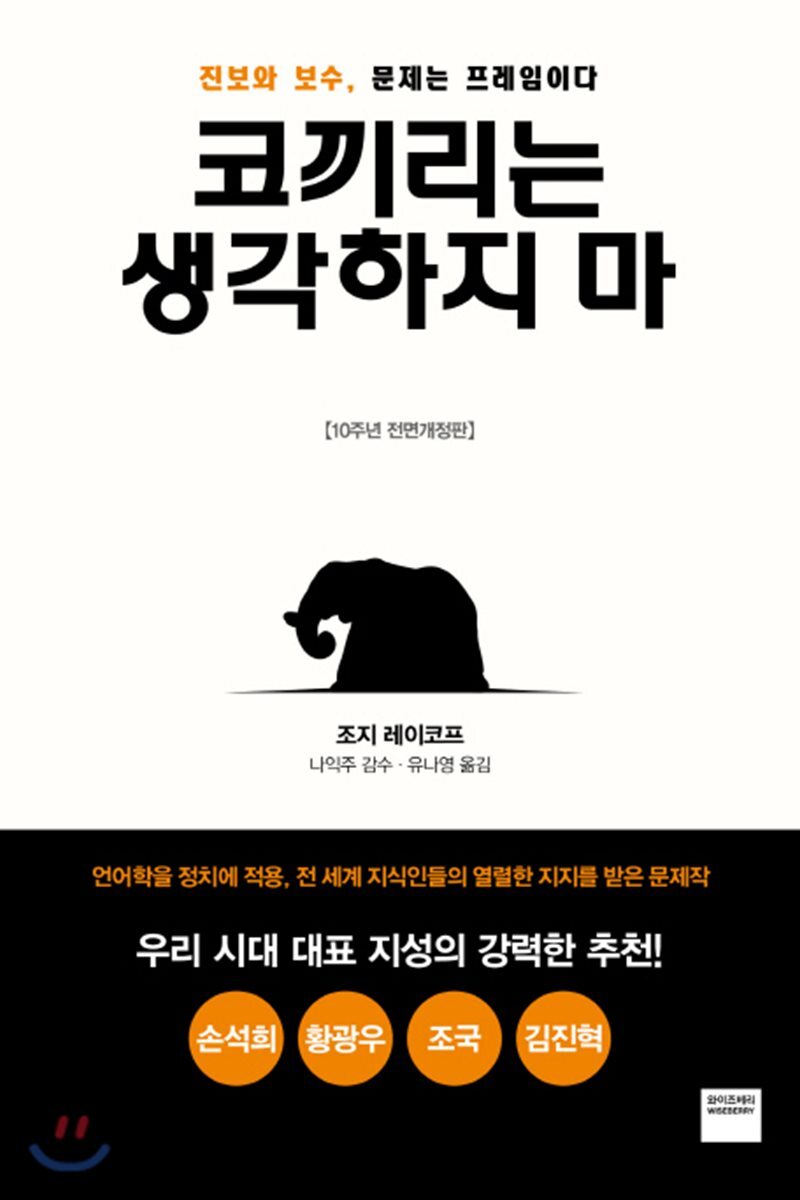
Don't think about elephants
 |
Description
Book Introduction
The very same book that appeared in Yoo Si-min's Allileo Books
Spring 2024, a fierce reversal of the best rankings!
Why, of all times, should I take this book out and read it again?
This is a completely revised edition of the best-selling book, Don't Think of an Elephant, by George Lakoff, a world-renowned scholar who founded cognitive linguistics and applied linguistics to real-world politics.
This book answers the age-old progressive question, "Why do ordinary citizens vote for conservative parties that go against their own interests?" and clearly analyzes why the Enlightenment belief that people will make the right choice when they know the truth does not work in reality, making it a must-read for both the political circles of Yeouido and conscious citizens.
Professor Jinhyeok Kim (former EBS PD), who planned EBS's 'Knowledge Channel e', produced the 'frame' segment after reading this book, which became a huge hit, and the book's contents were the main reference for the 'Kingmaker' segment of anchor Seokhee Son's 'Documentary Prime', which aired in 2012 ahead of the US and Korean presidential elections.
The author hoped that this book would be read by journalists and media professionals, above all else, and as he hoped, "frame" has gone beyond the confines of academia and become a term commonly encountered in the media in Korea.
It has also become a fundamental book not only in politics but also in the fields of public relations, marketing, and communications, as it deals with how the mind of the voter (consumer) works.
Dissecting a world trapped in frames
What is a frame? Why is all politics moral?
Frames are mental structures that shape how we view the world.
When we hear a word, a frame associated with it is activated in our brain.
If you say, “Don’t think of an elephant!”, people will think of an elephant.
If you negate a frame, that frame becomes active.
And the more often a frame is activated, the stronger it becomes.
Therefore, when we use the language of the other side in political discourse to refute their opinions, the other side's frame becomes more active and stronger in the minds of those who hear us, while our own perspective is weakened.
So, progressives must express their beliefs using progressive language, not conservative language.
All political solutions are presented under the assumption that they are correct.
So all politics is moral, but moral perspectives are different, and much of our moral beliefs are unconscious.
What divides America's political camp in two is a difference in morality.
Conservatism is based on the strict morality of a father, and progressivism is based on the morality of a caring parent.
This is why same-sex marriage and abortion are such important issues in American politics.
Spring 2024, a fierce reversal of the best rankings!
Why, of all times, should I take this book out and read it again?
This is a completely revised edition of the best-selling book, Don't Think of an Elephant, by George Lakoff, a world-renowned scholar who founded cognitive linguistics and applied linguistics to real-world politics.
This book answers the age-old progressive question, "Why do ordinary citizens vote for conservative parties that go against their own interests?" and clearly analyzes why the Enlightenment belief that people will make the right choice when they know the truth does not work in reality, making it a must-read for both the political circles of Yeouido and conscious citizens.
Professor Jinhyeok Kim (former EBS PD), who planned EBS's 'Knowledge Channel e', produced the 'frame' segment after reading this book, which became a huge hit, and the book's contents were the main reference for the 'Kingmaker' segment of anchor Seokhee Son's 'Documentary Prime', which aired in 2012 ahead of the US and Korean presidential elections.
The author hoped that this book would be read by journalists and media professionals, above all else, and as he hoped, "frame" has gone beyond the confines of academia and become a term commonly encountered in the media in Korea.
It has also become a fundamental book not only in politics but also in the fields of public relations, marketing, and communications, as it deals with how the mind of the voter (consumer) works.
Dissecting a world trapped in frames
What is a frame? Why is all politics moral?
Frames are mental structures that shape how we view the world.
When we hear a word, a frame associated with it is activated in our brain.
If you say, “Don’t think of an elephant!”, people will think of an elephant.
If you negate a frame, that frame becomes active.
And the more often a frame is activated, the stronger it becomes.
Therefore, when we use the language of the other side in political discourse to refute their opinions, the other side's frame becomes more active and stronger in the minds of those who hear us, while our own perspective is weakened.
So, progressives must express their beliefs using progressive language, not conservative language.
All political solutions are presented under the assumption that they are correct.
So all politics is moral, but moral perspectives are different, and much of our moral beliefs are unconscious.
What divides America's political camp in two is a difference in morality.
Conservatism is based on the strict morality of a father, and progressivism is based on the morality of a caring parent.
This is why same-sex marriage and abortion are such important issues in American politics.
- You can preview some of the book's contents.
Preview
index
Introduction: Reframing Social Change
Part 1: Framing Theory and Application
01 How to get public opinion on our side
Part 2: How to frame what is outside the frame
02 How to frame something that is outside the frame
03 Reflexes between the brain and the world
04 Organic causality
05 Politics and Humanity
06 The private depends on the public.
Part 3: Framing Specific Issues
07 The Question of Freedom
08 Piketty's Insights on the Accelerating Inequality Between Rich and Poor
09 Corporate Dominance
Part 4: Looking back on the past 10 years
10 'Marriage' has many meanings.
Metaphor of the 11 terrorist attacks
12 Metaphors can kill people
Part 5: From Theory to Action
13 What Conservatives Want
14. What Unites Progress
15 Frequently Asked Questions
16 How to Respond to Conservatives
Part 1: Framing Theory and Application
01 How to get public opinion on our side
Part 2: How to frame what is outside the frame
02 How to frame something that is outside the frame
03 Reflexes between the brain and the world
04 Organic causality
05 Politics and Humanity
06 The private depends on the public.
Part 3: Framing Specific Issues
07 The Question of Freedom
08 Piketty's Insights on the Accelerating Inequality Between Rich and Poor
09 Corporate Dominance
Part 4: Looking back on the past 10 years
10 'Marriage' has many meanings.
Metaphor of the 11 terrorist attacks
12 Metaphors can kill people
Part 5: From Theory to Action
13 What Conservatives Want
14. What Unites Progress
15 Frequently Asked Questions
16 How to Respond to Conservatives
Into the book
If we want to negate a frame, we must first recall that frame.
Nixon learned that truth the hard way early on.
This was at a time when he was under intense pressure to resign after the Watergate scandal.
At this time he appeared on TV and said this.
“I am not a conman.” At that moment, everyone thought he was a conman.
This anecdote teaches us a fundamental principle of framing: don't use the opponent's language to argue against him.
The other person's language brings a certain frame to it, and it's not the frame I want.
---From "Chapter 1: How to Turn Public Opinion to Our Side"
George W.
From the very day Bush entered the White House, the word "tax relief" began to flow out of the White House.
This phrase was repeated daily, picked up by the media explaining his policies, and gradually it crept into public discourse until even liberals began using it.
When the word 'tax' is placed before 'relief', the following metaphor is born:
Taxation is a pain.
So, the one who eliminates this pain is a hero, and the one who gets in his way is a bad guy.
This is the frame.
This frame is made up of concepts like 'pain' and 'hero'.
This framing language flowed from the White House, was inserted into press releases, was broadcast on every radio and television station, and was printed in every newspaper.
And soon even Democratic lawmakers and their supporters were using the term tax relief.
It's like shooting yourself in the foot.
When Democrats proposed "tax relief for the middle class," we saw them adopt the conservative view that taxation is a burden.
---From "Chapter 1: How to Turn Public Opinion to Our Side"
During the Vietnam War, conservatives realized that the majority of smart young people in America were not becoming conservatives.
'Conservative' was a dirty word.
So in 1970, just two months before he was appointed to the Supreme Court by Nixon, Lewis Powell, then president of the U.S. Chamber of Commerce, wrote a memo known as the "Powell Memo."
This memo later became a document that determined the fate of conservatism.
He wrote that conservatives must step up to prevent the country's best and brightest young people from becoming anti-business.
Powell proposed establishing research centers both inside and outside the university.
So the idea was to provide professorships to do research, write books, and teach these young people to think in the right way.
After Powell went to the Supreme Court, this thinking was taken up by William Simon, who was then Treasury Secretary under the Nixon administration.
He persuaded several tycoons, including Coors, Scape, and Olin, to establish the Heritage Foundation, the Olin Endowed Professorship, and the Harvard Olin Institute.
These labs played a huge role.
First of all, those involved here have written far more books on the issue as a whole than the left.
Conservatives support intellectuals who represent them.
They also create many opportunities to expose themselves to the media.
He even set up a studio in the hall below the research center to make it easier to appear on television.
---From "Chapter 1: How to Turn Public Opinion to Our Side"
It's no coincidence that conservatives win when they successfully frame an issue.
They got a head start of 40 to 50 years and are reaping the benefits of investing over $2 billion in think tanks and think tanks.
Progressive foundations spread their money thinly across as many places as possible.
Direct, grassroots support targeted at those in immediate need is a priority.
Activists and advocates are overworked, underpaid, and have little time or energy to think about how to connect with the public.
Conservatives build infrastructure.
We accept media.
Make a long-term plan.
Scholarships are awarded to right-wing law students on the condition that they join conservative organizations to attend law school.
And we help them find good jobs after they graduate from law school.
---From "Chapter 1: How to Turn Public Opinion to Our Side"
Comedian Jimmy Kimmel sent one of his show's production crews out into the streets of Los Angeles with a microphone and asked passersby simple questions.
Which do you prefer, Obamacare or the Affordable Care Act? An overwhelming majority said they dislike Obamacare but think the Affordable Care Act is a good idea.
Most of them didn't know that these two were the same bill.
After all, when the name changes, the instructions usually change too.
They chose two moral realms: 'freedom' and 'life'.
In relation to 'freedom', they attacked the system as a 'government takeover of the [insurance industry]', and in relation to 'life', they repeated for months that the system included a 'death declaration committee' (a derisive name for a committee of experts involved in life-sustaining treatment for the elderly).
The president and his administration officials countered by listing the facts, the provisions of the bill.
This was of no use.
His adviser, David Axelrod, sent a memo to the Organization for America email list, which has about 13 million supporters, asking them to promote the president's policies to their friends and neighbors.
He said there were 24 things to remember, and to make it "easier," he divided the list of facts into three groups of eight each! No cognitive scientist ever told him that no one would remember a list of eight items in three groups.
Had Obama understood the conservatives' framing tactics, he could have easily neutralized their attacks.
He could have taken the two moral issues of 'freedom' and 'life' from a progressive perspective.
If I have cancer and I don't have health insurance, I'm not free.
Perhaps I will suffer and die (the question of 'life').
If you suffer multiple injuries in a car accident and don't have health insurance, you're not free.
Because you will either live or die disabled for the rest of your life.
If you break your leg and don't have health insurance, you're not free.
Because you will never be able to walk or run freely again.
When we lose our health, we become slaves.
Disease binds us.
Even cataracts, which are fatal to our eyesight but easily treatable with modern medicine, can blind us and imprison us without health insurance.
---From "Chapter 7: The Problem of Freedom"
More than half of Americans now support gay marriage.
Gay marriage is legal in 19 states.
But the remaining 31 states still have a long way to go.
The conservative framework that gay marriage is against the Bible, threatens the very definition of marriage, will lead children to homosexuality, and that gay marriage is all about sex has not changed.
Recent conservatives have been repeatedly using the term "homosexual," which includes the word "sex" and the suffix "homo."
That is why same-sex marriage is called homosexual marriage.
Despite all these efforts, conservatism is fighting a losing battle against love, commitment, family, and community.
The vast majority of younger generations accept gay marriage.
Just before taking office, President Obama did not explicitly support gay marriage, leaving his position on the issue open to interpretation, saying it was “evolving.”
Now he has 'evolved.' The metaphor of evolution suggests adaptation to a changing political context.
---From Chapter 10, “Marriage Has Numerous Meanings”
It is worth noting the process by which the Bush administration framed, revised, and searched for metaphors after 9/11.
The main frame was that it was a crime against the victim, and that the criminals should be brought to justice and punished.
It took only a few hours for that crime to turn into war, with concepts like casualties, enemies, military action, and the right to wage war following.
Senior government officials acknowledged that this situation did not fit with our understanding of the war.
There are enemies and casualties, but no enemy troops, units, tanks, battleships, fighter planes, or battlefields, and there are no strategic objectives or clear victories.
The 'war' frame didn't fit.
Colin Powell said that troops cannot be deployed without specific strike objectives, a clear and achievable definition of victory, and a clear withdrawal strategy.
He pointed out that none of what he had mentioned existed in this 'war'.
---From "Chapter 11: Metaphors of Terror"
After 9/11, I felt a justified fear that the Bush administration was being given unchecked power to pursue a conservative agenda domestically.
This was a topic that could not be discussed in the media at the time, but it was a fact.
They didn't raise taxes on the rich to pay for the war.
Instead, they cut it! They took Social Security surpluses from the "coffers" to fund the war, and every Democratic member of Congress except one voted for it.
The total cost of waging war has so far reached $3 trillion, and it continues to rise when you factor in the ongoing costs of treating wounded soldiers and supporting the governments of Iraq and Afghanistan.
It has devastated the American economy, the American education system and infrastructure, and has robbed vast amounts of much-needed public resources.
The middle class got poorer and the rich got richer.
The Earth is getting hotter.
The conservative movement grew and grew.
Foreign policy and domestic policy are closely linked.
Guns produced for war are sold at gun shows and kill children.
Small unmanned reconnaissance drones and computer technology developed to monitor foreign enemies are now being used to monitor citizens at home.
And the money spent on foreign wars will deplete public resources at home.
---From "Chapter 11: Metaphors of Terror"
One of the core metaphors of our foreign policy is the metaphor that “the nation is the people.”
The nation of Iraq is conceptualized in terms of one person, Saddam Hussein, and is used hundreds of times a day.
“Saddam is a dictator.
He uses this metaphor when he says things like, “We have to stop him.”
This metaphor obscures the fact that the 3,000 bombs dropped over the first two days will not fall on just that one person.
These bombs will kill thousands of innocent people, not the ones we are fighting against, as this metaphor conceals.
In the 'rescue' scenario, the first victims are the Iraqi people, and the second are neighboring countries that Saddam did not attack but that appear to be threatened by him.
This is why Bush and Powell constantly list Saddam's crimes against the Iraqi people and the weapons he used to attack his neighbors.
Most Americans accepted the idea that the Iraq war was about saving the Iraqi people and protecting neighboring countries.
In reality, this war threatens the safety and well-being of the Iraqi people.
---From “Chapter 12: Metaphors Can Kill”
What conservative intellectuals did was to create a link, through frames and language, between strict paternal morality in the home and religion and politics and business.
This conceptual link clearly exerts a very powerful emotional force on the less wealthy, allowing it to transcend economic self-interest.
According to the implication of this moral system, the rich are good people who have earned their money through hard work and deserve to enjoy it, and those who rule the public and private spheres are responsible for maintaining the proper moral order of this society.
It's a kind of conservative social contract.
After 40 to 50 years of work by think tank intellectuals, language experts, writers, advertising agencies, and media professionals, Conservatives have achieved a revolutionary change in thought and language.
Through language, they have succeeded in creating an image of liberals as weak elites (despite their popular policies) and unpatriotic tax-paying idiots.
The easygoing image of Ronald Reagan or George W.
Bush's John Wayne-style "big brother" image is a result of borrowing the language, dialect, gestures, and narrative style of rural populists.
Meanwhile, the way conservatives present their hosts and pundits on radio talk shows speaks is like a preacher preaching hellfire.
But the message is the same.
That liberals threaten American culture and values, and that we must fight against them on every front.
According to conservatives, liberals threaten morality, religion, family, everything true Americans hold dear, and by extension, the entire nation.
Conservatives claim that liberals' positions on strategic issues like guns, fetuses, taxes, same-sex marriage, the flag, and religious education in schools clearly demonstrate their "treason."
These wedge issues are important not in themselves, but because of the strict fatherly worldview they represent.
These interrelated interests—personal, governmental, corporation, and social—reinforce one another, and conservatism, as an all-encompassing moral system, creates a powerful structure that threatens progressive values and American democracy.
---From "Chapter 13 What Conservatives Want"
Listing policy programs is a major obstacle to the unification of progressive forces.
Because differences become apparent as soon as the program takes concrete form.
Progressives tend to talk mainly about policies and programs.
But most Americans don't want to know the details.
The core values of progressivism are communal values that see America as a caring, responsible family.
The meaning of democratic politics is that we act on this care and responsibility through a government that provides public resources for everyone, from the poor to ordinary citizens to businessmen large and small.
If I have become wealthy by using public resources based on taxes paid by others, it is only fair that I give my share so that others can also benefit.
Red states and blue states, liberals and conservatives, Republicans and Democrats, we're all in this together.
That's what democracy means.
So we must unite, as we did for a brief moment immediately following 9/11.
We must not be divided by the vicious culture war.
---From "Chapter 14: Binding Progress Together"
At first, conservatives tried to eliminate social security programs one by one, but eventually they came up with the idea of eliminating them all at once.
This is a deep type of strategic planning that affects a wide range of areas.
Cutting taxes would increase the government deficit, leaving no money for things like health care for poor children or subsidies for the disabled.
As a result, overall social security policies, including implementation of health, education, and environmental regulations, are being regressed.
At the same time, the good people they consider, mainly the wealthy (who became wealthy by following the rules), will be rewarded by the tax cuts.
---From "Chapter 15 Frequently Asked Questions"
If the Republican Party possesses such a massive infrastructure, how can we possibly catch up? Conservatives have spent billions of dollars over four decades, building 43 research institutes to reframe public discourse and bring the debate into their own sphere of influence, but in our case, science is on our side.
Cognitive science and linguistics can help us understand how they did it.
And we know that we can do the equivalent work in much less time and with far fewer resources.
We also know how they trained themselves linguistically and how we can train ourselves.
Nixon learned that truth the hard way early on.
This was at a time when he was under intense pressure to resign after the Watergate scandal.
At this time he appeared on TV and said this.
“I am not a conman.” At that moment, everyone thought he was a conman.
This anecdote teaches us a fundamental principle of framing: don't use the opponent's language to argue against him.
The other person's language brings a certain frame to it, and it's not the frame I want.
---From "Chapter 1: How to Turn Public Opinion to Our Side"
George W.
From the very day Bush entered the White House, the word "tax relief" began to flow out of the White House.
This phrase was repeated daily, picked up by the media explaining his policies, and gradually it crept into public discourse until even liberals began using it.
When the word 'tax' is placed before 'relief', the following metaphor is born:
Taxation is a pain.
So, the one who eliminates this pain is a hero, and the one who gets in his way is a bad guy.
This is the frame.
This frame is made up of concepts like 'pain' and 'hero'.
This framing language flowed from the White House, was inserted into press releases, was broadcast on every radio and television station, and was printed in every newspaper.
And soon even Democratic lawmakers and their supporters were using the term tax relief.
It's like shooting yourself in the foot.
When Democrats proposed "tax relief for the middle class," we saw them adopt the conservative view that taxation is a burden.
---From "Chapter 1: How to Turn Public Opinion to Our Side"
During the Vietnam War, conservatives realized that the majority of smart young people in America were not becoming conservatives.
'Conservative' was a dirty word.
So in 1970, just two months before he was appointed to the Supreme Court by Nixon, Lewis Powell, then president of the U.S. Chamber of Commerce, wrote a memo known as the "Powell Memo."
This memo later became a document that determined the fate of conservatism.
He wrote that conservatives must step up to prevent the country's best and brightest young people from becoming anti-business.
Powell proposed establishing research centers both inside and outside the university.
So the idea was to provide professorships to do research, write books, and teach these young people to think in the right way.
After Powell went to the Supreme Court, this thinking was taken up by William Simon, who was then Treasury Secretary under the Nixon administration.
He persuaded several tycoons, including Coors, Scape, and Olin, to establish the Heritage Foundation, the Olin Endowed Professorship, and the Harvard Olin Institute.
These labs played a huge role.
First of all, those involved here have written far more books on the issue as a whole than the left.
Conservatives support intellectuals who represent them.
They also create many opportunities to expose themselves to the media.
He even set up a studio in the hall below the research center to make it easier to appear on television.
---From "Chapter 1: How to Turn Public Opinion to Our Side"
It's no coincidence that conservatives win when they successfully frame an issue.
They got a head start of 40 to 50 years and are reaping the benefits of investing over $2 billion in think tanks and think tanks.
Progressive foundations spread their money thinly across as many places as possible.
Direct, grassroots support targeted at those in immediate need is a priority.
Activists and advocates are overworked, underpaid, and have little time or energy to think about how to connect with the public.
Conservatives build infrastructure.
We accept media.
Make a long-term plan.
Scholarships are awarded to right-wing law students on the condition that they join conservative organizations to attend law school.
And we help them find good jobs after they graduate from law school.
---From "Chapter 1: How to Turn Public Opinion to Our Side"
Comedian Jimmy Kimmel sent one of his show's production crews out into the streets of Los Angeles with a microphone and asked passersby simple questions.
Which do you prefer, Obamacare or the Affordable Care Act? An overwhelming majority said they dislike Obamacare but think the Affordable Care Act is a good idea.
Most of them didn't know that these two were the same bill.
After all, when the name changes, the instructions usually change too.
They chose two moral realms: 'freedom' and 'life'.
In relation to 'freedom', they attacked the system as a 'government takeover of the [insurance industry]', and in relation to 'life', they repeated for months that the system included a 'death declaration committee' (a derisive name for a committee of experts involved in life-sustaining treatment for the elderly).
The president and his administration officials countered by listing the facts, the provisions of the bill.
This was of no use.
His adviser, David Axelrod, sent a memo to the Organization for America email list, which has about 13 million supporters, asking them to promote the president's policies to their friends and neighbors.
He said there were 24 things to remember, and to make it "easier," he divided the list of facts into three groups of eight each! No cognitive scientist ever told him that no one would remember a list of eight items in three groups.
Had Obama understood the conservatives' framing tactics, he could have easily neutralized their attacks.
He could have taken the two moral issues of 'freedom' and 'life' from a progressive perspective.
If I have cancer and I don't have health insurance, I'm not free.
Perhaps I will suffer and die (the question of 'life').
If you suffer multiple injuries in a car accident and don't have health insurance, you're not free.
Because you will either live or die disabled for the rest of your life.
If you break your leg and don't have health insurance, you're not free.
Because you will never be able to walk or run freely again.
When we lose our health, we become slaves.
Disease binds us.
Even cataracts, which are fatal to our eyesight but easily treatable with modern medicine, can blind us and imprison us without health insurance.
---From "Chapter 7: The Problem of Freedom"
More than half of Americans now support gay marriage.
Gay marriage is legal in 19 states.
But the remaining 31 states still have a long way to go.
The conservative framework that gay marriage is against the Bible, threatens the very definition of marriage, will lead children to homosexuality, and that gay marriage is all about sex has not changed.
Recent conservatives have been repeatedly using the term "homosexual," which includes the word "sex" and the suffix "homo."
That is why same-sex marriage is called homosexual marriage.
Despite all these efforts, conservatism is fighting a losing battle against love, commitment, family, and community.
The vast majority of younger generations accept gay marriage.
Just before taking office, President Obama did not explicitly support gay marriage, leaving his position on the issue open to interpretation, saying it was “evolving.”
Now he has 'evolved.' The metaphor of evolution suggests adaptation to a changing political context.
---From Chapter 10, “Marriage Has Numerous Meanings”
It is worth noting the process by which the Bush administration framed, revised, and searched for metaphors after 9/11.
The main frame was that it was a crime against the victim, and that the criminals should be brought to justice and punished.
It took only a few hours for that crime to turn into war, with concepts like casualties, enemies, military action, and the right to wage war following.
Senior government officials acknowledged that this situation did not fit with our understanding of the war.
There are enemies and casualties, but no enemy troops, units, tanks, battleships, fighter planes, or battlefields, and there are no strategic objectives or clear victories.
The 'war' frame didn't fit.
Colin Powell said that troops cannot be deployed without specific strike objectives, a clear and achievable definition of victory, and a clear withdrawal strategy.
He pointed out that none of what he had mentioned existed in this 'war'.
---From "Chapter 11: Metaphors of Terror"
After 9/11, I felt a justified fear that the Bush administration was being given unchecked power to pursue a conservative agenda domestically.
This was a topic that could not be discussed in the media at the time, but it was a fact.
They didn't raise taxes on the rich to pay for the war.
Instead, they cut it! They took Social Security surpluses from the "coffers" to fund the war, and every Democratic member of Congress except one voted for it.
The total cost of waging war has so far reached $3 trillion, and it continues to rise when you factor in the ongoing costs of treating wounded soldiers and supporting the governments of Iraq and Afghanistan.
It has devastated the American economy, the American education system and infrastructure, and has robbed vast amounts of much-needed public resources.
The middle class got poorer and the rich got richer.
The Earth is getting hotter.
The conservative movement grew and grew.
Foreign policy and domestic policy are closely linked.
Guns produced for war are sold at gun shows and kill children.
Small unmanned reconnaissance drones and computer technology developed to monitor foreign enemies are now being used to monitor citizens at home.
And the money spent on foreign wars will deplete public resources at home.
---From "Chapter 11: Metaphors of Terror"
One of the core metaphors of our foreign policy is the metaphor that “the nation is the people.”
The nation of Iraq is conceptualized in terms of one person, Saddam Hussein, and is used hundreds of times a day.
“Saddam is a dictator.
He uses this metaphor when he says things like, “We have to stop him.”
This metaphor obscures the fact that the 3,000 bombs dropped over the first two days will not fall on just that one person.
These bombs will kill thousands of innocent people, not the ones we are fighting against, as this metaphor conceals.
In the 'rescue' scenario, the first victims are the Iraqi people, and the second are neighboring countries that Saddam did not attack but that appear to be threatened by him.
This is why Bush and Powell constantly list Saddam's crimes against the Iraqi people and the weapons he used to attack his neighbors.
Most Americans accepted the idea that the Iraq war was about saving the Iraqi people and protecting neighboring countries.
In reality, this war threatens the safety and well-being of the Iraqi people.
---From “Chapter 12: Metaphors Can Kill”
What conservative intellectuals did was to create a link, through frames and language, between strict paternal morality in the home and religion and politics and business.
This conceptual link clearly exerts a very powerful emotional force on the less wealthy, allowing it to transcend economic self-interest.
According to the implication of this moral system, the rich are good people who have earned their money through hard work and deserve to enjoy it, and those who rule the public and private spheres are responsible for maintaining the proper moral order of this society.
It's a kind of conservative social contract.
After 40 to 50 years of work by think tank intellectuals, language experts, writers, advertising agencies, and media professionals, Conservatives have achieved a revolutionary change in thought and language.
Through language, they have succeeded in creating an image of liberals as weak elites (despite their popular policies) and unpatriotic tax-paying idiots.
The easygoing image of Ronald Reagan or George W.
Bush's John Wayne-style "big brother" image is a result of borrowing the language, dialect, gestures, and narrative style of rural populists.
Meanwhile, the way conservatives present their hosts and pundits on radio talk shows speaks is like a preacher preaching hellfire.
But the message is the same.
That liberals threaten American culture and values, and that we must fight against them on every front.
According to conservatives, liberals threaten morality, religion, family, everything true Americans hold dear, and by extension, the entire nation.
Conservatives claim that liberals' positions on strategic issues like guns, fetuses, taxes, same-sex marriage, the flag, and religious education in schools clearly demonstrate their "treason."
These wedge issues are important not in themselves, but because of the strict fatherly worldview they represent.
These interrelated interests—personal, governmental, corporation, and social—reinforce one another, and conservatism, as an all-encompassing moral system, creates a powerful structure that threatens progressive values and American democracy.
---From "Chapter 13 What Conservatives Want"
Listing policy programs is a major obstacle to the unification of progressive forces.
Because differences become apparent as soon as the program takes concrete form.
Progressives tend to talk mainly about policies and programs.
But most Americans don't want to know the details.
The core values of progressivism are communal values that see America as a caring, responsible family.
The meaning of democratic politics is that we act on this care and responsibility through a government that provides public resources for everyone, from the poor to ordinary citizens to businessmen large and small.
If I have become wealthy by using public resources based on taxes paid by others, it is only fair that I give my share so that others can also benefit.
Red states and blue states, liberals and conservatives, Republicans and Democrats, we're all in this together.
That's what democracy means.
So we must unite, as we did for a brief moment immediately following 9/11.
We must not be divided by the vicious culture war.
---From "Chapter 14: Binding Progress Together"
At first, conservatives tried to eliminate social security programs one by one, but eventually they came up with the idea of eliminating them all at once.
This is a deep type of strategic planning that affects a wide range of areas.
Cutting taxes would increase the government deficit, leaving no money for things like health care for poor children or subsidies for the disabled.
As a result, overall social security policies, including implementation of health, education, and environmental regulations, are being regressed.
At the same time, the good people they consider, mainly the wealthy (who became wealthy by following the rules), will be rewarded by the tax cuts.
---From "Chapter 15 Frequently Asked Questions"
If the Republican Party possesses such a massive infrastructure, how can we possibly catch up? Conservatives have spent billions of dollars over four decades, building 43 research institutes to reframe public discourse and bring the debate into their own sphere of influence, but in our case, science is on our side.
Cognitive science and linguistics can help us understand how they did it.
And we know that we can do the equivalent work in much less time and with far fewer resources.
We also know how they trained themselves linguistically and how we can train ourselves.
---From "Chapter 15 Frequently Asked Questions"
Publisher's Review
Beyond linguistics and political discourse, this unprecedented bestseller has become a must-read for the media industry, marketing, PR, and communications.
Why is reframing social change? Does a "political center" exist?
If we succeed in reframing public discourse, we will change the way the public sees the world.
Reframing is more about accessing what like-minded people already unconsciously believe, bringing it to the level of consciousness, and repeating it until it enters public discourse.
This doesn't happen overnight.
This is a continuous process, one that requires repetition, focus, and dedication.
In the United States and Korea, there exists a large so-called 'middle class' that is neither conservative nor progressive.
Lakoff defines them as possessors of 'biconceptualism'.
There is no moral system or political position corresponding to the middle class.
Even those who consider themselves moderates often have distinctly conservative or progressive opinions on certain issues.
So George Lakoff advises against moving to the right to appeal to the 'middle class'.
Moving to the right is detrimental in two ways.
First, it alienates progressive supporters and activates the conservative frame in the minds of voters who have dualistic ideas.
In the minds of those with dual concepts, both conservative and progressive, which frame is more active becomes a decisive variable in the election.
As progressives who have a nurturing, caring, and considerate morality, the more we talk to those with dual concepts about empathy and responsibility for others, the closer we can get.
You can ask them who they care about the most, what responsibility they feel toward the person they care about, and how they put that responsibility into practice.
This way, we activate the 'model of care' in their minds as much as possible.
Respecting and treating others politely also activates the 'care model' in communication.
◈ Latest issues that have not yet been framed
In this book, the author discusses how to frame emerging issues that have not yet been framed.
[freedom]
The message of conservatism dominates our daily lives, and conservatism has eventually come to own the word "freedom."
In a democracy, the word freedom is extremely important, and most political discourse, whether in elections or in everyday decision-making, boils down to questions about freedom.
The author suggests that the values of progress should be actively linked to freedom, framing progress as the freedom to live with dignity even when injured or ill, the freedom for children from poor families to enjoy equal educational opportunities, and the freedom to enjoy equal rights regardless of race, gender, or sexual orientation.
Piketty's Insights on Wealth Polarization
Thomas Piketty's research, which has taken the world by storm, has not yet been framed within the framework of progress.
The degree of polarization can be seen in the ratio of productive wealth through labor to reinvested wealth through investment returns. According to Piketty's research, the extreme wealth inequality that existed until the early 20th century rapidly alleviated after World War I and II as a significant portion of reinvested wealth disappeared.
However, since the 1980s, reinvestment wealth has again exceeded productive wealth, and wealth polarization has deepened.
In 1976, the top 1 percent owned 19.9 percent of the wealth in the United States; by 2010, that had increased to 35.4 percent.
Piketty says that political change through a wealth tax is necessary.
But the concentration of wealth also leads to a concentration of political influence, making change more difficult.
Furthermore, the increasingly powerful influence of investors has led corporate managers to treat only the most essential talent as company assets, while treating the rest of the workforce as disposable resources, thereby lowering the quality and satisfaction of labor.
Rapid polarization must be framed in light of the fact that it not only increases inequality but also has a number of organic effects, including a decline in public resources, a decline in liberal education, and a deterioration in the quality of labor.
Corporate governance
In 2010, a U.S. court ruled that a law limiting political spending by corporations and organizations was unconstitutional.
As laws regulating corporations are declared unconstitutional one after another, corporations are gaining extra-legal rights, accelerating their dominance in society.
Piketty points out that a political solution is needed, but the feasibility of this solution is greatly diminished now that politics is largely swayed by corporate lobbying rather than the public.
Conservatives often accuse the 'government' of taking away their freedom.
But corporate dominance will take away even more 'freedom'.
Corporate control is a major issue, but it has not yet been framed in the public mind.
◈ Clearly answers misunderstandings and questions about frames.
In the newly added Part 2, George Lakoff clearly explains various misunderstandings and questions about frames, presenting detailed evidence and premises.
He gives the example of a group asking him to frame a global warming bill by "next Tuesday," and argues that framing isn't about creating a slogan that appeals to the public.
First, the concept that the slogan signifies must be framed in the public's mind.
In particular, in order for the public to understand complex phenomena such as global warming and polarization, which are caused by organic causation rather than direct causation, a framework called 'organic causation' is first necessary.
In addition to this, it explains from the basics how to put things outside the frame into the frame by presenting the concept of reflexivity, which states that the world reflects our understanding and our understanding reflects the world; the discovery of the mirror neuron system, which provides neuroscientific evidence to support empathy and sympathy, which are the basis of progressive morality; and the frame that says that individual freedom depends on public resources, that “the private depends on the public.”
◈ How is the revised edition different from the first edition?
The first edition was 144 pages long, but the completely revised edition has a significantly increased volume of 192 pages. Two chapters were deleted from the 10-chapter first edition and eight chapters were added to the revised edition, so half of the 16-chapter revised edition is completely new content.
The original eight chapters have also been updated with new data and new analysis.
In addition, the Korean edition was completely retranslated, including the content that was in the first edition, with more accurate terminology and context, and additional content, after discussion with the editor.
For example, in the first edition, 'liberal' was written as 'Liberal' because it recently tended to refer to progressive figures with Democratic tendencies in the United States, but in the revised edition, it was translated as 'liberal' to preserve its original meaning.
The dissertation discusses in detail how the American context can be applied to the Korean situation, including the American "tax relief" and the Korean "tax bomb," and the American "tobacco lawsuits" that recognized an organic causal relationship and the Korean situation that did not.
◈ What is the reason for the major revision?
Unlike in Korea, in the English-speaking world, the publication of revised editions is common, but it is very unusual for a book to be completely rewritten.
George Lakoff states in the foreword:
Democrat Obama won the 2008 presidential election with a superior framing.
But the Republicans quickly regained control of the framing war.
Lakoff writes that the goal of this revised edition is to explain what happened after the election, why the Democrats lost the frame war again, and what to do about it.
Even though "Don't Think of an Elephant" is widely read in our country, people who claim to be progressive use language that activates the conservative frame, such as "tax bomb" and "free school meals," and are unable to accurately frame their own values.
Professor Cho Kuk welcomed the publication of a comprehensively revised edition with significant improvements in both length and content, saying, “Victory will not come to self-sufficient and therefore incompetent progressives who are only eager to criticize and oppose the conservative frame without a self-directed frame.
Progressives who talk about "de-ideologization" and "centrism" while forgetting that voters vote based on their identity and values rather than their own interests are like chasing a mirage.
"I strongly hope that many who feel frustrated after experiencing 10 years of conservative rule will read this comprehensively revised edition and prepare for the next 10 years," he said. Hwang Gwang-woo, director of the Institute of Classical Studies, added, "A tax bomb? How can this single metaphor change the face of the president?"
“There is a linguist who exposed the conspiracy of frames, saying, ‘Frames come before policies,’” he recommended this book.
Why is reframing social change? Does a "political center" exist?
If we succeed in reframing public discourse, we will change the way the public sees the world.
Reframing is more about accessing what like-minded people already unconsciously believe, bringing it to the level of consciousness, and repeating it until it enters public discourse.
This doesn't happen overnight.
This is a continuous process, one that requires repetition, focus, and dedication.
In the United States and Korea, there exists a large so-called 'middle class' that is neither conservative nor progressive.
Lakoff defines them as possessors of 'biconceptualism'.
There is no moral system or political position corresponding to the middle class.
Even those who consider themselves moderates often have distinctly conservative or progressive opinions on certain issues.
So George Lakoff advises against moving to the right to appeal to the 'middle class'.
Moving to the right is detrimental in two ways.
First, it alienates progressive supporters and activates the conservative frame in the minds of voters who have dualistic ideas.
In the minds of those with dual concepts, both conservative and progressive, which frame is more active becomes a decisive variable in the election.
As progressives who have a nurturing, caring, and considerate morality, the more we talk to those with dual concepts about empathy and responsibility for others, the closer we can get.
You can ask them who they care about the most, what responsibility they feel toward the person they care about, and how they put that responsibility into practice.
This way, we activate the 'model of care' in their minds as much as possible.
Respecting and treating others politely also activates the 'care model' in communication.
◈ Latest issues that have not yet been framed
In this book, the author discusses how to frame emerging issues that have not yet been framed.
[freedom]
The message of conservatism dominates our daily lives, and conservatism has eventually come to own the word "freedom."
In a democracy, the word freedom is extremely important, and most political discourse, whether in elections or in everyday decision-making, boils down to questions about freedom.
The author suggests that the values of progress should be actively linked to freedom, framing progress as the freedom to live with dignity even when injured or ill, the freedom for children from poor families to enjoy equal educational opportunities, and the freedom to enjoy equal rights regardless of race, gender, or sexual orientation.
Piketty's Insights on Wealth Polarization
Thomas Piketty's research, which has taken the world by storm, has not yet been framed within the framework of progress.
The degree of polarization can be seen in the ratio of productive wealth through labor to reinvested wealth through investment returns. According to Piketty's research, the extreme wealth inequality that existed until the early 20th century rapidly alleviated after World War I and II as a significant portion of reinvested wealth disappeared.
However, since the 1980s, reinvestment wealth has again exceeded productive wealth, and wealth polarization has deepened.
In 1976, the top 1 percent owned 19.9 percent of the wealth in the United States; by 2010, that had increased to 35.4 percent.
Piketty says that political change through a wealth tax is necessary.
But the concentration of wealth also leads to a concentration of political influence, making change more difficult.
Furthermore, the increasingly powerful influence of investors has led corporate managers to treat only the most essential talent as company assets, while treating the rest of the workforce as disposable resources, thereby lowering the quality and satisfaction of labor.
Rapid polarization must be framed in light of the fact that it not only increases inequality but also has a number of organic effects, including a decline in public resources, a decline in liberal education, and a deterioration in the quality of labor.
Corporate governance
In 2010, a U.S. court ruled that a law limiting political spending by corporations and organizations was unconstitutional.
As laws regulating corporations are declared unconstitutional one after another, corporations are gaining extra-legal rights, accelerating their dominance in society.
Piketty points out that a political solution is needed, but the feasibility of this solution is greatly diminished now that politics is largely swayed by corporate lobbying rather than the public.
Conservatives often accuse the 'government' of taking away their freedom.
But corporate dominance will take away even more 'freedom'.
Corporate control is a major issue, but it has not yet been framed in the public mind.
◈ Clearly answers misunderstandings and questions about frames.
In the newly added Part 2, George Lakoff clearly explains various misunderstandings and questions about frames, presenting detailed evidence and premises.
He gives the example of a group asking him to frame a global warming bill by "next Tuesday," and argues that framing isn't about creating a slogan that appeals to the public.
First, the concept that the slogan signifies must be framed in the public's mind.
In particular, in order for the public to understand complex phenomena such as global warming and polarization, which are caused by organic causation rather than direct causation, a framework called 'organic causation' is first necessary.
In addition to this, it explains from the basics how to put things outside the frame into the frame by presenting the concept of reflexivity, which states that the world reflects our understanding and our understanding reflects the world; the discovery of the mirror neuron system, which provides neuroscientific evidence to support empathy and sympathy, which are the basis of progressive morality; and the frame that says that individual freedom depends on public resources, that “the private depends on the public.”
◈ How is the revised edition different from the first edition?
The first edition was 144 pages long, but the completely revised edition has a significantly increased volume of 192 pages. Two chapters were deleted from the 10-chapter first edition and eight chapters were added to the revised edition, so half of the 16-chapter revised edition is completely new content.
The original eight chapters have also been updated with new data and new analysis.
In addition, the Korean edition was completely retranslated, including the content that was in the first edition, with more accurate terminology and context, and additional content, after discussion with the editor.
For example, in the first edition, 'liberal' was written as 'Liberal' because it recently tended to refer to progressive figures with Democratic tendencies in the United States, but in the revised edition, it was translated as 'liberal' to preserve its original meaning.
The dissertation discusses in detail how the American context can be applied to the Korean situation, including the American "tax relief" and the Korean "tax bomb," and the American "tobacco lawsuits" that recognized an organic causal relationship and the Korean situation that did not.
◈ What is the reason for the major revision?
Unlike in Korea, in the English-speaking world, the publication of revised editions is common, but it is very unusual for a book to be completely rewritten.
George Lakoff states in the foreword:
Democrat Obama won the 2008 presidential election with a superior framing.
But the Republicans quickly regained control of the framing war.
Lakoff writes that the goal of this revised edition is to explain what happened after the election, why the Democrats lost the frame war again, and what to do about it.
Even though "Don't Think of an Elephant" is widely read in our country, people who claim to be progressive use language that activates the conservative frame, such as "tax bomb" and "free school meals," and are unable to accurately frame their own values.
Professor Cho Kuk welcomed the publication of a comprehensively revised edition with significant improvements in both length and content, saying, “Victory will not come to self-sufficient and therefore incompetent progressives who are only eager to criticize and oppose the conservative frame without a self-directed frame.
Progressives who talk about "de-ideologization" and "centrism" while forgetting that voters vote based on their identity and values rather than their own interests are like chasing a mirage.
"I strongly hope that many who feel frustrated after experiencing 10 years of conservative rule will read this comprehensively revised edition and prepare for the next 10 years," he said. Hwang Gwang-woo, director of the Institute of Classical Studies, added, "A tax bomb? How can this single metaphor change the face of the president?"
“There is a linguist who exposed the conspiracy of frames, saying, ‘Frames come before policies,’” he recommended this book.
GOODS SPECIFICS
- Date of issue: April 1, 2015
- Page count, weight, size: 318 pages | 502g | 140*210*20mm
- ISBN13: 9788937834950
- ISBN10: 8937834952
You may also like
카테고리
korean


korean

![GQ KOREA Mark (Monthly): December [2025]](http://librairie.coreenne.fr/cdn/shop/files/8ef265dbbfbf186523ed75ba7319009d.jpg?v=1765340328&width=3840)


