

AI and the music industry
 |
Description
Book Introduction
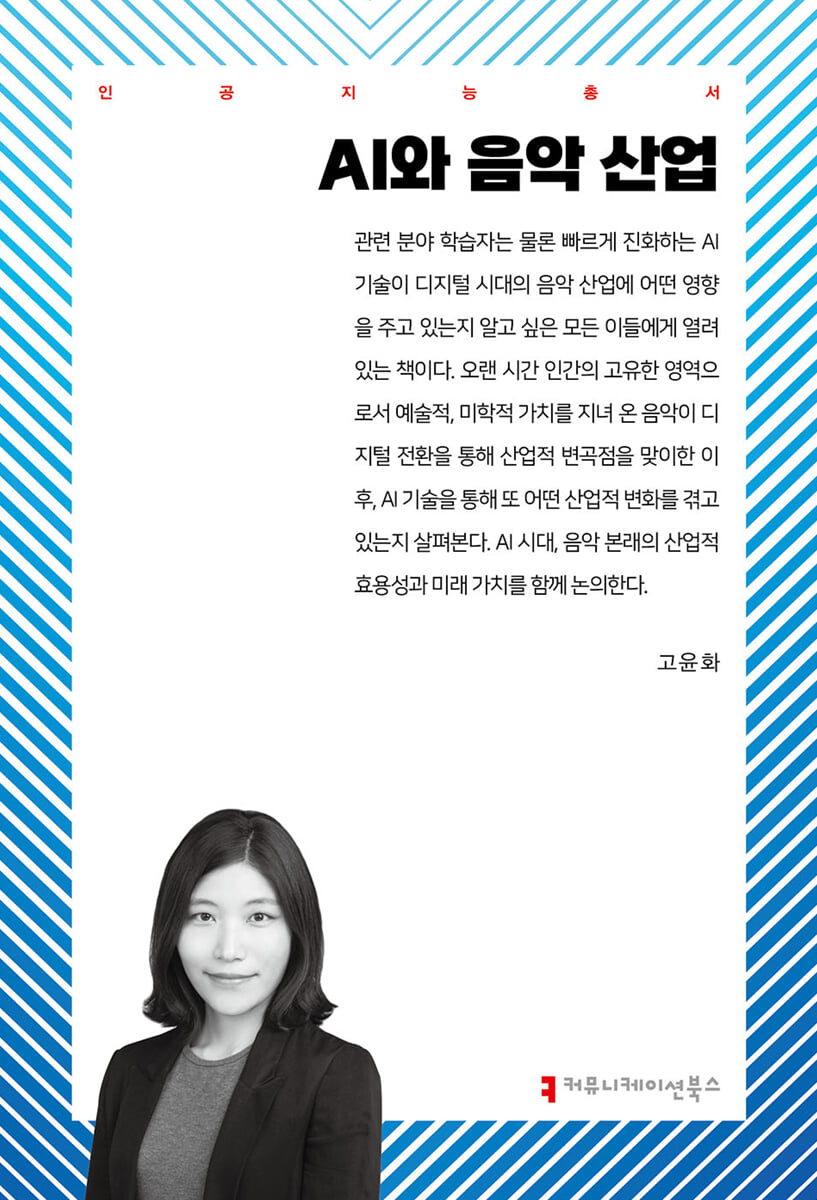
Music, a uniquely human domain with artistic and aesthetic value, has long been at the forefront of human endeavor. Following the digital transformation, it has reached an industrial inflection point. This article examines the further industrial changes being wrought by AI technology. We discuss the inherent industrial utility and future value of music in the AI era.
- You can preview some of the book's contents.
Preview
index
How the music industry is changing in the AI era.
01 AI and Digital Transformation
02 AI and Creation
03 Playing with AI
04 AI and Vocal, Voice Synthesis Technology
05 AI and Music Recommendation Algorithms
06 AI and Music Education
07 AI and Music Concert Performance
08 AI and K-pop
09 AI and Copyright
10 AI and the Future Value of the Music Industry
01 AI and Digital Transformation
02 AI and Creation
03 Playing with AI
04 AI and Vocal, Voice Synthesis Technology
05 AI and Music Recommendation Algorithms
06 AI and Music Education
07 AI and Music Concert Performance
08 AI and K-pop
09 AI and Copyright
10 AI and the Future Value of the Music Industry
Into the book
Since the mid-2010s, the introduction of deep learning-based TTS models, or deep learning techniques, into the TTS field has brought about significant changes.
Google's 'Tacotron' series and DeepMind's 'WaveNet' are considered representative models.
The Tacotron series implements an end-to-end model system that converts text input into an intermediate representation such as a Mel spectrogram (a visualization of how the pitch, timbre, and intensity of a sound change over time, used in various fields such as speech recognition, music information retrieval, and audio analysis), and then restores it to speech, enabling more natural and flexible speech synthesis.
--- From "04_AI and Vocal, Voice Synthesis Technology"
It is clear that AI-powered music education is revolutionizing traditional music education methods through its advantages of personalized learning, improved learning efficiency, support for music creation, and real-time feedback.
Moreover, AI tools are economical and accessible, playing a positive role in promoting the universalization of music education.
However, AI-based music education lacks emotional feedback and still has limitations in guiding improvisation and creative expression.
Additionally, there is a high possibility of technical errors and there are aspects of the role of human teachers that cannot be replaced.
Google's 'Tacotron' series and DeepMind's 'WaveNet' are considered representative models.
The Tacotron series implements an end-to-end model system that converts text input into an intermediate representation such as a Mel spectrogram (a visualization of how the pitch, timbre, and intensity of a sound change over time, used in various fields such as speech recognition, music information retrieval, and audio analysis), and then restores it to speech, enabling more natural and flexible speech synthesis.
--- From "04_AI and Vocal, Voice Synthesis Technology"
It is clear that AI-powered music education is revolutionizing traditional music education methods through its advantages of personalized learning, improved learning efficiency, support for music creation, and real-time feedback.
Moreover, AI tools are economical and accessible, playing a positive role in promoting the universalization of music education.
However, AI-based music education lacks emotional feedback and still has limitations in guiding improvisation and creative expression.
Additionally, there is a high possibility of technical errors and there are aspects of the role of human teachers that cannot be replaced.
--- From "06_AI and Music Education"
Publisher's Review
How will the music industry change in the AI era?
This book explores how AI technology is impacting creation, distribution, and consumption across the rapidly changing structure and trends of the music industry following the digital transformation. From AI composition, voice synthesis, and personalized recommendation algorithms to the use of AI in the K-pop industry, it presents concrete examples of the practical changes brought about by the convergence of technology and art.
It also covers a wide range of ethical and legal issues, including the evolution of music education and performance, and copyright issues in AI-created works.
Starting with the question, "How will the music industry change in the AI era?", it clearly outlines today's reality, where technology has transformed not only the way we "make" music but also the way we "listen."
This is a must-read for readers interested in the intersection of music and AI.
This book explores how AI technology is impacting creation, distribution, and consumption across the rapidly changing structure and trends of the music industry following the digital transformation. From AI composition, voice synthesis, and personalized recommendation algorithms to the use of AI in the K-pop industry, it presents concrete examples of the practical changes brought about by the convergence of technology and art.
It also covers a wide range of ethical and legal issues, including the evolution of music education and performance, and copyright issues in AI-created works.
Starting with the question, "How will the music industry change in the AI era?", it clearly outlines today's reality, where technology has transformed not only the way we "make" music but also the way we "listen."
This is a must-read for readers interested in the intersection of music and AI.
GOODS SPECIFICS
- Date of issue: April 30, 2025
- Page count, weight, size: 135 pages | 128*188*6mm
- ISBN13: 9791143000682
You may also like
카테고리
korean


korean

![GQ KOREA Mark (Monthly): December [2025]](http://librairie.coreenne.fr/cdn/shop/files/8ef265dbbfbf186523ed75ba7319009d.jpg?v=1765340328&width=3840)


