

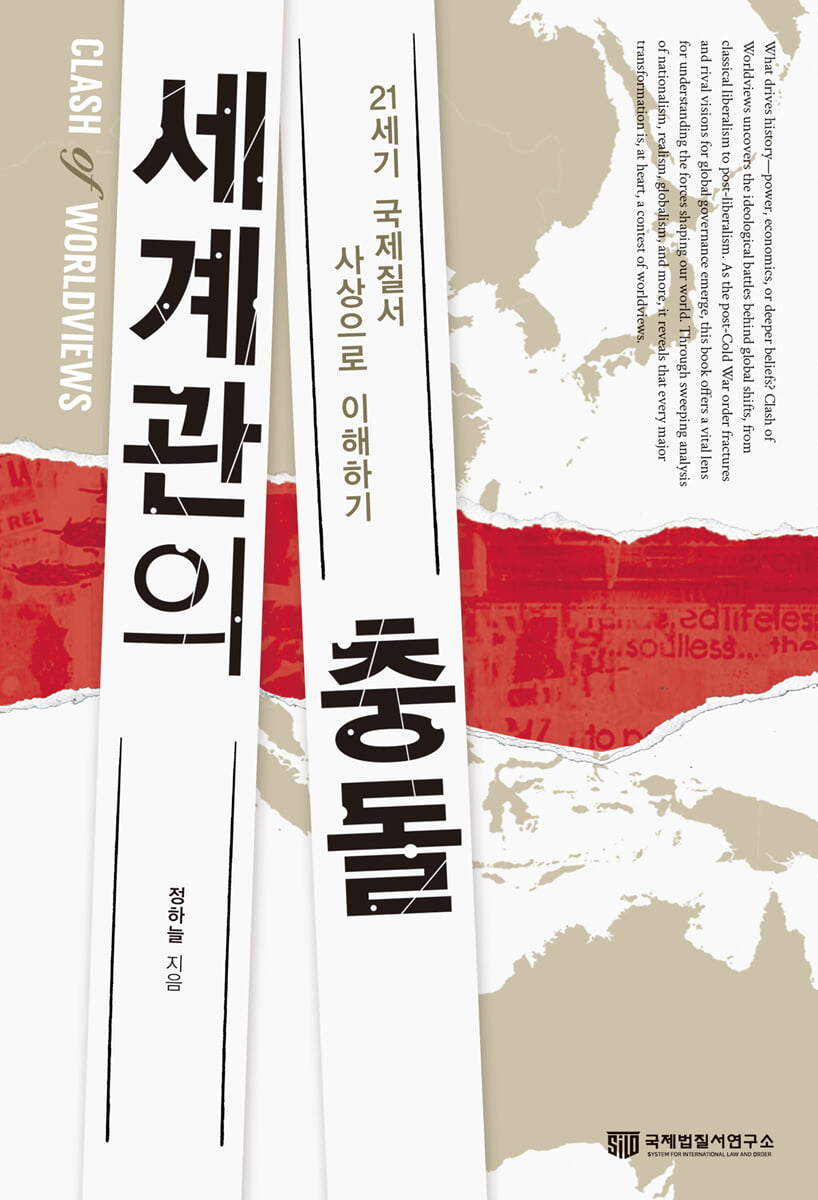
Clash of worldviews
 |
Description
Book Introduction
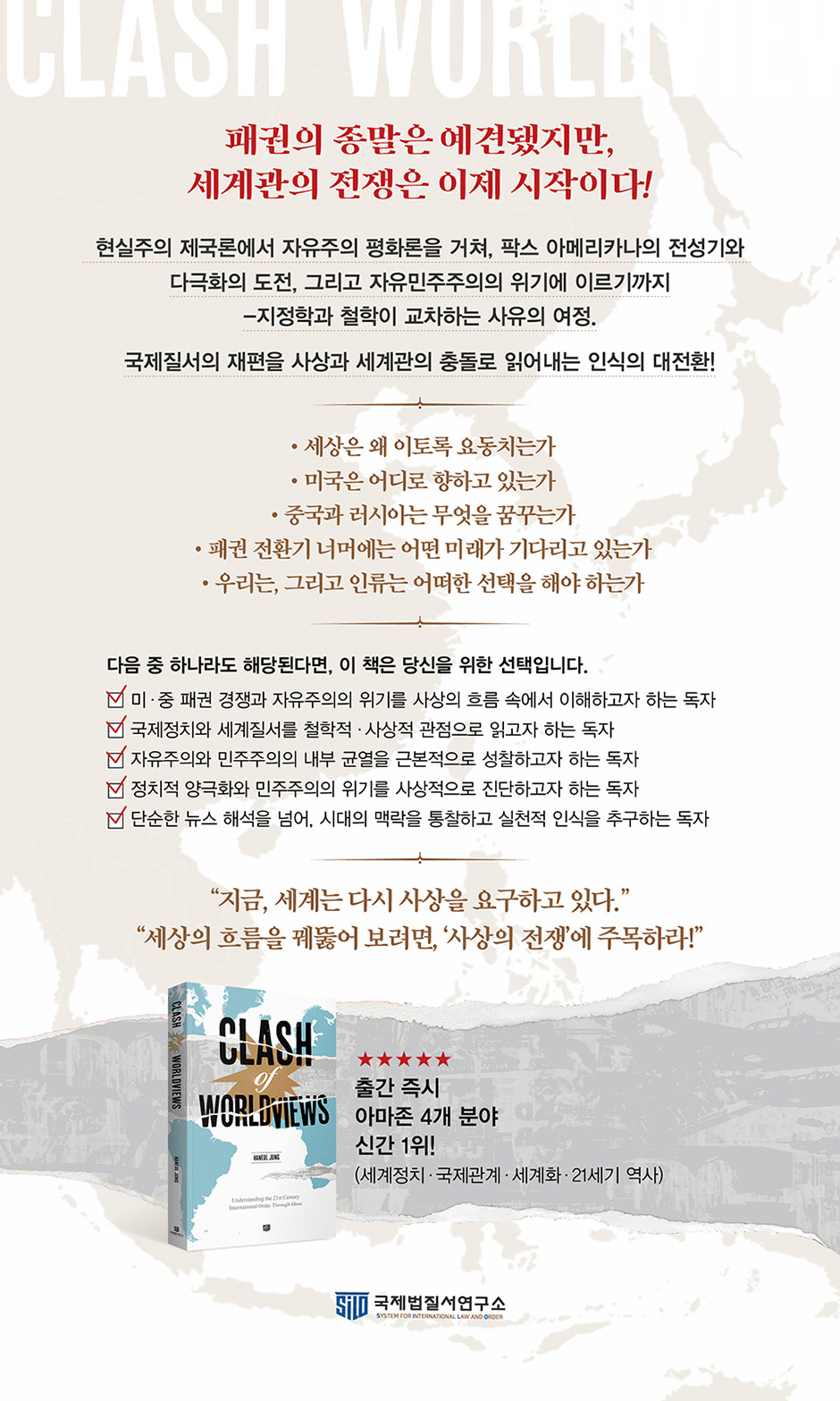
The end of hegemony was foreseen.
Now, the war of worldviews begins.
The disintegration of American hegemony, the challenges of China and Russia, the increasing frequency of wars, the retreat of free trade, the fragmentation of supply chains, the decline and fragmentation of democracy… The world today is not simply undergoing a reorganization of power, but rather a clash of worldviews and ideologies.
"Clash of Worldviews: Understanding the 21st Century International Order through Ideology" interprets today's chaos not as a simple competition of national power, but as a war of ideologies in which nations, civilizations, and individuals clash over the "rightful image of the world."
In his previous work, "Understanding the 21st Century International Order in the Context: The Future of South Korea in the Hegemonic Shift," the author explained the origins, development, and future of the hegemonic shift, focusing on events and context. In his new book, which returns after two years, he explores the hidden driving force behind the flow of the transition, the ideological power known as "worldview."
From ancient times, when empires perceived the world as a stage for the survival of the fittest, to the liberal order based on the Enlightenment and Kant's theory of perpetual peace, to 19th-century realism and balance-of-power ideology, to American exceptionalism and the liberal international order, to the ideological conflicts of the Cold War, to the neoliberal ideals of the post-Cold War era, to the multipolar worldviews championed by powers that change the status quo, such as China and Russia, and even to the systemic crisis facing liberal democracy today? This book explains the flow of worldviews that have clashed at every critical turning point in human history with insights that cross politics, history, ideology, and philosophy.
And we ask where the world is going and what ideas we should stand on.
Now, the world is calling for ideas again.
A book that answers that question.
Now, the war of worldviews begins.
The disintegration of American hegemony, the challenges of China and Russia, the increasing frequency of wars, the retreat of free trade, the fragmentation of supply chains, the decline and fragmentation of democracy… The world today is not simply undergoing a reorganization of power, but rather a clash of worldviews and ideologies.
"Clash of Worldviews: Understanding the 21st Century International Order through Ideology" interprets today's chaos not as a simple competition of national power, but as a war of ideologies in which nations, civilizations, and individuals clash over the "rightful image of the world."
In his previous work, "Understanding the 21st Century International Order in the Context: The Future of South Korea in the Hegemonic Shift," the author explained the origins, development, and future of the hegemonic shift, focusing on events and context. In his new book, which returns after two years, he explores the hidden driving force behind the flow of the transition, the ideological power known as "worldview."
From ancient times, when empires perceived the world as a stage for the survival of the fittest, to the liberal order based on the Enlightenment and Kant's theory of perpetual peace, to 19th-century realism and balance-of-power ideology, to American exceptionalism and the liberal international order, to the ideological conflicts of the Cold War, to the neoliberal ideals of the post-Cold War era, to the multipolar worldviews championed by powers that change the status quo, such as China and Russia, and even to the systemic crisis facing liberal democracy today? This book explains the flow of worldviews that have clashed at every critical turning point in human history with insights that cross politics, history, ideology, and philosophy.
And we ask where the world is going and what ideas we should stand on.
Now, the world is calling for ideas again.
A book that answers that question.
- You can preview some of the book's contents.
Preview
index
Preface to the English edition
Preface to the Korean edition
Chapter 1: A Changing World
Chapter 2: The Nature and Principles of International Politics
Chapter 3: Power and Legitimacy: The Challenge of Realpolitik in History
Chapter 4: The European Enlightenment: Opening the Door to Modernity
Chapter 5: Kant's Vision of Peace and the Liberal Worldview
Chapter 6: The Paradox of the Balance of Power: Geopolitics in 19th-Century Europe
Chapter 7: The Mission of the New World: American Exceptionalism and Liberal Internationalism
1.
The Origins of Liberal Hegemony
2.
Emergence as a global actor
Chapter 8: World War II: The Clash of Ideologies and the Birth of the Cold War
Chapter 9: Dynamics of the Cold War
1.
Strategy, Ideology, and Superpower Competition
2.
The Dawn of Multilateralism
Chapter 10: Pax Americana and the Liberal International Order
Chapter 11: China and Russia's Challenges to Multipolarity
Chapter 12: The Decline of Unipolar Hegemony and the Rise of Multipolar Systems
Chapter 13: A World Without Hegemons
1.
The United States: From Hegemon to Superpower
2.
Lost Liberal Democracies: In the Absence of Leadership
3.
China and Russia: Competitors and Partners
4.
The Global South: Land of Opportunity: The Intersection of a Multipolar World
Chapter 14: Can Multilateralism Survive in a Multipolar Era?
Chapter 15: The Existential Crisis of Liberal Democracy
1.
The expansion and division of liberal ideology
2.
The Dangers of Polarization: The Threat Extremism Poses to Liberal Democracy
3.
Potential Solution: The Rise of the Political Center
4.
The Future of Liberal Democracy and the Fate of a Multipolar World
Chapter 16: In the midst of the turbulent changes: Reflections on the future
References
Preface to the Korean edition
Chapter 1: A Changing World
Chapter 2: The Nature and Principles of International Politics
Chapter 3: Power and Legitimacy: The Challenge of Realpolitik in History
Chapter 4: The European Enlightenment: Opening the Door to Modernity
Chapter 5: Kant's Vision of Peace and the Liberal Worldview
Chapter 6: The Paradox of the Balance of Power: Geopolitics in 19th-Century Europe
Chapter 7: The Mission of the New World: American Exceptionalism and Liberal Internationalism
1.
The Origins of Liberal Hegemony
2.
Emergence as a global actor
Chapter 8: World War II: The Clash of Ideologies and the Birth of the Cold War
Chapter 9: Dynamics of the Cold War
1.
Strategy, Ideology, and Superpower Competition
2.
The Dawn of Multilateralism
Chapter 10: Pax Americana and the Liberal International Order
Chapter 11: China and Russia's Challenges to Multipolarity
Chapter 12: The Decline of Unipolar Hegemony and the Rise of Multipolar Systems
Chapter 13: A World Without Hegemons
1.
The United States: From Hegemon to Superpower
2.
Lost Liberal Democracies: In the Absence of Leadership
3.
China and Russia: Competitors and Partners
4.
The Global South: Land of Opportunity: The Intersection of a Multipolar World
Chapter 14: Can Multilateralism Survive in a Multipolar Era?
Chapter 15: The Existential Crisis of Liberal Democracy
1.
The expansion and division of liberal ideology
2.
The Dangers of Polarization: The Threat Extremism Poses to Liberal Democracy
3.
Potential Solution: The Rise of the Political Center
4.
The Future of Liberal Democracy and the Fate of a Multipolar World
Chapter 16: In the midst of the turbulent changes: Reflections on the future
References
Detailed image
Into the book
Ultimately, the biggest factor that determines political intuition is one's personal values.
People can see the same facts but arrive at completely different 'truths' depending on their values.
And that value system is built on a worldview.
In other words, the worldview is the fundamental standard that most deeply determines human thought and behavior.
--- p.7~8
There are three main factors driving this massive change.
The first is the reorganization of the power structure.
For the past 30 years, the international community has been under a unipolar system in which the United States reigns as the sole hegemon.
Now that era is coming to an end.
As the power of the United States, which had controlled the international order with overwhelming superiority, weakens, the international community is heralding the return of traditional great power rivalry.
However, the topography of the next era is still shrouded in thick fog.
The second is a structural transformation of the world economic order.
The liberal international order values prosperity and peace through free trade and economic interdependence.
But its legitimacy is rapidly being shaken.
As early as 2016, or at the latest as early as 2022, the United States began to question free trade and prioritize protectionism and industrial policies.
Global supply chains are fragmenting and markets are becoming more fragmented.
The era of comprehensive free trade has effectively come to an end.
Third, the decline of liberal ideology.
For decades, progressive values such as human rights, democracy, and environmental protection have served as the common language of the international community.
But now, there are more and more countries that are openly rejecting this.
Some countries argue that these values are incompatible with their culture and traditions, while others point out the flaws in liberalism itself.
On the other hand, liberal democratic countries are failing to provide a consistent response.
As a result, the international community is losing even the minimal consensus on universal values.
A world that has lost its common denominator of values inevitably becomes unstable.
Multilateralism is shaken and international tensions are bound to rise.
--- p.16
Liberal hegemony and traditional hegemony are fundamentally different.
Liberal hegemony secures its legitimacy not only through force but also through institutions and norms.
Therefore, the United States in the post-Cold War era has defined itself not as a hegemon but as “primus inter pares, first among equals.”
Because the leadership of a liberal hegemon can be recognized as legitimate only when it is based on voluntary consent and universal principles.
In reality, the multilateral regime that has supported the US-led international order was designed, at least institutionally, to allow all member states to raise issues about US leadership on an equal footing.
But today, even the United States faces the temptation to abandon its liberal identity as a leader and redefine itself as the "most powerful actor" in multipolarity.
--- p.17
When people hear the word 'politics', many first think of elections, parliament, and government systems.
But the essence of politics is not limited to institutions.
Factional strife in the workplace, the running of a company or community, and even decision-making within the home are all "political" in the sense that they involve dynamics surrounding power and influence.
In short, politics can be seen as the exercise of power revealed in human relationships.
The true value of power is revealed in the process of resource allocation, conflict of interest, and prioritization of values.
Especially in situations where it is difficult to resolve issues through social consensus alone, power is needed to make necessary decisions and implement them.
Power operates as a central element in both domestic and international politics, but the two spheres exhibit distinct structural differences.
--- p.23~24
The essence of politics is power, that is, gaining and maintaining influence over others.
Therefore, the logical end point of all political ambitions cannot be anything other than securing ‘hegemony.’
This is also true in international politics.
One of the most powerful, if not the most fundamental, motivations driving national action in the international community is the pursuit of hegemony.
--- p.25
Liberal theorists evaluate the post-Cold War international order as a significant period of moral and institutional advancement for human civilization.
It was a historic moment that finally broke free from the "law of the jungle" that had dominated international society since the beginning of time, and succeeded, if only briefly, in moving toward a more peaceful world order.
From their perspective, the current global turmoil is not simply a geopolitical crisis; it involves a profound ideological one.
The current crisis can be interpreted not only as the result of the opportunistic rise of authoritarian states seeking to undermine liberal norms, but also as the result of the United States, once the guardian of the liberal international order, failing to faithfully fulfill its responsibilities.
On the other hand, realist theorists underestimate the historical value and significance of the post-Cold War liberal international order.
The past era was merely a short-lived, exceptional period in which there was no challenger to the overwhelming global hegemony.
The United States, like other dominant powers throughout history, has always prioritized its own interests and sought to maintain a hegemonic order within its sphere of influence.
Therefore, today's global turmoil is seen as a natural and predictable consequence of the weakening of American global hegemony and the resulting redistribution of power.
Although liberalism and realism present different perspectives on the nature and maintenance of international order, they share a common ground through the concept of 'legitimacy.'
Liberalism understands legitimacy as the result of agreement through norms and institutions, while realism regards it as a strategic means of maintaining hegemony.
Nonetheless, the two theories share a common understanding that securing legitimacy is essential for maintaining the stability of the international order.
--- p.35~36
When a great power establishes hegemony in a particular region, it tends to establish and maintain order in that region.
Because it is in the interests of a hegemonic power to stably maintain order and peace within the region.
However, peace based on hegemony has several structural limitations.
Cases of true hegemony being established in the international community are extremely rare, and even those that do not last long.
The ancient Pax Romana and Pax Sinica, the modern Pax Britannica, and even the modern Pax Americana eventually withdrew from the stage of history.
The fall of Pax Romana plunged Europe into centuries of chaos, East Asia was rocked by upheaval each time a unified Chinese dynasty collapsed, and the decline of Pax Britannica led to World War I.
Today, the weakening of Pax Americana is also pushing the world into a new vortex of uncertainty.
Moreover, hegemony is inextricably linked to imperialism.
All hegemonic orders are inevitably structured around a hegemonic power, and the autonomy and sovereignty of peripheral states are inevitably violated.
In other words, the erosion of sovereignty of a dominated country is not an accidental event, but a structural property of the hegemonic order.
Therefore, peace based on hegemony is neither sustainable nor desirable.
--- p.75~76
Americans' unwavering belief in American exceptionalism is, of course, closely linked to the pride they feel in their vast territory, abundant resources, and geopolitical dominance.
But American exceptionalism is a complex concept that goes beyond mere material prosperity, deeply rooted in American history, culture, and identity.
Most countries have a founding myth that shapes their identity.
As historian Yuval Harari has pointed out, powerful narratives, such as founding myths, serve to unite members of society.
The United States, founded only after the modern era, has established a unique national identity based on the "ideology of liberalism" rather than "myth," unlike older civilizations.
A prime example is the story of the English Puritan immigrants who crossed the Atlantic in search of religious freedom.
This shaped the image of America as 'freedom' and 'a new beginning', and served to elevate 'freedom' and the 'American Dream' as the American identity instead of the general national myth.
--- p.93~94
Neoliberalism, which emerged in the post-Cold War international order, has characteristics that distinguish it from the classical liberalism of the 18th century.
Like classical liberalism, neoliberalism is a powerful trend that has had a profound impact on society as a whole.
However, unlike classical liberalism, which considered the individual's 'moral freedom' as its core value, neoliberalism put forward a market-centered economic philosophy, free competition, efficiency, and individual autonomy as an economic subject as its central values.
In other words, individual elements of classical liberalism, such as guaranteeing private property rights, limiting government power, and promoting individual autonomy, were reconstructed within the context of 'capitalist logic' rather than morality and ethics.
--- p.139~140
“Every civilization considers itself the center of the world and narrates its history as the central narrative of human history.”
--- p.150
The current situation of declining American global hegemony can be largely explained by three factors.
These factors are independent yet closely interconnected.
First is the relative weakening of America's national power.
The rigid structural foundation of the unipolar system that has been maintained since the end of the Cold War has been shaken.
Powers that are changing the status quo, such as China and Russia, have seen this as a historical opportunity and have begun to move in earnest to transform the US-centric order into a traditional multipolar system that is advantageous to them.
Although America's economic and military power remains overwhelming, the gap is rapidly narrowing due to the rapid rise of emerging powers.
Second, there is a change in perception within American society.
As the enormous costs and burdens of maintaining the liberal international order became clear, fatigue and skepticism about maintaining hegemony spread.
As a result, the popular support for making sacrifices and taking responsibility for maintaining international order has weakened, which in turn has limited America's foreign policy and its ability to exert global influence.
Third, the legitimacy of American hegemony is weakened.
America's past leadership was underpinned by the normative appeal of the liberal international order and an international consensus on American values.
But as this ideological foundation is shaken, the international consensus that underpins American leadership is also weakening.
In this way, American hegemony is facing a complex situation in which it is weakening in multiple dimensions, with external challenges as well as internal changes in perception and a crisis of legitimacy simultaneously at work.
--- p.169
There was once a belief that even if American unipolar hegemony were to disintegrate, the liberal international order built on top of it would persist.
There has also been an optimistic outlook that a non-polar or poly-nodal world will open up, replacing the traditional hegemonic structure with a global system where power is evenly distributed, i.e., no single country monopolizes hegemony.
However, the reality we witness today is closer to the return of a traditional multipolar system steeped in strategic competition and zero-sum competition, rather than a multilateral system based on cooperation.
Representative status quo change forces like China and Russia are increasingly strengthening their aggressive nationalism, and even the United States, the established hegemon, is showing skepticism about the liberal values it has defended.
As a result, the spread of nationalism, and furthermore, statism, is moving beyond a simple regional phenomenon and becoming a global trend.
--- p.183
The problem is that liberal democracies themselves face a complex crisis: the undermining of the democratic order, the spread of populism, and the rise of authoritarian alternatives.
As the fragmentation of the international order accelerates and the normative cohesion necessary for multilateralism weakens, and even liberal democratic states fall into systemic crisis, multilateralism will inevitably be reduced to an empty formality.
This would mean that the international community has lost the ability to respond to the common crises that humanity will inevitably face in the remainder of the 21st century.
--- p.237~238
Like the liberal international order, liberal democracy has its roots in the liberal tradition derived from the Enlightenment.
However, today's liberalism has changed significantly in both form and content compared to classical liberalism.
Its scope has expanded significantly, its structure has become fragmented, and its internal consistency has weakened.
--- p.243~244
However, the political discourses that are gaining traction in today's liberal democracies are increasingly tending to define ideological differences as a conflict between moral good and evil, rather than as objects of constructive understanding and coordination.
It is a zero-sum game of truth and lies, justice and injustice, and even good and evil.
This approach solidifies political positions into religious doctrines.
As ideology becomes dogmatic, the room for political compromise diminishes, and debate becomes a battleground for excluding opponents from the public sphere.
Political opponents are perceived as enemies to be eliminated, not as objects of discussion and compromise.
In this way, the values of mutual respect and peaceful coexistence, which are at the core of democracy, are collapsing, and deep and intense conflicts are repeated.
People can see the same facts but arrive at completely different 'truths' depending on their values.
And that value system is built on a worldview.
In other words, the worldview is the fundamental standard that most deeply determines human thought and behavior.
--- p.7~8
There are three main factors driving this massive change.
The first is the reorganization of the power structure.
For the past 30 years, the international community has been under a unipolar system in which the United States reigns as the sole hegemon.
Now that era is coming to an end.
As the power of the United States, which had controlled the international order with overwhelming superiority, weakens, the international community is heralding the return of traditional great power rivalry.
However, the topography of the next era is still shrouded in thick fog.
The second is a structural transformation of the world economic order.
The liberal international order values prosperity and peace through free trade and economic interdependence.
But its legitimacy is rapidly being shaken.
As early as 2016, or at the latest as early as 2022, the United States began to question free trade and prioritize protectionism and industrial policies.
Global supply chains are fragmenting and markets are becoming more fragmented.
The era of comprehensive free trade has effectively come to an end.
Third, the decline of liberal ideology.
For decades, progressive values such as human rights, democracy, and environmental protection have served as the common language of the international community.
But now, there are more and more countries that are openly rejecting this.
Some countries argue that these values are incompatible with their culture and traditions, while others point out the flaws in liberalism itself.
On the other hand, liberal democratic countries are failing to provide a consistent response.
As a result, the international community is losing even the minimal consensus on universal values.
A world that has lost its common denominator of values inevitably becomes unstable.
Multilateralism is shaken and international tensions are bound to rise.
--- p.16
Liberal hegemony and traditional hegemony are fundamentally different.
Liberal hegemony secures its legitimacy not only through force but also through institutions and norms.
Therefore, the United States in the post-Cold War era has defined itself not as a hegemon but as “primus inter pares, first among equals.”
Because the leadership of a liberal hegemon can be recognized as legitimate only when it is based on voluntary consent and universal principles.
In reality, the multilateral regime that has supported the US-led international order was designed, at least institutionally, to allow all member states to raise issues about US leadership on an equal footing.
But today, even the United States faces the temptation to abandon its liberal identity as a leader and redefine itself as the "most powerful actor" in multipolarity.
--- p.17
When people hear the word 'politics', many first think of elections, parliament, and government systems.
But the essence of politics is not limited to institutions.
Factional strife in the workplace, the running of a company or community, and even decision-making within the home are all "political" in the sense that they involve dynamics surrounding power and influence.
In short, politics can be seen as the exercise of power revealed in human relationships.
The true value of power is revealed in the process of resource allocation, conflict of interest, and prioritization of values.
Especially in situations where it is difficult to resolve issues through social consensus alone, power is needed to make necessary decisions and implement them.
Power operates as a central element in both domestic and international politics, but the two spheres exhibit distinct structural differences.
--- p.23~24
The essence of politics is power, that is, gaining and maintaining influence over others.
Therefore, the logical end point of all political ambitions cannot be anything other than securing ‘hegemony.’
This is also true in international politics.
One of the most powerful, if not the most fundamental, motivations driving national action in the international community is the pursuit of hegemony.
--- p.25
Liberal theorists evaluate the post-Cold War international order as a significant period of moral and institutional advancement for human civilization.
It was a historic moment that finally broke free from the "law of the jungle" that had dominated international society since the beginning of time, and succeeded, if only briefly, in moving toward a more peaceful world order.
From their perspective, the current global turmoil is not simply a geopolitical crisis; it involves a profound ideological one.
The current crisis can be interpreted not only as the result of the opportunistic rise of authoritarian states seeking to undermine liberal norms, but also as the result of the United States, once the guardian of the liberal international order, failing to faithfully fulfill its responsibilities.
On the other hand, realist theorists underestimate the historical value and significance of the post-Cold War liberal international order.
The past era was merely a short-lived, exceptional period in which there was no challenger to the overwhelming global hegemony.
The United States, like other dominant powers throughout history, has always prioritized its own interests and sought to maintain a hegemonic order within its sphere of influence.
Therefore, today's global turmoil is seen as a natural and predictable consequence of the weakening of American global hegemony and the resulting redistribution of power.
Although liberalism and realism present different perspectives on the nature and maintenance of international order, they share a common ground through the concept of 'legitimacy.'
Liberalism understands legitimacy as the result of agreement through norms and institutions, while realism regards it as a strategic means of maintaining hegemony.
Nonetheless, the two theories share a common understanding that securing legitimacy is essential for maintaining the stability of the international order.
--- p.35~36
When a great power establishes hegemony in a particular region, it tends to establish and maintain order in that region.
Because it is in the interests of a hegemonic power to stably maintain order and peace within the region.
However, peace based on hegemony has several structural limitations.
Cases of true hegemony being established in the international community are extremely rare, and even those that do not last long.
The ancient Pax Romana and Pax Sinica, the modern Pax Britannica, and even the modern Pax Americana eventually withdrew from the stage of history.
The fall of Pax Romana plunged Europe into centuries of chaos, East Asia was rocked by upheaval each time a unified Chinese dynasty collapsed, and the decline of Pax Britannica led to World War I.
Today, the weakening of Pax Americana is also pushing the world into a new vortex of uncertainty.
Moreover, hegemony is inextricably linked to imperialism.
All hegemonic orders are inevitably structured around a hegemonic power, and the autonomy and sovereignty of peripheral states are inevitably violated.
In other words, the erosion of sovereignty of a dominated country is not an accidental event, but a structural property of the hegemonic order.
Therefore, peace based on hegemony is neither sustainable nor desirable.
--- p.75~76
Americans' unwavering belief in American exceptionalism is, of course, closely linked to the pride they feel in their vast territory, abundant resources, and geopolitical dominance.
But American exceptionalism is a complex concept that goes beyond mere material prosperity, deeply rooted in American history, culture, and identity.
Most countries have a founding myth that shapes their identity.
As historian Yuval Harari has pointed out, powerful narratives, such as founding myths, serve to unite members of society.
The United States, founded only after the modern era, has established a unique national identity based on the "ideology of liberalism" rather than "myth," unlike older civilizations.
A prime example is the story of the English Puritan immigrants who crossed the Atlantic in search of religious freedom.
This shaped the image of America as 'freedom' and 'a new beginning', and served to elevate 'freedom' and the 'American Dream' as the American identity instead of the general national myth.
--- p.93~94
Neoliberalism, which emerged in the post-Cold War international order, has characteristics that distinguish it from the classical liberalism of the 18th century.
Like classical liberalism, neoliberalism is a powerful trend that has had a profound impact on society as a whole.
However, unlike classical liberalism, which considered the individual's 'moral freedom' as its core value, neoliberalism put forward a market-centered economic philosophy, free competition, efficiency, and individual autonomy as an economic subject as its central values.
In other words, individual elements of classical liberalism, such as guaranteeing private property rights, limiting government power, and promoting individual autonomy, were reconstructed within the context of 'capitalist logic' rather than morality and ethics.
--- p.139~140
“Every civilization considers itself the center of the world and narrates its history as the central narrative of human history.”
--- p.150
The current situation of declining American global hegemony can be largely explained by three factors.
These factors are independent yet closely interconnected.
First is the relative weakening of America's national power.
The rigid structural foundation of the unipolar system that has been maintained since the end of the Cold War has been shaken.
Powers that are changing the status quo, such as China and Russia, have seen this as a historical opportunity and have begun to move in earnest to transform the US-centric order into a traditional multipolar system that is advantageous to them.
Although America's economic and military power remains overwhelming, the gap is rapidly narrowing due to the rapid rise of emerging powers.
Second, there is a change in perception within American society.
As the enormous costs and burdens of maintaining the liberal international order became clear, fatigue and skepticism about maintaining hegemony spread.
As a result, the popular support for making sacrifices and taking responsibility for maintaining international order has weakened, which in turn has limited America's foreign policy and its ability to exert global influence.
Third, the legitimacy of American hegemony is weakened.
America's past leadership was underpinned by the normative appeal of the liberal international order and an international consensus on American values.
But as this ideological foundation is shaken, the international consensus that underpins American leadership is also weakening.
In this way, American hegemony is facing a complex situation in which it is weakening in multiple dimensions, with external challenges as well as internal changes in perception and a crisis of legitimacy simultaneously at work.
--- p.169
There was once a belief that even if American unipolar hegemony were to disintegrate, the liberal international order built on top of it would persist.
There has also been an optimistic outlook that a non-polar or poly-nodal world will open up, replacing the traditional hegemonic structure with a global system where power is evenly distributed, i.e., no single country monopolizes hegemony.
However, the reality we witness today is closer to the return of a traditional multipolar system steeped in strategic competition and zero-sum competition, rather than a multilateral system based on cooperation.
Representative status quo change forces like China and Russia are increasingly strengthening their aggressive nationalism, and even the United States, the established hegemon, is showing skepticism about the liberal values it has defended.
As a result, the spread of nationalism, and furthermore, statism, is moving beyond a simple regional phenomenon and becoming a global trend.
--- p.183
The problem is that liberal democracies themselves face a complex crisis: the undermining of the democratic order, the spread of populism, and the rise of authoritarian alternatives.
As the fragmentation of the international order accelerates and the normative cohesion necessary for multilateralism weakens, and even liberal democratic states fall into systemic crisis, multilateralism will inevitably be reduced to an empty formality.
This would mean that the international community has lost the ability to respond to the common crises that humanity will inevitably face in the remainder of the 21st century.
--- p.237~238
Like the liberal international order, liberal democracy has its roots in the liberal tradition derived from the Enlightenment.
However, today's liberalism has changed significantly in both form and content compared to classical liberalism.
Its scope has expanded significantly, its structure has become fragmented, and its internal consistency has weakened.
--- p.243~244
However, the political discourses that are gaining traction in today's liberal democracies are increasingly tending to define ideological differences as a conflict between moral good and evil, rather than as objects of constructive understanding and coordination.
It is a zero-sum game of truth and lies, justice and injustice, and even good and evil.
This approach solidifies political positions into religious doctrines.
As ideology becomes dogmatic, the room for political compromise diminishes, and debate becomes a battleground for excluding opponents from the public sphere.
Political opponents are perceived as enemies to be eliminated, not as objects of discussion and compromise.
In this way, the values of mutual respect and peaceful coexistence, which are at the core of democracy, are collapsing, and deep and intense conflicts are repeated.
--- p.258~259
Publisher's Review
The Korean edition of "Clash of Worldviews: Understanding the 21st Century International Order through Ideology" has been published!
The end of hegemony is foreseen, but the war of worldviews has only just begun!
Two years after "Understanding the 21st Century International Order: The Future of South Korea in the Age of Hegemonic Transition," it's time to focus on the battle between "worldview" and "ideology."
The international order is in turmoil.
Free trade was pushed back by the rising tide of protectionism, and global supply chains began to fragment according to each country's interests.
Armed conflicts are reigniting around the world, and anxiety is growing that humanity is once again entering an 'age of war.'
As the unipolar hegemony of the United States is showing cracks and the foundations of the existing international order built on it are shaking, China and Russia are openly revealing their ambitions for a new world order.
Meanwhile, 'liberal democratic nations' are suffering internal rifts in values and communities, and face external skepticism about their legitimacy and superiority.
This shift goes beyond a simple reorganization of power; it is a serious warning that the ideological foundation of liberalism, which has sustained the post-Cold War world, and its very legitimacy, could collapse.
The new book, "Clash of Worldviews," interprets this upheaval not as a simple competition of national power or a clash of interests, but as a clash of "worldviews and ideologies" between nations and civilizations.
According to the author, today's chaos cannot be explained by the balance of power or national interest alone.
Beneath the competition of military, economic, and technological power, a more fundamental force called ‘worldview’ is at work.
Today's strategic competition is driven by the clashing ways in which nations and civilizations understand the world and their beliefs about what constitutes a just and legitimate international order.
In fact, history has always evolved through competition between worldviews.
This book reinterprets the decisive turning points in world history through the lens of ideology.
Starting from the period when ancient empires perceived the world as a stage for the survival of the fittest, to the liberal order based on the Enlightenment and Kant's theory of perpetual peace, to 19th-century realism and the idea of balance of power, to American exceptionalism and the liberal international order, to the ideological conflict of the Cold War, to the neoliberalism of the post-Cold War era, and to the multipolar worldview put forward by current powers like China and Russia - this book easily and intuitively illuminates the flow of worldviews that have clashed at every critical turning point in human history.
The End of Hegemony, the Existential Crisis of Liberal Democracy - Why Is Democracy Collapsing?
According to this book, today's global crisis stems largely from three axes.
First, the center of order is being shaken as the international power structure is being reorganized due to the weakening of American hegemony.
Second, the resurgence of protectionism and nationalism is disrupting global supply chains and shifting the world economy from integration to blocs.
Third, with the internal rifts within liberal democracy, the consistency and superiority of universal values such as human rights and democracy are being shaken, and the moral legitimacy of the liberal system itself is being questioned.
"Clash of Worldviews" argues that the wars, trade conflicts, and value debates we see in the news every day should be read not as fragmented events, but within the historical context of conflicting worldviews.
Why is free trade no longer a given? Why are even democratic nations beginning to question the values they once championed? Why is liberal leadership no longer persuasive in the international community? This book answers these questions with insights that cross ideology, politics, history, and philosophy.
In particular, the author sharply points out the philosophical crisis and the disappearance of politics within liberal democratic countries as much as the external challenges.
As democratic politics degenerates from the art of compromise and accommodation into a "battlefield of good and evil," the core principles of democracy—mutual respect and coexistence—are collapsing.
Ideological conflict is no longer a competition over policy differences, but a moral struggle in which the other side is viewed not as a partner to compromise with, but as an enemy to be eliminated.
As a result, populism and extremism are spreading, authoritarianism is emerging as a viable alternative, and liberal democracy is being pushed into a structural crisis.
The author analyzes that the root of this confusion lies in the corruption of liberalism itself.
Classical liberalism, rooted in the Enlightenment, lost its philosophical consistency as it gave way to postmodern progressivism, becoming a collection of contradictory ideologies that simultaneously embraced both extreme libertarianism and radical egalitarianism.
As a result, liberalism is no longer a common normative foundation, but has become a battleground of conflicting values.
The radical left is fueling far-right populism, which in turn is strengthening the radical left, and politics is regressing to the logic of zero-sum war rather than compromise.
The author emphasizes that the root of the current crisis is not so much the self-denial and divisions taking place within liberal democratic nations as it is external challenges from countries like China and Russia.
Profound insights from an expert who witnessed the collapse of the international order from the front lines!
Author Jeong Ha-neul is an international trade expert who has protected South Korea's national interests at the forefront of WTO disputes.
Fascinated by the ideals of the multilateral trade system, he chose international trade law early on. He was selected as the youngest 'Leading Lawyer' by Chambers & Partners, a global lawyer evaluation agency in the UK, and was also the youngest recipient of the Simdang Academic Award, demonstrating his talents from his days at a private law firm.
After being appointed Director of the Trade Dispute Response Division at the Ministry of Trade, Industry and Energy in 2018, he successfully led approximately one-quarter of the WTO disputes in which South Korea participated as a party, including the Korea-US steel and washing machine disputes and the Korea-Japan Fukushima fishery product dispute.
But by the time he finished his term, the international order was showing fundamental cracks.
The intensifying US-China hegemony competition, the paralysis of the WTO system, and the decline of free trade have raised more fundamental questions that cannot be explained solely through existing international laws and institutions.
"Why is the world colliding, and where are we headed?" Having witnessed the existential crisis facing not only the WTO system that underpinned the post-Cold War global economy, but also the liberal international order, its ideological foundation, the author resigned from public office in 2022 and founded the Institute for International Law and Order, where he began to explore the interplay between international law and global governance in earnest.
This new work, 『Clash of Worldviews: Understanding the 21st Century International Order through Ideology』, is a sequel to his previous work, 『Understanding the 21st Century International Order in the Context: The Future of the Republic of Korea in the Era of Hegemonic Transition』, published two years later.
If the previous work was an analysis of the origins, development, and future of the hegemonic transition, this book is an intellectual compass that delves into the hidden driving force behind the transition: the ideological force known as "worldview."
Beyond a simple explanation of phenomena, the book is permeated by a critical awareness that prompts us to consider where we should go from here.
This book, first published in English in June 2025, simultaneously achieved the number one spot in new book rankings in four categories on Amazon: world politics, international relations, globalization, and 21st-century history.
For readers contemplating the future of South Korea in a multipolar world, this book will serve as a guide, offering practical insights that go beyond simple analysis.
The end of hegemony is foreseen, but the war of worldviews has only just begun!
Two years after "Understanding the 21st Century International Order: The Future of South Korea in the Age of Hegemonic Transition," it's time to focus on the battle between "worldview" and "ideology."
The international order is in turmoil.
Free trade was pushed back by the rising tide of protectionism, and global supply chains began to fragment according to each country's interests.
Armed conflicts are reigniting around the world, and anxiety is growing that humanity is once again entering an 'age of war.'
As the unipolar hegemony of the United States is showing cracks and the foundations of the existing international order built on it are shaking, China and Russia are openly revealing their ambitions for a new world order.
Meanwhile, 'liberal democratic nations' are suffering internal rifts in values and communities, and face external skepticism about their legitimacy and superiority.
This shift goes beyond a simple reorganization of power; it is a serious warning that the ideological foundation of liberalism, which has sustained the post-Cold War world, and its very legitimacy, could collapse.
The new book, "Clash of Worldviews," interprets this upheaval not as a simple competition of national power or a clash of interests, but as a clash of "worldviews and ideologies" between nations and civilizations.
According to the author, today's chaos cannot be explained by the balance of power or national interest alone.
Beneath the competition of military, economic, and technological power, a more fundamental force called ‘worldview’ is at work.
Today's strategic competition is driven by the clashing ways in which nations and civilizations understand the world and their beliefs about what constitutes a just and legitimate international order.
In fact, history has always evolved through competition between worldviews.
This book reinterprets the decisive turning points in world history through the lens of ideology.
Starting from the period when ancient empires perceived the world as a stage for the survival of the fittest, to the liberal order based on the Enlightenment and Kant's theory of perpetual peace, to 19th-century realism and the idea of balance of power, to American exceptionalism and the liberal international order, to the ideological conflict of the Cold War, to the neoliberalism of the post-Cold War era, and to the multipolar worldview put forward by current powers like China and Russia - this book easily and intuitively illuminates the flow of worldviews that have clashed at every critical turning point in human history.
The End of Hegemony, the Existential Crisis of Liberal Democracy - Why Is Democracy Collapsing?
According to this book, today's global crisis stems largely from three axes.
First, the center of order is being shaken as the international power structure is being reorganized due to the weakening of American hegemony.
Second, the resurgence of protectionism and nationalism is disrupting global supply chains and shifting the world economy from integration to blocs.
Third, with the internal rifts within liberal democracy, the consistency and superiority of universal values such as human rights and democracy are being shaken, and the moral legitimacy of the liberal system itself is being questioned.
"Clash of Worldviews" argues that the wars, trade conflicts, and value debates we see in the news every day should be read not as fragmented events, but within the historical context of conflicting worldviews.
Why is free trade no longer a given? Why are even democratic nations beginning to question the values they once championed? Why is liberal leadership no longer persuasive in the international community? This book answers these questions with insights that cross ideology, politics, history, and philosophy.
In particular, the author sharply points out the philosophical crisis and the disappearance of politics within liberal democratic countries as much as the external challenges.
As democratic politics degenerates from the art of compromise and accommodation into a "battlefield of good and evil," the core principles of democracy—mutual respect and coexistence—are collapsing.
Ideological conflict is no longer a competition over policy differences, but a moral struggle in which the other side is viewed not as a partner to compromise with, but as an enemy to be eliminated.
As a result, populism and extremism are spreading, authoritarianism is emerging as a viable alternative, and liberal democracy is being pushed into a structural crisis.
The author analyzes that the root of this confusion lies in the corruption of liberalism itself.
Classical liberalism, rooted in the Enlightenment, lost its philosophical consistency as it gave way to postmodern progressivism, becoming a collection of contradictory ideologies that simultaneously embraced both extreme libertarianism and radical egalitarianism.
As a result, liberalism is no longer a common normative foundation, but has become a battleground of conflicting values.
The radical left is fueling far-right populism, which in turn is strengthening the radical left, and politics is regressing to the logic of zero-sum war rather than compromise.
The author emphasizes that the root of the current crisis is not so much the self-denial and divisions taking place within liberal democratic nations as it is external challenges from countries like China and Russia.
Profound insights from an expert who witnessed the collapse of the international order from the front lines!
Author Jeong Ha-neul is an international trade expert who has protected South Korea's national interests at the forefront of WTO disputes.
Fascinated by the ideals of the multilateral trade system, he chose international trade law early on. He was selected as the youngest 'Leading Lawyer' by Chambers & Partners, a global lawyer evaluation agency in the UK, and was also the youngest recipient of the Simdang Academic Award, demonstrating his talents from his days at a private law firm.
After being appointed Director of the Trade Dispute Response Division at the Ministry of Trade, Industry and Energy in 2018, he successfully led approximately one-quarter of the WTO disputes in which South Korea participated as a party, including the Korea-US steel and washing machine disputes and the Korea-Japan Fukushima fishery product dispute.
But by the time he finished his term, the international order was showing fundamental cracks.
The intensifying US-China hegemony competition, the paralysis of the WTO system, and the decline of free trade have raised more fundamental questions that cannot be explained solely through existing international laws and institutions.
"Why is the world colliding, and where are we headed?" Having witnessed the existential crisis facing not only the WTO system that underpinned the post-Cold War global economy, but also the liberal international order, its ideological foundation, the author resigned from public office in 2022 and founded the Institute for International Law and Order, where he began to explore the interplay between international law and global governance in earnest.
This new work, 『Clash of Worldviews: Understanding the 21st Century International Order through Ideology』, is a sequel to his previous work, 『Understanding the 21st Century International Order in the Context: The Future of the Republic of Korea in the Era of Hegemonic Transition』, published two years later.
If the previous work was an analysis of the origins, development, and future of the hegemonic transition, this book is an intellectual compass that delves into the hidden driving force behind the transition: the ideological force known as "worldview."
Beyond a simple explanation of phenomena, the book is permeated by a critical awareness that prompts us to consider where we should go from here.
This book, first published in English in June 2025, simultaneously achieved the number one spot in new book rankings in four categories on Amazon: world politics, international relations, globalization, and 21st-century history.
For readers contemplating the future of South Korea in a multipolar world, this book will serve as a guide, offering practical insights that go beyond simple analysis.
GOODS SPECIFICS
- Date of issue: November 30, 2025
- Page count, weight, size: 312 pages | 550g | 150*220*18mm
- ISBN13: 9791198411990
- ISBN10: 1198411996
You may also like
카테고리
korean


korean

![GQ KOREA Mark (Monthly): December [2025]](http://librairie.coreenne.fr/cdn/shop/files/8ef265dbbfbf186523ed75ba7319009d.jpg?v=1765340328&width=3840)


