

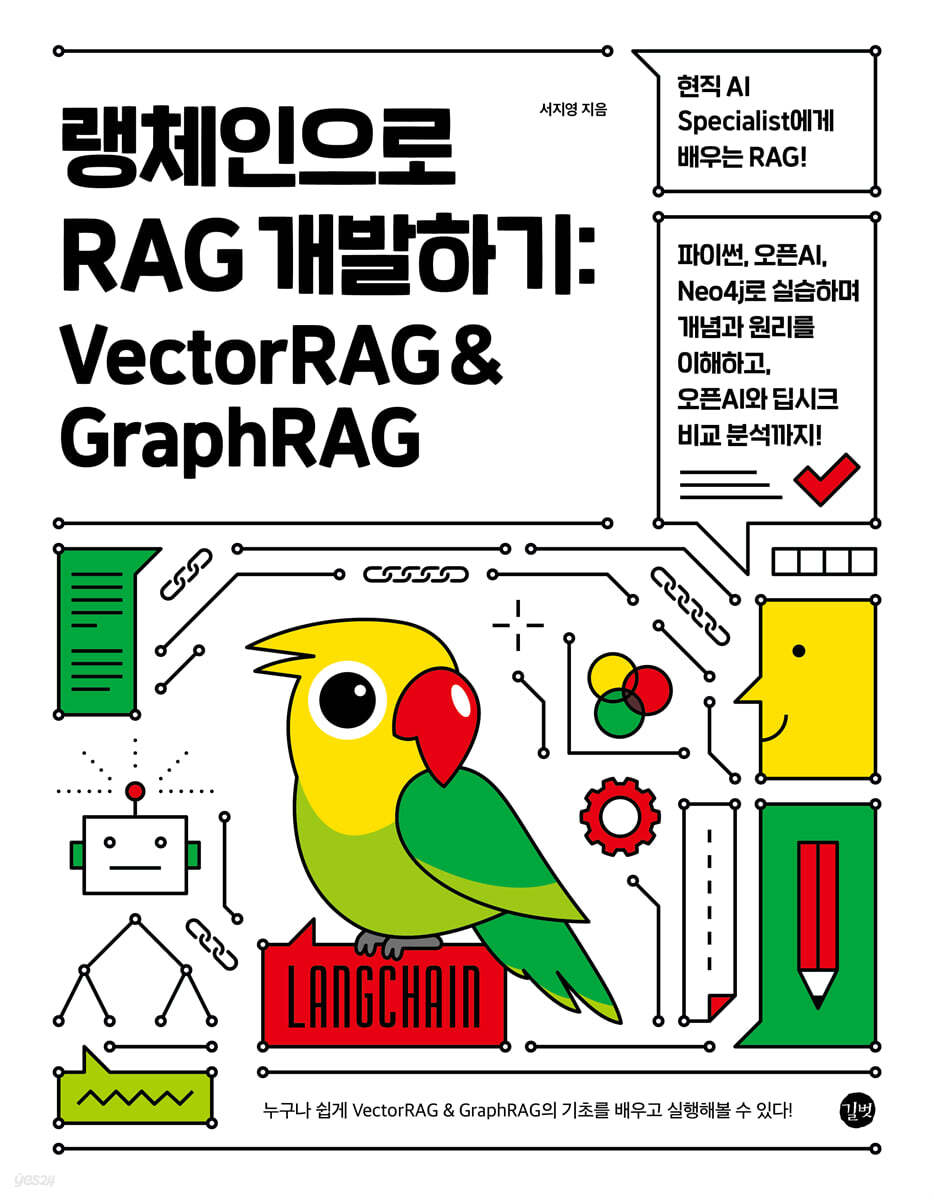
Developing RAG with Langchain: VectorRAG & GraphRAG
 |
Description
Book Introduction
A simple example of the differences between VectorRAG and GraphRAG and how to implement them!
We will directly verify the differences in concepts and performance between OpenAI and DeepSeek through hands-on practice.
What are the differences between VectorRAG and GraphRAG? And in what data and scenarios are they best suited for use? "Developing RAG with LangChain: VectorRAG & GraphRAG" compares the concepts and principles of the two and provides an easily understandable explanation.
We will briefly review the core theory and learn how to implement basic examples using Langchain.
When implementing GraphRAG, we will explore several ways to create and retrieve data in Neo4j.
When implementing VectorRAG, we will explore and use not only the OpenAI model but also the DeepSearch model.
You can directly check the performance difference between the two models by downloading the DeepSeek model locally and running it safely.
Through this book, you will learn the basics of RAG and LLM and experience basic implementation methods.
We will directly verify the differences in concepts and performance between OpenAI and DeepSeek through hands-on practice.
What are the differences between VectorRAG and GraphRAG? And in what data and scenarios are they best suited for use? "Developing RAG with LangChain: VectorRAG & GraphRAG" compares the concepts and principles of the two and provides an easily understandable explanation.
We will briefly review the core theory and learn how to implement basic examples using Langchain.
When implementing GraphRAG, we will explore several ways to create and retrieve data in Neo4j.
When implementing VectorRAG, we will explore and use not only the OpenAI model but also the DeepSearch model.
You can directly check the performance difference between the two models by downloading the DeepSeek model locally and running it safely.
Through this book, you will learn the basics of RAG and LLM and experience basic implementation methods.
- You can preview some of the book's contents.
Preview
index
Chapter 1: Understanding VectorRAG & GraphRAG Concepts
1.1 What is RAG?
____1.1.1 What is RAG?
____1.1.2 The Need for RAG
____1.1.3 RAG Core Principles
____1.1.4 How to implement RAG
1.2 What is VectorRAG?
____1.2.1 What is a vector?
____1.2.2 Vector Processing Process
____1.2.3 Vector Storage
____1.2.4 What is VectorRAG?
____1.2.5 When should I use VectorRAG?
1.3 What is GraphRAG?
____1.3.1 What is a graph?
____1.3.2 GraphDB: Neo4j
____1.3.3 What is GraphRAG?
____1.3.4 When do I use GraphRAG?
Chapter 2: Understanding OpenAI Concepts and Principles
2.1 What is OpenAI?
2.2 OpenAI model
____2.2.1 GPT series
____2.2.2 ChatGPT
____2.2.3 DALL·E series
____2.2.4 Whisper
____2.2.5 Sora
____2.2.6 Embedding
2.3 Principles of ChatGPT
____2.3.1 What is a transformer?
____2.3.2 Why Transformers Appeared
2.4 OpenAI Inference Model: o3-mini
____2.4.1 Questions that require inference
____2.4.2 Questions with a clear answer
2.5 Considerations When Using OpenAI Models
Chapter 3: Understanding DeepSeek Concepts and Principles
3.1 What is DeepSeek?
3.2 Background of DeepSeek's emergence
3.3 Principles of DeepSeek-R1
3.4 DeepSeek model
3.5 Considerations when using DeepSeek models
Chapter 4: Preparing the Practice Environment
4.1 Installing and Configuring Anaconda
____4.1.1 Installing Anaconda
____4.1.2 Configuring the Anaconda Virtual Environment
4.2 Preparing an API Key
4.3 Preparing the DeepSeek Model
4.4 Installing and Configuring Neo4j
____4.4.1 Installing Neo4j
____4.4.2 Learning how to use Neo4j
____4.4.3 Using Cypher in Neo4j
Chapter 5 VectorRAG Hands-on: Using the OpenAI API
5.1 Searching for Car Data
5.2 Searching Web Data
5.3 Retrieving Succulent Data from PDF
5.4 Using Langchain's Memory
5.5 Retrieving and searching data from multiple files
5.6 Comparison of Langchain and RamaIndex
5.7 Cases that are not suitable for VectorRAG
Chapter 6 VectorRAG Hands-on: Using the DeepSeek Model
6.1 Searching for car data
6.2 Searching Web Data
6.3 Retrieving Succulent Data from PDF
6.4 Using Langchain's Memory
6.5 Retrieving and searching data from multiple files
Chapter 7: GraphRAG Practice
7.1 Using Graphs in Lang Chains
7.2 Searching for soccer data
____7.2.1 Generating Soccer Data
____7.2.2 Retrieving Soccer Data
7.3 Importing and Searching PDF Files
7.4 Searching for movie data
____7.4.1 Generating Movie Data
____7.4.2 Searching for movie data
7.5 Searching for Car Data
____7.5.1 Creating Car Data
____7.5.2 Searching for Car Data
7.6 Searching for health data
____7.6.1 Creating Health Data
____7.6.2 Searching for Health Data
Chapter 8: Comparison of Copilot and GraphRAG and the Social Impact of RAG
8.1 Comparing Graph-Based Search with GraphRAG in Copilot
____8.1.1 Searches used in Copilot
____8.1.2 Comparison of regular RAG and Copilot searches
8.2 After the RAG Paradigm: What's Next?
____8.2.1 Limitations and future direction of RAG
____8.2.2 AI Agents and Reinforcement Learning
8.3 Social Impact of RAG
____8.3.1 Trust and Transparency Issues
____8.3.2 Ethical Considerations of AI
____8.3.3 Policy and Regulatory Issues
8.4 Changes in human life
____8.4.1 Changes in Work
____8.4.2 Changes in personal life
Search
1.1 What is RAG?
____1.1.1 What is RAG?
____1.1.2 The Need for RAG
____1.1.3 RAG Core Principles
____1.1.4 How to implement RAG
1.2 What is VectorRAG?
____1.2.1 What is a vector?
____1.2.2 Vector Processing Process
____1.2.3 Vector Storage
____1.2.4 What is VectorRAG?
____1.2.5 When should I use VectorRAG?
1.3 What is GraphRAG?
____1.3.1 What is a graph?
____1.3.2 GraphDB: Neo4j
____1.3.3 What is GraphRAG?
____1.3.4 When do I use GraphRAG?
Chapter 2: Understanding OpenAI Concepts and Principles
2.1 What is OpenAI?
2.2 OpenAI model
____2.2.1 GPT series
____2.2.2 ChatGPT
____2.2.3 DALL·E series
____2.2.4 Whisper
____2.2.5 Sora
____2.2.6 Embedding
2.3 Principles of ChatGPT
____2.3.1 What is a transformer?
____2.3.2 Why Transformers Appeared
2.4 OpenAI Inference Model: o3-mini
____2.4.1 Questions that require inference
____2.4.2 Questions with a clear answer
2.5 Considerations When Using OpenAI Models
Chapter 3: Understanding DeepSeek Concepts and Principles
3.1 What is DeepSeek?
3.2 Background of DeepSeek's emergence
3.3 Principles of DeepSeek-R1
3.4 DeepSeek model
3.5 Considerations when using DeepSeek models
Chapter 4: Preparing the Practice Environment
4.1 Installing and Configuring Anaconda
____4.1.1 Installing Anaconda
____4.1.2 Configuring the Anaconda Virtual Environment
4.2 Preparing an API Key
4.3 Preparing the DeepSeek Model
4.4 Installing and Configuring Neo4j
____4.4.1 Installing Neo4j
____4.4.2 Learning how to use Neo4j
____4.4.3 Using Cypher in Neo4j
Chapter 5 VectorRAG Hands-on: Using the OpenAI API
5.1 Searching for Car Data
5.2 Searching Web Data
5.3 Retrieving Succulent Data from PDF
5.4 Using Langchain's Memory
5.5 Retrieving and searching data from multiple files
5.6 Comparison of Langchain and RamaIndex
5.7 Cases that are not suitable for VectorRAG
Chapter 6 VectorRAG Hands-on: Using the DeepSeek Model
6.1 Searching for car data
6.2 Searching Web Data
6.3 Retrieving Succulent Data from PDF
6.4 Using Langchain's Memory
6.5 Retrieving and searching data from multiple files
Chapter 7: GraphRAG Practice
7.1 Using Graphs in Lang Chains
7.2 Searching for soccer data
____7.2.1 Generating Soccer Data
____7.2.2 Retrieving Soccer Data
7.3 Importing and Searching PDF Files
7.4 Searching for movie data
____7.4.1 Generating Movie Data
____7.4.2 Searching for movie data
7.5 Searching for Car Data
____7.5.1 Creating Car Data
____7.5.2 Searching for Car Data
7.6 Searching for health data
____7.6.1 Creating Health Data
____7.6.2 Searching for Health Data
Chapter 8: Comparison of Copilot and GraphRAG and the Social Impact of RAG
8.1 Comparing Graph-Based Search with GraphRAG in Copilot
____8.1.1 Searches used in Copilot
____8.1.2 Comparison of regular RAG and Copilot searches
8.2 After the RAG Paradigm: What's Next?
____8.2.1 Limitations and future direction of RAG
____8.2.2 AI Agents and Reinforcement Learning
8.3 Social Impact of RAG
____8.3.1 Trust and Transparency Issues
____8.3.2 Ethical Considerations of AI
____8.3.3 Policy and Regulatory Issues
8.4 Changes in human life
____8.4.1 Changes in Work
____8.4.2 Changes in personal life
Search
Detailed image

Publisher's Review
Simple, focusing on the core concepts and principles!
Introduction to RAG by implementing basic examples!
What this book covers: VectorRAG & GraphRAG
The core of LLM-related technology is RAG. RAG can be divided into VectorRAG and GraphRAG, depending on the nature of the data.
This book compares and learns the concepts and principles of VectorRAG and GraphRAG, which are similar yet different, including the concept of RAG.
We will examine the scenarios and data in which the VectorRAG method, a common RAG used in the past, and the GraphRAG method, which can identify and utilize relationships between data, can be utilized, and also learn about implementation methods using LangChain.
What this book covers: OpenAI & DeepSeek
Before we dive into the implementation using Langchain, we'll take a look at the models primarily used in RAG. This book briefly covers the principles and background of the OpenAI model, inference model, and open-source DeepSeek model.
Next, we will use the OpenAI model and the DeepSeek model respectively in the same LangChain code that implemented VectorRAG.
This allows us to actually compare the performance differences between the two models.
DeepSeek models are downloaded and run locally via Ollama for safe use.
This book's practical scenario: implementing a basic example.
Let's implement RAG using Langchain in various scenarios.
The examples are easy to follow and are the most basic and easy-to-follow examples, allowing you to understand the differences between OpenAI and DeepSeek models, and between VectorRAG and GraphRAG.
Lastly, since Copilot also utilizes Vector search and Graph search, let's briefly compare the differences between the search methods used in Copilot and VectorRAG and GraphRAG.
[VectorRAG Example]
ㆍ Search for car data
ㆍ Searching web data
ㆍ Searching for data in PDF
ㆍUsing Langchain memory
ㆍ Retrieve and search data from multiple files
[GraphRAG Example]
ㆍ Search soccer data
ㆍ Load PDF files and search
ㆍ Search movie data
ㆍ Search for car data
ㆍ Search health data
[Author's Preface]
This book is intended for:
ㆍ People who want to know the difference between VectorRAG and GraphRAG
ㆍ Developers who want to know how to implement VectorRAG and GraphRAG
ㆍ People who want to know the difference between OpenAI and DeepSeek
ㆍ People who want to check the performance difference between OpenAI and DeepSeek
No matter how much LLM-based technology develops, RAG can be said to be the core concept that serves as its foundation.
In particular, VectorRAG and GraphRAG play an important role in RAG.
If you understand this concept, you will be able to follow the various technologies that appear later without difficulty.
I hope this book will help lay that foundation.
Introduction to RAG by implementing basic examples!
What this book covers: VectorRAG & GraphRAG
The core of LLM-related technology is RAG. RAG can be divided into VectorRAG and GraphRAG, depending on the nature of the data.
This book compares and learns the concepts and principles of VectorRAG and GraphRAG, which are similar yet different, including the concept of RAG.
We will examine the scenarios and data in which the VectorRAG method, a common RAG used in the past, and the GraphRAG method, which can identify and utilize relationships between data, can be utilized, and also learn about implementation methods using LangChain.
What this book covers: OpenAI & DeepSeek
Before we dive into the implementation using Langchain, we'll take a look at the models primarily used in RAG. This book briefly covers the principles and background of the OpenAI model, inference model, and open-source DeepSeek model.
Next, we will use the OpenAI model and the DeepSeek model respectively in the same LangChain code that implemented VectorRAG.
This allows us to actually compare the performance differences between the two models.
DeepSeek models are downloaded and run locally via Ollama for safe use.
This book's practical scenario: implementing a basic example.
Let's implement RAG using Langchain in various scenarios.
The examples are easy to follow and are the most basic and easy-to-follow examples, allowing you to understand the differences between OpenAI and DeepSeek models, and between VectorRAG and GraphRAG.
Lastly, since Copilot also utilizes Vector search and Graph search, let's briefly compare the differences between the search methods used in Copilot and VectorRAG and GraphRAG.
[VectorRAG Example]
ㆍ Search for car data
ㆍ Searching web data
ㆍ Searching for data in PDF
ㆍUsing Langchain memory
ㆍ Retrieve and search data from multiple files
[GraphRAG Example]
ㆍ Search soccer data
ㆍ Load PDF files and search
ㆍ Search movie data
ㆍ Search for car data
ㆍ Search health data
[Author's Preface]
This book is intended for:
ㆍ People who want to know the difference between VectorRAG and GraphRAG
ㆍ Developers who want to know how to implement VectorRAG and GraphRAG
ㆍ People who want to know the difference between OpenAI and DeepSeek
ㆍ People who want to check the performance difference between OpenAI and DeepSeek
No matter how much LLM-based technology develops, RAG can be said to be the core concept that serves as its foundation.
In particular, VectorRAG and GraphRAG play an important role in RAG.
If you understand this concept, you will be able to follow the various technologies that appear later without difficulty.
I hope this book will help lay that foundation.
GOODS SPECIFICS
- Date of issue: April 25, 2025
- Page count, weight, size: 312 pages | 183*235*13mm
- ISBN13: 9791140713240
You may also like
카테고리
korean


korean

![GQ KOREA Mark (Monthly): December [2025]](http://librairie.coreenne.fr/cdn/shop/files/8ef265dbbfbf186523ed75ba7319009d.jpg?v=1765340328&width=3840)


