

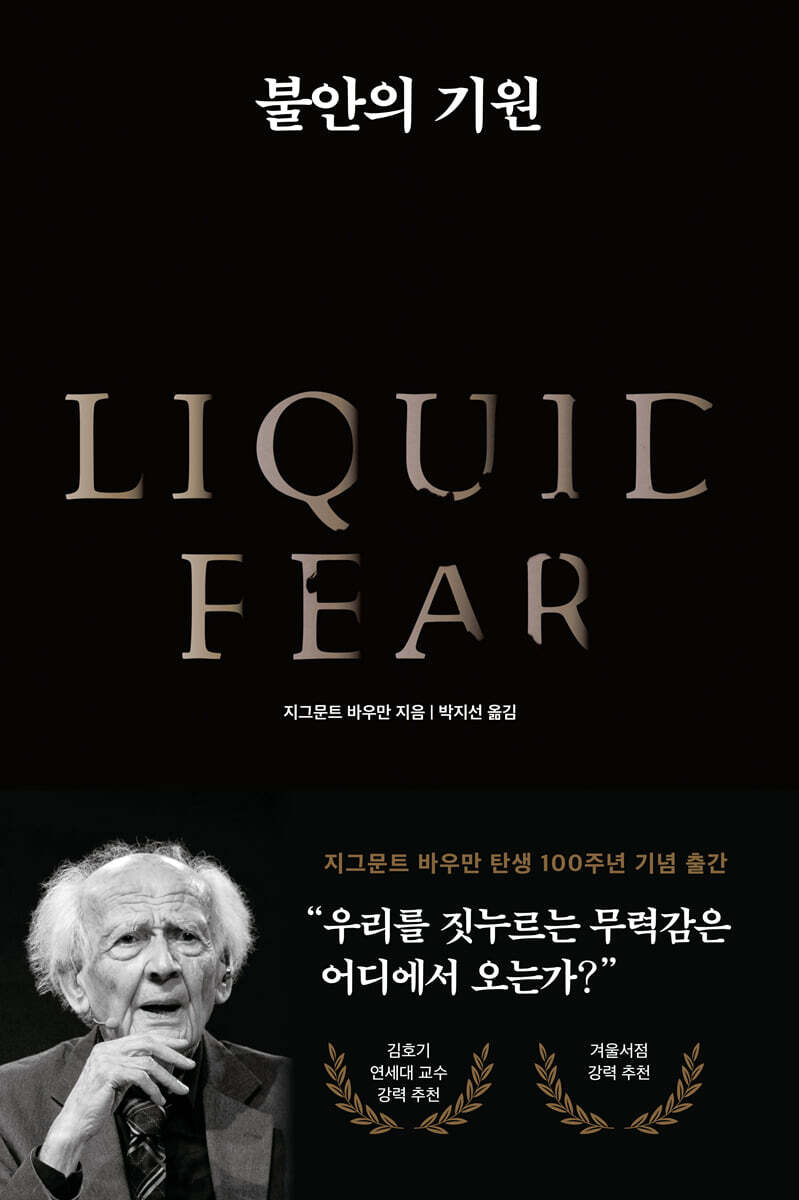
The origins of anxiety
 |
Description
Book Introduction
★★★ Published to commemorate the 100th anniversary of the birth of Zygmunt Bauman, the "philosopher of the square." ★★★
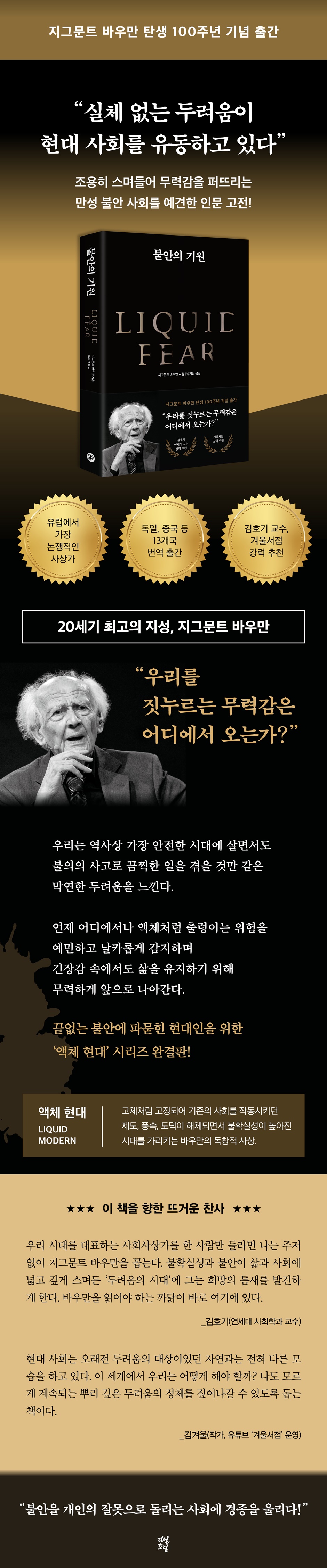
“Where does the feeling of helplessness that weighs us down come from?”
It seeps in quietly and spreads a sense of helplessness.
A humanities classic that predicted a society of chronic anxiety!
★★★ Published in 13 countries, including Germany, China, and Spain ★★★
★★★ Professor Emeritus Kim Ho-gi of Yonsei University strongly recommends "Winter Bookstore" ★★★
A new classic humanities book for our time has been published for modern people buried in endless anxiety.
This is 『The Origins of Anxiety』 by Zygmunt Bauman, who is considered the 'philosopher of the square' and 'the greatest intellectual of the 20th century', and has been at the forefront of solving various social problems facing modern society.
Published to commemorate the 100th anniversary of Bauman's birth, this book is part of his representative series, "Liquid Modernity." It analyzes the anxiety and fear that individuals experience in the present age, where uncertainty is heightened by the disintegration of existing institutions, customs, and morals that were once fixed as solids, from a philosophical and social scientific perspective.
Even though we live in the safest era in history, we still feel a vague fear that something terrible will happen to us in an unexpected accident.
Sensitive and sharply aware of the danger that ripples like liquid anytime, anywhere, they move forward helplessly to maintain their lives even in the midst of tension.
In this ‘chronic anxiety society,’ Bauman reveals the complex causal relationship between individual fears and the ruling system, and criticizes a society that easily blames anxiety on individuals.
As author Gyul-wool Kim of YouTube's 'Gyul Bookstore' strongly recommended, this book "points out the true nature of the deep-rooted fear that continues without us knowing" and helps us face the true nature of anxiety, and as Professor Ho-gi Kim highly praises, in the process, it leads us to "discover a gap of hope in an age of fear."
A modern classic that must be read in our time.
“Where does the feeling of helplessness that weighs us down come from?”
It seeps in quietly and spreads a sense of helplessness.
A humanities classic that predicted a society of chronic anxiety!
★★★ Published in 13 countries, including Germany, China, and Spain ★★★
★★★ Professor Emeritus Kim Ho-gi of Yonsei University strongly recommends "Winter Bookstore" ★★★
A new classic humanities book for our time has been published for modern people buried in endless anxiety.
This is 『The Origins of Anxiety』 by Zygmunt Bauman, who is considered the 'philosopher of the square' and 'the greatest intellectual of the 20th century', and has been at the forefront of solving various social problems facing modern society.
Published to commemorate the 100th anniversary of Bauman's birth, this book is part of his representative series, "Liquid Modernity." It analyzes the anxiety and fear that individuals experience in the present age, where uncertainty is heightened by the disintegration of existing institutions, customs, and morals that were once fixed as solids, from a philosophical and social scientific perspective.
Even though we live in the safest era in history, we still feel a vague fear that something terrible will happen to us in an unexpected accident.
Sensitive and sharply aware of the danger that ripples like liquid anytime, anywhere, they move forward helplessly to maintain their lives even in the midst of tension.
In this ‘chronic anxiety society,’ Bauman reveals the complex causal relationship between individual fears and the ruling system, and criticizes a society that easily blames anxiety on individuals.
As author Gyul-wool Kim of YouTube's 'Gyul Bookstore' strongly recommended, this book "points out the true nature of the deep-rooted fear that continues without us knowing" and helps us face the true nature of anxiety, and as Professor Ho-gi Kim highly praises, in the process, it leads us to "discover a gap of hope in an age of fear."
A modern classic that must be read in our time.
- You can preview some of the book's contents.
Preview
index
Recommendations: Kim Ho-gi (Professor Emeritus, Department of Sociology, Yonsei University), Kim Gyul-wool (Writer, Operator of the YouTube channel "Gyulwoo Bookstore")
Translator's Preface: A Portrait of Modern Man, Endlessly Anxious
Introduction: How Fear Drives Us
1.
Death, an inescapable fate
2.
The increasingly blurred boundaries of evil
3.
The desire to control the uncontrollable
4.
Globalization is robbing individuals of their security.
5.
Fear that spreads like liquid
Going Out: To Be Freed from Helplessness
annotation
Translator's Preface: A Portrait of Modern Man, Endlessly Anxious
Introduction: How Fear Drives Us
1.
Death, an inescapable fate
2.
The increasingly blurred boundaries of evil
3.
The desire to control the uncontrollable
4.
Globalization is robbing individuals of their security.
5.
Fear that spreads like liquid
Going Out: To Be Freed from Helplessness
annotation
Detailed image
Into the book
The fear that stems from the Titanic syndrome is that a collapse or disaster could strike us all blindly, indiscriminately, and randomly, without any pattern or reason, leaving us all unprepared and defenseless.
But other fears are just as terrifying.
Fear that I might be alone in a crowd of happy people, or at most one of a few chosen ones, and suffer alone while others continue to enjoy themselves noisily; fear that disaster might befall me as an individual; fear that I might become a target and meet an unfortunate end; fear that I might fall out of the speeding vehicle or be thrown overboard while the other passengers are fastening their seat belts and enjoying their journey as much as ever; fear of being left behind; fear of being excluded…
These fears are not just figments of the imagination.
In modern society, situations that cannot be seen or touched in reality become vividly real through the media that boasts authority.
The fears that plague many people can be strikingly similar when examined in individual cases, yet fighting them is considered a personal matter.
We each fight using our own resources, but most of us lack those resources.
Even if we pool our resources and offer those suffering from fear an equal opportunity to escape their fear safely, it is often unclear whether immediate protection is possible.
Even if the argument for facing fear together becomes compelling, the question remains: how do we bring together those who fight alone and keep them together?
--- From "Introduction: How Fear Moves Us"
Again, in our fluid modern society, all victories are temporary.
The stability that victory provides disappears the moment the existing balance of power shifts.
And that balance of power, like all balances, is short-lived.
It's like a photo that captures a moving object in an instant.
The danger may be buried underground, but it is not and cannot be completely eradicated.
And we must check the changing balance of power every day, the balance of power that is the only foundation on which fickle stability can stand, so that we can detect even the slightest signs of change in a timely manner, and even better, if we can prevent them.
In the fluid battlefield of modern society, small-scale conflicts constantly occur as we scout for updates on our list of threats and opportunities.
If you let your guard down even for a moment, you could be excluded.
Because the specter of exclusion, the specter of metaphorical death, haunts the battlefield.
--- 「1.
From "Death, an Irresistible Fate"
A crisis of trust in human relationships is bad news.
'Human relations' has become a border zone where reconnaissance and small skirmishes occur endlessly, rather than a well-protected and secluded space where we can finally shed the heavy armor and rigid masks we have been forced to wear in a harsh, competitive world.
In situations where trust has disappeared or trust is only reluctantly maintained, a ceasefire yesterday does not guarantee peace tomorrow.
In a situation where the norms that regulate our obligations and responsibilities are thrown into a crucible and mixed together, making it impossible for things to remain stable, the equations we struggle to unravel every day have few constants.
Calculating in this situation is like solving a puzzle with only a few vague and unreliable clues scattered around.
Most human relationships no longer provide assurance, peace, or mental comfort, but rather amplify anxiety.
Instead of giving you the rest you so desperately want, it gives you a life of constant anxiety and vigilance.
Danger signals flash incessantly and alarms sound incessantly.
--- 「2.
From "The Increasingly Blurry Lines of Evil"
Modern civilization is prone to disasters, and their recurrence leaves both those struggling to solve existing problems and those trying to address future ones bewildered.
Then, when disaster strikes, we respond like locking the barn door after the horse has bolted, but in most cases, the horse runs too far away to be caught.
And because of the tireless pursuit of modernization, the number of barns that need to be repaired multiplies.
--- 「3.
"The Desire to Control the Uncontrollable" pp. 172-173
Even if we stop people at the border, the possibility of another terrorist attack will not be completely eliminated.
Discontents arising from around the world can spread as easily as financial crises or the latest music or fashion trends.
And the impulse to take revenge on the real culprit, the suspect, or the most suitable and easily accessible scapegoat (if the culprit is unreachable) spreads just as easily.
Wherever such discontent and vengeance settle, it quickly takes root and becomes a local, rather than a global, problem.
And the frustration that comes from the global inability to find solutions is being felt locally.
--- 「4.
From “Globalization Takes Away Personal Safety”
The question of the state's political legitimacy has come into public debate again as a result of the decline of the function that served as the most important basis for the state's claim to legitimacy for most of the 20th century.
Until recently, it seemed possible to reach a consensus on the rights and responsibilities of citizens ("constitutional patriotism," to borrow a term from the German philosopher Jürgen Habermas) because there was a guarantee that they would be protected from the uncertainties of the market economy. But at present, such a consensus is impossible to achieve.
Market economies are notorious for making everyone, regardless of social status, feel insecure and for threatening everyone's social reputation and right to personal dignity.
In this situation, there is an urgent need to find an alternative that can justify the authority of the state and provide benefits to citizens when they fulfill their duties.
But other fears are just as terrifying.
Fear that I might be alone in a crowd of happy people, or at most one of a few chosen ones, and suffer alone while others continue to enjoy themselves noisily; fear that disaster might befall me as an individual; fear that I might become a target and meet an unfortunate end; fear that I might fall out of the speeding vehicle or be thrown overboard while the other passengers are fastening their seat belts and enjoying their journey as much as ever; fear of being left behind; fear of being excluded…
These fears are not just figments of the imagination.
In modern society, situations that cannot be seen or touched in reality become vividly real through the media that boasts authority.
The fears that plague many people can be strikingly similar when examined in individual cases, yet fighting them is considered a personal matter.
We each fight using our own resources, but most of us lack those resources.
Even if we pool our resources and offer those suffering from fear an equal opportunity to escape their fear safely, it is often unclear whether immediate protection is possible.
Even if the argument for facing fear together becomes compelling, the question remains: how do we bring together those who fight alone and keep them together?
--- From "Introduction: How Fear Moves Us"
Again, in our fluid modern society, all victories are temporary.
The stability that victory provides disappears the moment the existing balance of power shifts.
And that balance of power, like all balances, is short-lived.
It's like a photo that captures a moving object in an instant.
The danger may be buried underground, but it is not and cannot be completely eradicated.
And we must check the changing balance of power every day, the balance of power that is the only foundation on which fickle stability can stand, so that we can detect even the slightest signs of change in a timely manner, and even better, if we can prevent them.
In the fluid battlefield of modern society, small-scale conflicts constantly occur as we scout for updates on our list of threats and opportunities.
If you let your guard down even for a moment, you could be excluded.
Because the specter of exclusion, the specter of metaphorical death, haunts the battlefield.
--- 「1.
From "Death, an Irresistible Fate"
A crisis of trust in human relationships is bad news.
'Human relations' has become a border zone where reconnaissance and small skirmishes occur endlessly, rather than a well-protected and secluded space where we can finally shed the heavy armor and rigid masks we have been forced to wear in a harsh, competitive world.
In situations where trust has disappeared or trust is only reluctantly maintained, a ceasefire yesterday does not guarantee peace tomorrow.
In a situation where the norms that regulate our obligations and responsibilities are thrown into a crucible and mixed together, making it impossible for things to remain stable, the equations we struggle to unravel every day have few constants.
Calculating in this situation is like solving a puzzle with only a few vague and unreliable clues scattered around.
Most human relationships no longer provide assurance, peace, or mental comfort, but rather amplify anxiety.
Instead of giving you the rest you so desperately want, it gives you a life of constant anxiety and vigilance.
Danger signals flash incessantly and alarms sound incessantly.
--- 「2.
From "The Increasingly Blurry Lines of Evil"
Modern civilization is prone to disasters, and their recurrence leaves both those struggling to solve existing problems and those trying to address future ones bewildered.
Then, when disaster strikes, we respond like locking the barn door after the horse has bolted, but in most cases, the horse runs too far away to be caught.
And because of the tireless pursuit of modernization, the number of barns that need to be repaired multiplies.
--- 「3.
"The Desire to Control the Uncontrollable" pp. 172-173
Even if we stop people at the border, the possibility of another terrorist attack will not be completely eliminated.
Discontents arising from around the world can spread as easily as financial crises or the latest music or fashion trends.
And the impulse to take revenge on the real culprit, the suspect, or the most suitable and easily accessible scapegoat (if the culprit is unreachable) spreads just as easily.
Wherever such discontent and vengeance settle, it quickly takes root and becomes a local, rather than a global, problem.
And the frustration that comes from the global inability to find solutions is being felt locally.
--- 「4.
From “Globalization Takes Away Personal Safety”
The question of the state's political legitimacy has come into public debate again as a result of the decline of the function that served as the most important basis for the state's claim to legitimacy for most of the 20th century.
Until recently, it seemed possible to reach a consensus on the rights and responsibilities of citizens ("constitutional patriotism," to borrow a term from the German philosopher Jürgen Habermas) because there was a guarantee that they would be protected from the uncertainties of the market economy. But at present, such a consensus is impossible to achieve.
Market economies are notorious for making everyone, regardless of social status, feel insecure and for threatening everyone's social reputation and right to personal dignity.
In this situation, there is an urgent need to find an alternative that can justify the authority of the state and provide benefits to citizens when they fulfill their duties.
--- 「5.
From “Fear Spreading Like Liquid”
From “Fear Spreading Like Liquid”
Publisher's Review
"Unfounded fears are running rampant in modern society."
Zygmunt Bauman, the greatest intellectual of the 20th century
The final installment of the 'Liquid Modernity' series
To commemorate the 100th anniversary of Zygmunt Bauman's birth, his masterpiece, "The Origins of Anxiety," a volume in the "Liquid Modernity" series, has been published.
Bauman, considered 'Europe's most controversial philosopher', is a sociologist and philosopher who was expelled from Poland because he was Jewish and then immigrated to England. He has been actively speaking out on various issues facing modern society and has been at the forefront of social movements.
He established himself as the 'greatest intellectual of the 20th century' by interpreting modern society with the unique concept of 'liquid'.
'Liquid modernity' refers to an era in which existing systems, customs, and morals that were fixed like solids are disintegrating and uncertainty is increasing.
Bauman, also known as the "philosopher of the square," has spent his entire life actively speaking out about the evils of capitalism and the crisis of democracy occurring around the world, offering hope and practical perspectives.
In Korea, during the 2015 chimney strike by laid-off Ssangyong Motors workers, a message of support was sent to them, holding a piece of paper with the words "Cheer up! Kim Jeong-wook, Lee Chang-geun" written in Korean, which was a great encouragement to Koreans who were looking for a new path.
Because he has spent his life working with the marginalized, the hope and practical outlook he conveys resonates globally.
In particular, 『The Origins of Anxiety』 has been translated and published in 13 countries, including Germany, China, and Spain, and continues to serve as an undying light in civil society.
Professor Emeritus Kim Ho-gi, a sociologist, praised the book, saying, “If I had to name just one social thinker who has represented our times, I would choose Zygmunt Bauman without hesitation,” and author Kim Gyul-wool, who has introduced domestic and foreign books on her YouTube channel “Gyulwoo Bookstore,” strongly recommended “The Origin of Anxiety,” saying, “This book helps us figure out the true nature of the deep-rooted fears that continue without us even realizing it.” The book interprets the true nature of the chronic anxiety that is prevalent in society.
It delves into how fear drives us and how modern society exploits it, finding hope even in pessimistic realities.
This is a new classic humanities book for our time that contains the essence of Bauman's philosophy.
“Life is a long, long struggle.”
For modern people buried in endless anxiety
Cool insights from world-renowned scholars
"The Origin of Anxiety" vividly portrays the portrait of modern people, scattered like islands, lonely and anxious.
Modern people today are gripped by unrealistic fears.
Bauman calls this ‘liquid fear.’
As uncertainty becomes more extreme, modern people feel anxious in the face of liquid-like dangers that ripple everywhere, at any time.
Even if you work for a seemingly healthy company, you can lose your job overnight, or wake up and find yourself useless just by going to bed.
In this way, fear is being reproduced and expanded.
According to Bauman, modern people, who are pressured daily to pursue their own interests and satisfaction, believe that everyone is driven by selfish motives.
In such a society, human fellow humans become a source of existential anxiety and a realm rife with traps and ambushes.
This creates a kind of vicious cycle, weakening the already vulnerable bonds between humans, and that vulnerability in turn deepens fear.
Of course, it becomes more difficult to deal with fear.
Moreover, capitalists and the ruling class exploit these fears to profit and strengthen their power.
Bauman's insight also sounds an alarm in Korean society today.
In a society where democratic systems are crumbling, injustice that defies common sense is taken for granted, pessimistic news bursts out every day, and natural disasters continue to strike, making everything unpredictable, people are consumed by anxiety and a sense of helplessness.
Furthermore, in the process, people find objects of resentment and endlessly hate and divide each other.
But it's too early to give up.
In “The Origins of Anxiety,” Bauman notes that division and conflict are as old as human history.
Solving one problem often creates another, and the side effects are often more inconvenient than you might think.
All of these processes are natural, and civilization has developed through a mixture of integration and separation.
This is why Bauman is pessimistic in the short term and optimistic in the long term.
He delivers a powerful message of encouragement to modern people, saying, “Life is a long, long struggle.”
Through "The Origin of Anxiety," readers will be able to bravely confront the reality of social anxiety and take the first step toward breaking free from helplessness.
Zygmunt Bauman, the greatest intellectual of the 20th century
The final installment of the 'Liquid Modernity' series
To commemorate the 100th anniversary of Zygmunt Bauman's birth, his masterpiece, "The Origins of Anxiety," a volume in the "Liquid Modernity" series, has been published.
Bauman, considered 'Europe's most controversial philosopher', is a sociologist and philosopher who was expelled from Poland because he was Jewish and then immigrated to England. He has been actively speaking out on various issues facing modern society and has been at the forefront of social movements.
He established himself as the 'greatest intellectual of the 20th century' by interpreting modern society with the unique concept of 'liquid'.
'Liquid modernity' refers to an era in which existing systems, customs, and morals that were fixed like solids are disintegrating and uncertainty is increasing.
Bauman, also known as the "philosopher of the square," has spent his entire life actively speaking out about the evils of capitalism and the crisis of democracy occurring around the world, offering hope and practical perspectives.
In Korea, during the 2015 chimney strike by laid-off Ssangyong Motors workers, a message of support was sent to them, holding a piece of paper with the words "Cheer up! Kim Jeong-wook, Lee Chang-geun" written in Korean, which was a great encouragement to Koreans who were looking for a new path.
Because he has spent his life working with the marginalized, the hope and practical outlook he conveys resonates globally.
In particular, 『The Origins of Anxiety』 has been translated and published in 13 countries, including Germany, China, and Spain, and continues to serve as an undying light in civil society.
Professor Emeritus Kim Ho-gi, a sociologist, praised the book, saying, “If I had to name just one social thinker who has represented our times, I would choose Zygmunt Bauman without hesitation,” and author Kim Gyul-wool, who has introduced domestic and foreign books on her YouTube channel “Gyulwoo Bookstore,” strongly recommended “The Origin of Anxiety,” saying, “This book helps us figure out the true nature of the deep-rooted fears that continue without us even realizing it.” The book interprets the true nature of the chronic anxiety that is prevalent in society.
It delves into how fear drives us and how modern society exploits it, finding hope even in pessimistic realities.
This is a new classic humanities book for our time that contains the essence of Bauman's philosophy.
“Life is a long, long struggle.”
For modern people buried in endless anxiety
Cool insights from world-renowned scholars
"The Origin of Anxiety" vividly portrays the portrait of modern people, scattered like islands, lonely and anxious.
Modern people today are gripped by unrealistic fears.
Bauman calls this ‘liquid fear.’
As uncertainty becomes more extreme, modern people feel anxious in the face of liquid-like dangers that ripple everywhere, at any time.
Even if you work for a seemingly healthy company, you can lose your job overnight, or wake up and find yourself useless just by going to bed.
In this way, fear is being reproduced and expanded.
According to Bauman, modern people, who are pressured daily to pursue their own interests and satisfaction, believe that everyone is driven by selfish motives.
In such a society, human fellow humans become a source of existential anxiety and a realm rife with traps and ambushes.
This creates a kind of vicious cycle, weakening the already vulnerable bonds between humans, and that vulnerability in turn deepens fear.
Of course, it becomes more difficult to deal with fear.
Moreover, capitalists and the ruling class exploit these fears to profit and strengthen their power.
Bauman's insight also sounds an alarm in Korean society today.
In a society where democratic systems are crumbling, injustice that defies common sense is taken for granted, pessimistic news bursts out every day, and natural disasters continue to strike, making everything unpredictable, people are consumed by anxiety and a sense of helplessness.
Furthermore, in the process, people find objects of resentment and endlessly hate and divide each other.
But it's too early to give up.
In “The Origins of Anxiety,” Bauman notes that division and conflict are as old as human history.
Solving one problem often creates another, and the side effects are often more inconvenient than you might think.
All of these processes are natural, and civilization has developed through a mixture of integration and separation.
This is why Bauman is pessimistic in the short term and optimistic in the long term.
He delivers a powerful message of encouragement to modern people, saying, “Life is a long, long struggle.”
Through "The Origin of Anxiety," readers will be able to bravely confront the reality of social anxiety and take the first step toward breaking free from helplessness.
GOODS SPECIFICS
- Date of issue: April 2, 2025
- Page count, weight, size: 392 pages | 600g | 140*210*26mm
- ISBN13: 9791130664958
- ISBN10: 1130664953
You may also like
카테고리
korean


korean

![GQ KOREA Mark (Monthly): December [2025]](http://librairie.coreenne.fr/cdn/shop/files/8ef265dbbfbf186523ed75ba7319009d.jpg?v=1765340328&width=3840)


