

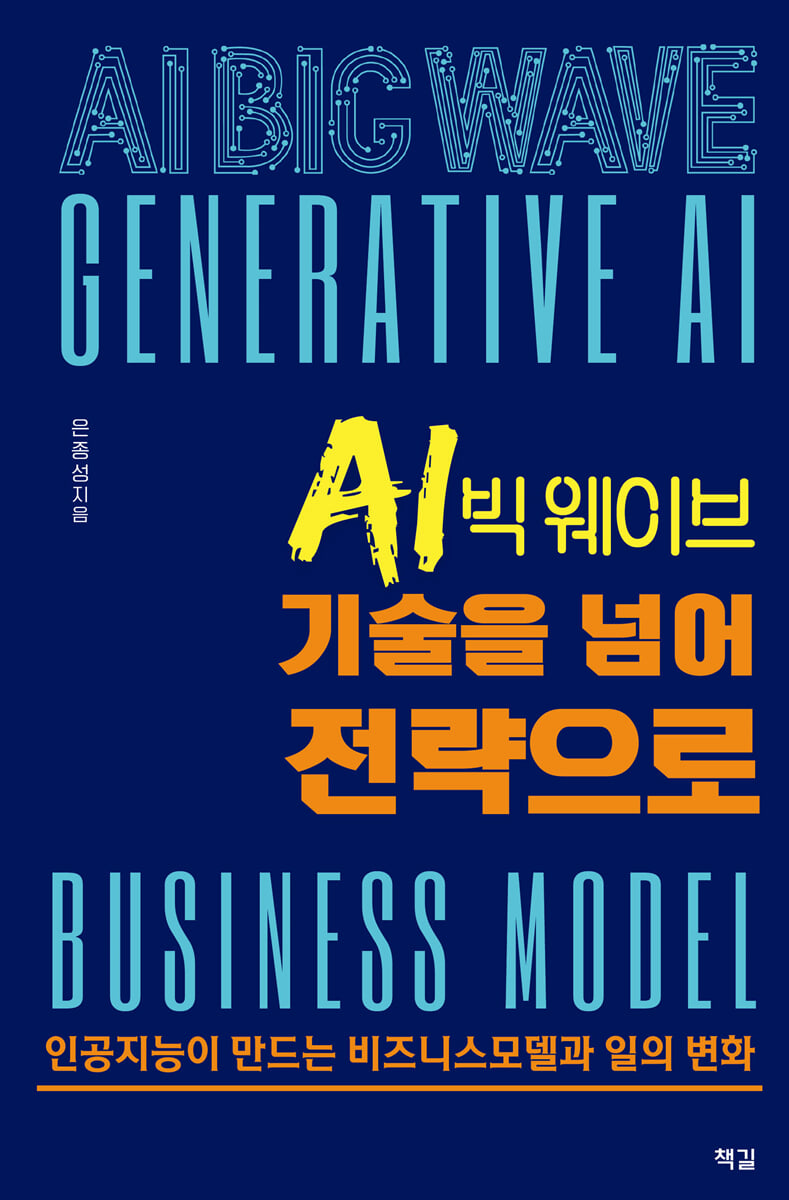
The AI Big Wave: Beyond Technology to Strategy
 |
Description
Book Introduction
A book that looks at artificial intelligence from a business model and strategy perspective.
Generative AI, AI agents, on-device AI… With the daily news pouring in, we feel as if we're riding a wave of change, but the most important questions still linger in the air.
"What does this technology mean to us?" "How can we leverage it to become a true strategy?" "The AI Big Wave - Beyond Technology to Strategy" begins with these questions.
This book goes beyond simply explaining AI technology.
While understanding technology is important, it offers the insight that the 'perspective' from which you view that technology is the starting point of strategy.
Even the same technology can produce completely different results depending on how you view it. A consistent message runs through the book.
AI is not a technology, it's a strategy.
More important than simple introduction is the process through which organizations and individuals ask and answer why, where, and how to introduce it.
Beyond task automation, AI is now emerging as an opportunity for comprehensive change, from redesigning business models to redefining customer touchpoints.
What's interesting is that this book doesn't just look at 'AI technology', but at the entire ecosystem surrounding AI.
From semiconductors, cloud computing, data infrastructure, algorithms, and even startup service models? AI doesn't operate alone.
The author traces the trends of the downstream and upstream industries, calmly showing where technology originates and where it is spreading.
This goes beyond simply predicting opportunities; it gives readers the power to design opportunities.
As the book progresses, more specific application examples become more interesting.
Why companies fail to build profitable models, the structure of the ecosystem surrounding AI agents, and the new market possibilities opened up by the combination of the metaverse and generative AI? This isn't just anecdotal information; it provides a framework for thinking that connects business strategy and industry analysis.
What is most impressive is the perspective that views AI as an 'extension' rather than a 'replacement' of humans.
This book, which discusses how technology can expand human creativity and judgment rather than the efficiency it brings, awakens readers to a sense of growing alongside technology, rather than being swayed by it.
"AI Big Wave" isn't just a book that explains AI well. It teaches us how to "think" about AI.
Strategic thinking that moves ahead of technology, insight that penetrates industry trends, and even serious reflection on the role of humans? This book contains all the questions we need to ask as we prepare for the AI era.
Generative AI, AI agents, on-device AI… With the daily news pouring in, we feel as if we're riding a wave of change, but the most important questions still linger in the air.
"What does this technology mean to us?" "How can we leverage it to become a true strategy?" "The AI Big Wave - Beyond Technology to Strategy" begins with these questions.
This book goes beyond simply explaining AI technology.
While understanding technology is important, it offers the insight that the 'perspective' from which you view that technology is the starting point of strategy.
Even the same technology can produce completely different results depending on how you view it. A consistent message runs through the book.
AI is not a technology, it's a strategy.
More important than simple introduction is the process through which organizations and individuals ask and answer why, where, and how to introduce it.
Beyond task automation, AI is now emerging as an opportunity for comprehensive change, from redesigning business models to redefining customer touchpoints.
What's interesting is that this book doesn't just look at 'AI technology', but at the entire ecosystem surrounding AI.
From semiconductors, cloud computing, data infrastructure, algorithms, and even startup service models? AI doesn't operate alone.
The author traces the trends of the downstream and upstream industries, calmly showing where technology originates and where it is spreading.
This goes beyond simply predicting opportunities; it gives readers the power to design opportunities.
As the book progresses, more specific application examples become more interesting.
Why companies fail to build profitable models, the structure of the ecosystem surrounding AI agents, and the new market possibilities opened up by the combination of the metaverse and generative AI? This isn't just anecdotal information; it provides a framework for thinking that connects business strategy and industry analysis.
What is most impressive is the perspective that views AI as an 'extension' rather than a 'replacement' of humans.
This book, which discusses how technology can expand human creativity and judgment rather than the efficiency it brings, awakens readers to a sense of growing alongside technology, rather than being swayed by it.
"AI Big Wave" isn't just a book that explains AI well. It teaches us how to "think" about AI.
Strategic thinking that moves ahead of technology, insight that penetrates industry trends, and even serious reflection on the role of humans? This book contains all the questions we need to ask as we prepare for the AI era.
- You can preview some of the book's contents.
Preview
index
Starting text … … … 50
1. What is your perspective on artificial intelligence?
From what perspective do you see it? … … … 20
Classification by technology method / Classification by application environment / Classification by learning method / Classification by data type / Classification by implementation method / From expert to general public / Analytical AI vs. Generative AI
In what situation and for what purpose would you use it? … … … 28
Industrial AI used in industrial settings / Front-end AI meeting end consumers / Blurring boundaries / AI will change everything / It will transform business models themselves / Why are companies hesitant to adopt it? / How should companies approach it? / It won't replace everything.
02. AI Industry Analysis and Business Opportunities
AI Industry Analysis and Business Opportunities… 42
Why We Need to Analyze Upstream and Downstream Industries / What are the Downstream Industries of the Generative AI Industry? / How Do Upstream Industries Affect Demand and the Competitive Environment?
What questions should I ask? … … … 48
What questions are necessary for industry analysis? / Who is the target audience? / The AI ecosystem shifting to a demand-centric approach / Commercialization strategies and practical applications of AI models / The expanding strategic roles of cloud companies and startups / The rise of industry-specific integrated solutions / The expanding role of data and infrastructure-based technology companies / Advanced AI agents and user-centric automation / Integration with existing systems and securing AI reliability / Technology has advanced, but trust remains a challenge.
03.
Technology is changing the competitive landscape.
Technology is changing the way we compete… … … 64
Artificial intelligence is self-learning software / Transformers that changed the flow of artificial intelligence / Recurrent neural networks (RNNs) and convolutional neural networks (CNNs) / AI that understands context more deeply / The scalability of Transformer technology / Transformers and the law of scaling
AI Technology Stack and Business Models… … … 74
Cloud vs. On-Device / Business Models from the Perspective of Generative AI Technology Stacks / Where Are Revenue Structures and Competitive Advantages Determined? / How Should Companies Adopt AI? / Can Service Models Become Revenue Models? / Midjourney vs. Snow vs. GPT-4o Image Generation / Don't Look for Gold, Sell Jeans
04.
AI Business Models from a B2B Perspective
How to conquer the B2B market? … … … 92
Leveraging AI to overcome the economic downturn / What problems must be solved? / Are AI services making money? / How can service models become profit models? / B2B must contribute to sales and profits first.
How to utilize AI? … … … 106
Approaching AI from the perspective of demand companies / Defining the problem comes before technology / Clarifying product-market fit (PMF) / Opportunity is more important than technology / Differentiating from general-purpose AI determines success or failure / What kind of AI agent should it be? / There are also technical challenges to be solved.
05.
On-device AI and the Internet of Things (IoT)
On-Device AI and the Internet of Things (IoT) … … … 124
The era of on-device AI has arrived / AI that can be used without the internet / AI becomes a technology that anyone can use / Customized AI reduces accessibility / Internet of Things (IoT) business models / On-device AI and business model transformation
Various business models are being created! … … … 134
IoT, the servitization of manufacturing / What revenue models are becoming possible? / On-device hyper-personalization and ecosystem expansion / Beyond hardware, software generates profits / The strategic advantage created by data monopolies
06.
Multimodal technology, video generation AI, and the metaverse
Multimodal technology and video creation… … … 146
Video generation AI: What's more difficult? / Why multimodal AI is the key to video generation / How does multimodal AI generate videos? / Breaking down the boundaries of content creation / Sora, between expectations and reality / Runway, a tool for creating animations / InVideo, a tool that makes anyone a video creator / A video generator that lets you assemble desired scenes / D-ID, which creates virtual character videos
Could the metaverse be a game-changer? … … … 160
Technological advancement alone is not enough / The possibility of new creative methods / The convergence of video generation AI and the metaverse / Lowering variable costs for metaverse implementation / The limitations of the metaverse and the potential for transformation through AI / An ecosystem must be created / Technology must be supported by ethics and regulations
07.
General-purpose AI that generates text and images
AI service that generates text… … … 174
Still Powerful Text-Centric AI / Vertical AI and General AI, Criteria for Selection / ChatGPT, the Most Widely Used Writing Tool / Claude, AI Strong in Natural Conversation / Gemini, AI Strong in Information Search / Perplexity, AI Strong in Up-to-Date Information / Rutten, Combination AI Optimized for Domestic Users
How should we leverage AI for text generation? … … … 184
Good questions lead to good answers / Defining a problem begins with understanding the situation / The goal is not speed, but completeness / Questions also need structure, using Markdown / Let's start with the questions that will help you ask good questions / AI questioning habits using Markdown
Multimodal technology and image generation AI… … … 192
You must choose according to your purpose / Few people actually create / An era where everyone can visualize / Imagination drawn with prompts, DALL·E / Sophisticated image creation, Midjourney / The strength of template-based design tools / Adobe Firefly / Openness and flexibility, stable diffusion / Google's experiment, the potential of image-fx / The ripple effect of image-generation AI that will change the entire industry
08. In what area is AI being utilized first?
Companies Leveraging AI Studios… … … 210
AI Studios: A Tool That Will Transform Marketing / Content Automation Marketing Strategy / TikTok: Experimenting with AI Studios for Marketing / AI Solutions for Image and Video Production / The Evolution of AI-Based Streaming Expanding to Mobile / The Shifting Center of Content Creation / The Strategic Value of AI Studios / Organizational Strategies for AI Studios / The Spread of AI Studios and the Challenges Behind Them
Industries Most Actively Utilizing AI… … … 224
From Personalization to Conversational Shopping / Naver Embracing Search and Shopping / Data Strategy for Sophisticated Chatting Experiences / AI-Based User Tailoring / AI Personalization Strategies of Global Retail Companies / Evolution of Precision Targeting, AI-Based Advertising Strategies / Strategic Transformation of Own Malls in the Era of User Tailoring / Brand Stories Become the Key to Differentiation / E-Commerce Transitioning to an "Experience Industry"
09. The Creator Economy Created by AI
The Creator Economy Driven by AI… 244
B2B and B2C: The Reality and Challenges of AI Service Models / The Expansion of AI Services: Driven by Influencers / The Influencer AI Ecosystem Fostered by Platforms / The Creator Economy Evolving into an Industry / AI Agents: Strategies for Overcoming Narrow Markets / B2C and B2B: The Two Axis of the AI Agent Market / Redefining the Creation Process Itself
What's the Future of Content Strategy in the AI Era? ... ... ... 256
Now is the era of AI optimization / Trust-based content determines AI's selection / Format expansion is another axis of content strategy / Broadens the intersection between content diffusion and AI recognition / Conditions for 'content that AI understands' / How to write keywords that AI reads / Narrative structure that AI can read / The vitality of content is reliable, up-to-date information / Content is now the form of strategy / Content is the interface connecting AI and users
10.
Redefining Work Capabilities and Jobs
AI agents that improve work efficiency… … … 274
The proliferation of AI agents and the selection criteria for services / Notion as an AI agent / My own AI model, Google Notebook LM / ClovaNote, an AI-based voice recording tool / Napkin AI, making infographics easier / Gamma AI, helping with PPT writing / Tactiq, which integrates with Zoom and Google Meet / Guide, making manuals easy to create / Wimzical, visualizing with images / Using AI is not a technology, but a capability / Operators and autonomous AI agents
Redefining Work Skills and Jobs… … … 292
What Jobs Will AI Replace First? / The Speed and Patterns of AI Adoption Vary by Industry / Restructuring Organizational Structure and Talent Strategy / The Rise of Flexible Workforce Utilization and Personal Branding / How Are Talents Changing? / Adapting to Change: Competitiveness in the AI Era
Attitudes toward the AI Big Wave… … … 302
Discovering the Future Industrial Landscape and Opportunities / Ethics and Trust-Building in the AI Era / An Era of Repeated Learning and Transformation / Technological Convergence and Creative Innovation / Social Change and Inclusive Response / A Global Perspective and Collaborative Strategy / An Attitude to Technology Shapes the Future
Concluding remarks… … … 314
1. What is your perspective on artificial intelligence?
From what perspective do you see it? … … … 20
Classification by technology method / Classification by application environment / Classification by learning method / Classification by data type / Classification by implementation method / From expert to general public / Analytical AI vs. Generative AI
In what situation and for what purpose would you use it? … … … 28
Industrial AI used in industrial settings / Front-end AI meeting end consumers / Blurring boundaries / AI will change everything / It will transform business models themselves / Why are companies hesitant to adopt it? / How should companies approach it? / It won't replace everything.
02. AI Industry Analysis and Business Opportunities
AI Industry Analysis and Business Opportunities… 42
Why We Need to Analyze Upstream and Downstream Industries / What are the Downstream Industries of the Generative AI Industry? / How Do Upstream Industries Affect Demand and the Competitive Environment?
What questions should I ask? … … … 48
What questions are necessary for industry analysis? / Who is the target audience? / The AI ecosystem shifting to a demand-centric approach / Commercialization strategies and practical applications of AI models / The expanding strategic roles of cloud companies and startups / The rise of industry-specific integrated solutions / The expanding role of data and infrastructure-based technology companies / Advanced AI agents and user-centric automation / Integration with existing systems and securing AI reliability / Technology has advanced, but trust remains a challenge.
03.
Technology is changing the competitive landscape.
Technology is changing the way we compete… … … 64
Artificial intelligence is self-learning software / Transformers that changed the flow of artificial intelligence / Recurrent neural networks (RNNs) and convolutional neural networks (CNNs) / AI that understands context more deeply / The scalability of Transformer technology / Transformers and the law of scaling
AI Technology Stack and Business Models… … … 74
Cloud vs. On-Device / Business Models from the Perspective of Generative AI Technology Stacks / Where Are Revenue Structures and Competitive Advantages Determined? / How Should Companies Adopt AI? / Can Service Models Become Revenue Models? / Midjourney vs. Snow vs. GPT-4o Image Generation / Don't Look for Gold, Sell Jeans
04.
AI Business Models from a B2B Perspective
How to conquer the B2B market? … … … 92
Leveraging AI to overcome the economic downturn / What problems must be solved? / Are AI services making money? / How can service models become profit models? / B2B must contribute to sales and profits first.
How to utilize AI? … … … 106
Approaching AI from the perspective of demand companies / Defining the problem comes before technology / Clarifying product-market fit (PMF) / Opportunity is more important than technology / Differentiating from general-purpose AI determines success or failure / What kind of AI agent should it be? / There are also technical challenges to be solved.
05.
On-device AI and the Internet of Things (IoT)
On-Device AI and the Internet of Things (IoT) … … … 124
The era of on-device AI has arrived / AI that can be used without the internet / AI becomes a technology that anyone can use / Customized AI reduces accessibility / Internet of Things (IoT) business models / On-device AI and business model transformation
Various business models are being created! … … … 134
IoT, the servitization of manufacturing / What revenue models are becoming possible? / On-device hyper-personalization and ecosystem expansion / Beyond hardware, software generates profits / The strategic advantage created by data monopolies
06.
Multimodal technology, video generation AI, and the metaverse
Multimodal technology and video creation… … … 146
Video generation AI: What's more difficult? / Why multimodal AI is the key to video generation / How does multimodal AI generate videos? / Breaking down the boundaries of content creation / Sora, between expectations and reality / Runway, a tool for creating animations / InVideo, a tool that makes anyone a video creator / A video generator that lets you assemble desired scenes / D-ID, which creates virtual character videos
Could the metaverse be a game-changer? … … … 160
Technological advancement alone is not enough / The possibility of new creative methods / The convergence of video generation AI and the metaverse / Lowering variable costs for metaverse implementation / The limitations of the metaverse and the potential for transformation through AI / An ecosystem must be created / Technology must be supported by ethics and regulations
07.
General-purpose AI that generates text and images
AI service that generates text… … … 174
Still Powerful Text-Centric AI / Vertical AI and General AI, Criteria for Selection / ChatGPT, the Most Widely Used Writing Tool / Claude, AI Strong in Natural Conversation / Gemini, AI Strong in Information Search / Perplexity, AI Strong in Up-to-Date Information / Rutten, Combination AI Optimized for Domestic Users
How should we leverage AI for text generation? … … … 184
Good questions lead to good answers / Defining a problem begins with understanding the situation / The goal is not speed, but completeness / Questions also need structure, using Markdown / Let's start with the questions that will help you ask good questions / AI questioning habits using Markdown
Multimodal technology and image generation AI… … … 192
You must choose according to your purpose / Few people actually create / An era where everyone can visualize / Imagination drawn with prompts, DALL·E / Sophisticated image creation, Midjourney / The strength of template-based design tools / Adobe Firefly / Openness and flexibility, stable diffusion / Google's experiment, the potential of image-fx / The ripple effect of image-generation AI that will change the entire industry
08. In what area is AI being utilized first?
Companies Leveraging AI Studios… … … 210
AI Studios: A Tool That Will Transform Marketing / Content Automation Marketing Strategy / TikTok: Experimenting with AI Studios for Marketing / AI Solutions for Image and Video Production / The Evolution of AI-Based Streaming Expanding to Mobile / The Shifting Center of Content Creation / The Strategic Value of AI Studios / Organizational Strategies for AI Studios / The Spread of AI Studios and the Challenges Behind Them
Industries Most Actively Utilizing AI… … … 224
From Personalization to Conversational Shopping / Naver Embracing Search and Shopping / Data Strategy for Sophisticated Chatting Experiences / AI-Based User Tailoring / AI Personalization Strategies of Global Retail Companies / Evolution of Precision Targeting, AI-Based Advertising Strategies / Strategic Transformation of Own Malls in the Era of User Tailoring / Brand Stories Become the Key to Differentiation / E-Commerce Transitioning to an "Experience Industry"
09. The Creator Economy Created by AI
The Creator Economy Driven by AI… 244
B2B and B2C: The Reality and Challenges of AI Service Models / The Expansion of AI Services: Driven by Influencers / The Influencer AI Ecosystem Fostered by Platforms / The Creator Economy Evolving into an Industry / AI Agents: Strategies for Overcoming Narrow Markets / B2C and B2B: The Two Axis of the AI Agent Market / Redefining the Creation Process Itself
What's the Future of Content Strategy in the AI Era? ... ... ... 256
Now is the era of AI optimization / Trust-based content determines AI's selection / Format expansion is another axis of content strategy / Broadens the intersection between content diffusion and AI recognition / Conditions for 'content that AI understands' / How to write keywords that AI reads / Narrative structure that AI can read / The vitality of content is reliable, up-to-date information / Content is now the form of strategy / Content is the interface connecting AI and users
10.
Redefining Work Capabilities and Jobs
AI agents that improve work efficiency… … … 274
The proliferation of AI agents and the selection criteria for services / Notion as an AI agent / My own AI model, Google Notebook LM / ClovaNote, an AI-based voice recording tool / Napkin AI, making infographics easier / Gamma AI, helping with PPT writing / Tactiq, which integrates with Zoom and Google Meet / Guide, making manuals easy to create / Wimzical, visualizing with images / Using AI is not a technology, but a capability / Operators and autonomous AI agents
Redefining Work Skills and Jobs… … … 292
What Jobs Will AI Replace First? / The Speed and Patterns of AI Adoption Vary by Industry / Restructuring Organizational Structure and Talent Strategy / The Rise of Flexible Workforce Utilization and Personal Branding / How Are Talents Changing? / Adapting to Change: Competitiveness in the AI Era
Attitudes toward the AI Big Wave… … … 302
Discovering the Future Industrial Landscape and Opportunities / Ethics and Trust-Building in the AI Era / An Era of Repeated Learning and Transformation / Technological Convergence and Creative Innovation / Social Change and Inclusive Response / A Global Perspective and Collaborative Strategy / An Attitude to Technology Shapes the Future
Concluding remarks… … … 314
Detailed image

Into the book
Same technology, different results: a difference in perspective.
How you view artificial intelligence (AI) determines where and how you will utilize the technology.
For example, if we think of AI as simply a tool that automatically writes reports or a technology that reduces repetitive tasks, its utility will remain very limited.
However, if we view AI as an opportunity to transform our organization's strategy and redesign the way we work, the same technology can be leveraged in completely different ways. How we view AI influences important business decisions.
Because that perspective becomes the basis for deciding why to introduce AI, where and how much to invest in, and how to utilize it in which department.
Approaching it with the mindset of "Let's slightly increase work efficiency" might only speed up the current process. However, approaching it with the mindset of "Let's create new value with AI" could fundamentally transform how we engage with customers, structure our products, and even provide services. Ultimately, AI isn't just about technology.
How we view it is a matter of our attitude and thinking.
Strategy begins the moment we consider what technology means to our work and our organization, rather than viewing it as a fad to be followed.
Even with the same technology, if our perspective changes, the future we can create will also change.
In this way, perspective is the starting point of strategy that must move ahead of technology.
Services abound, but revenue models are scarce.
While many companies and individuals are recognizing the potential of generative AI, they remain cautious when it comes to actual implementation.
While there is general agreement on the direction and potential of the technology, there are many practical limitations, such as security issues, information distortion (so-called "hallucination"), and ethical risks.
Above all, in situations where it is difficult to clearly predict the return on investment, it is difficult for companies to make hasty moves.
To actively adopt AI at the business strategy level, more specificity and proven case studies than expected are required. The market is experiencing explosive growth in generative AI-based services.
Although various platforms and startups are competing to release new products, they are having difficulty securing paying users.
While features are interesting, services that deliver the kind of value and differentiation that customers will pay for are still rare.
Because of this, many services remain at the level of a 'good idea' and fail to transition into a revenue model.
There still exists a gap between technological possibilities and market demand. The current generative AI market revolves around two axes.
One is for businesses (B2B) that want to reduce repetitive tasks and increase efficiency, and the other is for creators (B2C) that want to produce content quickly.
Meeting minutes management, automated summarization, and automated customer response are already being implemented in practice, and the use of AI in content planning and creation is steadily increasing.
While this isn't yet a change big enough to shake up the entire market, the accumulation of this kind of usage could be a significant turning point in the future.
The important thing is not to be swept up in trends, but to prepare a strategic approach that fits our organization and the way we work.
An eye for industry, the power to read trends
Whether we're doing business or introducing a new technology, it's crucial to understand the context in which those decisions are made.
Especially for rapidly evolving technologies like AI, understanding where the technology originated and where it's likely to spread is strategically significant.
The important concepts at this time are ‘backward industry’ and ‘forward industry.’
The supporting industry is the base industry that my industry depends on, that is, my 'supplier', and the forward industry is the 'consumer' of the products or services I create, that is, my 'demander'.
It may sound a bit unfamiliar, but it's actually a very intuitive concept. By properly analyzing this trend, you can more accurately predict future opportunities in your industry.
My competitiveness will naturally change depending on how quickly the downstream industry advances technologically, and I will be able to capture new business opportunities based on emerging demands in the upstream industry.
At the same time, it provides a useful analytical framework for proactively detecting and responding to risks as well as opportunities.
For example, technological changes in downstream industries can alter cost structures, and policy changes in upstream industries can shrink the market itself. Especially for technologies like AI, which can be linked to diverse industries, a three-dimensional perspective is essential to understand inter-industry trends.
If you only look at opportunities within a single industry, you'll likely narrow down your perspective and miss out on major market movements.
Seeing both the back and the front together means judging where I stand now and where I should move with a broader perspective.
While technological evolution is difficult to predict, industrial movements leave certain patterns.
Only those who can read the pattern can spot opportunities first and respond faster.
Ultimately, the ability to see through industrial trends becomes the starting point of strategic insight.
The structure of the forward-looking industry driving the AI agent ecosystem
The AI agent market is growing rapidly, but the players in the upstream industries that are actually driving this trend are relatively clearly defined.
The most crucial pillars are global tech companies that develop large-scale AI models or provide them as services.
They are expanding diverse use cases based on high-performance language models and multi-functional agent technologies, and are playing a pivotal role in spreading AI technology throughout the ecosystem through their own platforms.
Beyond simply possessing technology, they are establishing themselves as leaders in creating standards and shaping market structures. Furthermore, cloud companies, which provide the infrastructure for AI technology to operate and be deployed, are emerging as important frontline industries.
They provide a structure in which AI agents can actually operate, while processing large amounts of data and stably supporting an environment in which learning and inference are possible.
In particular, Amazon Web Services, Microsoft Azure, and Google Cloud are responsible for the overall technological foundation of AI companies from initial experiments to commercialization, and even function as distribution platforms.
Ultimately, they are the infrastructure pillars responsible for the foundation of the AI agent market. The role of startups launching specialized services leveraging AI agents across various verticals is also growing.
We are deeply engaged in specific industries, such as healthcare, law, marketing, and education, providing customized solutions and serving as a testing ground for implementing and validating AI technology into real-world business models.
They are rapidly identifying and nimbly responding to niche markets and specialized customer needs that large platforms often miss, thereby realizing the potential of AI agents.
Amidst the dynamic interactions of these diverse entities, the AI agent market is gradually establishing itself as a realistic industrial structure.
The era of on-device AI dawns with the emergence of installed AI.
Most AI services we know operate on the cloud.
In other words, data generated from the user's device is transmitted to the server, where it undergoes calculations and the results are sent back to the user.
But recently, there has been a change in this structure.
As 'on-device AI' technology advances, which processes data directly within the user's device without sending it to a central location, AI is beginning to come closer to the user.
AI is being embedded in a variety of devices, including smartphones, wearables, automobiles, and home appliances, and is gaining the ability to respond and make decisions in real time based on user needs. The most significant characteristics of on-device AI are speed and security.
Because data does not need to be sent to a server, the response speed is very fast, and it also has strengths in terms of security as sensitive personal information is not leaked externally.
For example, performing commands using voice assistants, analyzing biosignals from healthcare wearables, and detecting real-time risks in vehicles are all areas where on-device AI can be most effectively utilized.
These technologies go beyond mere convenience, offering users the experience of "more secure and immediate access to AI." When the Internet of Things (IoT) and on-device AI combine, we will experience AI in a much more intuitive and organic form in our daily lives.
Home appliances learn users' lifestyle patterns to save energy, and in smart factories, sensors process real-time data to detect machine anomalies in advance. The era of "field-centered AI" is dawning across industries and daily life.
On-device AI isn't simply a technological evolution; it's a direction that demonstrates how AI can become a part of our daily lives. For businesses, it offers clues for exploring new product strategies and service opportunities.
From the reader's perspective, this change is not something that will happen in the distant future, but is already beginning to unfold within our own hands.
The Metaverse and Generative AI: New Connectivity Potential
When the metaverse first gained attention, many people simply perceived it as a form of social interaction in a virtual space or as an extension of games.
However, recently, the metaverse is increasingly viewed as a platform that transforms content creation, economic activity, and communication methods, rather than simply a spatial concept.
In particular, the combination with generative AI is emerging as a key factor that will accelerate the evolution of the metaverse.
We're entering an era where anyone can create characters, set backgrounds, and construct worldviews with simple commands, without having to manually code complex 3D content. Generative AI is breaking down the "difficulty of content creation," which has been the biggest barrier to entry in the metaverse.
3D graphics, animations, and character settings, which were previously difficult to create without expertise, can now be created using text-based commands, making a user-participatory metaverse environment more realistic.
This is not just a technological advancement, but a trend that is changing the paradigm of content production itself.
The ability to create your own virtual world, engage in economic activities within it, and interact with others in real time opens up new market possibilities. Of course, there are still many hurdles to overcome.
There are still technical challenges to overcome, including reliance on high-spec devices, network infrastructure, and quality of immersive experiences.
However, the metaverse is once again gaining recognition as a game changer, as generative AI can dramatically shorten this process.
The important question for readers is this:
Rather than asking, "Will the metaverse rise again?", it's important to understand, "How is generative AI transforming the metaverse?" That question will unlock new opportunities.
How you view artificial intelligence (AI) determines where and how you will utilize the technology.
For example, if we think of AI as simply a tool that automatically writes reports or a technology that reduces repetitive tasks, its utility will remain very limited.
However, if we view AI as an opportunity to transform our organization's strategy and redesign the way we work, the same technology can be leveraged in completely different ways. How we view AI influences important business decisions.
Because that perspective becomes the basis for deciding why to introduce AI, where and how much to invest in, and how to utilize it in which department.
Approaching it with the mindset of "Let's slightly increase work efficiency" might only speed up the current process. However, approaching it with the mindset of "Let's create new value with AI" could fundamentally transform how we engage with customers, structure our products, and even provide services. Ultimately, AI isn't just about technology.
How we view it is a matter of our attitude and thinking.
Strategy begins the moment we consider what technology means to our work and our organization, rather than viewing it as a fad to be followed.
Even with the same technology, if our perspective changes, the future we can create will also change.
In this way, perspective is the starting point of strategy that must move ahead of technology.
Services abound, but revenue models are scarce.
While many companies and individuals are recognizing the potential of generative AI, they remain cautious when it comes to actual implementation.
While there is general agreement on the direction and potential of the technology, there are many practical limitations, such as security issues, information distortion (so-called "hallucination"), and ethical risks.
Above all, in situations where it is difficult to clearly predict the return on investment, it is difficult for companies to make hasty moves.
To actively adopt AI at the business strategy level, more specificity and proven case studies than expected are required. The market is experiencing explosive growth in generative AI-based services.
Although various platforms and startups are competing to release new products, they are having difficulty securing paying users.
While features are interesting, services that deliver the kind of value and differentiation that customers will pay for are still rare.
Because of this, many services remain at the level of a 'good idea' and fail to transition into a revenue model.
There still exists a gap between technological possibilities and market demand. The current generative AI market revolves around two axes.
One is for businesses (B2B) that want to reduce repetitive tasks and increase efficiency, and the other is for creators (B2C) that want to produce content quickly.
Meeting minutes management, automated summarization, and automated customer response are already being implemented in practice, and the use of AI in content planning and creation is steadily increasing.
While this isn't yet a change big enough to shake up the entire market, the accumulation of this kind of usage could be a significant turning point in the future.
The important thing is not to be swept up in trends, but to prepare a strategic approach that fits our organization and the way we work.
An eye for industry, the power to read trends
Whether we're doing business or introducing a new technology, it's crucial to understand the context in which those decisions are made.
Especially for rapidly evolving technologies like AI, understanding where the technology originated and where it's likely to spread is strategically significant.
The important concepts at this time are ‘backward industry’ and ‘forward industry.’
The supporting industry is the base industry that my industry depends on, that is, my 'supplier', and the forward industry is the 'consumer' of the products or services I create, that is, my 'demander'.
It may sound a bit unfamiliar, but it's actually a very intuitive concept. By properly analyzing this trend, you can more accurately predict future opportunities in your industry.
My competitiveness will naturally change depending on how quickly the downstream industry advances technologically, and I will be able to capture new business opportunities based on emerging demands in the upstream industry.
At the same time, it provides a useful analytical framework for proactively detecting and responding to risks as well as opportunities.
For example, technological changes in downstream industries can alter cost structures, and policy changes in upstream industries can shrink the market itself. Especially for technologies like AI, which can be linked to diverse industries, a three-dimensional perspective is essential to understand inter-industry trends.
If you only look at opportunities within a single industry, you'll likely narrow down your perspective and miss out on major market movements.
Seeing both the back and the front together means judging where I stand now and where I should move with a broader perspective.
While technological evolution is difficult to predict, industrial movements leave certain patterns.
Only those who can read the pattern can spot opportunities first and respond faster.
Ultimately, the ability to see through industrial trends becomes the starting point of strategic insight.
The structure of the forward-looking industry driving the AI agent ecosystem
The AI agent market is growing rapidly, but the players in the upstream industries that are actually driving this trend are relatively clearly defined.
The most crucial pillars are global tech companies that develop large-scale AI models or provide them as services.
They are expanding diverse use cases based on high-performance language models and multi-functional agent technologies, and are playing a pivotal role in spreading AI technology throughout the ecosystem through their own platforms.
Beyond simply possessing technology, they are establishing themselves as leaders in creating standards and shaping market structures. Furthermore, cloud companies, which provide the infrastructure for AI technology to operate and be deployed, are emerging as important frontline industries.
They provide a structure in which AI agents can actually operate, while processing large amounts of data and stably supporting an environment in which learning and inference are possible.
In particular, Amazon Web Services, Microsoft Azure, and Google Cloud are responsible for the overall technological foundation of AI companies from initial experiments to commercialization, and even function as distribution platforms.
Ultimately, they are the infrastructure pillars responsible for the foundation of the AI agent market. The role of startups launching specialized services leveraging AI agents across various verticals is also growing.
We are deeply engaged in specific industries, such as healthcare, law, marketing, and education, providing customized solutions and serving as a testing ground for implementing and validating AI technology into real-world business models.
They are rapidly identifying and nimbly responding to niche markets and specialized customer needs that large platforms often miss, thereby realizing the potential of AI agents.
Amidst the dynamic interactions of these diverse entities, the AI agent market is gradually establishing itself as a realistic industrial structure.
The era of on-device AI dawns with the emergence of installed AI.
Most AI services we know operate on the cloud.
In other words, data generated from the user's device is transmitted to the server, where it undergoes calculations and the results are sent back to the user.
But recently, there has been a change in this structure.
As 'on-device AI' technology advances, which processes data directly within the user's device without sending it to a central location, AI is beginning to come closer to the user.
AI is being embedded in a variety of devices, including smartphones, wearables, automobiles, and home appliances, and is gaining the ability to respond and make decisions in real time based on user needs. The most significant characteristics of on-device AI are speed and security.
Because data does not need to be sent to a server, the response speed is very fast, and it also has strengths in terms of security as sensitive personal information is not leaked externally.
For example, performing commands using voice assistants, analyzing biosignals from healthcare wearables, and detecting real-time risks in vehicles are all areas where on-device AI can be most effectively utilized.
These technologies go beyond mere convenience, offering users the experience of "more secure and immediate access to AI." When the Internet of Things (IoT) and on-device AI combine, we will experience AI in a much more intuitive and organic form in our daily lives.
Home appliances learn users' lifestyle patterns to save energy, and in smart factories, sensors process real-time data to detect machine anomalies in advance. The era of "field-centered AI" is dawning across industries and daily life.
On-device AI isn't simply a technological evolution; it's a direction that demonstrates how AI can become a part of our daily lives. For businesses, it offers clues for exploring new product strategies and service opportunities.
From the reader's perspective, this change is not something that will happen in the distant future, but is already beginning to unfold within our own hands.
The Metaverse and Generative AI: New Connectivity Potential
When the metaverse first gained attention, many people simply perceived it as a form of social interaction in a virtual space or as an extension of games.
However, recently, the metaverse is increasingly viewed as a platform that transforms content creation, economic activity, and communication methods, rather than simply a spatial concept.
In particular, the combination with generative AI is emerging as a key factor that will accelerate the evolution of the metaverse.
We're entering an era where anyone can create characters, set backgrounds, and construct worldviews with simple commands, without having to manually code complex 3D content. Generative AI is breaking down the "difficulty of content creation," which has been the biggest barrier to entry in the metaverse.
3D graphics, animations, and character settings, which were previously difficult to create without expertise, can now be created using text-based commands, making a user-participatory metaverse environment more realistic.
This is not just a technological advancement, but a trend that is changing the paradigm of content production itself.
The ability to create your own virtual world, engage in economic activities within it, and interact with others in real time opens up new market possibilities. Of course, there are still many hurdles to overcome.
There are still technical challenges to overcome, including reliance on high-spec devices, network infrastructure, and quality of immersive experiences.
However, the metaverse is once again gaining recognition as a game changer, as generative AI can dramatically shorten this process.
The important question for readers is this:
Rather than asking, "Will the metaverse rise again?", it's important to understand, "How is generative AI transforming the metaverse?" That question will unlock new opportunities.
--- From the text
Publisher's Review
A book that approaches artificial intelligence technology from the perspective of industrial structure.
The surprise I felt when I first encountered generative AI is still vivid.
It was hard to believe that we had truly arrived in an era where reports could be completed, images drawn, and video scripts suggested with the click of a button.
But at some point, I began to sense a surge of similar tools, and increasingly similar results. While using AI was no longer difficult, the question of how to use it to truly transform it into a strategy remained vague. "AI Big Wave - Beyond Technology, Toward Strategy" is exactly what I needed at this juncture. It advocates viewing AI not simply as a tool, but as a strategic asset that can reshape the direction of a business.
It's not just a book that explains how to write, but it makes you ask yourself why you write, where you should write, and what kind of future you can create through it.
There are two good things about this book.
One is that it doesn't explain the technology too technically.
Rather than focusing on the principles or structure of technology, we focus on the 'criteria for decision-making' that we actually need to consider.
For example, it carefully examines why the approach of "Let's increase efficiency through AI" differs from the approach of "Let's create new value through AI," and what business models they ultimately lead to.
The possibilities and limitations I vaguely sensed while using generative AI? Reading this book, I realized, "Ah, so that's why strategy is important." Another key point is that it views AI as a flow within the entire ecosystem.
It doesn't simply examine the tools I use, but also the companies that create AI, the cloud that provides the data, the startups that ride on top of it, and the structure where actual profits are generated. By analyzing all these processes from a business perspective, it helps me understand where and how AI generates revenue and what opportunities it can offer me.
Above all, this book neither praises AI nor criticizes it.
While looking at possibilities as possibilities, it also clearly points out the current realistic constraints.
Despite the proliferation of AI services, why haven't they truly achieved a profitable model? Why are companies hesitant to adopt AI? The message that strategy begins with a shift in perspective, not technology? Anyone currently using AI can't help but agree. Ultimately, this book is essential for anyone who has "used" AI but hasn't yet begun to "utilize" it.
It teaches you how to think, not just how to use it, and opens the way to move beyond technology to strategy.
The surprise I felt when I first encountered generative AI is still vivid.
It was hard to believe that we had truly arrived in an era where reports could be completed, images drawn, and video scripts suggested with the click of a button.
But at some point, I began to sense a surge of similar tools, and increasingly similar results. While using AI was no longer difficult, the question of how to use it to truly transform it into a strategy remained vague. "AI Big Wave - Beyond Technology, Toward Strategy" is exactly what I needed at this juncture. It advocates viewing AI not simply as a tool, but as a strategic asset that can reshape the direction of a business.
It's not just a book that explains how to write, but it makes you ask yourself why you write, where you should write, and what kind of future you can create through it.
There are two good things about this book.
One is that it doesn't explain the technology too technically.
Rather than focusing on the principles or structure of technology, we focus on the 'criteria for decision-making' that we actually need to consider.
For example, it carefully examines why the approach of "Let's increase efficiency through AI" differs from the approach of "Let's create new value through AI," and what business models they ultimately lead to.
The possibilities and limitations I vaguely sensed while using generative AI? Reading this book, I realized, "Ah, so that's why strategy is important." Another key point is that it views AI as a flow within the entire ecosystem.
It doesn't simply examine the tools I use, but also the companies that create AI, the cloud that provides the data, the startups that ride on top of it, and the structure where actual profits are generated. By analyzing all these processes from a business perspective, it helps me understand where and how AI generates revenue and what opportunities it can offer me.
Above all, this book neither praises AI nor criticizes it.
While looking at possibilities as possibilities, it also clearly points out the current realistic constraints.
Despite the proliferation of AI services, why haven't they truly achieved a profitable model? Why are companies hesitant to adopt AI? The message that strategy begins with a shift in perspective, not technology? Anyone currently using AI can't help but agree. Ultimately, this book is essential for anyone who has "used" AI but hasn't yet begun to "utilize" it.
It teaches you how to think, not just how to use it, and opens the way to move beyond technology to strategy.
GOODS SPECIFICS
- Date of issue: May 1, 2025
- Page count, weight, size: 320 pages | 149*225*23mm
- ISBN13: 9791198442598
- ISBN10: 119844259X
You may also like
카테고리
korean


korean

![GQ KOREA Mark (Monthly): December [2025]](http://librairie.coreenne.fr/cdn/shop/files/8ef265dbbfbf186523ed75ba7319009d.jpg?v=1765340328&width=3840)


