

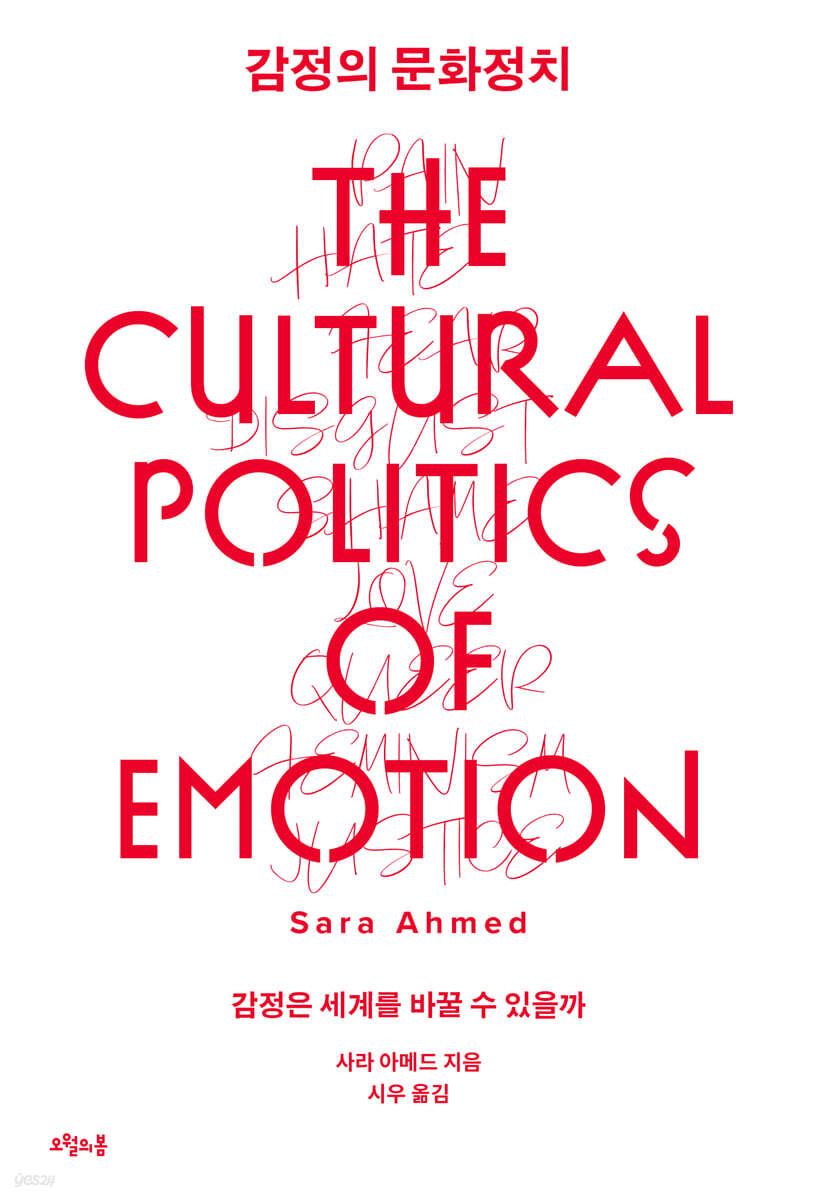
Cultural Politics of Emotions
 |
Description
Book Introduction
Why does society not change at all?
Is there any possibility of change?
Even when we recognize the structural contradictions inherent in the cultural politics of emotion, why does society remain unchangeable? Why do power relations stubbornly persist despite collective resistance? Sarah Ahmed explains the reason with the word "investment."
In other words, the world does not change because we continue to 'invest' in social norms.
We pursue and are attached to a life that is consistent with social ideals ('the life we know').
They still regard capitalism, heterosexism, and nationalism as ideal social norms.
We consider pursuing this essential for the happiness of future generations.
It is difficult to let go of the emotions that cling to us to maintain this norm.
So, is there a way out of this cultural politics of emotion? Is there any possibility of change? The alternative, Sara Ahmed suggests, is to live a life that no longer repeats the same pattern.
Living with others in a different way, realizing that the various emotions I feel can define different worlds, feeling anger, pain, and finding wonder in the ordinary things I encounter in my daily life.
It is said that by undertaking this kind of emotional journey, the relationship between the subject and the group can be re-established.
I am pinning my hopes on taking political action to make what has not yet happened our future.
“Hope tells us that we must act now, not just wait for a future that is always ahead of us.” (394) Above all, it is important to examine how the emotions we emit are formed.
Why do we hate transgender people? Why does the mere mention of "feminism" evoke feelings of disgust and hatred? Why do we hate China and North Korea? Why do we despise foreign workers? We need to reflect on the history and social structures that shaped how these feelings came to be within us.
Is there any possibility of change?
Even when we recognize the structural contradictions inherent in the cultural politics of emotion, why does society remain unchangeable? Why do power relations stubbornly persist despite collective resistance? Sarah Ahmed explains the reason with the word "investment."
In other words, the world does not change because we continue to 'invest' in social norms.
We pursue and are attached to a life that is consistent with social ideals ('the life we know').
They still regard capitalism, heterosexism, and nationalism as ideal social norms.
We consider pursuing this essential for the happiness of future generations.
It is difficult to let go of the emotions that cling to us to maintain this norm.
So, is there a way out of this cultural politics of emotion? Is there any possibility of change? The alternative, Sara Ahmed suggests, is to live a life that no longer repeats the same pattern.
Living with others in a different way, realizing that the various emotions I feel can define different worlds, feeling anger, pain, and finding wonder in the ordinary things I encounter in my daily life.
It is said that by undertaking this kind of emotional journey, the relationship between the subject and the group can be re-established.
I am pinning my hopes on taking political action to make what has not yet happened our future.
“Hope tells us that we must act now, not just wait for a future that is always ahead of us.” (394) Above all, it is important to examine how the emotions we emit are formed.
Why do we hate transgender people? Why does the mere mention of "feminism" evoke feelings of disgust and hatred? Why do we hate China and North Korea? Why do we despise foreign workers? We need to reflect on the history and social structures that shaped how these feelings came to be within us.
- You can preview some of the book's contents.
Preview
index
time
Unlock: A Unique Study of the Neoliberal Present—Park Mi-seon
Introduction: What Emotions Do
Emotions and Objects | From Inside to Outside, From Outside to Inside | The Emotional Properties of Text
Chapter 1: The Randomness of Suffering
The Surface of Pain | The Sociality of Pain | The Politics of Pain
Chapter 2: Organizing Hatred
Jeongdong Economy | Hated Body | Hate Crimes
Chapter 3: The Emotional Politics of Fear
Fear and Anxiety | The Body in Fear | The World Economy of Fear
Chapter 4: The Performativity of Disgust
Disgust and Disembodiment | On Stickiness | Speaking of Disgust
Chapter 5: Feeling Shame in Front of Others
The Vivid Experience of Shame | National Shame | Shame and the Act of Speaking
Chapter 6 In the Name of Love
Identification and Idealization | National Ideals | Multicultural Love
Chapter 7 Queer Feeling
(Dis)comfort and Norms | Queer Grief | Queer Pleasure
Chapter 8 Feminist Attachment
Feminism and Anger | Feminism and Wonder | Feminism and Hope
Conclusion: Righteous Feelings
Review: Emotions and Their Objects
Emotional Transition | Dangerous Stranger | Happy Object
Conclusion: Emotions and Investigation
Acknowledgments | Acknowledgments for the Revised Edition | Translator's Note
Americas | References | Index
Unlock: A Unique Study of the Neoliberal Present—Park Mi-seon
Introduction: What Emotions Do
Emotions and Objects | From Inside to Outside, From Outside to Inside | The Emotional Properties of Text
Chapter 1: The Randomness of Suffering
The Surface of Pain | The Sociality of Pain | The Politics of Pain
Chapter 2: Organizing Hatred
Jeongdong Economy | Hated Body | Hate Crimes
Chapter 3: The Emotional Politics of Fear
Fear and Anxiety | The Body in Fear | The World Economy of Fear
Chapter 4: The Performativity of Disgust
Disgust and Disembodiment | On Stickiness | Speaking of Disgust
Chapter 5: Feeling Shame in Front of Others
The Vivid Experience of Shame | National Shame | Shame and the Act of Speaking
Chapter 6 In the Name of Love
Identification and Idealization | National Ideals | Multicultural Love
Chapter 7 Queer Feeling
(Dis)comfort and Norms | Queer Grief | Queer Pleasure
Chapter 8 Feminist Attachment
Feminism and Anger | Feminism and Wonder | Feminism and Hope
Conclusion: Righteous Feelings
Review: Emotions and Their Objects
Emotional Transition | Dangerous Stranger | Happy Object
Conclusion: Emotions and Investigation
Acknowledgments | Acknowledgments for the Revised Edition | Translator's Note
Americas | References | Index
Into the book
When we talk about experiences of suffering, we consider it as 'my suffering'.
Because they cannot feel the pain of others.
The pain I feel comes across as so vividly present, and the pain of others comes across as so vividly absent.
But the suffering of others exists.
Because I can read the pain in the other person's body.
--- p.77~78
The past is not dead, it is alive.
Because the past still lives in wounds that have not healed even now.
--- p.85
As I have already pointed out, interpreting the suffering of others as my own, and empathizing with others for the sake of restoring their bodies (in this case, the body of the nation), entails violence.
However, we must not respond to the fact that the suffering of others is monopolized as the suffering of the nation and that the wounds of others are fetishized as the damaged skin of the nation by forgetting the suffering of others.
Rather, what we need to do is learn to hear the impossible.
This becomes possible only when we respond to the suffering we cannot claim as our own.
Non-Indigenous listeners must explicitly accept the suffering of Indigenous peoples as their own (as part of a history that has caused suffering).
But it should not be done in a way that takes away the testimony of indigenous people from indigenous people.
Because their testimony is not about our feelings, nor about our ability to feel their feelings.
--- p.89
What the pain that cannot be conveyed even through empathy demands of us is not careful listening, but living [our bodies, our histories, our communities] differently.
This calls for action and a call for collective politics.
Suffering demands from us not a politics based on the possibility of reconciliation, but a politics of learning to live with the impossibility of reconciliation, a politics of learning to live with others, alongside others, yet not being one.
--- p.98
This feeling of vulnerability and fear not only shapes women's bodies, but also the way they navigate space.
Vulnerability is not an inherent characteristic of the female body.
Vulnerability defines femininity in a way that restricts movement in public spaces and forces excessive sedentarism in private spaces.
This is the effect that occurs.
--- p.160
If we examine the process by which a body becomes an object of disgust, we can see that disgust becomes a central issue in power relations.
Why is disgust such a central issue in power relations? Does it maintain power relations by maintaining physical boundaries?
--- p.196
It is important to understand what cultural implications are embedded in the way right-wing fascist groups utilize 'love'.
--- p.269
By expressing ‘my love’, I show that I am ‘by the other person’s side.’
It is not history, culture, or ethnicity, but love that unites a multicultural nation.
--- p.294
There is no good love that can change this world into a place worthy of the name of love, even if it speaks in the name of love.
But when we resist speaking in the name of love, when we acknowledge that we don't simply act out of love, when we understand that love, no matter how unconditional it may feel, has conditions, we may find a different kind of connection and relationship between the others we cherish and the world we seek to realize.
Perhaps love is important because it is an expression that refers to the emotion of solidarity with others while working to create another world.
--- p.306~307
When the family is portrayed as a place of vulnerability, a place in need of protection from others who would interfere with its reproduction, the family is idealized through a narrative of threat and anxiety.
--- p.312
Heterosexuality, as a script for an ideal life, has a much greater meaning.
It assumes that all relationships originate from the union of a man and a woman.
--- p.317
A queer life is one that doesn't start a family, doesn't get married, doesn't get stuck in hopeless romantic relationships, doesn't have or raise children, doesn't join neighborhood watch groups, and doesn't pray for the nation in times of war.
--- p.322
In queer politics, too, recognition is an important issue, but this recognition is not about the sadness felt by the other, but about the other as the one who is grieving.
Queer politics recognizes the importance of acknowledging that the Other is a person grieving loss, that they are the subject of grief rather than the object of it, and that they are not left alone in their grief.
Because sadness is about the other and is directed towards the other.
--- p.347
What we need to do is to critique the way we understand emotions as 'non-reasoning' and the way we treat 'rational thinking' as being independent of emotions or uninfluenced by others.
--- p.364
Understanding emotions as mediated rather than immediate reminds us that knowledge cannot be separated from the world of the body, which is made up of feelings and sensations.
Knowledge is closely related to things that make us sweat, tremble, and shudder.
All these feelings are felt above all on the surface of the body.
Because the surface of the body is where we touch the world and where the world touches us.
--- p.366
Emotions are very important because they tell us two things:
'Why is change so difficult?' (We still invest in what we criticize).
'Why is change possible, then?' (As we move, so do our investments).
--- p.367
Thus, collective action based on feminism becomes one way to respond to the suffering of others.
But the suffering of the typist is not something we can immediately fathom, but something we can barely grasp.
Crucially, responding to suffering relies on talking about suffering.
The act of speaking about pain becomes the background for the birth of 'us'.
--- p.371
Feminism can be most active and functional when it is not solely focused on criticizing patriarchy, when it is not confined to the categories of “women” or “gender.”
The loss of a defined target does not mean that feminist activism has failed, but rather that feminist activism is moving and can become a social movement.
--- p.377
I used to think that the world was set in stone from the beginning, but I realized that this world was actually created by chance over time.
It was also a wonder that it breathed life into pain and anger.
Wonder reminds us that what hurts, what causes pain, what we think is wrong, is not inevitable, that we can create it or undo it.
In this way, wonder fosters hope for change and strengthens the will to engage in politics.
--- p.387
We take action at this very moment.
In other words, the time for us to teach, to protest, to name, to feel, and to connect with others is now.
Through the struggle against the 'current system', openness grows, and this leads to different bodies coming together now.
Because they cannot feel the pain of others.
The pain I feel comes across as so vividly present, and the pain of others comes across as so vividly absent.
But the suffering of others exists.
Because I can read the pain in the other person's body.
--- p.77~78
The past is not dead, it is alive.
Because the past still lives in wounds that have not healed even now.
--- p.85
As I have already pointed out, interpreting the suffering of others as my own, and empathizing with others for the sake of restoring their bodies (in this case, the body of the nation), entails violence.
However, we must not respond to the fact that the suffering of others is monopolized as the suffering of the nation and that the wounds of others are fetishized as the damaged skin of the nation by forgetting the suffering of others.
Rather, what we need to do is learn to hear the impossible.
This becomes possible only when we respond to the suffering we cannot claim as our own.
Non-Indigenous listeners must explicitly accept the suffering of Indigenous peoples as their own (as part of a history that has caused suffering).
But it should not be done in a way that takes away the testimony of indigenous people from indigenous people.
Because their testimony is not about our feelings, nor about our ability to feel their feelings.
--- p.89
What the pain that cannot be conveyed even through empathy demands of us is not careful listening, but living [our bodies, our histories, our communities] differently.
This calls for action and a call for collective politics.
Suffering demands from us not a politics based on the possibility of reconciliation, but a politics of learning to live with the impossibility of reconciliation, a politics of learning to live with others, alongside others, yet not being one.
--- p.98
This feeling of vulnerability and fear not only shapes women's bodies, but also the way they navigate space.
Vulnerability is not an inherent characteristic of the female body.
Vulnerability defines femininity in a way that restricts movement in public spaces and forces excessive sedentarism in private spaces.
This is the effect that occurs.
--- p.160
If we examine the process by which a body becomes an object of disgust, we can see that disgust becomes a central issue in power relations.
Why is disgust such a central issue in power relations? Does it maintain power relations by maintaining physical boundaries?
--- p.196
It is important to understand what cultural implications are embedded in the way right-wing fascist groups utilize 'love'.
--- p.269
By expressing ‘my love’, I show that I am ‘by the other person’s side.’
It is not history, culture, or ethnicity, but love that unites a multicultural nation.
--- p.294
There is no good love that can change this world into a place worthy of the name of love, even if it speaks in the name of love.
But when we resist speaking in the name of love, when we acknowledge that we don't simply act out of love, when we understand that love, no matter how unconditional it may feel, has conditions, we may find a different kind of connection and relationship between the others we cherish and the world we seek to realize.
Perhaps love is important because it is an expression that refers to the emotion of solidarity with others while working to create another world.
--- p.306~307
When the family is portrayed as a place of vulnerability, a place in need of protection from others who would interfere with its reproduction, the family is idealized through a narrative of threat and anxiety.
--- p.312
Heterosexuality, as a script for an ideal life, has a much greater meaning.
It assumes that all relationships originate from the union of a man and a woman.
--- p.317
A queer life is one that doesn't start a family, doesn't get married, doesn't get stuck in hopeless romantic relationships, doesn't have or raise children, doesn't join neighborhood watch groups, and doesn't pray for the nation in times of war.
--- p.322
In queer politics, too, recognition is an important issue, but this recognition is not about the sadness felt by the other, but about the other as the one who is grieving.
Queer politics recognizes the importance of acknowledging that the Other is a person grieving loss, that they are the subject of grief rather than the object of it, and that they are not left alone in their grief.
Because sadness is about the other and is directed towards the other.
--- p.347
What we need to do is to critique the way we understand emotions as 'non-reasoning' and the way we treat 'rational thinking' as being independent of emotions or uninfluenced by others.
--- p.364
Understanding emotions as mediated rather than immediate reminds us that knowledge cannot be separated from the world of the body, which is made up of feelings and sensations.
Knowledge is closely related to things that make us sweat, tremble, and shudder.
All these feelings are felt above all on the surface of the body.
Because the surface of the body is where we touch the world and where the world touches us.
--- p.366
Emotions are very important because they tell us two things:
'Why is change so difficult?' (We still invest in what we criticize).
'Why is change possible, then?' (As we move, so do our investments).
--- p.367
Thus, collective action based on feminism becomes one way to respond to the suffering of others.
But the suffering of the typist is not something we can immediately fathom, but something we can barely grasp.
Crucially, responding to suffering relies on talking about suffering.
The act of speaking about pain becomes the background for the birth of 'us'.
--- p.371
Feminism can be most active and functional when it is not solely focused on criticizing patriarchy, when it is not confined to the categories of “women” or “gender.”
The loss of a defined target does not mean that feminist activism has failed, but rather that feminist activism is moving and can become a social movement.
--- p.377
I used to think that the world was set in stone from the beginning, but I realized that this world was actually created by chance over time.
It was also a wonder that it breathed life into pain and anger.
Wonder reminds us that what hurts, what causes pain, what we think is wrong, is not inevitable, that we can create it or undo it.
In this way, wonder fosters hope for change and strengthens the will to engage in politics.
--- p.387
We take action at this very moment.
In other words, the time for us to teach, to protest, to name, to feel, and to connect with others is now.
Through the struggle against the 'current system', openness grows, and this leads to different bodies coming together now.
--- p.402
Publisher's Review
“The best book on political life and cultural studies.”
"A Unique Study of the Neoliberal Present"
A must-read for affective theory and emotion research.
"A book for those who survive the unsurvivable."
What do emotions do?
A must-read for emotion research and affect theory
One of the books by feminist independent researcher Sarah Ahmed, “The Cultural Politics of Emotions,” has been published.
This book has been considered a must-read for those studying emotions and affective theory.
There are two questions this book raises and answers.
"Why is change so difficult in the world?" "Why is change possible, then?"
In this book, Sarah Ahmed explores how the power structures that surround us operate by analyzing emotions such as pain, hatred, fear, disgust, and shame.
In short, emotions are not free from power relations, and it shows how emotions are connected to sexism, racism, classism, etc., and cause or maintain discrimination and exclusion.
Ahmed analyzes the world by looking at emotions in terms of cultural politics.
For example, the feelings that flow between whites and blacks are fixed.
White people hate, fear, and even disgust black people.
They blame black people and even define themselves as the ones who have suffered, as if black people have always had such negative feelings.
“Those who practice racism and homophobia believe that others have stolen the joy that should belong to them.” (p. 349) This sentiment is likely similar not only between whites and blacks, but also between men and women, Israelis and Palestinians, conservative Christians and gays, and nations and refugees.
More privileged subjects define this society by blaming others for negative emotions such as pain, hatred, fear, disgust, and shame.
In this way, the existing power structure and social norms are maintained.
As Sarah Ahmed describes this book by asking not "What are emotions?" but "What do emotions do?", the cultural politics of emotions obscure precisely these histories and power structures and reproduce the history of violence.
It makes us accept a world based on violence, such as capitalism, racism, and heterosexism, as the norm.
This is why we feel disgust, hatred, and disgust when we encounter certain objects, races, cultures, etc.
Because our emotions are expressed in connection with society, politics, and history.
Cultural Politics of Our Time as Analyzed by a Feminist Independent Researcher
This book provides profound insights into important issues in modern society.
Ahmed combines his personal experience with academic research to present an original and challenging argument.
The issues of reconciliation surrounding the past, the response to the September 11 attacks, and the figures of refugees, immigrants, and strangers are all core themes of the book and events that have had a profound impact on Ahmed's own interactions with the world (p. 50).
Ahmed, the son of a white British mother and an Asian Pakistani father, has lived in Britain, Australia and Pakistan.
This served as a major backdrop for Ahmed's critical perspective on race, migration, difference, language, history, and nation.
Additionally, Ahmed identifies as a non-white lesbian feminist.
Ahmed's personal identity is reflected in this book, along with his academic research.
In this book, Ahmed analyzes the experiences of Audre Lorde and Frantz Fanon with racism, research examining the violence experienced by Indigenous Australians, and posts depicting others as disgusting in the context of events like the 9/11 terrorist attacks.
In addition, various texts such as government reports, political speeches, and newspaper articles appear.
Referencing Marxism, psychoanalysis, affect theory, phenomenology, feminism, and queer theory, it presents the reflection that 'emotions are a matter of justice and denial.'
In particular, the part that analyzes emotions not as entities but as a system of value accumulation through circulation, that is, an “affective economy,” with reference to Marxism, can be said to be a major feature of this book.
In other words, Ahmed says that emotions move like capital, are produced through circulation effects, and through this movement, emotions are materialized on the surface of collective bodies.
For example, the emotional economy of hate is one in which the emotion of hate circulates through many people's bodies, driving certain targets and groups into being perceived as threats.
This book is also considered a masterpiece in the study of emotion.
Affect has been a key word in the humanities and a topic of debate for several years.
However, unlike typical affect theorists, Sara Ahmed does not distinguish between affect and emotion.
The distinction between emotion and affect is only possible at the analytical level, and in reality it is difficult to clearly distinguish between them.
Ahmed is critical of affect theorists' insistence that emotions are personal, arguing that they are not personal but rather expressed through mediation with history, society, and politics.
Through 'What Do Emotions Do?', it provides answers to the questions, 'How do emotions move and attach to individuals and groups?' and 'How do emotions reproduce the world?'
How Emotions Hide Power Structures
How Social Norms and Histories of Violence Are Reproduced
This book consists of eight chapters.
Chapters 1 through 6 cover emotions like pain, hate, fear, disgust, shame, and love, while chapters 7 and 8 cover queerness (comfort and discomfort, sadness, joy) and feminism (anger, wonder, and hope).
In other words, this book starts with various emotions as a starting point for discussion, and ends with what each emotion does in each chapter.
Broadly speaking, emotions circulate among various bodies, binding people emotionally and uniting them politically and socially.
And by producing the other as a subject that causes threat, fear, anxiety, and hatred, it acts as a glue that gathers 'us' into a subject that must be defended.
Chapter 1 deals with 'suffering' and argues that not everyone's suffering receives equal attention and is unequal.
The report, Bringing Them Home, on Australia's 'Stolen Generations' provides a concrete example, in which the state refers to the suffering of Indigenous Australians as 'our' suffering.
When the state appropriates the suffering of Aboriginal Australians as 'our' suffering, the state becomes a suffering body, a wounded nation.
Thus, the nation is recreated as a victim, and the history that caused the suffering is forgotten.
In other words, the victims are being deprived of the right to even speak about the suffering they have endured.
It also presents a reflective point on the ethics of relationships that involve listening to and speaking about pain.
Chapter 2, which deals with 'hatred', traces how the feeling of being hurt turns into hatred toward the other.
The concept of 'affective economy' is presented to explain the process by which hatred circulates through symbols.
He also explains how hate works, using examples of refugees and migrants.
It also explores how hate crimes remain confined to the legal system and how the language of hate impacts those targeted by it.
Chapter 3 explores how the object of fear is created, focusing on the way the cause of 'fear' is sought in the body of the other.
The response to terrorism operates as a kind of 'fear economy'.
In the economy of fear, the figure of the terrorist is linked to a specific body and to the claim that anyone can be a terrorist.
That is, it emphasizes that the narrative of threat called fear reinforces social norms and maintains power.
Chapter 4 examines how 'disgust' (repulsion) produces bodies that the community must expel.
By analyzing the utterance "disgusting!" in response to the 9/11 terrorist attacks, we examine how objects that evoke disgust and aversion are created.
The argument that we must drive out the disgusting other shows the process by which certain other people are already perceived as disgusting and justify the endless expulsion of the other.
Chapter 5, which deals with 'shame,' examines the process by which the expression of shame through the act of expressing 'apology' functions as a kind of nation-building, and the process by which those in power consolidate their power.
Saying 'I'm ashamed' in itself covers up the shameful events of the past.
It also discusses the ambivalent nature of shame through the example of Australia's reconciliation efforts and its calls for government apologies for its history of slavery and colonialism.
That is, it reveals that shame is used to cover up present history by attributing unjust wrongs to past wrongs.
Chapter 6 examines the process by which hatred is packaged as 'love' and projected onto the object of one's hatred.
By focusing on the process by which multiculturalism operates as a categorical imperative to love differences, we examine how subjects who identify with the nation are born.
It also reveals that those who undermine national ideals will be excluded in the process.
The final two chapters discuss how emotions operate in queer and feminist politics.
And it tells us through our emotions how we should relate to social ideals.
These two chapters feature a range of emotions—discomfort, sadness, joy, anger, wonder, and hope—that are often linked to alternative politics.
Feminism is responding to pain and being angry, and the anger that feminists feel is an act of interpreting the world.
We place our hopes on creating the possibility of a non-normative life by living differently from the norm (Chapter 7) and on taking political action to make what has not yet happened our future (Chapter 8).
Why does society not change at all?
Is there any possibility of change?
Even when we recognize the structural contradictions inherent in the cultural politics of emotion, why does society remain unchangeable? Why do power relations stubbornly persist despite collective resistance? Sarah Ahmed explains the reason with the word "investment."
In other words, the world does not change because we continue to 'invest' in social norms.
We pursue and are attached to a life that is consistent with social ideals ('the life we know').
They still regard capitalism, heterosexism, and nationalism as ideal social norms.
We consider pursuing this essential for the happiness of future generations.
It is difficult to let go of the emotions that cling to us to maintain this norm.
So, is there a way out of this cultural politics of emotion? Is there any possibility of change? The alternative, Sara Ahmed suggests, is to live a life that no longer repeats the same pattern.
Living with others in a different way, realizing that the various emotions I feel can define different worlds, feeling anger, pain, and finding wonder in the ordinary things I encounter in my daily life.
It is said that by undertaking this kind of emotional journey, the relationship between the subject and the group can be re-established.
I am pinning my hopes on taking political action to make what has not yet happened our future.
“Hope tells us that we must act now, not just wait for a future that is always ahead of us.” (394) Above all, it is important to examine how the emotions we emit are formed.
Why do we hate transgender people? Why does the mere mention of "feminism" evoke feelings of disgust and hatred? Why do we hate China and North Korea? Why do we despise foreign workers? We need to reflect on the history and social structures that shaped how these feelings came to be within us.
Korean society is rife with feelings of hatred
Significance of the publication of the Korean version
《Cultural Politics of Emotions》 also delivers an important message to Korea.
This book effectively explains the situation in which, whenever a social disaster occurs, such as the Sewol Ferry Disaster, the Itaewon Disaster, or the May 18 Gwangju Uprising, "national grief" is emphasized, but the perpetrators and the social structure that caused the disaster are not revealed.
We can also reflect on the process by which the hatred and fear that permeated Korean society in 2018 when a large number of Yemenis applied for refugee status were created.
Every time we hold a queer parade, we can examine what is implicit in the narrative of "love" that conservative Christians speak of, and how various forms of misogyny are created.
We can also look back at how Koreans treat foreign workers and how they discriminate against and exclude them.
We can also examine the strategies of a nation that pursues a foreign policy based on power and fosters hatred and fear, as well as the resistance of disabled people who, despite enduring criticism and insults, still ride the subway today to fight for equality for all.
“I hope this book will reach those who disagree with the normative script, those who live the unsurvivable, and those who harbor a thrill for change.” (p. 496)
"A Unique Study of the Neoliberal Present"
A must-read for affective theory and emotion research.
"A book for those who survive the unsurvivable."
What do emotions do?
A must-read for emotion research and affect theory
One of the books by feminist independent researcher Sarah Ahmed, “The Cultural Politics of Emotions,” has been published.
This book has been considered a must-read for those studying emotions and affective theory.
There are two questions this book raises and answers.
"Why is change so difficult in the world?" "Why is change possible, then?"
In this book, Sarah Ahmed explores how the power structures that surround us operate by analyzing emotions such as pain, hatred, fear, disgust, and shame.
In short, emotions are not free from power relations, and it shows how emotions are connected to sexism, racism, classism, etc., and cause or maintain discrimination and exclusion.
Ahmed analyzes the world by looking at emotions in terms of cultural politics.
For example, the feelings that flow between whites and blacks are fixed.
White people hate, fear, and even disgust black people.
They blame black people and even define themselves as the ones who have suffered, as if black people have always had such negative feelings.
“Those who practice racism and homophobia believe that others have stolen the joy that should belong to them.” (p. 349) This sentiment is likely similar not only between whites and blacks, but also between men and women, Israelis and Palestinians, conservative Christians and gays, and nations and refugees.
More privileged subjects define this society by blaming others for negative emotions such as pain, hatred, fear, disgust, and shame.
In this way, the existing power structure and social norms are maintained.
As Sarah Ahmed describes this book by asking not "What are emotions?" but "What do emotions do?", the cultural politics of emotions obscure precisely these histories and power structures and reproduce the history of violence.
It makes us accept a world based on violence, such as capitalism, racism, and heterosexism, as the norm.
This is why we feel disgust, hatred, and disgust when we encounter certain objects, races, cultures, etc.
Because our emotions are expressed in connection with society, politics, and history.
Cultural Politics of Our Time as Analyzed by a Feminist Independent Researcher
This book provides profound insights into important issues in modern society.
Ahmed combines his personal experience with academic research to present an original and challenging argument.
The issues of reconciliation surrounding the past, the response to the September 11 attacks, and the figures of refugees, immigrants, and strangers are all core themes of the book and events that have had a profound impact on Ahmed's own interactions with the world (p. 50).
Ahmed, the son of a white British mother and an Asian Pakistani father, has lived in Britain, Australia and Pakistan.
This served as a major backdrop for Ahmed's critical perspective on race, migration, difference, language, history, and nation.
Additionally, Ahmed identifies as a non-white lesbian feminist.
Ahmed's personal identity is reflected in this book, along with his academic research.
In this book, Ahmed analyzes the experiences of Audre Lorde and Frantz Fanon with racism, research examining the violence experienced by Indigenous Australians, and posts depicting others as disgusting in the context of events like the 9/11 terrorist attacks.
In addition, various texts such as government reports, political speeches, and newspaper articles appear.
Referencing Marxism, psychoanalysis, affect theory, phenomenology, feminism, and queer theory, it presents the reflection that 'emotions are a matter of justice and denial.'
In particular, the part that analyzes emotions not as entities but as a system of value accumulation through circulation, that is, an “affective economy,” with reference to Marxism, can be said to be a major feature of this book.
In other words, Ahmed says that emotions move like capital, are produced through circulation effects, and through this movement, emotions are materialized on the surface of collective bodies.
For example, the emotional economy of hate is one in which the emotion of hate circulates through many people's bodies, driving certain targets and groups into being perceived as threats.
This book is also considered a masterpiece in the study of emotion.
Affect has been a key word in the humanities and a topic of debate for several years.
However, unlike typical affect theorists, Sara Ahmed does not distinguish between affect and emotion.
The distinction between emotion and affect is only possible at the analytical level, and in reality it is difficult to clearly distinguish between them.
Ahmed is critical of affect theorists' insistence that emotions are personal, arguing that they are not personal but rather expressed through mediation with history, society, and politics.
Through 'What Do Emotions Do?', it provides answers to the questions, 'How do emotions move and attach to individuals and groups?' and 'How do emotions reproduce the world?'
How Emotions Hide Power Structures
How Social Norms and Histories of Violence Are Reproduced
This book consists of eight chapters.
Chapters 1 through 6 cover emotions like pain, hate, fear, disgust, shame, and love, while chapters 7 and 8 cover queerness (comfort and discomfort, sadness, joy) and feminism (anger, wonder, and hope).
In other words, this book starts with various emotions as a starting point for discussion, and ends with what each emotion does in each chapter.
Broadly speaking, emotions circulate among various bodies, binding people emotionally and uniting them politically and socially.
And by producing the other as a subject that causes threat, fear, anxiety, and hatred, it acts as a glue that gathers 'us' into a subject that must be defended.
Chapter 1 deals with 'suffering' and argues that not everyone's suffering receives equal attention and is unequal.
The report, Bringing Them Home, on Australia's 'Stolen Generations' provides a concrete example, in which the state refers to the suffering of Indigenous Australians as 'our' suffering.
When the state appropriates the suffering of Aboriginal Australians as 'our' suffering, the state becomes a suffering body, a wounded nation.
Thus, the nation is recreated as a victim, and the history that caused the suffering is forgotten.
In other words, the victims are being deprived of the right to even speak about the suffering they have endured.
It also presents a reflective point on the ethics of relationships that involve listening to and speaking about pain.
Chapter 2, which deals with 'hatred', traces how the feeling of being hurt turns into hatred toward the other.
The concept of 'affective economy' is presented to explain the process by which hatred circulates through symbols.
He also explains how hate works, using examples of refugees and migrants.
It also explores how hate crimes remain confined to the legal system and how the language of hate impacts those targeted by it.
Chapter 3 explores how the object of fear is created, focusing on the way the cause of 'fear' is sought in the body of the other.
The response to terrorism operates as a kind of 'fear economy'.
In the economy of fear, the figure of the terrorist is linked to a specific body and to the claim that anyone can be a terrorist.
That is, it emphasizes that the narrative of threat called fear reinforces social norms and maintains power.
Chapter 4 examines how 'disgust' (repulsion) produces bodies that the community must expel.
By analyzing the utterance "disgusting!" in response to the 9/11 terrorist attacks, we examine how objects that evoke disgust and aversion are created.
The argument that we must drive out the disgusting other shows the process by which certain other people are already perceived as disgusting and justify the endless expulsion of the other.
Chapter 5, which deals with 'shame,' examines the process by which the expression of shame through the act of expressing 'apology' functions as a kind of nation-building, and the process by which those in power consolidate their power.
Saying 'I'm ashamed' in itself covers up the shameful events of the past.
It also discusses the ambivalent nature of shame through the example of Australia's reconciliation efforts and its calls for government apologies for its history of slavery and colonialism.
That is, it reveals that shame is used to cover up present history by attributing unjust wrongs to past wrongs.
Chapter 6 examines the process by which hatred is packaged as 'love' and projected onto the object of one's hatred.
By focusing on the process by which multiculturalism operates as a categorical imperative to love differences, we examine how subjects who identify with the nation are born.
It also reveals that those who undermine national ideals will be excluded in the process.
The final two chapters discuss how emotions operate in queer and feminist politics.
And it tells us through our emotions how we should relate to social ideals.
These two chapters feature a range of emotions—discomfort, sadness, joy, anger, wonder, and hope—that are often linked to alternative politics.
Feminism is responding to pain and being angry, and the anger that feminists feel is an act of interpreting the world.
We place our hopes on creating the possibility of a non-normative life by living differently from the norm (Chapter 7) and on taking political action to make what has not yet happened our future (Chapter 8).
Why does society not change at all?
Is there any possibility of change?
Even when we recognize the structural contradictions inherent in the cultural politics of emotion, why does society remain unchangeable? Why do power relations stubbornly persist despite collective resistance? Sarah Ahmed explains the reason with the word "investment."
In other words, the world does not change because we continue to 'invest' in social norms.
We pursue and are attached to a life that is consistent with social ideals ('the life we know').
They still regard capitalism, heterosexism, and nationalism as ideal social norms.
We consider pursuing this essential for the happiness of future generations.
It is difficult to let go of the emotions that cling to us to maintain this norm.
So, is there a way out of this cultural politics of emotion? Is there any possibility of change? The alternative, Sara Ahmed suggests, is to live a life that no longer repeats the same pattern.
Living with others in a different way, realizing that the various emotions I feel can define different worlds, feeling anger, pain, and finding wonder in the ordinary things I encounter in my daily life.
It is said that by undertaking this kind of emotional journey, the relationship between the subject and the group can be re-established.
I am pinning my hopes on taking political action to make what has not yet happened our future.
“Hope tells us that we must act now, not just wait for a future that is always ahead of us.” (394) Above all, it is important to examine how the emotions we emit are formed.
Why do we hate transgender people? Why does the mere mention of "feminism" evoke feelings of disgust and hatred? Why do we hate China and North Korea? Why do we despise foreign workers? We need to reflect on the history and social structures that shaped how these feelings came to be within us.
Korean society is rife with feelings of hatred
Significance of the publication of the Korean version
《Cultural Politics of Emotions》 also delivers an important message to Korea.
This book effectively explains the situation in which, whenever a social disaster occurs, such as the Sewol Ferry Disaster, the Itaewon Disaster, or the May 18 Gwangju Uprising, "national grief" is emphasized, but the perpetrators and the social structure that caused the disaster are not revealed.
We can also reflect on the process by which the hatred and fear that permeated Korean society in 2018 when a large number of Yemenis applied for refugee status were created.
Every time we hold a queer parade, we can examine what is implicit in the narrative of "love" that conservative Christians speak of, and how various forms of misogyny are created.
We can also look back at how Koreans treat foreign workers and how they discriminate against and exclude them.
We can also examine the strategies of a nation that pursues a foreign policy based on power and fosters hatred and fear, as well as the resistance of disabled people who, despite enduring criticism and insults, still ride the subway today to fight for equality for all.
“I hope this book will reach those who disagree with the normative script, those who live the unsurvivable, and those who harbor a thrill for change.” (p. 496)
GOODS SPECIFICS
- Date of issue: November 6, 2023
- Page count, weight, size: 568 pages | 646g | 143*210*33mm
- ISBN13: 9791168730830
You may also like
카테고리
korean


korean

![GQ KOREA Mark (Monthly): December [2025]](http://librairie.coreenne.fr/cdn/shop/files/8ef265dbbfbf186523ed75ba7319009d.jpg?v=1765340328&width=3840)


