

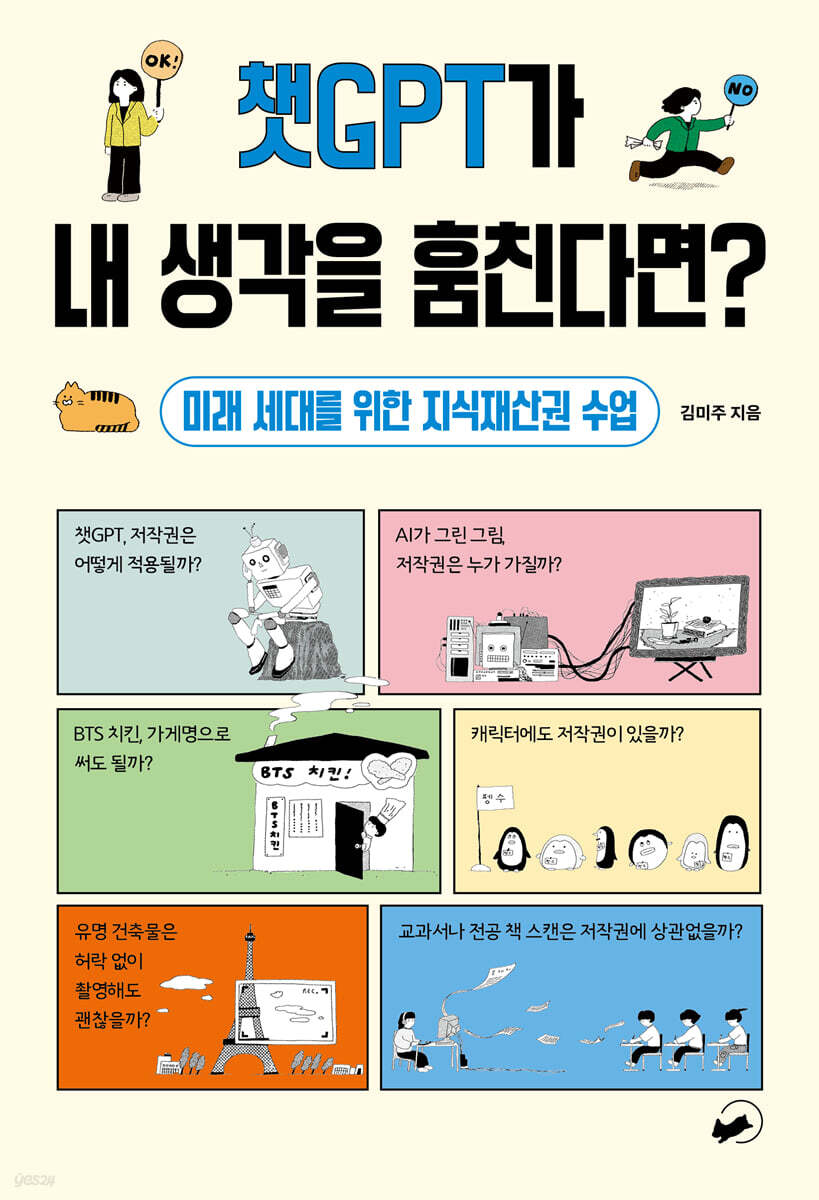
What if ChatGPT steals my thoughts?
 |
Description
Book Introduction
Intellectual Property Rights Class for Future Generations-
From the era of seeing to the era of making,
How to protect what's mine and use what's yours properly in a content-sharing society without time lag
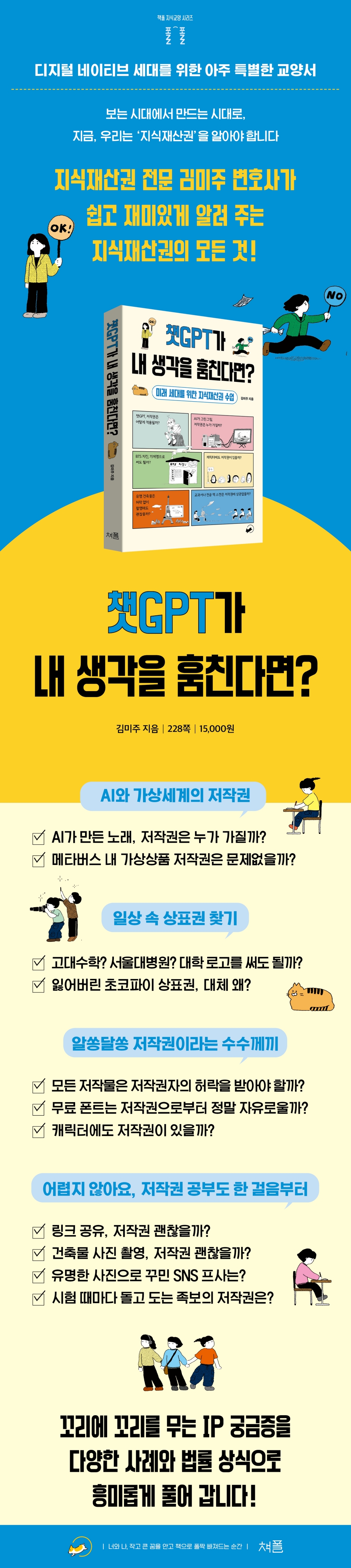
How will copyright be applied to ChatGPT? Who owns the copyright to AI-generated images? Can BTS Chicken be used as a store name? Do characters have copyrights? Can free images be used freely? What about using celebrity photos or recipes? These days, knowing one thing makes you curious about more than one.
As algorithms and big data bring in a torrent of information and knowledge, new questions also increase.
The important thing here is that knowing one, knowing two, knowing three doesn't mean that it's all 'mine.'
As the amount of information increases, issues that arise are those of ‘intellectual property rights’ such as ‘copyrights,’ ‘trademarks,’ and ‘patents.’
The words or images I post on my social media can be 'information' that helps someone.
Sometimes, without my knowledge, someone infringes on my copyright without my permission.
Or the opposite can also happen.
Character designs or photo images taken for fun, cover dances or movie edits you made because you liked them, or links shared with friends can easily be copyright infringements.
Anyone can be a victim of copyright infringement, and sometimes even cause harm to others.
Author Kim Mi-ju, known as Coupang's first in-house lawyer and the legal representative for Pengsoo, Catch! Teeny Ping, Titleist, and PXG, has been practicing law for over a decade, focusing on intellectual property rights protection.
As countless cases have come to him asking questions and seeking advice on issues such as how copyright applies under legal protection, whether there are exceptions, and whether trademarks are illegal, the author has compiled many of the cases and domestic and international cases that have occurred in the past into this book in an easy-to-understand and interesting way.
In a world where we create content ourselves, share it across time zones and borders, and exchange feedback, we need to understand intellectual property rights so that "knowledge can become power and wealth," and prepare for the future.
The third book in the Bookpole knowledge and culture series, 'Polpole'.
From the era of seeing to the era of making,
How to protect what's mine and use what's yours properly in a content-sharing society without time lag
How will copyright be applied to ChatGPT? Who owns the copyright to AI-generated images? Can BTS Chicken be used as a store name? Do characters have copyrights? Can free images be used freely? What about using celebrity photos or recipes? These days, knowing one thing makes you curious about more than one.
As algorithms and big data bring in a torrent of information and knowledge, new questions also increase.
The important thing here is that knowing one, knowing two, knowing three doesn't mean that it's all 'mine.'
As the amount of information increases, issues that arise are those of ‘intellectual property rights’ such as ‘copyrights,’ ‘trademarks,’ and ‘patents.’
The words or images I post on my social media can be 'information' that helps someone.
Sometimes, without my knowledge, someone infringes on my copyright without my permission.
Or the opposite can also happen.
Character designs or photo images taken for fun, cover dances or movie edits you made because you liked them, or links shared with friends can easily be copyright infringements.
Anyone can be a victim of copyright infringement, and sometimes even cause harm to others.
Author Kim Mi-ju, known as Coupang's first in-house lawyer and the legal representative for Pengsoo, Catch! Teeny Ping, Titleist, and PXG, has been practicing law for over a decade, focusing on intellectual property rights protection.
As countless cases have come to him asking questions and seeking advice on issues such as how copyright applies under legal protection, whether there are exceptions, and whether trademarks are illegal, the author has compiled many of the cases and domestic and international cases that have occurred in the past into this book in an easy-to-understand and interesting way.
In a world where we create content ourselves, share it across time zones and borders, and exchange feedback, we need to understand intellectual property rights so that "knowledge can become power and wealth," and prepare for the future.
The third book in the Bookpole knowledge and culture series, 'Polpole'.
- You can preview some of the book's contents.
Preview
index
Prologue: Now is the time to learn about 'intellectual property rights'
Can I ask you anything?
Before we begin, let's cover some basic terminology.
Part 1.
Why is that? Intellectual Property Rights Made Easy
1 Copyright in AI and Virtual Worlds
Who owns the copyright to AI-generated images? | AI voice patents: Is sound copyrightable? | ChatGPT: How will copyright apply? | Is copyright for virtual goods in the metaverse a problem?
2 Finding Trademarks in Everyday Life
BTS Chicken, can I use it as a store name? | Ancient Mathematics? Seoul National University Hospital? Is using a university logo a trademark infringement? | Drug Gimbap, Drug Pillow, can't be used as a trademark anymore? | Colors can be trademarked, too? | Why did the Choco Pie trademark get lost? | Can trademarks be stolen?
Part 2.
Is it or isn't it? The mystery of copyright.
1 Hide tight, copyright boyla
Is there a copyright on taste? | Is there a copyright on recipes? | Is there a copyright on maps? | Is there a copyright on scents? | Is there a copyright on news?
2 The sweet temptation to just use it
Does every work require permission from the copyright holder? | Who owns the celebrity photos I took? | Are free fonts truly copyright-free? | Why have the carols we used to hear on every street disappeared? | Do characters have copyrights?
Part 3.
Is it okay? Useful intellectual property cases to know.
1 Before you get hurt, learn about copyright.
Sharing a link, is it copyrightable? | Copying and uploading a sentence from a book, is it copyrightable? | Taking a photo of a building, is it copyrightable? | Reviewing a movie I watch, is it copyrightable? | Dancing along, is it copyrightable? | Using a famous photo as my SNS profile picture, is it copyrightable?
2 The IP story that goes on and on
What about the copyright of the genealogy that's circulated every exam? | Is it okay to scan major textbooks and still be copyrighted? | Isn't parody a copyright infringement? | Is there copyright in baseball cheering songs? | What are the standards for determining design rights?
Epilogue: Safely and Properly Protecting Intellectual Property Rights Everyday
Can I ask you anything?
Before we begin, let's cover some basic terminology.
Part 1.
Why is that? Intellectual Property Rights Made Easy
1 Copyright in AI and Virtual Worlds
Who owns the copyright to AI-generated images? | AI voice patents: Is sound copyrightable? | ChatGPT: How will copyright apply? | Is copyright for virtual goods in the metaverse a problem?
2 Finding Trademarks in Everyday Life
BTS Chicken, can I use it as a store name? | Ancient Mathematics? Seoul National University Hospital? Is using a university logo a trademark infringement? | Drug Gimbap, Drug Pillow, can't be used as a trademark anymore? | Colors can be trademarked, too? | Why did the Choco Pie trademark get lost? | Can trademarks be stolen?
Part 2.
Is it or isn't it? The mystery of copyright.
1 Hide tight, copyright boyla
Is there a copyright on taste? | Is there a copyright on recipes? | Is there a copyright on maps? | Is there a copyright on scents? | Is there a copyright on news?
2 The sweet temptation to just use it
Does every work require permission from the copyright holder? | Who owns the celebrity photos I took? | Are free fonts truly copyright-free? | Why have the carols we used to hear on every street disappeared? | Do characters have copyrights?
Part 3.
Is it okay? Useful intellectual property cases to know.
1 Before you get hurt, learn about copyright.
Sharing a link, is it copyrightable? | Copying and uploading a sentence from a book, is it copyrightable? | Taking a photo of a building, is it copyrightable? | Reviewing a movie I watch, is it copyrightable? | Dancing along, is it copyrightable? | Using a famous photo as my SNS profile picture, is it copyrightable?
2 The IP story that goes on and on
What about the copyright of the genealogy that's circulated every exam? | Is it okay to scan major textbooks and still be copyrighted? | Isn't parody a copyright infringement? | Is there copyright in baseball cheering songs? | What are the standards for determining design rights?
Epilogue: Safely and Properly Protecting Intellectual Property Rights Everyday
Detailed image
Into the book
Isn't this a wonderful painting? This is "Space Opera Theater" (Theater D'opera Spatial), the grand prize winner at an art competition held in Colorado, USA in 2021.
But there is a hidden secret to this painting.
This painting was created by AI without using any actual brushes or paints.
No matter how much you look at it, it still looks like a real painting, doesn't it? Here's a question: Is it perfectly acceptable to submit a painting drawn by AI, not a human, to an art contest? There are still sharply divided opinions on this matter.
On the one hand, “AI programs should be viewed as ‘tools’ for creation, just like brushes, paints, or other art tools.
“The process of thinking of keywords, selecting photos, and editing them all involves human effort and creativity,” he asserts.
However, looking at overseas case law, there are still many cases where copyright is not recognized for drawings drawn by AI.
--- pp.21~23
While numerous studies continue to explore the use of ChatGPT, there are issues that cannot be overlooked.
I've compiled a few bold questions.
- Who owns the content created in ChatGPT?
- Can anyone use the content created by ChatGPT?
- Where does ChatGPT's information come from, and is it reliable?
How can ChatGPT help with intellectual property rights?
Let's take a look at them one by one.
First, while content generated by ChatGPT may be protected by copyright, the AI itself cannot own the content.
Even in Europe and the United States, AI cannot own copyright because it lacks legal personality, a prerequisite for owning intangible assets.
So, can the AI company that developed ChatGPT own the copyright?
--- pp.32~33
Among the incidents that took advantage of celebrities' names or fame, there is the 'BTS fake photobook' incident.
Company A was a company that produced and sold magazines that mainly featured photos and articles of celebrities.
Company A produced and sold a BTS photobook without the consent of Big Hit Entertainment, BTS's agency.
Accordingly, Big Hit Entertainment filed a lawsuit against Company A.
The court accepted Big Hit Entertainment's application for an injunction, judging that Company A had committed an illegal act based on Article 2, Paragraph 1, Subparagraph 3 of the Unfair Competition Prevention Act.
After this incident, the Patent Office recognized the importance of expanding the scope of intellectual property rights and attempted to introduce publicity rights.
--- p.50
Do you know who won first place in the 2019 Person of the Year in the Broadcasting and Entertainment category? It wasn't BTS or Yoo Jae-suk, it was Pengsoo.
I hesitate to call him a person though.
As you all know, Pengsoo is a character created by EBS.
However, this penguin almost couldn't use its own name due to trademark infringement.
What's going on? As of 2019, a search of trademarks related to Pengsoo at the Korean Intellectual Property Office revealed a total of 18 trademark applications.
Of these, only two trademarks were applied for by EBS, and the rest were all applied for by third parties.
The problem was that the EBS trademark application was later than the trademark applications of other people.
South Korea's trademark law adopts the 'first-to-file principle'.
Let's take a moment here to look at what electoral college means.
--- pp.79~80
With the growing demand for home-cooked meals and the proliferation of videos sharing simple cooking methods, recipes are now readily available anytime, anywhere.
So, is copyright for a recipe recognized? Given the ever-evolving definition of copyright, we must first consider whether a recipe should be considered a creative work expressing human thought and emotion.
Recipes are not protected under copyright law because they are considered "human ideas" rather than unique creations.
If you watch a YouTube video that teaches you how to cook a dish and then make and sell it, there is no problem under copyright law.
--- p.94
This actually happened in the past.
It looks like one athlete really liked a photo of himself taken by a fan.
He used this photo as a promotional post for a paid messenger.
A fan who found out about this protested to the player, saying, "You used it without permission," and they started fighting.
The fan who took the photo asked the player to take the post down, but the player refused.
The fan responded, 'I took the photo, so the copyright belongs to me.
It required 'permission to use'.
Meanwhile, the athlete said, 'I have the right to the portrait because it is a picture of me.
So, he argued, 'there is no need for permission to use it.'
So, which of the two is right?
--- pp.128~129
Have you ever seen a variety show or drama on social media recently with the screen flipped horizontally, the voices altered, or the screen tilted? Just by visiting Facebook, you can easily come across these videos.
The screen doesn't display properly. Is this simply a bug that occurred during the upload of these videos? It's not a bug; it's intentional.
These are all common methods used these days to avoid copyright infringement.
People who upload videos like this say there are many ways to avoid copyright infringement, such as, "It's okay to use it for a short time," "You can just change the audio or remove it entirely," or "It's okay to adjust the size, flip, or speed of the video."
I think it's okay as long as you don't use the original footage as is.
Is that really true?
--- pp.173~174
In fact, there was a copyright lawsuit over a high school exam question.
As a copyright infringement was found against an internet site that had posted exam questions from a high school without permission, it was confirmed that Korean courts accept exam questions and mock exam questions as copyrighted works.
“If high school teachers create exam questions or provide answers without plagiarizing others in order to measure the academic performance of students in their schools and calculate their academic grades, and the expression of the questions or answers provided have a minimal level of creativity, then the exam questions are considered copyrighted works under the Copyright Act.” This is a case where the court ruled that an internet site that uploaded exam questions without permission infringed on copyright and held the internet site liable for damages.
(Seoul Central District Court 2006.
10.
18.
(See Decision 2005gahap73377)
But there is a hidden secret to this painting.
This painting was created by AI without using any actual brushes or paints.
No matter how much you look at it, it still looks like a real painting, doesn't it? Here's a question: Is it perfectly acceptable to submit a painting drawn by AI, not a human, to an art contest? There are still sharply divided opinions on this matter.
On the one hand, “AI programs should be viewed as ‘tools’ for creation, just like brushes, paints, or other art tools.
“The process of thinking of keywords, selecting photos, and editing them all involves human effort and creativity,” he asserts.
However, looking at overseas case law, there are still many cases where copyright is not recognized for drawings drawn by AI.
--- pp.21~23
While numerous studies continue to explore the use of ChatGPT, there are issues that cannot be overlooked.
I've compiled a few bold questions.
- Who owns the content created in ChatGPT?
- Can anyone use the content created by ChatGPT?
- Where does ChatGPT's information come from, and is it reliable?
How can ChatGPT help with intellectual property rights?
Let's take a look at them one by one.
First, while content generated by ChatGPT may be protected by copyright, the AI itself cannot own the content.
Even in Europe and the United States, AI cannot own copyright because it lacks legal personality, a prerequisite for owning intangible assets.
So, can the AI company that developed ChatGPT own the copyright?
--- pp.32~33
Among the incidents that took advantage of celebrities' names or fame, there is the 'BTS fake photobook' incident.
Company A was a company that produced and sold magazines that mainly featured photos and articles of celebrities.
Company A produced and sold a BTS photobook without the consent of Big Hit Entertainment, BTS's agency.
Accordingly, Big Hit Entertainment filed a lawsuit against Company A.
The court accepted Big Hit Entertainment's application for an injunction, judging that Company A had committed an illegal act based on Article 2, Paragraph 1, Subparagraph 3 of the Unfair Competition Prevention Act.
After this incident, the Patent Office recognized the importance of expanding the scope of intellectual property rights and attempted to introduce publicity rights.
--- p.50
Do you know who won first place in the 2019 Person of the Year in the Broadcasting and Entertainment category? It wasn't BTS or Yoo Jae-suk, it was Pengsoo.
I hesitate to call him a person though.
As you all know, Pengsoo is a character created by EBS.
However, this penguin almost couldn't use its own name due to trademark infringement.
What's going on? As of 2019, a search of trademarks related to Pengsoo at the Korean Intellectual Property Office revealed a total of 18 trademark applications.
Of these, only two trademarks were applied for by EBS, and the rest were all applied for by third parties.
The problem was that the EBS trademark application was later than the trademark applications of other people.
South Korea's trademark law adopts the 'first-to-file principle'.
Let's take a moment here to look at what electoral college means.
--- pp.79~80
With the growing demand for home-cooked meals and the proliferation of videos sharing simple cooking methods, recipes are now readily available anytime, anywhere.
So, is copyright for a recipe recognized? Given the ever-evolving definition of copyright, we must first consider whether a recipe should be considered a creative work expressing human thought and emotion.
Recipes are not protected under copyright law because they are considered "human ideas" rather than unique creations.
If you watch a YouTube video that teaches you how to cook a dish and then make and sell it, there is no problem under copyright law.
--- p.94
This actually happened in the past.
It looks like one athlete really liked a photo of himself taken by a fan.
He used this photo as a promotional post for a paid messenger.
A fan who found out about this protested to the player, saying, "You used it without permission," and they started fighting.
The fan who took the photo asked the player to take the post down, but the player refused.
The fan responded, 'I took the photo, so the copyright belongs to me.
It required 'permission to use'.
Meanwhile, the athlete said, 'I have the right to the portrait because it is a picture of me.
So, he argued, 'there is no need for permission to use it.'
So, which of the two is right?
--- pp.128~129
Have you ever seen a variety show or drama on social media recently with the screen flipped horizontally, the voices altered, or the screen tilted? Just by visiting Facebook, you can easily come across these videos.
The screen doesn't display properly. Is this simply a bug that occurred during the upload of these videos? It's not a bug; it's intentional.
These are all common methods used these days to avoid copyright infringement.
People who upload videos like this say there are many ways to avoid copyright infringement, such as, "It's okay to use it for a short time," "You can just change the audio or remove it entirely," or "It's okay to adjust the size, flip, or speed of the video."
I think it's okay as long as you don't use the original footage as is.
Is that really true?
--- pp.173~174
In fact, there was a copyright lawsuit over a high school exam question.
As a copyright infringement was found against an internet site that had posted exam questions from a high school without permission, it was confirmed that Korean courts accept exam questions and mock exam questions as copyrighted works.
“If high school teachers create exam questions or provide answers without plagiarizing others in order to measure the academic performance of students in their schools and calculate their academic grades, and the expression of the questions or answers provided have a minimal level of creativity, then the exam questions are considered copyrighted works under the Copyright Act.” This is a case where the court ruled that an internet site that uploaded exam questions without permission infringed on copyright and held the internet site liable for damages.
(Seoul Central District Court 2006.
10.
18.
(See Decision 2005gahap73377)
--- pp.191~192
Publisher's Review
Intellectual property rights: A must-read for today's teenagers!
If knowledge can become power, wealth, and your own weapon,
What are intellectual property rights? You've probably seen the word "IP" in news articles or online recently. IP (Intellectual Property Rights) is precisely what it is.
The term 'copyright' is often used interchangeably to refer to one's rights to creative works, but in reality, there are various other terms, including copyright, patent rights, design rights, and utility model rights, all of which are included in intellectual property rights.
The copyrights and patents we know are rights that fall within the broad category of intellectual property rights.
Author Kim Mi-ju, a lawyer at Law Firm Mi-ju and known as the legal representative for Pengsoo, Catch! Teenie Ping, Titleist, and PXG, has been practicing law for over a decade, primarily focusing on intellectual property protection.
As countless cases have come to him asking questions and seeking advice on issues such as how copyright applies under legal protection, whether there are exceptions, and whether trademarks are illegal, the author has compiled many of the cases he has encountered and various domestic and international cases into this book in an easy-to-understand and interesting way.
Especially these days, there is a lot of curiosity based on 'AI (artificial intelligence)'.
Deep learning AI programs such as ChatGPT and Nutty are gradually developing.
It would be great if it could help make life more convenient and efficient, but a sharp issue that arises as deep learning AI programs become active is copyright.
ChatGPT's vast information power is unclear as it does not disclose its 'source', making it unclear how and through what route the data was collected.
Anyone can think at any time, “Isn’t this similar to something I wrote on my blog before?”
The author has written this book to serve as a stepping stone for those who find intellectual property rights unfamiliar, those who are struggling with them, and those who are curious about them.
Part 1, "Why Is That? Intellectual Property Rights Made Easy," focuses on "Copyright in AI and Virtual Worlds" and "Trademark Issues in Everyday Life." We explore whether AI can hold copyright, how copyright applies to virtual goods in the metaverse, whether trademarks like "BTS Chicken" and "Seoul National University Hospital" are illegal, and why "Drug 00" can no longer be used as a trademark.
Part 2, "To Exist or Not to Exist? The Mystery of Copyright," delves into the questions about copyright and patents that have long puzzled us.
It covers copyright issues through hotly debated cases, such as whether all works must receive permission from the copyright holder, whether free fonts are truly copyright-free, whether recipes are copyright-free, whether the "flavor" I developed can be patented, and whether colors, maps, and scents are copyrighted.
Part 3, "Is It Okay? Useful Intellectual Property Cases to Know," provides useful information through practical, everyday applications of copyright, such as SNS profile pictures decorated with famous photos, scans of major textbooks, exam genealogy, cover dances, movie reviews, and handwritten sentences. It also offers practical solutions and methods for directly utilizing and preparing for these situations.
Useful case studies and legal knowledge to know!
A solid daily guide to protecting your unique work called "I"
As technology advances and information and communication technology evolves innovatively, the universality of 'sharing' is becoming stronger.
The photos you save online, the things you use most, your favorite brands, etc. are already loved by many people other than yourself.
These are things that most people have and share similar tastes.
Perhaps that is why people seem to be gradually realizing the importance of what only 'they' possess.
Intellectual property-related applications are increasing worldwide, and many startups are emerging based on intellectual property rights.
Intellectual property rights can be seen as a means of making one's unique characteristics known to the world.
Once content is made public, it becomes available to many people.
It can build fame and fortune, but on the other hand, it can also damage the value of the original work.
There are also cases where conflicts and arguments continue to be difficult due to unwanted lawsuits or issues being raised.
In a reality where light and shadow coexist, intellectual property rights are the rights that legally prove that I am the owner of a creative work and protect its value.
A work is protected by copyright from the moment it is created, even without separate registration.
Just as there are no two identical works in the world, there are no two people exactly like me.
Therefore, it would be impossible for me to find my own meaning in others.
I hope the author will not compare his unique life of creating a work called 'I' to the path taken by others.
I recommend a healthy attitude of not being impatient with the time other people live, and not imitating what others have as if it were your own.
How about using other people's things safely and properly, and taking good care of your own things, as long as it is helpful?
This book will serve as a solid guide for readers, helping them cultivate the strength to legitimately accumulate knowledge and wealth without being swayed by a society where shortcuts are rampant.
If knowledge can become power, wealth, and your own weapon,
What are intellectual property rights? You've probably seen the word "IP" in news articles or online recently. IP (Intellectual Property Rights) is precisely what it is.
The term 'copyright' is often used interchangeably to refer to one's rights to creative works, but in reality, there are various other terms, including copyright, patent rights, design rights, and utility model rights, all of which are included in intellectual property rights.
The copyrights and patents we know are rights that fall within the broad category of intellectual property rights.
Author Kim Mi-ju, a lawyer at Law Firm Mi-ju and known as the legal representative for Pengsoo, Catch! Teenie Ping, Titleist, and PXG, has been practicing law for over a decade, primarily focusing on intellectual property protection.
As countless cases have come to him asking questions and seeking advice on issues such as how copyright applies under legal protection, whether there are exceptions, and whether trademarks are illegal, the author has compiled many of the cases he has encountered and various domestic and international cases into this book in an easy-to-understand and interesting way.
Especially these days, there is a lot of curiosity based on 'AI (artificial intelligence)'.
Deep learning AI programs such as ChatGPT and Nutty are gradually developing.
It would be great if it could help make life more convenient and efficient, but a sharp issue that arises as deep learning AI programs become active is copyright.
ChatGPT's vast information power is unclear as it does not disclose its 'source', making it unclear how and through what route the data was collected.
Anyone can think at any time, “Isn’t this similar to something I wrote on my blog before?”
The author has written this book to serve as a stepping stone for those who find intellectual property rights unfamiliar, those who are struggling with them, and those who are curious about them.
Part 1, "Why Is That? Intellectual Property Rights Made Easy," focuses on "Copyright in AI and Virtual Worlds" and "Trademark Issues in Everyday Life." We explore whether AI can hold copyright, how copyright applies to virtual goods in the metaverse, whether trademarks like "BTS Chicken" and "Seoul National University Hospital" are illegal, and why "Drug 00" can no longer be used as a trademark.
Part 2, "To Exist or Not to Exist? The Mystery of Copyright," delves into the questions about copyright and patents that have long puzzled us.
It covers copyright issues through hotly debated cases, such as whether all works must receive permission from the copyright holder, whether free fonts are truly copyright-free, whether recipes are copyright-free, whether the "flavor" I developed can be patented, and whether colors, maps, and scents are copyrighted.
Part 3, "Is It Okay? Useful Intellectual Property Cases to Know," provides useful information through practical, everyday applications of copyright, such as SNS profile pictures decorated with famous photos, scans of major textbooks, exam genealogy, cover dances, movie reviews, and handwritten sentences. It also offers practical solutions and methods for directly utilizing and preparing for these situations.
Useful case studies and legal knowledge to know!
A solid daily guide to protecting your unique work called "I"
As technology advances and information and communication technology evolves innovatively, the universality of 'sharing' is becoming stronger.
The photos you save online, the things you use most, your favorite brands, etc. are already loved by many people other than yourself.
These are things that most people have and share similar tastes.
Perhaps that is why people seem to be gradually realizing the importance of what only 'they' possess.
Intellectual property-related applications are increasing worldwide, and many startups are emerging based on intellectual property rights.
Intellectual property rights can be seen as a means of making one's unique characteristics known to the world.
Once content is made public, it becomes available to many people.
It can build fame and fortune, but on the other hand, it can also damage the value of the original work.
There are also cases where conflicts and arguments continue to be difficult due to unwanted lawsuits or issues being raised.
In a reality where light and shadow coexist, intellectual property rights are the rights that legally prove that I am the owner of a creative work and protect its value.
A work is protected by copyright from the moment it is created, even without separate registration.
Just as there are no two identical works in the world, there are no two people exactly like me.
Therefore, it would be impossible for me to find my own meaning in others.
I hope the author will not compare his unique life of creating a work called 'I' to the path taken by others.
I recommend a healthy attitude of not being impatient with the time other people live, and not imitating what others have as if it were your own.
How about using other people's things safely and properly, and taking good care of your own things, as long as it is helpful?
This book will serve as a solid guide for readers, helping them cultivate the strength to legitimately accumulate knowledge and wealth without being swayed by a society where shortcuts are rampant.
GOODS SPECIFICS
- Date of issue: April 14, 2023
- Page count, weight, size: 228 pages | 314g | 140*205*15mm
- ISBN13: 9791198176554
- ISBN10: 1198176555
You may also like
카테고리
korean


korean

![GQ KOREA Mark (Monthly): December [2025]](http://librairie.coreenne.fr/cdn/shop/files/8ef265dbbfbf186523ed75ba7319009d.jpg?v=1765340328&width=3840)


