

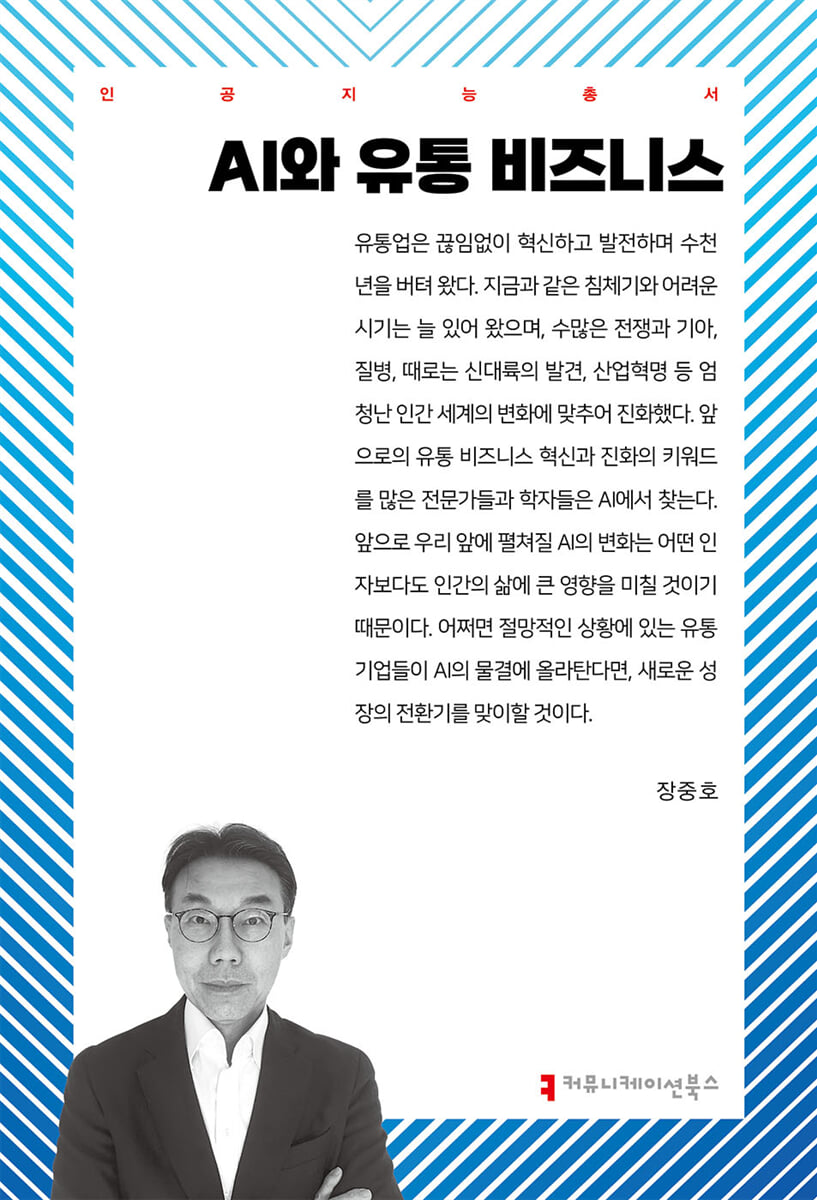
AI and the Distribution Business
 |
Description
Book Introduction
We analyze the innovations and opportunities that AI technology will bring to the distribution industry.
We present how to design the future of distribution with AI, including personalized customer service, supply chain optimization, and digital transformation.
We present how to design the future of distribution with AI, including personalized customer service, supply chain optimization, and digital transformation.
- You can preview some of the book's contents.
Preview
index
The intersection of AI and distribution: the beginning of change.
01 Evolution of the Distribution Business Paradigm
02 Understanding the Distribution Business Value Chain
03 Twelve Key AI Technologies for Transforming the Distribution Business
04 AI Product and Merchandising
05 AI Marketing
06 AI Store
07 AI Logistics and Delivery
08 AI Customer Experience
09 AI and Big Data
10 AI and Distribution Business Ethics
01 Evolution of the Distribution Business Paradigm
02 Understanding the Distribution Business Value Chain
03 Twelve Key AI Technologies for Transforming the Distribution Business
04 AI Product and Merchandising
05 AI Marketing
06 AI Store
07 AI Logistics and Delivery
08 AI Customer Experience
09 AI and Big Data
10 AI and Distribution Business Ethics
Into the book
At the heart of Retail 4.0 lies a diverse array of digital technologies. AI is a core technology used across all areas of the retail industry, enabling demand forecasting, personalized recommendations, and price optimization based on consumer data.
This allows companies to improve the accuracy and efficiency of decision-making and provide better service to customers.
The Internet of Things (IoT) enables efficient operations by collecting and connecting data in real time from stores, logistics centers, and consumer homes.
Smart stores utilizing IoT monitor the status of in-store products in real time and provide an optimized operating environment.
These technologies help retailers respond more quickly to consumer demands.
--- From "01_Evolution of the Distribution Business Paradigm"
In offline stores, AI automates inventory management, customer flow analysis, payment systems, and store environment management, contributing to increased sales and improved customer experience. AI monitors in-store inventory in real time and automatically reorders insufficient items to prevent out-of-stock issues.
Analyze customer movement data to place popular products at the front of the store or place promotional products in optimal locations within the store to increase the likelihood of purchase.
By automatically monitoring and optimizing each area that requires human intervention, such as in-store temperature, power usage, and cleaning, through IoT sensors and AI, it is having a significant impact on reducing manpower and costs.
--- From "03_Twelve Core AI Technologies for Distribution Business Transformation"
In addition to unmanned store technology, smart shelves are a key component of store intelligence technology. They automatically recognize when a customer picks up or returns an item, provide product information on displays or voice speakers near the shelf, and enable personalized recommendations.
Japan's Lawson convenience store chain has introduced AI-powered smart shelves that display detailed product information and recommend related products on a digital screen when a customer picks up an item from the shelf.
These technologies enhance customer convenience and support purchasing decisions, leading to increased sales.
--- From "06_AI Store"
Modern retail companies are strengthening their competitiveness based on the massive amount of data generated from customers, products, and social media.
However, to effectively collect, store, process, and analyze customer data, SCM data, and social big data, and to utilize them in AI technology, advanced data infrastructure, platforms, and specialized capabilities are essential.
Distribution companies must have scalable storage infrastructure to adapt to an environment where the volume and variety of data is explosively increasing.
To efficiently store large amounts of data and increase accessibility, cloud-based storage must be utilized, and a data lake must be built to store both structured and unstructured data.
This allows companies to improve the accuracy and efficiency of decision-making and provide better service to customers.
The Internet of Things (IoT) enables efficient operations by collecting and connecting data in real time from stores, logistics centers, and consumer homes.
Smart stores utilizing IoT monitor the status of in-store products in real time and provide an optimized operating environment.
These technologies help retailers respond more quickly to consumer demands.
--- From "01_Evolution of the Distribution Business Paradigm"
In offline stores, AI automates inventory management, customer flow analysis, payment systems, and store environment management, contributing to increased sales and improved customer experience. AI monitors in-store inventory in real time and automatically reorders insufficient items to prevent out-of-stock issues.
Analyze customer movement data to place popular products at the front of the store or place promotional products in optimal locations within the store to increase the likelihood of purchase.
By automatically monitoring and optimizing each area that requires human intervention, such as in-store temperature, power usage, and cleaning, through IoT sensors and AI, it is having a significant impact on reducing manpower and costs.
--- From "03_Twelve Core AI Technologies for Distribution Business Transformation"
In addition to unmanned store technology, smart shelves are a key component of store intelligence technology. They automatically recognize when a customer picks up or returns an item, provide product information on displays or voice speakers near the shelf, and enable personalized recommendations.
Japan's Lawson convenience store chain has introduced AI-powered smart shelves that display detailed product information and recommend related products on a digital screen when a customer picks up an item from the shelf.
These technologies enhance customer convenience and support purchasing decisions, leading to increased sales.
--- From "06_AI Store"
Modern retail companies are strengthening their competitiveness based on the massive amount of data generated from customers, products, and social media.
However, to effectively collect, store, process, and analyze customer data, SCM data, and social big data, and to utilize them in AI technology, advanced data infrastructure, platforms, and specialized capabilities are essential.
Distribution companies must have scalable storage infrastructure to adapt to an environment where the volume and variety of data is explosively increasing.
To efficiently store large amounts of data and increase accessibility, cloud-based storage must be utilized, and a data lake must be built to store both structured and unstructured data.
--- From "09_AI and Big Data"
Publisher's Review
The Future of Distribution: Powered by AI
AI is no longer just a technology; it is a key tool that is changing the landscape of industry.
The distribution industry, in particular, is turning crises into opportunities through its integration with AI.
Innovative AI technologies, such as generative AI, deep learning, and foundational models, are deeply penetrating each stage of the distribution value chain, creating new business models.
This book presents various case studies demonstrating how AI is key to overcoming the current crisis in the distribution industry. AI-powered customer-tailored services, real-time demand forecasting, and supply chain optimization are helping overcome the limitations of traditional distribution methods.
Furthermore, amidst the real-world challenges facing the distribution business, such as demographic shifts, rising labor costs, and intensifying global competition, AI enables flexible and agile response strategies. AI is no longer simply a means of efficiency improvement; it is a strategic choice that determines the survival and growth of the distribution industry. This book examines practical methods for AI adoption and the potential new opportunities it can create, offering guidance to distribution professionals and those contemplating future distribution strategies.
AI is no longer just a technology; it is a key tool that is changing the landscape of industry.
The distribution industry, in particular, is turning crises into opportunities through its integration with AI.
Innovative AI technologies, such as generative AI, deep learning, and foundational models, are deeply penetrating each stage of the distribution value chain, creating new business models.
This book presents various case studies demonstrating how AI is key to overcoming the current crisis in the distribution industry. AI-powered customer-tailored services, real-time demand forecasting, and supply chain optimization are helping overcome the limitations of traditional distribution methods.
Furthermore, amidst the real-world challenges facing the distribution business, such as demographic shifts, rising labor costs, and intensifying global competition, AI enables flexible and agile response strategies. AI is no longer simply a means of efficiency improvement; it is a strategic choice that determines the survival and growth of the distribution industry. This book examines practical methods for AI adoption and the potential new opportunities it can create, offering guidance to distribution professionals and those contemplating future distribution strategies.
GOODS SPECIFICS
- Date of issue: April 14, 2025
- Page count, weight, size: 113 pages | 128*188*8mm
- ISBN13: 9791173079337
You may also like
카테고리
korean


korean

![GQ KOREA Mark (Monthly): December [2025]](http://librairie.coreenne.fr/cdn/shop/files/8ef265dbbfbf186523ed75ba7319009d.jpg?v=1765340328&width=3840)


