

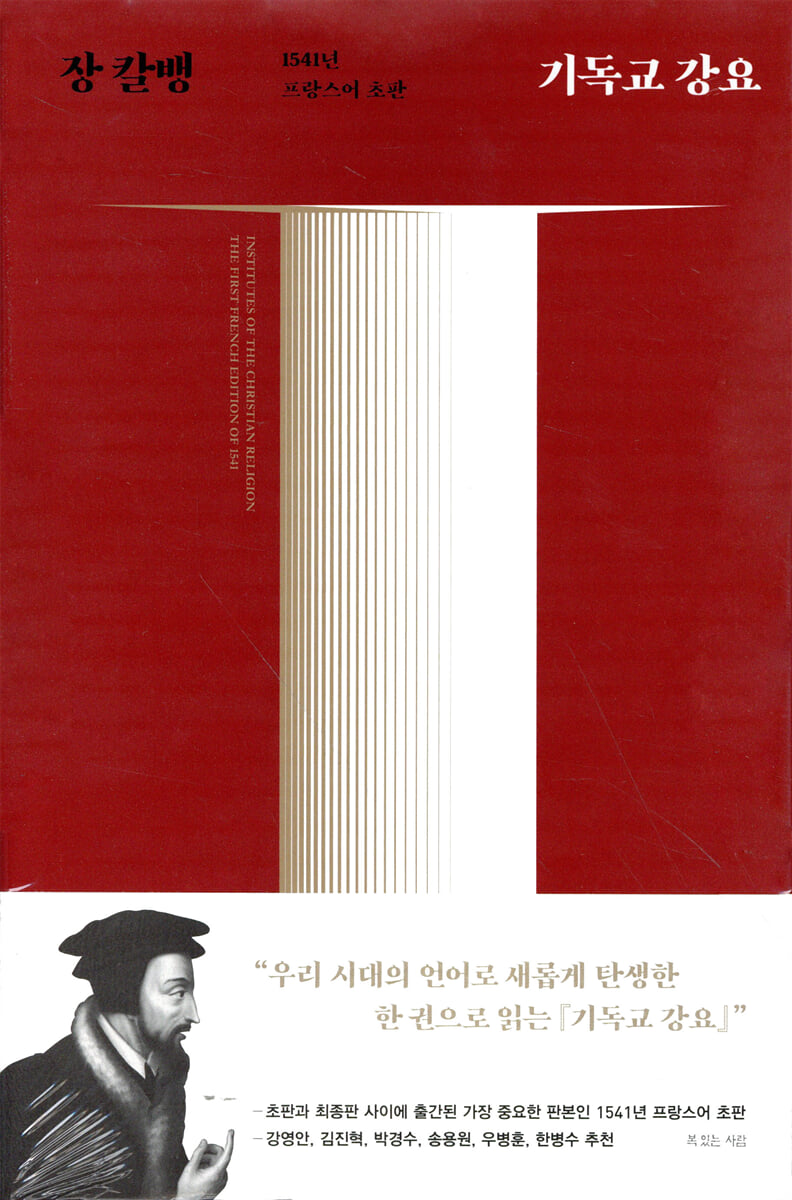
The Institutes of the Christian Religion (first edition in French, 1541)
 |
Description
Book Introduction
"A masterpiece in which the passionate heart of Calvin's theology beats
Finally, he came to us wearing the language of today!"
"The Institutes of the Christian Religion: A Newly Reimagined Volume in the Language of Our Times"
- The first French edition of 1541, the most important edition published between the first and final editions.
- Recommended by Kang Young-an, Kim Jin-hyeok, Park Gyeong-su, Song Yong-won, Woo Byeong-hun, and Han Byeong-su
First published in Latin in 1536, Institutes of the Christian Religion was intended to be a guide or introduction to the core of the Christian faith.
Calvin sought to meet the needs of those who “still know little about the gospel, but who hunger and thirst after Christ and who will ultimately be trained in true godliness.”
However, after the extraordinary success of the first edition, Calvin, eager to explain the Christian faith more fully, published a much-enhanced second Latin edition in 1539.
Through this process, 『Institutes of the Christian Religion』 was significantly transformed from a doctrinal book into a doctrinal book that covered the main doctrines by topic.
In 1541, Calvin translated the second Latin edition into French to accommodate the common believers in his home country who did not know Latin.
The book you are reading is the first French edition of 1541 of the Institutes of the Christian Religion, the most important and widely read of the several editions published between the first and final Latin editions (1559).
The French first edition, along with the Latin second edition, served as the basis for subsequent editions, and was written in a popular language intended for a much wider readership, making it easy to understand biblical concepts and important theological content.
Calvin published the first French edition of this book in 1541 with three purposes.
First, it was intended to be helpful not only to readers who want to learn the basics of faith, but also to theology students who want to gain a deeper understanding of all theological topics.
Second, I wanted to write a book that would be helpful for a deeper understanding of the Bible, rather than just a simple catechism.
Third, I hoped that even ordinary believers in my home country who did not know Latin would read this book in French and learn the core of the faith.
Readers of this book will fully appreciate that Calvin's intentions and objectives were successful.
Even for those who think, "Isn't the final edition enough?", there is a reason why I would recommend the 1541 French first edition of this book even more.
First of all, it is important data for estimating how Calvin's thought developed.
This book clearly shows what Calvin thought in his early 30s.
Next, Calvin himself explains Latin technical terms in everyday language.
This book was written from the beginning with the general reader in mind, so even difficult theological content was made easier to understand.
Finally, the final version can bore the reader because of its complexity, but this book does not.
The 'conciseness' (brevitas) and 'ease' (facilitas) that Calvin pursued in his commentary are perfectly implemented here.
The first French edition of 1541 is a much-loved edition.
Unlike the triumphant launch of the first edition in 1536 or the grand finale of the final version in 1559, this one is permeated with the story of a failed reformer's transformation into a balanced and gentle pastor in a refugee community.
If Wartburg has Luther's German Bible, Strasbourg has Calvin's French Institutes of the Christian Religion.
Thus, the masterpiece that vividly captures the process of Calvin's theology's cultivation, which was noticeably broadening and deepening, has finally been translated into Korean, full of today's sensibilities.
This book shines even more thanks to the translation that captures Calvin's writing style and the excellent editing skills.
We invite you to the vast plains where Calvin's confession, reminiscent of Paul's, "What happened to me actually served to advance the gospel," resonates.
Finally, he came to us wearing the language of today!"
"The Institutes of the Christian Religion: A Newly Reimagined Volume in the Language of Our Times"
- The first French edition of 1541, the most important edition published between the first and final editions.
- Recommended by Kang Young-an, Kim Jin-hyeok, Park Gyeong-su, Song Yong-won, Woo Byeong-hun, and Han Byeong-su
First published in Latin in 1536, Institutes of the Christian Religion was intended to be a guide or introduction to the core of the Christian faith.
Calvin sought to meet the needs of those who “still know little about the gospel, but who hunger and thirst after Christ and who will ultimately be trained in true godliness.”
However, after the extraordinary success of the first edition, Calvin, eager to explain the Christian faith more fully, published a much-enhanced second Latin edition in 1539.
Through this process, 『Institutes of the Christian Religion』 was significantly transformed from a doctrinal book into a doctrinal book that covered the main doctrines by topic.
In 1541, Calvin translated the second Latin edition into French to accommodate the common believers in his home country who did not know Latin.
The book you are reading is the first French edition of 1541 of the Institutes of the Christian Religion, the most important and widely read of the several editions published between the first and final Latin editions (1559).
The French first edition, along with the Latin second edition, served as the basis for subsequent editions, and was written in a popular language intended for a much wider readership, making it easy to understand biblical concepts and important theological content.
Calvin published the first French edition of this book in 1541 with three purposes.
First, it was intended to be helpful not only to readers who want to learn the basics of faith, but also to theology students who want to gain a deeper understanding of all theological topics.
Second, I wanted to write a book that would be helpful for a deeper understanding of the Bible, rather than just a simple catechism.
Third, I hoped that even ordinary believers in my home country who did not know Latin would read this book in French and learn the core of the faith.
Readers of this book will fully appreciate that Calvin's intentions and objectives were successful.
Even for those who think, "Isn't the final edition enough?", there is a reason why I would recommend the 1541 French first edition of this book even more.
First of all, it is important data for estimating how Calvin's thought developed.
This book clearly shows what Calvin thought in his early 30s.
Next, Calvin himself explains Latin technical terms in everyday language.
This book was written from the beginning with the general reader in mind, so even difficult theological content was made easier to understand.
Finally, the final version can bore the reader because of its complexity, but this book does not.
The 'conciseness' (brevitas) and 'ease' (facilitas) that Calvin pursued in his commentary are perfectly implemented here.
The first French edition of 1541 is a much-loved edition.
Unlike the triumphant launch of the first edition in 1536 or the grand finale of the final version in 1559, this one is permeated with the story of a failed reformer's transformation into a balanced and gentle pastor in a refugee community.
If Wartburg has Luther's German Bible, Strasbourg has Calvin's French Institutes of the Christian Religion.
Thus, the masterpiece that vividly captures the process of Calvin's theology's cultivation, which was noticeably broadening and deepening, has finally been translated into Korean, full of today's sensibilities.
This book shines even more thanks to the translation that captures Calvin's writing style and the excellent editing skills.
We invite you to the vast plains where Calvin's confession, reminiscent of Paul's, "What happened to me actually served to advance the gospel," resonates.
- You can preview some of the book's contents.
Preview
index
Foreword_Robert White
outline
A letter of dedication to Francis I
Chapter 1: Knowledge of God
Chapter 2: Knowledge of Man and Free Will
Chapter 3 The Law
Chapter 4: Faith and the Apostles' Creed Commentary
Chapter 5 Repentance
Chapter 6 Justification by Faith and Works
Chapter 7: Similarities and Differences Between the Old and New Testaments
Chapter 8 God's Predestination and Providence
Chapter 9: Prayer and Commentary on the Lord's Prayer
Chapter 10 Sacraments
Chapter 11 Baptism
Chapter 12 The Lord's Supper
Chapter 13 Five Rites Misunderstood as Sacraments:
Sacrament of Confirmation, Sacrament of Confession, Sacrament of Exaltation, Sacrament of Holy Orders, Sacrament of Matrimony
Chapter 14 Christian Freedom
Chapter 15: The Power of the Church
Chapter 16 Secular Government
Chapter 17 The Christian Life
Appendix: Comparison of the 1541 and 1560 editions of Institutes of the Christian Religion
main
Index (Bible verses, names, topics)
Translator's Note
outline
A letter of dedication to Francis I
Chapter 1: Knowledge of God
Chapter 2: Knowledge of Man and Free Will
Chapter 3 The Law
Chapter 4: Faith and the Apostles' Creed Commentary
Chapter 5 Repentance
Chapter 6 Justification by Faith and Works
Chapter 7: Similarities and Differences Between the Old and New Testaments
Chapter 8 God's Predestination and Providence
Chapter 9: Prayer and Commentary on the Lord's Prayer
Chapter 10 Sacraments
Chapter 11 Baptism
Chapter 12 The Lord's Supper
Chapter 13 Five Rites Misunderstood as Sacraments:
Sacrament of Confirmation, Sacrament of Confession, Sacrament of Exaltation, Sacrament of Holy Orders, Sacrament of Matrimony
Chapter 14 Christian Freedom
Chapter 15: The Power of the Church
Chapter 16 Secular Government
Chapter 17 The Christian Life
Appendix: Comparison of the 1541 and 1560 editions of Institutes of the Christian Religion
main
Index (Bible verses, names, topics)
Translator's Note
Into the book
It is abundantly clear that there is in the human heart some innate sense of divinity, which cannot be avoided by claiming ignorance of it.
The Lord has filled everyone with some understanding of His majesty.
So people come to know that there is only one God and that He is their Creator.
---From “Chapter 1: Knowledge of God”
The human will is bound by the bondage of sin and cannot make any progress toward good.
I can't even try to do that.
Such a movement is the first step toward turning to God, and the Bible teaches that this movement is entirely by the grace of the Holy Spirit.
---From "Chapter 2: Knowledge of Humans and Free Will"
God loves justice and righteousness, but hates sin.
If we do not wish to turn away from our Creator through willful ingratitude, we must always cherish righteousness and strive to attain it while we live.
A human being can never excuse himself by claiming incompetence, or by claiming that he is in a position where he cannot repay anything, like a bankrupt debtor.
---From "Chapter 3 Law"
First, we must learn to pay attention to the Word of God to understand the nature and power of faith.
Faith is so close and intimate to the Word of God that nothing outside of faith can measure His Word.
Because the Word of God is the object and purpose that faith must look to forever.
---From “Chapter 4: Faith and the Apostles’ Creed Commentary”
The beginning of repentance is hatred for sin.
This hatred first makes us realize that Christ gave himself not to anyone else but to poor, suffering sinners who stagger under the weight of sorrow and misery and groan in the pangs of childbirth.
Once we begin to repent in this way, we must pursue repentance every day of our lives if we want to abide in Christ.
---From "Chapter 5 Repentance"
If we seek to know how our conscience can find peace and joy before God, we find that it is only through the free gift of righteousness, given by God's good will.
We should always remember Solomon's words (Proverbs 20:9):
“Who can say, ‘I have made my heart pure and my sins have been washed away’?”
---From “Chapter 6 Justification by Faith and Merit of Works”
The Old Testament fills the conscience with fear, but the New Testament fills the conscience with joy and gladness.
The Old Testament tightly binds and restricts the conscience with a yoke of slavery, but the New Testament rescues and redeems the conscience, setting it free.
The Old Testament patriarchs knew that the law was enslaving them through bondage and an uneasy conscience, and they looked forward to the gospel to help them.
The Lord has filled everyone with some understanding of His majesty.
So people come to know that there is only one God and that He is their Creator.
---From “Chapter 1: Knowledge of God”
The human will is bound by the bondage of sin and cannot make any progress toward good.
I can't even try to do that.
Such a movement is the first step toward turning to God, and the Bible teaches that this movement is entirely by the grace of the Holy Spirit.
---From "Chapter 2: Knowledge of Humans and Free Will"
God loves justice and righteousness, but hates sin.
If we do not wish to turn away from our Creator through willful ingratitude, we must always cherish righteousness and strive to attain it while we live.
A human being can never excuse himself by claiming incompetence, or by claiming that he is in a position where he cannot repay anything, like a bankrupt debtor.
---From "Chapter 3 Law"
First, we must learn to pay attention to the Word of God to understand the nature and power of faith.
Faith is so close and intimate to the Word of God that nothing outside of faith can measure His Word.
Because the Word of God is the object and purpose that faith must look to forever.
---From “Chapter 4: Faith and the Apostles’ Creed Commentary”
The beginning of repentance is hatred for sin.
This hatred first makes us realize that Christ gave himself not to anyone else but to poor, suffering sinners who stagger under the weight of sorrow and misery and groan in the pangs of childbirth.
Once we begin to repent in this way, we must pursue repentance every day of our lives if we want to abide in Christ.
---From "Chapter 5 Repentance"
If we seek to know how our conscience can find peace and joy before God, we find that it is only through the free gift of righteousness, given by God's good will.
We should always remember Solomon's words (Proverbs 20:9):
“Who can say, ‘I have made my heart pure and my sins have been washed away’?”
---From “Chapter 6 Justification by Faith and Merit of Works”
The Old Testament fills the conscience with fear, but the New Testament fills the conscience with joy and gladness.
The Old Testament tightly binds and restricts the conscience with a yoke of slavery, but the New Testament rescues and redeems the conscience, setting it free.
The Old Testament patriarchs knew that the law was enslaving them through bondage and an uneasy conscience, and they looked forward to the gospel to help them.
---From “Chapter 7: Similarities and Differences between the Old and New Testaments”
Publisher's Review
characteristic
-The first French edition of 1541, the most important edition published between the first and final editions.
-A translation that captures Calvin's original spirit and a smooth, meticulous editing.
- Includes a comparison table of volumes, chapters, and articles with the 1560 French edition.
Target audience
- Those who wish to delve deeply into the life and thought of John Calvin
- Those who seek to approach the essence and core of the Reformation and Protestantism.
-Those who want to understand the Bible more deeply
-All believers who strive to think and live according to Christ
-The first French edition of 1541, the most important edition published between the first and final editions.
-A translation that captures Calvin's original spirit and a smooth, meticulous editing.
- Includes a comparison table of volumes, chapters, and articles with the 1560 French edition.
Target audience
- Those who wish to delve deeply into the life and thought of John Calvin
- Those who seek to approach the essence and core of the Reformation and Protestantism.
-Those who want to understand the Bible more deeply
-All believers who strive to think and live according to Christ
GOODS SPECIFICS
- Publication date: January 10, 2022
- Format: Hardcover book binding method guide
- Page count, weight, size: 1,152 pages | 1,528g | 152*227*60mm
- ISBN13: 9791197467622
- ISBN10: 1197467629
You may also like
카테고리
korean


korean

![GQ KOREA Mark (Monthly): December [2025]](http://librairie.coreenne.fr/cdn/shop/files/8ef265dbbfbf186523ed75ba7319009d.jpg?v=1765340328&width=3840)


