

Smith's Wealth of Nations
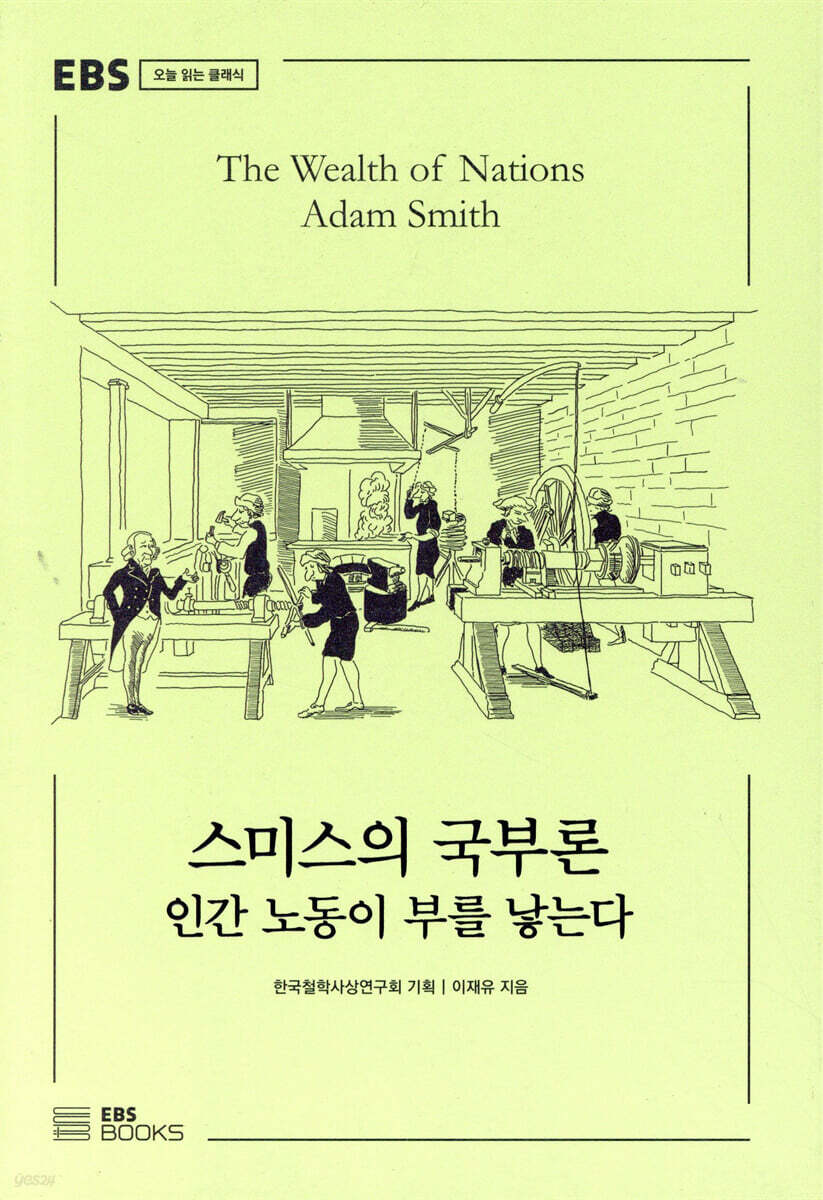 |
Description
Book Introduction
Adam Smith, the mother of modern economics
Talking about the source of a nation's wealth
Adam Smith, the mother of modern economics, proposed the labor theory of value, which states that the source of a nation's wealth is human labor.
Smith's liberal economics is linked to neoliberalism today.
However, his ideas also provide a starting point for solving the problems of the capitalist economy represented by neoliberalism.
This is because, in his book, The Wealth of Nations, ‘human labor’ and ‘the anthropology of labor’ occupy the greatest proportion.
This book is a guide to the world of Adam Smith's thought and The Wealth of Nations by Professor Jae-Yu Lee, a philosopher who has studied and researched political economy, human beings, labor, and value issues.
Smith said that the people who drive the economy are motivated by self-love.
Narcissism is empathy, and empathy manifests itself in labor.
Through this empathy and labor, each individual can live as a free being, free from the conflicts of interest between them (hostile competition and the inevitable product of this competition, monopoly).
Smith wrote The Wealth of Nations while dreaming of this kind of free life.
Essentially, The Wealth of Nations is known as the work that first established the theory of classical bourgeois (capitalist) economics.
The core of classical economics is known as the 'night watch state' and 'laissez-faire'.
A night watchman state means minimizing the state or government's intervention in the market, and laissez-faire is a 'market fundamentalism' that leaves everything to the free will of the market.
However, today's neoliberalism is worsening the problems of the capitalist economy rather than solving them, such as the decline in regular employment, the expansion of non-regular employment, and the deepening gap between the rich and the poor.
Author Lee Jae-yu attempts to reveal that, contrary to popular belief, Smith's ideas in "The Wealth of Nations" provide a starting point for resolving the problems of the capitalist economy, represented by neoliberalism (market fundamentalism).
Talking about the source of a nation's wealth
Adam Smith, the mother of modern economics, proposed the labor theory of value, which states that the source of a nation's wealth is human labor.
Smith's liberal economics is linked to neoliberalism today.
However, his ideas also provide a starting point for solving the problems of the capitalist economy represented by neoliberalism.
This is because, in his book, The Wealth of Nations, ‘human labor’ and ‘the anthropology of labor’ occupy the greatest proportion.
This book is a guide to the world of Adam Smith's thought and The Wealth of Nations by Professor Jae-Yu Lee, a philosopher who has studied and researched political economy, human beings, labor, and value issues.
Smith said that the people who drive the economy are motivated by self-love.
Narcissism is empathy, and empathy manifests itself in labor.
Through this empathy and labor, each individual can live as a free being, free from the conflicts of interest between them (hostile competition and the inevitable product of this competition, monopoly).
Smith wrote The Wealth of Nations while dreaming of this kind of free life.
Essentially, The Wealth of Nations is known as the work that first established the theory of classical bourgeois (capitalist) economics.
The core of classical economics is known as the 'night watch state' and 'laissez-faire'.
A night watchman state means minimizing the state or government's intervention in the market, and laissez-faire is a 'market fundamentalism' that leaves everything to the free will of the market.
However, today's neoliberalism is worsening the problems of the capitalist economy rather than solving them, such as the decline in regular employment, the expansion of non-regular employment, and the deepening gap between the rich and the poor.
Author Lee Jae-yu attempts to reveal that, contrary to popular belief, Smith's ideas in "The Wealth of Nations" provide a starting point for resolving the problems of the capitalist economy, represented by neoliberalism (market fundamentalism).
- You can preview some of the book's contents.
Preview
index
introduction
Chapter 1: Adam Smith, the Mother of Modern Economics
Philosophy, what is this?
Mother of modern economics
The Foundations of Adam Smith's Philosophical Worldview: The Empiric Principle of Association and the Principle of Sympathy
The human view of market liberalism and welfarism, and Marx's materialist view of humanity
Chapter 2: Reading The Wealth of Nations
The Starting Point of Philosophy: Doubt About Myself and the Establishment of Consciousness About Myself
Divide the work to help each other live well
How capital expands its own body
Europe that violated the natural course of things
Should we prioritize commerce or agriculture?
I exist because my country exists.
In closing
Chapter 3: Milestones of Philosophy
Adam Smith, The Theory of Moral Sentiments
David Hume, On the Understanding
Jean-Jacques Rousseau, The Social Contract
John Locke, Treatise on Government
David Ricardo, On the Principles of Political Economy and Taxation
Karl Marx, Capital
Life chronology
References
Chapter 1: Adam Smith, the Mother of Modern Economics
Philosophy, what is this?
Mother of modern economics
The Foundations of Adam Smith's Philosophical Worldview: The Empiric Principle of Association and the Principle of Sympathy
The human view of market liberalism and welfarism, and Marx's materialist view of humanity
Chapter 2: Reading The Wealth of Nations
The Starting Point of Philosophy: Doubt About Myself and the Establishment of Consciousness About Myself
Divide the work to help each other live well
How capital expands its own body
Europe that violated the natural course of things
Should we prioritize commerce or agriculture?
I exist because my country exists.
In closing
Chapter 3: Milestones of Philosophy
Adam Smith, The Theory of Moral Sentiments
David Hume, On the Understanding
Jean-Jacques Rousseau, The Social Contract
John Locke, Treatise on Government
David Ricardo, On the Principles of Political Economy and Taxation
Karl Marx, Capital
Life chronology
References
Into the book
Humor is a mental attitude, and living one's own life proactively is the process of establishing one's own philosophical worldview.
The establishment of a philosophical worldview begins with doubting everything one takes for granted.
What kind of humor did Adam Smith develop through "The Wealth of Nations"? What did he doubt while establishing his own identity? Isn't clarifying my own humor the very meaning of reading the classics? Let's begin our journey to discover that meaning.
---From the "Preface"
The atomized and selfish view of humanity and the emergence of an absolute state and capital based on the social contract are two sides of the same coin in the modern philosophical worldview.
Modern philosophy is divided into an empiricist worldview and a rationalist worldview.
The empiricist worldview is linked to a selfish view of humanity, and the rationalist worldview is linked to the emergence of absolute states and capital.
However, Adam Smith, like Hume, was based on a modern worldview, but he tried to distance himself from the empiricist and rationalist worldviews.
The human relationship that emerged as a result of this is one of empathy.
And based on this view of humanity, he discussed 'laissez-faire' ('invisible hand', 'night watchman'), 'division of labor', and the labor theory of value and the relationship between wages, profit, and land rent in 'The Wealth of Nations'.
---From "Chapter 1: Adam Smith, the Mother of Modern Economics"
Like David Hume, for Adam Smith, humans were not beings who lived in the reality of nature, but in the reality created by their own minds and imaginations.
The emotions, which Hume and Smith called passion and sentiment, were for both men a more plausible source of action and a more certain object of experience than reason.
Based on this, Smith published his first book, The Theory of Moral Sentiments, a compilation of his ethical writings in 1759.
---From "Chapter 1: Adam Smith, the Mother of Modern Economics"
Finally, on March 9, 1776, The Wealth of Nations was published in two quarto volumes.
The original title of this first edition was An Inquiry into the Nature and Causes of the Wealth of Nations, and the price was 1 pound 16 shillings.
The book went through five editions during Smith's lifetime, and was quickly translated into German, French, Danish, and other foreign languages.
The augmented edition was published as a separate volume in November 1784.
The expanded edition allowed Smith to address sensitive current affairs of the time, particularly the serious corruption and tyranny of the East India Company in India, making The Wealth of Nations a vivid work that is in touch with reality.
The new edition, consisting of 24,000 words in 13 chapters, opposed wheat and herring subsidies and supported free trade with France.
---From "Chapter 1: Adam Smith, the Mother of Modern Economics"
What Smith considered most important was the wealth and social benefit of all citizens.
Therefore, his economics is based on an ideological foundation that is quite different from the market-fundamentalist laissez-faire (which is called neoliberalism today) advocated by modern bourgeois economics and the resulting monopolization of wealth by a small number of people.
The book that clearly shows these differences is 『The Wealth of Nations』.
And as long as The Wealth of Nations emerges as a solution to the problems of neoliberalism advocated by modern bourgeois economics, The Wealth of Nations will remain a living classic.
---From "Chapter 1: Adam Smith, the Mother of Modern Economics"
If Adam Smith had seen the excessive and poor working conditions and frequent industrial accidents in South Korea today, he would have made a moral appeal to South Korea's capitalists (employers) to have 'reason and humanity.'
However, it is questionable whether his appeal, which regarded the laws of capitalist economics as 'natural laws', would have resonated with employers.
This is because capitalists, who are agents of the laws of nature (the laws of capitalist economics), cannot be evaluated as ‘good’ or ‘bad’ capitalists, as Marx said.
In other words, capitalists are also beings who have no choice but to follow the laws of capitalism.
So how can workers be guaranteed "rational and humane" rest? To answer this question, shouldn't we first consider whether the economic laws of capitalism are truly "immutable" and "natural laws"?
---From "Chapter 2: Reading The Wealth of Nations"
Adam Smith says that physiocracy is very meaningful and “justified.”
In other words, he says that physiocracy is valid because “the wealth of nations is not composed of the non-consumable precious metal called money, but of consumable goods that are annually reproduced by the labor of the society,” such as rice, sweets, clothes, and shoes, and because “complete freedom” (pp. 837-838) in trade with foreign countries is the only thing that maximizes wealth.
---From "Chapter 2: Reading The Wealth of Nations"
Adam Smith's Theory of Moral Sentiments (1759) discusses the basis of human moral sentiments.
The basis of moral sentiments is human empathy, which means feeling joy or sorrow when witnessing the joy or sorrow of others.
When we feel this kind of empathy, we can become happy.
However, the standard for this empathy is the 'impartial spectator'.
An impartial observer determines whether one's actions are selfish or allow for harmonious relationships with others.
This impartial observer leads to the 'invisible hand' in The Wealth of Nations.
The establishment of a philosophical worldview begins with doubting everything one takes for granted.
What kind of humor did Adam Smith develop through "The Wealth of Nations"? What did he doubt while establishing his own identity? Isn't clarifying my own humor the very meaning of reading the classics? Let's begin our journey to discover that meaning.
---From the "Preface"
The atomized and selfish view of humanity and the emergence of an absolute state and capital based on the social contract are two sides of the same coin in the modern philosophical worldview.
Modern philosophy is divided into an empiricist worldview and a rationalist worldview.
The empiricist worldview is linked to a selfish view of humanity, and the rationalist worldview is linked to the emergence of absolute states and capital.
However, Adam Smith, like Hume, was based on a modern worldview, but he tried to distance himself from the empiricist and rationalist worldviews.
The human relationship that emerged as a result of this is one of empathy.
And based on this view of humanity, he discussed 'laissez-faire' ('invisible hand', 'night watchman'), 'division of labor', and the labor theory of value and the relationship between wages, profit, and land rent in 'The Wealth of Nations'.
---From "Chapter 1: Adam Smith, the Mother of Modern Economics"
Like David Hume, for Adam Smith, humans were not beings who lived in the reality of nature, but in the reality created by their own minds and imaginations.
The emotions, which Hume and Smith called passion and sentiment, were for both men a more plausible source of action and a more certain object of experience than reason.
Based on this, Smith published his first book, The Theory of Moral Sentiments, a compilation of his ethical writings in 1759.
---From "Chapter 1: Adam Smith, the Mother of Modern Economics"
Finally, on March 9, 1776, The Wealth of Nations was published in two quarto volumes.
The original title of this first edition was An Inquiry into the Nature and Causes of the Wealth of Nations, and the price was 1 pound 16 shillings.
The book went through five editions during Smith's lifetime, and was quickly translated into German, French, Danish, and other foreign languages.
The augmented edition was published as a separate volume in November 1784.
The expanded edition allowed Smith to address sensitive current affairs of the time, particularly the serious corruption and tyranny of the East India Company in India, making The Wealth of Nations a vivid work that is in touch with reality.
The new edition, consisting of 24,000 words in 13 chapters, opposed wheat and herring subsidies and supported free trade with France.
---From "Chapter 1: Adam Smith, the Mother of Modern Economics"
What Smith considered most important was the wealth and social benefit of all citizens.
Therefore, his economics is based on an ideological foundation that is quite different from the market-fundamentalist laissez-faire (which is called neoliberalism today) advocated by modern bourgeois economics and the resulting monopolization of wealth by a small number of people.
The book that clearly shows these differences is 『The Wealth of Nations』.
And as long as The Wealth of Nations emerges as a solution to the problems of neoliberalism advocated by modern bourgeois economics, The Wealth of Nations will remain a living classic.
---From "Chapter 1: Adam Smith, the Mother of Modern Economics"
If Adam Smith had seen the excessive and poor working conditions and frequent industrial accidents in South Korea today, he would have made a moral appeal to South Korea's capitalists (employers) to have 'reason and humanity.'
However, it is questionable whether his appeal, which regarded the laws of capitalist economics as 'natural laws', would have resonated with employers.
This is because capitalists, who are agents of the laws of nature (the laws of capitalist economics), cannot be evaluated as ‘good’ or ‘bad’ capitalists, as Marx said.
In other words, capitalists are also beings who have no choice but to follow the laws of capitalism.
So how can workers be guaranteed "rational and humane" rest? To answer this question, shouldn't we first consider whether the economic laws of capitalism are truly "immutable" and "natural laws"?
---From "Chapter 2: Reading The Wealth of Nations"
Adam Smith says that physiocracy is very meaningful and “justified.”
In other words, he says that physiocracy is valid because “the wealth of nations is not composed of the non-consumable precious metal called money, but of consumable goods that are annually reproduced by the labor of the society,” such as rice, sweets, clothes, and shoes, and because “complete freedom” (pp. 837-838) in trade with foreign countries is the only thing that maximizes wealth.
---From "Chapter 2: Reading The Wealth of Nations"
Adam Smith's Theory of Moral Sentiments (1759) discusses the basis of human moral sentiments.
The basis of moral sentiments is human empathy, which means feeling joy or sorrow when witnessing the joy or sorrow of others.
When we feel this kind of empathy, we can become happy.
However, the standard for this empathy is the 'impartial spectator'.
An impartial observer determines whether one's actions are selfish or allow for harmonious relationships with others.
This impartial observer leads to the 'invisible hand' in The Wealth of Nations.
---From "Chapter 3: Milestones of Philosophy"
Publisher's Review
The philosophical meaning of the 'invisible hand':
Human nature to seek harmonious relationships
Smith's ideas remain a precious legacy for humanity, but they are certainly not confined to the vaults of museums.
We often refer to Smith as the mother of modern economics.
Of course, there were many people who studied economic phenomena before Smith.
There was William Petty, John Locke, David Hume, François Quesnay, etc., without having to go all the way to Aristotle.
But why, leaving these people aside, is Smith specifically called the mother of modern economics? It's because he was the first to argue that the essence of wealth is labor.
What Smith considered most important was the wealth and social benefit of all citizens.
Therefore, his economics is based on an ideological foundation that is quite different from the market-fundamentalist laissez-faire (which is called neoliberalism today) advocated by modern bourgeois economics and the resulting monopolization of wealth by a small number of people.
The book that clearly shows these differences is 『The Wealth of Nations』.
And as long as The Wealth of Nations emerges as a solution to the problems of neoliberalism advocated by modern bourgeois economics, The Wealth of Nations will remain a living classic.
Chapter 1 of this book, "Adam Smith, the Mother of Modern Economics," explores Smith's life, thoughts, and the historical context.
Adam Smith's worldview is based on modern empiricism, especially Hume's empiricism.
Hume's principle of association and the philosophy of sympathy based on it are closely connected to Adam Smith's moral philosophy of 'sympathy' and his view of humanity.
Humans with various emotions have empathy through the 'invisible hand', similar to Hume's principle of association.
In particular, the author states that this 'invisible hand' does not refer to the principles of the market or market liberalism, but rather to the human nature of striving for harmonious relationships, and that this is well revealed in Part 2 of 'The Wealth of Nations'.
In Chapter 2, we begin reading 『The Wealth of Nations』 in earnest.
It describes Smith's theory of dividing work (division of labor) to live well together, an explanation of how capital expands its own body, a critique of Europe for violating the natural course of things, a position on whether to prioritize commerce or agriculture, and the source of national wealth and the role and relationship of individuals.
The last three chapters help readers understand major books such as Adam Smith's Theory of Moral Sentiments, David Hume's On the Understanding, Jean-Jacques Rousseau's The Social Contract, John Locke's Treatise on Government, David Ricardo's On the Principles of Political Economy and Taxation, and Karl Marx's Capital, which serve as milestones in Smith's thought.
EBS Classics to Read Today
“Why is it a classic again today?”
This is because the thoughtful writings of thinkers from the East and the West, past and present, pose challenging questions to us living in the modern era and provide deep resonance and reflection.
The "EBS Today's Classics" series is a friendly guide and companion that helps you read Eastern and Western philosophical classics in an easy and three-dimensional way.
For readers who might get lost in the forest of ideas, the author provides a stepping stone to find direction and think for themselves.
If you re-examine Eastern and Western classics today and read them calmly, you will soon discover a new path.
Reading these classics becomes a valuable key to asking, thinking, and answering questions for yourself.
The humanistic wisdom of the classics provides us with a guidepost for life today.
-Korean Philosophical Thought Research Association
Philosophical thoughts that remained in textbooks
Here, you can encounter new and colorful things in your daily life!
From Confucius, Laozi, and Mencius to Plato, Thomas More, Locke, and Adam Smith! And even modern philosophers like Wittgenstein, Gilles Deleuze, and Slavoj Žižek.
EBS has compiled the epic journey of Eastern and Western and modern philosophy into its "Reading Classics Today" series.
Readers who are passionate about philosophy and frequent bookstores but aren't satisfied with "digest philosophy books." Those who long to read classics but are stymied by the formidable barrier of "original texts." Those who love philosophy but find it too heavy and burdensome to pull it off the shelf. This series of classic readings is for everyone, from high school students to adults seeking a deep philosophical understanding and contemporary relevance.
A philosophical classic you must read at least once in your life.
Start your philosophy binge today with "EBS Today's Classics"!
Understand the core ideas of classic philosophy, and explore the history of Eastern and Western philosophy and the genealogy of modern thought in this comprehensive collection of classic philosophy! Discover the lives of individual philosophers, as well as key philosophical ideas and their lineages, with other recommended reading! "Reading Classics Today," a joint project between EBS and the Korean Society for the Study of Philosophy, offers a comprehensive overview of modern and contemporary philosophy! Through this series, you can examine contemporary society, politics, and economics through classic philosophy, and revisit the philosophical reflections essential to individuals and communities in contemporary society.
Human nature to seek harmonious relationships
Smith's ideas remain a precious legacy for humanity, but they are certainly not confined to the vaults of museums.
We often refer to Smith as the mother of modern economics.
Of course, there were many people who studied economic phenomena before Smith.
There was William Petty, John Locke, David Hume, François Quesnay, etc., without having to go all the way to Aristotle.
But why, leaving these people aside, is Smith specifically called the mother of modern economics? It's because he was the first to argue that the essence of wealth is labor.
What Smith considered most important was the wealth and social benefit of all citizens.
Therefore, his economics is based on an ideological foundation that is quite different from the market-fundamentalist laissez-faire (which is called neoliberalism today) advocated by modern bourgeois economics and the resulting monopolization of wealth by a small number of people.
The book that clearly shows these differences is 『The Wealth of Nations』.
And as long as The Wealth of Nations emerges as a solution to the problems of neoliberalism advocated by modern bourgeois economics, The Wealth of Nations will remain a living classic.
Chapter 1 of this book, "Adam Smith, the Mother of Modern Economics," explores Smith's life, thoughts, and the historical context.
Adam Smith's worldview is based on modern empiricism, especially Hume's empiricism.
Hume's principle of association and the philosophy of sympathy based on it are closely connected to Adam Smith's moral philosophy of 'sympathy' and his view of humanity.
Humans with various emotions have empathy through the 'invisible hand', similar to Hume's principle of association.
In particular, the author states that this 'invisible hand' does not refer to the principles of the market or market liberalism, but rather to the human nature of striving for harmonious relationships, and that this is well revealed in Part 2 of 'The Wealth of Nations'.
In Chapter 2, we begin reading 『The Wealth of Nations』 in earnest.
It describes Smith's theory of dividing work (division of labor) to live well together, an explanation of how capital expands its own body, a critique of Europe for violating the natural course of things, a position on whether to prioritize commerce or agriculture, and the source of national wealth and the role and relationship of individuals.
The last three chapters help readers understand major books such as Adam Smith's Theory of Moral Sentiments, David Hume's On the Understanding, Jean-Jacques Rousseau's The Social Contract, John Locke's Treatise on Government, David Ricardo's On the Principles of Political Economy and Taxation, and Karl Marx's Capital, which serve as milestones in Smith's thought.
EBS Classics to Read Today
“Why is it a classic again today?”
This is because the thoughtful writings of thinkers from the East and the West, past and present, pose challenging questions to us living in the modern era and provide deep resonance and reflection.
The "EBS Today's Classics" series is a friendly guide and companion that helps you read Eastern and Western philosophical classics in an easy and three-dimensional way.
For readers who might get lost in the forest of ideas, the author provides a stepping stone to find direction and think for themselves.
If you re-examine Eastern and Western classics today and read them calmly, you will soon discover a new path.
Reading these classics becomes a valuable key to asking, thinking, and answering questions for yourself.
The humanistic wisdom of the classics provides us with a guidepost for life today.
-Korean Philosophical Thought Research Association
Philosophical thoughts that remained in textbooks
Here, you can encounter new and colorful things in your daily life!
From Confucius, Laozi, and Mencius to Plato, Thomas More, Locke, and Adam Smith! And even modern philosophers like Wittgenstein, Gilles Deleuze, and Slavoj Žižek.
EBS has compiled the epic journey of Eastern and Western and modern philosophy into its "Reading Classics Today" series.
Readers who are passionate about philosophy and frequent bookstores but aren't satisfied with "digest philosophy books." Those who long to read classics but are stymied by the formidable barrier of "original texts." Those who love philosophy but find it too heavy and burdensome to pull it off the shelf. This series of classic readings is for everyone, from high school students to adults seeking a deep philosophical understanding and contemporary relevance.
A philosophical classic you must read at least once in your life.
Start your philosophy binge today with "EBS Today's Classics"!
Understand the core ideas of classic philosophy, and explore the history of Eastern and Western philosophy and the genealogy of modern thought in this comprehensive collection of classic philosophy! Discover the lives of individual philosophers, as well as key philosophical ideas and their lineages, with other recommended reading! "Reading Classics Today," a joint project between EBS and the Korean Society for the Study of Philosophy, offers a comprehensive overview of modern and contemporary philosophy! Through this series, you can examine contemporary society, politics, and economics through classic philosophy, and revisit the philosophical reflections essential to individuals and communities in contemporary society.
GOODS SPECIFICS
- Date of issue: June 30, 2022
- Page count, weight, size: 192 pages | 262g | 128*188*12mm
- ISBN13: 9788954799812
- ISBN10: 8954799817
You may also like
카테고리
korean


korean

![GQ KOREA Mark (Monthly): December [2025]](http://librairie.coreenne.fr/cdn/shop/files/8ef265dbbfbf186523ed75ba7319009d.jpg?v=1765340328&width=3840)


