

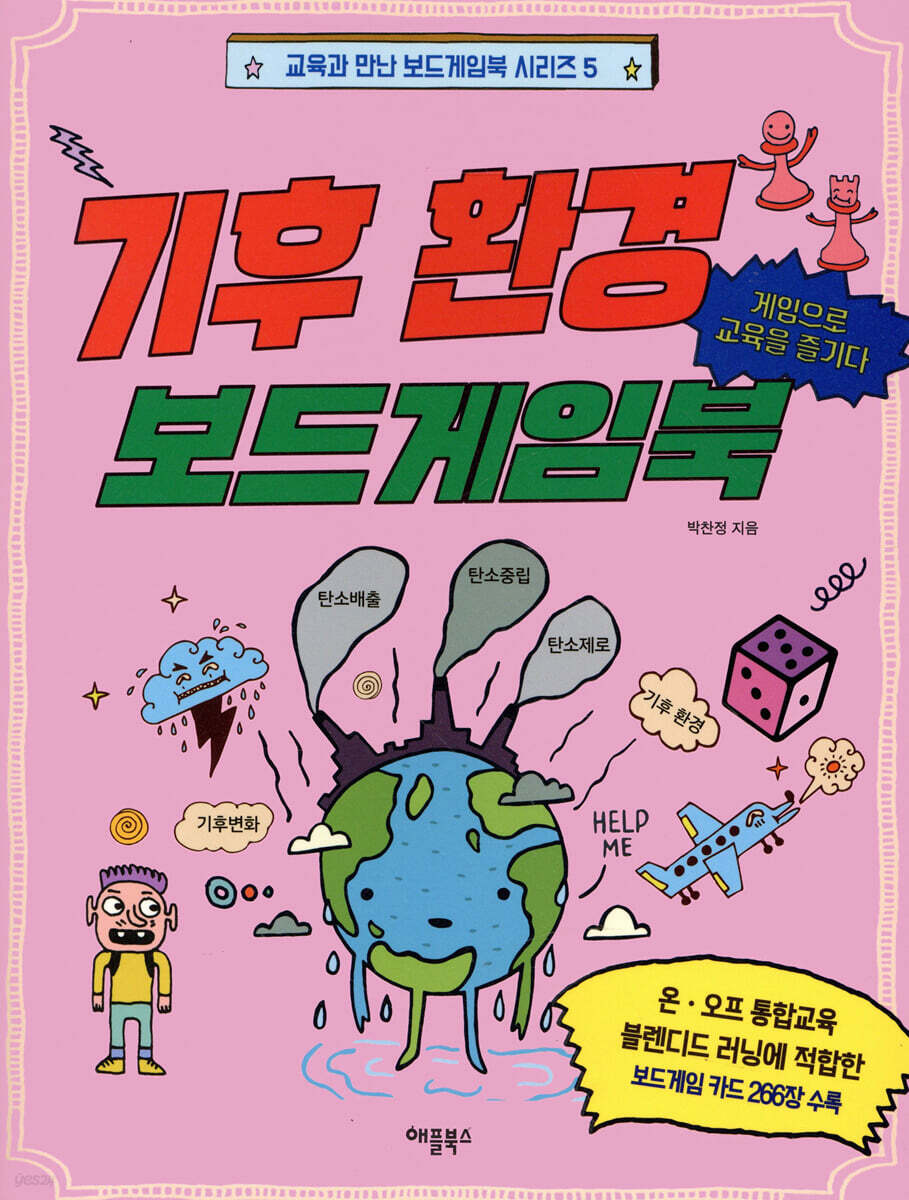
Climate and Environment Board Game Book
 |
Description
Book Introduction
Zero Carbon Challenge Game, Human Greed and Carbon Emissions Game, You're In? Climate Environment Game Let's protect the planet's threatened environment by practicing carbon neutrality with three board games! The Earth's climate is changing at a rate and scale unprecedented in history. As abnormal weather and natural disasters occur one after another, changes occur across the entire ecosystem, threatening the survival of plants and animals on Earth, and humanity cannot escape their influence. The cause is carbon dioxide, the main culprit of global warming. Now we must reduce our use of fossil fuels to bring the carbon emissions accumulated in the atmosphere into line with the amount of carbon absorbed by the atmosphere, reaching zero. This is 'carbon neutrality'. The fifth series of 'Board Game Books that Met Education', 'Climate and Environment Board Game Book', is the third social studies activity material guide published by author Chan-Jeong Park, who has been thinking about class content using games in schools, following 'Social Studies Board Game Book' and 'Politics and Culture Board Game Book'. This book uses three board games to raise awareness of climate change, recognize specific action plans for carbon neutrality, and emphasize the role of global democratic citizens in contributing to preventing climate change. |
- You can preview some of the book's contents.
Preview
index
Recommendation for this book
Prologue: Let's protect the climate and environment with board games.
Structure and Use of This Book
Chapter 1: Let's overcome climate change with games
Chapter 2: Climate and Environment Board Game
Carbon Zero Challenge Game
Human Greed and the Carbon Emissions Game
You're here? Climate Environment Game
Activity materials
Carbon Zero Challenge Game Manual
56 carbon cards
6 carbon zero cards
Human Greed and Carbon Emissions Game Manual
Game board
72 carbon emission cards
36 profit cards
Character card
dice
Are you there? Climate Environment Game Manual
72 climate cards
24 Earth Cards
Climate Card Collector's Edition
Memory aid board
Card cover
Prologue: Let's protect the climate and environment with board games.
Structure and Use of This Book
Chapter 1: Let's overcome climate change with games
Chapter 2: Climate and Environment Board Game
Carbon Zero Challenge Game
Human Greed and the Carbon Emissions Game
You're here? Climate Environment Game
Activity materials
Carbon Zero Challenge Game Manual
56 carbon cards
6 carbon zero cards
Human Greed and Carbon Emissions Game Manual
Game board
72 carbon emission cards
36 profit cards
Character card
dice
Are you there? Climate Environment Game Manual
72 climate cards
24 Earth Cards
Climate Card Collector's Edition
Memory aid board
Card cover
Detailed image

Into the book
Burning fossil fuels releases carbon dioxide, a major contributor to the greenhouse effect.
If all the carbon dioxide emitted by humans had accumulated on Earth, humanity might have already been extinct.
Fortunately, nature has absorbed human-created carbon dioxide through forests and swamps.
However, since the Industrial Revolution, the amount of carbon dioxide emitted by humans has exceeded nature's absorption capacity, and unabsorbed carbon dioxide remains and accumulates in the atmosphere.
This accumulated carbon dioxide has become a decisive factor in raising the Earth's temperature by trapping geothermal heat within the atmosphere.
Currently, the world emits approximately 50 billion tons of greenhouse gases and is pursuing carbon neutrality policies to address the climate crisis.
It is important to examine where and how much greenhouse gases are emitted and develop reduction measures tailored to each sector.
---From "Chapter 1: Overcoming Climate Change with Games"
Learning Help
1.
Adjust game difficulty
Teachers can select appropriate cards based on the students' level, and can lower the difficulty level by collecting only five types of climate cards instead of all six.
After playing the game, discuss any difficult or incomprehensible parts of the climate cards and have the teacher explain them.
2.
Try out different games
The Climate Card Collector's Edition basically allows you to collect 3 climate cards.
In the basic game, you can collect an infinite number of climate cards, and the game ends when you collect all of them. However, you can modify the rules to allow you to collect up to 3 climate cards at a time, and discard any additional climate cards collected.
3.
Additional effects of the game
Since COVID-19, our mutual interest and emotional bonds have weakened.
The game becomes more intimate as participants repeatedly call out each other's names, saying things like "Do you have ○○ climate?" to obtain cards.
Also, make sure that you don't continue to favor just one person.
4.
Use the Notes and Memory Aids
To prevent one student from being singled out too often, a rule can be set that prohibits the same person from being singled out three times in a row, and the game can be played while recording the information on a memory aid board for those who have trouble remembering.
5.
Performance evaluation and related activities
The game includes the characteristics of the world's climates as well as environmental issues that appear in each climate zone.
You can have students present or write reports on climate change by linking climate-specific characteristics and environmental issues to climate change. You can also try an additional activity of discovering climate-specific environmental issues not presented in the game and making them into cards.
---From "Chapter 2 - Climate Environment Board Game"
Game Preparation (by Group)
1.
Settings
Shuffle the carbon cards to make a pile.
2.
start
The game order is determined through rock-paper-scissors, etc.
Move to the right or left of the first player.
Game progress
3.
game
1) Shuffle the carbon cards (including the new start card) into piles and receive 6 cards each.
2) Take one card from the pile and spread it out on the floor. (Reveal the starting point card)
3) When it is your turn, act according to the following rules (discarding cards and declaring surrender)
· You can discard a card with a number lower than the card spread out on the floor.
· You can discard a new start card. (You can freely discard a new start card after any card.)
· If a new start card is spread out on the floor, you can discard any card you want.
· After the Carbon Emission 0 card, you must discard a 50 card or a Fresh Start card.
· If you have no cards to discard, you must take one card from the pile.
· (Declaration of surrender) Give up the game by receiving a penalty equal to the sum of the points of the carbon cards you hold in your hand.
4) Game End Conditions: The game ends when at least one player puts down all the cards in their hand or declares surrender, leaving the player with only one player.
· Anyone who puts down all their cards receives a Carbon Zero (Carbon -100 points) card as a bonus.
· A person who declares surrender receives a penalty equal to the sum of the carbon card points held in his or her hand.
· All cards that cannot be discarded are penalized, and new start cards that cannot be discarded are counted as 100 penalty points.
Game results
4.
Victory conditions
1) Play the game 3 times and add up the scores.
2) The person with the lowest final total score (carbon emissions) wins.
· Carbon Zero (Carbon - 100 points) cards received as a bonus are also included when calculating scores.
If all the carbon dioxide emitted by humans had accumulated on Earth, humanity might have already been extinct.
Fortunately, nature has absorbed human-created carbon dioxide through forests and swamps.
However, since the Industrial Revolution, the amount of carbon dioxide emitted by humans has exceeded nature's absorption capacity, and unabsorbed carbon dioxide remains and accumulates in the atmosphere.
This accumulated carbon dioxide has become a decisive factor in raising the Earth's temperature by trapping geothermal heat within the atmosphere.
Currently, the world emits approximately 50 billion tons of greenhouse gases and is pursuing carbon neutrality policies to address the climate crisis.
It is important to examine where and how much greenhouse gases are emitted and develop reduction measures tailored to each sector.
---From "Chapter 1: Overcoming Climate Change with Games"
Learning Help
1.
Adjust game difficulty
Teachers can select appropriate cards based on the students' level, and can lower the difficulty level by collecting only five types of climate cards instead of all six.
After playing the game, discuss any difficult or incomprehensible parts of the climate cards and have the teacher explain them.
2.
Try out different games
The Climate Card Collector's Edition basically allows you to collect 3 climate cards.
In the basic game, you can collect an infinite number of climate cards, and the game ends when you collect all of them. However, you can modify the rules to allow you to collect up to 3 climate cards at a time, and discard any additional climate cards collected.
3.
Additional effects of the game
Since COVID-19, our mutual interest and emotional bonds have weakened.
The game becomes more intimate as participants repeatedly call out each other's names, saying things like "Do you have ○○ climate?" to obtain cards.
Also, make sure that you don't continue to favor just one person.
4.
Use the Notes and Memory Aids
To prevent one student from being singled out too often, a rule can be set that prohibits the same person from being singled out three times in a row, and the game can be played while recording the information on a memory aid board for those who have trouble remembering.
5.
Performance evaluation and related activities
The game includes the characteristics of the world's climates as well as environmental issues that appear in each climate zone.
You can have students present or write reports on climate change by linking climate-specific characteristics and environmental issues to climate change. You can also try an additional activity of discovering climate-specific environmental issues not presented in the game and making them into cards.
---From "Chapter 2 - Climate Environment Board Game"
Game Preparation (by Group)
1.
Settings
Shuffle the carbon cards to make a pile.
2.
start
The game order is determined through rock-paper-scissors, etc.
Move to the right or left of the first player.
Game progress
3.
game
1) Shuffle the carbon cards (including the new start card) into piles and receive 6 cards each.
2) Take one card from the pile and spread it out on the floor. (Reveal the starting point card)
3) When it is your turn, act according to the following rules (discarding cards and declaring surrender)
· You can discard a card with a number lower than the card spread out on the floor.
· You can discard a new start card. (You can freely discard a new start card after any card.)
· If a new start card is spread out on the floor, you can discard any card you want.
· After the Carbon Emission 0 card, you must discard a 50 card or a Fresh Start card.
· If you have no cards to discard, you must take one card from the pile.
· (Declaration of surrender) Give up the game by receiving a penalty equal to the sum of the points of the carbon cards you hold in your hand.
4) Game End Conditions: The game ends when at least one player puts down all the cards in their hand or declares surrender, leaving the player with only one player.
· Anyone who puts down all their cards receives a Carbon Zero (Carbon -100 points) card as a bonus.
· A person who declares surrender receives a penalty equal to the sum of the carbon card points held in his or her hand.
· All cards that cannot be discarded are penalized, and new start cards that cannot be discarded are counted as 100 penalty points.
Game results
4.
Victory conditions
1) Play the game 3 times and add up the scores.
2) The person with the lowest final total score (carbon emissions) wins.
· Carbon Zero (Carbon - 100 points) cards received as a bonus are also included when calculating scores.
---From "Activity Materials - Carbon Zero Challenge Game Manual"
Publisher's Review
This book examines the efforts to achieve zero carbon emissions and the reality of carbon emissions, and examines the characteristics of each climate zone and the causes of environmental change. It is designed to be easily understood by social studies teachers, instructors, parents, and students. It also provides activity materials and board game cards that allow students to learn while having fun through three board games.
Join the fight to solve climate change through games
The 'Carbon Zero Challenge Game' is designed to raise students' awareness of carbon neutrality and climate change, and to explore specific practical ways to address climate change in their daily lives.
If you can put into practice even a few of the practical solutions you learn from the game, you can transform from a bystander to a participant in the climate change issue.
In 'Human Greed and the Carbon Emissions Game,' we examine specific examples of industries that emit a lot of carbon and explore alternative industries.
Through games, we experience the infinite desires of human beings and consider what attitude we should have for sustainable development.
We can also explore a desirable mindset for solving climate change issues.
In "You Are Here? Climate Environment Game," we learn about the climate characteristics and landscapes of the world we live in, and identify the environmental problems and causes that arise in each climate zone.
Climate has average characteristics depending on latitude, such as tropical, temperate, and cold, but abnormalities are occurring frequently due to environmental pollution and global warming.
We hope to remember the beauty of our planet and become protagonists in protecting and preserving its ecosystem.
Effective social studies content through gamification
Includes 266 board game cards suitable for blended learning, both online and offline.
1.
Carbon Zero Challenge Game
You can explore various practical measures for carbon neutrality and find good actions for carbon neutrality that are not on the card, and create your own card.
Based on the contents of the Carbon Neutrality Practice Card, you can create a carbon neutrality practice log that you can do at home and practice it at home during the online class period.
2.
Human Greed and the Carbon Emissions Game
During online classes, you can learn about high-carbon industries presented on cards, and through research and exploration activities, you can investigate the actual state of high-carbon industries and write a report.
3.
You're here? Climate Environment Game
The cards can be used as an activity to understand the various climate characteristics of each region, and in online classes, they can be connected to a quiz activity where students show the climate cards and guess the correct answer, or an activity where students predict how the climate region will change due to climate change.
Who needs this book?
* Teachers and instructors preparing carbon-neutral curriculum content
* Parents who want to help their children learn social studies
* Middle and high school students interested in climate change
Join the fight to solve climate change through games
The 'Carbon Zero Challenge Game' is designed to raise students' awareness of carbon neutrality and climate change, and to explore specific practical ways to address climate change in their daily lives.
If you can put into practice even a few of the practical solutions you learn from the game, you can transform from a bystander to a participant in the climate change issue.
In 'Human Greed and the Carbon Emissions Game,' we examine specific examples of industries that emit a lot of carbon and explore alternative industries.
Through games, we experience the infinite desires of human beings and consider what attitude we should have for sustainable development.
We can also explore a desirable mindset for solving climate change issues.
In "You Are Here? Climate Environment Game," we learn about the climate characteristics and landscapes of the world we live in, and identify the environmental problems and causes that arise in each climate zone.
Climate has average characteristics depending on latitude, such as tropical, temperate, and cold, but abnormalities are occurring frequently due to environmental pollution and global warming.
We hope to remember the beauty of our planet and become protagonists in protecting and preserving its ecosystem.
Effective social studies content through gamification
Includes 266 board game cards suitable for blended learning, both online and offline.
1.
Carbon Zero Challenge Game
You can explore various practical measures for carbon neutrality and find good actions for carbon neutrality that are not on the card, and create your own card.
Based on the contents of the Carbon Neutrality Practice Card, you can create a carbon neutrality practice log that you can do at home and practice it at home during the online class period.
2.
Human Greed and the Carbon Emissions Game
During online classes, you can learn about high-carbon industries presented on cards, and through research and exploration activities, you can investigate the actual state of high-carbon industries and write a report.
3.
You're here? Climate Environment Game
The cards can be used as an activity to understand the various climate characteristics of each region, and in online classes, they can be connected to a quiz activity where students show the climate cards and guess the correct answer, or an activity where students predict how the climate region will change due to climate change.
Who needs this book?
* Teachers and instructors preparing carbon-neutral curriculum content
* Parents who want to help their children learn social studies
* Middle and high school students interested in climate change
GOODS SPECIFICS
- Date of issue: May 17, 2022
- Page count, weight, size: 164 pages | 664g | 190*250*20mm
- ISBN13: 9791190147453
- ISBN10: 1190147459
You may also like
카테고리
korean


korean

![GQ KOREA Mark (Monthly): December [2025]](http://librairie.coreenne.fr/cdn/shop/files/8ef265dbbfbf186523ed75ba7319009d.jpg?v=1765340328&width=3840)


