

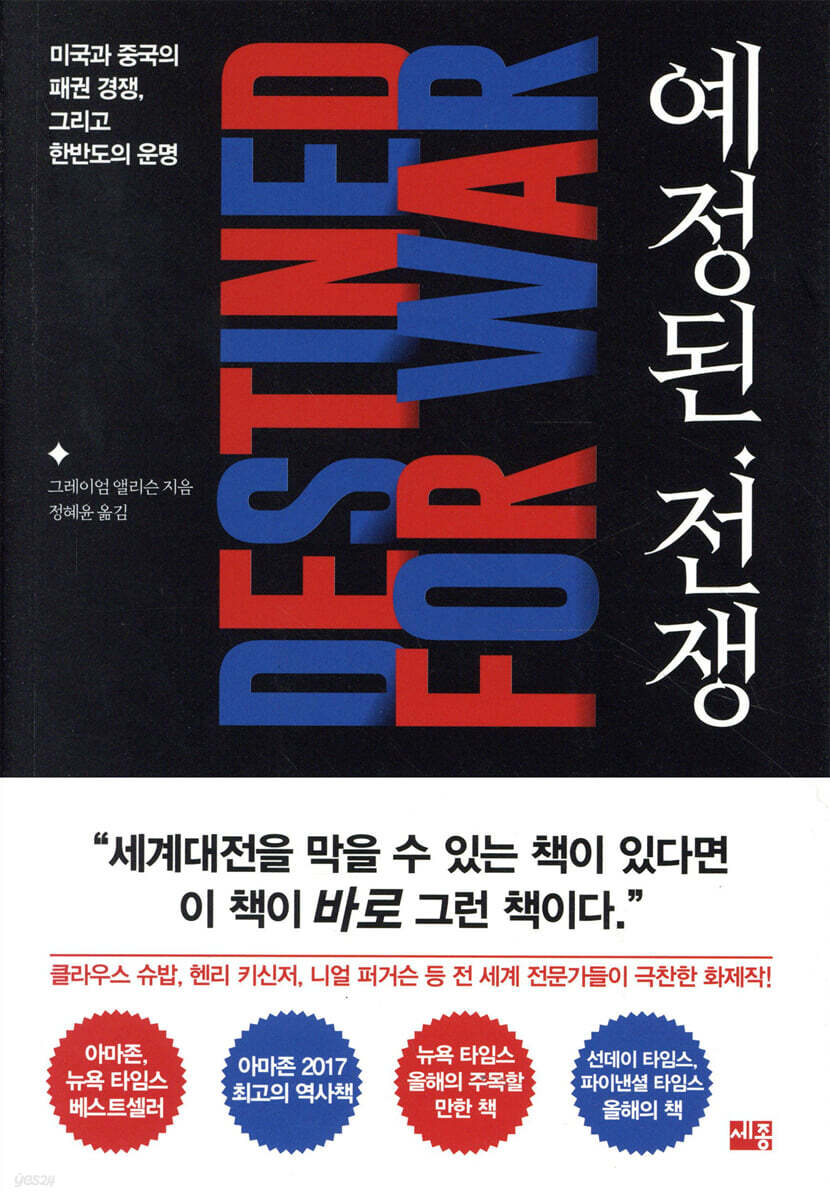
scheduled war
 |
Description
Book Introduction
If a hegemonic power and a rising power collide, the odds of war are 80%. A US-China war is closer than you think! What will become of the Korean Peninsula? A hit piece lauded by experts worldwide, including Klaus Schwab, Henry Kissinger, and Niall Ferguson! * Amazon, New York Times bestseller * National bestseller * Amazon's Best History Books of 2017 * New York Times Notable Book of the Year * Sunday Times, Financial Times Book of the Year A sharp perspective on the tensions, distrust, and dilemmas between the United States and China. Now, China and the United States are moving toward a war that neither side wants. This is because the most likely outcome when a rising power threatens a ruling power is war, known as the 'Thucydides Trap'. Historian Thucydides explains that the Peloponnesian War, which devastated ancient Greece, was caused by the fear of the hegemonic power Sparta over the rise of the new power Athens. Over the past 500 years, this situation has occurred 16 times, 12 of which have ultimately resulted in war. Now, the 17th case is ongoing. The possibility of a rapidly rising China coming into direct conflict with the undisputed hegemonic power, the United States, is increasing. Graham Allison, a leading political scientist of our time, explains why the "Thucydides Trap" is the best lens through which to understand US-China relations, and tells us what painful steps we must take now to avoid disaster. |
- You can preview some of the book's contents.
Preview
index
preface
introduction
Part 1 │ The Rise of China
1.
The greatest actor in world history
Part 2 │ Lessons from History
2.
Athens vs. Sparta
3.
500 years
4.
England vs. Germany
Part 3 │ The Calm Before the Storm
5.
Imagine China being just like the United States.
6.
What Xi Jinping's China Wants
7.
Clash of Civilizations
8.
Towards War
Part 4 │ War is not inevitable
9.
Twelve Keys to Open the Door to Peace
10.
Where to go now?
conclusion
Acknowledgements
Appendix 1: Thucydides' Trap Case File
Appendix 2: Seven Scarecrows
main
Source of the illustration
index
introduction
Part 1 │ The Rise of China
1.
The greatest actor in world history
Part 2 │ Lessons from History
2.
Athens vs. Sparta
3.
500 years
4.
England vs. Germany
Part 3 │ The Calm Before the Storm
5.
Imagine China being just like the United States.
6.
What Xi Jinping's China Wants
7.
Clash of Civilizations
8.
Towards War
Part 4 │ War is not inevitable
9.
Twelve Keys to Open the Door to Peace
10.
Where to go now?
conclusion
Acknowledgements
Appendix 1: Thucydides' Trap Case File
Appendix 2: Seven Scarecrows
main
Source of the illustration
index
Into the book
If Hollywood were to make a movie about China confronting the United States and ultimately leading to war, it would be hard to find two more fitting central characters than Xi Jinping and Donald Trump.
This is because both of them are the embodiment of a deep desire for their respective countries to become great.
In 2012, China designated Xi Jinping as its new leader, highlighting its role as a rising power, while the United States signaled a more active response as a dominant power by electing Donald Trump, who had been hostile to China during the campaign.
In terms of personal character, there are probably no two people more different than Trump and Xi Jinping.
However, if we look at the two characters from the perspective of protagonists struggling to become the best, there is an ominous similarity between them.
Will the imminent clash between these two superpowers escalate into war? No one knows.
But it is clear that the mechanics that Thucydides uncovered will become increasingly powerful in the years to come.
---From the "Preface"
When a rising power threatens to displace the ruling power, the resulting structural pressures leading to armed conflict are more the rule than the exception.
This dynamic is commonly found in other relationship structures, even within families.
How should we respond when a boy, as he enters adolescence, shows signs of outgrowing his older brother (or even his father)? Should we reallocate room, closet space, and seating based not only on age but also on relative size? In a species dominated by alpha males like gorillas, as potential successors grow larger and stronger, both the current leader and any would-be challengers prepare for a final showdown.
In the business world, when companies like Apple, Google, and Uber, which have risen rapidly thanks to groundbreaking technological changes, enter new industries at a rapid pace, the executives of established companies like Hewlett-Packard, Microsoft, and taxi companies have no choice but to adopt and adapt to the business models of these new companies, thereby starting a fierce competition.
If you just sit still, you'll end up ruined.
---From "Preface"
The United States and China can also avoid war if they properly grasp two truths.
First, the likelihood of a war between the United States and China within a few decades of the current orbit is not just real, it is much higher than currently recognized.
In fact, from the perspective of historical experience, the likelihood of war occurring is greater than the likelihood of it not occurring.
Moreover, if we underestimate the risks, they will increase.
If leaders in Beijing and Washington continue to behave as they have for the past decade, the United States and China will undoubtedly end up at war.
Second, war is not inevitable.
A look at history reveals that major ruling powers have been able to manage their relationships with rivals, even those who threatened their positions, without resorting to war.
Such success stories, as well as failures, offer many lessons for today's politicians.
Only those who fail to learn from history are condemned to repeat it.
---From "Preface"
There is no guarantee that a Sino-US conflict will necessarily result in the intervention of US or Chinese military forces.
Instead, it could be caused by confrontation with third-party allies or confrontation between third-party countries.
We came close to that scenario in 2010.
An incident occurred in which North Korea sank the South Korean warship Cheonan, killing 46 South Korean sailors.
North Korea denied responsibility, and China supported North Korea's denial.
But Seoul insisted that Pyongyang was responsible.
In the end, North and South Korea and their allies went to the brink and then backed down.
But now, the background conditions and catalytic factors have completely changed, so it is difficult to guarantee that war will be easily avoided.
This is especially true if the third-party parties involved are not sufficiently trained in the lingering tensions that the Korean Peninsula has endured for decades.
---「 8.
From "Towards War"
From China's perspective, even now, it is absolutely unacceptable for South Korea to occupy North Korea or for the US military to be drawn near the Chinese border.
But if the current regime in Pyongyang collapses and the South Korean president refuses to send troops to stabilize the situation on the Korean Peninsula, he will find it difficult to survive politically.
In fact, the war plan that the United States currently has includes a method in which, if such a situation arises, the US and South Korean military would advance into North Korea, stabilize the country, and ultimately achieve unification between the two Koreas.
Experts have analyzed around ten paths that could lead to war, starting with the collapse of the North Korean regime, but it will suffice to examine just three of them here.
First, there is the assumption that if Kim Jong-un dies without a clear successor, various factions within the military will fight for power, eventually leading to a civil war, and ultimately the country will fall into chaos.
North Korea's increasingly sophisticated intermediate-range missile technology could be the impetus for the second scenario.
A third scenario would be that China, fearing instability along its border, would deploy large numbers of troops to stabilize North Korea and make it a buffer state between China and U.S. forces stationed in South Korea.
---「 8.
From "Towards War"
In essence, America's strategy toward China is one built on the assumption that China will follow the path of Germany and Japan.
Therefore, like these countries, China is expected to accept its place within the US-led international legal order.
When pressed to explain their logic, these strategists argue that a wealthier China will be allowed a larger stake in the international system and thus, over time, become a “responsible stakeholder.”
Moreover, he adds, as citizens become wealthier, they will increasingly desire political freedom, paving the way for the kind of democratic reforms we have seen in Japan, South Korea, and Taiwan.
Lee Kuan Yew pointed out two flaws in America's dual strategy of "embracing but containing."
First of all, China has no intention of becoming a democratic country.
He speaks bluntly.
“If they try to go in that direction, China will collapse.” Second, comparing China to Germany or Japan ignores the fact that these two countries were first defeated in a full-scale war, then occupied by American troops, and then for a time were ruled by the highest-ranking American commander, who even wrote their own constitutions.
This is because both of them are the embodiment of a deep desire for their respective countries to become great.
In 2012, China designated Xi Jinping as its new leader, highlighting its role as a rising power, while the United States signaled a more active response as a dominant power by electing Donald Trump, who had been hostile to China during the campaign.
In terms of personal character, there are probably no two people more different than Trump and Xi Jinping.
However, if we look at the two characters from the perspective of protagonists struggling to become the best, there is an ominous similarity between them.
Will the imminent clash between these two superpowers escalate into war? No one knows.
But it is clear that the mechanics that Thucydides uncovered will become increasingly powerful in the years to come.
---From the "Preface"
When a rising power threatens to displace the ruling power, the resulting structural pressures leading to armed conflict are more the rule than the exception.
This dynamic is commonly found in other relationship structures, even within families.
How should we respond when a boy, as he enters adolescence, shows signs of outgrowing his older brother (or even his father)? Should we reallocate room, closet space, and seating based not only on age but also on relative size? In a species dominated by alpha males like gorillas, as potential successors grow larger and stronger, both the current leader and any would-be challengers prepare for a final showdown.
In the business world, when companies like Apple, Google, and Uber, which have risen rapidly thanks to groundbreaking technological changes, enter new industries at a rapid pace, the executives of established companies like Hewlett-Packard, Microsoft, and taxi companies have no choice but to adopt and adapt to the business models of these new companies, thereby starting a fierce competition.
If you just sit still, you'll end up ruined.
---From "Preface"
The United States and China can also avoid war if they properly grasp two truths.
First, the likelihood of a war between the United States and China within a few decades of the current orbit is not just real, it is much higher than currently recognized.
In fact, from the perspective of historical experience, the likelihood of war occurring is greater than the likelihood of it not occurring.
Moreover, if we underestimate the risks, they will increase.
If leaders in Beijing and Washington continue to behave as they have for the past decade, the United States and China will undoubtedly end up at war.
Second, war is not inevitable.
A look at history reveals that major ruling powers have been able to manage their relationships with rivals, even those who threatened their positions, without resorting to war.
Such success stories, as well as failures, offer many lessons for today's politicians.
Only those who fail to learn from history are condemned to repeat it.
---From "Preface"
There is no guarantee that a Sino-US conflict will necessarily result in the intervention of US or Chinese military forces.
Instead, it could be caused by confrontation with third-party allies or confrontation between third-party countries.
We came close to that scenario in 2010.
An incident occurred in which North Korea sank the South Korean warship Cheonan, killing 46 South Korean sailors.
North Korea denied responsibility, and China supported North Korea's denial.
But Seoul insisted that Pyongyang was responsible.
In the end, North and South Korea and their allies went to the brink and then backed down.
But now, the background conditions and catalytic factors have completely changed, so it is difficult to guarantee that war will be easily avoided.
This is especially true if the third-party parties involved are not sufficiently trained in the lingering tensions that the Korean Peninsula has endured for decades.
---「 8.
From "Towards War"
From China's perspective, even now, it is absolutely unacceptable for South Korea to occupy North Korea or for the US military to be drawn near the Chinese border.
But if the current regime in Pyongyang collapses and the South Korean president refuses to send troops to stabilize the situation on the Korean Peninsula, he will find it difficult to survive politically.
In fact, the war plan that the United States currently has includes a method in which, if such a situation arises, the US and South Korean military would advance into North Korea, stabilize the country, and ultimately achieve unification between the two Koreas.
Experts have analyzed around ten paths that could lead to war, starting with the collapse of the North Korean regime, but it will suffice to examine just three of them here.
First, there is the assumption that if Kim Jong-un dies without a clear successor, various factions within the military will fight for power, eventually leading to a civil war, and ultimately the country will fall into chaos.
North Korea's increasingly sophisticated intermediate-range missile technology could be the impetus for the second scenario.
A third scenario would be that China, fearing instability along its border, would deploy large numbers of troops to stabilize North Korea and make it a buffer state between China and U.S. forces stationed in South Korea.
---「 8.
From "Towards War"
In essence, America's strategy toward China is one built on the assumption that China will follow the path of Germany and Japan.
Therefore, like these countries, China is expected to accept its place within the US-led international legal order.
When pressed to explain their logic, these strategists argue that a wealthier China will be allowed a larger stake in the international system and thus, over time, become a “responsible stakeholder.”
Moreover, he adds, as citizens become wealthier, they will increasingly desire political freedom, paving the way for the kind of democratic reforms we have seen in Japan, South Korea, and Taiwan.
Lee Kuan Yew pointed out two flaws in America's dual strategy of "embracing but containing."
First of all, China has no intention of becoming a democratic country.
He speaks bluntly.
“If they try to go in that direction, China will collapse.” Second, comparing China to Germany or Japan ignores the fact that these two countries were first defeated in a full-scale war, then occupied by American troops, and then for a time were ruled by the highest-ranking American commander, who even wrote their own constitutions.
---「10.
From "Where to Go Now"
From "Where to Go Now"
Publisher's Review
When a hegemonic power and a rising power collide, the probability of war is 80%.
The US-China war is closer than you think!
What will become of the fate of the Korean Peninsula?
Klaus Schwab, Henry Kissinger, Niall Ferguson, etc.
A hot topic that has been highly praised by experts around the world!
“If there is a book that can prevent world war, this is it.”
If you read "The War of Destiny" and apply the lessons it teaches, you could save millions of lives.
It will help.
_ Klaus Schwab (Chairman of the World Economic Forum)
The Thucydides Trap is a term that describes the conflict between a rising power and a ruling power.
I read this book with great interest.
_ Henry Kissinger (former U.S. Secretary of State)
*Amazon, New York Times bestseller
*National bestseller
*Amazon's Best History Books of 2017
*New York Times Notable Book of the Year
*The Sunday Times and Financial Times 'Book of the Year'
A sharp perspective on the tensions, distrust, and dilemmas between the United States and China.
The US-China relationship is currently the most important international relationship in the world.
As China's rise cracks the rigid world order centered around the United States, the international community, which operates according to the logic of power, is also inevitably facing a tectonic shift.
Above all, concerns about armed conflict are growing because both of the current leaders of the two countries, US President Trump and Chinese President Xi Jinping, have a strong desire to make their countries great again.
Whenever US-China relations become precarious, there is a phrase that frequently appears in political circles and the media.
This is the 'Thucydides Trap'.
This term was coined by Graham Allison, one of America's leading national security and defense policy analysts and political scientist.
Taking Thucydides' insight from his History of the Peloponnesian War as a clue, he summarized the natural and dangerous situation that arises when a newly rising power threatens to take over the position of an existing hegemon in one word, "Thucydides' Trap."
Thucydides, who was the first to gain insight into real politics, revealed in his History of the Peloponnesian War why nations that had coexisted peacefully for decades ended up in a catastrophic war. He keenly observed that while war is generally thought to be caused by the 'fact' of national interests, there is another fundamental cause.
He argues that the Peloponnesian War, which devastated ancient Greece, was caused by the fear of the ruling power (Sparta) being threatened by the rise of a new power (Athens).
Graham Allison, who realized that this insight of Thucydides was a perfect explanation of the conflict between great powers, identified 16 cases in which the rise of a new power overthrew the position of an existing hegemon, and found that 12 of them ended in wars such as World War I and II, the Second Sino-Japanese War, and the Napoleonic Wars, and that only 4 cases were wars avoided.
In his book, Destined for War, he warns that the relationship between the United States and China, which is the 17th case, is at risk of falling into the "Thucydides Trap."
In this book, the author soberly assesses the potential for conflict between the United States and China, offers in-depth perspectives on the role of the Korean Peninsula, the dynamics of international politics, and diplomatic dilemmas, and offers persuasive advice on preventing a third world war.
Will the US and China escape the 'Thucydides Trap' that led to two world wars?
China is now not just the world's largest country, but also the greatest engine of global economic growth and the largest country in history.
The scale and speed of China's growth are beyond our imagination.
Over the past two years, China's GDP growth has been larger than that of India's entire economy, and in 2015, China's economy was enough to create Greece in 16 weeks.
China's economy, which accounts for about 18% of global GDP, is doubling every seven years, three times faster than the United States.
China is not merely a threat to the United States; it has already surpassed it in many areas, including manufacturing, consumption, and market size. China's growth is occurring in virtually every sector, including construction, transportation, education, health, computing, communications, science, and technological innovation.
If changes continue at this rate, the Chinese will experience a 100-fold improvement in their standard of living in their lifetime.
Former Australian Prime Minister Kevin Rudd describes China's explosive growth as Britain's Industrial Revolution and the global information revolution compressed into 30 years.
Despite these tangible figures, the United States refuses to acknowledge that China, once small and manageable, has become a giant overnight.
The Middle East remains the most important foreign policy issue.
They also point out China's slowing growth and disparage it by citing imitation and mass production as the causes of its growth.
However, even if China's growth is slowing, its economic growth rate is still 6-7%, which is much higher than that of the United States and other countries, which are 'recovering' at an annual economic growth rate of 2.1%.
In this way, the United States is engaging in a full-scale power struggle with China without fully realizing that the balance of power is being reorganized.
Graham Allison warns that as these structural tensions become more intense, even the smallest spark could spark a major conflict.
If the United States continues with foolish optimism and complacency in its economic relations to date, it is highly likely that it will end in war.
Facing China's rise squarely is the first step toward creating peaceful U.S.-China relations.
The author says that to understand this in depth, we need a lens called the 'Thucydides Trap'.
He examined the historical record of the past 500 years and discovered the basic structure of the dynamics that lead to war.
The reason why the competition for hegemony between great powers ultimately leads to war lies in the depth of structural tension.
The more national interests, excessive fear, and pride become entangled with one another, the more likely it is to lead to war.
The author calls these the “rising power syndrome” and the “dominant power syndrome.”
Emerging nations are united by heightened self-awareness, self-centered arrogance, a desire for international recognition, and boundless ambition, while the established powers, experiencing decline, are driven by excessive fear, anxiety, and paranoia.
The ruling powers perceive the demands of the rising powers as excessive and ungrateful, while the rising powers feel dissatisfied that they are being treated unfairly, as they were when they were weaker, and that the established powers are blocking their path.
These tensions can linger and flare up into a major conflagration triggered by something as trivial as resource competition, trade conflicts, or domestic political shifts.
War can also break out due to ignorance or misjudgment of the other party.
To prevent conflict between the two, it is important to accurately understand the true nature of China's dream and the strategies to achieve it.
Xi Jinping's dream for China's future is to become the leader in Asia and ultimately the world's most powerful nation.
The China Dream combines economic prosperity and power, with the aim of regaining past dominance, exerting dominance over neighboring regions, and earning respect for China's superiority.
This is not about expanding borders, nor is it about spreading its values around the world like the United States.
Its purpose is to maintain the international hierarchy and revive Chinese nationalism and patriotism.
The China Dream is not just a rhetorical expression.
Indeed, Xi Jinping has declared a fierce anti-corruption war, promoted nationalism by spearheading a revival of classical thought, accelerated economic development through corporate restructuring and the strengthening of science and technology, and rebuilt the military through bureaucratic reorganization.
This series of actions coincides with the expansionist trend toward Asia.
China uses its economic power as a carrot and stick to influence its neighbors.
Examples include halting exports of rare metals to Japan in 2010 to secure the return of detained Chinese fishermen, and halting purchases of Norwegian salmon in 2011 to express displeasure at dissident Liu Xiaobo's Nobel Prize win.
In this situation, as long as the United States seeks to maintain its position in Asia, the likelihood of armed conflict will increase.
Moreover, apart from the Thucydides Trap, there is something else that makes US-China relations more difficult.
It is the 'clash of civilizations'.
The fundamental differences between the United States and China are giving rise to a "clash of civilizations," which could soon lead to the most violent conflict of all.
While freedom is a core value of American politics, order is a core value of China's politics.
While America's foreign policy is oriented toward international order, China's goal is a harmonious hierarchy.
The United States seeks to resolve the issue immediately through a decisive war, while China seeks to achieve victory by properly managing the issue through long-term, gradual measures.
These different conceptual differences come into play in sensitive issues such as the Senkaku Islands and the South China Sea sovereignty dispute.
The author, who is aware that strategic miscalculations can lead to war, fully explains China's perspective and strategy toward its neighbors.
China will likely deal with the standoff with the United States in the South China Sea on a long-term basis until it catches up with American military power.
It will also strengthen diplomatic and economic ties with neighboring countries, making them dependent on China and weakening relations with the United States.
They may also employ strategies such as sowing discord between Japan and South Korea to prevent other countries from uniting.
And while they will try to avoid war as much as possible, if they lose in negotiations, there is a possibility that they will end up in military conflict.
The author combines practical realism with intellectual depth to explain international issues in an accessible manner, while also suggesting ways to peacefully navigate the Thucydides Trap.
Third-party assistance, such as the UN, could also be sought, as was the case in the 15th century when Spain took Portugal's place without serious conflict through papal mediation.
Leaders can exercise wisdom and make decisions that protect their own interests while also accommodating the demands of other nations, as happened in the early 20th century when the United States displaced Britain as the world's most powerful nation.
In addition, the fear of nuclear weapons, the domestic situation, and strong alliances could be keys to peace.
Above all, the author says, leaders around the world must combine intense reflection with even more intense action.
Unless both sides make difficult and painful choices to avoid war, war will become inevitable.
The US-China war is closer than you think!
What will become of the fate of the Korean Peninsula?
Klaus Schwab, Henry Kissinger, Niall Ferguson, etc.
A hot topic that has been highly praised by experts around the world!
“If there is a book that can prevent world war, this is it.”
If you read "The War of Destiny" and apply the lessons it teaches, you could save millions of lives.
It will help.
_ Klaus Schwab (Chairman of the World Economic Forum)
The Thucydides Trap is a term that describes the conflict between a rising power and a ruling power.
I read this book with great interest.
_ Henry Kissinger (former U.S. Secretary of State)
*Amazon, New York Times bestseller
*National bestseller
*Amazon's Best History Books of 2017
*New York Times Notable Book of the Year
*The Sunday Times and Financial Times 'Book of the Year'
A sharp perspective on the tensions, distrust, and dilemmas between the United States and China.
The US-China relationship is currently the most important international relationship in the world.
As China's rise cracks the rigid world order centered around the United States, the international community, which operates according to the logic of power, is also inevitably facing a tectonic shift.
Above all, concerns about armed conflict are growing because both of the current leaders of the two countries, US President Trump and Chinese President Xi Jinping, have a strong desire to make their countries great again.
Whenever US-China relations become precarious, there is a phrase that frequently appears in political circles and the media.
This is the 'Thucydides Trap'.
This term was coined by Graham Allison, one of America's leading national security and defense policy analysts and political scientist.
Taking Thucydides' insight from his History of the Peloponnesian War as a clue, he summarized the natural and dangerous situation that arises when a newly rising power threatens to take over the position of an existing hegemon in one word, "Thucydides' Trap."
Thucydides, who was the first to gain insight into real politics, revealed in his History of the Peloponnesian War why nations that had coexisted peacefully for decades ended up in a catastrophic war. He keenly observed that while war is generally thought to be caused by the 'fact' of national interests, there is another fundamental cause.
He argues that the Peloponnesian War, which devastated ancient Greece, was caused by the fear of the ruling power (Sparta) being threatened by the rise of a new power (Athens).
Graham Allison, who realized that this insight of Thucydides was a perfect explanation of the conflict between great powers, identified 16 cases in which the rise of a new power overthrew the position of an existing hegemon, and found that 12 of them ended in wars such as World War I and II, the Second Sino-Japanese War, and the Napoleonic Wars, and that only 4 cases were wars avoided.
In his book, Destined for War, he warns that the relationship between the United States and China, which is the 17th case, is at risk of falling into the "Thucydides Trap."
In this book, the author soberly assesses the potential for conflict between the United States and China, offers in-depth perspectives on the role of the Korean Peninsula, the dynamics of international politics, and diplomatic dilemmas, and offers persuasive advice on preventing a third world war.
Will the US and China escape the 'Thucydides Trap' that led to two world wars?
China is now not just the world's largest country, but also the greatest engine of global economic growth and the largest country in history.
The scale and speed of China's growth are beyond our imagination.
Over the past two years, China's GDP growth has been larger than that of India's entire economy, and in 2015, China's economy was enough to create Greece in 16 weeks.
China's economy, which accounts for about 18% of global GDP, is doubling every seven years, three times faster than the United States.
China is not merely a threat to the United States; it has already surpassed it in many areas, including manufacturing, consumption, and market size. China's growth is occurring in virtually every sector, including construction, transportation, education, health, computing, communications, science, and technological innovation.
If changes continue at this rate, the Chinese will experience a 100-fold improvement in their standard of living in their lifetime.
Former Australian Prime Minister Kevin Rudd describes China's explosive growth as Britain's Industrial Revolution and the global information revolution compressed into 30 years.
Despite these tangible figures, the United States refuses to acknowledge that China, once small and manageable, has become a giant overnight.
The Middle East remains the most important foreign policy issue.
They also point out China's slowing growth and disparage it by citing imitation and mass production as the causes of its growth.
However, even if China's growth is slowing, its economic growth rate is still 6-7%, which is much higher than that of the United States and other countries, which are 'recovering' at an annual economic growth rate of 2.1%.
In this way, the United States is engaging in a full-scale power struggle with China without fully realizing that the balance of power is being reorganized.
Graham Allison warns that as these structural tensions become more intense, even the smallest spark could spark a major conflict.
If the United States continues with foolish optimism and complacency in its economic relations to date, it is highly likely that it will end in war.
Facing China's rise squarely is the first step toward creating peaceful U.S.-China relations.
The author says that to understand this in depth, we need a lens called the 'Thucydides Trap'.
He examined the historical record of the past 500 years and discovered the basic structure of the dynamics that lead to war.
The reason why the competition for hegemony between great powers ultimately leads to war lies in the depth of structural tension.
The more national interests, excessive fear, and pride become entangled with one another, the more likely it is to lead to war.
The author calls these the “rising power syndrome” and the “dominant power syndrome.”
Emerging nations are united by heightened self-awareness, self-centered arrogance, a desire for international recognition, and boundless ambition, while the established powers, experiencing decline, are driven by excessive fear, anxiety, and paranoia.
The ruling powers perceive the demands of the rising powers as excessive and ungrateful, while the rising powers feel dissatisfied that they are being treated unfairly, as they were when they were weaker, and that the established powers are blocking their path.
These tensions can linger and flare up into a major conflagration triggered by something as trivial as resource competition, trade conflicts, or domestic political shifts.
War can also break out due to ignorance or misjudgment of the other party.
To prevent conflict between the two, it is important to accurately understand the true nature of China's dream and the strategies to achieve it.
Xi Jinping's dream for China's future is to become the leader in Asia and ultimately the world's most powerful nation.
The China Dream combines economic prosperity and power, with the aim of regaining past dominance, exerting dominance over neighboring regions, and earning respect for China's superiority.
This is not about expanding borders, nor is it about spreading its values around the world like the United States.
Its purpose is to maintain the international hierarchy and revive Chinese nationalism and patriotism.
The China Dream is not just a rhetorical expression.
Indeed, Xi Jinping has declared a fierce anti-corruption war, promoted nationalism by spearheading a revival of classical thought, accelerated economic development through corporate restructuring and the strengthening of science and technology, and rebuilt the military through bureaucratic reorganization.
This series of actions coincides with the expansionist trend toward Asia.
China uses its economic power as a carrot and stick to influence its neighbors.
Examples include halting exports of rare metals to Japan in 2010 to secure the return of detained Chinese fishermen, and halting purchases of Norwegian salmon in 2011 to express displeasure at dissident Liu Xiaobo's Nobel Prize win.
In this situation, as long as the United States seeks to maintain its position in Asia, the likelihood of armed conflict will increase.
Moreover, apart from the Thucydides Trap, there is something else that makes US-China relations more difficult.
It is the 'clash of civilizations'.
The fundamental differences between the United States and China are giving rise to a "clash of civilizations," which could soon lead to the most violent conflict of all.
While freedom is a core value of American politics, order is a core value of China's politics.
While America's foreign policy is oriented toward international order, China's goal is a harmonious hierarchy.
The United States seeks to resolve the issue immediately through a decisive war, while China seeks to achieve victory by properly managing the issue through long-term, gradual measures.
These different conceptual differences come into play in sensitive issues such as the Senkaku Islands and the South China Sea sovereignty dispute.
The author, who is aware that strategic miscalculations can lead to war, fully explains China's perspective and strategy toward its neighbors.
China will likely deal with the standoff with the United States in the South China Sea on a long-term basis until it catches up with American military power.
It will also strengthen diplomatic and economic ties with neighboring countries, making them dependent on China and weakening relations with the United States.
They may also employ strategies such as sowing discord between Japan and South Korea to prevent other countries from uniting.
And while they will try to avoid war as much as possible, if they lose in negotiations, there is a possibility that they will end up in military conflict.
The author combines practical realism with intellectual depth to explain international issues in an accessible manner, while also suggesting ways to peacefully navigate the Thucydides Trap.
Third-party assistance, such as the UN, could also be sought, as was the case in the 15th century when Spain took Portugal's place without serious conflict through papal mediation.
Leaders can exercise wisdom and make decisions that protect their own interests while also accommodating the demands of other nations, as happened in the early 20th century when the United States displaced Britain as the world's most powerful nation.
In addition, the fear of nuclear weapons, the domestic situation, and strong alliances could be keys to peace.
Above all, the author says, leaders around the world must combine intense reflection with even more intense action.
Unless both sides make difficult and painful choices to avoid war, war will become inevitable.
GOODS SPECIFICS
- Date of publication: January 22, 2018
- Page count, weight, size: 516 pages | 720g | 148*215*35mm
- ISBN13: 9788984076778
- ISBN10: 8984076775
You may also like
카테고리
korean


korean

![GQ KOREA Mark (Monthly): December [2025]](http://librairie.coreenne.fr/cdn/shop/files/8ef265dbbfbf186523ed75ba7319009d.jpg?v=1765340328&width=3840)


