

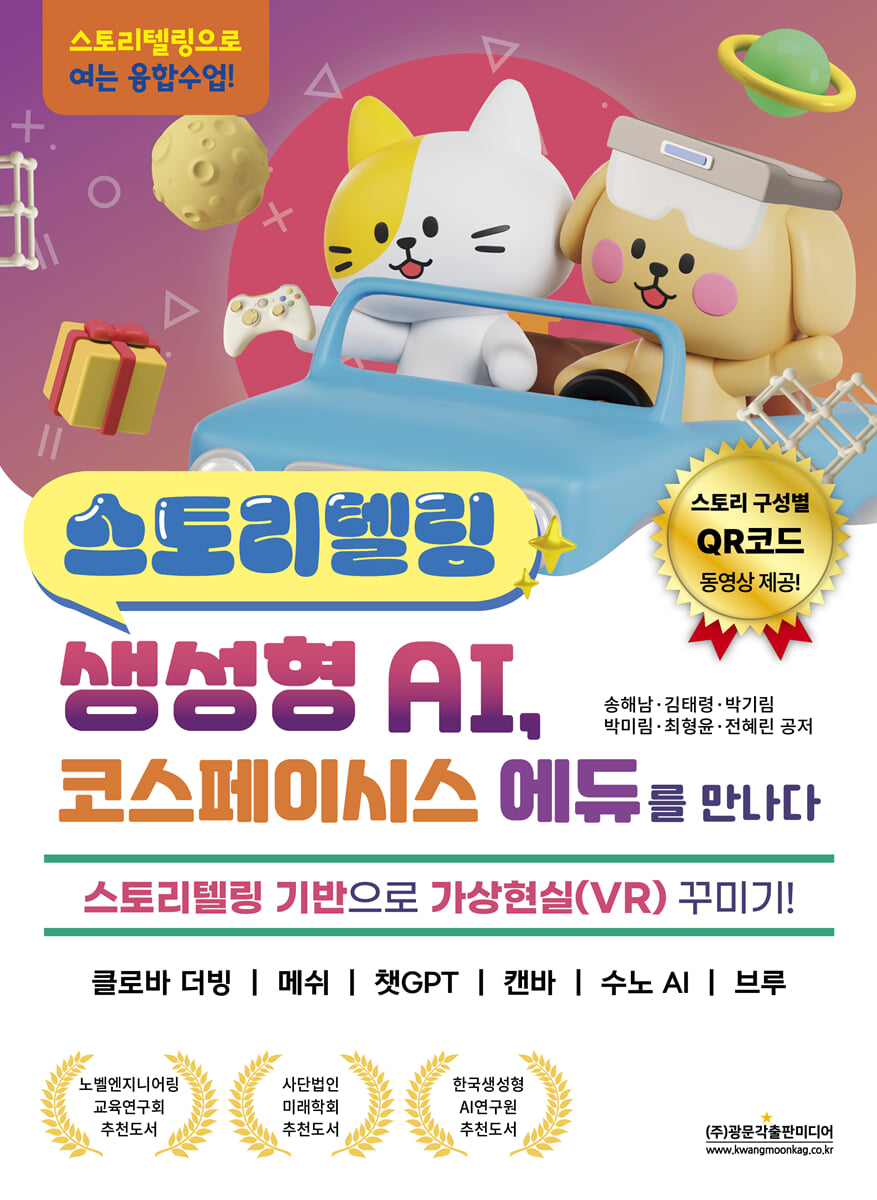
Meet Cospace Edu, the storytelling generative AI.
 |
Description
Book Introduction
How can we develop our storytelling skills? To cultivate these skills, stories must go beyond mere imagination.
Our students should be given the opportunity to realize the world through stories and receive feedback on their imagination.
Additionally, an environment is needed where one can directly visualize and experience the stories they create.
A platform that can be a powerful tool at this time is Cospaces Edu.
Cospaces Edu is the most convenient platform among existing educational VR edtech tools.
It also boasts high-quality output.
High degree of freedom, support for various objects, and convenient interface reduce the burden on beginners.
High-level programming is also possible, especially based on coding functions that support interaction between objects.
Our students should be given the opportunity to realize the world through stories and receive feedback on their imagination.
Additionally, an environment is needed where one can directly visualize and experience the stories they create.
A platform that can be a powerful tool at this time is Cospaces Edu.
Cospaces Edu is the most convenient platform among existing educational VR edtech tools.
It also boasts high-quality output.
High degree of freedom, support for various objects, and convenient interface reduce the burden on beginners.
High-level programming is also possible, especially based on coding functions that support interaction between objects.
index
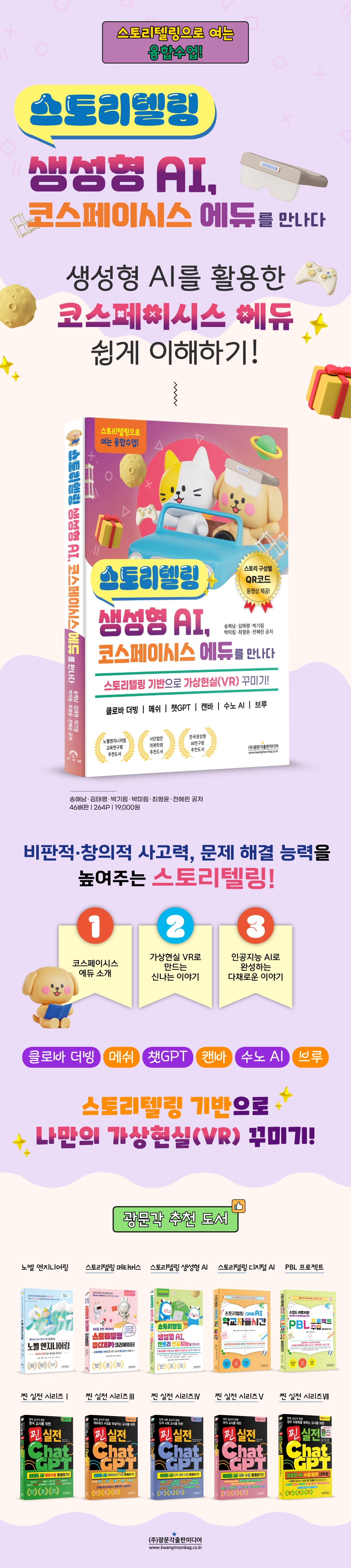
Chapter 1: Introduction to Cospace Edu
1-1 What is Coursespace Edu?
1-2 How to Use Coursespace Edu
Chapter 2: Exciting Stories Created with Virtual Reality VR
2-1 Alice's Wonderland
2-2 The Tale of the Rabbit Who Went to the Dragon Palace
2-3 Shout Hakuna Matata with Simba
2-4 Following in Snow White's Footsteps
2-5 Making Aladdin's Magic Carpet
2-6 Forest Candy House Escape Operation
2-7 The sound of a flute that lures rats
2-8 Save Sparky from Buzz
2-9 Operation to Create a Bridge
Chapter 3: A Colorful Story Completed with Artificial Intelligence AI
3-1 The Little Mermaid and the Prince Meet (Clover Dubbing)
3-2 The important thing is a house that doesn't collapse (mesh)
3-3 Sphinx's Puzzle Quiz (ChatGPT)
3-4 Magic School's Picture Gatekeeper (Canvas)
3-5 Making the Les Miserables Musical (Suno AI)
3-6 The Nutcracker's Candy Kingdom Ball (Brew)
1-1 What is Coursespace Edu?
1-2 How to Use Coursespace Edu
Chapter 2: Exciting Stories Created with Virtual Reality VR
2-1 Alice's Wonderland
2-2 The Tale of the Rabbit Who Went to the Dragon Palace
2-3 Shout Hakuna Matata with Simba
2-4 Following in Snow White's Footsteps
2-5 Making Aladdin's Magic Carpet
2-6 Forest Candy House Escape Operation
2-7 The sound of a flute that lures rats
2-8 Save Sparky from Buzz
2-9 Operation to Create a Bridge
Chapter 3: A Colorful Story Completed with Artificial Intelligence AI
3-1 The Little Mermaid and the Prince Meet (Clover Dubbing)
3-2 The important thing is a house that doesn't collapse (mesh)
3-3 Sphinx's Puzzle Quiz (ChatGPT)
3-4 Magic School's Picture Gatekeeper (Canvas)
3-5 Making the Les Miserables Musical (Suno AI)
3-6 The Nutcracker's Candy Kingdom Ball (Brew)
Detailed image
Publisher's Review
What will the future look like? Will cars fly in the sky, and will cities be built under the sea or in space? We've constantly pondered the future, whether we're drawing pictures or writing stories.
Because the word future itself makes us feel hopeful and moving forward.
Of the countless futures we imagine, some may come true and some may not.
How do experts predict this future? There are many ways to predict the future, but the most common is the "scenario" technique.
Scenario technique is a method of imagining various situations that could occur in the future and specifically imagining how each situation would unfold.
This technique allows us to predict various future scenarios and identify potential problems in each scenario.
The ability to think as one, connecting past, present, and future, is one of the greatest human abilities.
Beyond the animal brain's ability to survive through mere stimulation and response, the human brain's ability to anticipate, prepare for, and solve the future through mental functions, and even to pass this process on, is unique to humans.
The most important role in this process is played by ‘story’.
The existence of 'stories' that can encompass human culture and psychology while sharing social messages can be said to be the essence of human activity.
For example, when teaching 'benevolence', if you explain it based on a story about people in a village who help and care for each other, students will not only understand the meaning of benevolence with their heads, but will also feel it with their hearts.
Through the scenes in the story where the village becomes one and helps each other, we naturally come to realize the value of 'togetherness'.
The same is true in the learning process.
Rather than simply presenting climate change and sea level rise figures to students to educate them about the environment, it would be more effective to tell a story about how climate change could force humanity to migrate to new areas.
Students will more easily understand the severity of the problem and think about solutions.
This type of storytelling can simultaneously strengthen students' critical thinking, problem-solving, and creative thinking skills.
So how can we develop our storytelling skills?
To develop storytelling skills, stories must not be merely imaginary.
Our students should be given the opportunity to create worlds from stories and receive feedback on their imagination.
Additionally, you need an environment where you can directly visualize and experience the stories you create.
A platform that can be a powerful tool in this regard is Cospaces Edu.
Cospaces Edu is the most convenient platform among existing educational VR edtech tools.
It also boasts high-quality output.
High degree of freedom, support for various objects, and convenient interface reduce the burden on beginners.
High-level programming is also possible, especially based on coding features that support interaction between objects.
We are constantly giving our lives to digital.
The first computers were simple calculators, but now we live and build systems on a digital foundation.
As social interaction and many aspects of future work life shift towards the digital, the world of the metaverse is sure to arrive.
Expand your world through the metaverse, where you become the protagonist of the digital world, and through storytelling that conveys the inherent mental functions of humans.
Let your imagination run wild.
And I hope you can realize it to your heart's content.
Because the word future itself makes us feel hopeful and moving forward.
Of the countless futures we imagine, some may come true and some may not.
How do experts predict this future? There are many ways to predict the future, but the most common is the "scenario" technique.
Scenario technique is a method of imagining various situations that could occur in the future and specifically imagining how each situation would unfold.
This technique allows us to predict various future scenarios and identify potential problems in each scenario.
The ability to think as one, connecting past, present, and future, is one of the greatest human abilities.
Beyond the animal brain's ability to survive through mere stimulation and response, the human brain's ability to anticipate, prepare for, and solve the future through mental functions, and even to pass this process on, is unique to humans.
The most important role in this process is played by ‘story’.
The existence of 'stories' that can encompass human culture and psychology while sharing social messages can be said to be the essence of human activity.
For example, when teaching 'benevolence', if you explain it based on a story about people in a village who help and care for each other, students will not only understand the meaning of benevolence with their heads, but will also feel it with their hearts.
Through the scenes in the story where the village becomes one and helps each other, we naturally come to realize the value of 'togetherness'.
The same is true in the learning process.
Rather than simply presenting climate change and sea level rise figures to students to educate them about the environment, it would be more effective to tell a story about how climate change could force humanity to migrate to new areas.
Students will more easily understand the severity of the problem and think about solutions.
This type of storytelling can simultaneously strengthen students' critical thinking, problem-solving, and creative thinking skills.
So how can we develop our storytelling skills?
To develop storytelling skills, stories must not be merely imaginary.
Our students should be given the opportunity to create worlds from stories and receive feedback on their imagination.
Additionally, you need an environment where you can directly visualize and experience the stories you create.
A platform that can be a powerful tool in this regard is Cospaces Edu.
Cospaces Edu is the most convenient platform among existing educational VR edtech tools.
It also boasts high-quality output.
High degree of freedom, support for various objects, and convenient interface reduce the burden on beginners.
High-level programming is also possible, especially based on coding features that support interaction between objects.
We are constantly giving our lives to digital.
The first computers were simple calculators, but now we live and build systems on a digital foundation.
As social interaction and many aspects of future work life shift towards the digital, the world of the metaverse is sure to arrive.
Expand your world through the metaverse, where you become the protagonist of the digital world, and through storytelling that conveys the inherent mental functions of humans.
Let your imagination run wild.
And I hope you can realize it to your heart's content.
GOODS SPECIFICS
- Date of issue: March 28, 2025
- Page count, weight, size: 264 pages | 692g | 188*257*14mm
- ISBN13: 9791193205501
- ISBN10: 1193205506
You may also like
카테고리
korean


korean

![GQ KOREA Mark (Monthly): December [2025]](http://librairie.coreenne.fr/cdn/shop/files/8ef265dbbfbf186523ed75ba7319009d.jpg?v=1765340328&width=3840)


