

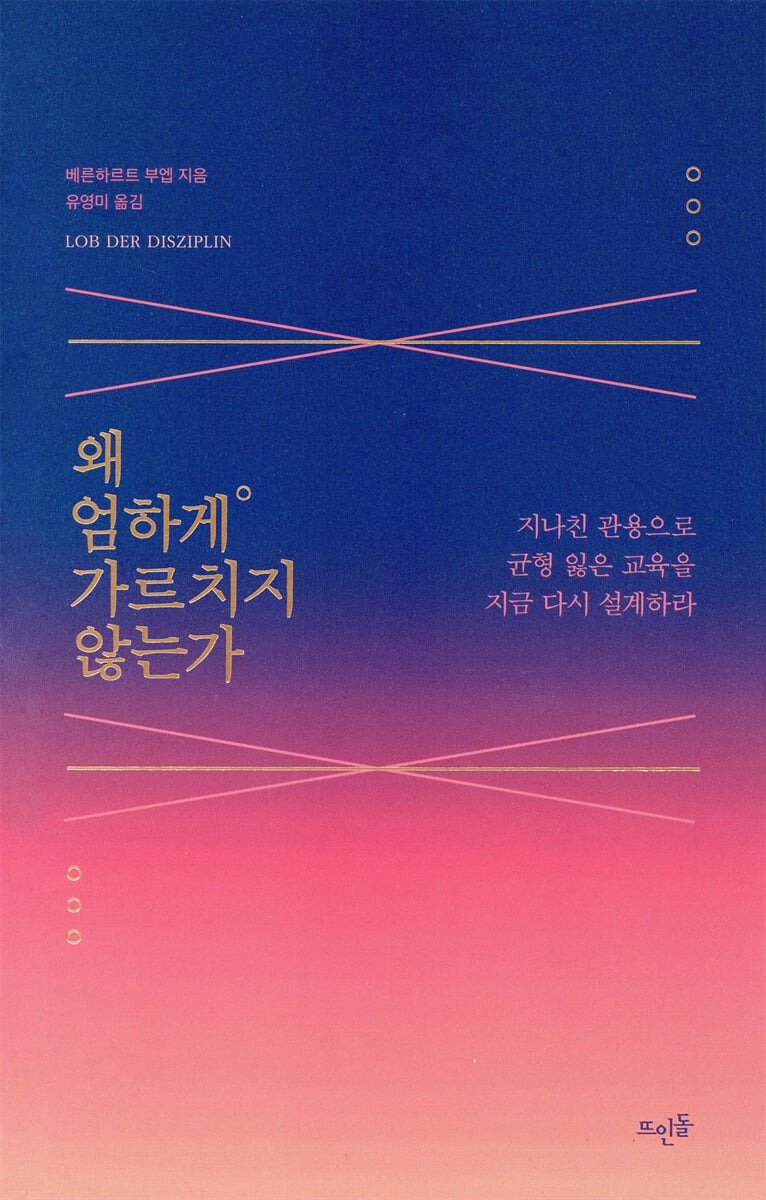
Why don't you teach them strictly?
 |
Description
Book Introduction
The principal of the prestigious German school Salem School offers a bitter critique of the distorted educational reality in "Why Don't We Teach Strictly?"
Author Bernhard Bueb, a renowned educator and principal of the prestigious Salem School in Germany, has been a strong critic of the German education system, and in this book he has organized his consistently asserted propositions point by point.
This book provides practical advice and examples for parents and teachers struggling with the balance between freedom and discipline.
Author Bernhard Bueb, a renowned educator and principal of the prestigious Salem School in Germany, has been a strong critic of the German education system, and in this book he has organized his consistently asserted propositions point by point.
This book provides practical advice and examples for parents and teachers struggling with the balance between freedom and discipline.
- You can preview some of the book's contents.
Preview
index
Introduction
To Korean readers
Recommendation
Part 1: Why Strict Education Again?
It takes courage to teach harshly.
The child is not yet a mature being.
Never give up on a child
Adults without authority hurt children.
Part 2: Just reading emotions isn't enough
There is no need to discuss everything with your child.
Why are we raising unruly children?
Don't be afraid to punish
Part 3: The Art of Teaching Strictly
Give your child the gift of community
Allow your child to play
Teach them to make effort a habit.
Conclusion
To Korean readers
Recommendation
Part 1: Why Strict Education Again?
It takes courage to teach harshly.
The child is not yet a mature being.
Never give up on a child
Adults without authority hurt children.
Part 2: Just reading emotions isn't enough
There is no need to discuss everything with your child.
Why are we raising unruly children?
Don't be afraid to punish
Part 3: The Art of Teaching Strictly
Give your child the gift of community
Allow your child to play
Teach them to make effort a habit.
Conclusion
Detailed image

Into the book
Education today is in crisis.
The crisis in education is none other than a crisis in character education.
These days, children are not being raised, they are being neglected.
Surrounded by unexpectedly aggressive educators—television, smartphones, materialism, and lookism.
The anticipation for the future that would give wings to children's motivation has been pushed aside by anxiety about the future.
A society that promotes competition, egocentrism, and the idea that money is everything…
There is no end to the things that can make children anxious.
Children who are anxious about the future do not try to prepare for it.
That is, without training or putting in effort, you do not run towards your dreams.
- Page 16
Those who want to educate need to have the courage to train children.
But training is the ugly duckling of pedagogy.
At the same time, it is the foundation of all education.
Training has everything humans hate.
Obedience, renunciation, moderation, patience.
Training follows the principle of performance, not the principle of pleasure.
It limits, regulates, and even commands the process of reaching a goal.
They say good training begins with batting average and ends with autonomy.
The final fruit of training is self-discipline.
However, this training can only bear fruit if it is based on the ‘love’ of the child, not the teacher’s coercion.
As I said before, education is a never-ending balancing act between conflicting concepts.
Parents and teachers must strike a balance between actively guiding children and allowing them to grow on their own.
We must strike a balance between principle and tolerance, between discipline and love, between consistency and consideration, between control and trust.
However, these conflicting concepts are necessary for each other, and true education is only possible when they are carefully selected and utilized.
-Pages 21-22
In recent decades, there has been a growing trend toward using psychology to compensate for the consequences of inadequate education.
The era of psychology began when educators shifted their focus from training to love.
The psychologization of education went hand in hand with the humanization of education.
Lack of effort, aggressive behavior, and difficulty concentrating have been explained by psychological models developed by various schools of psychology.
There is no longer any need to morally interpret a child's behavior.
A child who is inattentive is diagnosed with attention deficit hyperactivity disorder (ADHD), a child who refuses to study is diagnosed with undiscovered genius, and teasing other children is diagnosed as a result of a weak ego or a lack of affection in childhood.
We must pay attention to children as moral agents, and not be too quick to psychologically explain their behavior and give them absolution.
And, as I said before, in an age of abundance and consumerism, we need to help children resist the pressures of consumerism.
-Page 75
There are some punishments that should be removed from educators' lists of punishments.
The first one is corporal punishment.
Corporal punishment destroys human dignity.
Depriving someone of love and attention is also a mean and uneducational punishment.
This is so harsh on children that it causes anxiety.
People who give such punishments are most likely to lack true love.
Another bad habit that needs to be stopped is deducting points for having a bad attitude.
Grades should be a tool to evaluate a student's academic ability, not an assessment of their attitude.
Whether a student behaves pleasantly or unpleasantly should not be reflected in the grade.
When teachers are reluctant to impose other punishments, they may be tempted to use grade deductions as a punishment.
Educators call this the "score whirlwind."
Many teachers try to discipline students for being late, misbehaving, being lazy, or disrupting class with a "grading whip."
It should be formal and natural for teachers to impose appropriate punishments for misbehavior to prevent such behavior.
If a student skips class, there are various ways to make them study; if they misbehave, you can talk to the principal; if they disrupt class, you can temporarily remove them from the class.
Teachers have a hard time acting justly when grades are misused as punishment, so much thought needs to be given to legitimate punishment.
The crisis in education is none other than a crisis in character education.
These days, children are not being raised, they are being neglected.
Surrounded by unexpectedly aggressive educators—television, smartphones, materialism, and lookism.
The anticipation for the future that would give wings to children's motivation has been pushed aside by anxiety about the future.
A society that promotes competition, egocentrism, and the idea that money is everything…
There is no end to the things that can make children anxious.
Children who are anxious about the future do not try to prepare for it.
That is, without training or putting in effort, you do not run towards your dreams.
- Page 16
Those who want to educate need to have the courage to train children.
But training is the ugly duckling of pedagogy.
At the same time, it is the foundation of all education.
Training has everything humans hate.
Obedience, renunciation, moderation, patience.
Training follows the principle of performance, not the principle of pleasure.
It limits, regulates, and even commands the process of reaching a goal.
They say good training begins with batting average and ends with autonomy.
The final fruit of training is self-discipline.
However, this training can only bear fruit if it is based on the ‘love’ of the child, not the teacher’s coercion.
As I said before, education is a never-ending balancing act between conflicting concepts.
Parents and teachers must strike a balance between actively guiding children and allowing them to grow on their own.
We must strike a balance between principle and tolerance, between discipline and love, between consistency and consideration, between control and trust.
However, these conflicting concepts are necessary for each other, and true education is only possible when they are carefully selected and utilized.
-Pages 21-22
In recent decades, there has been a growing trend toward using psychology to compensate for the consequences of inadequate education.
The era of psychology began when educators shifted their focus from training to love.
The psychologization of education went hand in hand with the humanization of education.
Lack of effort, aggressive behavior, and difficulty concentrating have been explained by psychological models developed by various schools of psychology.
There is no longer any need to morally interpret a child's behavior.
A child who is inattentive is diagnosed with attention deficit hyperactivity disorder (ADHD), a child who refuses to study is diagnosed with undiscovered genius, and teasing other children is diagnosed as a result of a weak ego or a lack of affection in childhood.
We must pay attention to children as moral agents, and not be too quick to psychologically explain their behavior and give them absolution.
And, as I said before, in an age of abundance and consumerism, we need to help children resist the pressures of consumerism.
-Page 75
There are some punishments that should be removed from educators' lists of punishments.
The first one is corporal punishment.
Corporal punishment destroys human dignity.
Depriving someone of love and attention is also a mean and uneducational punishment.
This is so harsh on children that it causes anxiety.
People who give such punishments are most likely to lack true love.
Another bad habit that needs to be stopped is deducting points for having a bad attitude.
Grades should be a tool to evaluate a student's academic ability, not an assessment of their attitude.
Whether a student behaves pleasantly or unpleasantly should not be reflected in the grade.
When teachers are reluctant to impose other punishments, they may be tempted to use grade deductions as a punishment.
Educators call this the "score whirlwind."
Many teachers try to discipline students for being late, misbehaving, being lazy, or disrupting class with a "grading whip."
It should be formal and natural for teachers to impose appropriate punishments for misbehavior to prevent such behavior.
If a student skips class, there are various ways to make them study; if they misbehave, you can talk to the principal; if they disrupt class, you can temporarily remove them from the class.
Teachers have a hard time acting justly when grades are misused as punishment, so much thought needs to be given to legitimate punishment.
---From pages 118-119
Publisher's Review
The principal of the prestigious Salem School in Germany
A bitter criticism of the distorted reality of education
When you say 'teach them harshly', many people will think of an aggressive and cold attitude.
Many will object, saying that we are returning to an education system that devalues and oppresses children, rather than believing in their abilities and encouraging them to do better.
But let's take a closer look at the reality of our education.
Our education has lost its balance between principle and tolerance, discipline and love, consistency and consideration.
While adults are abandoning strict education and becoming overly loving and considerate, children are becoming beings who do not know how to love, care, and take responsibility.
Today's Korean education system is busy reading and comforting children's emotions rather than focusing on cultivating morality and order.
Many people no longer try to morally interpret children's behavior.
Children who are inattentive are diagnosed with attention deficit hyperactivity disorder (ADHD) and excluded from general education, children who refuse to study are considered to have undiscovered genius, and teasing other children is concluded to be a phenomenon resulting from a weak ego or a lack of affection in childhood.
Of course, it is important to examine your emotions.
However, focusing only on emotions can cause major problems in a child's character development.
It could be a lack of effort, lack of discipline, or a failure to learn to focus, but we need to consider whether we are giving a free pass to disorderly behavior in the name of autonomy and trust.
If we continue to neglect children like this without principles and consistency, we will only end up producing children who will never become adults.
Now our education needs to become more rigorous.
Author Bernhard Bueb, a renowned educator and principal of the prestigious Salem School in Germany, has been a strong critic of the German education system, and in this book he has organized his consistently asserted propositions point by point.
Since the Hitler regime, liberal education has spread throughout Germany, and the country has consistently maintained an educational philosophy that respects children's human rights and freedom.
However, children grew up without knowing manners and consideration, and as a result, they became immature beings who were only left with their own desires and could not do anything on their own.
Parents expected their children to be bright and positive people, but the reality was different.
The child may not have any stubbornness, but he has become a selfish person who only cares about himself, and the parents are suffering from the child's endless demands.
The author points out the negative effects of this liberal education and emphasizes the importance of strict education based on love.
For parents and teachers struggling between freedom and discipline
Practical advice and examples
Not only in our country but also around the world, children are taking the place of superiors and becoming unhesitating partners of their parents and teachers.
It is a child's natural right to argue endlessly with adults and throw tantrums to get their way.
Adults find this process difficult, but they are reluctant to correct their children because of their preconceptions and fears about unilaterally setting rules and demanding that they follow them.
But amidst all this, there is a new educational method that is gaining attention.
This is the French educational law.
As a country with a strong image of democracy and freedom, it seems natural that it would provide free education, but anachronistic things are happening in this country.
French education law is based on 'principles'.
And parents and teachers are not the child's servants, but his commanders.
The commander pushes the children to follow the rules that contain the basics and common sense that they must follow as members of society.
This is because only then can both adults and children be happy, and children can realize and practice the things essential to living.
Author Bernhard Bueb tells the same story.
Strict education does not mean coercion or violence.
Instead, it is a process of actively intervening in children's lives, training them, and preparing them to stand on their own two feet.
This book presents examples of wrong education that the author has observed over a long period of time, along with good examples of strict education that he has persistently practiced.
The author asserts that children who receive a good, rigorous and consistent education learn self-control, perseverance, and consideration, and grow into mature adults who know how to achieve their goals and love themselves and others.
The author also pursued liberal education at one time, but most of the time, it ended up being harmful or regressive to children.
The conclusion drawn from such experiences of failure is that children are not yet mature beings.
No child can do well on his own.
A human being can grow into a mature person only through constant self-discipline, self-restraint, and renunciation.
The author makes a compelling argument.
"Now is the time to water, prune, and fertilize the children's garden that has been left to waste!" The author's deep reflections and countless examples of failure and success provide resolute and practical answers to parents and teachers who are at a loss as to how to treat their children.
Presenting new discourse and alternatives in education
This book shook German society and education as soon as it was published.
It was a clash between a laissez-faire educational method and a strict educational method that emphasized training.
Many people who had focused solely on liberal education were able to see the topic of 'balanced education' in a new light, and it became the center of debate on television debates and in daily newspapers.
These discourses must take place concretely in our country as well.
There are many reasons why the foundations of society have collapsed and responsibility and principles have disappeared, but among them, education bears a large part of the responsibility.
In order to restore the fundamentals of society, we must reflect on the ways in which we have taught children in a disorderly manner and clearly present the direction in which they should go.
We must also help children make sound decisions and think maturely through consistent and rigorous training.
The caring, communicative, and democratic society we dream of doesn't just happen.
The author asserts that this will be achieved through "courageous adults" who strictly teach children at home, at school, and in kindergarten, and push them to develop habits of self-control and hard work.
A bitter criticism of the distorted reality of education
When you say 'teach them harshly', many people will think of an aggressive and cold attitude.
Many will object, saying that we are returning to an education system that devalues and oppresses children, rather than believing in their abilities and encouraging them to do better.
But let's take a closer look at the reality of our education.
Our education has lost its balance between principle and tolerance, discipline and love, consistency and consideration.
While adults are abandoning strict education and becoming overly loving and considerate, children are becoming beings who do not know how to love, care, and take responsibility.
Today's Korean education system is busy reading and comforting children's emotions rather than focusing on cultivating morality and order.
Many people no longer try to morally interpret children's behavior.
Children who are inattentive are diagnosed with attention deficit hyperactivity disorder (ADHD) and excluded from general education, children who refuse to study are considered to have undiscovered genius, and teasing other children is concluded to be a phenomenon resulting from a weak ego or a lack of affection in childhood.
Of course, it is important to examine your emotions.
However, focusing only on emotions can cause major problems in a child's character development.
It could be a lack of effort, lack of discipline, or a failure to learn to focus, but we need to consider whether we are giving a free pass to disorderly behavior in the name of autonomy and trust.
If we continue to neglect children like this without principles and consistency, we will only end up producing children who will never become adults.
Now our education needs to become more rigorous.
Author Bernhard Bueb, a renowned educator and principal of the prestigious Salem School in Germany, has been a strong critic of the German education system, and in this book he has organized his consistently asserted propositions point by point.
Since the Hitler regime, liberal education has spread throughout Germany, and the country has consistently maintained an educational philosophy that respects children's human rights and freedom.
However, children grew up without knowing manners and consideration, and as a result, they became immature beings who were only left with their own desires and could not do anything on their own.
Parents expected their children to be bright and positive people, but the reality was different.
The child may not have any stubbornness, but he has become a selfish person who only cares about himself, and the parents are suffering from the child's endless demands.
The author points out the negative effects of this liberal education and emphasizes the importance of strict education based on love.
For parents and teachers struggling between freedom and discipline
Practical advice and examples
Not only in our country but also around the world, children are taking the place of superiors and becoming unhesitating partners of their parents and teachers.
It is a child's natural right to argue endlessly with adults and throw tantrums to get their way.
Adults find this process difficult, but they are reluctant to correct their children because of their preconceptions and fears about unilaterally setting rules and demanding that they follow them.
But amidst all this, there is a new educational method that is gaining attention.
This is the French educational law.
As a country with a strong image of democracy and freedom, it seems natural that it would provide free education, but anachronistic things are happening in this country.
French education law is based on 'principles'.
And parents and teachers are not the child's servants, but his commanders.
The commander pushes the children to follow the rules that contain the basics and common sense that they must follow as members of society.
This is because only then can both adults and children be happy, and children can realize and practice the things essential to living.
Author Bernhard Bueb tells the same story.
Strict education does not mean coercion or violence.
Instead, it is a process of actively intervening in children's lives, training them, and preparing them to stand on their own two feet.
This book presents examples of wrong education that the author has observed over a long period of time, along with good examples of strict education that he has persistently practiced.
The author asserts that children who receive a good, rigorous and consistent education learn self-control, perseverance, and consideration, and grow into mature adults who know how to achieve their goals and love themselves and others.
The author also pursued liberal education at one time, but most of the time, it ended up being harmful or regressive to children.
The conclusion drawn from such experiences of failure is that children are not yet mature beings.
No child can do well on his own.
A human being can grow into a mature person only through constant self-discipline, self-restraint, and renunciation.
The author makes a compelling argument.
"Now is the time to water, prune, and fertilize the children's garden that has been left to waste!" The author's deep reflections and countless examples of failure and success provide resolute and practical answers to parents and teachers who are at a loss as to how to treat their children.
Presenting new discourse and alternatives in education
This book shook German society and education as soon as it was published.
It was a clash between a laissez-faire educational method and a strict educational method that emphasized training.
Many people who had focused solely on liberal education were able to see the topic of 'balanced education' in a new light, and it became the center of debate on television debates and in daily newspapers.
These discourses must take place concretely in our country as well.
There are many reasons why the foundations of society have collapsed and responsibility and principles have disappeared, but among them, education bears a large part of the responsibility.
In order to restore the fundamentals of society, we must reflect on the ways in which we have taught children in a disorderly manner and clearly present the direction in which they should go.
We must also help children make sound decisions and think maturely through consistent and rigorous training.
The caring, communicative, and democratic society we dream of doesn't just happen.
The author asserts that this will be achieved through "courageous adults" who strictly teach children at home, at school, and in kindergarten, and push them to develop habits of self-control and hard work.
GOODS SPECIFICS
- Date of publication: May 28, 2014
- Page count, weight, size: 164 pages | 350g | 135*210*20mm
- ISBN13: 9788958075226
- ISBN10: 8958075228
You may also like
카테고리
korean


korean

![GQ KOREA Mark (Monthly): December [2025]](http://librairie.coreenne.fr/cdn/shop/files/8ef265dbbfbf186523ed75ba7319009d.jpg?v=1765340328&width=3840)


