

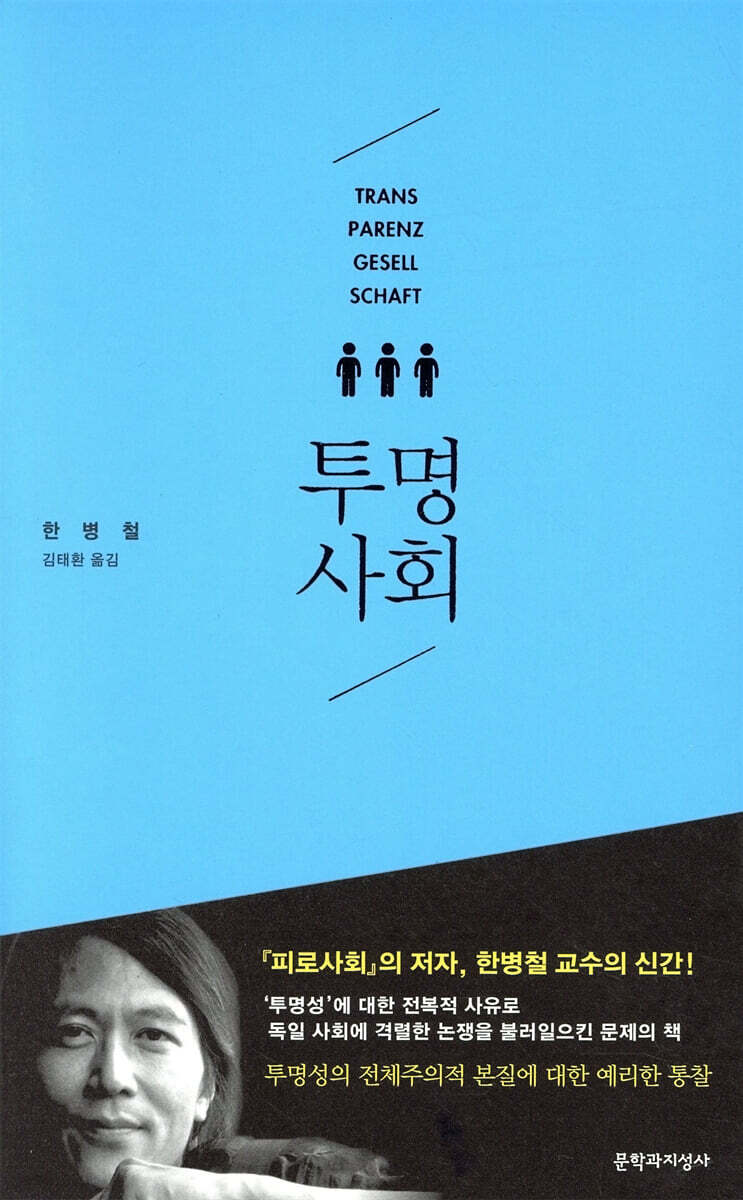
transparent society
 |
Description
Book Introduction
A new work by Han Byung-chul, the German philosopher who heated up Korean society with "The Fatigued Society"!
"A transparent society is a new society of control, where everyone watches everyone else."
A warning to modern people who, under the belief that "transparency" creates a trustworthy society, voluntarily display everything about themselves and create their own "digital control society"! A controversial work that sparked fierce debate in German society, where transparency is considered an absolute value!
Today, transparency is believed to breed 'trust'.
I believe that if the decision-making processes of state power, such as the government and the National Assembly, become transparent, and if corporate financial management becomes transparent, society will become more trustworthy, both politically and economically.
Ultimately, transparency is expected to bring about more democracy, greater freedom of information, and greater efficiency.
However, this book says that a society in which all information is transparently disclosed inevitably becomes a controlled society.
Transparency does not create a society of trust, but a society of control.
The moment we become infinitely connected and communicate unlimited information, we are surrounded by unlimited surveillance.
We, who so willingly reveal everything about ourselves through the Internet and social media, are unknowingly contributing to the construction of a massive 'digital control society.'
His insight is painful and sharp.
A transparent society is a controlled society, a surveillance society.
"A transparent society is a new society of control, where everyone watches everyone else."
A warning to modern people who, under the belief that "transparency" creates a trustworthy society, voluntarily display everything about themselves and create their own "digital control society"! A controversial work that sparked fierce debate in German society, where transparency is considered an absolute value!
Today, transparency is believed to breed 'trust'.
I believe that if the decision-making processes of state power, such as the government and the National Assembly, become transparent, and if corporate financial management becomes transparent, society will become more trustworthy, both politically and economically.
Ultimately, transparency is expected to bring about more democracy, greater freedom of information, and greater efficiency.
However, this book says that a society in which all information is transparently disclosed inevitably becomes a controlled society.
Transparency does not create a society of trust, but a society of control.
The moment we become infinitely connected and communicate unlimited information, we are surrounded by unlimited surveillance.
We, who so willingly reveal everything about ourselves through the Internet and social media, are unknowingly contributing to the construction of a massive 'digital control society.'
His insight is painful and sharp.
A transparent society is a controlled society, a surveillance society.
- You can preview some of the book's contents.
Preview
index
Preface to the Korean Edition 5
transparent society
Positive Society 13 | Exhibition Society 28 | Explicit Society 38 | Pornographic Society 48 | Acceleration
Society 63 | Intimate Society 72 | Information Society 78 | Disclosure Society 87 | Control Society 93
| Americas 103
In the crowd - digital landscapes
Introduction 113 | Without Respect 115 | A Society of Fury 124 | In the Crowd 127 | Escape
Parametrization 136 | Clever Hans 144 | Escape into Images 152 | Hand to Hand
From Garak to Hunter 158 | From Farmer to Hunter 166 | From Subject to Project
176 | Nomos of the Earth 183 | Digital Ghosts 188 | Information Fatigue 195 |
Jaehyun/Representative's Crisis 200 | From Citizen to Consumer 205 | The Complete Life Project
Tokol 210 | Psychopolitics 217 | Americas 223
Translator's Note 227
transparent society
Positive Society 13 | Exhibition Society 28 | Explicit Society 38 | Pornographic Society 48 | Acceleration
Society 63 | Intimate Society 72 | Information Society 78 | Disclosure Society 87 | Control Society 93
| Americas 103
In the crowd - digital landscapes
Introduction 113 | Without Respect 115 | A Society of Fury 124 | In the Crowd 127 | Escape
Parametrization 136 | Clever Hans 144 | Escape into Images 152 | Hand to Hand
From Garak to Hunter 158 | From Farmer to Hunter 166 | From Subject to Project
176 | Nomos of the Earth 183 | Digital Ghosts 188 | Information Fatigue 195 |
Jaehyun/Representative's Crisis 200 | From Citizen to Consumer 205 | The Complete Life Project
Tokol 210 | Psychopolitics 217 | Americas 223
Translator's Note 227
Into the book
P.5: Today, the word 'transparency' is like a ghost, wandering through all areas of life.
Transparency is emphasized not only in politics but also in the economy.
Transparency is expected to bring about greater democracy, greater freedom of information, and greater efficiency.
Transparency breeds trust.
This is a popular belief these days.
What people are forgetting at this time is that the calls for transparency have become much louder in a society where trust is rapidly losing its meaning.
P.7: Transparency creates a glass human whose insides can be seen through.
Herein lies the violence of transparency.
Unlimited freedom and unlimited communication turn into total control and surveillance.
Social media is also increasingly becoming a digital panopticon that monitors and exploits social life.
The panopticon of the disciplinary society isolated prisoners and prevented them from talking to each other for more effective surveillance.
But the inhabitants of the digital panopticon actively communicate with one another and, in the process, voluntarily expose themselves.
They thereby actively participate in the construction of the digital panopticon.
P.24~25: The Pirate Party, a party of transparency, is pushing further down the path of post-politics and depolitics.
The Pirate Party is the first political party that is anti-party and has no color.
Transparency has no color.
In the Pirate Party, color is only permitted as long as it is a non-ideological opinion, not an ideology.
Opinions leave no trace.
Opinions do not have the power to dominate and permeate the whole as ideologies do.
[… … ] Politics is confined to the existing socio-economic relations without touching them, and is reduced to a role of merely managing various social desires.
Transparency is emphasized not only in politics but also in the economy.
Transparency is expected to bring about greater democracy, greater freedom of information, and greater efficiency.
Transparency breeds trust.
This is a popular belief these days.
What people are forgetting at this time is that the calls for transparency have become much louder in a society where trust is rapidly losing its meaning.
P.7: Transparency creates a glass human whose insides can be seen through.
Herein lies the violence of transparency.
Unlimited freedom and unlimited communication turn into total control and surveillance.
Social media is also increasingly becoming a digital panopticon that monitors and exploits social life.
The panopticon of the disciplinary society isolated prisoners and prevented them from talking to each other for more effective surveillance.
But the inhabitants of the digital panopticon actively communicate with one another and, in the process, voluntarily expose themselves.
They thereby actively participate in the construction of the digital panopticon.
P.24~25: The Pirate Party, a party of transparency, is pushing further down the path of post-politics and depolitics.
The Pirate Party is the first political party that is anti-party and has no color.
Transparency has no color.
In the Pirate Party, color is only permitted as long as it is a non-ideological opinion, not an ideology.
Opinions leave no trace.
Opinions do not have the power to dominate and permeate the whole as ideologies do.
[… … ] Politics is confined to the existing socio-economic relations without touching them, and is reduced to a role of merely managing various social desires.
--- From the text
Publisher's Review
A transparent society is not a society where people can trust each other.
It is a new control society where everyone watches everyone else.
A new book by Han Byung-chul, author of The Fatigued Society, which shook Korean society!
For subversive reasons about transparency
A controversial book that sparked heated debate in German society
Professor Han Byeong-cheol (Berlin University of the Arts), author of The Fatigued Society, has published a new book, The Transparent Society.
Transparenzgesellschaft (Transparent Society) (2012), which sparked great controversy by presenting a critical stance that directly contradicts the mainstream discourse on 'transparency' in German society, and Im Schwarm, which presented a diagnosis of the digital civilization that has brought about a new crisis in our lives.
This is a translation of Ansichten des Digitalen (In the Crowd. Digital Landscapes) (2013) and bound into one volume.
In this book, the author attempts a subversive reflection on the totalitarian nature of transparency.
According to the author, transparency is a “neoliberal demand.”
It indiscriminately exposes everything and turns it into information.
On the other hand, the unfamiliar, the ambiguous, and the heterogeneous are dismantled in the name of transparency.
Transparent Society sharply exposes the systemic violence of transparency, a problem that could never be realized if viewed solely from the perspective of eradicating corruption and freedom of information, using Han Byung-chul's characteristically concise writing style.
A transparent society does not lead us to more freedom or better democracy.
A state of surveillance of everyone, forcing us into a "digital panopticon."
‘Transparency’ is a hot topic these days.
Transparency is now being emphasized in almost every area of our lives, not just in politics and economics.
People expect that transparency will lead to more democracy, more freedom of information, and greater efficiency.
In particular, with the development of the Internet and social networks, information has become equally available to everyone and unlimited communication has become possible, leading to the belief that we are one step closer to a transparent society.
However, in Transparent Society, Han Byung-chul questions the concept of transparency, which has been regarded as a positive value.
He argues that a transparent society is not a trust society, but a new control society.
The transparent society forces us into a state of surveillance of everyone by everyone, a 'digital panopticon'.
The inhabitants of this society are not subject to surveillance by the authorities, but rather participate in the construction of a 'digital panopticon' by voluntarily exposing and exhibiting themselves, even mistaking it for 'freedom'.
Here, the distinction between Big Brother and the Panopticon prisoners disappears.
In contrast to the isolated and isolated prisoners of the Benthamite panopticon, the inhabitants of modern controlled societies are networked and communicate fiercely with one another.
Excessive communication, not isolation, ensures transparency.
Transparency transforms everything into 'information', leading us to a state of 'glass people' where everything is completely stripped bare, where there are no secrets, where everyone is the same.
Making humans into a completely naked 'glass human'
A keen insight into the totalitarian nature of transparency
Han Byung-chul says that transparency is a systemic force, an ideology, that dominates all social processes and draws them into a wave of fundamental change.
Today's social system forces transparency to make all social processes manipulable and expeditious.
The pressure of acceleration goes hand in hand with the dissolution of negativity.
Transparency stabilizes and accelerates systems by eliminating the unfamiliar and the foreign.
In a transparent society, the other gradually disappears and the tendency toward narcissism is strengthened.
Moreover, transparency does not contain any negativity that fundamentally questions the existing system.
Transparency does not see outside the system, it simply checks and optimizes what already exists.
In such a society, politics is reduced to the role of simply managing various social needs without touching existing socioeconomic relations.
Elections and shopping become similar, and governance becomes more like marketing.
Han Byung-chul pushes the idea of transparency beyond the realms of daily life and politics to the visual and cognitive levels.
With the advancement of digital technology, which allows everything to be easily converted into an object of information and communication, the realm of visual and cognitive negativity—that is, the realm of the hidden and the secret—is gradually disappearing.
Thus, a pornographic society is established where everything is directly exposed, a society of exhibition where all meaning disappears and only the visible is given value.
Han Byung-chul vividly portrays a society in which everything is superficial, a society where there is no truth but only information, a narcissistic society in which opportunities to directly encounter strangers are decreasing and people can only live by dealing with things they have become accustomed to.
No negativity allowed
Defending opacity against the tide of transparency!
Professor Han Byung-chul's books have long attracted the attention of a wide range of readers beyond the German philosophy community.
However, it was from the time of Fatigue Society (2010) that major German media outlets began to focus on Han Byung-chul.
Germany's ZDF broadcaster described Han Byung-chul as "the most radical thinker," and the Frankfurter Allgemeine Zeitung (FAZ) described him as a pioneer of a new kind of cultural criticism that had never been seen before.
The subsequent publication of Transparent Society once again sparked controversy and buzz in German society.
If we think only in terms of 'controversy', we can say that the transparent society was much more noisy than the fatigue society.
Because German society has placed a high value on transparency, Han Byung-chul's defense of 'opacity' had such a great impact.
The image of a transparent society that Han Byung-chul portrays resonates surprisingly well with today's Korean society.
Of course, looking at the qualification controversies that arise every time a high-ranking public official is appointed or the corruption scandals that occur in the economic sphere, one might wonder if Korean society is still too opaque to critically think about transparency.
However, if we consider that the transparency that Han Byung-chul speaks of is a systemic force that operates across all areas, transcending the realms of politics and economics, it would be difficult to find a case in which Korean society has been swayed by the flow of comprehensive transparency at such a rapid pace and without much social deliberation.
This book will provide a new perspective for those who want to critically consider issues such as how to live in an age of personal information leaks, why we must submit our consumption records to the government during the year-end tax settlement period, how the threatening slogan "Dabonda" can become the name of a popular product, why we are so obsessed with plastic surgery, why digital civilization and social media do not give rise to a new form of direct democracy, and why unlimited freedom of communication does not lead to solidarity.
It is a new control society where everyone watches everyone else.
A new book by Han Byung-chul, author of The Fatigued Society, which shook Korean society!
For subversive reasons about transparency
A controversial book that sparked heated debate in German society
Professor Han Byeong-cheol (Berlin University of the Arts), author of The Fatigued Society, has published a new book, The Transparent Society.
Transparenzgesellschaft (Transparent Society) (2012), which sparked great controversy by presenting a critical stance that directly contradicts the mainstream discourse on 'transparency' in German society, and Im Schwarm, which presented a diagnosis of the digital civilization that has brought about a new crisis in our lives.
This is a translation of Ansichten des Digitalen (In the Crowd. Digital Landscapes) (2013) and bound into one volume.
In this book, the author attempts a subversive reflection on the totalitarian nature of transparency.
According to the author, transparency is a “neoliberal demand.”
It indiscriminately exposes everything and turns it into information.
On the other hand, the unfamiliar, the ambiguous, and the heterogeneous are dismantled in the name of transparency.
Transparent Society sharply exposes the systemic violence of transparency, a problem that could never be realized if viewed solely from the perspective of eradicating corruption and freedom of information, using Han Byung-chul's characteristically concise writing style.
A transparent society does not lead us to more freedom or better democracy.
A state of surveillance of everyone, forcing us into a "digital panopticon."
‘Transparency’ is a hot topic these days.
Transparency is now being emphasized in almost every area of our lives, not just in politics and economics.
People expect that transparency will lead to more democracy, more freedom of information, and greater efficiency.
In particular, with the development of the Internet and social networks, information has become equally available to everyone and unlimited communication has become possible, leading to the belief that we are one step closer to a transparent society.
However, in Transparent Society, Han Byung-chul questions the concept of transparency, which has been regarded as a positive value.
He argues that a transparent society is not a trust society, but a new control society.
The transparent society forces us into a state of surveillance of everyone by everyone, a 'digital panopticon'.
The inhabitants of this society are not subject to surveillance by the authorities, but rather participate in the construction of a 'digital panopticon' by voluntarily exposing and exhibiting themselves, even mistaking it for 'freedom'.
Here, the distinction between Big Brother and the Panopticon prisoners disappears.
In contrast to the isolated and isolated prisoners of the Benthamite panopticon, the inhabitants of modern controlled societies are networked and communicate fiercely with one another.
Excessive communication, not isolation, ensures transparency.
Transparency transforms everything into 'information', leading us to a state of 'glass people' where everything is completely stripped bare, where there are no secrets, where everyone is the same.
Making humans into a completely naked 'glass human'
A keen insight into the totalitarian nature of transparency
Han Byung-chul says that transparency is a systemic force, an ideology, that dominates all social processes and draws them into a wave of fundamental change.
Today's social system forces transparency to make all social processes manipulable and expeditious.
The pressure of acceleration goes hand in hand with the dissolution of negativity.
Transparency stabilizes and accelerates systems by eliminating the unfamiliar and the foreign.
In a transparent society, the other gradually disappears and the tendency toward narcissism is strengthened.
Moreover, transparency does not contain any negativity that fundamentally questions the existing system.
Transparency does not see outside the system, it simply checks and optimizes what already exists.
In such a society, politics is reduced to the role of simply managing various social needs without touching existing socioeconomic relations.
Elections and shopping become similar, and governance becomes more like marketing.
Han Byung-chul pushes the idea of transparency beyond the realms of daily life and politics to the visual and cognitive levels.
With the advancement of digital technology, which allows everything to be easily converted into an object of information and communication, the realm of visual and cognitive negativity—that is, the realm of the hidden and the secret—is gradually disappearing.
Thus, a pornographic society is established where everything is directly exposed, a society of exhibition where all meaning disappears and only the visible is given value.
Han Byung-chul vividly portrays a society in which everything is superficial, a society where there is no truth but only information, a narcissistic society in which opportunities to directly encounter strangers are decreasing and people can only live by dealing with things they have become accustomed to.
No negativity allowed
Defending opacity against the tide of transparency!
Professor Han Byung-chul's books have long attracted the attention of a wide range of readers beyond the German philosophy community.
However, it was from the time of Fatigue Society (2010) that major German media outlets began to focus on Han Byung-chul.
Germany's ZDF broadcaster described Han Byung-chul as "the most radical thinker," and the Frankfurter Allgemeine Zeitung (FAZ) described him as a pioneer of a new kind of cultural criticism that had never been seen before.
The subsequent publication of Transparent Society once again sparked controversy and buzz in German society.
If we think only in terms of 'controversy', we can say that the transparent society was much more noisy than the fatigue society.
Because German society has placed a high value on transparency, Han Byung-chul's defense of 'opacity' had such a great impact.
The image of a transparent society that Han Byung-chul portrays resonates surprisingly well with today's Korean society.
Of course, looking at the qualification controversies that arise every time a high-ranking public official is appointed or the corruption scandals that occur in the economic sphere, one might wonder if Korean society is still too opaque to critically think about transparency.
However, if we consider that the transparency that Han Byung-chul speaks of is a systemic force that operates across all areas, transcending the realms of politics and economics, it would be difficult to find a case in which Korean society has been swayed by the flow of comprehensive transparency at such a rapid pace and without much social deliberation.
This book will provide a new perspective for those who want to critically consider issues such as how to live in an age of personal information leaks, why we must submit our consumption records to the government during the year-end tax settlement period, how the threatening slogan "Dabonda" can become the name of a popular product, why we are so obsessed with plastic surgery, why digital civilization and social media do not give rise to a new form of direct democracy, and why unlimited freedom of communication does not lead to solidarity.
GOODS SPECIFICS
- Date of issue: March 11, 2014
- Page count, weight, size: 235 pages | 261g | 200*125*20mm
- ISBN13: 9788932026114
- ISBN10: 8932026114
You may also like
카테고리
korean


korean

![GQ KOREA Mark (Monthly): December [2025]](http://librairie.coreenne.fr/cdn/shop/files/8ef265dbbfbf186523ed75ba7319009d.jpg?v=1765340328&width=3840)


