

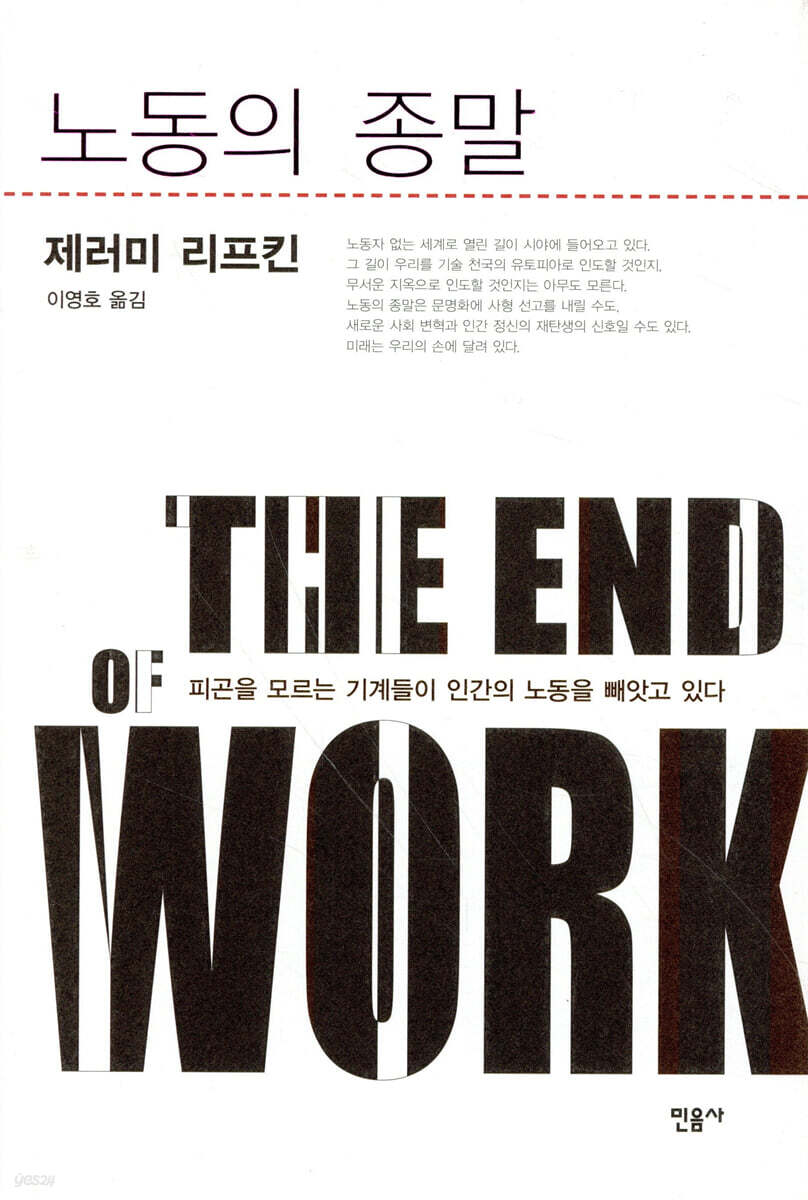
The End of Labor
 |
Description
Book Introduction
Machines that don't know fatigue
It's taking away human labor
This is a revised edition of The End of Work, published in the mid-1990s.
The revised edition includes a 40-page introduction by author Jeremy Rifkin, written to reflect the realities of the book.
Will the advanced information society be a utopia, liberating people from labor and providing them with more leisure and enjoyment, or will it be a dystopia, a conflict between a small number of high-tech engineers and a large number of permanently unemployed people? In this book, world-renowned scholar Jeremy Rifkin once again demonstrates his remarkable insight into technological change and the resulting structural changes in the global economy and society.
Rifkin's prediction that technological advancement would create a large number of unemployed people proved to be correct.
The revised edition, published after the first edition, includes a preface containing Rifkin's insights into the future of work.
Since “The End of Work,” the author has shown keen insight into future society through works such as “The End of Ownership” and “The Hydrogen Revolution.”
In the preface to the revised edition, he presents to readers the sharper perspective he has developed while organizing these previous works.
"The End of Work" argues that advanced technology, the information society, and management innovation are not enriching human lives, but rather eliminating jobs.
Some new jobs will be created, but most of them will be low-wage, temporary positions.
This will accelerate the polarization of society, and a society with deep polarization is more likely to fall into a dystopia (a defective society) rather than a technologically advanced utopia, is Rifkin's diagnosis of the future society.
To overcome the global labor crisis, Rifkin emphasizes the need for voluntary organizations and labor promotion to provide services necessary for community maintenance and reconstruction, and calls for a fundamental shift in humanity's thinking and a decisive decision regarding the true meaning of labor.
It's taking away human labor
This is a revised edition of The End of Work, published in the mid-1990s.
The revised edition includes a 40-page introduction by author Jeremy Rifkin, written to reflect the realities of the book.
Will the advanced information society be a utopia, liberating people from labor and providing them with more leisure and enjoyment, or will it be a dystopia, a conflict between a small number of high-tech engineers and a large number of permanently unemployed people? In this book, world-renowned scholar Jeremy Rifkin once again demonstrates his remarkable insight into technological change and the resulting structural changes in the global economy and society.
Rifkin's prediction that technological advancement would create a large number of unemployed people proved to be correct.
The revised edition, published after the first edition, includes a preface containing Rifkin's insights into the future of work.
Since “The End of Work,” the author has shown keen insight into future society through works such as “The End of Ownership” and “The Hydrogen Revolution.”
In the preface to the revised edition, he presents to readers the sharper perspective he has developed while organizing these previous works.
"The End of Work" argues that advanced technology, the information society, and management innovation are not enriching human lives, but rather eliminating jobs.
Some new jobs will be created, but most of them will be low-wage, temporary positions.
This will accelerate the polarization of society, and a society with deep polarization is more likely to fall into a dystopia (a defective society) rather than a technologically advanced utopia, is Rifkin's diagnosis of the future society.
To overcome the global labor crisis, Rifkin emphasizes the need for voluntary organizations and labor promotion to provide services necessary for community maintenance and reconstruction, and calls for a fundamental shift in humanity's thinking and a decisive decision regarding the true meaning of labor.
- You can preview some of the book's contents.
Preview
index
Recommendation
Preface to the Revised Edition
Preface to the 1st edition
Part 1: Two Aspects of Technology
1.
The End of Labor
2.
Technology Confidence and Market Reality
3.
The ideal of a technological paradise
Part 2: The Third Industrial Revolution
4.
Moving to a high-tech frontier
5.
Technology and the Black Experience
6.
The Great Debate on Automation
7.
Post-Fordism
Part 3: The Decline of the Global Workforce
8.
A world where farmers are no longer needed
9.
The End of Blue Collar
10.
The Last Service Worker
Part 4: The Price of Progress
11.
Winners and Losers in Advanced Technology
12.
Requiem for the Working Class
13.
The fate of the nation
14.
An increasingly dangerous world
Part 5: The Dawn of the Market Age
15.
Reengineering working hours
16.
New social contract
17.
Strengthening the Third Sector
18.
Globalization of the social economy
Preface to the Revised Edition
Preface to the 1st edition
Part 1: Two Aspects of Technology
1.
The End of Labor
2.
Technology Confidence and Market Reality
3.
The ideal of a technological paradise
Part 2: The Third Industrial Revolution
4.
Moving to a high-tech frontier
5.
Technology and the Black Experience
6.
The Great Debate on Automation
7.
Post-Fordism
Part 3: The Decline of the Global Workforce
8.
A world where farmers are no longer needed
9.
The End of Blue Collar
10.
The Last Service Worker
Part 4: The Price of Progress
11.
Winners and Losers in Advanced Technology
12.
Requiem for the Working Class
13.
The fate of the nation
14.
An increasingly dangerous world
Part 5: The Dawn of the Market Age
15.
Reengineering working hours
16.
New social contract
17.
Strengthening the Third Sector
18.
Globalization of the social economy
Into the book
We have several options to address the future of employment.
Each of these alternatives requires human imagination.
For example, we need to rethink the nature of labor and explore alternatives for what roles and contributions humans can make in the coming society.
--- p.22
France became the first country in the world to limit the workweek to 35 hours.
In France, the publication of The End of Work helped to ignite debate about reducing working hours.
The alternatives mentioned in The End of Work were adopted by Philippe Seguin, then President of the French Parliament and a member of the ruling Republican Party.
--- p.28
Eventually, labor will be done by machines.
Labor is simply about producing utility.
On the other hand, people must be liberated to create intrinsic value and revitalize a shared sense of social community.
By liberating people from work, they can make a significant contribution to creating social capital in a civil society that dreams of a great leap forward for humanity in the coming century.
What is required now is the will and determination to embark on this ultimate human journey.
--- p.45
Today we witness the wonders and magic of new technologies.
We have been led to believe that modern technology will liberate us.
Many people are pinning their hopes for a better tomorrow on the liberating potential of the computer revolution.
But the economic lot of the vast majority of workers will continue to deteriorate even amid technological abundance.
--- p.71
Today, the long-held utopian dream of a future technological paradise is within reach.
The technologies of the information and communications revolution promise a world with virtually no workers in the coming century, a long-held dream.
Ironically, the closer we seem to be to the dream of a technological utopia, the more we see a future of flawed societies (dystopias).
This is because market forces continue to create only production and profit without any thought given to creating additional leisure time for the millions of workers who are losing their jobs.
--- p.122
Transnational corporations are increasingly relying on a new generation of workers—silicon collars—as they enter a new era of rapid communication, lean manufacturing, and just-in-time marketing and distribution practices.
A large portion of the workforce is being left behind, and they are unlikely to ever re-enter the emerging, high-tech global economy.
--- p.208
The shift from a society based on mass employment in the private sphere to one in which social life is organized according to non-market criteria will require a reexamination of our current worldview.
Redefining the role of the individual in a society without mass formal labor will probably be the fundamental issue of the coming era.
--- p.338
The end of work could spell the death sentence for civilization.
At the same time, the end of labor may signal a new social transformation and a rebirth of the human spirit.
The future is in our hands.
Each of these alternatives requires human imagination.
For example, we need to rethink the nature of labor and explore alternatives for what roles and contributions humans can make in the coming society.
--- p.22
France became the first country in the world to limit the workweek to 35 hours.
In France, the publication of The End of Work helped to ignite debate about reducing working hours.
The alternatives mentioned in The End of Work were adopted by Philippe Seguin, then President of the French Parliament and a member of the ruling Republican Party.
--- p.28
Eventually, labor will be done by machines.
Labor is simply about producing utility.
On the other hand, people must be liberated to create intrinsic value and revitalize a shared sense of social community.
By liberating people from work, they can make a significant contribution to creating social capital in a civil society that dreams of a great leap forward for humanity in the coming century.
What is required now is the will and determination to embark on this ultimate human journey.
--- p.45
Today we witness the wonders and magic of new technologies.
We have been led to believe that modern technology will liberate us.
Many people are pinning their hopes for a better tomorrow on the liberating potential of the computer revolution.
But the economic lot of the vast majority of workers will continue to deteriorate even amid technological abundance.
--- p.71
Today, the long-held utopian dream of a future technological paradise is within reach.
The technologies of the information and communications revolution promise a world with virtually no workers in the coming century, a long-held dream.
Ironically, the closer we seem to be to the dream of a technological utopia, the more we see a future of flawed societies (dystopias).
This is because market forces continue to create only production and profit without any thought given to creating additional leisure time for the millions of workers who are losing their jobs.
--- p.122
Transnational corporations are increasingly relying on a new generation of workers—silicon collars—as they enter a new era of rapid communication, lean manufacturing, and just-in-time marketing and distribution practices.
A large portion of the workforce is being left behind, and they are unlikely to ever re-enter the emerging, high-tech global economy.
--- p.208
The shift from a society based on mass employment in the private sphere to one in which social life is organized according to non-market criteria will require a reexamination of our current worldview.
Redefining the role of the individual in a society without mass formal labor will probably be the fundamental issue of the coming era.
--- p.338
The end of work could spell the death sentence for civilization.
At the same time, the end of labor may signal a new social transformation and a rebirth of the human spirit.
The future is in our hands.
--- p.361
Publisher's Review
Rifkin's prediction has now become reality.
The 21st century is the age of the silicon collar worker.
Will the 21st century be a technological utopia or a gloomy dystopia?
This book is a rebuttal to Toffler's optimistic outlook on the 21st century information society.
This is because layoffs and mass unemployment caused by the information society and management innovation following advanced technology are heralding the end of labor worldwide, regardless of whether it is blue-collar or white-collar.
The era of silicone-collar workers has already begun.
Is the 21st century truly a century of hope or a century of destruction?
In this challenging, somewhat bleak, but ultimately very informative book, Rifkin argues that we are entering a historical transition in which human labor is slowly and inevitably declining.
Global unemployment is now at its highest level since the Great Depression of the 1930s.
More than 800 million people worldwide are unemployed or potentially unemployed.
The main characters that are driving human labor to the brink of death are advanced technology, the information society, and management innovation.
According to Rifkin, once a job is lost, it never comes back.
Most of the jobs that are created are low-wage and temporary.
This rapidly polarizes the world into two irreconcilable forces.
On one side is the information elite who control and manage the high-tech global economy, and on the other is the vast mass of permanently unemployed, completely unnecessary and hopeless in an increasingly automated world.
Rifkin's diagnosis of the global economic order is that the coexistence of these two irreconcilable groups on Earth makes humanity more likely to fall into a dystopia (a defective society) rather than a technological utopia.
Classics in the fields of futurology, economics, and sociology
A must-read for those living in the era he predicted.
Since the publication of this book, Rifkin has published a series of works filled with outstanding insight, including The End of Ownership, The European Dream, and The Age of Empathy, establishing himself as a unique author who covers a wide range of fields, including futurology, economics, and sociology.
"The End of Work" has been used as a textbook in over 300 universities around the world for over a decade, and is also used as a textbook for major and liberal arts courses at many universities in Korea.
As is typical of Rifkin's writings, this book presents his characteristically clear arguments and rigorous logic.
For this reason, sentences from this book often appear in essay tests and textbooks.
The reason Rifkin's insights do not age with the passage of time lies in their outstanding logic.
The 2020s we are facing is the very 'future' that Rifkin predicted in this book.
Rifkin's point resonates even more deeply today because we are witnessing and experiencing firsthand the changing work environment and job paradigm.
The alternative Rifkin proposes to prevent this society from heading toward a dystopian future is even more urgent for us in this age.
The insights Rifkin explores in his recent books, The Global Green New Deal, The Zero Marginal Cost Society, and The Third Industrial Revolution, are all extensions of The End of Work.
Rifkin has always been keenly aware of the emergence of new technologies and structural changes in society.
This book is a starting point for assessing the trajectory of Rifkin's thought, and is a must-read for readers who wish to follow that trajectory.
This book is divided into five parts.
Part 1: Two Aspects of Technology examines the current technological revolution to understand its impact on employment and the global economy.
Part 2, The Third Industrial Revolution, examines how early automation innovations impacted the lives of Black workers and unions in the United States, providing context for the debate over technology and employment.
Their experiences could be a precursor to the future of countless service and white-collar workers, middle managers, and professional employees.
In Part 3, The Decline of the Global Workforce, Rifkin details how massive technological and organizational changes in agriculture, manufacturing, and the service sector are drastically reducing the number of workers.
Part 4, The Price of Progress, examines in detail the ripple effects of the Third Industrial Revolution on the global workforce, simultaneously assessing the impact of the new technological revolution on both industrialized and developing countries.
In particular, we note the uncomfortable correlation between the rise in technological unemployment and the rise in crime and violence.
It describes the conflict between groups that have formed a lawless subculture due to poverty and despair, and the government that seeks to provide order and safety to the citizens, and the ways in which they can be addressed.
Finally, in Part 5: The Dawn of the Post-Market Era, we examine some practical steps needed to address productivity gains as part of efforts to mitigate the effects of massive technological substitution and to reap the benefits of the high-tech revolution.
Rifkin concludes the book by discussing how to renew human values and social relations, and how to formalize the post-market paradigm and enable a transition from a market-oriented perspective to a new third sector perspective.
The final five parts are Rifkin's alternatives to the pessimistic outlook.
What is needed is a new alternative and approach that transcends the threat of technological advancement inherent in a market economy and opens up a post-market era.
It is a new paradigm that fairly distributes the benefits of technological advancements to their victims and strengthens the emerging third sector.
That is, to encourage and value voluntary organizations and labor that provide the services necessary for maintaining and rebuilding communities.
A new social contract is needed to strengthen the third sector, as evidenced by terms like “shadow wages for volunteering” and “social wages for community services.”
This requires new roles for governments, private businesses, and even working people.
According to Rifkin, this social economy, which is not based solely on productivity, will allow us to rediscover human spirits such as intimacy, brotherly solidarity, and the spirit of service, and will initiate a great transformation toward a new society.
This book provides an opportunity to reflect on how seriously our society, obsessed with blind competition and productivity growth, is considering and preparing for the rising unemployment and accompanying problems brought about by technological advancement.
The 21st century is the age of the silicon collar worker.
Will the 21st century be a technological utopia or a gloomy dystopia?
This book is a rebuttal to Toffler's optimistic outlook on the 21st century information society.
This is because layoffs and mass unemployment caused by the information society and management innovation following advanced technology are heralding the end of labor worldwide, regardless of whether it is blue-collar or white-collar.
The era of silicone-collar workers has already begun.
Is the 21st century truly a century of hope or a century of destruction?
In this challenging, somewhat bleak, but ultimately very informative book, Rifkin argues that we are entering a historical transition in which human labor is slowly and inevitably declining.
Global unemployment is now at its highest level since the Great Depression of the 1930s.
More than 800 million people worldwide are unemployed or potentially unemployed.
The main characters that are driving human labor to the brink of death are advanced technology, the information society, and management innovation.
According to Rifkin, once a job is lost, it never comes back.
Most of the jobs that are created are low-wage and temporary.
This rapidly polarizes the world into two irreconcilable forces.
On one side is the information elite who control and manage the high-tech global economy, and on the other is the vast mass of permanently unemployed, completely unnecessary and hopeless in an increasingly automated world.
Rifkin's diagnosis of the global economic order is that the coexistence of these two irreconcilable groups on Earth makes humanity more likely to fall into a dystopia (a defective society) rather than a technological utopia.
Classics in the fields of futurology, economics, and sociology
A must-read for those living in the era he predicted.
Since the publication of this book, Rifkin has published a series of works filled with outstanding insight, including The End of Ownership, The European Dream, and The Age of Empathy, establishing himself as a unique author who covers a wide range of fields, including futurology, economics, and sociology.
"The End of Work" has been used as a textbook in over 300 universities around the world for over a decade, and is also used as a textbook for major and liberal arts courses at many universities in Korea.
As is typical of Rifkin's writings, this book presents his characteristically clear arguments and rigorous logic.
For this reason, sentences from this book often appear in essay tests and textbooks.
The reason Rifkin's insights do not age with the passage of time lies in their outstanding logic.
The 2020s we are facing is the very 'future' that Rifkin predicted in this book.
Rifkin's point resonates even more deeply today because we are witnessing and experiencing firsthand the changing work environment and job paradigm.
The alternative Rifkin proposes to prevent this society from heading toward a dystopian future is even more urgent for us in this age.
The insights Rifkin explores in his recent books, The Global Green New Deal, The Zero Marginal Cost Society, and The Third Industrial Revolution, are all extensions of The End of Work.
Rifkin has always been keenly aware of the emergence of new technologies and structural changes in society.
This book is a starting point for assessing the trajectory of Rifkin's thought, and is a must-read for readers who wish to follow that trajectory.
This book is divided into five parts.
Part 1: Two Aspects of Technology examines the current technological revolution to understand its impact on employment and the global economy.
Part 2, The Third Industrial Revolution, examines how early automation innovations impacted the lives of Black workers and unions in the United States, providing context for the debate over technology and employment.
Their experiences could be a precursor to the future of countless service and white-collar workers, middle managers, and professional employees.
In Part 3, The Decline of the Global Workforce, Rifkin details how massive technological and organizational changes in agriculture, manufacturing, and the service sector are drastically reducing the number of workers.
Part 4, The Price of Progress, examines in detail the ripple effects of the Third Industrial Revolution on the global workforce, simultaneously assessing the impact of the new technological revolution on both industrialized and developing countries.
In particular, we note the uncomfortable correlation between the rise in technological unemployment and the rise in crime and violence.
It describes the conflict between groups that have formed a lawless subculture due to poverty and despair, and the government that seeks to provide order and safety to the citizens, and the ways in which they can be addressed.
Finally, in Part 5: The Dawn of the Post-Market Era, we examine some practical steps needed to address productivity gains as part of efforts to mitigate the effects of massive technological substitution and to reap the benefits of the high-tech revolution.
Rifkin concludes the book by discussing how to renew human values and social relations, and how to formalize the post-market paradigm and enable a transition from a market-oriented perspective to a new third sector perspective.
The final five parts are Rifkin's alternatives to the pessimistic outlook.
What is needed is a new alternative and approach that transcends the threat of technological advancement inherent in a market economy and opens up a post-market era.
It is a new paradigm that fairly distributes the benefits of technological advancements to their victims and strengthens the emerging third sector.
That is, to encourage and value voluntary organizations and labor that provide the services necessary for maintaining and rebuilding communities.
A new social contract is needed to strengthen the third sector, as evidenced by terms like “shadow wages for volunteering” and “social wages for community services.”
This requires new roles for governments, private businesses, and even working people.
According to Rifkin, this social economy, which is not based solely on productivity, will allow us to rediscover human spirits such as intimacy, brotherly solidarity, and the spirit of service, and will initiate a great transformation toward a new society.
This book provides an opportunity to reflect on how seriously our society, obsessed with blind competition and productivity growth, is considering and preparing for the rising unemployment and accompanying problems brought about by technological advancement.
GOODS SPECIFICS
- Date of issue: May 20, 2005
- Page count, weight, size: 452 pages | 700g | 148*210*30mm
- ISBN13: 9788937425363
- ISBN10: 893742536X
You may also like
카테고리
korean


korean

![GQ KOREA Mark (Monthly): December [2025]](http://librairie.coreenne.fr/cdn/shop/files/8ef265dbbfbf186523ed75ba7319009d.jpg?v=1765340328&width=3840)


