

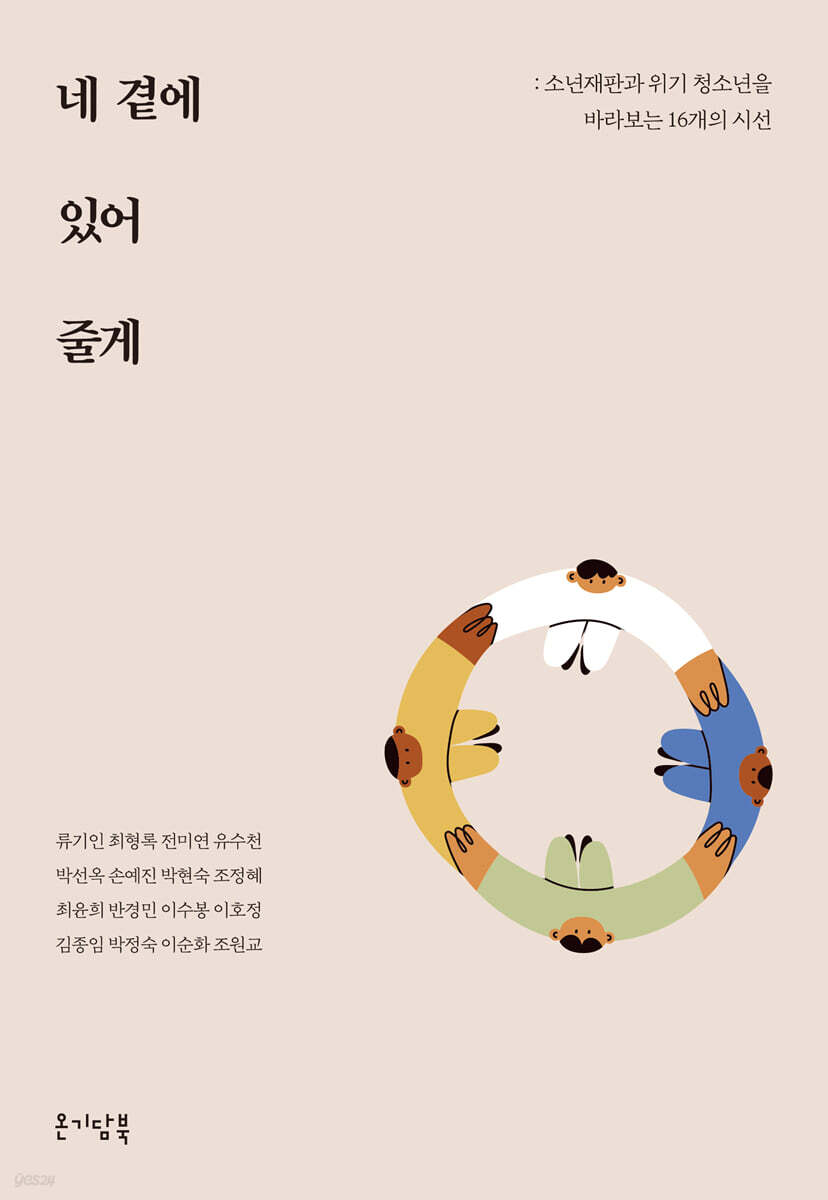
I'll be by your side
 |
Description
Book Introduction
Juvenile Trials: Capturing Diverse Perspectives and Voices from the Scenes of Juvenile Cases
A book born from the concerns of a judge in charge of juvenile trials
Judge Ryu Ki-in, the head of the juvenile division of Changwon District Court, began to feel the need for a change in our society's community interest and awareness of juvenile trials and juveniles under protection as he neared the end of his one-year stint in the juvenile division.
As a judge in charge of juvenile trials, I realized that our society's prejudice and bias against juvenile delinquents are much greater and deeper than I thought. With the belief that it takes a village to raise a child properly, I decided to publish a book that would convey the vivid voices of those at the scene of juvenile crimes.
In juvenile trials and juvenile cases, there is not just one judge in charge, but a network of various organizations and related parties.
The juvenile court's juvenile division participation officers, investigators, youth recovery center staff, and mental health experts and public defenders are all people who work even closer to the juveniles under protection than their parents, listen to their stories, and cry and laugh together with them.
Therefore, in order to gain a three-dimensional understanding of the current state of juvenile justice and at-risk youth in our society, the perspectives and voices of those involved in juvenile cases who have worked with at-risk youth for a long time are equally important.
By being by the children's side and supporting them, these people are finally able to face the hidden pain and inner feelings of the children that they cannot tell anyone else.
Although there are already several good books on juvenile trials, this is why Judge Ryu took the initiative to plan and actively participate in writing a book that includes the perspectives and voices of various field workers.
A book born from the concerns of a judge in charge of juvenile trials
Judge Ryu Ki-in, the head of the juvenile division of Changwon District Court, began to feel the need for a change in our society's community interest and awareness of juvenile trials and juveniles under protection as he neared the end of his one-year stint in the juvenile division.
As a judge in charge of juvenile trials, I realized that our society's prejudice and bias against juvenile delinquents are much greater and deeper than I thought. With the belief that it takes a village to raise a child properly, I decided to publish a book that would convey the vivid voices of those at the scene of juvenile crimes.
In juvenile trials and juvenile cases, there is not just one judge in charge, but a network of various organizations and related parties.
The juvenile court's juvenile division participation officers, investigators, youth recovery center staff, and mental health experts and public defenders are all people who work even closer to the juveniles under protection than their parents, listen to their stories, and cry and laugh together with them.
Therefore, in order to gain a three-dimensional understanding of the current state of juvenile justice and at-risk youth in our society, the perspectives and voices of those involved in juvenile cases who have worked with at-risk youth for a long time are equally important.
By being by the children's side and supporting them, these people are finally able to face the hidden pain and inner feelings of the children that they cannot tell anyone else.
Although there are already several good books on juvenile trials, this is why Judge Ryu took the initiative to plan and actively participate in writing a book that includes the perspectives and voices of various field workers.
- You can preview some of the book's contents.
Preview
index
Recommendations by Oh Seon-hwa, Park Bo-hee, and Do Chun-seok
Preface Dreaming of a future we can build together _Ryu Ki-in
Part 1.
Inside and Outside of Juvenile Court
1.
Can't you stay by my side? _Ryu Ki-in
2.
Inside and Outside of Juvenile Court _Choi Hyeong-rok
3.
Extreme Job: Boy Investigator _Jeon Mi-yeon
4.
Peace to the children who have lived like war _Yusucheon
5.
The sharp child Seunghyun _Park Seonok
Part 2.
I'm still waiting for you
6.
Waiting for a new light _Son Ye-jin
7.
Hyunmin's Painful Coming-of-Age Story _Park Hyun-sook
8.
I'm waiting for the girls today too _Jo Jeong-hye
9.
A Monk Who Became a Mother _Choi Yun-hee
10.
Even though I hate it, I'll do it again _Ban Kyung-min
Part 3.
Be by my side, be by my side
11.
For a better ending _Lee Soo-bong
12.
Children's Hidden Voices _Lee Ho-jeong
13.
A Journey with My Little Ones _Kim Jong-im
14.
Adults really don't know _Park Jeong-suk
15.
Warm yet strict _Lee Soon-hwa
16.
The Path of Companionship, by the Side of the Protected Youth _Jo Won-gyo
supplement.
The story of 'Walking School', where we walk together as one _Ryu Gi-in
1.
The road we walk together is beautiful
2.
A short but meaningful meeting
3.
Days of Mandorong with a Great Cause
Preface Dreaming of a future we can build together _Ryu Ki-in
Part 1.
Inside and Outside of Juvenile Court
1.
Can't you stay by my side? _Ryu Ki-in
2.
Inside and Outside of Juvenile Court _Choi Hyeong-rok
3.
Extreme Job: Boy Investigator _Jeon Mi-yeon
4.
Peace to the children who have lived like war _Yusucheon
5.
The sharp child Seunghyun _Park Seonok
Part 2.
I'm still waiting for you
6.
Waiting for a new light _Son Ye-jin
7.
Hyunmin's Painful Coming-of-Age Story _Park Hyun-sook
8.
I'm waiting for the girls today too _Jo Jeong-hye
9.
A Monk Who Became a Mother _Choi Yun-hee
10.
Even though I hate it, I'll do it again _Ban Kyung-min
Part 3.
Be by my side, be by my side
11.
For a better ending _Lee Soo-bong
12.
Children's Hidden Voices _Lee Ho-jeong
13.
A Journey with My Little Ones _Kim Jong-im
14.
Adults really don't know _Park Jeong-suk
15.
Warm yet strict _Lee Soon-hwa
16.
The Path of Companionship, by the Side of the Protected Youth _Jo Won-gyo
supplement.
The story of 'Walking School', where we walk together as one _Ryu Gi-in
1.
The road we walk together is beautiful
2.
A short but meaningful meeting
3.
Days of Mandorong with a Great Cause
Detailed image
Into the book
Here is the story of the juvenile justice officials at Changwon District Court who put into practice the all-too-familiar saying, "It takes a village to raise a child."
Although there are many parts that are too immature to express in words, I hope you will read the earnest hearts of the co-authors who listen to the voices of children and work with them.
In fact, no child can say that he or she does not know the other person's child.
The same goes for any child around us.
They are all our children.
Even though they may not always be attractive to us, they are all our future.
If we listen to those children's voices and stand by their side today, wouldn't our future and the future of us be brighter?
--- From "Preface: Dreaming of a Future We'll Create Together"
I don't know how many times I sighed while struggling through the heavy records.
If you look only at the outcome of the case, you can't help but hate the juvenile offender.
But as you go through the records one by one, you can see the boy's family environment.
…It is rather strange that a boy who has lived a life of being beaten does not use violence when spending time with friends.
There is a hidden cry among the flights that are thought to deserve severe punishment.
Tears are occasionally seen amidst the boys' swearing and fistfights.
'I see.
How hard was it? You wanted to talk, too, but you didn't know how.
'I guess I've only ever seen adults speak and act that way.'
--- From "Can't You Be By My Side?"
The place where all the data collected through various channels is gathered is on the desk of the juvenile judge's office.
The moment you open the records on the desk, the letters turn into a video and play.
The voices of the boy and his guardian, the probation office and juvenile detention center, the delinquency prevention center and the Gyeongnam Children and Youth Counseling Education Center, and the voices of the public defender teachers are heard in three dimensions.
Let's play those voices slowly.
Because you have to listen carefully.
Sometimes it pauses for a moment.
The heartbreaking breathing of the boy, his guardian, and his teacher is conveyed as it is.
Individual cases, each boy has a story.
… …
To just sit there and listen is the beginning, the process, and the end.
The juvenile judge listens to the boy's story again and again, echoing in the records today.
It would be great if we could listen together.
I feel stronger.
Because they are all our children.
--- From "Can't You Be By My Side?"
Watching the guards, I realized that just the change of having an environment where they can eat three meals a day and sleep comfortably was enough to change the children.
While seeing Changsu at the Shalom Youth Recovery Center, I also got a similar feeling from seeing Eun-gyeol's face at the Somang Youth Recovery Center.
The same was true at the 6th institution, Hyogwangwon, in Daejeon, the 6th institution, Neulsarang, in Daegu, and the 6th institution, Didimteo, in Busan.
I wondered if these were the same kids I had seen in court just a few months ago.
In the courtroom, there were boys crying and complaining.
After visiting over ten institutions over the past six months, talking directly with them and observing their living environments, and meeting with officials from these institutions and organizations on numerous occasions, I found myself changing my perspective on the boys.
--- From "Inside and Outside the Juvenile Court"
So far, over 220 children have passed through Shalom.
While running Shalom, I analyzed the factors that influenced children's misconduct, and it seemed that environmental issues were much more significant than individual problems.
…
When juvenile delinquency becomes an issue, public opinion tends to focus on punishment. However, rather than focusing solely on a few provocative incidents, I hope we can carefully examine the environmental causes that led to these children's behavior.
I hope that the world will look back and realize that adults have responsibility.
We must not forget that children are victims of the social structure created by adults.
--- From "Peace to the Children Who Lived Like War"
Saebit Youth Recovery Center is celebrating its 11th anniversary this year, 2024.
It's been six years since I started working here.
Over the past 11 years, nearly 200 children have lived and left the center.
…
Living with so many children, I have felt frustrated and heartbroken more than once because there seemed to be no visible change.
In my impatience to change, I couldn't wait for the children and kept nagging them.
But isn't it too much for adults to expect noticeable changes within six months of entering the center?
…
I promise to wait for the children's time by their side.
Rather than hating or distrusting them, I decided to wait with anticipation and hope for their full potential.
--- From "Waiting for a New Light"
"I did some wrong, but shouldn't my parents be punished for forcing me into this kind of household? Parents who don't even raise me properly are fine, so why should I be punished for living this way?"
What would the lives of the two sisters have been like if their family and parents had been a strong fence?
No matter how hard the two children struggled, it was difficult for them to escape their environment.
While their parents neglected and neglected their duties, the two children spent their teenage years in and out of court.
--- From "The Hidden Voices of Children"
I want to have some time to wait, so I first prepare an empty room in my heart, create some space, and then gesture to Seoyeon.
We convey our feelings through all kinds of methods, keeping the thread of conversation connected.
Express your concerns and worries, say hello, joke around, and speak with interest.
For the next few days, Seoyeon will be my number one VIP emergency target, and I will respond to any messages she sends me at any time.
Okay! I try to communicate sincerely, with sincerity, focus, interest, and concern.
Seoyeon, how are you? I'll be waiting for you.
--- From "Warm and Strict"
Of the juveniles I have met over the years as a public defender and a guardian, only a few have returned to the juvenile court due to recidivism.
Most people's attitudes change after experiencing a trial just once or twice.
It shows that he is trying hard to overcome puberty.
It's truly admirable that the children are conscious of their teacher, who is a public defender and watches over them, even when they waver at times.
As long as my health permits, I hope to continue on the path of a public defender for a long time, working with these hard-working juveniles.
Although there are many parts that are too immature to express in words, I hope you will read the earnest hearts of the co-authors who listen to the voices of children and work with them.
In fact, no child can say that he or she does not know the other person's child.
The same goes for any child around us.
They are all our children.
Even though they may not always be attractive to us, they are all our future.
If we listen to those children's voices and stand by their side today, wouldn't our future and the future of us be brighter?
--- From "Preface: Dreaming of a Future We'll Create Together"
I don't know how many times I sighed while struggling through the heavy records.
If you look only at the outcome of the case, you can't help but hate the juvenile offender.
But as you go through the records one by one, you can see the boy's family environment.
…It is rather strange that a boy who has lived a life of being beaten does not use violence when spending time with friends.
There is a hidden cry among the flights that are thought to deserve severe punishment.
Tears are occasionally seen amidst the boys' swearing and fistfights.
'I see.
How hard was it? You wanted to talk, too, but you didn't know how.
'I guess I've only ever seen adults speak and act that way.'
--- From "Can't You Be By My Side?"
The place where all the data collected through various channels is gathered is on the desk of the juvenile judge's office.
The moment you open the records on the desk, the letters turn into a video and play.
The voices of the boy and his guardian, the probation office and juvenile detention center, the delinquency prevention center and the Gyeongnam Children and Youth Counseling Education Center, and the voices of the public defender teachers are heard in three dimensions.
Let's play those voices slowly.
Because you have to listen carefully.
Sometimes it pauses for a moment.
The heartbreaking breathing of the boy, his guardian, and his teacher is conveyed as it is.
Individual cases, each boy has a story.
… …
To just sit there and listen is the beginning, the process, and the end.
The juvenile judge listens to the boy's story again and again, echoing in the records today.
It would be great if we could listen together.
I feel stronger.
Because they are all our children.
--- From "Can't You Be By My Side?"
Watching the guards, I realized that just the change of having an environment where they can eat three meals a day and sleep comfortably was enough to change the children.
While seeing Changsu at the Shalom Youth Recovery Center, I also got a similar feeling from seeing Eun-gyeol's face at the Somang Youth Recovery Center.
The same was true at the 6th institution, Hyogwangwon, in Daejeon, the 6th institution, Neulsarang, in Daegu, and the 6th institution, Didimteo, in Busan.
I wondered if these were the same kids I had seen in court just a few months ago.
In the courtroom, there were boys crying and complaining.
After visiting over ten institutions over the past six months, talking directly with them and observing their living environments, and meeting with officials from these institutions and organizations on numerous occasions, I found myself changing my perspective on the boys.
--- From "Inside and Outside the Juvenile Court"
So far, over 220 children have passed through Shalom.
While running Shalom, I analyzed the factors that influenced children's misconduct, and it seemed that environmental issues were much more significant than individual problems.
…
When juvenile delinquency becomes an issue, public opinion tends to focus on punishment. However, rather than focusing solely on a few provocative incidents, I hope we can carefully examine the environmental causes that led to these children's behavior.
I hope that the world will look back and realize that adults have responsibility.
We must not forget that children are victims of the social structure created by adults.
--- From "Peace to the Children Who Lived Like War"
Saebit Youth Recovery Center is celebrating its 11th anniversary this year, 2024.
It's been six years since I started working here.
Over the past 11 years, nearly 200 children have lived and left the center.
…
Living with so many children, I have felt frustrated and heartbroken more than once because there seemed to be no visible change.
In my impatience to change, I couldn't wait for the children and kept nagging them.
But isn't it too much for adults to expect noticeable changes within six months of entering the center?
…
I promise to wait for the children's time by their side.
Rather than hating or distrusting them, I decided to wait with anticipation and hope for their full potential.
--- From "Waiting for a New Light"
"I did some wrong, but shouldn't my parents be punished for forcing me into this kind of household? Parents who don't even raise me properly are fine, so why should I be punished for living this way?"
What would the lives of the two sisters have been like if their family and parents had been a strong fence?
No matter how hard the two children struggled, it was difficult for them to escape their environment.
While their parents neglected and neglected their duties, the two children spent their teenage years in and out of court.
--- From "The Hidden Voices of Children"
I want to have some time to wait, so I first prepare an empty room in my heart, create some space, and then gesture to Seoyeon.
We convey our feelings through all kinds of methods, keeping the thread of conversation connected.
Express your concerns and worries, say hello, joke around, and speak with interest.
For the next few days, Seoyeon will be my number one VIP emergency target, and I will respond to any messages she sends me at any time.
Okay! I try to communicate sincerely, with sincerity, focus, interest, and concern.
Seoyeon, how are you? I'll be waiting for you.
--- From "Warm and Strict"
Of the juveniles I have met over the years as a public defender and a guardian, only a few have returned to the juvenile court due to recidivism.
Most people's attitudes change after experiencing a trial just once or twice.
It shows that he is trying hard to overcome puberty.
It's truly admirable that the children are conscious of their teacher, who is a public defender and watches over them, even when they waver at times.
As long as my health permits, I hope to continue on the path of a public defender for a long time, working with these hard-working juveniles.
--- From "The Path of a Companion, Beside the Protected Youth"
Publisher's Review
With a sense of responsibility to be ‘by your side’ rather than isolate or exclude others
"I did my part, but shouldn't my parents be punished for forcing me into this kind of household? Parents who don't even raise me properly are fine, so why should I be punished for living this way?" (p. 190)
This is a protest from a child who was repeatedly tried as a juvenile and eventually sentenced to a juvenile detention center. We cannot dismiss this as a simple complaint from a stubborn person.
If any child is growing up in the midst of violence, abuse, indifference, neglect, loneliness, fear, or hunger, it is clearly the responsibility of adults.
Because no child would choose that kind of growing environment on their own.
When a problem arises, whether for individuals or communities, rather than examining and reflecting on the root cause, they tend to focus on eliminating or resolving the problem itself as quickly as possible.
This is why the solution that is always suggested is to confine people in iron-clad walls or cells through isolation and exclusion.
This approach will ultimately exacerbate and worsen the problem, trapping us in a vicious cycle.
This is why sixteen authors, each with a different background in their organizations, work, and lives, consistently oppose the argument that "juvenile delinquents must be resolutely isolated from our society."
The authors unanimously say that we must give ourselves to them and become their side.
“Most of the so-called juvenile delinquents, the boys who disrupt social order and commit crimes, are actually immature children who commit mistakes and then regret them without knowing what to do.
Criminal behavior is clearly wrong, and you must pay the price and take responsibility for it.
However, we should not reject the child itself as a defective being.
“When we reject and let go of a juvenile delinquent, we also see cases where the juvenile drags his peers into even bigger crimes, and they become gangsters and violent together.” (pp. 234-235)
From the 'Recommendation' to the 'Appendix', a long and deep resonance
Among those who recommended this book, there is someone who has a close relationship with the Juvenile Division of Changwon District Court and one of the co-authors.
He, who describes himself as a “notorious troublemaker” and reveals that he “wouldn’t stop flying and ended up being sentenced to a long-term juvenile detention center,” told me that after being asked to write a letter of recommendation, he spent 12 hours staring at the monitor, agonizing.
Am I really qualified? What if the recommendation I write ends up being negative? I said I would write it, but what should I write?
The worries must have been long and deep.
The words of gratitude he left to the Juvenile Division of Changwon District Court and the co-authors of this book through the recommendation section left a deep impression.
“Thank you for silently watching over us as we lived in fear, always feeling alone.
I will not let the unconditional love you gave me, which I gave birth to with my heart and raised with my mind, go to waste. Even though it may be a little slow, I will one day become an adult who can give back to the world.
“Thank you so much.” (Page 9)
At the end of this book, there are three stories about the ‘Walking School with Children in Need’, which was planned and run by the main author, Judge Ryu Ki-in.
Not only is the reason for starting the walking school included, but also brief comments from the children and mentors who participated in the walking school.
Additionally, it also contains vivid scenes from the 'Olle Trail Hiking Trip' where Judge Ryu spent a considerable amount of time talking with the juvenile under protection while walking for 8 nights and 9 days.
※ An interview with Chief Judge Ryu Ki-in, the planner and lead author, is included as an appendix at the end of the press release.
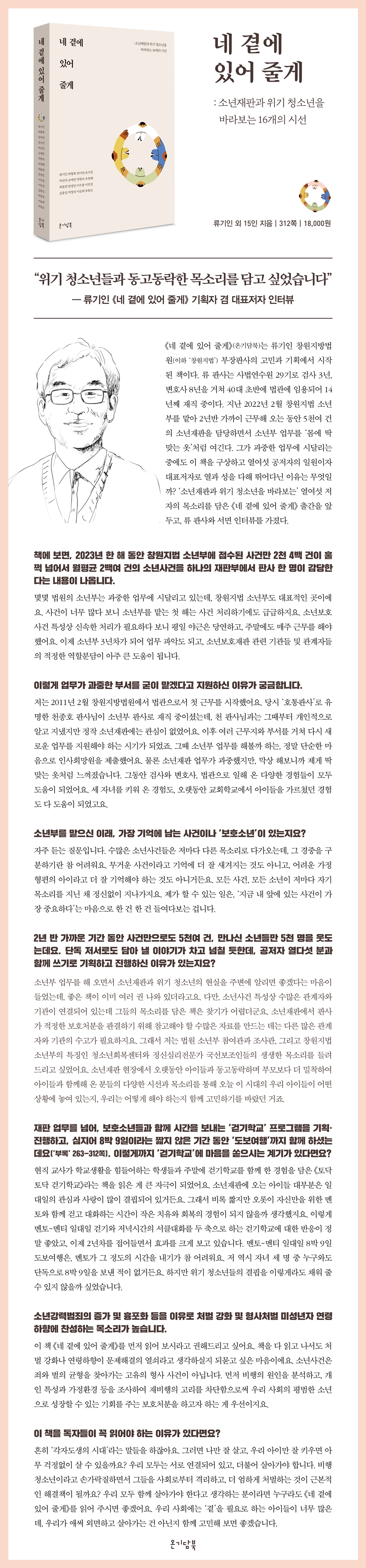
"I wanted to capture the voices of those who shared the joys and sorrows of the children at the scene of the juvenile incident."
― Interview with Ryu Ki-in, planner and lead author
“I’ll Be by Your Side” (Onkidam Books) is a book that began with the concerns and planning of Judge Ryu Gi-in of Changwon District Court (hereafter “Changwon District Court”).
Judge Ryu graduated from the 29th class of the Judicial Research and Training Institute. After working as a prosecutor for 3 years and as a lawyer for 8 years, he was appointed as a judge in his early 40s and has been serving for 14 years.
Since taking up the position of Juvenile Division of Changwon District Court in February 2022, he has worked for nearly two and a half years, handling over 5,000 juvenile cases, and he considers the work of the Juvenile Division to be a "suit that fits him perfectly."
What prompted him to conceive this book, despite his overwhelming workload, and to devote his energy and passion to it as one of sixteen co-authors and lead author? Ahead of the publication of "I'll Be By Your Side," a collection of sixteen authors' perspectives on juvenile justice and at-risk youth, we had a written interview with Judge Ryu.
― According to the book, in 2023 alone, the number of cases filed with the Changwon District Court Juvenile Division exceeded 2,400, meaning that one judge in each division handles an average of 200 juvenile cases per month.
The juvenile divisions of some courts are struggling with excessive workload, and the juvenile division of Changwon District Court is a prime example.
Because there are so many cases, the first year in charge of the juvenile department is busy just dealing with the cases.
Because juvenile protection cases require quick processing, working overtime on weekdays was a given, and I had to work every weekend as well.
Now that I am in my third year at the Juvenile Department, I have a better understanding of the work, and the appropriate division of roles among the juvenile protection trial-related organizations and officials is of great help.
― I'm curious as to why you applied to take on such a demanding department.
I started working as a judge at Changwon District Court in February 2011.
At the time, Judge Chun Jong-ho, famous as the 'shouting judge', was serving as a judge in the juvenile division of Changwon District Court. I had known Judge Chun personally since then, but I had no interest in juvenile trials.
After that, I worked in various places and positions, including as Associate Judge of the Criminal Appeals Division, Associate Judge of the High Court, Single Judge of the Family Division at the Busan Family Court, Single Judge of the Civil Division at the Daegu District Court, Chief Judge of the Criminal Appeals Division at the Changwon District Court, and Head of the Masan Branch of the Changwon District Court. Then, it was time to apply for a new position.
At that time, I submitted my application with a very simple thought of wanting to work in the youth department.
There is still no family court in Gyeongnam, and the juvenile court work was burdensome because the Changwon District Court did not have enough judges. However, once I actually started working, it felt like a perfect fit for me.
All of my diverse experiences as a prosecutor, lawyer, and judge have been helpful.
My experience raising three children and teaching children as a Sunday school teacher for a long time were both helpful.
― Since you took charge of the juvenile division, is there a case or ‘juvenile in need of protection’ that stands out most in your memory?
This is a frequently asked question.
Numerous juvenile cases come across with different voices, and it is difficult to distinguish their severity.
It's not like a serious incident is more memorable, nor is it like a child from a difficult family background remembering things better.
Every event, every boy, passes by in a frenzy, each with his own voice.
What I can do is to look at each case one by one with the mindset that 'the case in front of me right now is the most important.'
If we don't do that, we'll be left helpless by the catastrophic events.
I also consciously try not to dwell on certain events.
I also tell children in court.
“Let’s never meet here again.
“Just hearing that you are doing well later is enough for me.”
― In the past two and a half years, there have been over 5,000 incidents, and the number of boys you've met has exceeded 5,000.
It seems like there are so many stories to tell in a solo book, but is there a reason you decided to write it with fifteen co-authors?
While working in the Juvenile Department, I felt it would be good to inform people about the reality of juvenile trials and at-risk youth, and I found that several good books have already been published.
However, due to the nature of juvenile cases, there are numerous people and organizations involved, but it is difficult to find a book that contains their voices.
In juvenile trials, the creation of the numerous materials that judges must refer to in order to decide on an appropriate protective measure requires the efforts of many other stakeholders and agencies.
So, I wanted to share the vivid voices of the juvenile division participants and investigators, as well as the youth recovery center and psychiatric and psychological specialist public defenders, which are the hallmarks of the juvenile division of the Changwon District Court.
I hoped that through the diverse perspectives and voices of those who have been with children for a long time in the juvenile court field, and who have been closer to them than their parents, we could think together about what kind of situation our children are in today and what we should do about it.
― Beyond your judicial duties, you planned and ran a "walking school" program where you spent time with juveniles under protection, and even went on a "walking trip" with them for a considerable period of eight nights and nine days (Appendix, pp. 263-312).
Is there a reason why you are so devoted to 'Walking School'?
I was greatly inspired by reading a book called "Todak Todak Walking School," which contains the experiences of a current teacher who held a walking school with students who were having a hard time with school life on the weekends.
Most children who come to juvenile court lack one-on-one attention and love.
So, I thought that even if it was short, walking and talking with a mentor just for you would be a small healing and recovery experience.
We first tried a two-night, three-day walking school that suited our circumstances. In the evening, all participants gathered together and had a circle discussion time without any 'advice, advice, evaluation, or judgment'.
The response to our walking school, which focuses on one-on-one mentor-mentee walking and evening circle conversations, has been really positive.
Now, as we enter our second year, we are seeing significant results.
The 8-night, 9-day mentor-mentee one-on-one walking trip is a program that has been run by the Mansa Boys Foundation for over 10 years, but realistically, it is difficult for mentors to make time for that amount of time.
I, too, have never spent eight nights and nine days alone with any of my three children.
But I thought that maybe this was the way to fill the void left by at-risk youth.
― There are growing voices in favor of strengthening punishment and lowering the age of criminal punishment for juveniles due to the increase and brutality of juvenile crimes.
I would like to recommend that you read this book first, “I’ll Be By Your Side.”
After reading the book, I still want to ask if you still think that strengthening punishment or lowering the age of criminal responsibility is the key to solving the problem.
Juvenile cases are not unique criminal cases that seek to find a balance between crime and punishment.
First, we need to analyze the cause of the misconduct, investigate the individual's characteristics and family environment, and then take protective measures to prevent recidivism, thereby giving the child the opportunity to grow into an ordinary boy in our society.
― Is there a reason why readers should definitely read this book?
People often say, 'This is the era of each person for himself.'
So, if I just live well and raise my children well, can I live without worry? We are all interconnected and must live together.
Is labeling juvenile delinquents as such, isolating them from society, and punishing them more harshly the fundamental solution? Anyone who believes we must all live together should read "I'll Be By Your Side."
There are so many children in our society who need our help, and I hope we can all consider whether we are trying to ignore them and live our lives.
― Lastly, who would particularly benefit from reading “I’ll Be By Your Side”?
I hope that all parents, more than anyone else, will read this book.
I hope that parents who do their best to support their children and hope that they grow up well will share a little, just a little, of their 'side' with other children in our society.
I don't think there's a single person in our society who doesn't need to read this book.
If at least one million readers read this book, I think the problem of youth crisis in our country will improve significantly.
"I did my part, but shouldn't my parents be punished for forcing me into this kind of household? Parents who don't even raise me properly are fine, so why should I be punished for living this way?" (p. 190)
This is a protest from a child who was repeatedly tried as a juvenile and eventually sentenced to a juvenile detention center. We cannot dismiss this as a simple complaint from a stubborn person.
If any child is growing up in the midst of violence, abuse, indifference, neglect, loneliness, fear, or hunger, it is clearly the responsibility of adults.
Because no child would choose that kind of growing environment on their own.
When a problem arises, whether for individuals or communities, rather than examining and reflecting on the root cause, they tend to focus on eliminating or resolving the problem itself as quickly as possible.
This is why the solution that is always suggested is to confine people in iron-clad walls or cells through isolation and exclusion.
This approach will ultimately exacerbate and worsen the problem, trapping us in a vicious cycle.
This is why sixteen authors, each with a different background in their organizations, work, and lives, consistently oppose the argument that "juvenile delinquents must be resolutely isolated from our society."
The authors unanimously say that we must give ourselves to them and become their side.
“Most of the so-called juvenile delinquents, the boys who disrupt social order and commit crimes, are actually immature children who commit mistakes and then regret them without knowing what to do.
Criminal behavior is clearly wrong, and you must pay the price and take responsibility for it.
However, we should not reject the child itself as a defective being.
“When we reject and let go of a juvenile delinquent, we also see cases where the juvenile drags his peers into even bigger crimes, and they become gangsters and violent together.” (pp. 234-235)
From the 'Recommendation' to the 'Appendix', a long and deep resonance
Among those who recommended this book, there is someone who has a close relationship with the Juvenile Division of Changwon District Court and one of the co-authors.
He, who describes himself as a “notorious troublemaker” and reveals that he “wouldn’t stop flying and ended up being sentenced to a long-term juvenile detention center,” told me that after being asked to write a letter of recommendation, he spent 12 hours staring at the monitor, agonizing.
Am I really qualified? What if the recommendation I write ends up being negative? I said I would write it, but what should I write?
The worries must have been long and deep.
The words of gratitude he left to the Juvenile Division of Changwon District Court and the co-authors of this book through the recommendation section left a deep impression.
“Thank you for silently watching over us as we lived in fear, always feeling alone.
I will not let the unconditional love you gave me, which I gave birth to with my heart and raised with my mind, go to waste. Even though it may be a little slow, I will one day become an adult who can give back to the world.
“Thank you so much.” (Page 9)
At the end of this book, there are three stories about the ‘Walking School with Children in Need’, which was planned and run by the main author, Judge Ryu Ki-in.
Not only is the reason for starting the walking school included, but also brief comments from the children and mentors who participated in the walking school.
Additionally, it also contains vivid scenes from the 'Olle Trail Hiking Trip' where Judge Ryu spent a considerable amount of time talking with the juvenile under protection while walking for 8 nights and 9 days.
※ An interview with Chief Judge Ryu Ki-in, the planner and lead author, is included as an appendix at the end of the press release.
"I wanted to capture the voices of those who shared the joys and sorrows of the children at the scene of the juvenile incident."
― Interview with Ryu Ki-in, planner and lead author
“I’ll Be by Your Side” (Onkidam Books) is a book that began with the concerns and planning of Judge Ryu Gi-in of Changwon District Court (hereafter “Changwon District Court”).
Judge Ryu graduated from the 29th class of the Judicial Research and Training Institute. After working as a prosecutor for 3 years and as a lawyer for 8 years, he was appointed as a judge in his early 40s and has been serving for 14 years.
Since taking up the position of Juvenile Division of Changwon District Court in February 2022, he has worked for nearly two and a half years, handling over 5,000 juvenile cases, and he considers the work of the Juvenile Division to be a "suit that fits him perfectly."
What prompted him to conceive this book, despite his overwhelming workload, and to devote his energy and passion to it as one of sixteen co-authors and lead author? Ahead of the publication of "I'll Be By Your Side," a collection of sixteen authors' perspectives on juvenile justice and at-risk youth, we had a written interview with Judge Ryu.
― According to the book, in 2023 alone, the number of cases filed with the Changwon District Court Juvenile Division exceeded 2,400, meaning that one judge in each division handles an average of 200 juvenile cases per month.
The juvenile divisions of some courts are struggling with excessive workload, and the juvenile division of Changwon District Court is a prime example.
Because there are so many cases, the first year in charge of the juvenile department is busy just dealing with the cases.
Because juvenile protection cases require quick processing, working overtime on weekdays was a given, and I had to work every weekend as well.
Now that I am in my third year at the Juvenile Department, I have a better understanding of the work, and the appropriate division of roles among the juvenile protection trial-related organizations and officials is of great help.
― I'm curious as to why you applied to take on such a demanding department.
I started working as a judge at Changwon District Court in February 2011.
At the time, Judge Chun Jong-ho, famous as the 'shouting judge', was serving as a judge in the juvenile division of Changwon District Court. I had known Judge Chun personally since then, but I had no interest in juvenile trials.
After that, I worked in various places and positions, including as Associate Judge of the Criminal Appeals Division, Associate Judge of the High Court, Single Judge of the Family Division at the Busan Family Court, Single Judge of the Civil Division at the Daegu District Court, Chief Judge of the Criminal Appeals Division at the Changwon District Court, and Head of the Masan Branch of the Changwon District Court. Then, it was time to apply for a new position.
At that time, I submitted my application with a very simple thought of wanting to work in the youth department.
There is still no family court in Gyeongnam, and the juvenile court work was burdensome because the Changwon District Court did not have enough judges. However, once I actually started working, it felt like a perfect fit for me.
All of my diverse experiences as a prosecutor, lawyer, and judge have been helpful.
My experience raising three children and teaching children as a Sunday school teacher for a long time were both helpful.
― Since you took charge of the juvenile division, is there a case or ‘juvenile in need of protection’ that stands out most in your memory?
This is a frequently asked question.
Numerous juvenile cases come across with different voices, and it is difficult to distinguish their severity.
It's not like a serious incident is more memorable, nor is it like a child from a difficult family background remembering things better.
Every event, every boy, passes by in a frenzy, each with his own voice.
What I can do is to look at each case one by one with the mindset that 'the case in front of me right now is the most important.'
If we don't do that, we'll be left helpless by the catastrophic events.
I also consciously try not to dwell on certain events.
I also tell children in court.
“Let’s never meet here again.
“Just hearing that you are doing well later is enough for me.”
― In the past two and a half years, there have been over 5,000 incidents, and the number of boys you've met has exceeded 5,000.
It seems like there are so many stories to tell in a solo book, but is there a reason you decided to write it with fifteen co-authors?
While working in the Juvenile Department, I felt it would be good to inform people about the reality of juvenile trials and at-risk youth, and I found that several good books have already been published.
However, due to the nature of juvenile cases, there are numerous people and organizations involved, but it is difficult to find a book that contains their voices.
In juvenile trials, the creation of the numerous materials that judges must refer to in order to decide on an appropriate protective measure requires the efforts of many other stakeholders and agencies.
So, I wanted to share the vivid voices of the juvenile division participants and investigators, as well as the youth recovery center and psychiatric and psychological specialist public defenders, which are the hallmarks of the juvenile division of the Changwon District Court.
I hoped that through the diverse perspectives and voices of those who have been with children for a long time in the juvenile court field, and who have been closer to them than their parents, we could think together about what kind of situation our children are in today and what we should do about it.
― Beyond your judicial duties, you planned and ran a "walking school" program where you spent time with juveniles under protection, and even went on a "walking trip" with them for a considerable period of eight nights and nine days (Appendix, pp. 263-312).
Is there a reason why you are so devoted to 'Walking School'?
I was greatly inspired by reading a book called "Todak Todak Walking School," which contains the experiences of a current teacher who held a walking school with students who were having a hard time with school life on the weekends.
Most children who come to juvenile court lack one-on-one attention and love.
So, I thought that even if it was short, walking and talking with a mentor just for you would be a small healing and recovery experience.
We first tried a two-night, three-day walking school that suited our circumstances. In the evening, all participants gathered together and had a circle discussion time without any 'advice, advice, evaluation, or judgment'.
The response to our walking school, which focuses on one-on-one mentor-mentee walking and evening circle conversations, has been really positive.
Now, as we enter our second year, we are seeing significant results.
The 8-night, 9-day mentor-mentee one-on-one walking trip is a program that has been run by the Mansa Boys Foundation for over 10 years, but realistically, it is difficult for mentors to make time for that amount of time.
I, too, have never spent eight nights and nine days alone with any of my three children.
But I thought that maybe this was the way to fill the void left by at-risk youth.
― There are growing voices in favor of strengthening punishment and lowering the age of criminal punishment for juveniles due to the increase and brutality of juvenile crimes.
I would like to recommend that you read this book first, “I’ll Be By Your Side.”
After reading the book, I still want to ask if you still think that strengthening punishment or lowering the age of criminal responsibility is the key to solving the problem.
Juvenile cases are not unique criminal cases that seek to find a balance between crime and punishment.
First, we need to analyze the cause of the misconduct, investigate the individual's characteristics and family environment, and then take protective measures to prevent recidivism, thereby giving the child the opportunity to grow into an ordinary boy in our society.
― Is there a reason why readers should definitely read this book?
People often say, 'This is the era of each person for himself.'
So, if I just live well and raise my children well, can I live without worry? We are all interconnected and must live together.
Is labeling juvenile delinquents as such, isolating them from society, and punishing them more harshly the fundamental solution? Anyone who believes we must all live together should read "I'll Be By Your Side."
There are so many children in our society who need our help, and I hope we can all consider whether we are trying to ignore them and live our lives.
― Lastly, who would particularly benefit from reading “I’ll Be By Your Side”?
I hope that all parents, more than anyone else, will read this book.
I hope that parents who do their best to support their children and hope that they grow up well will share a little, just a little, of their 'side' with other children in our society.
I don't think there's a single person in our society who doesn't need to read this book.
If at least one million readers read this book, I think the problem of youth crisis in our country will improve significantly.
GOODS SPECIFICS
- Date of issue: June 17, 2024
- Page count, weight, size: 312 pages | 145*210*30mm
- ISBN13: 9791198780805
- ISBN10: 1198780800
You may also like
카테고리
korean


korean

![GQ KOREA Mark (Monthly): December [2025]](http://librairie.coreenne.fr/cdn/shop/files/8ef265dbbfbf186523ed75ba7319009d.jpg?v=1765340328&width=3840)


