

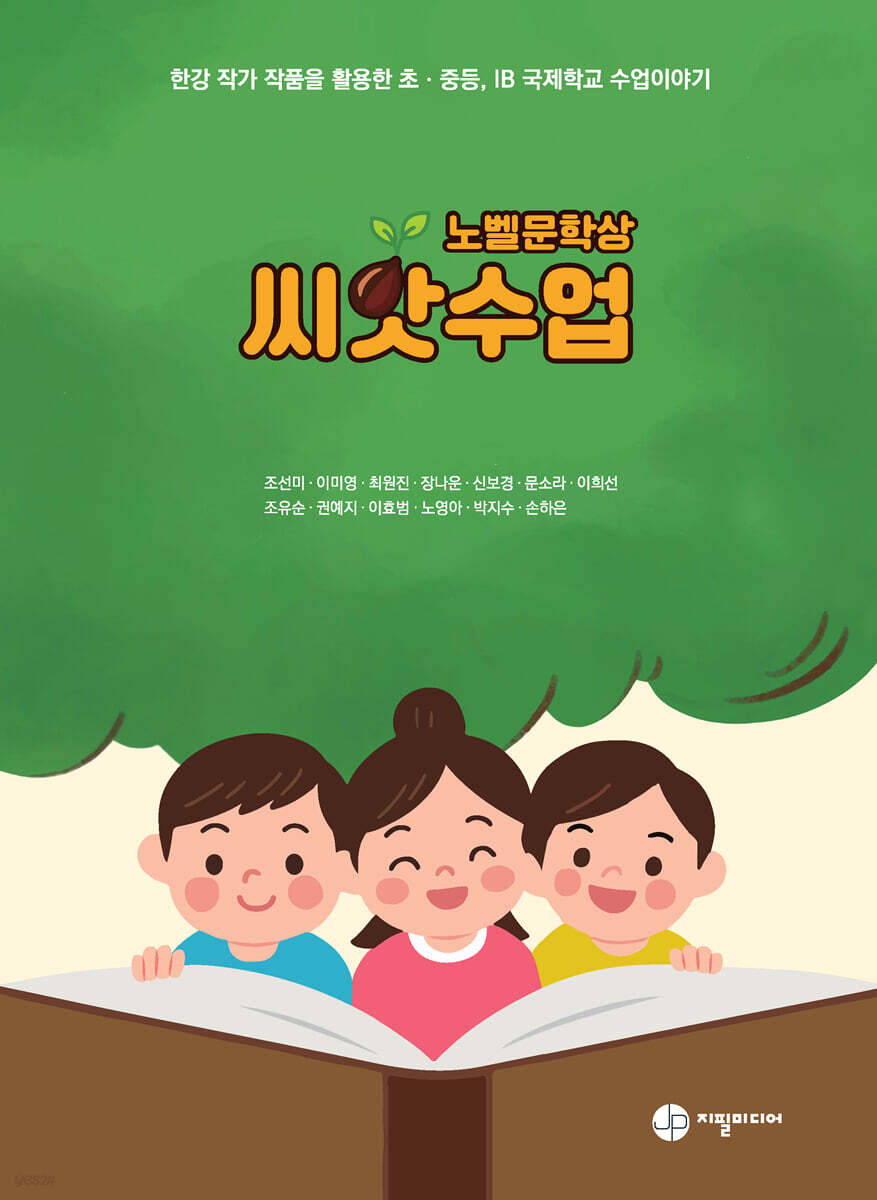
Nobel Prize in Literature Seed Class
 |
Description
Book Introduction
The Swedish Academy, in awarding her the Nobel Prize in Literature, described her work as “powerful lyrical prose that confronts historical trauma and reveals the fragility of human life.”
At that moment, Korean literature proudly etched its name at the center of world history.
It was a moving historical scene that confirmed that the pain and memories our society has harbored for decades, and the power of literature that has tenaciously held onto them, have touched the hearts of people around the world.
But as delighted as I was with this glorious news, I was faced with the inevitable question as a teacher.
"How should we read Han Kang's books with our children? How can we introduce this world-renowned work to elementary and middle school classrooms?" This question struck me one day, like a bolt from the blue, in a brief notification on my phone.
“Teacher, please buy me the book ‘The Vegetarian’!”
In the reading and humanities club I run, teachers give each student a book of their choice every month so that they can read it together.
The core of this activity is the experience of encountering the world through reading books of one's own choosing.
But then a child who usually quietly followed the opinions of other friends sent me a message himself.
That one sentence about wanting to read a book by a Nobel Prize-winning author wasn't just a request to me; it was a question I couldn't avoid as a teacher.
To be honest, the start wasn't smooth.
When I announced my intention to introduce Han Kang's work into the classroom, the voices around me were filled with concern and doubt rather than anticipation.
“I’m worried that the story is too dark and might be a burden on children’s emotions.” “The subject matter is sensitive and might not be suitable for elementary school students.” Every time I heard those words, my heart wavered, but inside, my faith grew stronger.
“A good book is read differently depending on the reader’s age, and always opens the door to various interpretations.
And we must not deprive our children of the opportunity to read works that have moved the world in Korean. Following that faint but firm conviction, I set out to find Han Kang's complete works.
Fortunately, I discovered Han Kang's only picture book that elementary school students can read, "The Little Thunder Fairy, the Little Lightning Fairy," and the fairy tales "The Box of Tears" and "My Name is Sunflower," and I gradually introduced them into the classroom.
The children's reactions proved that our confidence was not wrong.
The Nobel Prize in Literature may seem a bit unfamiliar to first graders, but Han Kang's picture books provide a bridge for children to comfortably encounter the sensibilities of a world-renowned author.
Taking advantage of the characteristics of first graders who love stories and have a rich imagination, we read Han Kang's picture books together and created picture books while feeling the world-renowned author's sensibility.
Using illustrations from picture books, I created “The Heart of a Fairy, The Weather in the Sky,” and paying attention to the author’s intentions, I completed “It’s Okay to Be Scared.”
It was a meaningful time where children from two schools participated together, sharing their thoughts and warm hearts.
The request for a class on author Han Kang's works for upper elementary school students was realized at a valuable reading culture experience event held at the Jeollanam-do Student Education and Culture Center.
This course is structured into six periods to align with the eight-hour reading unit of 'Reading One Book a Semester', and the remaining two hours are designed to be connected to classroom activities by the homeroom teacher.
Before meeting with students, I first went through a four-hour training session with homeroom teachers who wanted to teach the program, where I shared in-depth the program's intentions and goals.
Afterwards, we began meeting with 416 students from nine schools in the Jeonnam region through the picture book “Tear Box.”
By reading the book aloud, the children were able to connect with the characters' emotions, and by writing "My Tear Box," they courageously shared their own life experiences.
Shadow play activities were a valuable time to vividly embody the work and listen to each other's stories.
To promote the value of Hangang classes and expand them to more classrooms, we have organized open classes and shared classes.
Surprisingly, over 100 teachers participated, and through this, we were able to deeply share our teaching concerns and achieve valuable results by confirming the generalizability of the class.
This clearly demonstrates that Han Kang's abstract and lyrical prose can stimulate children's imaginations in elementary school classrooms and expand into profound reflection.
In particular, students at Hanryeo Elementary School continued to write with their homeroom teachers even after the 6-hour program, which resulted in the publication of a book titled “Our Box of Tears.” A small school at the foot of Jirisan Mountain in Gurye also implemented the fairy tale “My Name is Sunflower” as a reading humanities guidance class following “Box of Tears” and actively shared the case with surrounding teachers, opening the way for a beautiful spread.
In this process, I organized a research group called 'Nohansuseon (Teachers who teach using Nobel Prize-winning Han Kang's works)' and gathered case studies from elementary, middle, and high schools, as well as from Singapore's IB International School, which made me realize the universal power of literature education.
In middle school, I read "The Vegetarian" with students from a non-grade reading club in grades 1-3.
Are society's criteria for distinguishing between "normal" and "abnormal" justified? Can art save people, or can it destroy them? If Yeong-hye had lived in today's modern society, would her life have been different? There was so much to discuss about Han Kang's work, so full of wounds and symbolism.
When we decided to use "The Boy Acts" in our classrooms in high school, the first thing that came to mind was, "Will children be able to handle such a heavy narrative?"
The May 18th Democratization Movement is recorded in textbooks only as a date and the number of casualties, but in novels, it comes across as the voices of suffering individuals and vivid emotions.
There were concerns about the level of detail in the novel, and whether children would be able to shoulder that burden in such a short period of time.
Another concern was, "Will children who have difficulty communicating with others after COVID-19 be able to read such a difficult book, think deeply, and speak freely?"
To address these two concerns, we posted a notice containing the teacher's intentions for the class to inform the students of the direction of the class and to prevent them from feeling anxious.
After thoroughly reading the book, we discussed various topics: how do the characters in the novel connect with the community? How can historical events impact individuals? What role does literature play when it deals with historical events? What advantages and disadvantages might literature have in recording history compared to other media?
The interpretation of the title was also interesting.
One student interpreted the boy's 'coming' to mean that the boy is walking towards us now and telling us about the tragedy.
The children experienced that literature does not simply record the past, but poses questions to us living in the present.
After learning how to face the pain of history through "The Boy Comes," I developed a desire to go one step further.
Another novel by author Han Kang, "No Farewell," deals with the specific history of the Jeju April 3 Incident, but also poses the question to us today: "What will we not say goodbye to?"
I felt it would take me a long time to answer this weighty question, so I designed a month-long project class.
I hoped that the children would slowly absorb Jeju's pain, connect it to their own lives, and ultimately find answers in their own words.
The book "No Farewell" mainly deals with non-competitive discussion topics.
And finally, the heated conversation in the classroom led to a new stage called the “Boy Comes” reading discussion contest.
The depth of reflection the children displayed was too valuable to be simply a classroom activity.
From the preliminary topic, "The Positive and Negative Influence of Historical Literature Works Like 'The Boy Acts' on School History Education," to the final topic, "Can Individual Resistance Against State Violence Be Justified?", students won gold prizes at the Jeonnam Reading and Debate Contest for their experiences of reflection and growth through books.
Deep reading was a time when I learned firsthand that “history is not a story in a book, but a question that asks us how we should live.”
Furthermore, Han Kang's poetry collection, which expresses abstract emotions in concrete language, was also implemented as a class in high school classrooms.
I wanted to make readers feel that reading poetry is not simply interpretation, but a process of transforming feelings into perception, and the most important thing I focused on when selecting the works was the 'density of sensory language.'
In this respect, "I Put Dinner in the Drawer" was the most appropriate.
From the title, the senses of sight, smell, and touch are organically intertwined, and the connections between images are concrete yet open in structure.
In particular, the title, which combines the object ‘drawer’ and the time ‘evening’, already functions as a symbolic system for the five senses.
The poetry class began with a theory-oriented class that focused on understanding the basic structure and components of modern poetry.
Afterwards, we conducted participatory activities such as reading poetry with all five senses and creating a sensory map, as well as interviewing the speaker in the work.
The core goal of the class was to foster a deep understanding of poetry as a “language of the senses” and, further, to inspire students to truly love literature.
In elementary, middle, and high school classrooms, classes utilizing author Han Kang's works have gradually deepened and broadened.
In particular, during the last summer vacation, as part of the 2030 Research Society's international exchange activities, I was able to confirm the true value of the 'Nobel Prize in Literature Seed Class' we had been conducting while meeting an IB literature teacher from Singapore International School.
In overseas IB educational settings, classes were already being held with "The Boy Acts," which was recognized for its literary value and universality several years before author Han Kang received the Nobel Prize in Literature.
International students and teachers read and discussed Han Kang's works translated into English, and we witnessed firsthand the active research and sharing of numerous inquiry-based learning examples and student writing.
In fact, Han Kang's work is an excellent example that can be utilized across the IB curriculum's MYP (Middle Years Programme) and DP (Diploma Programme).
"The Vegetarian" leads students to explore issues of humanity and community through the conflict between individual freedom and social norms, while "The Boy Comes" addresses deeper themes of collective violence, memory, and human dignity, demanding critical reflection.
While both works originate from Korea's unique historical and cultural context, their close connection to global issues such as freedom, human rights, memory, and healing has allowed them to elicit empathy and discussion in international classrooms.
Therefore, I believe that the classes our research group conducted are not simply individual experiences, but the result of collective effort and deep reflection in the educational field.
At that moment, Korean literature proudly etched its name at the center of world history.
It was a moving historical scene that confirmed that the pain and memories our society has harbored for decades, and the power of literature that has tenaciously held onto them, have touched the hearts of people around the world.
But as delighted as I was with this glorious news, I was faced with the inevitable question as a teacher.
"How should we read Han Kang's books with our children? How can we introduce this world-renowned work to elementary and middle school classrooms?" This question struck me one day, like a bolt from the blue, in a brief notification on my phone.
“Teacher, please buy me the book ‘The Vegetarian’!”
In the reading and humanities club I run, teachers give each student a book of their choice every month so that they can read it together.
The core of this activity is the experience of encountering the world through reading books of one's own choosing.
But then a child who usually quietly followed the opinions of other friends sent me a message himself.
That one sentence about wanting to read a book by a Nobel Prize-winning author wasn't just a request to me; it was a question I couldn't avoid as a teacher.
To be honest, the start wasn't smooth.
When I announced my intention to introduce Han Kang's work into the classroom, the voices around me were filled with concern and doubt rather than anticipation.
“I’m worried that the story is too dark and might be a burden on children’s emotions.” “The subject matter is sensitive and might not be suitable for elementary school students.” Every time I heard those words, my heart wavered, but inside, my faith grew stronger.
“A good book is read differently depending on the reader’s age, and always opens the door to various interpretations.
And we must not deprive our children of the opportunity to read works that have moved the world in Korean. Following that faint but firm conviction, I set out to find Han Kang's complete works.
Fortunately, I discovered Han Kang's only picture book that elementary school students can read, "The Little Thunder Fairy, the Little Lightning Fairy," and the fairy tales "The Box of Tears" and "My Name is Sunflower," and I gradually introduced them into the classroom.
The children's reactions proved that our confidence was not wrong.
The Nobel Prize in Literature may seem a bit unfamiliar to first graders, but Han Kang's picture books provide a bridge for children to comfortably encounter the sensibilities of a world-renowned author.
Taking advantage of the characteristics of first graders who love stories and have a rich imagination, we read Han Kang's picture books together and created picture books while feeling the world-renowned author's sensibility.
Using illustrations from picture books, I created “The Heart of a Fairy, The Weather in the Sky,” and paying attention to the author’s intentions, I completed “It’s Okay to Be Scared.”
It was a meaningful time where children from two schools participated together, sharing their thoughts and warm hearts.
The request for a class on author Han Kang's works for upper elementary school students was realized at a valuable reading culture experience event held at the Jeollanam-do Student Education and Culture Center.
This course is structured into six periods to align with the eight-hour reading unit of 'Reading One Book a Semester', and the remaining two hours are designed to be connected to classroom activities by the homeroom teacher.
Before meeting with students, I first went through a four-hour training session with homeroom teachers who wanted to teach the program, where I shared in-depth the program's intentions and goals.
Afterwards, we began meeting with 416 students from nine schools in the Jeonnam region through the picture book “Tear Box.”
By reading the book aloud, the children were able to connect with the characters' emotions, and by writing "My Tear Box," they courageously shared their own life experiences.
Shadow play activities were a valuable time to vividly embody the work and listen to each other's stories.
To promote the value of Hangang classes and expand them to more classrooms, we have organized open classes and shared classes.
Surprisingly, over 100 teachers participated, and through this, we were able to deeply share our teaching concerns and achieve valuable results by confirming the generalizability of the class.
This clearly demonstrates that Han Kang's abstract and lyrical prose can stimulate children's imaginations in elementary school classrooms and expand into profound reflection.
In particular, students at Hanryeo Elementary School continued to write with their homeroom teachers even after the 6-hour program, which resulted in the publication of a book titled “Our Box of Tears.” A small school at the foot of Jirisan Mountain in Gurye also implemented the fairy tale “My Name is Sunflower” as a reading humanities guidance class following “Box of Tears” and actively shared the case with surrounding teachers, opening the way for a beautiful spread.
In this process, I organized a research group called 'Nohansuseon (Teachers who teach using Nobel Prize-winning Han Kang's works)' and gathered case studies from elementary, middle, and high schools, as well as from Singapore's IB International School, which made me realize the universal power of literature education.
In middle school, I read "The Vegetarian" with students from a non-grade reading club in grades 1-3.
Are society's criteria for distinguishing between "normal" and "abnormal" justified? Can art save people, or can it destroy them? If Yeong-hye had lived in today's modern society, would her life have been different? There was so much to discuss about Han Kang's work, so full of wounds and symbolism.
When we decided to use "The Boy Acts" in our classrooms in high school, the first thing that came to mind was, "Will children be able to handle such a heavy narrative?"
The May 18th Democratization Movement is recorded in textbooks only as a date and the number of casualties, but in novels, it comes across as the voices of suffering individuals and vivid emotions.
There were concerns about the level of detail in the novel, and whether children would be able to shoulder that burden in such a short period of time.
Another concern was, "Will children who have difficulty communicating with others after COVID-19 be able to read such a difficult book, think deeply, and speak freely?"
To address these two concerns, we posted a notice containing the teacher's intentions for the class to inform the students of the direction of the class and to prevent them from feeling anxious.
After thoroughly reading the book, we discussed various topics: how do the characters in the novel connect with the community? How can historical events impact individuals? What role does literature play when it deals with historical events? What advantages and disadvantages might literature have in recording history compared to other media?
The interpretation of the title was also interesting.
One student interpreted the boy's 'coming' to mean that the boy is walking towards us now and telling us about the tragedy.
The children experienced that literature does not simply record the past, but poses questions to us living in the present.
After learning how to face the pain of history through "The Boy Comes," I developed a desire to go one step further.
Another novel by author Han Kang, "No Farewell," deals with the specific history of the Jeju April 3 Incident, but also poses the question to us today: "What will we not say goodbye to?"
I felt it would take me a long time to answer this weighty question, so I designed a month-long project class.
I hoped that the children would slowly absorb Jeju's pain, connect it to their own lives, and ultimately find answers in their own words.
The book "No Farewell" mainly deals with non-competitive discussion topics.
And finally, the heated conversation in the classroom led to a new stage called the “Boy Comes” reading discussion contest.
The depth of reflection the children displayed was too valuable to be simply a classroom activity.
From the preliminary topic, "The Positive and Negative Influence of Historical Literature Works Like 'The Boy Acts' on School History Education," to the final topic, "Can Individual Resistance Against State Violence Be Justified?", students won gold prizes at the Jeonnam Reading and Debate Contest for their experiences of reflection and growth through books.
Deep reading was a time when I learned firsthand that “history is not a story in a book, but a question that asks us how we should live.”
Furthermore, Han Kang's poetry collection, which expresses abstract emotions in concrete language, was also implemented as a class in high school classrooms.
I wanted to make readers feel that reading poetry is not simply interpretation, but a process of transforming feelings into perception, and the most important thing I focused on when selecting the works was the 'density of sensory language.'
In this respect, "I Put Dinner in the Drawer" was the most appropriate.
From the title, the senses of sight, smell, and touch are organically intertwined, and the connections between images are concrete yet open in structure.
In particular, the title, which combines the object ‘drawer’ and the time ‘evening’, already functions as a symbolic system for the five senses.
The poetry class began with a theory-oriented class that focused on understanding the basic structure and components of modern poetry.
Afterwards, we conducted participatory activities such as reading poetry with all five senses and creating a sensory map, as well as interviewing the speaker in the work.
The core goal of the class was to foster a deep understanding of poetry as a “language of the senses” and, further, to inspire students to truly love literature.
In elementary, middle, and high school classrooms, classes utilizing author Han Kang's works have gradually deepened and broadened.
In particular, during the last summer vacation, as part of the 2030 Research Society's international exchange activities, I was able to confirm the true value of the 'Nobel Prize in Literature Seed Class' we had been conducting while meeting an IB literature teacher from Singapore International School.
In overseas IB educational settings, classes were already being held with "The Boy Acts," which was recognized for its literary value and universality several years before author Han Kang received the Nobel Prize in Literature.
International students and teachers read and discussed Han Kang's works translated into English, and we witnessed firsthand the active research and sharing of numerous inquiry-based learning examples and student writing.
In fact, Han Kang's work is an excellent example that can be utilized across the IB curriculum's MYP (Middle Years Programme) and DP (Diploma Programme).
"The Vegetarian" leads students to explore issues of humanity and community through the conflict between individual freedom and social norms, while "The Boy Comes" addresses deeper themes of collective violence, memory, and human dignity, demanding critical reflection.
While both works originate from Korea's unique historical and cultural context, their close connection to global issues such as freedom, human rights, memory, and healing has allowed them to elicit empathy and discussion in international classrooms.
Therefore, I believe that the classes our research group conducted are not simply individual experiences, but the result of collective effort and deep reflection in the educational field.
- You can preview some of the book's contents.
Preview
index
prolog
Why the Han River? Why the Nobel Prize in Literature Seed Class?
The educational significance of encountering Han Kang's works in the classroom
Five Questions About Hangang Literature in the Classroom
Part 1: What Han River works can be taught in the classroom?
Chapter 1: The Little Fairy of Thunder, The Little Fairy of Lightning
Chapter 2: The Box of Tears
Chapter 3 My Name is Sunflower
Chapter 4 Vegetarians
Chapter 5: The Adventures of the Lion King Brothers: A Book Recommended by Author Han Kang
Chapter 6: The Boy Comes
Chapter 7: No Farewell
Chapter 8 I put dinner in the drawer
Part 2: How to Plant the Seeds of the Nobel Prize in Literature in Elementary School Classrooms
Chapter 1: Beginning the Elementary Classroom with Han Kang's Picture Books: Reading "The Little Fairy of Thunder, the Little Fairy of Lightning"
Chapter 2: Beginning the Upper Elementary Classroom with Han River Fairy Tales: "The Box of Tears" Fairy Tale Lesson
Chapter 3: An Upper Elementary Classroom, Asking Questions with Han River Fairy Tales: "My Name is Sunflower" Fairy Tale Lesson
Part 3: Middle School Classroom: Dive into the Sea of Literature
Chapter 1: A Middle School Classroom Immersed in Literature: "The Vegetarian" Reading and Discussion Club Class
Chapter 2: Middle School Classrooms, Immersed in Literature: "The Adventures of the Lion King Brothers" Reading and Discussion Club Class
Part 4: High School Classroom: Reflecting on "Memory" Through Literature
Chapter 1: "The Boy Comes": A Class Where Korean and History Meet: A Class That Connects Memories
Chapter 2: "The Boy Comes" and "No Farewell" Project Classes
Chapter 3: "I Put Dinner in the Drawer" Poetry Lesson
Part 5: How is literature taught in IB international schools?
Chapter 1: Literature Class: The Vegetarian and The Boy Comes
supplement
1.
Teaching and Learning Curriculum
2.
"Tear Box" AI-powered song writing and composition
3.
Examples of student work
Epilogue
In 2024, under the winter sky of Stockholm, a name resonated throughout the world.
Han River!
Why the Han River? Why the Nobel Prize in Literature Seed Class?
The educational significance of encountering Han Kang's works in the classroom
Five Questions About Hangang Literature in the Classroom
Part 1: What Han River works can be taught in the classroom?
Chapter 1: The Little Fairy of Thunder, The Little Fairy of Lightning
Chapter 2: The Box of Tears
Chapter 3 My Name is Sunflower
Chapter 4 Vegetarians
Chapter 5: The Adventures of the Lion King Brothers: A Book Recommended by Author Han Kang
Chapter 6: The Boy Comes
Chapter 7: No Farewell
Chapter 8 I put dinner in the drawer
Part 2: How to Plant the Seeds of the Nobel Prize in Literature in Elementary School Classrooms
Chapter 1: Beginning the Elementary Classroom with Han Kang's Picture Books: Reading "The Little Fairy of Thunder, the Little Fairy of Lightning"
Chapter 2: Beginning the Upper Elementary Classroom with Han River Fairy Tales: "The Box of Tears" Fairy Tale Lesson
Chapter 3: An Upper Elementary Classroom, Asking Questions with Han River Fairy Tales: "My Name is Sunflower" Fairy Tale Lesson
Part 3: Middle School Classroom: Dive into the Sea of Literature
Chapter 1: A Middle School Classroom Immersed in Literature: "The Vegetarian" Reading and Discussion Club Class
Chapter 2: Middle School Classrooms, Immersed in Literature: "The Adventures of the Lion King Brothers" Reading and Discussion Club Class
Part 4: High School Classroom: Reflecting on "Memory" Through Literature
Chapter 1: "The Boy Comes": A Class Where Korean and History Meet: A Class That Connects Memories
Chapter 2: "The Boy Comes" and "No Farewell" Project Classes
Chapter 3: "I Put Dinner in the Drawer" Poetry Lesson
Part 5: How is literature taught in IB international schools?
Chapter 1: Literature Class: The Vegetarian and The Boy Comes
supplement
1.
Teaching and Learning Curriculum
2.
"Tear Box" AI-powered song writing and composition
3.
Examples of student work
Epilogue
In 2024, under the winter sky of Stockholm, a name resonated throughout the world.
Han River!
Detailed image

Publisher's Review
In an interview with a reporter, author Han Kang said this:
“I feel like I’ve become stronger after reading a lot of books.
When I'm too busy to read books, I feel like I'm losing my sense of humor and that I'm not in a good state.
When I get hungry for books and read them like crazy for a few days, there are times when I feel recharged and stronger.
“When I don’t read, I feel like I’m falling apart, but when I read, I feel like the broken parts are coming back together.”
I believe this confession most profoundly explains why we should read literature with children.
Han Kang was a lifelong reader as well as a writer, so his writing moves our hearts.
Reading Han Kang's works in the classroom ultimately provides our children with the inner strength and foundation to become lifelong readers.
I sincerely hope so.
I hope that someday, through literature, children will experience that they have become “stronger than before.”
May you find a moment of healing where your broken heart comes back together.
And I hope that the reading, discussion, and writing that begin in the classroom will lead children to a lifelong path of reading and reflection.
The Nobel Prize in Literature is not just a splendid honor; it has raised burning, essential questions for all of us.
Why is literature so vital? How can literature protect us from our fragility and lead us to the deepest depths of human existence? How should Han Kang's works be incorporated into our curricula? Han Kang's award goes beyond a great achievement for Korean literature; it has reaffirmed these questions, questions our education must never overlook.
Even though it may seem small and insignificant at first, that seed will eventually take root, push up a stem, and eventually bloom and become a seed again, scattering throughout the world.
I believe that the seeds of literature that grow in children's hearts will eventually grow into a strong forest that connects them and embraces the world.
Our research group teachers vividly experienced firsthand the crucial moment in which Han Kang's literary works were planted as small seeds in the children's souls in the classroom.
We cherish the small seed we discovered in the hearts of all teachers and readers who open this book.
“I feel like I’ve become stronger after reading a lot of books.
When I'm too busy to read books, I feel like I'm losing my sense of humor and that I'm not in a good state.
When I get hungry for books and read them like crazy for a few days, there are times when I feel recharged and stronger.
“When I don’t read, I feel like I’m falling apart, but when I read, I feel like the broken parts are coming back together.”
I believe this confession most profoundly explains why we should read literature with children.
Han Kang was a lifelong reader as well as a writer, so his writing moves our hearts.
Reading Han Kang's works in the classroom ultimately provides our children with the inner strength and foundation to become lifelong readers.
I sincerely hope so.
I hope that someday, through literature, children will experience that they have become “stronger than before.”
May you find a moment of healing where your broken heart comes back together.
And I hope that the reading, discussion, and writing that begin in the classroom will lead children to a lifelong path of reading and reflection.
The Nobel Prize in Literature is not just a splendid honor; it has raised burning, essential questions for all of us.
Why is literature so vital? How can literature protect us from our fragility and lead us to the deepest depths of human existence? How should Han Kang's works be incorporated into our curricula? Han Kang's award goes beyond a great achievement for Korean literature; it has reaffirmed these questions, questions our education must never overlook.
Even though it may seem small and insignificant at first, that seed will eventually take root, push up a stem, and eventually bloom and become a seed again, scattering throughout the world.
I believe that the seeds of literature that grow in children's hearts will eventually grow into a strong forest that connects them and embraces the world.
Our research group teachers vividly experienced firsthand the crucial moment in which Han Kang's literary works were planted as small seeds in the children's souls in the classroom.
We cherish the small seed we discovered in the hearts of all teachers and readers who open this book.
GOODS SPECIFICS
- Date of issue: November 18, 2025
- Page count, weight, size: 256 pages | 188*257*20mm
- ISBN13: 9791193187968
- ISBN10: 1193187966
You may also like
카테고리
korean


korean

![GQ KOREA Mark (Monthly): December [2025]](http://librairie.coreenne.fr/cdn/shop/files/8ef265dbbfbf186523ed75ba7319009d.jpg?v=1765340328&width=3840)


