

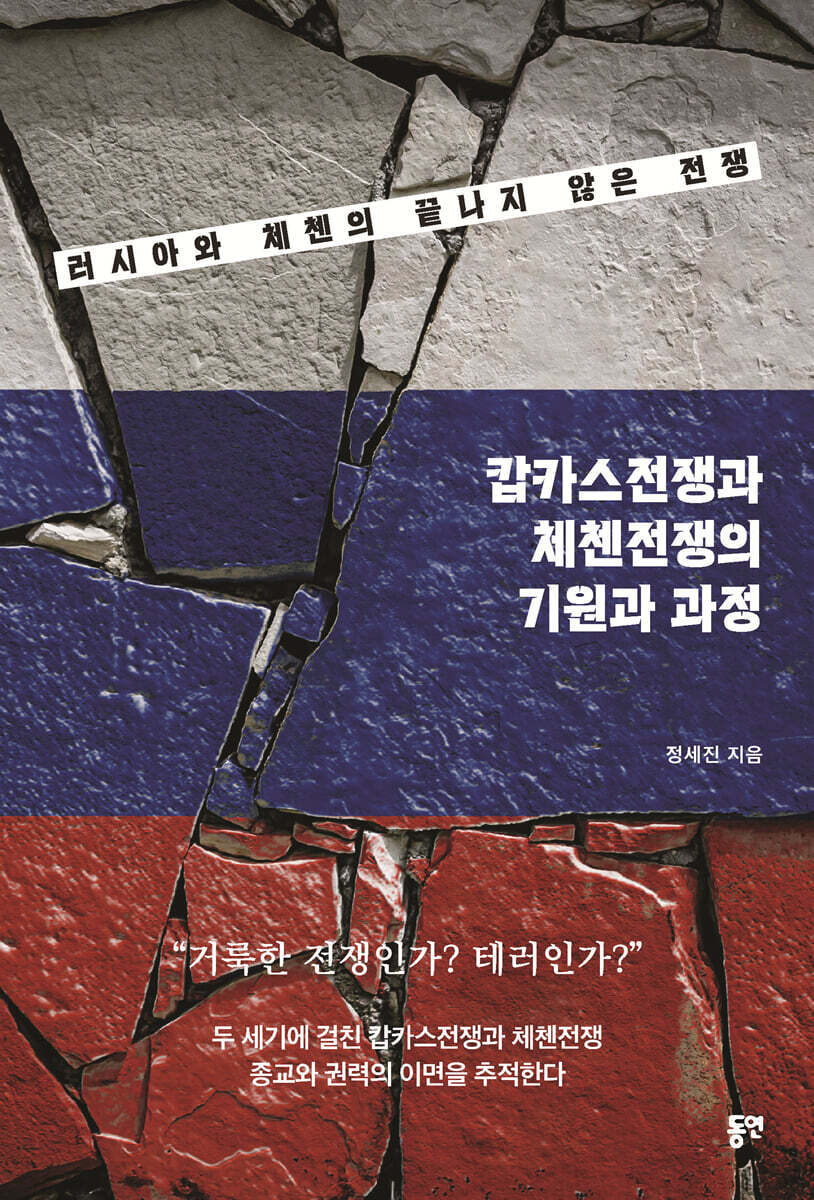
The Origins and Course of the Caucasian and Chechen Wars
 |
Description
Book Introduction
Jihad or Terrorism? Interpreting the Chechen War
This war, which took place within Russia and Eurasia, is a key conflict in the history of Russia and Eastern Europe.
The Russo-Ukrainian War, which broke out in 2022 and is still ongoing, has captured global attention, but the Caucasus and Chechen Wars, which took place over 30 years ago, are significant events that illuminate the relationship between present-day Russia and its neighbors.
The Caucasian War was a war that broke out when Imperial Russia attempted to expand its territory into southern Russia due to its imperialistic ambitions.
This played a decisive role in Russia's incorporation into the European empire.
Russia won this war, which lasted nearly half a century from 1816 to 1864, and was able to conquer Central Asia and lay the foundation for its empire.
From then until the dissolution of the Soviet Union in 1991, Russia dominated the Caucasus and Central Asia for a long time, and its victory in the Caucasus War served as the basis for this.
Historical time passed and the Chechen War occurred again.
The conflict in the Chechen region is still not over.
It is difficult to predict how conflict in this region will resurface in the future.
Political stability will be achieved for the time being, but the possibility of conflict resurfacing in some form remains, depending on how the "Ukrainian War" unfolds in 2022.
Jihad (holy war), in Islamic countries, all wars against infidels are considered holy war.
The author examines the ideology of jihad held by peoples who wish to achieve independence.
It is believed that this process may provide at least some answers about the history, destiny, and future direction of a particular people.
Jihad was a concept of war and an icon of struggle adopted by those who were at a disadvantage in Russia.
This war, which took place within Russia and Eurasia, is a key conflict in the history of Russia and Eastern Europe.
The Russo-Ukrainian War, which broke out in 2022 and is still ongoing, has captured global attention, but the Caucasus and Chechen Wars, which took place over 30 years ago, are significant events that illuminate the relationship between present-day Russia and its neighbors.
The Caucasian War was a war that broke out when Imperial Russia attempted to expand its territory into southern Russia due to its imperialistic ambitions.
This played a decisive role in Russia's incorporation into the European empire.
Russia won this war, which lasted nearly half a century from 1816 to 1864, and was able to conquer Central Asia and lay the foundation for its empire.
From then until the dissolution of the Soviet Union in 1991, Russia dominated the Caucasus and Central Asia for a long time, and its victory in the Caucasus War served as the basis for this.
Historical time passed and the Chechen War occurred again.
The conflict in the Chechen region is still not over.
It is difficult to predict how conflict in this region will resurface in the future.
Political stability will be achieved for the time being, but the possibility of conflict resurfacing in some form remains, depending on how the "Ukrainian War" unfolds in 2022.
Jihad (holy war), in Islamic countries, all wars against infidels are considered holy war.
The author examines the ideology of jihad held by peoples who wish to achieve independence.
It is believed that this process may provide at least some answers about the history, destiny, and future direction of a particular people.
Jihad was a concept of war and an icon of struggle adopted by those who were at a disadvantage in Russia.
- You can preview some of the book's contents.
Preview
index
preface
introduction
Part 1│The First Caucasian War and the Origins of Jihad
Chapter 1: The History of Imperial Russia's Occupation of the North Caucasus and the Origins of Jihad
Chapter 2: Chechen Imam Mansour's Declaration of Jihad and the First Caucasian War
Part 2│The Second Caucasian War and Jihad
Chapter 3: Military conflicts between Russia and the North Caucasian peoples and the course of the Second Caucasian War
Chapter 4 - Jihad or Terrorism?
: The connection between Imam Shamil's theocracy and the holy war
Chapter 5 - Was there only jihad in the 19th-century North Caucasus?
Kunta Haji's philosophy of peace and coexistence against war
Part 3│The Course of the First Chechen War (1994-1996) and Jihad
Chapter 6: The Prelude to the Russo-Chechen War
: The process of forced migration to Chechnya in the 1940s and human rights discourse
Chapter 7 - Is the First Chechen War a Déjà Vu of the Caucasian War?
: The origins and course of war
Part 4│The Second Chechen War (1999–2002) and the Holy War
Chapter 8: The Second Chechen War, the Declaration of a Theocracy, and Jihad
Chapter 9: The Second Chechen War and Russia's Response
: Focusing on Commander Basayev's jihadist struggle and Putin's counter-terrorism operation
Chapter 10 - Jihad or Terrorism?
: Hermeneutics of the Chechen War
conclusion
References
index
introduction
Part 1│The First Caucasian War and the Origins of Jihad
Chapter 1: The History of Imperial Russia's Occupation of the North Caucasus and the Origins of Jihad
Chapter 2: Chechen Imam Mansour's Declaration of Jihad and the First Caucasian War
Part 2│The Second Caucasian War and Jihad
Chapter 3: Military conflicts between Russia and the North Caucasian peoples and the course of the Second Caucasian War
Chapter 4 - Jihad or Terrorism?
: The connection between Imam Shamil's theocracy and the holy war
Chapter 5 - Was there only jihad in the 19th-century North Caucasus?
Kunta Haji's philosophy of peace and coexistence against war
Part 3│The Course of the First Chechen War (1994-1996) and Jihad
Chapter 6: The Prelude to the Russo-Chechen War
: The process of forced migration to Chechnya in the 1940s and human rights discourse
Chapter 7 - Is the First Chechen War a Déjà Vu of the Caucasian War?
: The origins and course of war
Part 4│The Second Chechen War (1999–2002) and the Holy War
Chapter 8: The Second Chechen War, the Declaration of a Theocracy, and Jihad
Chapter 9: The Second Chechen War and Russia's Response
: Focusing on Commander Basayev's jihadist struggle and Putin's counter-terrorism operation
Chapter 10 - Jihad or Terrorism?
: Hermeneutics of the Chechen War
conclusion
References
index
Into the book
Not all Muslims actively participated in Mansur's uprising.
Some refused to participate in the uprising.
The Avars swore allegiance to Russia, while the Kabardians remained neutral.
The Ottoman Turks ultimately lost control of the North Caucasus due to two policies toward the Caucasus.
When war broke out with Russia, the Ottoman Turks approached the North Caucasian peoples to offer support.
However, in times of peace, the Ottoman Turks ignored their struggles and preferred a policy of maintaining the existing regime in the region.
As a result, the Ottoman Turks lost the trust of the North Caucasian peoples.
Nevertheless, the North Caucasian peoples supported the Ottoman Turks and fought on their side against Russia.
--- From “Part 1, Chapter 2 _ Chechen Imam Mansour’s Declaration of Jihad and the First Caucasian War”
The dance begins with slow body movements.
And then move counterclockwise in a circle with increasingly faster movements.
They praise God with songs while dancing in a circle.
Zikr is a direct communication with Allah through the medium of angels and praises God.
They followed the mystical and ascetic principles of Sufism and were devoted to the Tariqa doctrine that Muslims should seek union with God and the 'path to God'.
The topics of praise are varied.
It includes various events of great saints, topics concerning Muslims in general, praises of God, praises of Kunta Haji, and praises of Ali as the righteous caliph.
The purpose of the praise ceremony is to ask believers to remember their duties before God and to live a moral life and conduct while remembering the changing world and nature, and to express the hope that they will faithfully observe all the commandments of Islam and pursue honesty in their thoughts and actions.
--- From “Part 2, Chapter 5 - Is there only jihad in the 19th-century North Caucasus?”
What was the cause of the forced relocation of the Chechens? The authorities primarily cited the Chechens' collaboration with the German military, but the truth remains unclear.
My doctoral thesis advisor, the late Sergei Archunov, a renowned historian, emphasized that the forced relocation was not carried out by Stalin because the Chechens had collaborated with the German army, but rather as a retaliation for the political resistance the Chechens had shown to the authorities before and during World War II.
Officially, Soviet authorities stated that the forced relocation was a form of punishment for Chechens who had committed treason.
The authorities' position was that ethnic minorities in the border areas were expected to fulfill their national duty to resist the German advance, but that in times of war crisis, they did not do so, and the Chechens did not do the same.
The most horrific incident documented was the cremation alive of about 700 Chechens in the Galanchozh barn in the Khaibakh district of Shatoy region, Chechnya, on February 27, 1944.
The youngest was three years old, and among the oldest was a 100-year-old.
Once they reached the road, they were to be transported by truck to the train station, but they could not walk to the road.
There was a fire extinguisher inside the barn, and everyone inside died.
Mikhail Gvishiani (Михаил Гвишиани, 1905–1966), head of the NKVD administration in Beria's Far East and head of Galantoz during the relocation operation, ordered the arson.
There were many other atrocities as well.
--- From “Part 3, Chapter 6 _ The Prelude to the Russo-Chechen War”
Even within Chechnya, a gap had already widened between the Russified political, cultural, and scientific intelligentsia and the general public.
Supporters of traditional views differed from supporters of Chechnya's modernization.
The independence activists faced opposition from those who advocated for autonomy within the Russian Federation.
The authoritarian rule of the Dudayev regime in 1993 was met with much disappointment compared to the hopes for Chechen unification that had been expressed in 1991.
In the early days of the Dudayev government, those in power began to lose power.
In 1994, Yeltsin strongly criticized the Chechen regime as an illegal dictatorship exercised by Dudayev and his "bandit formations."
This was the Russian government's official statement regarding the Chechens who had antipathy towards Dudayev.
--- From “Part 3, Chapter 7 - Is the First Chechen War a Déjà Vu of the Caucasian War?”
What does jihad mean? Jihad is a declaration of holy war against infidels.
These include Wahhabism in 18th-century Saudi Arabia, movements in West Africa in the 18th and early 19th centuries, and jihadist movements in Sumatra in the early 19th century.
Jihad arose against Europeans, opposing the establishment of colonies by European countries.
These movements include the Wahhabis in South Asia, the Shamils in the Caucasus, the Abdel Qadirs in Algeria, and the Senussis in Libya.
Wahhabism, which emerged before and after World War II, is associated with jihad.
Although Wahhabism has been an ideological element of the jihadist movement in Islamic countries, it is not itself the most powerful source of jihad and is closely linked to the founding ideology of Saudi Arabia.
Instead, jihad is understood to mean a 'holy war', or 'holy war', against the infidels.
It is also somewhat connected to the realistic situation of Muslim society.
--- From “Part 4, Chapter 8 _ The Second Chechen War, the Declaration of a Theocratic State, and Jihad”
As the First Chechen War, which began in 1994, dragged on, the Russian military became increasingly determined to not only achieve victory but also to dismantle Chechnya and end its desire for independence.
As the Russian army waged a fierce war, the losses and fears of the Chechen people also increased.
This led the Chechens to arm themselves with radical Islamism.
The Chechens showed a stronger resistance movement towards the Russians.
What lesson can we learn from the Chechen War? It is that the role of Islam has changed in the midst of the conflict and strife of war.
That is, the fact is that they resisted Russia more strongly with the Islamic spirit by arming themselves with Wahhabism.
The history of the Chechen resistance shows many parallels to conflict zones around the world.
It also provides insight and lessons in some ways.
Since the second war began in October 1999, terrorism in Chechnya has become increasingly brutal.
Civilians, including women and children, were targeted, executions were carried out on several occasions, and fleeing hostages were shot in the back.
Chechens committed several terrorist acts within the Russian Federation and in the North Caucasus before and after World War II.
The comments of female rebels who participated in the 2004 Beslan terrorist attack in North Ossetia provide insight into the Chechens' terrorist tendencies.
“Russian soldiers killed our children in Chechnya,” she said.
So we came here to kill your children,” he said.
That was the motto.
“It is regrettable that the school was taken over and so many children died at the hands of the Russian army,” Basayev, who planned the Beslan attack, said in an interview.
But I don't regret occupying the school.
“Just 100 kilometers away from that school, a war without any rules or borders is going on, and open mass killings of Chechens are continuing,” he said, criticizing Russia.
--- From “Part 4, Chapter 9 _ The Second Chechen War and Russia’s Response”
Jihad, which is generally used in Arab countries in the Middle East, is a very political term.
Jihad is generally accepted as the Islamic concept of holy war.
When we think of the term jihad, the most common understanding is war or struggle.
Muslims have historically and traditionally championed jihad as a banner of struggle against non-Muslim peoples, and the term remains relevant in modern global society.
Jihad is perceived in a very negative sense by the Russian Federation authorities, who have fought fierce wars with Muslim ethnic groups, including the Chechen War, since the collapse of the Soviet Union in 1991.
They claim that terrorists from the North Caucasus, including ethnic Chechens, invoke jihad whenever they commit terrorism.
Russian rulers have argued that the large Muslim population within the Russian Federation and the frequent occurrence of terrorist attacks, particularly in the North Caucasus, are due to the presence of many jihadists within the federation.
Some refused to participate in the uprising.
The Avars swore allegiance to Russia, while the Kabardians remained neutral.
The Ottoman Turks ultimately lost control of the North Caucasus due to two policies toward the Caucasus.
When war broke out with Russia, the Ottoman Turks approached the North Caucasian peoples to offer support.
However, in times of peace, the Ottoman Turks ignored their struggles and preferred a policy of maintaining the existing regime in the region.
As a result, the Ottoman Turks lost the trust of the North Caucasian peoples.
Nevertheless, the North Caucasian peoples supported the Ottoman Turks and fought on their side against Russia.
--- From “Part 1, Chapter 2 _ Chechen Imam Mansour’s Declaration of Jihad and the First Caucasian War”
The dance begins with slow body movements.
And then move counterclockwise in a circle with increasingly faster movements.
They praise God with songs while dancing in a circle.
Zikr is a direct communication with Allah through the medium of angels and praises God.
They followed the mystical and ascetic principles of Sufism and were devoted to the Tariqa doctrine that Muslims should seek union with God and the 'path to God'.
The topics of praise are varied.
It includes various events of great saints, topics concerning Muslims in general, praises of God, praises of Kunta Haji, and praises of Ali as the righteous caliph.
The purpose of the praise ceremony is to ask believers to remember their duties before God and to live a moral life and conduct while remembering the changing world and nature, and to express the hope that they will faithfully observe all the commandments of Islam and pursue honesty in their thoughts and actions.
--- From “Part 2, Chapter 5 - Is there only jihad in the 19th-century North Caucasus?”
What was the cause of the forced relocation of the Chechens? The authorities primarily cited the Chechens' collaboration with the German military, but the truth remains unclear.
My doctoral thesis advisor, the late Sergei Archunov, a renowned historian, emphasized that the forced relocation was not carried out by Stalin because the Chechens had collaborated with the German army, but rather as a retaliation for the political resistance the Chechens had shown to the authorities before and during World War II.
Officially, Soviet authorities stated that the forced relocation was a form of punishment for Chechens who had committed treason.
The authorities' position was that ethnic minorities in the border areas were expected to fulfill their national duty to resist the German advance, but that in times of war crisis, they did not do so, and the Chechens did not do the same.
The most horrific incident documented was the cremation alive of about 700 Chechens in the Galanchozh barn in the Khaibakh district of Shatoy region, Chechnya, on February 27, 1944.
The youngest was three years old, and among the oldest was a 100-year-old.
Once they reached the road, they were to be transported by truck to the train station, but they could not walk to the road.
There was a fire extinguisher inside the barn, and everyone inside died.
Mikhail Gvishiani (Михаил Гвишиани, 1905–1966), head of the NKVD administration in Beria's Far East and head of Galantoz during the relocation operation, ordered the arson.
There were many other atrocities as well.
--- From “Part 3, Chapter 6 _ The Prelude to the Russo-Chechen War”
Even within Chechnya, a gap had already widened between the Russified political, cultural, and scientific intelligentsia and the general public.
Supporters of traditional views differed from supporters of Chechnya's modernization.
The independence activists faced opposition from those who advocated for autonomy within the Russian Federation.
The authoritarian rule of the Dudayev regime in 1993 was met with much disappointment compared to the hopes for Chechen unification that had been expressed in 1991.
In the early days of the Dudayev government, those in power began to lose power.
In 1994, Yeltsin strongly criticized the Chechen regime as an illegal dictatorship exercised by Dudayev and his "bandit formations."
This was the Russian government's official statement regarding the Chechens who had antipathy towards Dudayev.
--- From “Part 3, Chapter 7 - Is the First Chechen War a Déjà Vu of the Caucasian War?”
What does jihad mean? Jihad is a declaration of holy war against infidels.
These include Wahhabism in 18th-century Saudi Arabia, movements in West Africa in the 18th and early 19th centuries, and jihadist movements in Sumatra in the early 19th century.
Jihad arose against Europeans, opposing the establishment of colonies by European countries.
These movements include the Wahhabis in South Asia, the Shamils in the Caucasus, the Abdel Qadirs in Algeria, and the Senussis in Libya.
Wahhabism, which emerged before and after World War II, is associated with jihad.
Although Wahhabism has been an ideological element of the jihadist movement in Islamic countries, it is not itself the most powerful source of jihad and is closely linked to the founding ideology of Saudi Arabia.
Instead, jihad is understood to mean a 'holy war', or 'holy war', against the infidels.
It is also somewhat connected to the realistic situation of Muslim society.
--- From “Part 4, Chapter 8 _ The Second Chechen War, the Declaration of a Theocratic State, and Jihad”
As the First Chechen War, which began in 1994, dragged on, the Russian military became increasingly determined to not only achieve victory but also to dismantle Chechnya and end its desire for independence.
As the Russian army waged a fierce war, the losses and fears of the Chechen people also increased.
This led the Chechens to arm themselves with radical Islamism.
The Chechens showed a stronger resistance movement towards the Russians.
What lesson can we learn from the Chechen War? It is that the role of Islam has changed in the midst of the conflict and strife of war.
That is, the fact is that they resisted Russia more strongly with the Islamic spirit by arming themselves with Wahhabism.
The history of the Chechen resistance shows many parallels to conflict zones around the world.
It also provides insight and lessons in some ways.
Since the second war began in October 1999, terrorism in Chechnya has become increasingly brutal.
Civilians, including women and children, were targeted, executions were carried out on several occasions, and fleeing hostages were shot in the back.
Chechens committed several terrorist acts within the Russian Federation and in the North Caucasus before and after World War II.
The comments of female rebels who participated in the 2004 Beslan terrorist attack in North Ossetia provide insight into the Chechens' terrorist tendencies.
“Russian soldiers killed our children in Chechnya,” she said.
So we came here to kill your children,” he said.
That was the motto.
“It is regrettable that the school was taken over and so many children died at the hands of the Russian army,” Basayev, who planned the Beslan attack, said in an interview.
But I don't regret occupying the school.
“Just 100 kilometers away from that school, a war without any rules or borders is going on, and open mass killings of Chechens are continuing,” he said, criticizing Russia.
--- From “Part 4, Chapter 9 _ The Second Chechen War and Russia’s Response”
Jihad, which is generally used in Arab countries in the Middle East, is a very political term.
Jihad is generally accepted as the Islamic concept of holy war.
When we think of the term jihad, the most common understanding is war or struggle.
Muslims have historically and traditionally championed jihad as a banner of struggle against non-Muslim peoples, and the term remains relevant in modern global society.
Jihad is perceived in a very negative sense by the Russian Federation authorities, who have fought fierce wars with Muslim ethnic groups, including the Chechen War, since the collapse of the Soviet Union in 1991.
They claim that terrorists from the North Caucasus, including ethnic Chechens, invoke jihad whenever they commit terrorism.
Russian rulers have argued that the large Muslim population within the Russian Federation and the frequent occurrence of terrorist attacks, particularly in the North Caucasus, are due to the presence of many jihadists within the federation.
--- From "Part 4, Chapter 10 - Jihad or Terrorism?"
Publisher's Review
Jihad or Terrorism? Interpreting the Chechen War
This war, which took place within Russia and Eurasia, is a key conflict in the history of Russia and Eastern Europe.
The Russo-Ukrainian War, which broke out in 2022 and is still ongoing, has captured global attention, but the Caucasus and Chechen Wars, which took place over 30 years ago, are significant events that illuminate the relationship between present-day Russia and its neighbors.
The Caucasian War was a war that broke out when Imperial Russia attempted to expand its territory into southern Russia due to its imperialistic ambitions.
This played a decisive role in Russia's incorporation into the European empire.
Russia won this war, which lasted nearly half a century from 1816 to 1864, and was able to conquer Central Asia and lay the foundation for its empire.
From then until the dissolution of the Soviet Union in 1991, Russia dominated the Caucasus and Central Asia for a long time, and its victory in the Caucasus War served as the basis for this.
Historical time passed and the Chechen War occurred again.
The conflict in the Chechen region is still not over.
It is difficult to predict how conflict in this region will resurface in the future.
Political stability will be achieved for the time being, but the possibility of conflict resurfacing in some form remains, depending on how the "Ukrainian War" unfolds in 2022.
Jihad (holy war), in Islamic countries, all wars against infidels are considered holy war.
The author examines the ideology of jihad held by peoples who wish to achieve independence.
It is believed that this process may provide at least some answers about the history, destiny, and future direction of a particular people.
Jihad was a concept of war and an icon of struggle adopted by those who were at a disadvantage in Russia.
The author of this book, Jeong Se-jin, has long been interested in and researched the 'Caucasus War' of the first half of the 19th century, which took place in Chechnya and Dagestan within the Russian Federation, and the 'Chechen War' that took place in the Chechen Autonomous Republic within the Russian Federation from 1994 to 1996 and from 1999 to 2001.
This book is the result of over 20 years of research.
Author Jeong Se-jin wanted to describe the fate of a nation.
In addition, we will attempt to argue the overall nature of the war through various sources.
A key theme throughout this process was Islam.
But religious elements such as Islam and Russian Orthodoxy are not all there is to it.
Also, I wanted to talk about one nation.
But this is not a simple story.
It is a desperate struggle for survival and life for a nation.
It is far from enough to contain all the historical pain and scars of the warring parties in one volume, but he said he wanted to tell the story of a specific people, even if only in a small way.
Part 1 describes the general characteristics of jihad in the North Caucasus in the 18th and 19th centuries.
Part 2 describes the struggle of the North Caucasian peoples, including the Chechen and Dagestan ethnic groups, with the spirit of jihad against the imperial Russian army that was invading them during the Second Caucasian War, which can be considered a full-scale Caucasian War.
Part 3 deals with the course of the First Chechen War (1994-1996) and jihad, while Part 4 deals with the Second Chechen War (1999-2002) and holy war as a general theme.
This war, which took place within Russia and Eurasia, is a key conflict in the history of Russia and Eastern Europe.
The Russo-Ukrainian War, which broke out in 2022 and is still ongoing, has captured global attention, but the Caucasus and Chechen Wars, which took place over 30 years ago, are significant events that illuminate the relationship between present-day Russia and its neighbors.
The Caucasian War was a war that broke out when Imperial Russia attempted to expand its territory into southern Russia due to its imperialistic ambitions.
This played a decisive role in Russia's incorporation into the European empire.
Russia won this war, which lasted nearly half a century from 1816 to 1864, and was able to conquer Central Asia and lay the foundation for its empire.
From then until the dissolution of the Soviet Union in 1991, Russia dominated the Caucasus and Central Asia for a long time, and its victory in the Caucasus War served as the basis for this.
Historical time passed and the Chechen War occurred again.
The conflict in the Chechen region is still not over.
It is difficult to predict how conflict in this region will resurface in the future.
Political stability will be achieved for the time being, but the possibility of conflict resurfacing in some form remains, depending on how the "Ukrainian War" unfolds in 2022.
Jihad (holy war), in Islamic countries, all wars against infidels are considered holy war.
The author examines the ideology of jihad held by peoples who wish to achieve independence.
It is believed that this process may provide at least some answers about the history, destiny, and future direction of a particular people.
Jihad was a concept of war and an icon of struggle adopted by those who were at a disadvantage in Russia.
The author of this book, Jeong Se-jin, has long been interested in and researched the 'Caucasus War' of the first half of the 19th century, which took place in Chechnya and Dagestan within the Russian Federation, and the 'Chechen War' that took place in the Chechen Autonomous Republic within the Russian Federation from 1994 to 1996 and from 1999 to 2001.
This book is the result of over 20 years of research.
Author Jeong Se-jin wanted to describe the fate of a nation.
In addition, we will attempt to argue the overall nature of the war through various sources.
A key theme throughout this process was Islam.
But religious elements such as Islam and Russian Orthodoxy are not all there is to it.
Also, I wanted to talk about one nation.
But this is not a simple story.
It is a desperate struggle for survival and life for a nation.
It is far from enough to contain all the historical pain and scars of the warring parties in one volume, but he said he wanted to tell the story of a specific people, even if only in a small way.
Part 1 describes the general characteristics of jihad in the North Caucasus in the 18th and 19th centuries.
Part 2 describes the struggle of the North Caucasian peoples, including the Chechen and Dagestan ethnic groups, with the spirit of jihad against the imperial Russian army that was invading them during the Second Caucasian War, which can be considered a full-scale Caucasian War.
Part 3 deals with the course of the First Chechen War (1994-1996) and jihad, while Part 4 deals with the Second Chechen War (1999-2002) and holy war as a general theme.
GOODS SPECIFICS
- Date of issue: November 3, 2025
- Page count, weight, size: 360 pages | 152*224*30mm
- ISBN13: 9788964472163
- ISBN10: 8964472160
You may also like
카테고리
korean


korean

![GQ KOREA Mark (Monthly): December [2025]](http://librairie.coreenne.fr/cdn/shop/files/8ef265dbbfbf186523ed75ba7319009d.jpg?v=1765340328&width=3840)


