

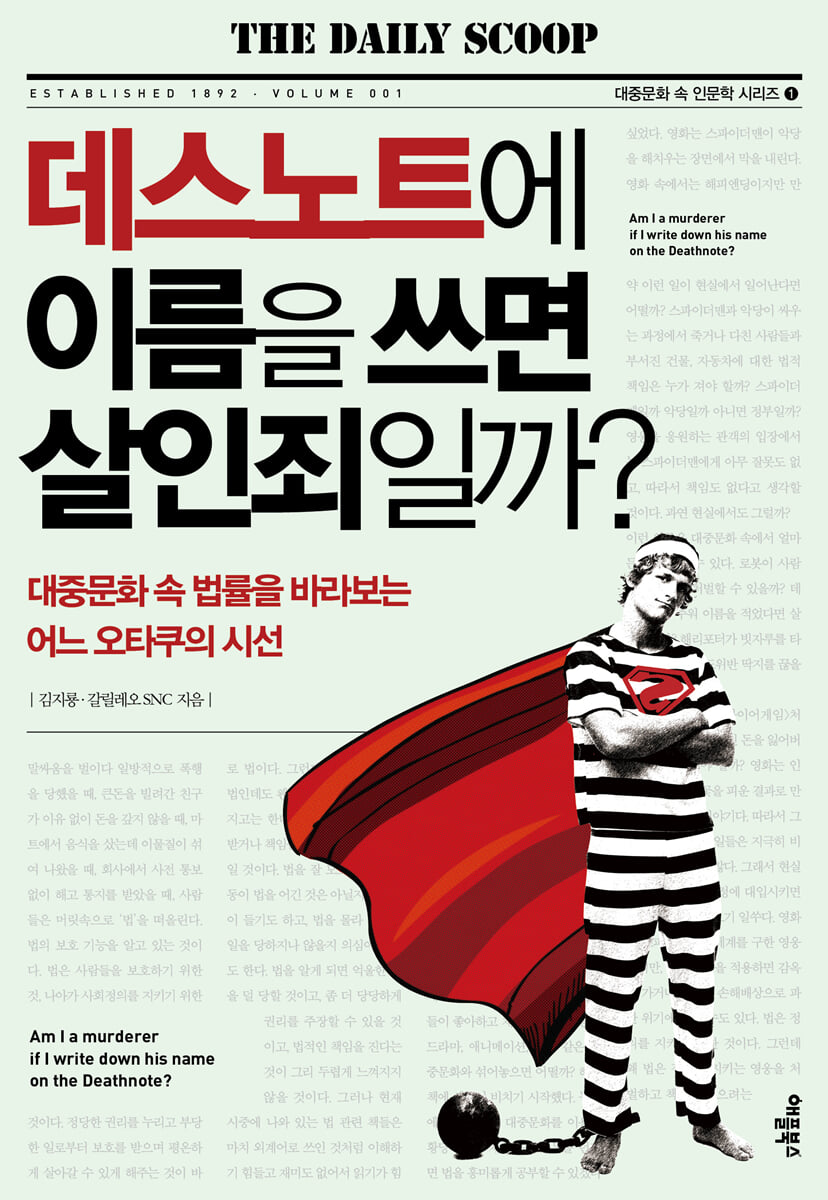
Is it murder to write your name in the Death Note?
 |
Description
Book Introduction
- Is the Hulk guilty for causing trouble by transforming into a monster?
- Who will compensate for the building that Spider-Man destroyed?
- Can Harry Potter fly freely in the sky?
The Avengers take on alien villains from outer space! The Hulk leaps between New York City's skyscrapers and sinks an alien spaceship in the heart of the city.
Captain America's shield unfortunately misses the villain and crashes into the building behind him, but the fight ultimately ends in victory for the Avengers! It's a refreshing scene from the movie.
But what about the people inside the buildings that the Hulk clutched tightly as he soared through the air, and the buildings that were crushed by his leaps? Did the buildings hit by Captain America's shield have insurance against such unforeseen events? It's a question we've all probably pondered at least once.
"Writing Your Name in a Death Note: Is It Murder?" examines the legal interpretations and disputes surrounding this famous pop culture scene from the perspectives of criminal law, civil law, and the Constitution.
By asking interesting and imaginative questions about stories that everyone knows, we will be able to distinguish between legal and illegal.
Moreover, the legal knowledge you have acquired will become an unshakable bridge that will help you cross these chaotic times.
- Who will compensate for the building that Spider-Man destroyed?
- Can Harry Potter fly freely in the sky?
The Avengers take on alien villains from outer space! The Hulk leaps between New York City's skyscrapers and sinks an alien spaceship in the heart of the city.
Captain America's shield unfortunately misses the villain and crashes into the building behind him, but the fight ultimately ends in victory for the Avengers! It's a refreshing scene from the movie.
But what about the people inside the buildings that the Hulk clutched tightly as he soared through the air, and the buildings that were crushed by his leaps? Did the buildings hit by Captain America's shield have insurance against such unforeseen events? It's a question we've all probably pondered at least once.
"Writing Your Name in a Death Note: Is It Murder?" examines the legal interpretations and disputes surrounding this famous pop culture scene from the perspectives of criminal law, civil law, and the Constitution.
By asking interesting and imaginative questions about stories that everyone knows, we will be able to distinguish between legal and illegal.
Moreover, the legal knowledge you have acquired will become an unshakable bridge that will help you cross these chaotic times.
index
introduction
Chapter 1: Understanding Criminal Law Through the "Death Note"
1.
Wouldn't it be a crime for a robot to kill? : Ghost in the Shell
2.
Is writing your name in the Death Note a crime? : Death Note
3.
Do the Forty Thieves Deserve to Die? : "Ali Baba and the Forty Thieves"
4.
How Serious Is Bullying? : 〈LIFE〉
5.
Is the Hulk guilty for causing trouble by transforming into a monster? : Hulk
6.
Can Taekwon V Run on the Road? : Robot Taekwon V
7.
Can Harry Potter fly freely? : Harry Potter
Chapter 2: Understanding Civil Law through Spider-Man
1.
Who is the owner of Pokémon? : 〈Pokemon〉
2.
Should gambling debts be repaid even if it means selling one's soul? : Tazza
3.
Is Son Goku the Unfilial Boy Who Murdered His Grandfather? : Dragon Ball
4.
Who Will Pay for the Buildings Spider-Man Destroys? : 〈Spider-Man〉
5.
Is there an obligation to keep money sent in Liar Game? : Liar Game
6.
Could Taekwon V be inherited from his father? : 〈Robot Taekwon V〉
Chapter 3: Understanding the Constitution through "Transformers"
1.
Is killing a Transformer murder? : Transformers
2.
Who will compensate for the property stolen by Hong Gildong? : The Story of Hong Gildong
3.
Can ET be taken out of the country? : 〈ET〉
4.
Why are the numbers in hero groups always odd? : Romance of the Three Kingdoms
5.
Can Peter Pan marry Wendy? : Peter Pan
Chapter 1: Understanding Criminal Law Through the "Death Note"
1.
Wouldn't it be a crime for a robot to kill? : Ghost in the Shell
2.
Is writing your name in the Death Note a crime? : Death Note
3.
Do the Forty Thieves Deserve to Die? : "Ali Baba and the Forty Thieves"
4.
How Serious Is Bullying? : 〈LIFE〉
5.
Is the Hulk guilty for causing trouble by transforming into a monster? : Hulk
6.
Can Taekwon V Run on the Road? : Robot Taekwon V
7.
Can Harry Potter fly freely? : Harry Potter
Chapter 2: Understanding Civil Law through Spider-Man
1.
Who is the owner of Pokémon? : 〈Pokemon〉
2.
Should gambling debts be repaid even if it means selling one's soul? : Tazza
3.
Is Son Goku the Unfilial Boy Who Murdered His Grandfather? : Dragon Ball
4.
Who Will Pay for the Buildings Spider-Man Destroys? : 〈Spider-Man〉
5.
Is there an obligation to keep money sent in Liar Game? : Liar Game
6.
Could Taekwon V be inherited from his father? : 〈Robot Taekwon V〉
Chapter 3: Understanding the Constitution through "Transformers"
1.
Is killing a Transformer murder? : Transformers
2.
Who will compensate for the property stolen by Hong Gildong? : The Story of Hong Gildong
3.
Can ET be taken out of the country? : 〈ET〉
4.
Why are the numbers in hero groups always odd? : Romance of the Three Kingdoms
5.
Can Peter Pan marry Wendy? : Peter Pan
Into the book
"Commander Kusunagi! You are under arrest for murder!"
“What is that…….”
“Your face was captured on CCTV before you covered it with optical camouflage.
The pistol ballistic test is also over, and ah… … It would be nice if I could have done the initial reaction, but I changed my body once… … .
Anyway, he is arrested on suspicion of murder.
You have the right to an attorney… … .”
At this time, Chief Aramaki of Section 9 steps forward to stop the prosecutors.
“Lieutenant Kusunagi is… not human.
"It's a robot, a robot! How can you convict a robot of murder?"
“You’re not a person?”
“Looking at it this way, it looks like a person, right? But inside, it’s titanium and covered in carbon fiber.
I told you, you don't even have a brain.
"It's a robot, a robot! Stop wasting your energy and get out of here."
At Chief Aramaki's words, the prosecutors return to the prosecutor's office with blank expressions.
Are you saying that robots can kill without being guilty?
--- p.18
Something similar to the Death Note is 'Curse'.
If you put a curse on someone and they die, is it considered murder? (……) In order for a crime to be clearly established, there must be a causal relationship between the criminal act (the act of execution) and the result of the crime.
A causal relationship is only recognized when it can be said that 'there is no result without the act of commission' between the criminal act and the resulting result.
If there is no causal relationship, it is not a crime and therefore cannot be punished under criminal law.
An act that is not a crime and is not subject to punishment because it cannot achieve its purpose due to the nature of the act is called an 'impossible crime'.
For example, having a shaman perform a ritual to kill a person.
Is it murder to shoot someone with a water gun with the intent to kill them? Shooting someone with a water gun doesn't kill them (in such cases, the situation usually ends with the technical term "murderer").
This also falls under the category of impossible crimes.
Even if a criminal is incapable of committing a crime, he or she must be punished because he or she acted with criminal intent. However, if it is not deemed dangerous, the punishment may be exempted.
--- p.50~51
The woodcutter in "Single Fart" was able to control the smell of his farts.
The smell is stored in the stomach.
When the master paid, he pressed his stomach and farted.
It is something that can be managed, so it becomes an object, a property that can be bought and sold for money.
But the smell of bread is something that the bakery owner cannot control.
This is because they are created naturally when baking bread and fly into the air.
This cannot be property.
Since it is not property, it cannot be bought or sold for money.
You have no right to ask for money just because you smelled bread.
--- p.161~162
Ordering chicken over the phone is also a contract.
The freedom to decide whether or not to order chicken is the 'freedom to enter into a contract'.
You can't complain to a chicken restaurant about why there aren't many orders these days.
The freedom to decide which store to order from is the 'freedom of choice of the other party.'
Even if my friend insists that I don't order from a certain chicken restaurant because it's unfriendly, I still have the freedom to order from that place (but our freedom to buy chicken from a large supermarket is somewhat limited).
Is it possible to call a chicken restaurant and have them refuse delivery because they don't like my voice? Yes, it is possible.
Because the chicken restaurant owner also has the freedom to choose his customers.
The freedom to freely decide the contents of a contract is ‘freedom to decide the contents.’
It is possible to order chicken that is priced at 10,000 won for a discount of 1,000 won if the owner approves.
It is also possible to order chicken that costs 10,000 won and offer 20,000 won.
It is even possible to make a contract where you can get 100,000 won if you deliver a 10,000 won chicken within 5 minutes.
It may be stupid, but no one can interfere with such a contract.
Whether you give 20,000 won or 100,000 won for a 10,000 won chicken is up to the individual to decide.
Also, if the owner decides to charge only 10,000 won for a 20,000 won chicken, no one can interfere.
--- p.181~182
The English expressions ET and alien do not mean 'human'.
Because no matter how similar they may look to humans, aliens are not humans.
Therefore, killing an alien does not constitute murder.
This is because the crime of murder under the criminal law applies only when one person kills another.
Just as a robot killing a person is not considered murder, a person killing an alien is not considered murder.
Since the crime of murder is not established, there is no corresponding punishment.
“What is that…….”
“Your face was captured on CCTV before you covered it with optical camouflage.
The pistol ballistic test is also over, and ah… … It would be nice if I could have done the initial reaction, but I changed my body once… … .
Anyway, he is arrested on suspicion of murder.
You have the right to an attorney… … .”
At this time, Chief Aramaki of Section 9 steps forward to stop the prosecutors.
“Lieutenant Kusunagi is… not human.
"It's a robot, a robot! How can you convict a robot of murder?"
“You’re not a person?”
“Looking at it this way, it looks like a person, right? But inside, it’s titanium and covered in carbon fiber.
I told you, you don't even have a brain.
"It's a robot, a robot! Stop wasting your energy and get out of here."
At Chief Aramaki's words, the prosecutors return to the prosecutor's office with blank expressions.
Are you saying that robots can kill without being guilty?
--- p.18
Something similar to the Death Note is 'Curse'.
If you put a curse on someone and they die, is it considered murder? (……) In order for a crime to be clearly established, there must be a causal relationship between the criminal act (the act of execution) and the result of the crime.
A causal relationship is only recognized when it can be said that 'there is no result without the act of commission' between the criminal act and the resulting result.
If there is no causal relationship, it is not a crime and therefore cannot be punished under criminal law.
An act that is not a crime and is not subject to punishment because it cannot achieve its purpose due to the nature of the act is called an 'impossible crime'.
For example, having a shaman perform a ritual to kill a person.
Is it murder to shoot someone with a water gun with the intent to kill them? Shooting someone with a water gun doesn't kill them (in such cases, the situation usually ends with the technical term "murderer").
This also falls under the category of impossible crimes.
Even if a criminal is incapable of committing a crime, he or she must be punished because he or she acted with criminal intent. However, if it is not deemed dangerous, the punishment may be exempted.
--- p.50~51
The woodcutter in "Single Fart" was able to control the smell of his farts.
The smell is stored in the stomach.
When the master paid, he pressed his stomach and farted.
It is something that can be managed, so it becomes an object, a property that can be bought and sold for money.
But the smell of bread is something that the bakery owner cannot control.
This is because they are created naturally when baking bread and fly into the air.
This cannot be property.
Since it is not property, it cannot be bought or sold for money.
You have no right to ask for money just because you smelled bread.
--- p.161~162
Ordering chicken over the phone is also a contract.
The freedom to decide whether or not to order chicken is the 'freedom to enter into a contract'.
You can't complain to a chicken restaurant about why there aren't many orders these days.
The freedom to decide which store to order from is the 'freedom of choice of the other party.'
Even if my friend insists that I don't order from a certain chicken restaurant because it's unfriendly, I still have the freedom to order from that place (but our freedom to buy chicken from a large supermarket is somewhat limited).
Is it possible to call a chicken restaurant and have them refuse delivery because they don't like my voice? Yes, it is possible.
Because the chicken restaurant owner also has the freedom to choose his customers.
The freedom to freely decide the contents of a contract is ‘freedom to decide the contents.’
It is possible to order chicken that is priced at 10,000 won for a discount of 1,000 won if the owner approves.
It is also possible to order chicken that costs 10,000 won and offer 20,000 won.
It is even possible to make a contract where you can get 100,000 won if you deliver a 10,000 won chicken within 5 minutes.
It may be stupid, but no one can interfere with such a contract.
Whether you give 20,000 won or 100,000 won for a 10,000 won chicken is up to the individual to decide.
Also, if the owner decides to charge only 10,000 won for a 20,000 won chicken, no one can interfere.
--- p.181~182
The English expressions ET and alien do not mean 'human'.
Because no matter how similar they may look to humans, aliens are not humans.
Therefore, killing an alien does not constitute murder.
This is because the crime of murder under the criminal law applies only when one person kills another.
Just as a robot killing a person is not considered murder, a person killing an alien is not considered murder.
Since the crime of murder is not established, there is no corresponding punishment.
--- p.285
Publisher's Review
After being exposed to radiation during an accident during an experiment, he would lose consciousness and turn into a green monster called the Hulk whenever he felt angry.
He left the United States out of fear that if he were caught by the police, he would spend the rest of his life in prison and pay a huge amount of restitution, due to the destruction he had caused and the people he had hurt while transforming into the Hulk.
dripping.
There was a knock on the door of his one-room apartment.
I opened the door, thinking it was strange that no one would come, and saw a familiar face.
Betty Ross, his former girlfriend and colleague.
“How did you find out about this place?”
“Bruce, what the hell are you doing here? Come back with me.”
“That can’t be happening.
“He’s already had a big accident, and who knows, he might turn into the Hulk again at any moment.”
“Don’t worry.
“Because I created the vaccine.”
"really?"
Bruce was delighted that he no longer had to turn into a monster, but his expression soon turned dead.
“But I can’t go back.
“Because of what happened last time, you’ll be locked up in jail as soon as you get back.”
Then an unfamiliar voice is heard.
“No.”
There was another guest behind Betty.
“Who are you?”
“This is the lawyer Betty hired.
“You are innocent.”
“What did you say?”
“It means it’s okay to go back to the United States.
You are not responsible because you did it while you were unconscious.”
(From the text)
In an age where compasses are needed, we turn to the law for guidance.
A society that changes every day, a world where there is never a moment of peace.
We live in a complex era where everyone has different opinions about what justice really is.
In times like these, the need for individuals to know the law becomes stronger.
The law is the crystallization of wisdom that humanity has revised and organized over generations to better live.
Sometimes, someone had to shed blood and wait a long time for a bill to pass.
And still, people make laws to live a better tomorrow.
The law is the foundation of individuals and society and is the standard for important decisions.
Laws are not there simply to punish crime.
The law affects all aspects of human life, including marriage, moving, and property.
It is also the role of the law to organize things so that people can live together peacefully.
Knowing these laws means understanding the scope of what an individual can do and their rights, and being able to enjoy them to the fullest.
The law gives us the strength to not be afraid when we are wronged, and the strength to confidently say 'no' to what is wrong.
The more you know, the more free you become. This magical law will become an unshakable bridge that will help you cross turbulent times.
Understand with imagination that is as interesting as a movie and as funny as a cartoon.
If you accidentally picked up a notebook on the street and wrote down your friends' names as a phone book, only to find out it was a Death Note, would you be imprisoned for murder? Wouldn't Harry Potter fly on a broomstick without breaking aviation safety laws? Who should compensate Spider-Man for the buildings, roads, and cars he destroys while fighting villains? The answers to these questions seem simple at first, but they are actually quite complex and "legal" issues, where guilt or innocence, victim or perpetrator, are determined by whether or not a single condition is met.
This book explains criminal law, civil law, and the Constitution in an easy-to-understand way through "hot scenes" in popular culture that are often overlooked, based on the proposition that "what you see is not always the law."
Unlike existing legal books that are too rigid, it explains things in an easy-to-understand and fun way using examples from popular culture such as movies, books, and dramas.
The "flaws" in popular culture, viewed through the lens of law, will naturally foster a perspective that distinguishes between legality and illegality, and help us rediscover and reinterpret the impression and meaning of law.
The law does not bind.
Rather, make it free!
Chapter 1 explains the 'criminal law', which has been created and refined since the advent of modern civil society with the aim of giving citizens freedom of action, through situations in 'Ghost in the Shell', 'Death Note', 'Ali Baba and the Forty Thieves', 'Hulk', 'Robot Taekwon V', 'Harry Potter', and 'LIFE'.
* Preview of the content: When you see a mean person, you feel like beating them up without even realizing it (it is a natural emotion that all humans feel, so don't feel guilty about it).
I also feel like sneaking around hiding or throwing away that person's stuff to spite him.
Is it a bad thing to think like this? Bad things can be broadly divided into two categories.
One is morally reprehensible, and the other is legally criminal and punishable.
For a crime to be a criminal offense under the latter category, two requirements must be met.
One is the intention to commit a crime, and the other is the actual act.
Just thinking things like, 'I should hit my friend' or 'I should steal something' does not constitute a crime.
So there is no need to be punished.
This is the difference between law and morality.
The law protects the essential elements for individual happiness!
Chapter 2 explains the laws for citizens, especially the 'civil law' that protects property and defines its scope, using 'Pokemon', 'Tazza', 'Dragon Ball', 'Spider-Man', 'Liar Game', and 'Robot Taekwon V'.
* Preview of the content: A person whose store sign is about to fall down because Spider-Man is spinning a web one day, and a person who is mentally shocked when Spider-Man flies past their window while they are changing clothes after a bath.
As superheroes are bound to have side effects, would these individuals, if they were to collectively sue Spider-Man, stand a chance? We explore the potential for damages through "Spider-Man's Justice" and the resulting damages.
There is no present without the tearful struggles of the past!
Chapter 3 discusses the 'constitution', which is the result of efforts to escape from the tyranny of absolute power and the oppression of feudalism, through 'Transformers', 'The Story of Hong Gildong', 'ET', 'Romance of the Three Kingdoms', and 'Peter Pan'.
* Preview of the content: If the people saw grain or money left in front of their houses, they would have known that Hong Gildong had left it there.
However, this is considered ‘acquisition of stolen goods’ and can result in imprisonment of up to 7 years.
It may seem like a just act for Hong Gil-dong to steal from corrupt officials and give it to the poor, but the law that exists for justice also punishes such injustice.
Is there a tragedy like this?
Hong Gil-dong was sentenced to about 15 years in prison, and poor people could also be sentenced to prison.
Why does this happen?
He left the United States out of fear that if he were caught by the police, he would spend the rest of his life in prison and pay a huge amount of restitution, due to the destruction he had caused and the people he had hurt while transforming into the Hulk.
dripping.
There was a knock on the door of his one-room apartment.
I opened the door, thinking it was strange that no one would come, and saw a familiar face.
Betty Ross, his former girlfriend and colleague.
“How did you find out about this place?”
“Bruce, what the hell are you doing here? Come back with me.”
“That can’t be happening.
“He’s already had a big accident, and who knows, he might turn into the Hulk again at any moment.”
“Don’t worry.
“Because I created the vaccine.”
"really?"
Bruce was delighted that he no longer had to turn into a monster, but his expression soon turned dead.
“But I can’t go back.
“Because of what happened last time, you’ll be locked up in jail as soon as you get back.”
Then an unfamiliar voice is heard.
“No.”
There was another guest behind Betty.
“Who are you?”
“This is the lawyer Betty hired.
“You are innocent.”
“What did you say?”
“It means it’s okay to go back to the United States.
You are not responsible because you did it while you were unconscious.”
(From the text)
In an age where compasses are needed, we turn to the law for guidance.
A society that changes every day, a world where there is never a moment of peace.
We live in a complex era where everyone has different opinions about what justice really is.
In times like these, the need for individuals to know the law becomes stronger.
The law is the crystallization of wisdom that humanity has revised and organized over generations to better live.
Sometimes, someone had to shed blood and wait a long time for a bill to pass.
And still, people make laws to live a better tomorrow.
The law is the foundation of individuals and society and is the standard for important decisions.
Laws are not there simply to punish crime.
The law affects all aspects of human life, including marriage, moving, and property.
It is also the role of the law to organize things so that people can live together peacefully.
Knowing these laws means understanding the scope of what an individual can do and their rights, and being able to enjoy them to the fullest.
The law gives us the strength to not be afraid when we are wronged, and the strength to confidently say 'no' to what is wrong.
The more you know, the more free you become. This magical law will become an unshakable bridge that will help you cross turbulent times.
Understand with imagination that is as interesting as a movie and as funny as a cartoon.
If you accidentally picked up a notebook on the street and wrote down your friends' names as a phone book, only to find out it was a Death Note, would you be imprisoned for murder? Wouldn't Harry Potter fly on a broomstick without breaking aviation safety laws? Who should compensate Spider-Man for the buildings, roads, and cars he destroys while fighting villains? The answers to these questions seem simple at first, but they are actually quite complex and "legal" issues, where guilt or innocence, victim or perpetrator, are determined by whether or not a single condition is met.
This book explains criminal law, civil law, and the Constitution in an easy-to-understand way through "hot scenes" in popular culture that are often overlooked, based on the proposition that "what you see is not always the law."
Unlike existing legal books that are too rigid, it explains things in an easy-to-understand and fun way using examples from popular culture such as movies, books, and dramas.
The "flaws" in popular culture, viewed through the lens of law, will naturally foster a perspective that distinguishes between legality and illegality, and help us rediscover and reinterpret the impression and meaning of law.
The law does not bind.
Rather, make it free!
Chapter 1 explains the 'criminal law', which has been created and refined since the advent of modern civil society with the aim of giving citizens freedom of action, through situations in 'Ghost in the Shell', 'Death Note', 'Ali Baba and the Forty Thieves', 'Hulk', 'Robot Taekwon V', 'Harry Potter', and 'LIFE'.
* Preview of the content: When you see a mean person, you feel like beating them up without even realizing it (it is a natural emotion that all humans feel, so don't feel guilty about it).
I also feel like sneaking around hiding or throwing away that person's stuff to spite him.
Is it a bad thing to think like this? Bad things can be broadly divided into two categories.
One is morally reprehensible, and the other is legally criminal and punishable.
For a crime to be a criminal offense under the latter category, two requirements must be met.
One is the intention to commit a crime, and the other is the actual act.
Just thinking things like, 'I should hit my friend' or 'I should steal something' does not constitute a crime.
So there is no need to be punished.
This is the difference between law and morality.
The law protects the essential elements for individual happiness!
Chapter 2 explains the laws for citizens, especially the 'civil law' that protects property and defines its scope, using 'Pokemon', 'Tazza', 'Dragon Ball', 'Spider-Man', 'Liar Game', and 'Robot Taekwon V'.
* Preview of the content: A person whose store sign is about to fall down because Spider-Man is spinning a web one day, and a person who is mentally shocked when Spider-Man flies past their window while they are changing clothes after a bath.
As superheroes are bound to have side effects, would these individuals, if they were to collectively sue Spider-Man, stand a chance? We explore the potential for damages through "Spider-Man's Justice" and the resulting damages.
There is no present without the tearful struggles of the past!
Chapter 3 discusses the 'constitution', which is the result of efforts to escape from the tyranny of absolute power and the oppression of feudalism, through 'Transformers', 'The Story of Hong Gildong', 'ET', 'Romance of the Three Kingdoms', and 'Peter Pan'.
* Preview of the content: If the people saw grain or money left in front of their houses, they would have known that Hong Gildong had left it there.
However, this is considered ‘acquisition of stolen goods’ and can result in imprisonment of up to 7 years.
It may seem like a just act for Hong Gil-dong to steal from corrupt officials and give it to the poor, but the law that exists for justice also punishes such injustice.
Is there a tragedy like this?
Hong Gil-dong was sentenced to about 15 years in prison, and poor people could also be sentenced to prison.
Why does this happen?
GOODS SPECIFICS
- Date of issue: October 13, 2025
- Page count, weight, size: 352 pages | 562g | 145*210*21mm
- ISBN13: 9791199441118
- ISBN10: 1199441112
You may also like
카테고리
korean


korean

![GQ KOREA Mark (Monthly): December [2025]](http://librairie.coreenne.fr/cdn/shop/files/8ef265dbbfbf186523ed75ba7319009d.jpg?v=1765340328&width=3840)


