

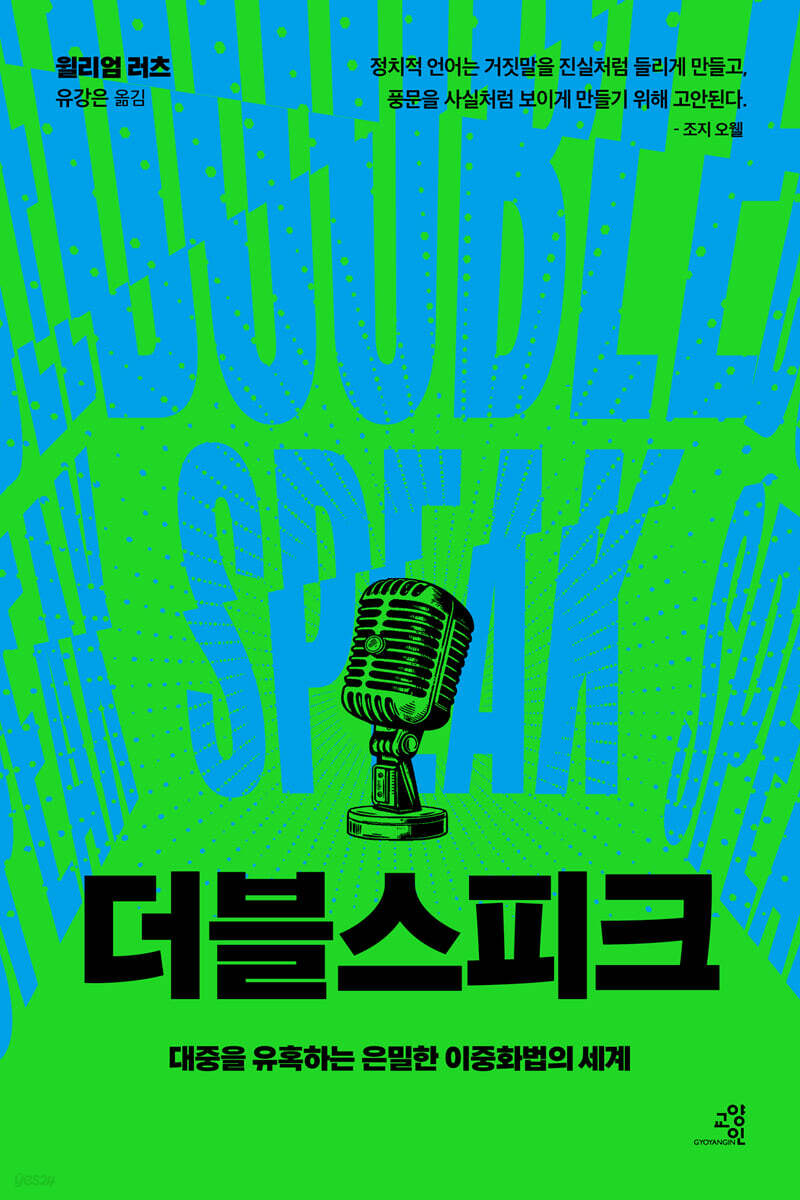
Double Speak
 |
Description
Book Introduction
“The dark age when martial law was painted as enlightenment and riots as the right to resist.
“A must-read for liberal arts that will help you navigate clearly.”
_ Cho Hyo-je (Professor Emeritus, Sungkonghoe University)
Revealing how words hide the truth
Classic works on doublespeak
When language obscures truth and glorifies power, what reality do we face? The concepts of "newspeak" and "doublethink," described by British author George Orwell in his novel "1984," were later expanded into the term "doublespeak," warning us of the power of words to disguise lies as truth.
"Doublespeak" is the masterpiece of William Lutz, an American linguist who dedicated his life to tracing the true nature of such language and analyzing its misuse, and it is a book that had a decisive influence on popularizing the concept of "doublespeak."
Doublespeak is a classic work that poignantly examines how language becomes a tool of politics and power, enabling social deception.
It sharply exposes the deceptive intentions hidden in the words that surround us, from official government statements, corporate advertising slogans, media reports, and everyday language.
Through a wealth of examples, Lutz vividly demonstrates how those in power manipulate words to evade accountability and manipulate public opinion.
Representative examples of euphemisms include expressing “killing a person” as “unlawful or arbitrary deprivation of life” and glossing over civilian casualties in military operations as “collateral damage.”
The author keenly points out that these seemingly plausible statements are actually tools to dilute the truth and conceal lies.
“If we call the illegal overthrow of a legitimate government ‘destabilization of the government’ and call lies ‘ineffective speech,’ we are evading responsibility, whitewashing evil, packaging negative events as positive, and using a double standard to make unpleasant things seem appealing.
The double standard is a method of pretending to communicate while actually refusing to communicate.
These are words designed to change our perception of reality and pollute our thinking.
Such words do not help develop and preserve our culture and civilization.
This language of deception breeds suspicion, cynicism, distrust, and ultimately, hostility.” _Page 41
“A must-read for liberal arts that will help you navigate clearly.”
_ Cho Hyo-je (Professor Emeritus, Sungkonghoe University)
Revealing how words hide the truth
Classic works on doublespeak
When language obscures truth and glorifies power, what reality do we face? The concepts of "newspeak" and "doublethink," described by British author George Orwell in his novel "1984," were later expanded into the term "doublespeak," warning us of the power of words to disguise lies as truth.
"Doublespeak" is the masterpiece of William Lutz, an American linguist who dedicated his life to tracing the true nature of such language and analyzing its misuse, and it is a book that had a decisive influence on popularizing the concept of "doublespeak."
Doublespeak is a classic work that poignantly examines how language becomes a tool of politics and power, enabling social deception.
It sharply exposes the deceptive intentions hidden in the words that surround us, from official government statements, corporate advertising slogans, media reports, and everyday language.
Through a wealth of examples, Lutz vividly demonstrates how those in power manipulate words to evade accountability and manipulate public opinion.
Representative examples of euphemisms include expressing “killing a person” as “unlawful or arbitrary deprivation of life” and glossing over civilian casualties in military operations as “collateral damage.”
The author keenly points out that these seemingly plausible statements are actually tools to dilute the truth and conceal lies.
“If we call the illegal overthrow of a legitimate government ‘destabilization of the government’ and call lies ‘ineffective speech,’ we are evading responsibility, whitewashing evil, packaging negative events as positive, and using a double standard to make unpleasant things seem appealing.
The double standard is a method of pretending to communicate while actually refusing to communicate.
These are words designed to change our perception of reality and pollute our thinking.
Such words do not help develop and preserve our culture and civilization.
This language of deception breeds suspicion, cynicism, distrust, and ultimately, hostility.” _Page 41
- You can preview some of the book's contents.
Preview
index
preface
Chapter 1: The Secret World of Doublespeak
Chapter 2: We are fooled by doublespeak every day.
Chapter 3: The Magic of Double Speak to Seduce Consumers
Chapter 4: How to Fire Without Getting Fired
Chapter 5: Technicians of Language Manipulation
Chapter 6: A War Without War or Death
Chapter 7: The Politics of Doublespeak
Chapter 8: Nuclear War and the War of Words
Acknowledgements
Chapter 1: The Secret World of Doublespeak
Chapter 2: We are fooled by doublespeak every day.
Chapter 3: The Magic of Double Speak to Seduce Consumers
Chapter 4: How to Fire Without Getting Fired
Chapter 5: Technicians of Language Manipulation
Chapter 6: A War Without War or Death
Chapter 7: The Politics of Doublespeak
Chapter 8: Nuclear War and the War of Words
Acknowledgements
Detailed image

Into the book
When a euphemism is used to mislead or deceive the listener, it becomes a double standard.
For example, in 1984, the U.S. State Department announced that it would no longer use the word "murder" in its annual country reports on human rights practices.
Instead, he declared that he would use the phrase "unlawful or arbitrary deprivation of life," arguing that this was a more accurate expression.
The real purpose of adopting this phrase was simply to avoid the embarrassment of government-sanctioned killings in countries that the United States supports or has certified as respecting the human rights of its citizens.
--- p.15, 16
The fourth method of doubling is inflated language, which makes the ordinary seem extraordinary, makes everyday events seem impressive, makes people, situations, or things that are not usually considered important seem important, and makes simple things seem complicated.
… … In the Pentagon's dual-use approach, a "preemptive strike" means that the US military attacked first.
The statement that 'engagement with enemies on all sides began' means that the US forces were ambushed.
--- p.20, 21
Wall Street is churning out dual-asset securities like junk bonds.
It's rare to see industry publications write that the stock market has "collapsed."
While others might say the stock market has crashed, Wall Streeters prefer to say the market is "retreating," "relieving," "having a technical correction," "having a technical correction," "falling due to profit taking," "falling due to reduced volume," or "losing some ground."
--- p.30~31
The double-crossing method is insidious.
Because it can contaminate and ultimately destroy the function of language as a means of communication between people and social groups.
… … As the double-talk method becomes widely used, it soon becomes a new word commonly used in the political sphere, and both the speaker and the listener become convinced that they truly understand this language.
After a while, we may truly believe that politicians are not lying but simply "misspeaking," that their actions are not illegal but merely "inappropriate," and that fraud and criminal conspiracy are merely "miscertifications."
--- p.41, 42
Diet beers have been around for a few years now, but they haven't sold well.
Then, marketing geniuses like Miller Brewing Company came along and changed the word "diet" to "lite" and used a large number of models who were former athletes to extol the virtues of "less filling" beer, completely changing the landscape.
We don't really know what light food is or why it's called light, but we do know one thing when we buy light food at the supermarket:
The point is that it is expensive.
… … Legally, manufacturers can label a product “light” even if it has only a few fewer calories than a comparable product.
--- p.59, 60
Some toothpaste ads claim that it “helps prevent cavities,” but they don’t actually say that it prevents cavities.
Some liquid detergent ads claim that it “helps kill germs in your home,” but they don’t actually say that it kills germs, nor do they specify which germs it kills.
… … If you start looking for the clever phrase “helpful” in advertising, you’ll be surprised at how often it appears.
And if you analyze the claims made in ads that use this phrase, you'll find that they don't actually say anything.
--- p.141, 142
The reason companies use double standards when laying off workers is because such language provides clear economic benefits.
… … LTV Corporation claimed that it did not lay off 600 workers at its steel plant in Aliquippa, Pennsylvania, in 1985.
The company called the layoffs an "indefinite suspension."
Since the factory was not completely closed, there was no need to provide severance pay or pensions to the workers who lost their jobs.
--- p.208
In the new textbook, Japan's invasion of China was changed to Japan's "advance."
The annexation of Korea in 1910 led to the 'advance' of the Japanese military and the establishment of the 'Government-General', and the March 1st Movement in 1919 against Japanese occupation became a 'riot'.
… … The last king of Joseon simply ‘stepped down’.
The revised textbooks made no mention whatsoever of the fact that thousands of young Korean women were forcibly taken to the front lines and used as "comfort women" for the Japanese military.
--- p.243
Chilean military dictator Augusto Pinochet, who overthrew the elected government of Salvador Allende Gossens in 1973 and seized power, declared martial law in 1984, saying:
“Now more than ever, we must firmly defend the institutional order that governs us, in order to preserve democracy and freedom.” … … Pinochet continued a long tradition of those who subvert democracy to protect it and those who destroy it to save it.
For example, in 1984, the U.S. State Department announced that it would no longer use the word "murder" in its annual country reports on human rights practices.
Instead, he declared that he would use the phrase "unlawful or arbitrary deprivation of life," arguing that this was a more accurate expression.
The real purpose of adopting this phrase was simply to avoid the embarrassment of government-sanctioned killings in countries that the United States supports or has certified as respecting the human rights of its citizens.
--- p.15, 16
The fourth method of doubling is inflated language, which makes the ordinary seem extraordinary, makes everyday events seem impressive, makes people, situations, or things that are not usually considered important seem important, and makes simple things seem complicated.
… … In the Pentagon's dual-use approach, a "preemptive strike" means that the US military attacked first.
The statement that 'engagement with enemies on all sides began' means that the US forces were ambushed.
--- p.20, 21
Wall Street is churning out dual-asset securities like junk bonds.
It's rare to see industry publications write that the stock market has "collapsed."
While others might say the stock market has crashed, Wall Streeters prefer to say the market is "retreating," "relieving," "having a technical correction," "having a technical correction," "falling due to profit taking," "falling due to reduced volume," or "losing some ground."
--- p.30~31
The double-crossing method is insidious.
Because it can contaminate and ultimately destroy the function of language as a means of communication between people and social groups.
… … As the double-talk method becomes widely used, it soon becomes a new word commonly used in the political sphere, and both the speaker and the listener become convinced that they truly understand this language.
After a while, we may truly believe that politicians are not lying but simply "misspeaking," that their actions are not illegal but merely "inappropriate," and that fraud and criminal conspiracy are merely "miscertifications."
--- p.41, 42
Diet beers have been around for a few years now, but they haven't sold well.
Then, marketing geniuses like Miller Brewing Company came along and changed the word "diet" to "lite" and used a large number of models who were former athletes to extol the virtues of "less filling" beer, completely changing the landscape.
We don't really know what light food is or why it's called light, but we do know one thing when we buy light food at the supermarket:
The point is that it is expensive.
… … Legally, manufacturers can label a product “light” even if it has only a few fewer calories than a comparable product.
--- p.59, 60
Some toothpaste ads claim that it “helps prevent cavities,” but they don’t actually say that it prevents cavities.
Some liquid detergent ads claim that it “helps kill germs in your home,” but they don’t actually say that it kills germs, nor do they specify which germs it kills.
… … If you start looking for the clever phrase “helpful” in advertising, you’ll be surprised at how often it appears.
And if you analyze the claims made in ads that use this phrase, you'll find that they don't actually say anything.
--- p.141, 142
The reason companies use double standards when laying off workers is because such language provides clear economic benefits.
… … LTV Corporation claimed that it did not lay off 600 workers at its steel plant in Aliquippa, Pennsylvania, in 1985.
The company called the layoffs an "indefinite suspension."
Since the factory was not completely closed, there was no need to provide severance pay or pensions to the workers who lost their jobs.
--- p.208
In the new textbook, Japan's invasion of China was changed to Japan's "advance."
The annexation of Korea in 1910 led to the 'advance' of the Japanese military and the establishment of the 'Government-General', and the March 1st Movement in 1919 against Japanese occupation became a 'riot'.
… … The last king of Joseon simply ‘stepped down’.
The revised textbooks made no mention whatsoever of the fact that thousands of young Korean women were forcibly taken to the front lines and used as "comfort women" for the Japanese military.
--- p.243
Chilean military dictator Augusto Pinochet, who overthrew the elected government of Salvador Allende Gossens in 1973 and seized power, declared martial law in 1984, saying:
“Now more than ever, we must firmly defend the institutional order that governs us, in order to preserve democracy and freedom.” … … Pinochet continued a long tradition of those who subvert democracy to protect it and those who destroy it to save it.
--- p.251
Publisher's Review
How language becomes a tool of power,
Paralyze the public's judgment,
Destroying democracy?
The author warns that doublespeak is not simply a play on words or rhetoric, but a dangerous weapon that paralyzes the public's judgment.
The various forms of doublespeak, such as the flowery rhetoric of political speeches, the obscure jargon of bureaucratic organizations, and the exaggerated expressions in advertising, are all accomplices in obscuring the truth.
Such language may seem like communication, but it actually silences thought, covers up wrongdoings, and consolidates power.
By dissecting the hidden power at work behind language, this book makes us realize how the words we take for granted have obscured our vision.
Since its first publication in 1989, Doublespeak has established itself as a must-read classic when discussing issues of language and power.
Even after decades, the 'war of words' over truth continues, and is becoming more sophisticated.
For today's readers, navigating an era of fake news and "post-truth," this book's insights are even more urgent.
"Double Speak" profoundly reminds us that opening our eyes to read the other side of words is the first step toward protecting the truth in an age of chaos.
“The purpose of language is to convey truth.
This is very important in democracy.
Because every citizen has a say in the issues facing the country.
“If these issues cannot be discussed in clear and honest language, voters cannot make informed choices.” _William Lutz
Hidden words, obscured meaning, erased reality
Doublespeak lifts the curtain
William Lutz's masterpiece, "Doublespeak," which popularized the concept of "doublespeak" and exposed its deceptive nature, has been published in Korea for the first time.
For decades, Lutz has tracked and analyzed countless examples of double standards used in politics, economics, and the military, warning of how distorted language undermines democracy.
Doublespeak is the culmination of Lutz's long-term exploration of the manipulation and distortion of language that permeates every aspect of society.
Since its first publication in 1989, it has been regarded as a classic work on doublespeak and has provided an analytical framework for the study of political discourse and advertising language.
(The Korean edition being published this time is based on the 2015 revised edition.) For us living in an era of fake news and post-truth, this book will serve as an intellectual weapon and survival manual to help us think critically without being swayed by the language of power.
Was the Itaewon tragedy an "accident" or a "disaster"? Is the 69-hour workweek "flexible working hours"?
- In an age of fake news and post-truth, the overflowing double standard
[Enlightenment] Used by former President Yoon Seok-yeol's lawyer during the fourth impeachment trial on January 23, 2025.
It was criticized as an attempt to glorify and defend the illegal martial law as a public enlightenment measure.
[Right to Request Reconsideration] Used by the Ministry of Justice under the Yoon Seok-yeol administration in June 2024 to refer to the ‘presidential veto.’
Although it was based on legal terms, it was a double-speak intended to reduce the political burden of frequent vetoes.
[Flexible Working Hours] Announced by the Minister of Employment and Labor in March 2023.
Although they said they would maintain the 52-hour workweek, the policy was to actually allow up to 69 hours of work per week by expanding overtime work units.
A term that packages long working hours as ‘flexibility.’
[Itaewon Incident] The government has instructed the use of the term "accident/death" instead of "disaster/victim" regarding the Itaewon disaster that occurred on October 29, 2022.
Doublespeak diluting the nature and responsibility of the incident.
[Alternative facts] An expression that packages a claim that is not true as if it were simply “another type of fact.”
A phrase that became widely known when it was used by the Donald Trump administration in the United States in 2017.
[High-intensity interrogation techniques] Harsh torture.
A term used by the U.S. government to justify physical and psychological torture.
[Special Military Operations] An expression referring to Russia's invasion of Ukraine in 2022.
It hides the negative perception of war of aggression and packages the act of aggression in a plausible way.
[Collateral damage] An expression used by the U.S. Department of Defense to refer to civilian deaths or destruction of civilian facilities during military operations.
This is a typical military doublespeak that dilutes the responsibility for war and moral tragedy by reducing the reality of civilian massacre and damage to the word "collateral."
[Voluntary retirement] A term used by companies to beautify layoffs.
On the surface, it is packaged as if the employee is leaving the company 'voluntarily', but in reality, it is a dismissal method that is closer to coercion.
[4 Major Rivers Restoration Project] The name of the national river restoration project promoted by the Lee Myung-bak administration in 2008.
A term used to describe large-scale civil engineering projects as ecological restoration.
[Correct History Textbook] An expression used by the Park Geun-hye government during the process of nationalizing history textbooks in 2015.
It was criticized for defining nationalization as 'correct' and obscuring diversity and criticism.
Words to defend the indefensible
Doublespeak, often translated as 'double-talking', refers to language that intentionally conceals, distorts, or even reverses facts and truths.
The harmful political language that British author George Orwell warned about in his essay “Politics and the English Language” (1946), language that distorts and conceals reality, is what we call doublespeak today.
Orwell said:
'In our time, political speech and writing are mainly used to defend the indefensible.
… … political language consists largely of euphemisms, evasions, and purely ambiguous expressions.
… … political language … … is designed to make lies sound like truth, murder look like admirable behavior, and mere hearsay look like established fact.’” _24, 25
The double-edged sword is “not the product of carelessness or lazy thinking,” but rather “the product of careful thinking.”
It is not a simple slip of the tongue, but language deliberately designed to manipulate the public mind.
Politicians don't lie, they just "misspeak"
The author warns that the abuse of the double standard goes beyond mere expressive problems and can have serious implications for public thought and public discourse.
It reminds us all that language can be a powerful tool for exercising political power, and that we all have a responsibility to monitor it.
“The list of duality methods is endless, and if you have been paying attention to this issue, you may be able to add examples of your own observations.
I encourage all readers to be active critics on this issue.
Only when we recognize and confront the duality method can we make progress in eliminating it from our language.
… … I hope this book will help create a public language that reveals facts rather than hides them, accepts responsibility rather than evades it, and promotes thought rather than hinders it.
And I hope that this will help open a public forum where all participants can fully understand each other's words.” _Preface
“We must become critical consumers of language.”
In an interview about the book, Lutz was asked, “What kind of change do you hope this book will actually make in the world?”
Lutz replied:
“I hope this book will serve as a survival manual for living in the media age.
I want people to be aware as consumers of language.
We often say that we should be meticulous consumers when purchasing things.
Likewise, we should not simply accept the language used in society, but examine it carefully.
Because we are consumers of products as well as consumers of language.
We must become critical consumers of language.
“When we encounter poorly written and flawed language (in government speech, public documents, legal jargon, or corporate advertising), we should return it to them like a broken appliance and demand that it be replaced with ‘proper language, clear language.’”
Paralyze the public's judgment,
Destroying democracy?
The author warns that doublespeak is not simply a play on words or rhetoric, but a dangerous weapon that paralyzes the public's judgment.
The various forms of doublespeak, such as the flowery rhetoric of political speeches, the obscure jargon of bureaucratic organizations, and the exaggerated expressions in advertising, are all accomplices in obscuring the truth.
Such language may seem like communication, but it actually silences thought, covers up wrongdoings, and consolidates power.
By dissecting the hidden power at work behind language, this book makes us realize how the words we take for granted have obscured our vision.
Since its first publication in 1989, Doublespeak has established itself as a must-read classic when discussing issues of language and power.
Even after decades, the 'war of words' over truth continues, and is becoming more sophisticated.
For today's readers, navigating an era of fake news and "post-truth," this book's insights are even more urgent.
"Double Speak" profoundly reminds us that opening our eyes to read the other side of words is the first step toward protecting the truth in an age of chaos.
“The purpose of language is to convey truth.
This is very important in democracy.
Because every citizen has a say in the issues facing the country.
“If these issues cannot be discussed in clear and honest language, voters cannot make informed choices.” _William Lutz
Hidden words, obscured meaning, erased reality
Doublespeak lifts the curtain
William Lutz's masterpiece, "Doublespeak," which popularized the concept of "doublespeak" and exposed its deceptive nature, has been published in Korea for the first time.
For decades, Lutz has tracked and analyzed countless examples of double standards used in politics, economics, and the military, warning of how distorted language undermines democracy.
Doublespeak is the culmination of Lutz's long-term exploration of the manipulation and distortion of language that permeates every aspect of society.
Since its first publication in 1989, it has been regarded as a classic work on doublespeak and has provided an analytical framework for the study of political discourse and advertising language.
(The Korean edition being published this time is based on the 2015 revised edition.) For us living in an era of fake news and post-truth, this book will serve as an intellectual weapon and survival manual to help us think critically without being swayed by the language of power.
Was the Itaewon tragedy an "accident" or a "disaster"? Is the 69-hour workweek "flexible working hours"?
- In an age of fake news and post-truth, the overflowing double standard
[Enlightenment] Used by former President Yoon Seok-yeol's lawyer during the fourth impeachment trial on January 23, 2025.
It was criticized as an attempt to glorify and defend the illegal martial law as a public enlightenment measure.
[Right to Request Reconsideration] Used by the Ministry of Justice under the Yoon Seok-yeol administration in June 2024 to refer to the ‘presidential veto.’
Although it was based on legal terms, it was a double-speak intended to reduce the political burden of frequent vetoes.
[Flexible Working Hours] Announced by the Minister of Employment and Labor in March 2023.
Although they said they would maintain the 52-hour workweek, the policy was to actually allow up to 69 hours of work per week by expanding overtime work units.
A term that packages long working hours as ‘flexibility.’
[Itaewon Incident] The government has instructed the use of the term "accident/death" instead of "disaster/victim" regarding the Itaewon disaster that occurred on October 29, 2022.
Doublespeak diluting the nature and responsibility of the incident.
[Alternative facts] An expression that packages a claim that is not true as if it were simply “another type of fact.”
A phrase that became widely known when it was used by the Donald Trump administration in the United States in 2017.
[High-intensity interrogation techniques] Harsh torture.
A term used by the U.S. government to justify physical and psychological torture.
[Special Military Operations] An expression referring to Russia's invasion of Ukraine in 2022.
It hides the negative perception of war of aggression and packages the act of aggression in a plausible way.
[Collateral damage] An expression used by the U.S. Department of Defense to refer to civilian deaths or destruction of civilian facilities during military operations.
This is a typical military doublespeak that dilutes the responsibility for war and moral tragedy by reducing the reality of civilian massacre and damage to the word "collateral."
[Voluntary retirement] A term used by companies to beautify layoffs.
On the surface, it is packaged as if the employee is leaving the company 'voluntarily', but in reality, it is a dismissal method that is closer to coercion.
[4 Major Rivers Restoration Project] The name of the national river restoration project promoted by the Lee Myung-bak administration in 2008.
A term used to describe large-scale civil engineering projects as ecological restoration.
[Correct History Textbook] An expression used by the Park Geun-hye government during the process of nationalizing history textbooks in 2015.
It was criticized for defining nationalization as 'correct' and obscuring diversity and criticism.
Words to defend the indefensible
Doublespeak, often translated as 'double-talking', refers to language that intentionally conceals, distorts, or even reverses facts and truths.
The harmful political language that British author George Orwell warned about in his essay “Politics and the English Language” (1946), language that distorts and conceals reality, is what we call doublespeak today.
Orwell said:
'In our time, political speech and writing are mainly used to defend the indefensible.
… … political language consists largely of euphemisms, evasions, and purely ambiguous expressions.
… … political language … … is designed to make lies sound like truth, murder look like admirable behavior, and mere hearsay look like established fact.’” _24, 25
The double-edged sword is “not the product of carelessness or lazy thinking,” but rather “the product of careful thinking.”
It is not a simple slip of the tongue, but language deliberately designed to manipulate the public mind.
Politicians don't lie, they just "misspeak"
The author warns that the abuse of the double standard goes beyond mere expressive problems and can have serious implications for public thought and public discourse.
It reminds us all that language can be a powerful tool for exercising political power, and that we all have a responsibility to monitor it.
“The list of duality methods is endless, and if you have been paying attention to this issue, you may be able to add examples of your own observations.
I encourage all readers to be active critics on this issue.
Only when we recognize and confront the duality method can we make progress in eliminating it from our language.
… … I hope this book will help create a public language that reveals facts rather than hides them, accepts responsibility rather than evades it, and promotes thought rather than hinders it.
And I hope that this will help open a public forum where all participants can fully understand each other's words.” _Preface
“We must become critical consumers of language.”
In an interview about the book, Lutz was asked, “What kind of change do you hope this book will actually make in the world?”
Lutz replied:
“I hope this book will serve as a survival manual for living in the media age.
I want people to be aware as consumers of language.
We often say that we should be meticulous consumers when purchasing things.
Likewise, we should not simply accept the language used in society, but examine it carefully.
Because we are consumers of products as well as consumers of language.
We must become critical consumers of language.
“When we encounter poorly written and flawed language (in government speech, public documents, legal jargon, or corporate advertising), we should return it to them like a broken appliance and demand that it be replaced with ‘proper language, clear language.’”
GOODS SPECIFICS
- Date of issue: August 29, 2025
- Page count, weight, size: 420 pages | 542g | 141*210*27mm
- ISBN13: 9791193154458
- ISBN10: 1193154456
You may also like
카테고리
korean


korean

![GQ KOREA Mark (Monthly): December [2025]](http://librairie.coreenne.fr/cdn/shop/files/8ef265dbbfbf186523ed75ba7319009d.jpg?v=1765340328&width=3840)


