

A practical guide to self-study time in the classroom
 |
Description
Book Introduction
Don't worry about the next semester's 'Scholar's Poetry' - easily, informatively, and enjoyably with just one book!
From organization to class application and operational know-how! Designed and operated directly by current teachers.
A Complete Guide to the 308th Class of School Self-Study Time: A to Z
In accordance with the 2022 revised curriculum, which aims for "initiative" and "deep learning" to prepare for the uncertainties of future society, "school autonomous time" has been introduced to the curriculum.
While it is certainly rewarding for each school and field teacher to exercise their autonomy to design classes that meet the needs of their students, the lack of proper standards or manuals has undoubtedly led to numerous difficulties in design and operation.
In response to these concerns and needs, current elementary school teachers, who are actually responsible for organizing autonomous school hours, gathered together.
The authors, who have served as research directors in planning curriculums for all levels, actively participated in research conferences, and published several books, have poured all their expertise as education experts into this book.
It provides everything you need to know about organizing and designing school autonomous time, including how to ensure the connection between core ideas and content elements, how to develop achievement standards, and what to keep in mind when securing time.
In addition, the authors propose 'cross-curricular learning' as the content of school autonomous time to reduce the burden on schools and maximize the effectiveness of school autonomous time.
Cross-curricular learning pursues practical learning closely related to life and has the characteristic of crossing multiple subjects, thus ensuring interdisciplinary connection and diversity of learning activities.
It is a perfect fit for school autonomous time in terms of practical feasibility in schools.
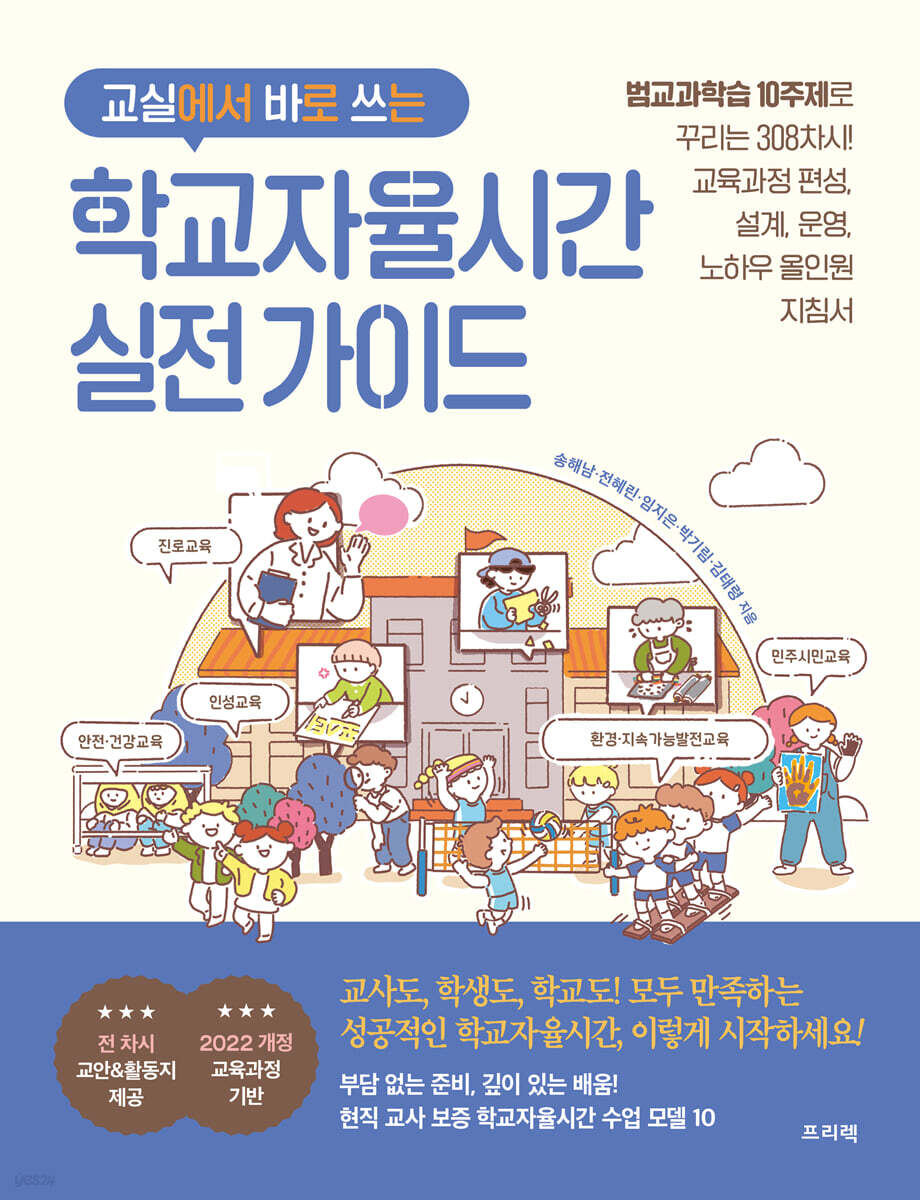
We design and propose classes for elementary school students in grades 3-6 based on ten cross-curricular topics: safety and health education, environment and sustainable development education, character education, economics and finance education, human rights education, Dokdo education, career education, democratic citizenship education, unification education, and multicultural education.
Above all, the core of this book is that it contains 10 lesson models that contain the entire syllabus, activity sheets, and detailed operation know-how for the entire school autonomous time class for one semester, consisting of lessons 1-29 and lessons 1-32.
It will be a great help in organizing the next semester's 'Scholar's City' as it contains not only the changes in students and the educational effects that I have observed while applying the actual class, but also the precautions and tips I have felt while running it.
Furthermore, we have added convenience and practicality by providing the original teaching materials and activity sheets as online appendices so that readers can use them right away in their classrooms.
I hope that this book will help teachers reduce their burden and students learn more deeply, making school autonomous time a rewarding experience.
From organization to class application and operational know-how! Designed and operated directly by current teachers.
A Complete Guide to the 308th Class of School Self-Study Time: A to Z
In accordance with the 2022 revised curriculum, which aims for "initiative" and "deep learning" to prepare for the uncertainties of future society, "school autonomous time" has been introduced to the curriculum.
While it is certainly rewarding for each school and field teacher to exercise their autonomy to design classes that meet the needs of their students, the lack of proper standards or manuals has undoubtedly led to numerous difficulties in design and operation.
In response to these concerns and needs, current elementary school teachers, who are actually responsible for organizing autonomous school hours, gathered together.
The authors, who have served as research directors in planning curriculums for all levels, actively participated in research conferences, and published several books, have poured all their expertise as education experts into this book.
It provides everything you need to know about organizing and designing school autonomous time, including how to ensure the connection between core ideas and content elements, how to develop achievement standards, and what to keep in mind when securing time.
In addition, the authors propose 'cross-curricular learning' as the content of school autonomous time to reduce the burden on schools and maximize the effectiveness of school autonomous time.
Cross-curricular learning pursues practical learning closely related to life and has the characteristic of crossing multiple subjects, thus ensuring interdisciplinary connection and diversity of learning activities.
It is a perfect fit for school autonomous time in terms of practical feasibility in schools.
We design and propose classes for elementary school students in grades 3-6 based on ten cross-curricular topics: safety and health education, environment and sustainable development education, character education, economics and finance education, human rights education, Dokdo education, career education, democratic citizenship education, unification education, and multicultural education.
Above all, the core of this book is that it contains 10 lesson models that contain the entire syllabus, activity sheets, and detailed operation know-how for the entire school autonomous time class for one semester, consisting of lessons 1-29 and lessons 1-32.
It will be a great help in organizing the next semester's 'Scholar's City' as it contains not only the changes in students and the educational effects that I have observed while applying the actual class, but also the precautions and tips I have felt while running it.
Furthermore, we have added convenience and practicality by providing the original teaching materials and activity sheets as online appendices so that readers can use them right away in their classrooms.
I hope that this book will help teachers reduce their burden and students learn more deeply, making school autonomous time a rewarding experience.
- You can preview some of the book's contents.
Preview
index
Part 0.
Expand your learning horizons with school self-study time!
1. Concept and Background of School Autonomy Time
1.1 Key Points of the 2022 Revised Curriculum
1.2 What is school autonomous time?
2. Organization and operation of school autonomous time
2.1 Organization of school autonomous time
2.2 Points to note when operating school autonomous time
3. Design of school autonomous time
3.1 Core Ideas and Content Elements
3.2 Achievement Standards
4. Cross-curricular learning and school autonomous time
4.1 Definition and necessity of cross-curricular learning
4.2 School Autonomy Time as a Method of Cross-Curriculum Learning
Part 1.
Safety and Health Education for Third Graders [Become a Safety Guardian and Health Hero!]
1. Prepare for class
1.1 Necessity and Objectives of the Activity
1.2 Content structure and achievement standards
1.3 Teaching and Learning Stages? Evaluation? Curriculum Organization
2 Class Operation
2.1 Health: Starting a Healthy Lifestyle with Strong Habits [Lessons 1-13]
(1) Exercise and Health: My Exercise Habits [Session 1-4]
(2) Healthy Living Practice [5-8th Session]
(3) Understanding Diseases and Infectious Diseases [Sessions 9-11]
(4) Commitment to a Healthy Life [12th-13th Session]
2.2 Safety: Coping with Disasters and Everyday Risks [Sessions 14-29]
(1) Safety Rules and Survival Swimming Preparation [14-15 Sessions]
(2) Traffic Safety [16th-17th Session]
(3) Resolving conflicts between friends [18-19th sessions]
(4) Preventing Smartphone Addiction [20th Session]
(5) Fire Evacuation Drill [21st-23rd Session]
(6) Earthquake Safety Education [24th-26th Sessions]
(7) First Aid [Classes 27-29]
Part 2.
Third Grade Environment? Sustainable Development Education [Practice that Changes Tomorrow]
1. Prepare for class
1.1 Necessity and Objectives of the Activity
1.2 Content structure and achievement standards
1.3 Teaching and Learning Stages? Evaluation? Curriculum Organization
2 Class Operation
2.1 Creating a Sustainable Environment: Taking Action to Improve the Environment in Our Lives [Session 1-12]
(1) Recognizing the severity of the climate crisis and raising ecological awareness [1-5 periods]
(2) Exploring the ecology of the place we live [6-7th period]
(3) Understanding the severity of the extinction crisis and the importance of ecological balance [8-9 sessions]
(4) Implementing Solutions for a Sustainable Environment [10th-11th Sessions]
(5) Growing Plants and Connecting with Nature [12th Session]
2.2 Pursuing a Sustainable Economy: Making Rational Economic Choices in Life [Sessions 13-20]
(1) Creating a poster for the campaign to reduce food waste [13-15 sessions]
(2) Experience Upcycling [16-18 Sessions]
(3) Participating in the Used Goods Market [19th-20th Session]
2.3 Moving Toward a Sustainable Society: Realizing a Society of Inclusion in Everyday Life [Sessions 21-27]
(1) Practicing equality in household chores [Session 21-23]
(2) Preserving Sustainable National Heritage [Session 24-27]
2.4 Rephrasing the Story: Moving Toward a Better Tomorrow [Session 28-29]
Part 3.
4th Grade Character Education [Emotional Talk! Character Development with Art]
1. Prepare for class
1.1 Necessity and Objectives of the Activity
1.2 Content structure and achievement standards
1.3 Teaching and Learning Stages? Evaluation? Curriculum Organization
2 Class Operation
2.1 Filial Piety/Respect/Consideration: Aesthetic Sensibility [Session 1-9]
(1) Filial piety and courtesy [1-2 periods]
(2) Respect [3-5 periods]
(3) Consideration [6th to 9th periods]
2.2 Responsibility/Integrity/Honesty: Self-Management [Session 10-18]
(1) Responsibility [10th to 12th periods]
(2) Sincerity [13th to 15th periods]
(3) Honesty [16th to 18th lessons]
2.3 Empathy/Communication: Collaborative Communication [Session 19-26]
(1) Empathy [Classes 19-21]
(2) Communication [Classes 22-26]
2.4 Cooperation: Community [Lessons 27-29]
4.
4th Grade Economics and Financial Education [Smart Economics and Financial Life]
1. Prepare for class
1.1 Necessity and Objectives of the Activity
1.2 Content structure and achievement standards
1.3 Teaching and Learning Stages? Evaluation? Curriculum Organization
2 Class Operation
2.1 Rational Choice and Economics: Economics and Rational Decision-Making [Sessions 1-6]
(1) Understanding the scarcity of resources and the concept of currency [1-2 sessions]
(2) Distinguishing between needs and wants [3-4 sessions]
(3) Understanding Economic Entities (Production/Consumption) [5-6 Sessions]
2.2 Becoming a Good Consumer: Exploring Independent Consumption [Sessions 7-13]
(1) Becoming a Wise Consumer in the Face of Advertising [Session 7-8]
(2) Planning your allowance [Session 9-11]
(3) Exploring Consumer Rights and Responsibilities [Session 12-13]
2.3 Becoming a Producer: Participating in Meaningful Production Processes [Sessions 14-22]
(1) Understanding producers and the production process [14-15 sessions]
(2) Making Your Own Product [16-19 Sessions]
(3) Experiencing production as a professional activity [20-22 sessions]
2.4 Smart Financial Practices: Finance in the Future Society [Sessions 23-25]
2.5 Social Justice: Values and Attitudes for a Fair Economy [Sessions 26-29]
(1) Social Enterprise and Fair Distribution [Lessons 26-27]
(2) Cultivating a practical attitude toward a fair society (sessions 28-29)
Part 5.
5th Grade Human Rights Education [A Classroom Where Human Rights Breathe]
1. Prepare for class
1.1 Necessity and Objectives of the Activity
1.2 Content structure and achievement standards
1.3 Teaching and Learning Stages? Evaluation? Curriculum Organization
2 Class Operation
2.1 Reading: "The Art Museum Where People Live" [Periods 1-3]
2.2 Problem Awareness: Exploring Human Rights in Real Life [Session 4-6]
2.3 Designing Solutions and Creating Creations: Solving and Implementing Human Rights Issues [Sessions 7-28]
(1) Solving Racial Discrimination Problems [Sessions 7-9]
(2) Solving Child Labor Problems [Session 10-13]
(3) Solving Gender Discrimination Problems [Session 14-17]
(4) Solving Socially Disadvantaged Problems [18-24 Sessions]
(5) Solving Human Rights Issues in Daily Life [Session 25-28]
2.4 Rewriting the Story: Creating a Classroom Where Human Rights Breathe
(1) Our class holds a human rights contest [29th-30th periods]
(2) A New Story Containing Human Rights Awareness [Sessions 31-32]
Part 6.
5th Grade Dokdo Education [Letters to Dokdo]
1. Prepare for class
1.1 Necessity and Objectives of the Activity
1.2 Content structure and achievement standards
1.3 Teaching and Learning Stages? Evaluation? Curriculum Organization
2 Class Operation
2.1 Reading: "Letters from Our Dokdo" [Periods 1-3]
2.2 Problem Recognition: Recognizing the Dokdo Territorial Issue [Session 4-5]
2.3 Solution Design: Taking a Step Closer to Dokdo [Session 6-14]
(1) Learn about the efforts of people trying to protect Dokdo [Session 6-8]
(2) Finding Accurate Information About Dokdo [Sessions 9-11]
(3) Exploring Dokdo's Geographical Information [Lessons 12-14]
2.4 Creating a Creative Work: Expressing Our Land, Dokdo [Session 15-27]
(1) Making Dokdo stamps [15-16th sessions]
(2) Making a Dokdo Poster [17th-18th Session]
(3) Drawing an 8-panel cartoon of Dokdo travel [19th-20th lessons]
(4) Creating a video introducing Dokdo [Lessons 21-24]
(5) Dokdo physical expression activity [25-27th period]
2.5 Rewriting the Story: Writing a Letter to Dokdo [Sessions 28-32]
Part 7.
5th Grade Career Education [Career Roadmap I Create]
1. Prepare for class
1.1 Necessity and Objectives of the Activity
1.2 Content structure and achievement standards
1.3 Teaching and Learning Stages? Evaluation? Curriculum Organization
2 Class Operation
2.1 Problem Recognition: Examining Changing Jobs [Sessions 1-6]
(1) Drawing a one-panel cartoon of the future I imagined [1-2 sessions]
(2) Investigating the Changing Future of Jobs [Sessions 3-6]
2.2 Self-Exploration: Self-Exploration and Career Path Finding [Sessions 7-10]
2.3 Career Exploration: Analyzing My Career Exploration [Sessions 11-14]
(1) Recognizing the Value of Work and Labor [11th-12th Sessions]
(2) Designing a new career idea [13th-14th period]
2.4 Career Planning: Designing Your Own Career Ideas [Sessions 15-26]
(1) Exploring future career information using media [15-18th period]
(2) Creating a career introduction video and career experience program [Session 19-22]
(3) Creating a career experience program information poster [23rd-24th period]
(4) Creating My Future Profile [Lessons 25-26]
2.5 Career Experience: Experience the Future Career Booth [Sessions 27-32]
(1) Experiencing Future Careers [Classes 27-30]
(2) Looking back on future career experiences [31-32nd period]
Part 8.
6th Grade Democratic Citizenship Education [Creating a Democratic Classroom Together]
1. Prepare for class
1.1 Necessity and Objectives of the Activity
1.2 Content structure and achievement standards
1.3 Teaching and Learning Stages? Evaluation? Curriculum Organization
2 Class Operation
2.1 Understanding the Concept: Understanding the Meaning and Role of Law [Sessions 1-6]
(1) Understanding the meaning and role of law in traditional fairy tales [1-3 periods]
(2) Understanding the Meaning of Democracy [Session 4-6]
2.2 Applying the Concept: Sowing the Seeds of Democracy in Our Class [Session 7-16]
(1) Exploring the Values Necessary for a Democratic Classroom [Sessions 7-10]
(2) Creating a Class Constitution for a Classroom Where We Live Together [Periods 11-13]
(3) Determining the roles needed in our classroom [14-16th periods]
2.3 Problem Recognition: Identifying Classroom, School, and Community Problems [Sessions 17-22]
(1) Opening a mock autonomous court to solve class problems [17th-18th periods]
(2) Resolving class issues democratically through autonomous activities [19th-20th periods]
(3) Improving Our School's Problems with Nudge Ideas ① [21-22 Sessions]
2.4 Collaborative Communication: Solving Problems on and Off Campus Through Collaborative Communication [Sessions 23-29]
(1) Improving Our School's Problems with Nudge Ideas② [Classes 23-25]
(2) Participating in the Student Autonomy Court [26th-27th Session]
(3) Participate in solving local problems [28-30 sessions]
2.5 Practice and Reflection: Reflecting on My Life and Pledge to Practice [Session 31-32]
Part 9.
6th Grade Unification Education [The Unification Story We Create]
1. Prepare for class
1.1 Necessity and Objectives of the Activity
1.2 Content structure and achievement standards
1.3 Teaching and Learning Stages? Evaluation? Curriculum Organization
2 Class Operation
2.1 Reading: "Joint Elementary School of North and South Korea" [Periods 1-3]
2.2 Problem Awareness: Our History: Is Unification Necessary? [Sessions 4-7]
(1) Exploring the historical background of North and South Korea [Session 4-5]
(2) Discussing difficulties that may arise after unification [Session 6-7]
2.3 Solution Design: Experiencing a Future Unified Korean Peninsula [Session 8-16]
(1) Interest in North Korea [8-9th Session]
(2) Planning a trip to North Korea [Session 10-12]
(3) Experience North and South Korean Folk Games [Session 13-16]
2.4 Creating Creative Works: Our School, Where North and South Korea Work Together [Periods 17-27]
(1) Creating a North-South Standard Dictionary [Sessions 17-19]
(2) Creating a joint elementary school song for North and South Korea [20th-21st periods]
(3) Designing a Joint Elementary School Emblem for North and South Korea [Session 22-23]
(4) Cooking Representative Dishes of North and South Korea [Session 24-27]
2.5 Rewriting the Story: Creating a Unified Newspaper [Sessions 28-32]
Part 10.
6th Grade Multicultural Education [A World Beyond Differences: A World of Togetherness]
1.
Class preparation
1.1 Necessity and Objectives of the Activity
1.2 Content structure and achievement standards
1.3 Teaching and Learning Stages, Evaluation, and Curriculum Organization
2.
Class operation
2.1 Reading: "Multicultural Friend Min-i is Angry" [Periods 1-3]
2.2 Problem Recognition: Exploring Diverse Perspectives on the World [Session 4-7]
(1) Investigation of cultural bias and discrimination cases [Session 4-5]
(2) Experience various cultural situations [6-7th period]
2.3 Solution Design: Seeing, Hearing, and Enjoying Diverse Cultures [Session 8-15]
(1) Exploring Lifestyles in Various Cultures [8-9 Sessions]
(2) Music from various cultures [10-13 lessons]
(3) Play in various cultures [14-15th period]
2.4 Creating Creations: A Multicultural World of Togetherness [Lessons 16-29]
(1) Traditional folk dances from various cultures [16-20 lessons]
(2) Global Village [21-24th Session]
(3) Multicultural Musical [Classes 25-29]
2.5 Rewriting the Story: We Become One as Global Citizens [Sessions 30-32]
Expand your learning horizons with school self-study time!
1. Concept and Background of School Autonomy Time
1.1 Key Points of the 2022 Revised Curriculum
1.2 What is school autonomous time?
2. Organization and operation of school autonomous time
2.1 Organization of school autonomous time
2.2 Points to note when operating school autonomous time
3. Design of school autonomous time
3.1 Core Ideas and Content Elements
3.2 Achievement Standards
4. Cross-curricular learning and school autonomous time
4.1 Definition and necessity of cross-curricular learning
4.2 School Autonomy Time as a Method of Cross-Curriculum Learning
Part 1.
Safety and Health Education for Third Graders [Become a Safety Guardian and Health Hero!]
1. Prepare for class
1.1 Necessity and Objectives of the Activity
1.2 Content structure and achievement standards
1.3 Teaching and Learning Stages? Evaluation? Curriculum Organization
2 Class Operation
2.1 Health: Starting a Healthy Lifestyle with Strong Habits [Lessons 1-13]
(1) Exercise and Health: My Exercise Habits [Session 1-4]
(2) Healthy Living Practice [5-8th Session]
(3) Understanding Diseases and Infectious Diseases [Sessions 9-11]
(4) Commitment to a Healthy Life [12th-13th Session]
2.2 Safety: Coping with Disasters and Everyday Risks [Sessions 14-29]
(1) Safety Rules and Survival Swimming Preparation [14-15 Sessions]
(2) Traffic Safety [16th-17th Session]
(3) Resolving conflicts between friends [18-19th sessions]
(4) Preventing Smartphone Addiction [20th Session]
(5) Fire Evacuation Drill [21st-23rd Session]
(6) Earthquake Safety Education [24th-26th Sessions]
(7) First Aid [Classes 27-29]
Part 2.
Third Grade Environment? Sustainable Development Education [Practice that Changes Tomorrow]
1. Prepare for class
1.1 Necessity and Objectives of the Activity
1.2 Content structure and achievement standards
1.3 Teaching and Learning Stages? Evaluation? Curriculum Organization
2 Class Operation
2.1 Creating a Sustainable Environment: Taking Action to Improve the Environment in Our Lives [Session 1-12]
(1) Recognizing the severity of the climate crisis and raising ecological awareness [1-5 periods]
(2) Exploring the ecology of the place we live [6-7th period]
(3) Understanding the severity of the extinction crisis and the importance of ecological balance [8-9 sessions]
(4) Implementing Solutions for a Sustainable Environment [10th-11th Sessions]
(5) Growing Plants and Connecting with Nature [12th Session]
2.2 Pursuing a Sustainable Economy: Making Rational Economic Choices in Life [Sessions 13-20]
(1) Creating a poster for the campaign to reduce food waste [13-15 sessions]
(2) Experience Upcycling [16-18 Sessions]
(3) Participating in the Used Goods Market [19th-20th Session]
2.3 Moving Toward a Sustainable Society: Realizing a Society of Inclusion in Everyday Life [Sessions 21-27]
(1) Practicing equality in household chores [Session 21-23]
(2) Preserving Sustainable National Heritage [Session 24-27]
2.4 Rephrasing the Story: Moving Toward a Better Tomorrow [Session 28-29]
Part 3.
4th Grade Character Education [Emotional Talk! Character Development with Art]
1. Prepare for class
1.1 Necessity and Objectives of the Activity
1.2 Content structure and achievement standards
1.3 Teaching and Learning Stages? Evaluation? Curriculum Organization
2 Class Operation
2.1 Filial Piety/Respect/Consideration: Aesthetic Sensibility [Session 1-9]
(1) Filial piety and courtesy [1-2 periods]
(2) Respect [3-5 periods]
(3) Consideration [6th to 9th periods]
2.2 Responsibility/Integrity/Honesty: Self-Management [Session 10-18]
(1) Responsibility [10th to 12th periods]
(2) Sincerity [13th to 15th periods]
(3) Honesty [16th to 18th lessons]
2.3 Empathy/Communication: Collaborative Communication [Session 19-26]
(1) Empathy [Classes 19-21]
(2) Communication [Classes 22-26]
2.4 Cooperation: Community [Lessons 27-29]
4.
4th Grade Economics and Financial Education [Smart Economics and Financial Life]
1. Prepare for class
1.1 Necessity and Objectives of the Activity
1.2 Content structure and achievement standards
1.3 Teaching and Learning Stages? Evaluation? Curriculum Organization
2 Class Operation
2.1 Rational Choice and Economics: Economics and Rational Decision-Making [Sessions 1-6]
(1) Understanding the scarcity of resources and the concept of currency [1-2 sessions]
(2) Distinguishing between needs and wants [3-4 sessions]
(3) Understanding Economic Entities (Production/Consumption) [5-6 Sessions]
2.2 Becoming a Good Consumer: Exploring Independent Consumption [Sessions 7-13]
(1) Becoming a Wise Consumer in the Face of Advertising [Session 7-8]
(2) Planning your allowance [Session 9-11]
(3) Exploring Consumer Rights and Responsibilities [Session 12-13]
2.3 Becoming a Producer: Participating in Meaningful Production Processes [Sessions 14-22]
(1) Understanding producers and the production process [14-15 sessions]
(2) Making Your Own Product [16-19 Sessions]
(3) Experiencing production as a professional activity [20-22 sessions]
2.4 Smart Financial Practices: Finance in the Future Society [Sessions 23-25]
2.5 Social Justice: Values and Attitudes for a Fair Economy [Sessions 26-29]
(1) Social Enterprise and Fair Distribution [Lessons 26-27]
(2) Cultivating a practical attitude toward a fair society (sessions 28-29)
Part 5.
5th Grade Human Rights Education [A Classroom Where Human Rights Breathe]
1. Prepare for class
1.1 Necessity and Objectives of the Activity
1.2 Content structure and achievement standards
1.3 Teaching and Learning Stages? Evaluation? Curriculum Organization
2 Class Operation
2.1 Reading: "The Art Museum Where People Live" [Periods 1-3]
2.2 Problem Awareness: Exploring Human Rights in Real Life [Session 4-6]
2.3 Designing Solutions and Creating Creations: Solving and Implementing Human Rights Issues [Sessions 7-28]
(1) Solving Racial Discrimination Problems [Sessions 7-9]
(2) Solving Child Labor Problems [Session 10-13]
(3) Solving Gender Discrimination Problems [Session 14-17]
(4) Solving Socially Disadvantaged Problems [18-24 Sessions]
(5) Solving Human Rights Issues in Daily Life [Session 25-28]
2.4 Rewriting the Story: Creating a Classroom Where Human Rights Breathe
(1) Our class holds a human rights contest [29th-30th periods]
(2) A New Story Containing Human Rights Awareness [Sessions 31-32]
Part 6.
5th Grade Dokdo Education [Letters to Dokdo]
1. Prepare for class
1.1 Necessity and Objectives of the Activity
1.2 Content structure and achievement standards
1.3 Teaching and Learning Stages? Evaluation? Curriculum Organization
2 Class Operation
2.1 Reading: "Letters from Our Dokdo" [Periods 1-3]
2.2 Problem Recognition: Recognizing the Dokdo Territorial Issue [Session 4-5]
2.3 Solution Design: Taking a Step Closer to Dokdo [Session 6-14]
(1) Learn about the efforts of people trying to protect Dokdo [Session 6-8]
(2) Finding Accurate Information About Dokdo [Sessions 9-11]
(3) Exploring Dokdo's Geographical Information [Lessons 12-14]
2.4 Creating a Creative Work: Expressing Our Land, Dokdo [Session 15-27]
(1) Making Dokdo stamps [15-16th sessions]
(2) Making a Dokdo Poster [17th-18th Session]
(3) Drawing an 8-panel cartoon of Dokdo travel [19th-20th lessons]
(4) Creating a video introducing Dokdo [Lessons 21-24]
(5) Dokdo physical expression activity [25-27th period]
2.5 Rewriting the Story: Writing a Letter to Dokdo [Sessions 28-32]
Part 7.
5th Grade Career Education [Career Roadmap I Create]
1. Prepare for class
1.1 Necessity and Objectives of the Activity
1.2 Content structure and achievement standards
1.3 Teaching and Learning Stages? Evaluation? Curriculum Organization
2 Class Operation
2.1 Problem Recognition: Examining Changing Jobs [Sessions 1-6]
(1) Drawing a one-panel cartoon of the future I imagined [1-2 sessions]
(2) Investigating the Changing Future of Jobs [Sessions 3-6]
2.2 Self-Exploration: Self-Exploration and Career Path Finding [Sessions 7-10]
2.3 Career Exploration: Analyzing My Career Exploration [Sessions 11-14]
(1) Recognizing the Value of Work and Labor [11th-12th Sessions]
(2) Designing a new career idea [13th-14th period]
2.4 Career Planning: Designing Your Own Career Ideas [Sessions 15-26]
(1) Exploring future career information using media [15-18th period]
(2) Creating a career introduction video and career experience program [Session 19-22]
(3) Creating a career experience program information poster [23rd-24th period]
(4) Creating My Future Profile [Lessons 25-26]
2.5 Career Experience: Experience the Future Career Booth [Sessions 27-32]
(1) Experiencing Future Careers [Classes 27-30]
(2) Looking back on future career experiences [31-32nd period]
Part 8.
6th Grade Democratic Citizenship Education [Creating a Democratic Classroom Together]
1. Prepare for class
1.1 Necessity and Objectives of the Activity
1.2 Content structure and achievement standards
1.3 Teaching and Learning Stages? Evaluation? Curriculum Organization
2 Class Operation
2.1 Understanding the Concept: Understanding the Meaning and Role of Law [Sessions 1-6]
(1) Understanding the meaning and role of law in traditional fairy tales [1-3 periods]
(2) Understanding the Meaning of Democracy [Session 4-6]
2.2 Applying the Concept: Sowing the Seeds of Democracy in Our Class [Session 7-16]
(1) Exploring the Values Necessary for a Democratic Classroom [Sessions 7-10]
(2) Creating a Class Constitution for a Classroom Where We Live Together [Periods 11-13]
(3) Determining the roles needed in our classroom [14-16th periods]
2.3 Problem Recognition: Identifying Classroom, School, and Community Problems [Sessions 17-22]
(1) Opening a mock autonomous court to solve class problems [17th-18th periods]
(2) Resolving class issues democratically through autonomous activities [19th-20th periods]
(3) Improving Our School's Problems with Nudge Ideas ① [21-22 Sessions]
2.4 Collaborative Communication: Solving Problems on and Off Campus Through Collaborative Communication [Sessions 23-29]
(1) Improving Our School's Problems with Nudge Ideas② [Classes 23-25]
(2) Participating in the Student Autonomy Court [26th-27th Session]
(3) Participate in solving local problems [28-30 sessions]
2.5 Practice and Reflection: Reflecting on My Life and Pledge to Practice [Session 31-32]
Part 9.
6th Grade Unification Education [The Unification Story We Create]
1. Prepare for class
1.1 Necessity and Objectives of the Activity
1.2 Content structure and achievement standards
1.3 Teaching and Learning Stages? Evaluation? Curriculum Organization
2 Class Operation
2.1 Reading: "Joint Elementary School of North and South Korea" [Periods 1-3]
2.2 Problem Awareness: Our History: Is Unification Necessary? [Sessions 4-7]
(1) Exploring the historical background of North and South Korea [Session 4-5]
(2) Discussing difficulties that may arise after unification [Session 6-7]
2.3 Solution Design: Experiencing a Future Unified Korean Peninsula [Session 8-16]
(1) Interest in North Korea [8-9th Session]
(2) Planning a trip to North Korea [Session 10-12]
(3) Experience North and South Korean Folk Games [Session 13-16]
2.4 Creating Creative Works: Our School, Where North and South Korea Work Together [Periods 17-27]
(1) Creating a North-South Standard Dictionary [Sessions 17-19]
(2) Creating a joint elementary school song for North and South Korea [20th-21st periods]
(3) Designing a Joint Elementary School Emblem for North and South Korea [Session 22-23]
(4) Cooking Representative Dishes of North and South Korea [Session 24-27]
2.5 Rewriting the Story: Creating a Unified Newspaper [Sessions 28-32]
Part 10.
6th Grade Multicultural Education [A World Beyond Differences: A World of Togetherness]
1.
Class preparation
1.1 Necessity and Objectives of the Activity
1.2 Content structure and achievement standards
1.3 Teaching and Learning Stages, Evaluation, and Curriculum Organization
2.
Class operation
2.1 Reading: "Multicultural Friend Min-i is Angry" [Periods 1-3]
2.2 Problem Recognition: Exploring Diverse Perspectives on the World [Session 4-7]
(1) Investigation of cultural bias and discrimination cases [Session 4-5]
(2) Experience various cultural situations [6-7th period]
2.3 Solution Design: Seeing, Hearing, and Enjoying Diverse Cultures [Session 8-15]
(1) Exploring Lifestyles in Various Cultures [8-9 Sessions]
(2) Music from various cultures [10-13 lessons]
(3) Play in various cultures [14-15th period]
2.4 Creating Creations: A Multicultural World of Togetherness [Lessons 16-29]
(1) Traditional folk dances from various cultures [16-20 lessons]
(2) Global Village [21-24th Session]
(3) Multicultural Musical [Classes 25-29]
2.5 Rewriting the Story: We Become One as Global Citizens [Sessions 30-32]
Detailed image

Publisher's Review
How far can school self-study time go?
Create fun and exciting scholarly poems based on 10 interdisciplinary learning topics!
School Autonomy Time, first introduced in the 2022 revised curriculum, is "time to open and operate new subjects or activities outside of the curriculum outlined in the national curriculum."
Breaking away from the established, uniform education system, teachers on the front lines have been given the authority to 'design' new education that meets the unique needs and demands of our region, our school, and our students.
This is an opportunity for each teacher, as an educational professional, to fully demonstrate their expertise and capabilities, while at the same time providing students with the benefit of breaking free from standardized textbooks and receiving more engaging and beneficial lessons that can immediately benefit their daily lives.
But on the other hand, the 32-hour class that must be organized without any specific guidelines or manuals feels daunting.
Whether it's restructuring the curriculum, selecting class topics, or finding or creating teaching materials...
Nothing would have been easy.
What should I do in the 'Scholar's Poem' next semester?
At such times, take a quick look at this book, “A Practical Guide to Self-Study Time in the Classroom.”
Five current elementary school teachers, deeply empathetic to the concerns of the educational field, have joined forces to reduce the burden of school autonomous time and maximize its effectiveness.
The topic of the school autonomous time class suggested by the authors is ‘cross-curricular learning.’
Cross-curricular learning, which pursues education that is closely related to real life and contextual, and that crosses all subjects, is well-suited to the school's autonomous time and its purposes and needs.
Now, experience 308 classes of school-based independent learning, diversely covering 10 interdisciplinary topics.
With third-grade elementary school students, we promote daily well-being through safety, health, environmental, and sustainable development education. With fourth-grade elementary school students, we cultivate a wise daily life through character, economics, and financial education.
Additionally, with fifth graders, we broaden their horizons through human rights, Dokdo, and career education, enabling them to encounter the world outside of themselves. With sixth graders, we dream of a future where they will live as respectable members of society through democratic citizenship, unification, and multicultural education.
It doesn't stop at just theory and guidance.
All the lessons and activities introduced in this book have been proven and implemented in actual classrooms, from planning to operation.
To ensure that this school-based learning experience can be implemented smoothly in the classrooms of independent teachers, we've included all the information necessary for class design and operation, from curriculum planning and organization to content structure, achievement standards, and assessment.
In particular, I am confident that the useful teaching materials, operational precautions, and know-how that you would not know unless you tried them yourself will be of great help.
Furthermore, we have provided the original lesson plans and activity sheets for each class as an online appendix, adding to the convenience of our readers and teachers.
It will literally be a school autonomous time where you can ‘use it right in the classroom.’
You can follow the lessons introduced here as they are, but it would be even better if you reconstructed them by adding your own ideas.
With this book, successful school self-study time that satisfies teachers, schools, and students won't be difficult.
Create fun and exciting scholarly poems based on 10 interdisciplinary learning topics!
School Autonomy Time, first introduced in the 2022 revised curriculum, is "time to open and operate new subjects or activities outside of the curriculum outlined in the national curriculum."
Breaking away from the established, uniform education system, teachers on the front lines have been given the authority to 'design' new education that meets the unique needs and demands of our region, our school, and our students.
This is an opportunity for each teacher, as an educational professional, to fully demonstrate their expertise and capabilities, while at the same time providing students with the benefit of breaking free from standardized textbooks and receiving more engaging and beneficial lessons that can immediately benefit their daily lives.
But on the other hand, the 32-hour class that must be organized without any specific guidelines or manuals feels daunting.
Whether it's restructuring the curriculum, selecting class topics, or finding or creating teaching materials...
Nothing would have been easy.
What should I do in the 'Scholar's Poem' next semester?
At such times, take a quick look at this book, “A Practical Guide to Self-Study Time in the Classroom.”
Five current elementary school teachers, deeply empathetic to the concerns of the educational field, have joined forces to reduce the burden of school autonomous time and maximize its effectiveness.
The topic of the school autonomous time class suggested by the authors is ‘cross-curricular learning.’
Cross-curricular learning, which pursues education that is closely related to real life and contextual, and that crosses all subjects, is well-suited to the school's autonomous time and its purposes and needs.
Now, experience 308 classes of school-based independent learning, diversely covering 10 interdisciplinary topics.
With third-grade elementary school students, we promote daily well-being through safety, health, environmental, and sustainable development education. With fourth-grade elementary school students, we cultivate a wise daily life through character, economics, and financial education.
Additionally, with fifth graders, we broaden their horizons through human rights, Dokdo, and career education, enabling them to encounter the world outside of themselves. With sixth graders, we dream of a future where they will live as respectable members of society through democratic citizenship, unification, and multicultural education.
It doesn't stop at just theory and guidance.
All the lessons and activities introduced in this book have been proven and implemented in actual classrooms, from planning to operation.
To ensure that this school-based learning experience can be implemented smoothly in the classrooms of independent teachers, we've included all the information necessary for class design and operation, from curriculum planning and organization to content structure, achievement standards, and assessment.
In particular, I am confident that the useful teaching materials, operational precautions, and know-how that you would not know unless you tried them yourself will be of great help.
Furthermore, we have provided the original lesson plans and activity sheets for each class as an online appendix, adding to the convenience of our readers and teachers.
It will literally be a school autonomous time where you can ‘use it right in the classroom.’
You can follow the lessons introduced here as they are, but it would be even better if you reconstructed them by adding your own ideas.
With this book, successful school self-study time that satisfies teachers, schools, and students won't be difficult.
GOODS SPECIFICS
- Date of issue: August 25, 2025
- Page count, weight, size: 448 pages | 188*245*30mm
- ISBN13: 9788965404187
- ISBN10: 8965404185
You may also like
카테고리
korean


korean

![GQ KOREA Mark (Monthly): December [2025]](http://librairie.coreenne.fr/cdn/shop/files/8ef265dbbfbf186523ed75ba7319009d.jpg?v=1765340328&width=3840)


