

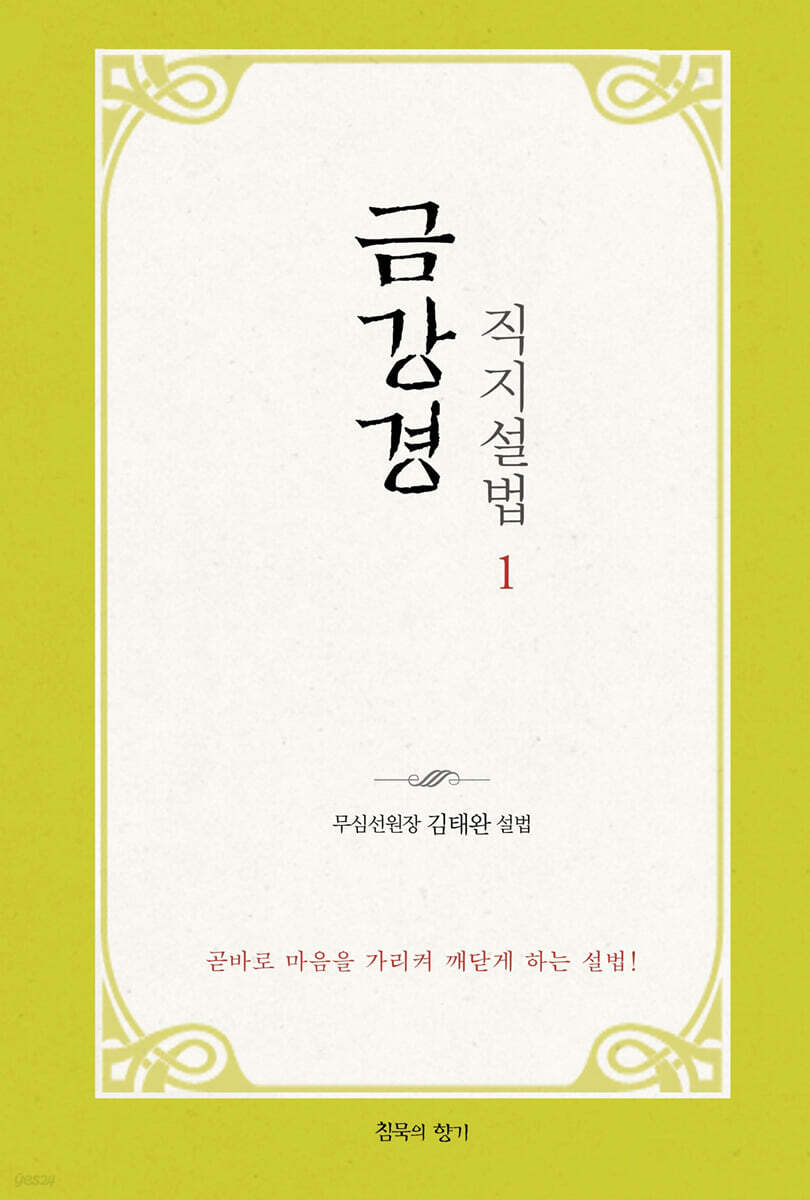
Diamond Sutra Direct Sermon 1
 |
Description
Book Introduction
A Diamond Sutra sermon that points directly to the mind and helps us realize our original nature!
A sermon optimized for enlightenment!
Kim Tae-wan, a Zen master who received a doctorate in the study of ancestral Zen and has been teaching students at Musim Zen Center since 2001 based on his own experience of studying that opened his eyes, faithfully follows the Zen Buddhist spirit of directly pointing to the human mind and leading us to enlightenment by pointing directly to our original mind.
Unlike many commentaries on the Diamond Sutra, 『Diamond Sutra Direct Commentary 1』 does not explain the passages of the Diamond Sutra to increase understanding or help readers understand it through thought.
Instead, it is a teaching optimized for enlightenment because it repeatedly points out from beginning to end what the Diamond Sutra wants to show, to help us realize and experience the original mind.
Our original mind is always evident here and now, but it is not an object of consciousness, so it cannot be found by ordinary means.
The best way and the fastest shortcut is to first listen to the teachings of an enlightened sage and receive guidance.
This book provides a correct understanding of the true nature of the mind and existence through various metaphors and explanations, and also contains detailed help for those who study.
To properly guide students, numerous misunderstandings and misconceptions must be corrected.
Even if you believe you know something well, you are often actually mistaken, and such misunderstandings are often so deep-rooted that they are not easily changed even when pointed out.
Captain Kim Tae-wan, with over 20 years of experience guiding students, offers a wealth of helpful advice and kindly guides students to stay on the right path and avoid going down the wrong path.
A sermon optimized for enlightenment!
Kim Tae-wan, a Zen master who received a doctorate in the study of ancestral Zen and has been teaching students at Musim Zen Center since 2001 based on his own experience of studying that opened his eyes, faithfully follows the Zen Buddhist spirit of directly pointing to the human mind and leading us to enlightenment by pointing directly to our original mind.
Unlike many commentaries on the Diamond Sutra, 『Diamond Sutra Direct Commentary 1』 does not explain the passages of the Diamond Sutra to increase understanding or help readers understand it through thought.
Instead, it is a teaching optimized for enlightenment because it repeatedly points out from beginning to end what the Diamond Sutra wants to show, to help us realize and experience the original mind.
Our original mind is always evident here and now, but it is not an object of consciousness, so it cannot be found by ordinary means.
The best way and the fastest shortcut is to first listen to the teachings of an enlightened sage and receive guidance.
This book provides a correct understanding of the true nature of the mind and existence through various metaphors and explanations, and also contains detailed help for those who study.
To properly guide students, numerous misunderstandings and misconceptions must be corrected.
Even if you believe you know something well, you are often actually mistaken, and such misunderstandings are often so deep-rooted that they are not easily changed even when pointed out.
Captain Kim Tae-wan, with over 20 years of experience guiding students, offers a wealth of helpful advice and kindly guides students to stay on the right path and avoid going down the wrong path.
- You can preview some of the book's contents.
Preview
index
preface
What is the Diamond Sutra?
1.
The reason for holding the Dharma Assembly:
2.
Seonhyeongi Cheongbun: Subori requests a sermon
3.
Mahayana Jeongjongbun: The right foundation of Mahayana
4.
Mysterious actions have no place to stay.
5.
Yeo-ri-sil-gyeon-bun: Seeing things as they are, honestly.
6.
The Rare Truth: True Faith is Rare
7.
Nothing to gain, nothing to say: Nothing to gain, nothing to say
8.
Legal Birth: Appears according to the law
9.
Everyday Impermanence: There is only one form, no other.
10.
Magnificent Pure Land: Decorating a Clean Land
11.
The blessings of non-action are excellent.
12.
Respect for the Right Teachings: Respect the right teachings.
What is the Diamond Sutra?
1.
The reason for holding the Dharma Assembly:
2.
Seonhyeongi Cheongbun: Subori requests a sermon
3.
Mahayana Jeongjongbun: The right foundation of Mahayana
4.
Mysterious actions have no place to stay.
5.
Yeo-ri-sil-gyeon-bun: Seeing things as they are, honestly.
6.
The Rare Truth: True Faith is Rare
7.
Nothing to gain, nothing to say: Nothing to gain, nothing to say
8.
Legal Birth: Appears according to the law
9.
Everyday Impermanence: There is only one form, no other.
10.
Magnificent Pure Land: Decorating a Clean Land
11.
The blessings of non-action are excellent.
12.
Respect for the Right Teachings: Respect the right teachings.
Into the book
It is not a name, a color, a sound, a smell, a taste, a feeling, a thought, or anything else.
There is always something that is not there.
Wherever there is every discriminating sound, color, smell, taste, feeling, and thought, this is there.
There's one of these everywhere.
So, all names and appearances are not names and appearances.
If we were to speak, we could say it like that.
Not all names and appearances are names and appearances.
(raising hand) This is it.
This one.
This one is all names and forms, and all names and forms are this one.
But because we are alive like this, we can wake up from our delusions.
The mind sometimes fantasizes and sometimes wakes up from its fantasies.
Delusions do not come from somewhere else. Just as waves cannot exist outside of water, and a reflection in a mirror cannot exist outside of the mirror, so too cannot delusions exist outside of the mind.
Delusions also arise from the mind.
But, if you are deceived by delusion and wander around, when you suddenly realize it, the truth is revealed within the delusion.
This is how the truth is revealed in the midst of delusion.
This is enlightenment.
The mind of a living being and the mind of a Buddha are the same mind.
It's just that living beings don't have enlightenment, and Buddha is enlightened.
The mind of a living being and the mind of a Buddha are not separate.
It's the same mind, but once you realize it, you're free from the delusions of ignorance, so there's nothing to worry about, but you still live like before.
It's still that feeling.
It's not that I have other thoughts.
Is there a separate mind for Buddha? No.
The heart is always one.
I only have this one heart.
This is the original mind, but we are experiencing this truth that we do not know, this aspect that we cannot know.
Then there is nothing left.
I only have this one heart.
This is the only one.
It's everywhere.
No matter what you do, there's this.
This one.
When this becomes clear, it is as if the dead have come back to life, and this universe is truly alive.
The universe is not inanimate.
The universe is one mind.
It is a living heart.
That is why it is called the Dharmakaya Buddha.
This universe is one living mind.
There is nothing that is not Buddha, and everything is alive.
The universe is alive.
So, this universe is called the Dharmakaya Buddha.
The three realms are based on the mind.
There is a saying that the whole world is but one mind.
You said that color is emptiness.
You can't just remove the color and have a ball.
Since color is the ball itself, you cannot get rid of the color and get only the ball.
When you realize the ball, there is color there.
That's why it's said that color is emptiness.
You can't study like this by discarding and taking things.
(Tapping the Dharma table) The act of discarding and taking is itself discrimination and delusion.
(Tapping the Dharma table) It is not about discarding and taking, it is not about choosing and rejecting, but the discernment to make such choices is suddenly cut off.
If it's this clear, there's nothing to throw away, nothing to take, nothing like that.
They're all just one.
Because there is nothing to throw away or take away, all colors appear as one, and it is emptiness.
There's a whole world of things going on, but there's nothing.
This strange law reveals the true nature of the legal world.
This is what we originally realized.
But, it means that while wandering around in delusion, you think you are a living being.
It's all said in the scriptures.
Since you are originally a Buddha, you just need to realize it.
All you have to do is realize it, but you're mistaken in thinking that there's something you have to do, something you have to get, something you have to work hard to accomplish and create.
That's not it.
There is no problem in the first place.
The experience is to wake up from that delusion and illusion.
That is enlightenment.
When you first learn Buddhism, you hear that living beings are those who go through the cycle of birth, aging, illness, and death, and that Buddha is the one who is liberated from this cycle of birth, aging, illness, and death. What do you think at first? If I study Buddhism well and attain enlightenment, I will die and never be reborn. There is a separate world called enlightenment, and I will go there… Everyone thinks that way at first.
I can't help but think that way.
Because it is said that those who reincarnate are living beings and those who escape reincarnation are Buddhas.
But when you actually experience it, realize it, and become liberated, what is the reality? You're just living as is, but there's nothing.
From the beginning, living is not living and dying is not dying.
That's why I say that.
Birth and death are Nirvana; birth, aging, illness, and death are the absence of birth, aging, illness, and death… This is the reality.
There is always something that is not there.
Wherever there is every discriminating sound, color, smell, taste, feeling, and thought, this is there.
There's one of these everywhere.
So, all names and appearances are not names and appearances.
If we were to speak, we could say it like that.
Not all names and appearances are names and appearances.
(raising hand) This is it.
This one.
This one is all names and forms, and all names and forms are this one.
But because we are alive like this, we can wake up from our delusions.
The mind sometimes fantasizes and sometimes wakes up from its fantasies.
Delusions do not come from somewhere else. Just as waves cannot exist outside of water, and a reflection in a mirror cannot exist outside of the mirror, so too cannot delusions exist outside of the mind.
Delusions also arise from the mind.
But, if you are deceived by delusion and wander around, when you suddenly realize it, the truth is revealed within the delusion.
This is how the truth is revealed in the midst of delusion.
This is enlightenment.
The mind of a living being and the mind of a Buddha are the same mind.
It's just that living beings don't have enlightenment, and Buddha is enlightened.
The mind of a living being and the mind of a Buddha are not separate.
It's the same mind, but once you realize it, you're free from the delusions of ignorance, so there's nothing to worry about, but you still live like before.
It's still that feeling.
It's not that I have other thoughts.
Is there a separate mind for Buddha? No.
The heart is always one.
I only have this one heart.
This is the original mind, but we are experiencing this truth that we do not know, this aspect that we cannot know.
Then there is nothing left.
I only have this one heart.
This is the only one.
It's everywhere.
No matter what you do, there's this.
This one.
When this becomes clear, it is as if the dead have come back to life, and this universe is truly alive.
The universe is not inanimate.
The universe is one mind.
It is a living heart.
That is why it is called the Dharmakaya Buddha.
This universe is one living mind.
There is nothing that is not Buddha, and everything is alive.
The universe is alive.
So, this universe is called the Dharmakaya Buddha.
The three realms are based on the mind.
There is a saying that the whole world is but one mind.
You said that color is emptiness.
You can't just remove the color and have a ball.
Since color is the ball itself, you cannot get rid of the color and get only the ball.
When you realize the ball, there is color there.
That's why it's said that color is emptiness.
You can't study like this by discarding and taking things.
(Tapping the Dharma table) The act of discarding and taking is itself discrimination and delusion.
(Tapping the Dharma table) It is not about discarding and taking, it is not about choosing and rejecting, but the discernment to make such choices is suddenly cut off.
If it's this clear, there's nothing to throw away, nothing to take, nothing like that.
They're all just one.
Because there is nothing to throw away or take away, all colors appear as one, and it is emptiness.
There's a whole world of things going on, but there's nothing.
This strange law reveals the true nature of the legal world.
This is what we originally realized.
But, it means that while wandering around in delusion, you think you are a living being.
It's all said in the scriptures.
Since you are originally a Buddha, you just need to realize it.
All you have to do is realize it, but you're mistaken in thinking that there's something you have to do, something you have to get, something you have to work hard to accomplish and create.
That's not it.
There is no problem in the first place.
The experience is to wake up from that delusion and illusion.
That is enlightenment.
When you first learn Buddhism, you hear that living beings are those who go through the cycle of birth, aging, illness, and death, and that Buddha is the one who is liberated from this cycle of birth, aging, illness, and death. What do you think at first? If I study Buddhism well and attain enlightenment, I will die and never be reborn. There is a separate world called enlightenment, and I will go there… Everyone thinks that way at first.
I can't help but think that way.
Because it is said that those who reincarnate are living beings and those who escape reincarnation are Buddhas.
But when you actually experience it, realize it, and become liberated, what is the reality? You're just living as is, but there's nothing.
From the beginning, living is not living and dying is not dying.
That's why I say that.
Birth and death are Nirvana; birth, aging, illness, and death are the absence of birth, aging, illness, and death… This is the reality.
--- From the text
Publisher's Review
Directly pointing to the human mind, seeing one's own nature and attaining Buddhahood,
A Diamond Sutra sermon that points directly to the mind and helps us realize our original nature!
Kim Tae-wan, a Zen master who received a doctorate in the study of ancestral Zen and has been teaching students at Musim Zen Center since 2001 based on his own experience of studying that opened his eyes, faithfully follows the Zen Buddhist spirit of directly pointing to the human mind and leading us to enlightenment by pointing directly to our original mind.
The Diamond Sutra, the most widely recited scripture in East Asia, is considered the most important scripture in both Zen and Gyo Buddhism.
Before becoming a monk, Great Master Huineng went to the market to sell firewood and first came to enlightenment after hearing a passage of the Diamond Sutra recited by a mendicant monk. The Diamond Sutra is also the basic scripture of the Jogye Order of Korean Buddhism, which inherited the lineage of the Sixth Patriarch Huineng.
Because of this, countless commentaries on the Diamond Sutra have been published in Korea.
However, the sermon on the Diamond Sutra, “Direct Commentary on the Diamond Sutra 1,” given by the director of Musim Seonwon, Kim Tae-wan, is different from the majority of commentaries.
Instead of explaining passages of the Diamond Sutra to increase understanding or make people understand it through their minds, it clearly shows what the Diamond Sutra is trying to show from beginning to end, that is, the original mind that is the basis of everything.
Thus, by simply listening to the Dharma with sufficient attention, anyone can be guided to realize and experience what is always here and now.
Buddhism is a religion of enlightenment,
Enlightenment is like waking up from a dream.
Buddhism is a religion of enlightenment.
Why do we speak of enlightenment? Because only enlightenment can fundamentally liberate us from the delusions that plague us and lead us to true freedom, satisfaction, and happiness.
Why is that so?
To use a metaphor, humans are tormented by various nightmares while dreaming, and no matter how hard they try, they cannot find true peace and happiness in their dreams.
Because the world of dreams is inherently vain and impermanent, as long as we live as individuals in dreams, we are bound to experience fundamental anxiety, fear, suffering, emptiness, dissatisfaction, and loneliness.
So what should we do?
It's simple.
Just wake up from your dream.
When you wake up from a dream, neither the dream world nor the events in the dream exist.
They didn't exist, so there was no problem in the first place.
Enlightenment is similar to this.
Enlightenment is waking up from the dream of delusion and discrimination and returning to reality without any problems.
“It is a strange experience to wake up from a dream called delusion, and once you wake up from a dream called delusion, there is nothing to empty because the delusion originally did not exist.
It originally didn't exist because it was originally a delusion.
Because it's like a dream.
Once you experience waking up from a dream of delusion, there is nothing to do because there was no delusion in the first place.
Just wake up.
Waking up from a dream is enlightenment.
Then you just have to never dream again.
“Don’t mistake something that isn’t there for something that is.” (p. 343)
Enlightenment is realizing our original mind.
Anyone, regardless of age or gender, can realize it!
Also, enlightenment is realizing.
But what does it mean to realize? As the Zen doctrine of "directly seeing one's own nature and becoming a Buddha" suggests, enlightenment is realizing our true nature, the mind.
However, the mind we are talking about here is not the thoughts, emotions, feelings, personality, or consciousness that are commonly referred to as mind in the world.
It refers to the original mind that is the source and basis of everything, unchanging, always here and now, and vividly alive.
This mind is not an object, so we cannot know it and it cannot be named.
This mind neither comes nor goes, has never been born nor perishes, has no inside or outside, is not divided, is not two, and is our original face.
In fact, there is only this one heart.
“It’s everywhere.
No matter what you do, there's this.
This one.
When this becomes clear, it is as if the dead have come back to life, and this universe is truly alive.
The universe is not inanimate.
The universe is one mind.
It is a living heart.
That is why it is called the Dharmakaya Buddha.
This universe is one living mind.
There is nothing that is not Buddha, and everything is alive.
The universe is alive.
So, this universe is called the Dharmakaya Buddha.
The three realms are based on the mind.
There is a saying that the whole world is but one mind.” (p. 191)
No matter how good enlightenment is, it is of no use to me if I cannot realize it myself.
However, since the original mind is the only reality, all beings cannot help but have this mind.
In Buddhism, this is called ‘the awakening of all sentient beings to Buddha-nature.’
The truth is that everyone has the same Buddha nature, so all you have to do is wake up, and of course, anyone can become enlightened.
In fact, it is said that many ordinary men and women who studied at Musimseonwon woke up, and that there was even an old Bodhisattva who realized this mind at the age of 90.
“That’s why there is a saying, ‘All living beings have Buddha nature.’
Everything that is alive and moving with consciousness has Buddha nature.
This means that everything is realized.
What I'm saying is that it's something that was realized from the beginning.
But… you are blocking yourself by creating your own thoughts.
“It is blocking enlightenment, blocking Buddhahood.” (p. 199)
A sermon optimized for enlightenment!
A wealth of helpful tips for students!
I said earlier that enlightenment is like waking up from a dream, but there are also differences between enlightenment and waking up from a dream.
When you wake up from a dream, the world in the dream disappears and becomes invisible, but even when you realize reality, this life goes on.
But it is fundamentally different from before.
How does it change? There are many ways to express it, but one of the author's experiences is as follows.
“The country disappears, this disappears, and all disappear at the same time.
At the same time, the feeling of being a country disappears, and the two things I have realized and gained through this disappear.
What happens when it disappears is that the world becomes as it was before, exposed as it was before.
The world of seeing, hearing, and feeling is clearly revealed, and strangely enough, the things I see, hear, feel, and know in the world that were previously considered separate from others and me, are now the things I see, hear, feel, and know in the world.
It's not something else, it's something like this.
"This is my true self, my true, original self, my original enlightenment... Is there such a thing? There is no such thing." (p. 255)
Our original mind is always evident here and now, but it is not an objective object, so it cannot be found by ordinary means.
First, the best way and the fastest shortcut is to listen to the teachings of an enlightened sage and receive guidance, and paying attention is important.
The Diamond Sutra sermon by Kim Tae-wan, the founder of Musim Seonwon, is the most optimized sermon for enlightenment because it repeatedly points out how to realize and experience the original mind.
It also provides a variety of rich parables and explanations that help us understand the true nature of mind and existence.
This book also contains detailed help for students.
To properly guide students, numerous misunderstandings and misconceptions must be corrected.
Even if you believe you know something well, you are often actually mistaken, and such misunderstandings are often so deep-rooted that they are not easily changed even when pointed out.
Captain Kim Tae-wan, with over 20 years of experience guiding students, offers a wealth of helpful advice and kindly guides students to stay on the right path and avoid going down the wrong path.
A Diamond Sutra sermon that points directly to the mind and helps us realize our original nature!
Kim Tae-wan, a Zen master who received a doctorate in the study of ancestral Zen and has been teaching students at Musim Zen Center since 2001 based on his own experience of studying that opened his eyes, faithfully follows the Zen Buddhist spirit of directly pointing to the human mind and leading us to enlightenment by pointing directly to our original mind.
The Diamond Sutra, the most widely recited scripture in East Asia, is considered the most important scripture in both Zen and Gyo Buddhism.
Before becoming a monk, Great Master Huineng went to the market to sell firewood and first came to enlightenment after hearing a passage of the Diamond Sutra recited by a mendicant monk. The Diamond Sutra is also the basic scripture of the Jogye Order of Korean Buddhism, which inherited the lineage of the Sixth Patriarch Huineng.
Because of this, countless commentaries on the Diamond Sutra have been published in Korea.
However, the sermon on the Diamond Sutra, “Direct Commentary on the Diamond Sutra 1,” given by the director of Musim Seonwon, Kim Tae-wan, is different from the majority of commentaries.
Instead of explaining passages of the Diamond Sutra to increase understanding or make people understand it through their minds, it clearly shows what the Diamond Sutra is trying to show from beginning to end, that is, the original mind that is the basis of everything.
Thus, by simply listening to the Dharma with sufficient attention, anyone can be guided to realize and experience what is always here and now.
Buddhism is a religion of enlightenment,
Enlightenment is like waking up from a dream.
Buddhism is a religion of enlightenment.
Why do we speak of enlightenment? Because only enlightenment can fundamentally liberate us from the delusions that plague us and lead us to true freedom, satisfaction, and happiness.
Why is that so?
To use a metaphor, humans are tormented by various nightmares while dreaming, and no matter how hard they try, they cannot find true peace and happiness in their dreams.
Because the world of dreams is inherently vain and impermanent, as long as we live as individuals in dreams, we are bound to experience fundamental anxiety, fear, suffering, emptiness, dissatisfaction, and loneliness.
So what should we do?
It's simple.
Just wake up from your dream.
When you wake up from a dream, neither the dream world nor the events in the dream exist.
They didn't exist, so there was no problem in the first place.
Enlightenment is similar to this.
Enlightenment is waking up from the dream of delusion and discrimination and returning to reality without any problems.
“It is a strange experience to wake up from a dream called delusion, and once you wake up from a dream called delusion, there is nothing to empty because the delusion originally did not exist.
It originally didn't exist because it was originally a delusion.
Because it's like a dream.
Once you experience waking up from a dream of delusion, there is nothing to do because there was no delusion in the first place.
Just wake up.
Waking up from a dream is enlightenment.
Then you just have to never dream again.
“Don’t mistake something that isn’t there for something that is.” (p. 343)
Enlightenment is realizing our original mind.
Anyone, regardless of age or gender, can realize it!
Also, enlightenment is realizing.
But what does it mean to realize? As the Zen doctrine of "directly seeing one's own nature and becoming a Buddha" suggests, enlightenment is realizing our true nature, the mind.
However, the mind we are talking about here is not the thoughts, emotions, feelings, personality, or consciousness that are commonly referred to as mind in the world.
It refers to the original mind that is the source and basis of everything, unchanging, always here and now, and vividly alive.
This mind is not an object, so we cannot know it and it cannot be named.
This mind neither comes nor goes, has never been born nor perishes, has no inside or outside, is not divided, is not two, and is our original face.
In fact, there is only this one heart.
“It’s everywhere.
No matter what you do, there's this.
This one.
When this becomes clear, it is as if the dead have come back to life, and this universe is truly alive.
The universe is not inanimate.
The universe is one mind.
It is a living heart.
That is why it is called the Dharmakaya Buddha.
This universe is one living mind.
There is nothing that is not Buddha, and everything is alive.
The universe is alive.
So, this universe is called the Dharmakaya Buddha.
The three realms are based on the mind.
There is a saying that the whole world is but one mind.” (p. 191)
No matter how good enlightenment is, it is of no use to me if I cannot realize it myself.
However, since the original mind is the only reality, all beings cannot help but have this mind.
In Buddhism, this is called ‘the awakening of all sentient beings to Buddha-nature.’
The truth is that everyone has the same Buddha nature, so all you have to do is wake up, and of course, anyone can become enlightened.
In fact, it is said that many ordinary men and women who studied at Musimseonwon woke up, and that there was even an old Bodhisattva who realized this mind at the age of 90.
“That’s why there is a saying, ‘All living beings have Buddha nature.’
Everything that is alive and moving with consciousness has Buddha nature.
This means that everything is realized.
What I'm saying is that it's something that was realized from the beginning.
But… you are blocking yourself by creating your own thoughts.
“It is blocking enlightenment, blocking Buddhahood.” (p. 199)
A sermon optimized for enlightenment!
A wealth of helpful tips for students!
I said earlier that enlightenment is like waking up from a dream, but there are also differences between enlightenment and waking up from a dream.
When you wake up from a dream, the world in the dream disappears and becomes invisible, but even when you realize reality, this life goes on.
But it is fundamentally different from before.
How does it change? There are many ways to express it, but one of the author's experiences is as follows.
“The country disappears, this disappears, and all disappear at the same time.
At the same time, the feeling of being a country disappears, and the two things I have realized and gained through this disappear.
What happens when it disappears is that the world becomes as it was before, exposed as it was before.
The world of seeing, hearing, and feeling is clearly revealed, and strangely enough, the things I see, hear, feel, and know in the world that were previously considered separate from others and me, are now the things I see, hear, feel, and know in the world.
It's not something else, it's something like this.
"This is my true self, my true, original self, my original enlightenment... Is there such a thing? There is no such thing." (p. 255)
Our original mind is always evident here and now, but it is not an objective object, so it cannot be found by ordinary means.
First, the best way and the fastest shortcut is to listen to the teachings of an enlightened sage and receive guidance, and paying attention is important.
The Diamond Sutra sermon by Kim Tae-wan, the founder of Musim Seonwon, is the most optimized sermon for enlightenment because it repeatedly points out how to realize and experience the original mind.
It also provides a variety of rich parables and explanations that help us understand the true nature of mind and existence.
This book also contains detailed help for students.
To properly guide students, numerous misunderstandings and misconceptions must be corrected.
Even if you believe you know something well, you are often actually mistaken, and such misunderstandings are often so deep-rooted that they are not easily changed even when pointed out.
Captain Kim Tae-wan, with over 20 years of experience guiding students, offers a wealth of helpful advice and kindly guides students to stay on the right path and avoid going down the wrong path.
GOODS SPECIFICS
- Date of issue: October 24, 2025
- Page count, weight, size: 374 pages | 558g | 152*225*19mm
- ISBN13: 9791199076587
- ISBN10: 1199076589
You may also like
카테고리
korean


korean

![GQ KOREA Mark (Monthly): December [2025]](http://librairie.coreenne.fr/cdn/shop/files/8ef265dbbfbf186523ed75ba7319009d.jpg?v=1765340328&width=3840)


