

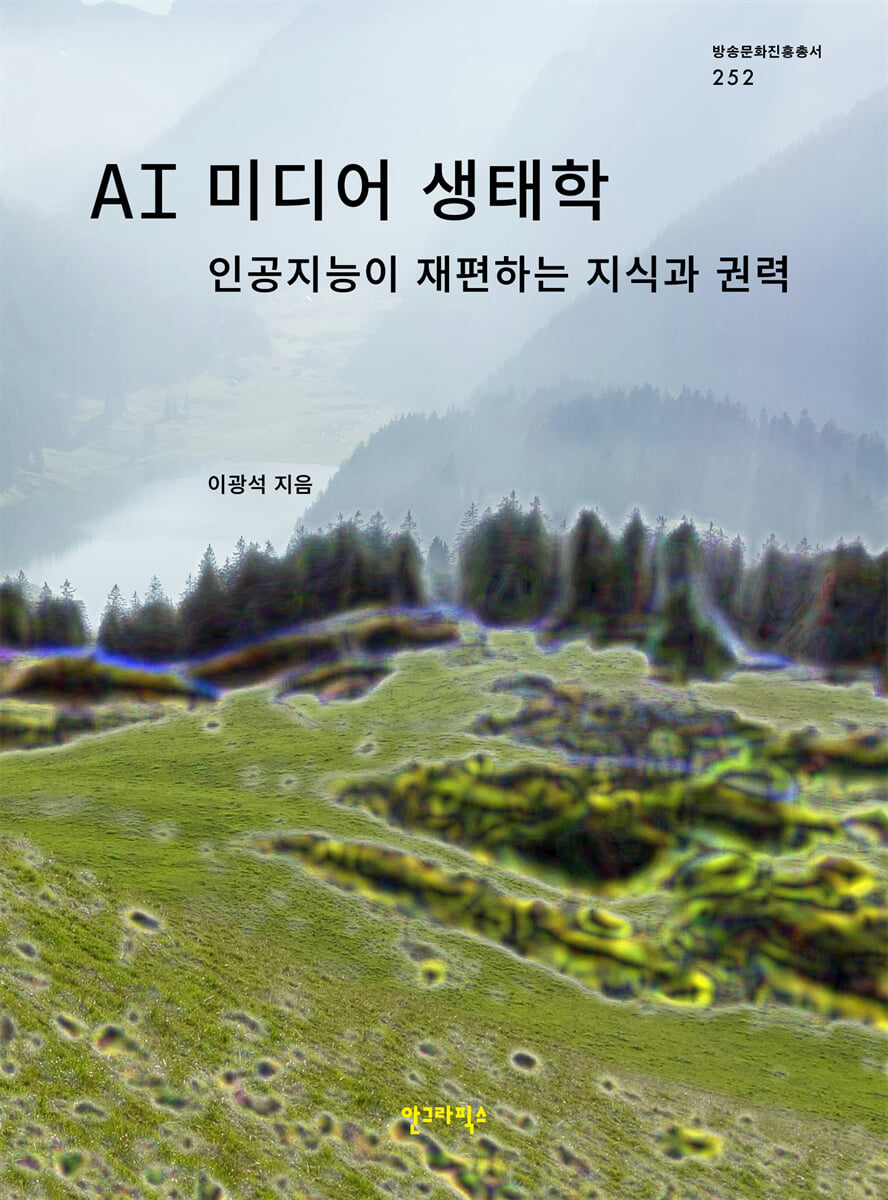
AI Media Ecology
 |
Description
Book Introduction
We analyze the impact of the development of artificial intelligence and changes in the media environment on our society, culture, and ecology, as well as their future direction.
This book focuses on how our lives are being reshaped in the AI-driven media society of the Anthropocene crisis, and what these changes mean for our social ethics, politics, and ecology.
This book focuses on how our lives are being reshaped in the AI-driven media society of the Anthropocene crisis, and what these changes mean for our social ethics, politics, and ecology.
- You can preview some of the book's contents.
Preview
index
Introduction - Beyond Techno-Worship and Faith
1 Anthropocene Technoecology
1. The contemporary landscape of 'capitalist realism'
2 The Anthropocene Crisis and Ecology
3 Symbiotic Technology Against the Techno-God
4 Ecological Thinking in Contemporary Technology
2 AI Synthetic Media and Anti-Ecologicalism
5 Techno-Realism and AI Creative Labor
6. Envisioning a "Brave New World" of Generative AI
7 The Decline of AI Synthetic Media and Remix Culture
8. The technological failure of Korea's AI chatbot, Iruda.
3 AI Ecological Aesthetics and Ecological Literacy
9. Socio-aesthetic Conditions of Art-Tech
10 Ecological Aesthetics Against AI Illusions
11 Generative AI Media and Ecological Literacy
4 Care, Pathos, and Data Commons
12 'Promiscuous Care': Preparing for Multiple Disasters
13 The Commons of Pathos and Building Other Worlds
14 The Politics of Records and Data Commons
5 For an AI Ecopolitics
15 (Non)human Replicants' Labor Life Solidarity
16 Ecopolitics of 'Exiled' Technological Beings
17 Decelerationism, the Method of Technoecological Politics
Search
Footnotes and citation sources
1 Anthropocene Technoecology
1. The contemporary landscape of 'capitalist realism'
2 The Anthropocene Crisis and Ecology
3 Symbiotic Technology Against the Techno-God
4 Ecological Thinking in Contemporary Technology
2 AI Synthetic Media and Anti-Ecologicalism
5 Techno-Realism and AI Creative Labor
6. Envisioning a "Brave New World" of Generative AI
7 The Decline of AI Synthetic Media and Remix Culture
8. The technological failure of Korea's AI chatbot, Iruda.
3 AI Ecological Aesthetics and Ecological Literacy
9. Socio-aesthetic Conditions of Art-Tech
10 Ecological Aesthetics Against AI Illusions
11 Generative AI Media and Ecological Literacy
4 Care, Pathos, and Data Commons
12 'Promiscuous Care': Preparing for Multiple Disasters
13 The Commons of Pathos and Building Other Worlds
14 The Politics of Records and Data Commons
5 For an AI Ecopolitics
15 (Non)human Replicants' Labor Life Solidarity
16 Ecopolitics of 'Exiled' Technological Beings
17 Decelerationism, the Method of Technoecological Politics
Search
Footnotes and citation sources
Detailed image

Into the book
As uncritical techno-optimism and technology-worship intensify, the introduction and application of new technologies are celebrated as if they break with old conventions and create new social values.
Technocratic social innovation is perceived as the right path for society and has become our dominant sentiment.
Again, this runs the risk of instrumental rationality, which sees technology itself as the core material for social innovation.
--- p.8
'AI Media Ecology' begins with the author's concern for restoring modern human media technology, which has become an object of worship and faith, to its rightful place.
It is also true that humanity has built civilization through its unique ability to invent technology, but that advanced technological advancements have also led to the Anthropocene crisis on Earth in many areas of our time.
This book examines the status and direction of AI technology in this age of crisis, where technology has become religion.
Finding a path to shared prosperity by transforming and rethinking contemporary cutting-edge media technologies is not easy.
But in the face of climate disaster, our human technology must also be humbled.
So I focus on ecological approaches and solutions to AI technology.
Above all, it emphasizes an 'ecological' approach that examines the peaceful intertwining of all living beings with non-human beings.
--- p.10
For us, accustomed to novelty, speed, acceleration, growth, competition, and development, emotions such as slowness, deceleration, degrowth, coexistence, and care are unfamiliar.
But the Anthropocene crisis is reminding us all that we cannot survive on this planet without a sense of ecological entanglement and relational emotions as our way of life.
In particular, the sense of symbiosis through technology is linked to becoming accustomed to 'slow-downism'.
--- p.306
The method of decelerationism needs to begin by revealing the technological infrastructure conditions and properties of contemporary artificial intelligence, which is masquerading as a clean, immaterial innovation technology.
First, in relation to the climate crisis, we need to pay attention to the excessive energy consumption and carbon emissions generated by the computational processing of generative AI.
In addition, we need to reveal the specific reality of AI's ecological cracks that we cannot easily see, such as the destruction and devastation of the natural environment due to indiscriminate "extractivism" of rare metals (rare earth elements), the exploitation of workers in the southern hemisphere who are mobilized for extraction and mining, the toxic refining process after rare earth mining, and the precarious status of workers mobilized for artificial intelligence reinforcement learning.
--- p.306
Our view of technology can no longer be a dichotomous diagnosis of either naive technological optimism about the distant future or self-deprecating fatalistic pessimism.
To tie contemporary technologies together within the Anthropocene ecological paradigm, we must first begin by recalibrating the mix and arrangement of artificial/natural, life/machine, virtual/real, and material/immaterial surrounding us, in a more realistic manner.
At that time, a test bed will be opened for ecological healing of the technological toxicity that has spread throughout the Earth.
Ultimately, decelerationism must become a crucial means of controlling the pace of capital's maddening technological acceleration and halting the Anthropocene crisis.
Technocratic social innovation is perceived as the right path for society and has become our dominant sentiment.
Again, this runs the risk of instrumental rationality, which sees technology itself as the core material for social innovation.
--- p.8
'AI Media Ecology' begins with the author's concern for restoring modern human media technology, which has become an object of worship and faith, to its rightful place.
It is also true that humanity has built civilization through its unique ability to invent technology, but that advanced technological advancements have also led to the Anthropocene crisis on Earth in many areas of our time.
This book examines the status and direction of AI technology in this age of crisis, where technology has become religion.
Finding a path to shared prosperity by transforming and rethinking contemporary cutting-edge media technologies is not easy.
But in the face of climate disaster, our human technology must also be humbled.
So I focus on ecological approaches and solutions to AI technology.
Above all, it emphasizes an 'ecological' approach that examines the peaceful intertwining of all living beings with non-human beings.
--- p.10
For us, accustomed to novelty, speed, acceleration, growth, competition, and development, emotions such as slowness, deceleration, degrowth, coexistence, and care are unfamiliar.
But the Anthropocene crisis is reminding us all that we cannot survive on this planet without a sense of ecological entanglement and relational emotions as our way of life.
In particular, the sense of symbiosis through technology is linked to becoming accustomed to 'slow-downism'.
--- p.306
The method of decelerationism needs to begin by revealing the technological infrastructure conditions and properties of contemporary artificial intelligence, which is masquerading as a clean, immaterial innovation technology.
First, in relation to the climate crisis, we need to pay attention to the excessive energy consumption and carbon emissions generated by the computational processing of generative AI.
In addition, we need to reveal the specific reality of AI's ecological cracks that we cannot easily see, such as the destruction and devastation of the natural environment due to indiscriminate "extractivism" of rare metals (rare earth elements), the exploitation of workers in the southern hemisphere who are mobilized for extraction and mining, the toxic refining process after rare earth mining, and the precarious status of workers mobilized for artificial intelligence reinforcement learning.
--- p.306
Our view of technology can no longer be a dichotomous diagnosis of either naive technological optimism about the distant future or self-deprecating fatalistic pessimism.
To tie contemporary technologies together within the Anthropocene ecological paradigm, we must first begin by recalibrating the mix and arrangement of artificial/natural, life/machine, virtual/real, and material/immaterial surrounding us, in a more realistic manner.
At that time, a test bed will be opened for ecological healing of the technological toxicity that has spread throughout the Earth.
Ultimately, decelerationism must become a crucial means of controlling the pace of capital's maddening technological acceleration and halting the Anthropocene crisis.
--- p.310
Publisher's Review
In an age of techno-worship, we must re-examine AI's human rights and bio-status.
Artificial intelligence and media technologies are rapidly changing our society, lives, and culture.
But the more a climate of "techno-optimism" and technology worship dominates society, blindly optimistic about technological progress or believing that innovation is the only solution, the more easily we fall into the delusion that "technology is the only solution."
This book fundamentally questions the dangers of viewing technology itself as the sole center of social innovation, and how technology as a tool should be reimagined in the face of social and ecological responsibility.
'AI Media Ecology' begins with the challenge of correcting a culture in which technology is revered as if it were a religion or a symbol of a new social order.
Technological advancement is undoubtedly a significant achievement for humanity, but we cannot ignore the fact that it has placed the entire planet in a crisis called the Anthropocene.
The book goes beyond the uncritical approach of “technology is the answer,” and asks why, how, and for whom artificial intelligence is being used.
And for innovation in the AI era to truly lead to shared prosperity, both technology and humans must be humble in the face of realities like the climate crisis and ecological inequality, and technology must be redesigned and used from an ecological perspective.
In particular, an ecological approach exposes the hidden underbelly of AI and media technology infrastructure. AI computation entails massive energy consumption and carbon emissions, and it also highlights issues we don't normally face, such as the indiscriminate mining of rare minerals, labor exploitation, and toxic waste.
The book points out that facing the real physical properties and social costs hidden behind the banner that "AI technology is a non-material and clean future industry" is the starting point for a true ecological transition.
"AI Media Ecology" argues that the very dichotomy between "naive future optimism blindly trusting technology" and "technology is ultimately destined to bring about catastrophe" is no longer realistic.
Now, we are asked to rearrange the dichotomous boundaries of artificial/natural, life/machine, material/immaterial, real/virtual, etc., and to take a fresh look at how various elements are intricately intertwined.
The key to solving the complex and hybrid impacts of media and technology at the forefront of change, and the resulting problems facing society—such as environmental destruction, data inequality, social polarization, and labor hierarchies—lies in “regulating the speed and indiscriminate application of technology itself, and promoting harmonious coexistence between ecology and society.”
We propose a new paradigm for all, ensuring that today's AI innovations are connected not to the technology itself but to "creating a sustainable future for both citizens and the planet."
Artificial intelligence and media technologies are rapidly changing our society, lives, and culture.
But the more a climate of "techno-optimism" and technology worship dominates society, blindly optimistic about technological progress or believing that innovation is the only solution, the more easily we fall into the delusion that "technology is the only solution."
This book fundamentally questions the dangers of viewing technology itself as the sole center of social innovation, and how technology as a tool should be reimagined in the face of social and ecological responsibility.
'AI Media Ecology' begins with the challenge of correcting a culture in which technology is revered as if it were a religion or a symbol of a new social order.
Technological advancement is undoubtedly a significant achievement for humanity, but we cannot ignore the fact that it has placed the entire planet in a crisis called the Anthropocene.
The book goes beyond the uncritical approach of “technology is the answer,” and asks why, how, and for whom artificial intelligence is being used.
And for innovation in the AI era to truly lead to shared prosperity, both technology and humans must be humble in the face of realities like the climate crisis and ecological inequality, and technology must be redesigned and used from an ecological perspective.
In particular, an ecological approach exposes the hidden underbelly of AI and media technology infrastructure. AI computation entails massive energy consumption and carbon emissions, and it also highlights issues we don't normally face, such as the indiscriminate mining of rare minerals, labor exploitation, and toxic waste.
The book points out that facing the real physical properties and social costs hidden behind the banner that "AI technology is a non-material and clean future industry" is the starting point for a true ecological transition.
"AI Media Ecology" argues that the very dichotomy between "naive future optimism blindly trusting technology" and "technology is ultimately destined to bring about catastrophe" is no longer realistic.
Now, we are asked to rearrange the dichotomous boundaries of artificial/natural, life/machine, material/immaterial, real/virtual, etc., and to take a fresh look at how various elements are intricately intertwined.
The key to solving the complex and hybrid impacts of media and technology at the forefront of change, and the resulting problems facing society—such as environmental destruction, data inequality, social polarization, and labor hierarchies—lies in “regulating the speed and indiscriminate application of technology itself, and promoting harmonious coexistence between ecology and society.”
We propose a new paradigm for all, ensuring that today's AI innovations are connected not to the technology itself but to "creating a sustainable future for both citizens and the planet."
GOODS SPECIFICS
- Date of issue: September 30, 2025
- Page count, weight, size: 316 pages | 148*200*30mm
- ISBN13: 9791168231092
You may also like
카테고리
korean


korean

![GQ KOREA Mark (Monthly): December [2025]](http://librairie.coreenne.fr/cdn/shop/files/8ef265dbbfbf186523ed75ba7319009d.jpg?v=1765340328&width=3840)


