

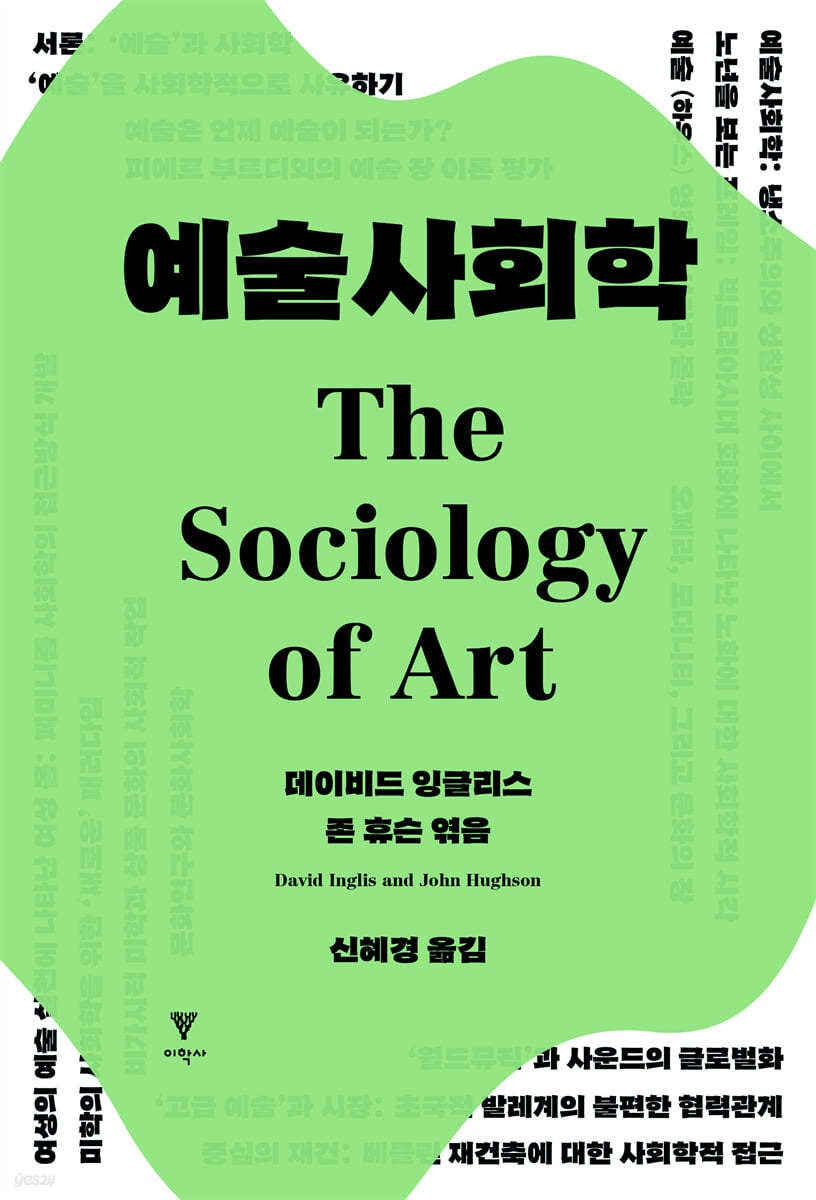
Sociology of Art
 |
Description
Book Introduction
From theory to practice,
A look at the past, present, and future of art sociology
The social significance of art
What comes to mind when we hear the word "art"? A painting hanging in a gallery or an orchestra playing in a concert hall? Do you prefer Schwarzenegger movies or ballet performances? The answers to these questions reveal a lot about us.
Likewise, a society's attitude toward art says a lot about that society.
Does art play a recognized, significant role in society, or does it merely perform a secondary function? Do diverse people in society actively participate in artistic production, or do they not? In other words, examining art is an excellent way to examine society, and conversely, examining society can also yield significant insights into art.
This book, curated by David Inglis of the University of Aberdeen and John Hewson of the University of Otago, provides a valuable opportunity to read in one place the writings of leading theorists representing contemporary Anglo-American art sociology, including Alan Swindewood, Janet Stewart, Janet Wolff, Paul Willis, and Helena Wulf.
This book, which deals with the fascinating approach of sociological analysis of art, introduces various theoretical concepts that characterize the sociology of art, from Bourdieu's thought to cultural studies, sociological aesthetics, art history, and feminist theory. By utilizing these theories and presenting specific case studies of painting, film, opera, popular music, ballet, cities, and architecture, it provides critical and reflective discussion points for the future direction of the sociology of art.
A look at the past, present, and future of art sociology
The social significance of art
What comes to mind when we hear the word "art"? A painting hanging in a gallery or an orchestra playing in a concert hall? Do you prefer Schwarzenegger movies or ballet performances? The answers to these questions reveal a lot about us.
Likewise, a society's attitude toward art says a lot about that society.
Does art play a recognized, significant role in society, or does it merely perform a secondary function? Do diverse people in society actively participate in artistic production, or do they not? In other words, examining art is an excellent way to examine society, and conversely, examining society can also yield significant insights into art.
This book, curated by David Inglis of the University of Aberdeen and John Hewson of the University of Otago, provides a valuable opportunity to read in one place the writings of leading theorists representing contemporary Anglo-American art sociology, including Alan Swindewood, Janet Stewart, Janet Wolff, Paul Willis, and Helena Wulf.
This book, which deals with the fascinating approach of sociological analysis of art, introduces various theoretical concepts that characterize the sociology of art, from Bourdieu's thought to cultural studies, sociological aesthetics, art history, and feminist theory. By utilizing these theories and presenting specific case studies of painting, film, opera, popular music, ballet, cities, and architecture, it provides critical and reflective discussion points for the future direction of the sociology of art.
- You can preview some of the book's contents.
Preview
index
Acknowledgements
Introduction: “Art” and Sociology
Key issues
Structure and Purpose
How to view
Part 1
Theory: Past, Present, Future
1.
Thinking about “Art” Sociologically ● David Inglis
introduction
Taking issue with “art”
Taking issue with “artists”
“Art” and “Society”
“Art world”
conclusion
2.
When Does Art Become Art? An Evaluation of Pierre Bourdieu's Art Field Theory ● Jeremy Lane
introduction
Social conditions of art acceptance
Social conditions of artistic production
Historical Origins of Autonomous Production
conclusion
3.
The Female Body in Women's Artistic Practice: Developing a Feminist Sociological Approach ● Alexandra Howson
introduction
Women's Art Production
The Politics of the Female Body in Women's Art
Psychoanalysis, postmodernism, visual culture
Poststructuralism, Philosophy, and (again) Psychoanalysis
Feminism and Art Today
conclusion
4.
A “New” Paradigm for the Sociology of Aesthetics ● Robert Witkin
introduction
abstract
symbol system
social system
perceptual system
tactile system
visual system
body systems
conclusion
Acknowledgements
5.
Invisible Aesthetics and the Social Work of Commodity Culture ● Paul Willis
introduction
The meaning of everyday life
Creating Product Culture and Informal Meaning
cultural products
Making the invisible visible
Representation of the invisible
Private and Public Art Worlds
conclusion
Acknowledgements
6.
Cultural Studies and Cultural Sociology ● Janet Wolff
introduction
Between “social life” and “text”
Sociology and “Culture”
Conclusion: Towards Reconciliation
7.
The Sociology of Art: Between Cynicism and Reflexivity ● David Inglis
introduction
implicit assumptions
ubiquity of power
Imperialism in Sociology
Bourdieu against himself
conclusion
Part 2
From Theory to Practice: Case Studies in the Sociology of Art
8.
Frames for Seeing Old Age: A Sociological Perspective on Aging in Victorian Paintings ● Mike Hepworth
introduction
Old Age and Victorian Art History
Frederick Walker and [Port of Refuge]
Hubert von Herkomer and [The Last Gathering]
Hubert von Herkomer and [A Scene from Twilight: Westminster Assembly]
complex reactions
conclusion
9.
The Rise and Fall of Art (House) Films ● Andrew Tudor
introduction
Established (1918-1939)
Consolidation (1950-1970)
Fragmentation (1970-2000)
conclusion
10.
Opera, Modernity, and the Place of Culture ● Alan Swingewood
introduction
Modernity, Opera Discourse, and Power
Theorizing Modernity
Aesthetics and Culture
Modernity and Venetian Opera
Court Opera and Bourgeois Opera
Opera canon and modern opera
conclusion
11.
“World Music” and the Globalization of Sound ● David Inglis and Roland Robertson
introduction
The essence of “world music”
Categories of world music
Social organization of world music
World Music and Globalization
The ambivalence of world music
conclusion
12.
“High Art” and the Market: The Uneasy Partnership of the Transnational Ballet World ● Helena Wolf
introduction
The Emergence of a Transnational Ballet World - Politics, Mentors, and Patrons
Markets, Ballet, and Distrust
The Best Dancers: Nureyev and His Mayor
Exchange: Ballet and Business
Conclusion: Ballet in the Global Market
13.
Rebuilding the Center: A Sociological Approach to Berlin's Reconstruction ● Janet Stewart
introduction
Formalism vs. Functionalism
Architectural Discourse and Sociological Discourse
Towards Dialectics
Architecture and the Postmodern Crisis
A model for 21st century architecture?
conclusion
References
About the Author
Translator's Note
Search
Introduction: “Art” and Sociology
Key issues
Structure and Purpose
How to view
Part 1
Theory: Past, Present, Future
1.
Thinking about “Art” Sociologically ● David Inglis
introduction
Taking issue with “art”
Taking issue with “artists”
“Art” and “Society”
“Art world”
conclusion
2.
When Does Art Become Art? An Evaluation of Pierre Bourdieu's Art Field Theory ● Jeremy Lane
introduction
Social conditions of art acceptance
Social conditions of artistic production
Historical Origins of Autonomous Production
conclusion
3.
The Female Body in Women's Artistic Practice: Developing a Feminist Sociological Approach ● Alexandra Howson
introduction
Women's Art Production
The Politics of the Female Body in Women's Art
Psychoanalysis, postmodernism, visual culture
Poststructuralism, Philosophy, and (again) Psychoanalysis
Feminism and Art Today
conclusion
4.
A “New” Paradigm for the Sociology of Aesthetics ● Robert Witkin
introduction
abstract
symbol system
social system
perceptual system
tactile system
visual system
body systems
conclusion
Acknowledgements
5.
Invisible Aesthetics and the Social Work of Commodity Culture ● Paul Willis
introduction
The meaning of everyday life
Creating Product Culture and Informal Meaning
cultural products
Making the invisible visible
Representation of the invisible
Private and Public Art Worlds
conclusion
Acknowledgements
6.
Cultural Studies and Cultural Sociology ● Janet Wolff
introduction
Between “social life” and “text”
Sociology and “Culture”
Conclusion: Towards Reconciliation
7.
The Sociology of Art: Between Cynicism and Reflexivity ● David Inglis
introduction
implicit assumptions
ubiquity of power
Imperialism in Sociology
Bourdieu against himself
conclusion
Part 2
From Theory to Practice: Case Studies in the Sociology of Art
8.
Frames for Seeing Old Age: A Sociological Perspective on Aging in Victorian Paintings ● Mike Hepworth
introduction
Old Age and Victorian Art History
Frederick Walker and [Port of Refuge]
Hubert von Herkomer and [The Last Gathering]
Hubert von Herkomer and [A Scene from Twilight: Westminster Assembly]
complex reactions
conclusion
9.
The Rise and Fall of Art (House) Films ● Andrew Tudor
introduction
Established (1918-1939)
Consolidation (1950-1970)
Fragmentation (1970-2000)
conclusion
10.
Opera, Modernity, and the Place of Culture ● Alan Swingewood
introduction
Modernity, Opera Discourse, and Power
Theorizing Modernity
Aesthetics and Culture
Modernity and Venetian Opera
Court Opera and Bourgeois Opera
Opera canon and modern opera
conclusion
11.
“World Music” and the Globalization of Sound ● David Inglis and Roland Robertson
introduction
The essence of “world music”
Categories of world music
Social organization of world music
World Music and Globalization
The ambivalence of world music
conclusion
12.
“High Art” and the Market: The Uneasy Partnership of the Transnational Ballet World ● Helena Wolf
introduction
The Emergence of a Transnational Ballet World - Politics, Mentors, and Patrons
Markets, Ballet, and Distrust
The Best Dancers: Nureyev and His Mayor
Exchange: Ballet and Business
Conclusion: Ballet in the Global Market
13.
Rebuilding the Center: A Sociological Approach to Berlin's Reconstruction ● Janet Stewart
introduction
Formalism vs. Functionalism
Architectural Discourse and Sociological Discourse
Towards Dialectics
Architecture and the Postmodern Crisis
A model for 21st century architecture?
conclusion
References
About the Author
Translator's Note
Search
Detailed image
.jpg)
Publisher's Review
When does art become art? How are art and society related?
A way to think about aesthetics and social issues together
Who might be labeled an artist? Sociologists are interested in demystifying the concepts of "great artist" and "romantic artist."
One way to challenge that notion is to emphasize that no artist produces his or her art entirely on his or her own.
Whether they paint or write poetry, their work relies directly or indirectly on a whole chain of other people.
In the European Middle Ages and Renaissance, cultural production was carried out at the behest of powerful patrons such as the Pope or wealthy nobles.
Cultural producers worked under clear constraints, having to create works of art that would satisfy patrons.
By the 19th century, patronage had declined as a factor in cultural production, but unlike in previous eras when artists commissioned works from wealthy patrons, artists now had to sell their work to intermediaries such as art dealers, exhibit it in galleries, and make a name for themselves through critics.
In this way, artists have come to occupy new positions in accordance with the special cultural division of labor and the social relationships they belong to in the flow of time.
These changing social conditions have had the effect of encouraging or discouraging certain forms of artistic practice.
In this way, the sociology of art, in the process of its academic consolidation, has focused on how the expressive and symbolic elements of culture are formed through various social systems, and has gone beyond simple reflection theory to analyze the influence of external factors such as technology, law and regulations, organizational forms, industrial structures, and markets on the production, distribution, and consumption of cultural products.
But for aestheticians, this reduced great works of art to mere results of social processes, and furthermore ran the risk of rendering the existence and role of art, intertwined in the complex interrelationships of society, overly passive.
Therefore, since the mid-2000s, there has been a growing argument in academic circles that the relationship between sociology and aesthetics in the sociology of art needs to be re-established in a more balanced way.
That is, we must reintroduce art into a social scientific approach to art, and promote meaningful dialogue between aesthetics and sociology, transcending the dichotomy between the aesthetic and the social.
A weighty insight into critical sociology
This book is a starting point for taking steps toward addressing these issues.
Throughout this book, the call to communicate and reason with oppositional things is multilayered and varied.
This is a criticism of the fact that the research on the sociology of art has been excessively biased towards non-artistic and social explanations.
In this book, Inglis argues that today's critical sociology of art, which inherits the tradition from Kant through Marx and Nietzsche, inherits Rousseau's view that "everything is fundamentally connected to politics" in that it equates power and culture and views the art world as a field of power struggle.
Under these premises, he asks the following question:
If critical sociology questions all common sense and dedicates itself to unraveling fundamental conflicts of interest, why doesn't it also question the very assumptions it presupposes? In short, the argument is that while the sociology of art offers sharp critiques of other disciplines like art history and aesthetics, it fails to cast a similarly critical eye on itself.
There is a huge difference between a cynical and dismissive approach to the problems of art and the discourse surrounding it and one that prioritizes a healthy, unbiased skepticism.
Sociologists should avoid falling into the former and embrace the latter.
In particular, Inglis's point that even the sociology of art's critique of aesthetics may be an "intellectual coup" and a "slave revolt" aimed at usurping the art world's discursive power is sharp and significant.
This book's argument that "this discipline, which considers itself critical, has not yet been sufficiently critical of itself" is worth deep reflection on by those studying art, along with their critique of today's "imperialism in sociology."
Bourdieu's Lasting Influence: A Case Study in Artistic Practice
This book points out the problems of Bourdieu's approach and the sociology of art in general, while also making diverse use of Bourdieu's methodology in empirical case studies.
Andrew Tudor actively utilizes Bourdieu's theory of the field of cultural products in analyzing the emergence and transformation of the field of cinema art.
In a multiplex culture where art has become commerce, art films have become just another commodity on the shelf.
Swinseywood applies Bourdieu's concept of cultural field to analyze opera in its historical, social, and cultural context from the perspective of the sociology of music.
Opera is often disparaged as an elitist art form, championed by a small elite, but it has remained a vital presence in modern culture by constantly reinventing its form through new and challenging works and subversive strategies in modern staging.
Wulff discusses the transnational ballet market, examining the transformation of the global ballet scene from a place for cultural elites to a place for mass production, and its marketing.
Qualitative research methods are employed, ranging from micro-analyses addressing the actual working practices of artists to macro-analyses examining the place of art within social structures, including ethnographic methods, analysis of historical sources, close readings of specific texts, and empirical analyses of critical and public responses.
This book is fascinating in that it seeks to break free from the existing framework of the sociology of art, while not overlooking the fact that sociological art studies have developed a range of useful ways of thinking and analytical tools. Furthermore, it goes a step further, arguing that today's sociology of art should not rest on its laurels, but must constantly critique its previous limitations and strive to transcend them.
Globalization and Common Culture: Artists of Everyday Life
One of the central themes discussed in this book is the 'globalization' of art.
This topic is covered extensively by Alan Swindlewood, Helena Wulf, and Janet Stewart, but the most comprehensive perspective is provided by Roland Robertson and Inglis.
In particular, Robertson coined the concept of 'glocal', a combination of the words global and local, and draws attention to the "simultaneous coexistence of both universalizing and specializing tendencies." Through this concept, he opposes one-sided globalization that does not take local specificities into account, and emphasizes the interaction between the world and the region, homogenization and heterogeneity.
The text boils down to the question, "Does globalization produce cultural standardization?" or "Does it enhance cultural diversity?" Robertson and Inglis offer a lucid reflection on the issues surrounding the definition and categories of world music, its social organization, and its celebration and critique.
This discussion is not only relevant to the case of world music, but also to the global phenomenon of K-pop that we are experiencing today.
Another discussion that reflects on this from another angle is Paul Willis's article exploring the possibilities for promoting artistic democracy.
Willis argues that artistic democracy can arise not by democratizing existing art, but from within the existing creative experiences and practices that are part of our common culture.
The concept of common culture he uses is a development of Raymond Williams's theory, in which Williams defined culture as the 'total way of life' of the masses through the expression "culture is the ordinary."
In other words, a common culture is about creating conditions in which the people can freely participate and contribute to the creation of meaning and value, while cultural democracy is about expanding the participation of the public as a producer of art and culture and enhancing everyone's creative capacity and enjoyment ability.
Willis points out that the term 'art' should be expanded to encompass ordinary everyday acts, and according to him, we are all 'artists of everyday life'.
Through the collaboration between cultural studies and sociology, this book presents an expanded concept of art, offering us the opportunity to seriously consider ourselves as artists creating the everyday world and the future of art and culture.
A way to think about aesthetics and social issues together
Who might be labeled an artist? Sociologists are interested in demystifying the concepts of "great artist" and "romantic artist."
One way to challenge that notion is to emphasize that no artist produces his or her art entirely on his or her own.
Whether they paint or write poetry, their work relies directly or indirectly on a whole chain of other people.
In the European Middle Ages and Renaissance, cultural production was carried out at the behest of powerful patrons such as the Pope or wealthy nobles.
Cultural producers worked under clear constraints, having to create works of art that would satisfy patrons.
By the 19th century, patronage had declined as a factor in cultural production, but unlike in previous eras when artists commissioned works from wealthy patrons, artists now had to sell their work to intermediaries such as art dealers, exhibit it in galleries, and make a name for themselves through critics.
In this way, artists have come to occupy new positions in accordance with the special cultural division of labor and the social relationships they belong to in the flow of time.
These changing social conditions have had the effect of encouraging or discouraging certain forms of artistic practice.
In this way, the sociology of art, in the process of its academic consolidation, has focused on how the expressive and symbolic elements of culture are formed through various social systems, and has gone beyond simple reflection theory to analyze the influence of external factors such as technology, law and regulations, organizational forms, industrial structures, and markets on the production, distribution, and consumption of cultural products.
But for aestheticians, this reduced great works of art to mere results of social processes, and furthermore ran the risk of rendering the existence and role of art, intertwined in the complex interrelationships of society, overly passive.
Therefore, since the mid-2000s, there has been a growing argument in academic circles that the relationship between sociology and aesthetics in the sociology of art needs to be re-established in a more balanced way.
That is, we must reintroduce art into a social scientific approach to art, and promote meaningful dialogue between aesthetics and sociology, transcending the dichotomy between the aesthetic and the social.
A weighty insight into critical sociology
This book is a starting point for taking steps toward addressing these issues.
Throughout this book, the call to communicate and reason with oppositional things is multilayered and varied.
This is a criticism of the fact that the research on the sociology of art has been excessively biased towards non-artistic and social explanations.
In this book, Inglis argues that today's critical sociology of art, which inherits the tradition from Kant through Marx and Nietzsche, inherits Rousseau's view that "everything is fundamentally connected to politics" in that it equates power and culture and views the art world as a field of power struggle.
Under these premises, he asks the following question:
If critical sociology questions all common sense and dedicates itself to unraveling fundamental conflicts of interest, why doesn't it also question the very assumptions it presupposes? In short, the argument is that while the sociology of art offers sharp critiques of other disciplines like art history and aesthetics, it fails to cast a similarly critical eye on itself.
There is a huge difference between a cynical and dismissive approach to the problems of art and the discourse surrounding it and one that prioritizes a healthy, unbiased skepticism.
Sociologists should avoid falling into the former and embrace the latter.
In particular, Inglis's point that even the sociology of art's critique of aesthetics may be an "intellectual coup" and a "slave revolt" aimed at usurping the art world's discursive power is sharp and significant.
This book's argument that "this discipline, which considers itself critical, has not yet been sufficiently critical of itself" is worth deep reflection on by those studying art, along with their critique of today's "imperialism in sociology."
Bourdieu's Lasting Influence: A Case Study in Artistic Practice
This book points out the problems of Bourdieu's approach and the sociology of art in general, while also making diverse use of Bourdieu's methodology in empirical case studies.
Andrew Tudor actively utilizes Bourdieu's theory of the field of cultural products in analyzing the emergence and transformation of the field of cinema art.
In a multiplex culture where art has become commerce, art films have become just another commodity on the shelf.
Swinseywood applies Bourdieu's concept of cultural field to analyze opera in its historical, social, and cultural context from the perspective of the sociology of music.
Opera is often disparaged as an elitist art form, championed by a small elite, but it has remained a vital presence in modern culture by constantly reinventing its form through new and challenging works and subversive strategies in modern staging.
Wulff discusses the transnational ballet market, examining the transformation of the global ballet scene from a place for cultural elites to a place for mass production, and its marketing.
Qualitative research methods are employed, ranging from micro-analyses addressing the actual working practices of artists to macro-analyses examining the place of art within social structures, including ethnographic methods, analysis of historical sources, close readings of specific texts, and empirical analyses of critical and public responses.
This book is fascinating in that it seeks to break free from the existing framework of the sociology of art, while not overlooking the fact that sociological art studies have developed a range of useful ways of thinking and analytical tools. Furthermore, it goes a step further, arguing that today's sociology of art should not rest on its laurels, but must constantly critique its previous limitations and strive to transcend them.
Globalization and Common Culture: Artists of Everyday Life
One of the central themes discussed in this book is the 'globalization' of art.
This topic is covered extensively by Alan Swindlewood, Helena Wulf, and Janet Stewart, but the most comprehensive perspective is provided by Roland Robertson and Inglis.
In particular, Robertson coined the concept of 'glocal', a combination of the words global and local, and draws attention to the "simultaneous coexistence of both universalizing and specializing tendencies." Through this concept, he opposes one-sided globalization that does not take local specificities into account, and emphasizes the interaction between the world and the region, homogenization and heterogeneity.
The text boils down to the question, "Does globalization produce cultural standardization?" or "Does it enhance cultural diversity?" Robertson and Inglis offer a lucid reflection on the issues surrounding the definition and categories of world music, its social organization, and its celebration and critique.
This discussion is not only relevant to the case of world music, but also to the global phenomenon of K-pop that we are experiencing today.
Another discussion that reflects on this from another angle is Paul Willis's article exploring the possibilities for promoting artistic democracy.
Willis argues that artistic democracy can arise not by democratizing existing art, but from within the existing creative experiences and practices that are part of our common culture.
The concept of common culture he uses is a development of Raymond Williams's theory, in which Williams defined culture as the 'total way of life' of the masses through the expression "culture is the ordinary."
In other words, a common culture is about creating conditions in which the people can freely participate and contribute to the creation of meaning and value, while cultural democracy is about expanding the participation of the public as a producer of art and culture and enhancing everyone's creative capacity and enjoyment ability.
Willis points out that the term 'art' should be expanded to encompass ordinary everyday acts, and according to him, we are all 'artists of everyday life'.
Through the collaboration between cultural studies and sociology, this book presents an expanded concept of art, offering us the opportunity to seriously consider ourselves as artists creating the everyday world and the future of art and culture.
GOODS SPECIFICS
- Date of issue: September 8, 2023
- Page count, weight, size: 408 pages | 532g | 153*225*19mm
- ISBN13: 9788961474351
You may also like
카테고리
korean


korean

![GQ KOREA Mark (Monthly): December [2025]](http://librairie.coreenne.fr/cdn/shop/files/8ef265dbbfbf186523ed75ba7319009d.jpg?v=1765340328&width=3840)


