

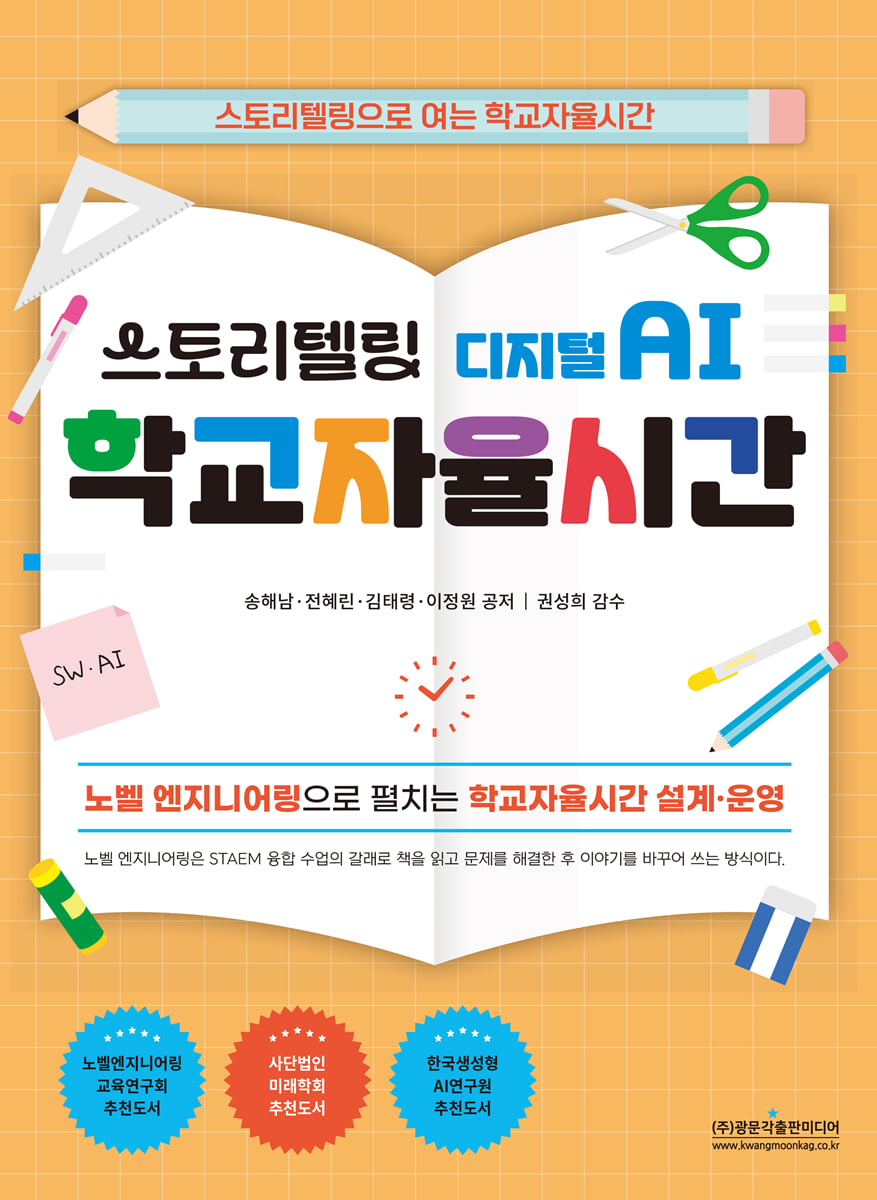
Storytelling Digital AI School Autonomous Time
 |
Description
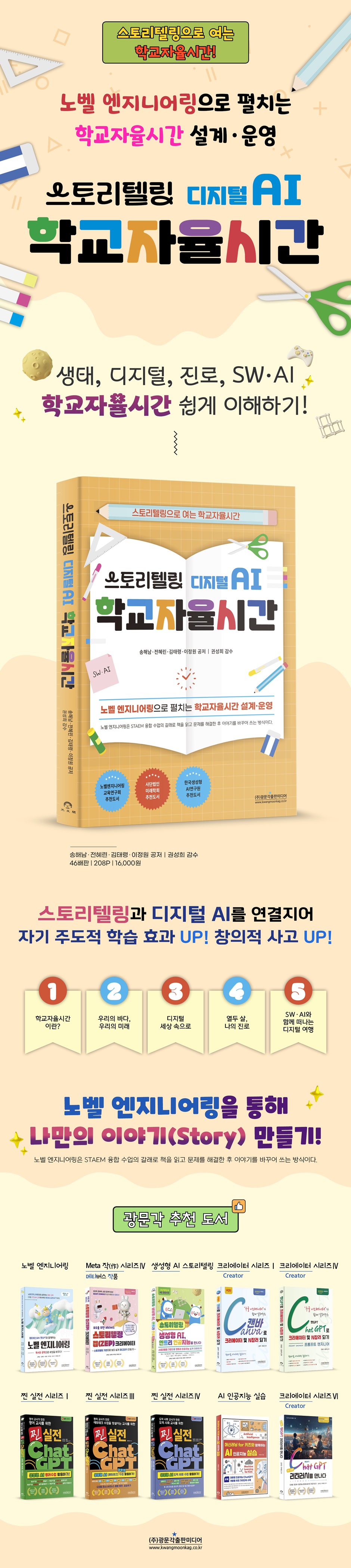
Book Introduction
Opening School Autonomy Time with Storytelling
Designing and Operating School Autonomy Time with Nobel Engineering
This school self-study period is a valuable opportunity for teachers to develop the skills necessary to nurture students into future leaders at the forefront of education.
For our students, who are preparing for a constantly changing and unpredictable future, this will be a place where they can not simply memorize knowledge, but rather question, explore, and solve problems on their own, collaborate, communicate, and generate creative ideas, and unleash their dreams and talents.
Designing and Operating School Autonomy Time with Nobel Engineering
This school self-study period is a valuable opportunity for teachers to develop the skills necessary to nurture students into future leaders at the forefront of education.
For our students, who are preparing for a constantly changing and unpredictable future, this will be a place where they can not simply memorize knowledge, but rather question, explore, and solve problems on their own, collaborate, communicate, and generate creative ideas, and unleash their dreams and talents.
- You can preview some of the book's contents.
Preview
index
Chapter 1: What is School Autonomy Time?
1-1.
2022 Revised Curriculum and School Autonomy Time Design
1-2.
Opening school self-study time
(1) Distinction between subjects, courses, and activities
(2) Explore basic terms to understand school autonomous time.
1-3.
Principles and methods for calculating school autonomous time hours
(1) Principle for calculating school autonomous time hours
(2) Method for calculating the number of school autonomous hours
1-4.
The reality of school autonomous time operation
(1) Continuous (fixed)
(2) Concentrated
(3) Mixed type
1-5.
School self-study time to approach Nobel Engineering
Chapter 2: Our Sea, Our Future
[Overview of the activity]
[Activity Design]
1.
Activity name: Our Sea, Our Future
2.
The need and goals of opening an activity
[footing]
[Teaching/Learning Direction and Content System]
[Extracting content elements that can be linked to existing curriculum]
[Achievement Standards]
[Class Flow]
[Class Description]
Reading a Book: Stories from the Sea: What We Need to Save
Periods 1-2: Reading "The Story of Beachcombing: Saving the Ocean" - Activity Sheet ①
Period 3: #Bookstagram
〈Problem Recognition〉 A Sad Story Told by the Sea
Lessons 4-5: Drawing the Dark Side - Activity Sheet ②
Periods 6-7: Music for the Sea - Activity Sheet ③
〈Solution Design〉 From Trash to Treasure, Stop Marine Pollution!
Periods 8-9: I'm a Plastic Investigator! - Activity Sheet ④ [Assessment]
Lessons 10-11: Making a New Mood Light - Activity Sheet ⑤
Lessons 12-16: Saving the Ocean with New Instruments - Activity Sheet ⑥
〈Creating Creations〉 Eco-friendly inventors who protect the Earth
Lessons 17-18: Natural Seaweed to Save the Ocean - Activity Sheet ⑦
Lessons 19-20: Making Eco-Friendly Toys
Lessons 21-23: Making Eco-Friendly Plastic with Milk
Lessons 24-25: Hosting an Eco-Friendly Plastics Exhibition
〈Rewriting the Story〉 The Future Sea We Protected
Lessons 26-28: Drawing Future Sea Story Comics - Activity Sheet ⑧ [Assessment]
Lesson 29: Presentation and Sharing
Chapter 3: Into the Digital World
[Overview of the activity]
[Activity Design]
1.
Activity name: Into the digital world
2.
The need and goals of opening an activity
[footing]
[Teaching/Learning Direction and Content System]
[Extracting content elements that can be linked to existing curriculum]
[Achievement Standards]
[Class Flow]
[Class Description]
Would you like to open a Dokkaebi phone?
Periods 1-2: Reading "Would You Like to Open a Goblin Phone?" - Activity Sheet ①
Period 3: Goblin Phone and Smartphone - Activity Sheet ②
〈Problem Recognition〉Understanding the Characteristics of Digital
Lessons 4-5: Understanding the Types of Digital Information
Periods 6-7: Digital and Analog Communication - Activity Sheet ③
Lessons 8-9: Exploring the Impact of Digital Society - Activity Sheet ④
〈Solution Design〉Learning the Digital World
Periods 10-11: Information and Media on the Internet (Digital Device Utilization) - Activity Sheet ⑤
Lessons 12-13: Developing Digital Collaboration Skills (Using Digital Devices)
Lessons 14-15: Writing a Proposal for Healthy Smartphone Use - Activity Sheet ⑥ [Assessment]
Lesson 16: Learning Etiquette on Social Media - Activity Sheet ⑦
〈Creating Creations〉 Navigating the Digital World
Lessons 17-18: Creating Digital Creations (Using Digital Devices)
Lessons 19-21: Digital Discussion & Participation in Digital Society - Activity Sheet ⑧
Lessons 22-23: Creating Yourself in Digital Space
Lessons 24-27: Creating a Goblin World VR - Activity Sheet ⑨ [Assessment]
〈Rewriting the Story〉 Becoming a Digital World Hero - Activity Sheet ⑩
Lessons 28-29: Writing Your Own Story
Chapter 4: Twelve Years Old, My Path
[Overview of the activity]
[Activity Design]
1.
Stage name: Twelve Years Old, My Path
2.
The need and goals of opening an activity
[footing]
[Teaching/Learning Direction and Content System]
[Extracting content elements that can be linked to existing curriculum]
[Achievement Standards]
[Class Flow]
[Class Description]
〈Reading a Book〉 Twelve years old, what is your hope for the future?
Lessons 1-2: Reading "Twelve-Year-Old Hopes for the Future"
Period 3: Two-Line Future Speaking - Activity Sheet ①
〈Problem Recognition〉 Understanding the Importance of Occupation
Periods 4-5: Imagining a World Without Jobs - Activity Sheet ②
Periods 6-7: Job Interviews - Activity Sheet ③
〈Solution Design〉 What Kind of Person Am I?
Periods 8-9: Career Interest Exploration Test and Report Writing - Activity Sheet ④ [Evaluation]
Lessons 10-11: Exploring MBTI and Careers
Lessons 12-13: Finding Your Strengths with a Multiple Intelligence Test
Lessons 14-15: Career Exploration - Activity Sheet ⑤
Lesson 16: Future Career Journal Writing - Activity Sheet ⑥
〈Creating Creations〉 Expressing My Future
Lessons 17-18: Creating a Vision Business Card
Lessons 19-20: Designing a Professional Logo
Lessons 21-22: Creating Occupational Goods
Lessons 23-25: Strength Branding, Creating Strength Branding Posters
Lessons 26-28: Creating a Career Vlog - Activity Sheet ⑦
〈Rewriting the Story〉 My Future, Our Future
Lessons 29-30: Hosting a Career Fair
Lessons 31-32: Expressing, Presenting, and Sharing My Career Story - Activity Sheet ⑧ [Assessment]
Chapter 5: A Digital Journey with SW and AI
[Overview of the activity]
[Activity Design]
1.
Activity Name: Digital Journey with SW and AI
2.
The need and goals of opening an activity
[footing]
[Teaching/Learning Direction and Content System]
[Extracting content elements that can be linked to existing curriculum]
[Achievement Standards]
[Class Flow]
[Class Description]
Reading a Book: Robot Friend Andy
Periods 1-2: Reading 'Robot Friend Andy' - Activity Sheet ①
Periods 3-4: Imagining Life with Robots - Activity Sheet ②
Problem Recognition: Artificial Intelligence Ethics
Lesson 5: Discussing AI Ethics Using Moral Machines - Activity Sheet ③
Lessons 6-7: Using AI Properly
〈Solution Design〉 Programming and Artificial Intelligence Models
Lesson 8: Enjoying AI with Quickdraw and Autodraw
Lessons 9-10: Understanding and Visualizing Data Using AI for Oceans - Activity Sheet ④
Lessons 11-12: Building AI Models with Teachable Machines [Assessment]
Lessons 13-15: Learning sequential, selection, and repetition structures
Lessons 16-17: Creating a Simple Program Using Variables
Lessons 18-19: Artificial Intelligence Programming Using Entry
Lessons 20-21: Robot Coding
Lessons 22-23: Coding AI Robots
〈Creating Creations〉 Human Life with Robots
Lesson 24: Imagining AI Robots for Our Lives - Activity Sheet ⑤
Lesson 25: Designing Your Own AI Robot Coding - Activity Sheet ⑥
Lessons 26-27: Coding Your Own AI Robot [Assessment]
Lesson 28: Debugging and Presentation Preparation - Activity Sheet ⑦
〈Rewriting the Story〉 The Future We Dream of
Lessons 29-30: Artificial Intelligence Robot Presentation - Activity Sheet ⑧
Lessons 31-32: Telling Stories with My Own AI Robot - Activity Sheet ⑨
1-1.
2022 Revised Curriculum and School Autonomy Time Design
1-2.
Opening school self-study time
(1) Distinction between subjects, courses, and activities
(2) Explore basic terms to understand school autonomous time.
1-3.
Principles and methods for calculating school autonomous time hours
(1) Principle for calculating school autonomous time hours
(2) Method for calculating the number of school autonomous hours
1-4.
The reality of school autonomous time operation
(1) Continuous (fixed)
(2) Concentrated
(3) Mixed type
1-5.
School self-study time to approach Nobel Engineering
Chapter 2: Our Sea, Our Future
[Overview of the activity]
[Activity Design]
1.
Activity name: Our Sea, Our Future
2.
The need and goals of opening an activity
[footing]
[Teaching/Learning Direction and Content System]
[Extracting content elements that can be linked to existing curriculum]
[Achievement Standards]
[Class Flow]
[Class Description]
Reading a Book: Stories from the Sea: What We Need to Save
Periods 1-2: Reading "The Story of Beachcombing: Saving the Ocean" - Activity Sheet ①
Period 3: #Bookstagram
〈Problem Recognition〉 A Sad Story Told by the Sea
Lessons 4-5: Drawing the Dark Side - Activity Sheet ②
Periods 6-7: Music for the Sea - Activity Sheet ③
〈Solution Design〉 From Trash to Treasure, Stop Marine Pollution!
Periods 8-9: I'm a Plastic Investigator! - Activity Sheet ④ [Assessment]
Lessons 10-11: Making a New Mood Light - Activity Sheet ⑤
Lessons 12-16: Saving the Ocean with New Instruments - Activity Sheet ⑥
〈Creating Creations〉 Eco-friendly inventors who protect the Earth
Lessons 17-18: Natural Seaweed to Save the Ocean - Activity Sheet ⑦
Lessons 19-20: Making Eco-Friendly Toys
Lessons 21-23: Making Eco-Friendly Plastic with Milk
Lessons 24-25: Hosting an Eco-Friendly Plastics Exhibition
〈Rewriting the Story〉 The Future Sea We Protected
Lessons 26-28: Drawing Future Sea Story Comics - Activity Sheet ⑧ [Assessment]
Lesson 29: Presentation and Sharing
Chapter 3: Into the Digital World
[Overview of the activity]
[Activity Design]
1.
Activity name: Into the digital world
2.
The need and goals of opening an activity
[footing]
[Teaching/Learning Direction and Content System]
[Extracting content elements that can be linked to existing curriculum]
[Achievement Standards]
[Class Flow]
[Class Description]
Would you like to open a Dokkaebi phone?
Periods 1-2: Reading "Would You Like to Open a Goblin Phone?" - Activity Sheet ①
Period 3: Goblin Phone and Smartphone - Activity Sheet ②
〈Problem Recognition〉Understanding the Characteristics of Digital
Lessons 4-5: Understanding the Types of Digital Information
Periods 6-7: Digital and Analog Communication - Activity Sheet ③
Lessons 8-9: Exploring the Impact of Digital Society - Activity Sheet ④
〈Solution Design〉Learning the Digital World
Periods 10-11: Information and Media on the Internet (Digital Device Utilization) - Activity Sheet ⑤
Lessons 12-13: Developing Digital Collaboration Skills (Using Digital Devices)
Lessons 14-15: Writing a Proposal for Healthy Smartphone Use - Activity Sheet ⑥ [Assessment]
Lesson 16: Learning Etiquette on Social Media - Activity Sheet ⑦
〈Creating Creations〉 Navigating the Digital World
Lessons 17-18: Creating Digital Creations (Using Digital Devices)
Lessons 19-21: Digital Discussion & Participation in Digital Society - Activity Sheet ⑧
Lessons 22-23: Creating Yourself in Digital Space
Lessons 24-27: Creating a Goblin World VR - Activity Sheet ⑨ [Assessment]
〈Rewriting the Story〉 Becoming a Digital World Hero - Activity Sheet ⑩
Lessons 28-29: Writing Your Own Story
Chapter 4: Twelve Years Old, My Path
[Overview of the activity]
[Activity Design]
1.
Stage name: Twelve Years Old, My Path
2.
The need and goals of opening an activity
[footing]
[Teaching/Learning Direction and Content System]
[Extracting content elements that can be linked to existing curriculum]
[Achievement Standards]
[Class Flow]
[Class Description]
〈Reading a Book〉 Twelve years old, what is your hope for the future?
Lessons 1-2: Reading "Twelve-Year-Old Hopes for the Future"
Period 3: Two-Line Future Speaking - Activity Sheet ①
〈Problem Recognition〉 Understanding the Importance of Occupation
Periods 4-5: Imagining a World Without Jobs - Activity Sheet ②
Periods 6-7: Job Interviews - Activity Sheet ③
〈Solution Design〉 What Kind of Person Am I?
Periods 8-9: Career Interest Exploration Test and Report Writing - Activity Sheet ④ [Evaluation]
Lessons 10-11: Exploring MBTI and Careers
Lessons 12-13: Finding Your Strengths with a Multiple Intelligence Test
Lessons 14-15: Career Exploration - Activity Sheet ⑤
Lesson 16: Future Career Journal Writing - Activity Sheet ⑥
〈Creating Creations〉 Expressing My Future
Lessons 17-18: Creating a Vision Business Card
Lessons 19-20: Designing a Professional Logo
Lessons 21-22: Creating Occupational Goods
Lessons 23-25: Strength Branding, Creating Strength Branding Posters
Lessons 26-28: Creating a Career Vlog - Activity Sheet ⑦
〈Rewriting the Story〉 My Future, Our Future
Lessons 29-30: Hosting a Career Fair
Lessons 31-32: Expressing, Presenting, and Sharing My Career Story - Activity Sheet ⑧ [Assessment]
Chapter 5: A Digital Journey with SW and AI
[Overview of the activity]
[Activity Design]
1.
Activity Name: Digital Journey with SW and AI
2.
The need and goals of opening an activity
[footing]
[Teaching/Learning Direction and Content System]
[Extracting content elements that can be linked to existing curriculum]
[Achievement Standards]
[Class Flow]
[Class Description]
Reading a Book: Robot Friend Andy
Periods 1-2: Reading 'Robot Friend Andy' - Activity Sheet ①
Periods 3-4: Imagining Life with Robots - Activity Sheet ②
Problem Recognition: Artificial Intelligence Ethics
Lesson 5: Discussing AI Ethics Using Moral Machines - Activity Sheet ③
Lessons 6-7: Using AI Properly
〈Solution Design〉 Programming and Artificial Intelligence Models
Lesson 8: Enjoying AI with Quickdraw and Autodraw
Lessons 9-10: Understanding and Visualizing Data Using AI for Oceans - Activity Sheet ④
Lessons 11-12: Building AI Models with Teachable Machines [Assessment]
Lessons 13-15: Learning sequential, selection, and repetition structures
Lessons 16-17: Creating a Simple Program Using Variables
Lessons 18-19: Artificial Intelligence Programming Using Entry
Lessons 20-21: Robot Coding
Lessons 22-23: Coding AI Robots
〈Creating Creations〉 Human Life with Robots
Lesson 24: Imagining AI Robots for Our Lives - Activity Sheet ⑤
Lesson 25: Designing Your Own AI Robot Coding - Activity Sheet ⑥
Lessons 26-27: Coding Your Own AI Robot [Assessment]
Lesson 28: Debugging and Presentation Preparation - Activity Sheet ⑦
〈Rewriting the Story〉 The Future We Dream of
Lessons 29-30: Artificial Intelligence Robot Presentation - Activity Sheet ⑧
Lessons 31-32: Telling Stories with My Own AI Robot - Activity Sheet ⑨
Detailed image
Publisher's Review
After the war, many mountains in our country became bare.
To solve this problem, the government led a reforestation project and planted many trees with strong reproductive capacity, such as acacia trees and pine trees.
Most of our mountains are currently blue in color.
Although state-led green space projects are no longer in place, each local government plants a variety of flowers to suit the characteristics and landscape of each region and holds festivals.
That is why we can now enjoy colorful flower festivals in each region.
Our country's educational curriculum has also undergone numerous changes, starting with the urgently created curriculum after liberation, through the 1st to 7th revisions, and continuing to the current system of frequent revisions.
The curriculum is a concrete educational plan and the product of intense reflection on the nation's future. Government-led efforts to achieve national development through education have created the country we know today.
However, as times change, the type of talent we pursue also changes.
The need for talents centered on diversity and creativity has shifted from industrialized standards to those centered on the basics. In particular, in Korea, where the educational curriculum is significantly more restrictive than in other countries, policies have been established to cultivate talents suited to diversity.
Local curriculum, school curriculum, and teacher training curriculum are all terms agreed upon in the educational world under the demands of the times.
It was a method to concretize the curriculum, to more closely reflect students' educational needs, and, in particular, to help individual teachers establish themselves as the main actors in the curriculum.
This autonomy and decentralization of the curriculum is a way to actively respond to changes in the educational environment and is an effort to create a system of mutual cooperation centered on the expertise and agency of educational stakeholders.
In line with this direction, the 2022 revised curriculum has established a system of 'school autonomous time.'
This school-based learning period is a valuable opportunity for teachers to develop the skills necessary to become the future leaders of their students, at the forefront of education.
For our students, preparing for a constantly changing and unpredictable future, this will be a place where they can not simply memorize knowledge, but also question, explore, and solve problems on their own, collaborate, communicate, and generate creative ideas, and unleash their dreams and talents.
It is no exaggeration to say that the future of a nation depends on education.
The former Soviet Union reached the moon less than 50 years after the Russian Revolution (1917) gave science and technology a major emphasis, and Japan became the only Asian country competing with the great powers 30 years after the Meiji Restoration made elementary education compulsory.
Moreover, Finland, a backward country, was able to become an educational powerhouse in just 30 years by implementing equal education, while also fostering global IT companies.
Moreover, the generation that led the counterculture movement in the 1960s in the United States became the main group founding innovative companies in Silicon Valley in the 1990s.
By the same principle, as we face a rapidly changing era with a rapidly declining population, it is our teachers' mission to desperately cultivate our children's core competencies for the Republic of Korea of 30 or 50 years from now.
However, for our teachers, new curriculum changes are always a challenge.
It's always challenging to bring something new to the field, beyond what we've been trained to do and what we're currently learning.
For those of us who were born into the 3rd industrial society and must raise students to prepare for the 4th industrial revolution, this feeling is even more evident.
This book was created for fellow teachers who are going through such difficulties together.
In the midst of the great wave of autonomous school hours, we wanted to create an example of a curriculum for the future by acting together as a small tetrapod within a breakwater.
Among them, we introduced Nobel Engineering, which is our best method, into the class.
Nobel Engineering is a branch of STAEM's convergence class that involves reading a book, solving a problem, and then rewriting the story.
We chose to use the power of storytelling to help students deeply empathize with their problems and internalize them by having them fiercely think about solutions.
The goal is to ensure that school self-study time is not simply a new topic, but rather integrated into students' lives and knowledge.
Of course, even if circumstances don't allow you to start by reading the entire book, each activity has been designed to be meaningful, so feel free to apply it as an idea.
More than anything, collaboration with the teacher community is crucial now, and we want to work together.
We would be most satisfied if you discussed the ideas in this book with your fellow teachers and students and applied them in a way that best suits your local, contemporary, and situational needs.
I hope that we can take small steps together to create change for the future of education.
To solve this problem, the government led a reforestation project and planted many trees with strong reproductive capacity, such as acacia trees and pine trees.
Most of our mountains are currently blue in color.
Although state-led green space projects are no longer in place, each local government plants a variety of flowers to suit the characteristics and landscape of each region and holds festivals.
That is why we can now enjoy colorful flower festivals in each region.
Our country's educational curriculum has also undergone numerous changes, starting with the urgently created curriculum after liberation, through the 1st to 7th revisions, and continuing to the current system of frequent revisions.
The curriculum is a concrete educational plan and the product of intense reflection on the nation's future. Government-led efforts to achieve national development through education have created the country we know today.
However, as times change, the type of talent we pursue also changes.
The need for talents centered on diversity and creativity has shifted from industrialized standards to those centered on the basics. In particular, in Korea, where the educational curriculum is significantly more restrictive than in other countries, policies have been established to cultivate talents suited to diversity.
Local curriculum, school curriculum, and teacher training curriculum are all terms agreed upon in the educational world under the demands of the times.
It was a method to concretize the curriculum, to more closely reflect students' educational needs, and, in particular, to help individual teachers establish themselves as the main actors in the curriculum.
This autonomy and decentralization of the curriculum is a way to actively respond to changes in the educational environment and is an effort to create a system of mutual cooperation centered on the expertise and agency of educational stakeholders.
In line with this direction, the 2022 revised curriculum has established a system of 'school autonomous time.'
This school-based learning period is a valuable opportunity for teachers to develop the skills necessary to become the future leaders of their students, at the forefront of education.
For our students, preparing for a constantly changing and unpredictable future, this will be a place where they can not simply memorize knowledge, but also question, explore, and solve problems on their own, collaborate, communicate, and generate creative ideas, and unleash their dreams and talents.
It is no exaggeration to say that the future of a nation depends on education.
The former Soviet Union reached the moon less than 50 years after the Russian Revolution (1917) gave science and technology a major emphasis, and Japan became the only Asian country competing with the great powers 30 years after the Meiji Restoration made elementary education compulsory.
Moreover, Finland, a backward country, was able to become an educational powerhouse in just 30 years by implementing equal education, while also fostering global IT companies.
Moreover, the generation that led the counterculture movement in the 1960s in the United States became the main group founding innovative companies in Silicon Valley in the 1990s.
By the same principle, as we face a rapidly changing era with a rapidly declining population, it is our teachers' mission to desperately cultivate our children's core competencies for the Republic of Korea of 30 or 50 years from now.
However, for our teachers, new curriculum changes are always a challenge.
It's always challenging to bring something new to the field, beyond what we've been trained to do and what we're currently learning.
For those of us who were born into the 3rd industrial society and must raise students to prepare for the 4th industrial revolution, this feeling is even more evident.
This book was created for fellow teachers who are going through such difficulties together.
In the midst of the great wave of autonomous school hours, we wanted to create an example of a curriculum for the future by acting together as a small tetrapod within a breakwater.
Among them, we introduced Nobel Engineering, which is our best method, into the class.
Nobel Engineering is a branch of STAEM's convergence class that involves reading a book, solving a problem, and then rewriting the story.
We chose to use the power of storytelling to help students deeply empathize with their problems and internalize them by having them fiercely think about solutions.
The goal is to ensure that school self-study time is not simply a new topic, but rather integrated into students' lives and knowledge.
Of course, even if circumstances don't allow you to start by reading the entire book, each activity has been designed to be meaningful, so feel free to apply it as an idea.
More than anything, collaboration with the teacher community is crucial now, and we want to work together.
We would be most satisfied if you discussed the ideas in this book with your fellow teachers and students and applied them in a way that best suits your local, contemporary, and situational needs.
I hope that we can take small steps together to create change for the future of education.
GOODS SPECIFICS
- Date of issue: February 17, 2025
- Page count, weight, size: 208 pages | 188*257*20mm
- ISBN13: 9791193205471
- ISBN10: 1193205476
You may also like
카테고리
korean


korean

![GQ KOREA Mark (Monthly): December [2025]](http://librairie.coreenne.fr/cdn/shop/files/8ef265dbbfbf186523ed75ba7319009d.jpg?v=1765340328&width=3840)


