

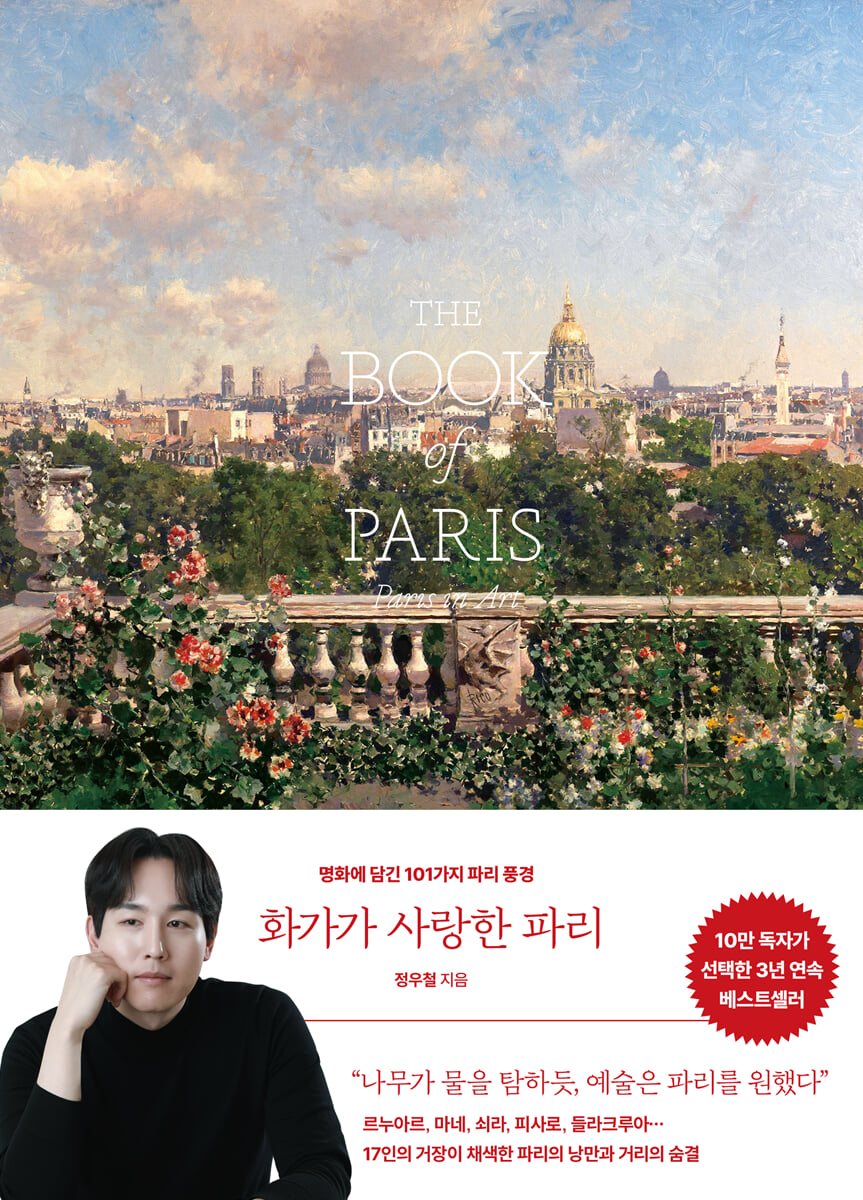
Paris loved by painters
 |
Description
Book Introduction
Docent Jeong Woo-cheol, who captivated 300,000 viewers and 100,000 readers,
Join 17 masters on a journey to Paris, the mecca of romance and art.
The "Loved by Artists" series is a bestseller in art education that gathers 101 works on a single theme and provides a glimpse into the artists' personalities and hidden stories.
Following Trees, Sea, and Night, the fourth theme to be presented is 'Paris,' the hometown of the heart that all artists in the world dream of.
Through the lives and art of 17 masters who were active in Paris and 101 masterpieces, we vividly explore the cityscape that stretches from the Seine River to the Louvre, Orsay, Montmartre, and the Champs-Élysées.
It follows the places where the gazes of masters of art history, such as Eugène Delacroix, Claude Monet, Edouard Manet, Giovanni Boldini, Marc Chagall, and Ilya Repin, lingered, and delicately captures the process by which they created the 'language of art' in the space called Paris.
The true value of art, as interpreted by docent Jeong Woo-cheol, comes from 'experience, not explanation.'
Paris is not just a tourist destination, but the 'world capital of art' that brings together the lives and works of artists.
The numerous masterpieces of the Louvre Museum, the daily lives of painters living on the hill of Montmartre, and even the sunset over the Seine River that runs through Paris…
Docent Jeong Woo-cheol breaks away from the rigid exhibition hall and talks about art at the 'site where the work was born,' providing readers with a captivating experience where 'a single piece of art approaches like a person's life.'
As the story unfolds around the city, you follow the splendid lights, street scenes, and people walking together, and before you know it, you find yourself in the heart of the city 'loved by the painter.'
Join 17 masters on a journey to Paris, the mecca of romance and art.
The "Loved by Artists" series is a bestseller in art education that gathers 101 works on a single theme and provides a glimpse into the artists' personalities and hidden stories.
Following Trees, Sea, and Night, the fourth theme to be presented is 'Paris,' the hometown of the heart that all artists in the world dream of.
Through the lives and art of 17 masters who were active in Paris and 101 masterpieces, we vividly explore the cityscape that stretches from the Seine River to the Louvre, Orsay, Montmartre, and the Champs-Élysées.
It follows the places where the gazes of masters of art history, such as Eugène Delacroix, Claude Monet, Edouard Manet, Giovanni Boldini, Marc Chagall, and Ilya Repin, lingered, and delicately captures the process by which they created the 'language of art' in the space called Paris.
The true value of art, as interpreted by docent Jeong Woo-cheol, comes from 'experience, not explanation.'
Paris is not just a tourist destination, but the 'world capital of art' that brings together the lives and works of artists.
The numerous masterpieces of the Louvre Museum, the daily lives of painters living on the hill of Montmartre, and even the sunset over the Seine River that runs through Paris…
Docent Jeong Woo-cheol breaks away from the rigid exhibition hall and talks about art at the 'site where the work was born,' providing readers with a captivating experience where 'a single piece of art approaches like a person's life.'
As the story unfolds around the city, you follow the splendid lights, street scenes, and people walking together, and before you know it, you find yourself in the heart of the city 'loved by the painter.'
- You can preview some of the book's contents.
Preview
index
Prologue _ Paris, the thrilling city of light and art
Eugène Delacroix - The Spirit of Paris That Ignited the Flames of Revolution
Luigi Loire - A city of gardens where the soul can rest
Jean-François Raffaeli - A street painter who captured the weight of life.
Claude Monet - The Face of Paris in a Waving Flag
Jean Vero - Parisian daily life captured in the middle of the street
Pierre-Auguste Renoir - The Painter Who Recorded the Warmth of the World
Vincent van Gogh - A New Opportunity in an Unfamiliar City
Marc Chagall - A Map of Memory Colored with the Temperature of Love
Pablo Picasso - A Ray of Light at the Edge of Loss
Giovanni Boldini - Moulin Rouge, the passion revived in red
Ilya Repin - The Order of Light Captured with a Sharp Eye
Georges Seurat - A Symphony Completed with Obsession
Gustave Caillebotte - A gaze that is close yet more distant than anyone else's
Edouard Manet - A Mirror Reflecting Reality Under Bright Light
Maurice Utrillo - The Painter Who Painted the World in Healing White
Suzanne Valadon - A painting of comfort as firm as roots
Camille Pissarro - The Last Landscape Left Behind Like a Confession
Epilogue: Small, Precious Moments That Comfort the Ordinary
Source of the work
Eugène Delacroix - The Spirit of Paris That Ignited the Flames of Revolution
Luigi Loire - A city of gardens where the soul can rest
Jean-François Raffaeli - A street painter who captured the weight of life.
Claude Monet - The Face of Paris in a Waving Flag
Jean Vero - Parisian daily life captured in the middle of the street
Pierre-Auguste Renoir - The Painter Who Recorded the Warmth of the World
Vincent van Gogh - A New Opportunity in an Unfamiliar City
Marc Chagall - A Map of Memory Colored with the Temperature of Love
Pablo Picasso - A Ray of Light at the Edge of Loss
Giovanni Boldini - Moulin Rouge, the passion revived in red
Ilya Repin - The Order of Light Captured with a Sharp Eye
Georges Seurat - A Symphony Completed with Obsession
Gustave Caillebotte - A gaze that is close yet more distant than anyone else's
Edouard Manet - A Mirror Reflecting Reality Under Bright Light
Maurice Utrillo - The Painter Who Painted the World in Healing White
Suzanne Valadon - A painting of comfort as firm as roots
Camille Pissarro - The Last Landscape Left Behind Like a Confession
Epilogue: Small, Precious Moments That Comfort the Ordinary
Source of the work
Detailed image

Into the book
Paris, a city whose name alone makes your heart race.
The glass pyramid of the Louvre, Mona Lisa's secret smile, the sunset over the Eiffel Tower and the Seine??.
Paris is a romantic travel destination that everyone dreams of visiting at least once.
Especially for me, Paris was not just a travel destination, but a place like a 'promise' to myself that I had kept deep in my heart for a long time.
Paris is still an exciting city, and its paintings always tell new stories.
This book, which captures the city's light and shadows along with 101 diverse Parisian landscapes, was prepared with the hope that it will help others dream of their first trip to Paris with a slightly richer perspective.
I sincerely hope that everyone who opens this book will have their own Paris painted in their heart, like a masterpiece.
--- From the "Prologue"
The Tuileries Garden was the place where the rhythm of the city of Paris was most clearly revealed.
Luigi Loire's paintings speak beyond the landscape before our eyes to how we remember cities.
The symmetrical order that can be seen from afar, and the texture of the floor and bricks that can only be seen when you get close.
Those little differences add up to create the mood of the afternoon, and we accept that mood as 'my Paris'.
If you ever go to Paris, don't just look at the huge masterpieces at the Louvre; take a step out into the gardens.
I would like to recall this picture among the shade of the trees, the sound of pebbles, and the laughter of children.
Even as I write this, I want to sit in the garden again and look at people.
Along the Loire River, you will discover your own Paris at your own pace.
--- From "Luigi Loire, the Garden City Where the Soul Rests"
The city of Paris sometimes becomes a stage in itself.
That day was June 30, 1878.
The red, white, and blue tricolor flags fluttered in the wind, filling the streets, and citizens all raised their heads and looked up at the sky.
The Rue Montorgueil and the Rue Saint-Denis, two streets that cut through the heart of Paris, were swayed by waves of flags.
And there was someone looking down at the scenery from a high balcony.
It's Claude Monet.
Monet left behind two paintings that day.
At first glance, these two works appear to be ordinary depictions of cityscapes, but they simultaneously capture the recovery of a nation, the vision of an artist, and a radiant yearning for democracy.
--- From "Claude Monet, The Face of Paris in the Waving Flag"
His gaze always fell first on people, not on monuments.
It captures expressions and gestures in places where people stop and pass by, such as cafes, theaters, parks, and benches along the river.
The wide boulevard, a symbol of modernity, was for him a new urban landscape, as well as a stage where people could pass each other and see how they lived.
Renoir loved scenes with people together.
I tried to capture the warmth that people give to each other in the same place, without missing a single moment when they sit side by side or brush shoulders.
Stop for a moment, look at people, and walk together.
That is the Parisian landscape that Renoir left behind, and it is an attitude that we must still learn from there.
Once this book is finished, I'll have to cross that bridge again.
This time, side by side with someone, at the same speed.
--- From "Pierre-Auguste Renoir, the Painter Who Recorded the Warmth of the World"
Chagall's Paris always began at the window.
He was a painter who put 'color before line' and a person who brought up memories before facts.
So the city in his paintings doesn't look like a rigid map, but like a stage where dreams are drawn, and people float high into the sky with the buoyancy of their hearts.
What kind of window do we need today? It doesn't have to be Paris.
What's important is the attitude of continuously practicing love in small ways right there.
“Knowing that life will end someday, we must paint the remaining time with the colors of love.” Chagall repeated these words in his later years.
It was a conclusion reached by a person without any foolishness or greed.
Just as Paris gave him the opportunity to dream, this place where we stand also gives us the opportunity to dream.
Try opening the window.
And like Chagall, paint today's small scene with your own colors.
When I look back someday, this scenery will become a canvas of the most beautiful memories.
--- From "Marc Chagall, A Map of Memory Colored with the Temperature of Love"
The young painter Georges Seurat.
He was in his mid-twenties at the time and believed in calculations rather than emotions, and theories rather than intuition.
He believed that the art of iron could be explored like science.
Instead of mixing colors on a palette, I encouraged the mixing to occur in the viewer's eyes.
This technique is the famous 'pointillism', a method of applying small dots of color side by side to make them appear as one color from a distance.
It takes a day to make a single dot, and years to complete a single painting.
It was truly an experiment close to the pinnacle of craftsmanship.
Seurat left behind 40 sketches and 20 drawings over a period of two years to complete this painting, “A Sunday Afternoon on the Island of La Grande Jatte.”
It was more like a giant blueprint than a single drawing.
I wanted to compose this painting like a visual symphony through vertical and horizontal composition, repeated shapes, and contrasting colors.
--- From "Georges Seurat, a symphony completed with a dot of obsession"
Edouard Manet was such a painter.
A person who knows how to make strange what we take for granted.
He focused on real-life figures, painting nudes of women sitting in a cafe, workers on the street, and women lying leisurely.
I believed that art should not only depict morality or beauty, but should also be a 'mirror' that reflects today's society.
This is what he meant to say.
The world we see now is not the same as it always was.
'The painting was fake from the beginning.
This is what I think of Paris. It's a city full of contradictions.' At that time, Paris was a glamorous city.
But it was also a lonely city.
Urbanization and industrialization brought people closer together, but their hearts grew further apart.
“A Bar at the Folies Bergère” seems to be his last greeting to the world, his most honest greeting.
“This is how I saw the world.
“What does your world look like?”
--- From "Edouard Manet, Mirror Reflecting Reality Under Bright Light"
Looking at Camille Pissarro's "The Seine and the Louvre, Paris" brings to mind many thoughts.
This is especially true when we remember that the artist painted this picture in 1903, the last year of his life.
In his youth, he led the era more passionately than anyone else at the center of Impressionism and embraced nature and life more deeply than anyone else.
But in his later years, illness made it impossible for him to walk in the fields under the sun any longer.
The illness took away his freedom to walk, but it gave him the time and space to observe the world beyond his window.
He quietly let countless moments of life flow by, as if capturing the four seasons in a single painting.
Warm times spent with loved ones, a body crumbling from illness, the changing visibility depending on the weather, days when I pick up a brush and days when I don't.
All those days were life.
Each day seems to pass by in a flash, but he seems to be confessing through this painting that every day is beautiful.
The glass pyramid of the Louvre, Mona Lisa's secret smile, the sunset over the Eiffel Tower and the Seine??.
Paris is a romantic travel destination that everyone dreams of visiting at least once.
Especially for me, Paris was not just a travel destination, but a place like a 'promise' to myself that I had kept deep in my heart for a long time.
Paris is still an exciting city, and its paintings always tell new stories.
This book, which captures the city's light and shadows along with 101 diverse Parisian landscapes, was prepared with the hope that it will help others dream of their first trip to Paris with a slightly richer perspective.
I sincerely hope that everyone who opens this book will have their own Paris painted in their heart, like a masterpiece.
--- From the "Prologue"
The Tuileries Garden was the place where the rhythm of the city of Paris was most clearly revealed.
Luigi Loire's paintings speak beyond the landscape before our eyes to how we remember cities.
The symmetrical order that can be seen from afar, and the texture of the floor and bricks that can only be seen when you get close.
Those little differences add up to create the mood of the afternoon, and we accept that mood as 'my Paris'.
If you ever go to Paris, don't just look at the huge masterpieces at the Louvre; take a step out into the gardens.
I would like to recall this picture among the shade of the trees, the sound of pebbles, and the laughter of children.
Even as I write this, I want to sit in the garden again and look at people.
Along the Loire River, you will discover your own Paris at your own pace.
--- From "Luigi Loire, the Garden City Where the Soul Rests"
The city of Paris sometimes becomes a stage in itself.
That day was June 30, 1878.
The red, white, and blue tricolor flags fluttered in the wind, filling the streets, and citizens all raised their heads and looked up at the sky.
The Rue Montorgueil and the Rue Saint-Denis, two streets that cut through the heart of Paris, were swayed by waves of flags.
And there was someone looking down at the scenery from a high balcony.
It's Claude Monet.
Monet left behind two paintings that day.
At first glance, these two works appear to be ordinary depictions of cityscapes, but they simultaneously capture the recovery of a nation, the vision of an artist, and a radiant yearning for democracy.
--- From "Claude Monet, The Face of Paris in the Waving Flag"
His gaze always fell first on people, not on monuments.
It captures expressions and gestures in places where people stop and pass by, such as cafes, theaters, parks, and benches along the river.
The wide boulevard, a symbol of modernity, was for him a new urban landscape, as well as a stage where people could pass each other and see how they lived.
Renoir loved scenes with people together.
I tried to capture the warmth that people give to each other in the same place, without missing a single moment when they sit side by side or brush shoulders.
Stop for a moment, look at people, and walk together.
That is the Parisian landscape that Renoir left behind, and it is an attitude that we must still learn from there.
Once this book is finished, I'll have to cross that bridge again.
This time, side by side with someone, at the same speed.
--- From "Pierre-Auguste Renoir, the Painter Who Recorded the Warmth of the World"
Chagall's Paris always began at the window.
He was a painter who put 'color before line' and a person who brought up memories before facts.
So the city in his paintings doesn't look like a rigid map, but like a stage where dreams are drawn, and people float high into the sky with the buoyancy of their hearts.
What kind of window do we need today? It doesn't have to be Paris.
What's important is the attitude of continuously practicing love in small ways right there.
“Knowing that life will end someday, we must paint the remaining time with the colors of love.” Chagall repeated these words in his later years.
It was a conclusion reached by a person without any foolishness or greed.
Just as Paris gave him the opportunity to dream, this place where we stand also gives us the opportunity to dream.
Try opening the window.
And like Chagall, paint today's small scene with your own colors.
When I look back someday, this scenery will become a canvas of the most beautiful memories.
--- From "Marc Chagall, A Map of Memory Colored with the Temperature of Love"
The young painter Georges Seurat.
He was in his mid-twenties at the time and believed in calculations rather than emotions, and theories rather than intuition.
He believed that the art of iron could be explored like science.
Instead of mixing colors on a palette, I encouraged the mixing to occur in the viewer's eyes.
This technique is the famous 'pointillism', a method of applying small dots of color side by side to make them appear as one color from a distance.
It takes a day to make a single dot, and years to complete a single painting.
It was truly an experiment close to the pinnacle of craftsmanship.
Seurat left behind 40 sketches and 20 drawings over a period of two years to complete this painting, “A Sunday Afternoon on the Island of La Grande Jatte.”
It was more like a giant blueprint than a single drawing.
I wanted to compose this painting like a visual symphony through vertical and horizontal composition, repeated shapes, and contrasting colors.
--- From "Georges Seurat, a symphony completed with a dot of obsession"
Edouard Manet was such a painter.
A person who knows how to make strange what we take for granted.
He focused on real-life figures, painting nudes of women sitting in a cafe, workers on the street, and women lying leisurely.
I believed that art should not only depict morality or beauty, but should also be a 'mirror' that reflects today's society.
This is what he meant to say.
The world we see now is not the same as it always was.
'The painting was fake from the beginning.
This is what I think of Paris. It's a city full of contradictions.' At that time, Paris was a glamorous city.
But it was also a lonely city.
Urbanization and industrialization brought people closer together, but their hearts grew further apart.
“A Bar at the Folies Bergère” seems to be his last greeting to the world, his most honest greeting.
“This is how I saw the world.
“What does your world look like?”
--- From "Edouard Manet, Mirror Reflecting Reality Under Bright Light"
Looking at Camille Pissarro's "The Seine and the Louvre, Paris" brings to mind many thoughts.
This is especially true when we remember that the artist painted this picture in 1903, the last year of his life.
In his youth, he led the era more passionately than anyone else at the center of Impressionism and embraced nature and life more deeply than anyone else.
But in his later years, illness made it impossible for him to walk in the fields under the sun any longer.
The illness took away his freedom to walk, but it gave him the time and space to observe the world beyond his window.
He quietly let countless moments of life flow by, as if capturing the four seasons in a single painting.
Warm times spent with loved ones, a body crumbling from illness, the changing visibility depending on the weather, days when I pick up a brush and days when I don't.
All those days were life.
Each day seems to pass by in a flash, but he seems to be confessing through this painting that every day is beautiful.
--- From "Camille Pissarro, the last landscape left behind like a confession"
Publisher's Review
The Pied Piper of the Art Museum, a Heart-Pounding Storyteller
An invitation from Paris by Docent Jeong Woo-cheol
Korea's leading exhibition docent, 'Docent Jeong Woo-cheol', has returned with 'Paris Loved by Painters'.
His detailed analysis of works and vivid storytelling, which he displayed at exhibitions of renowned masters such as Bernard Buffet, Toulouse-Lautrec, Joan Miró, Alphonse Mucha, and Marc Chagall, became a daily topic of conversation among art lovers.
He lowers the threshold of 'hard and difficult' art while summoning 'those people from that time' with interesting stories.
He is called 'The Pied Piper of the Art Museum' and has captivated 300,000 visitors and 100,000 readers. Following the sea and the night, he heads to 'Paris', the hometown of all artists in the world.
《Paris Loved by the Painter》 is the result of nearly ten years of field experience and reflections on art.
Paris, as described by docent Jeong Woo-cheol, is 'a city that is drawn in the mind like a masterpiece.'
As the name suggests, this book offers a special opportunity to look at the city of Paris at that time through the 'eyes of painters.'
The vivid storytelling that illuminates the artist's life and the sense of presence that comes from strolling through the streets of Paris come together, allowing readers to feel the light and shadow of Paris, the air and temperature of the streets, and the touch and breath of the artists with every turn of the page.
Meet "Those People of That Time" through 101 Masterpieces That Made History
Paris, the cradle of art that embraces the lives and souls of masters
Under the absolute monarchy of the 17th century, Paris, the center of splendid court art and a grand Catholic worldview, emerged as a leading center of global artistic trends.
The crowd that overthrew the monarchy in the French Revolution at the end of the 18th century built a new society under the name of 'Liberty, Equality, and Fraternity', and art also began to spread freely, free from power and authority.
Paris ushered in a golden age of modern art, splendid and beautiful, with the urban renovation led by Baron Haussmann in the mid-19th century, which improved the roads and illuminated the city.
Cafes and galleries dotted the streets served as gateways and passageways for the public and art, and ambitious young artists flocked to Paris in search of opportunities.
Pablo Picasso and Vincent van Gogh experienced chaos and hardship in the rapidly changing flow of modern cities, but after all these trials, they emerged as representative names of their times.
Jean-François Raffaeli and Jean Verreau gently documented the daily lives of people living together in the city and the warmth they share with each other.
Maurice Utrillo found a pillar to support life in the urban landscape, and Camille Pissarro, at the end of his life, testified to the preciousness of everyday life and the beauty of the city.
The city's boulevards and lights, cafes and galleries, and the people passing by have provided new inspiration to countless artists.
Paris, where innovation and evolution intersected from the Middle Ages to the modern era, and the desire for freedom and art, was not just a city, but the cradle and final resting place of countless artists.
《Paris Loved by the Painter》 is a book about life and art set in Paris, the capital of art.
By following the traces of artists that permeate every corner of the city, you can vividly experience the emotion of beautiful moments that bloom from ordinary daily life.
The gaze and hands of the masters who struggled to find their own art even amidst the weight and hardships of life convey a gentle emotion to the reader.
The Parisian landscape, a blend of art, romance, and human dreams, offers deep empathy and comfort to those of us living in the modern era.
An invitation from Paris by Docent Jeong Woo-cheol
Korea's leading exhibition docent, 'Docent Jeong Woo-cheol', has returned with 'Paris Loved by Painters'.
His detailed analysis of works and vivid storytelling, which he displayed at exhibitions of renowned masters such as Bernard Buffet, Toulouse-Lautrec, Joan Miró, Alphonse Mucha, and Marc Chagall, became a daily topic of conversation among art lovers.
He lowers the threshold of 'hard and difficult' art while summoning 'those people from that time' with interesting stories.
He is called 'The Pied Piper of the Art Museum' and has captivated 300,000 visitors and 100,000 readers. Following the sea and the night, he heads to 'Paris', the hometown of all artists in the world.
《Paris Loved by the Painter》 is the result of nearly ten years of field experience and reflections on art.
Paris, as described by docent Jeong Woo-cheol, is 'a city that is drawn in the mind like a masterpiece.'
As the name suggests, this book offers a special opportunity to look at the city of Paris at that time through the 'eyes of painters.'
The vivid storytelling that illuminates the artist's life and the sense of presence that comes from strolling through the streets of Paris come together, allowing readers to feel the light and shadow of Paris, the air and temperature of the streets, and the touch and breath of the artists with every turn of the page.
Meet "Those People of That Time" through 101 Masterpieces That Made History
Paris, the cradle of art that embraces the lives and souls of masters
Under the absolute monarchy of the 17th century, Paris, the center of splendid court art and a grand Catholic worldview, emerged as a leading center of global artistic trends.
The crowd that overthrew the monarchy in the French Revolution at the end of the 18th century built a new society under the name of 'Liberty, Equality, and Fraternity', and art also began to spread freely, free from power and authority.
Paris ushered in a golden age of modern art, splendid and beautiful, with the urban renovation led by Baron Haussmann in the mid-19th century, which improved the roads and illuminated the city.
Cafes and galleries dotted the streets served as gateways and passageways for the public and art, and ambitious young artists flocked to Paris in search of opportunities.
Pablo Picasso and Vincent van Gogh experienced chaos and hardship in the rapidly changing flow of modern cities, but after all these trials, they emerged as representative names of their times.
Jean-François Raffaeli and Jean Verreau gently documented the daily lives of people living together in the city and the warmth they share with each other.
Maurice Utrillo found a pillar to support life in the urban landscape, and Camille Pissarro, at the end of his life, testified to the preciousness of everyday life and the beauty of the city.
The city's boulevards and lights, cafes and galleries, and the people passing by have provided new inspiration to countless artists.
Paris, where innovation and evolution intersected from the Middle Ages to the modern era, and the desire for freedom and art, was not just a city, but the cradle and final resting place of countless artists.
《Paris Loved by the Painter》 is a book about life and art set in Paris, the capital of art.
By following the traces of artists that permeate every corner of the city, you can vividly experience the emotion of beautiful moments that bloom from ordinary daily life.
The gaze and hands of the masters who struggled to find their own art even amidst the weight and hardships of life convey a gentle emotion to the reader.
The Parisian landscape, a blend of art, romance, and human dreams, offers deep empathy and comfort to those of us living in the modern era.
GOODS SPECIFICS
- Date of issue: November 25, 2025
- Page count, weight, size: 184 pages | 572g | 165*230*15mm
- ISBN13: 9791199374027
- ISBN10: 1199374024
You may also like
카테고리
korean


korean

![GQ KOREA Mark (Monthly): December [2025]](http://librairie.coreenne.fr/cdn/shop/files/8ef265dbbfbf186523ed75ba7319009d.jpg?v=1765340328&width=3840)


