

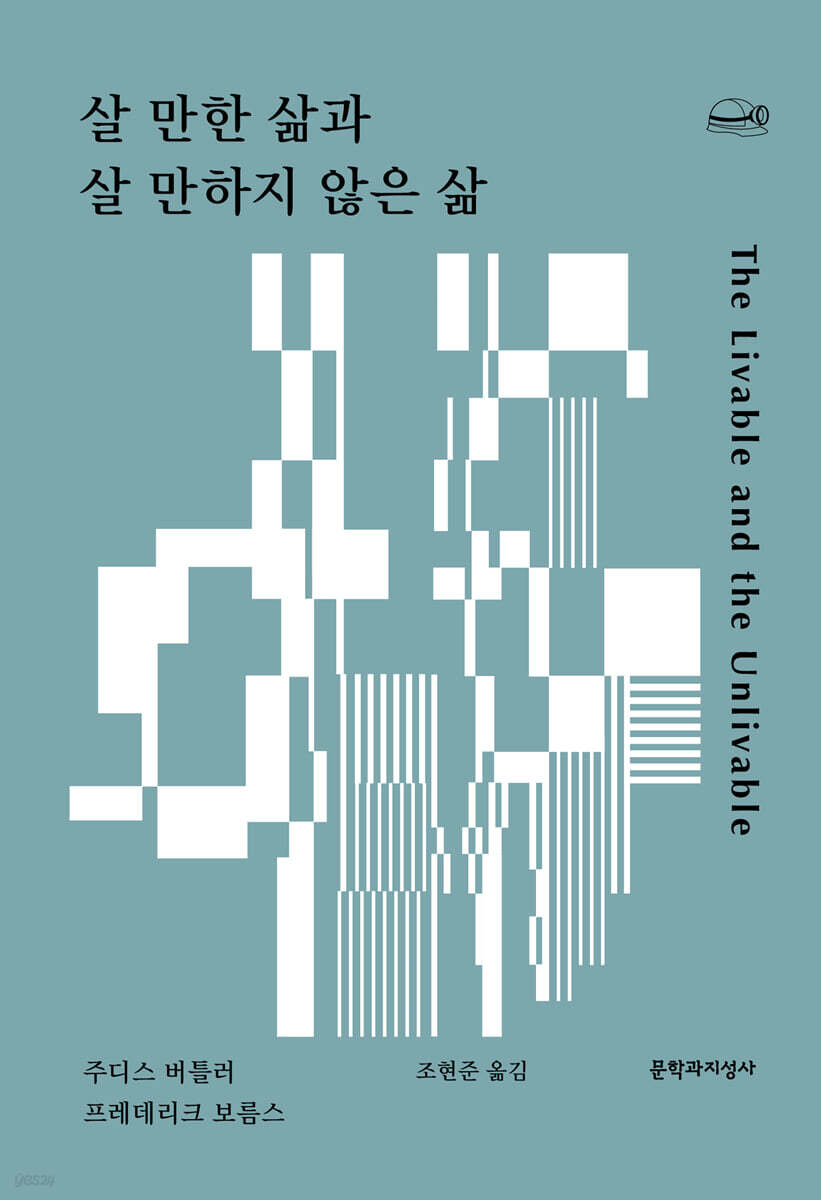
A life worth living and a life not worth living
 |
Description
Book Introduction
“The reason why we must refer to the subject as intersubjectivity is
If your life is not worth living,
And countless lives are not worth living
Because my life is not worth living either.”
A collection of conversations titled “The Life Worth Living and the Life Not Worth Living,” in which Judith Butler, a prominent American queer theorist and political ethicist, and Frédéric Worms, a French critical vitalist and philosopher who has mainly studied the ethics of care, explore the conditions that make life worth living or not worth living, has been published.
This book contains two conversations: the first took place in April 2018, when European society was experiencing serious social conflict due to the acceptance of millions of refugees, and the second took place in April 2022, when the threat of the coronavirus pandemic was heightened as it spread across the globe.
The two philosophers explore solutions to cope with such a grave emergency, discussing what it means to have a "life worth living," not just survival, and how to secure it.
They strongly demand a new political norm, one that ensures a 'livable' life for all.
The two philosophers begin with a theoretical and phenomenological discussion of the criteria for distinguishing between a livable and an unlivable life, but then move on to engage in a more in-depth conversation about how to respond to and recover from the crises of life we face today, focusing on specific issues of contemporary society such as forced migration, climate change, pandemics, and war violence.
For both scholars, ensuring a decent life for all is not simply a political or social goal, but an ethical duty and responsibility arising from human interdependence.
If your life is not worth living,
And countless lives are not worth living
Because my life is not worth living either.”
A collection of conversations titled “The Life Worth Living and the Life Not Worth Living,” in which Judith Butler, a prominent American queer theorist and political ethicist, and Frédéric Worms, a French critical vitalist and philosopher who has mainly studied the ethics of care, explore the conditions that make life worth living or not worth living, has been published.
This book contains two conversations: the first took place in April 2018, when European society was experiencing serious social conflict due to the acceptance of millions of refugees, and the second took place in April 2022, when the threat of the coronavirus pandemic was heightened as it spread across the globe.
The two philosophers explore solutions to cope with such a grave emergency, discussing what it means to have a "life worth living," not just survival, and how to secure it.
They strongly demand a new political norm, one that ensures a 'livable' life for all.
The two philosophers begin with a theoretical and phenomenological discussion of the criteria for distinguishing between a livable and an unlivable life, but then move on to engage in a more in-depth conversation about how to respond to and recover from the crises of life we face today, focusing on specific issues of contemporary society such as forced migration, climate change, pandemics, and war violence.
For both scholars, ensuring a decent life for all is not simply a political or social goal, but an ethical duty and responsibility arising from human interdependence.
- You can preview some of the book's contents.
Preview
index
introduction
Foreword - Artaud Charpentier, Laura Varillas
A life worth living and a life not worth living
Reviews
About the Author
Translator's Note: A life worth living for all of us
Foreword - Artaud Charpentier, Laura Varillas
A life worth living and a life not worth living
Reviews
About the Author
Translator's Note: A life worth living for all of us
Into the book
Worms: So what we're going to discuss now is the criteria for distinguishing between a life worth living and a life not worth living, and the importance of being able to define those criteria.
Because everyone has claims about what makes a particular experience or life “unworthy,” we need to be able to make judgments about these claims.
We often hear the words, “It’s not worth living in,” but who is it right to say such things?
Butler: If you want to argue that a life worth living and a life not worth living are conceptually opposed, you have to explain the simultaneity of these two things that occurs in the field of phenomenology.
The reason I've discussed this point at length is that the term resilience has become increasingly popular to describe what happens to migrants who are lost at sea, or people who are detained indefinitely, or people who are bombed in military conflicts.
They don't always go back to the way they were.
There are occasional moments of communal creative resistance (and they certainly exist).
Butler: If the structures we rely on fail, we too will fail and fall.
And while the harm we inflict will register as individual events in our lives, including our mental lives, these losses and failures are in fact to some extent shared by the community, and to some extent social, economic, and political.
So if we want to question what makes life worth living and what doesn't, we need to examine the institutional supports and infrastructure that make life fertile.
Worms: Our culture wants to forget that there really is a life that is caught up in an unlivable life.
I hope that there will be either victims (dead people) from this conflict or people who escape this conflict and live.
But it exists and it concerns us all, so we need to direct the discussion.
At least that's what I think.
--- From "A Life Worth Living and a Life Not Worth Living"
Worms: We know that certain people are more vulnerable than others, that their worlds are already being destroyed.
This is not just a vision for the future.
In both climate and pandemic cases, whether we think we've been through this and it's over now, or if we acknowledge that for some people it's not over yet, what we're rejecting is the idea of shared vulnerability.
Common vulnerabilities include pandemics, climate change, and even the war in Ukraine.
These things serve as a reminder that nowhere on Earth are we protected from vulnerability.
Butler: If any of us agree that this world is one in which such fundamental inequalities are confirmed or biased and reproduced, then it means that there are those who seek to preserve their way of life and claim the right to do so, while others are ignored.
But they depend on such others, and they, or we, are always in contact with such others, who, so to speak, cannot look away because the destruction is happening right before their eyes.
So, according to this logic, self-preservation has destructive implications.
Because everyone has claims about what makes a particular experience or life “unworthy,” we need to be able to make judgments about these claims.
We often hear the words, “It’s not worth living in,” but who is it right to say such things?
Butler: If you want to argue that a life worth living and a life not worth living are conceptually opposed, you have to explain the simultaneity of these two things that occurs in the field of phenomenology.
The reason I've discussed this point at length is that the term resilience has become increasingly popular to describe what happens to migrants who are lost at sea, or people who are detained indefinitely, or people who are bombed in military conflicts.
They don't always go back to the way they were.
There are occasional moments of communal creative resistance (and they certainly exist).
Butler: If the structures we rely on fail, we too will fail and fall.
And while the harm we inflict will register as individual events in our lives, including our mental lives, these losses and failures are in fact to some extent shared by the community, and to some extent social, economic, and political.
So if we want to question what makes life worth living and what doesn't, we need to examine the institutional supports and infrastructure that make life fertile.
Worms: Our culture wants to forget that there really is a life that is caught up in an unlivable life.
I hope that there will be either victims (dead people) from this conflict or people who escape this conflict and live.
But it exists and it concerns us all, so we need to direct the discussion.
At least that's what I think.
--- From "A Life Worth Living and a Life Not Worth Living"
Worms: We know that certain people are more vulnerable than others, that their worlds are already being destroyed.
This is not just a vision for the future.
In both climate and pandemic cases, whether we think we've been through this and it's over now, or if we acknowledge that for some people it's not over yet, what we're rejecting is the idea of shared vulnerability.
Common vulnerabilities include pandemics, climate change, and even the war in Ukraine.
These things serve as a reminder that nowhere on Earth are we protected from vulnerability.
Butler: If any of us agree that this world is one in which such fundamental inequalities are confirmed or biased and reproduced, then it means that there are those who seek to preserve their way of life and claim the right to do so, while others are ignored.
But they depend on such others, and they, or we, are always in contact with such others, who, so to speak, cannot look away because the destruction is happening right before their eyes.
So, according to this logic, self-preservation has destructive implications.
--- From the "Review"
Publisher's Review
The Encounter between Worms and Butler: The Intersection of "Critical Vitalism" and "The Philosophy of Precarious Life"
From her early days advocating the concept of gender performativity to her recent, powerful critiques of the Israeli-Palestinian war and other issues, Judith Butler's thinking has been centered on the pursuit of a "life worth living."
He has consistently argued that we must break down the discriminatory framework that determines which lives are worthy of protection, commemoration, and mourning, and that we must find and practice ways of non-violent coexistence.
Frederic Worms, a philosopher who inherited the vitalism of Bergson and Canguilhem and grounded in the psychoanalysis and ethics of care of Freud and Winnicott, his critical vitalism is an approach that critically explores the inherent norms and conditions of life itself.
Worms argues that in addition to basic necessities such as food, clothing, and shelter, care, relationships, and social conditions are essential for the maintenance and development of a subject's life.
So how can we distinguish between a life worth living and a life not worth living?
“A life that is not worth living is a kind of interruption of what we call the life of our body or the condition of life.
Frankly speaking, it would entail a destruction of the ego that would be tantamount to death.
And if I may make a comparison, it is worse than death, because while life goes on, that which makes life life, or enables someone to live it, has died.
[…] In fact, that is the core of what I call “critical vitalism.”
While Worms emphasized the objective conditions of a life worth living in contrast to death and attempted to maintain a clear boundary between a life worth living and a life not worth living, Butler places importance on how the subject becomes aware of his or her experience and what meaning he or she derives from it, and believes that whether or not one can receive social recognition and protection from an intersubjective perspective can be an important criterion for distinguishing between the two lives.
Butler's interest lies above all in urging resistance to improve precarious living conditions and transform social inequalities and power dynamics.
Building on the awareness that we are interdependent beings who cannot help but influence and be influenced by others, Butler repeatedly emphasizes the need for the practice of care and global solidarity as a process for realizing a life worth living for all.
“The reason we must speak of the subject as intersubjectivity is because my life is not worth living unless your life is worth living, and unless countless lives are worth living.
Because we are dependent on each other and on the social structure for our common life.
The subject of a country depends on care not only in infancy but throughout its entire life, and “care” here refers to social and institutional arrangements for a life worth living rather than maternal characteristics.
[…] Therefore, if we want to ask ourselves what conditions are worth living and what are not, we must look at the institutional support and infrastructure that make life fertile.”
The Politics of Coexistence and Living Together
Butler, who started from the sociopolitics of the body, and Worms, who started from the philosophy of life called critical vitalism, have different starting points, but they share the same view of supporting democracy based on the social philosophy of living life.
Both believe that acknowledging human interdependence should lead to a demand for radical equality among living beings.
They argue that true democracy must guarantee everyone a 'livable' standard of living and that it must play a role in protecting basic human life and dignity.
This book, filled with critical rigor, mutual respect, and warm humor, will help us imagine a "world worth living in," where support and care are available to all and the conditions for solidarity among living beings expand.
From her early days advocating the concept of gender performativity to her recent, powerful critiques of the Israeli-Palestinian war and other issues, Judith Butler's thinking has been centered on the pursuit of a "life worth living."
He has consistently argued that we must break down the discriminatory framework that determines which lives are worthy of protection, commemoration, and mourning, and that we must find and practice ways of non-violent coexistence.
Frederic Worms, a philosopher who inherited the vitalism of Bergson and Canguilhem and grounded in the psychoanalysis and ethics of care of Freud and Winnicott, his critical vitalism is an approach that critically explores the inherent norms and conditions of life itself.
Worms argues that in addition to basic necessities such as food, clothing, and shelter, care, relationships, and social conditions are essential for the maintenance and development of a subject's life.
So how can we distinguish between a life worth living and a life not worth living?
“A life that is not worth living is a kind of interruption of what we call the life of our body or the condition of life.
Frankly speaking, it would entail a destruction of the ego that would be tantamount to death.
And if I may make a comparison, it is worse than death, because while life goes on, that which makes life life, or enables someone to live it, has died.
[…] In fact, that is the core of what I call “critical vitalism.”
While Worms emphasized the objective conditions of a life worth living in contrast to death and attempted to maintain a clear boundary between a life worth living and a life not worth living, Butler places importance on how the subject becomes aware of his or her experience and what meaning he or she derives from it, and believes that whether or not one can receive social recognition and protection from an intersubjective perspective can be an important criterion for distinguishing between the two lives.
Butler's interest lies above all in urging resistance to improve precarious living conditions and transform social inequalities and power dynamics.
Building on the awareness that we are interdependent beings who cannot help but influence and be influenced by others, Butler repeatedly emphasizes the need for the practice of care and global solidarity as a process for realizing a life worth living for all.
“The reason we must speak of the subject as intersubjectivity is because my life is not worth living unless your life is worth living, and unless countless lives are worth living.
Because we are dependent on each other and on the social structure for our common life.
The subject of a country depends on care not only in infancy but throughout its entire life, and “care” here refers to social and institutional arrangements for a life worth living rather than maternal characteristics.
[…] Therefore, if we want to ask ourselves what conditions are worth living and what are not, we must look at the institutional support and infrastructure that make life fertile.”
The Politics of Coexistence and Living Together
Butler, who started from the sociopolitics of the body, and Worms, who started from the philosophy of life called critical vitalism, have different starting points, but they share the same view of supporting democracy based on the social philosophy of living life.
Both believe that acknowledging human interdependence should lead to a demand for radical equality among living beings.
They argue that true democracy must guarantee everyone a 'livable' standard of living and that it must play a role in protecting basic human life and dignity.
This book, filled with critical rigor, mutual respect, and warm humor, will help us imagine a "world worth living in," where support and care are available to all and the conditions for solidarity among living beings expand.
GOODS SPECIFICS
- Date of issue: December 26, 2024
- Page count, weight, size: 148 pages | 174g | 128*187*10mm
- ISBN13: 9788932043418
- ISBN10: 8932043418
You may also like
카테고리
korean


korean

![GQ KOREA Mark (Monthly): December [2025]](http://librairie.coreenne.fr/cdn/shop/files/8ef265dbbfbf186523ed75ba7319009d.jpg?v=1765340328&width=3840)


