

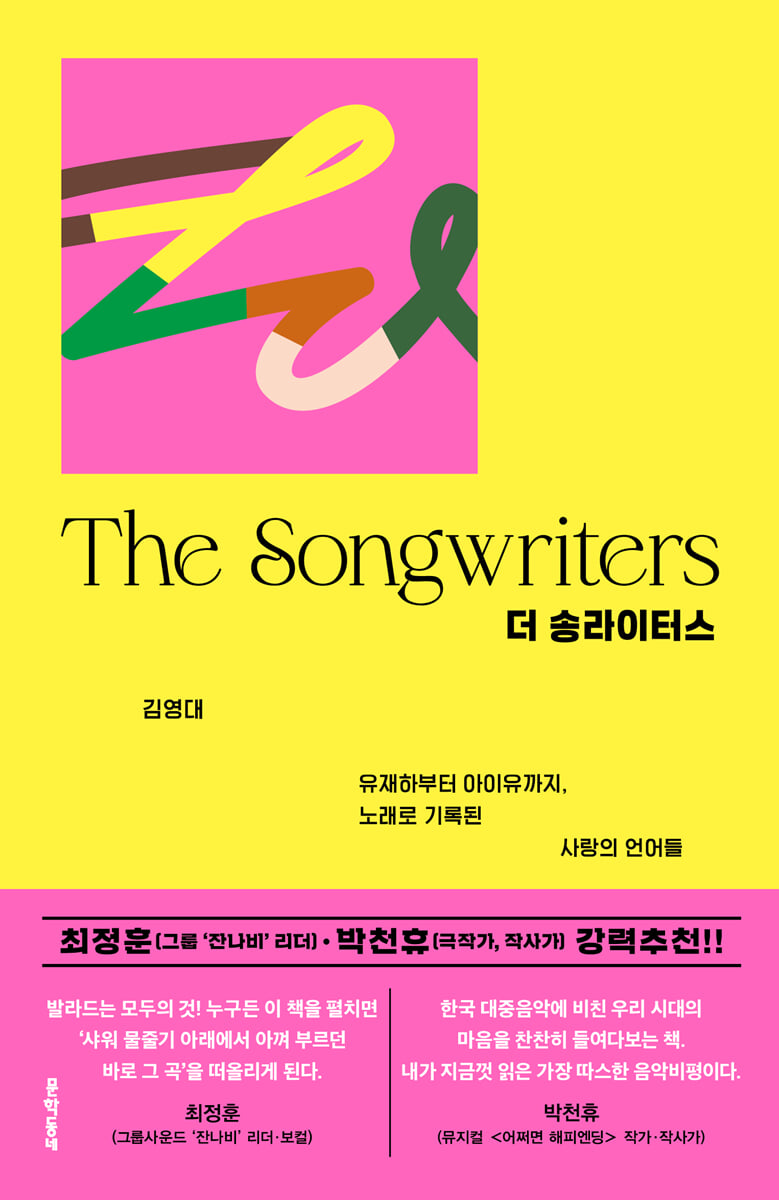
The Songwriters
 |
Description
Book Introduction
- A word from MD
- Memories of famous songs and love“I first learned love through ballads.” A book that looks back on the flow of Korean pop music history and the sensibilities of the times through the ballad genre.
We will read the history of Korean pop music by looking at the lyrics of 117 songs.
It also sheds new light on various artists and delicately conveys the emotion of delicate language in love songs.
November 25, 2025. Art PD Ahn Hyun-jae
★★Highly recommended by Choi Jeong-hoon (leader of the group 'Jannabi) and Park Cheon-hyu (playwright, lyricist)!!★★
★★"Anyone who opens this book will be reminded of 'that song I used to cherish under the shower'" _Choi Jeong-hoon (leader and vocalist of the group 'Jannabi)★★
★★"A book that carefully examines the spirit of our times as reflected in Korean popular music." _Park Cheon-hyu (writer and lyricist for the musical "Maybe a Happy Ending") ★★
“I first learned about love through ballads.”
From the era of pop music to the era of K-pop
Great songwriters have delivered
About immortal songs and the history of love
"The Songwriters" is a book in which music critic Kim Young-dae looks back on the flow of Korean pop music history and the sensibilities of the times through the ballad genre.
By examining the lyrics of 117 songs that can be called the essence of ballads one by one, it goes beyond the genre analysis of ballads and reads the history of Korean pop music through the language of emotions.
Also Lee Moon-se, Yoo Jae-ha, and Kim Kwang-seok.
Artists who have sent meaningful messages to the history of Korean pop music, such as Byun Jin-seop, Yoon Sang, Yoon Jong-shin, Shin Seung-hoon, Kim Dong-ryul, Kim Kwang-jin, Lee Seung-hwan, Yoo Hee-yeol, Lee So-ra, Sung Si-kyung, Jannabi, and IU, are reexamined from the perspective of songwriters, and music is viewed from the realm of lyrics rather than song form.
Through this, readers can experience and enjoy the music more richly by encountering the delicate language and poignant stories of familiar love songs.
The book is divided into three parts.
Part 1 showcases the unique emotions of ballads and the musical world of representative songwriters who created Korean ballads.
And you can meet artists and songs that carry on the tradition of Korean ballads, which began in earnest in 1986.
Part 2 introduces representative ballad songs centered on the chronicle of love that continues with encounters and partings, excitement and pain.
A ballad is a love song.
And the lyrics capture the spirit of the times by giving new and colorful variations to the familiar and obvious language of love.
In particular, here, 10 hashtags about love remind us of the sensibilities of the times as well as the unchanging love.
Part 3 contains the past and present of Korean ballads.
We will examine the lyricism of Korean pop music by examining songs from the 1960s and 1970s that already had ballad characteristics before the emergence of the ballad genre.
In addition, you can get a glimpse of the hidden charm of ballads that flexibly cross genre boundaries such as R&B, rock, and folk in the 2000s through an expert's perspective.
★★"Anyone who opens this book will be reminded of 'that song I used to cherish under the shower'" _Choi Jeong-hoon (leader and vocalist of the group 'Jannabi)★★
★★"A book that carefully examines the spirit of our times as reflected in Korean popular music." _Park Cheon-hyu (writer and lyricist for the musical "Maybe a Happy Ending") ★★
“I first learned about love through ballads.”
From the era of pop music to the era of K-pop
Great songwriters have delivered
About immortal songs and the history of love
"The Songwriters" is a book in which music critic Kim Young-dae looks back on the flow of Korean pop music history and the sensibilities of the times through the ballad genre.
By examining the lyrics of 117 songs that can be called the essence of ballads one by one, it goes beyond the genre analysis of ballads and reads the history of Korean pop music through the language of emotions.
Also Lee Moon-se, Yoo Jae-ha, and Kim Kwang-seok.
Artists who have sent meaningful messages to the history of Korean pop music, such as Byun Jin-seop, Yoon Sang, Yoon Jong-shin, Shin Seung-hoon, Kim Dong-ryul, Kim Kwang-jin, Lee Seung-hwan, Yoo Hee-yeol, Lee So-ra, Sung Si-kyung, Jannabi, and IU, are reexamined from the perspective of songwriters, and music is viewed from the realm of lyrics rather than song form.
Through this, readers can experience and enjoy the music more richly by encountering the delicate language and poignant stories of familiar love songs.
The book is divided into three parts.
Part 1 showcases the unique emotions of ballads and the musical world of representative songwriters who created Korean ballads.
And you can meet artists and songs that carry on the tradition of Korean ballads, which began in earnest in 1986.
Part 2 introduces representative ballad songs centered on the chronicle of love that continues with encounters and partings, excitement and pain.
A ballad is a love song.
And the lyrics capture the spirit of the times by giving new and colorful variations to the familiar and obvious language of love.
In particular, here, 10 hashtags about love remind us of the sensibilities of the times as well as the unchanging love.
Part 3 contains the past and present of Korean ballads.
We will examine the lyricism of Korean pop music by examining songs from the 1960s and 1970s that already had ballad characteristics before the emergence of the ballad genre.
In addition, you can get a glimpse of the hidden charm of ballads that flexibly cross genre boundaries such as R&B, rock, and folk in the 2000s through an expert's perspective.
- You can preview some of the book's contents.
Preview
index
prolog
A chronicle of love, breakups, regrets, excitement, and frustration?
Part 1.
The genre or emotion of ballad
Silent Cry: Ballads, Music Representing Modern Romanticism
Why Yoo Jae-ha? And the Emergence of Post-Yoo Jae-ha Songwriters
The city where ballads were born: the sensibility of city pop
Lee Moon-sae and Lee Young-hoon, the eternal ballad of the canon
I'll Hide and Watch You If You're a Burden: The Anthropology of Emotionality and Clinginess
Part 2.
#Listen to #Ballad in #Words
Ballad hashtag 1: #SlowlyLittlebySlowly #StillWounded #WillYouWait #HopeForABlindDate
Ballad Hashtag 2: #NeverAgain #Don'tMeetMe #BreakUpCut #PretendIt'sOkay
Ballad Hashtag 3: #OneStepBehind #I'm #Can'tHaveYou #ShakingYou
Ballad Hashtag 4: #OnlyHeaven #PermittedLove #EvenInADream #EvenInASoul
Ballad Hashtag 5: #ThatGirl #TornPhoto #ThatSongFromAlongWithTheMotherOfTwo
Ballad Hashtag 6: #WinterBecomesSpring #IfYouWishMe #ComeToMe #Useless
Ballad Hashtag 7: #IDon'tKnowNow #WhoIsItFor #NothingToSay #IDon'tKnow
Ballad Hashtag 8: #happiness #invitation #escape #peace
Ballad Hashtag 9: #Somehow #HopeForReunion #UnexpectedCall #HopeTorture
Ballad Hashtag 10: #EndOfYouth #ColdWind #LoveOver30 #LetGo
Part 3.
The world of ballads deepens and broadens
Ballad is not a genre
Ballad before ballad, K-pop before K-pop
Rock ballads, karaoke, and high-pitched voices (unavailable)
Whoa whoa, yeah yeah, I guess I'll have to bury it in Jamsil
The breakup stories of millennial R&B divas who had to suffer alone.
Shall We Sing Together? A Duet, a Microcosm of Relationships
Who is the ballad lyricist, GOAT?
The Golden Girls: A Portrait of an Unchanging Diva
supplement
Are Ballads Dead? The 10 Best Ballads of the K-Pop Era
Author's Note
A chronicle of love, breakups, regrets, excitement, and frustration?
Part 1.
The genre or emotion of ballad
Silent Cry: Ballads, Music Representing Modern Romanticism
Why Yoo Jae-ha? And the Emergence of Post-Yoo Jae-ha Songwriters
The city where ballads were born: the sensibility of city pop
Lee Moon-sae and Lee Young-hoon, the eternal ballad of the canon
I'll Hide and Watch You If You're a Burden: The Anthropology of Emotionality and Clinginess
Part 2.
#Listen to #Ballad in #Words
Ballad hashtag 1: #SlowlyLittlebySlowly #StillWounded #WillYouWait #HopeForABlindDate
Ballad Hashtag 2: #NeverAgain #Don'tMeetMe #BreakUpCut #PretendIt'sOkay
Ballad Hashtag 3: #OneStepBehind #I'm #Can'tHaveYou #ShakingYou
Ballad Hashtag 4: #OnlyHeaven #PermittedLove #EvenInADream #EvenInASoul
Ballad Hashtag 5: #ThatGirl #TornPhoto #ThatSongFromAlongWithTheMotherOfTwo
Ballad Hashtag 6: #WinterBecomesSpring #IfYouWishMe #ComeToMe #Useless
Ballad Hashtag 7: #IDon'tKnowNow #WhoIsItFor #NothingToSay #IDon'tKnow
Ballad Hashtag 8: #happiness #invitation #escape #peace
Ballad Hashtag 9: #Somehow #HopeForReunion #UnexpectedCall #HopeTorture
Ballad Hashtag 10: #EndOfYouth #ColdWind #LoveOver30 #LetGo
Part 3.
The world of ballads deepens and broadens
Ballad is not a genre
Ballad before ballad, K-pop before K-pop
Rock ballads, karaoke, and high-pitched voices (unavailable)
Whoa whoa, yeah yeah, I guess I'll have to bury it in Jamsil
The breakup stories of millennial R&B divas who had to suffer alone.
Shall We Sing Together? A Duet, a Microcosm of Relationships
Who is the ballad lyricist, GOAT?
The Golden Girls: A Portrait of an Unchanging Diva
supplement
Are Ballads Dead? The 10 Best Ballads of the K-Pop Era
Author's Note
Into the book
A chronicle of Korean love, separation, regret, excitement, and frustration through music, the great
This is a record of the 'history of love' we have shared with ballad songwriters.
--- p.24, from "Prologue"
While rock represented white extravagance, jazz represented black sensuality, and trot represented local sorrow, ballads began to receive attention as music representing Western sophistication and modern yet conservative romanticism, truly a 'new wave' song.
--- p.32, from “Silent Cry: Ballad, Music Representing Modern Romanticism”
Until the mid-1980s, the emotions of 'local sadness' or 'han' that naturally came to mind when talking about slow songs in pop music were replaced in Lee Moon-se's songs with emotions of 'longing' and 'wistfulness'.
This was not simply the personal taste of songwriter Lee Young-hoon, but rather a reflection of the emergence of a new generation and their musical tastes.
--- p.73, from “Lee Moon-se and Lee Young-hoon, the Eternal Canon of Ballads”
By the 1990s, a spoonful was added to this.
The immediate appearance of excessive emotion and pettiness.
It wasn't just a change in expression.
With the dawn of the 1990s and the rise of Generation X, the world became more honest, and lyrics accordingly began to let go of pretense.
--- p.86, from “I’ll hide and watch over you if you’re a burden: The Anthropology of Emotionality and Irritation”
〈Bangbaek〉 is a work in which everything, from the title to the lyrics, melody, and emotion, is so delicately woven and orchestrated.
Even within K-pop, SHINee, who were icons of experimental electronic sounds, were given such a sweet melody of youth, and this song has now become a classic of idol pop, redefining and perfecting the sense of 'refreshing' and 'whimsical' within idol music.
--- p.147, from “Ballad Hashtag 3”
There are many ballad masters, but Yoon Sang's music has a mysterious emotion that is difficult to explain.
(…) In some ways, this ‘adult innocence’ that can be a bit ticklish is persuasive not only because of the cold yet warm urban sound of Yoon Sang’s music, but also because of the lonely and fragile masculinity of the artist Yoon Sang.
--- p.170, from “Ballad Hashtag 5”
"To You Again" contains a story about a belated 'realization' and 'return' to love, which was rare not only at the time but also in the history of ballads.
(…) Of course, the harmony between Jinseop Byun’s sorrowful voice and the song, especially the lyrics, is practically perfect.
--- p.224-225, from “Ballad Hashtag 9”
Although Lee So-ra has already shown us the extremes of a sad breakup through “Please” and “Enough Now,” “The Wind Blows” conveys a completely different level of expressiveness than before.
The poetic language and cool tone prove that restrained sorrow, without sobs or screams, can be more painful and poignant.
--- p.237, from “10 Ballad Hashtags”
In fact, R&B is a genre that is closely related to ballads both musically and emotionally.
Not only is there an overwhelming number of songs about love, including the so-called 'slow jam' subgenre, but the rich emotions and flowing techniques melted into the elegant yet bluesy progression of the triple-beat pattern are also the unique identity of this genre.
--- p.289-290, from "Wow, Yeah, I guess I'll have to bury it in Jamsil"
Couldn't it be called a genre created by Az One? This fragile and pathetic feeling is expressed calmly, not through the flowing and virtuosic singing of their forte, R&B, but through classic pop ballads.
(…) In particular, it met with Yoon Sara’s writing, which boasted of a peak of emotion, and gave birth to another ‘classic.’
--- p.310-311, from "The Breakup Stories of Millennial R&B Divas Who Had to Hurt Alone"
Park Joo-yeon, a name that I would not be ashamed to call Korea's best lyricist.
He was one of the few lyricists who could have had as much influence on a song as the greatest composers who graced that glorious era of ballads.
Beyond just being a good writer, he was also a talented songwriter who understood music and could apply diverse compositional techniques to it.
--- p.326, from “Who is the ballad lyricist, GOAT?”
In this way, ballads survived in various ways.
Although it was pushed out of the center, it did not disappear, and although it was called an old genre, it was rediscovered as a form that accurately responded to the needs of the new era.
(…) The era of ballads may have ended, but the era of love songs has not.
Our 'history of love' is not over.
--- p.345, from “Has the Ballad Disappeared?”
“Spring Day” is not simply a song about missing someone.
It is a quiet warning to a society that tries to forget something or someone, and a song of comfort for those who want to remember.
In this song and video, BTS subtly yet beautifully weaves together a theme that many contemporary artists dare not touch.
It's a rare achievement that demonstrates how social ethics and artistic metaphor can coexist within the conservative confines of K-pop.
This is a record of the 'history of love' we have shared with ballad songwriters.
--- p.24, from "Prologue"
While rock represented white extravagance, jazz represented black sensuality, and trot represented local sorrow, ballads began to receive attention as music representing Western sophistication and modern yet conservative romanticism, truly a 'new wave' song.
--- p.32, from “Silent Cry: Ballad, Music Representing Modern Romanticism”
Until the mid-1980s, the emotions of 'local sadness' or 'han' that naturally came to mind when talking about slow songs in pop music were replaced in Lee Moon-se's songs with emotions of 'longing' and 'wistfulness'.
This was not simply the personal taste of songwriter Lee Young-hoon, but rather a reflection of the emergence of a new generation and their musical tastes.
--- p.73, from “Lee Moon-se and Lee Young-hoon, the Eternal Canon of Ballads”
By the 1990s, a spoonful was added to this.
The immediate appearance of excessive emotion and pettiness.
It wasn't just a change in expression.
With the dawn of the 1990s and the rise of Generation X, the world became more honest, and lyrics accordingly began to let go of pretense.
--- p.86, from “I’ll hide and watch over you if you’re a burden: The Anthropology of Emotionality and Irritation”
〈Bangbaek〉 is a work in which everything, from the title to the lyrics, melody, and emotion, is so delicately woven and orchestrated.
Even within K-pop, SHINee, who were icons of experimental electronic sounds, were given such a sweet melody of youth, and this song has now become a classic of idol pop, redefining and perfecting the sense of 'refreshing' and 'whimsical' within idol music.
--- p.147, from “Ballad Hashtag 3”
There are many ballad masters, but Yoon Sang's music has a mysterious emotion that is difficult to explain.
(…) In some ways, this ‘adult innocence’ that can be a bit ticklish is persuasive not only because of the cold yet warm urban sound of Yoon Sang’s music, but also because of the lonely and fragile masculinity of the artist Yoon Sang.
--- p.170, from “Ballad Hashtag 5”
"To You Again" contains a story about a belated 'realization' and 'return' to love, which was rare not only at the time but also in the history of ballads.
(…) Of course, the harmony between Jinseop Byun’s sorrowful voice and the song, especially the lyrics, is practically perfect.
--- p.224-225, from “Ballad Hashtag 9”
Although Lee So-ra has already shown us the extremes of a sad breakup through “Please” and “Enough Now,” “The Wind Blows” conveys a completely different level of expressiveness than before.
The poetic language and cool tone prove that restrained sorrow, without sobs or screams, can be more painful and poignant.
--- p.237, from “10 Ballad Hashtags”
In fact, R&B is a genre that is closely related to ballads both musically and emotionally.
Not only is there an overwhelming number of songs about love, including the so-called 'slow jam' subgenre, but the rich emotions and flowing techniques melted into the elegant yet bluesy progression of the triple-beat pattern are also the unique identity of this genre.
--- p.289-290, from "Wow, Yeah, I guess I'll have to bury it in Jamsil"
Couldn't it be called a genre created by Az One? This fragile and pathetic feeling is expressed calmly, not through the flowing and virtuosic singing of their forte, R&B, but through classic pop ballads.
(…) In particular, it met with Yoon Sara’s writing, which boasted of a peak of emotion, and gave birth to another ‘classic.’
--- p.310-311, from "The Breakup Stories of Millennial R&B Divas Who Had to Hurt Alone"
Park Joo-yeon, a name that I would not be ashamed to call Korea's best lyricist.
He was one of the few lyricists who could have had as much influence on a song as the greatest composers who graced that glorious era of ballads.
Beyond just being a good writer, he was also a talented songwriter who understood music and could apply diverse compositional techniques to it.
--- p.326, from “Who is the ballad lyricist, GOAT?”
In this way, ballads survived in various ways.
Although it was pushed out of the center, it did not disappear, and although it was called an old genre, it was rediscovered as a form that accurately responded to the needs of the new era.
(…) The era of ballads may have ended, but the era of love songs has not.
Our 'history of love' is not over.
--- p.345, from “Has the Ballad Disappeared?”
“Spring Day” is not simply a song about missing someone.
It is a quiet warning to a society that tries to forget something or someone, and a song of comfort for those who want to remember.
In this song and video, BTS subtly yet beautifully weaves together a theme that many contemporary artists dare not touch.
It's a rare achievement that demonstrates how social ethics and artistic metaphor can coexist within the conservative confines of K-pop.
--- p.348, from “Has the Ballad Disappeared?”
Publisher's Review
“In the lyrics that are poignant and poignant,
We are entering an era that transcends the individual.”
Ballad, a genre that captures the sensibilities of the times
The most heartbreaking song in the history of popular music
Fill a page with a surge of excitement!
Today, no one can deny that South Korean popular music, known as K-pop, has reached a world-class level.
Currently, popular music exists as an industry, and experts in each field participate in the creation of music, from production to distribution.
But before music became an industry, there were people who told stories only through 'music'.
In particular, this book focuses on Korean popular music from 1986 to 1996, which can also be called the era of miracles.
The only era in Korean pop history where author-musicians were idols.
Through the ballad music written at this time, we can experience the emotions that dominated an era without any filter.
Why ballads? The ballad genre isn't tied to pop music, either superior or subordinate. It thrives on the power of storytelling rather than musical quality.
In other words, songs that contain the most Korean stories are concentrated in this genre.
Most music criticism and discourses focus on the form of the song.
Ultimately, singer-songwriters, composers, and producers take the lead in looking at music. This book departs from the mainstream debates surrounding music and looks back at the emotions embedded in music, attempting to fill a blank page in the history of popular culture.
The lyricism of Korean ballads represented by the duo of Yoo Jae-ha and Lee Moon-sae and Lee Young-hoon, the Toy-style emotional excess and honest sarcasm shown by Yoo Hee-yeol in the 1990s, and even the new form of ballads that blossomed in K-pop after the 2000s.
It meticulously depicts the aesthetics of love and the emotional map created by songwriters of each generation.
The author says in this book that ballads today are used as a language to define a new kind of love.
In the K-pop era, the love narrative in ballads has now shifted to emotions that arise from the close relationship between fans and artists.
This is the birth of a new emotional language called 'fan song'.
This book selects 10 K-pop idol songs that continue the lyricism of ballads, showcasing the evolving sensibility of ballads.
Although ballads have been pushed out of the center of popular music since their golden age, they are still being rediscovered as a form that touches our hearts and, going one step further, responds to the demands of the times.
This book, which meticulously depicts the aesthetics of love and the emotional maps created by songwriters of each generation, will help you fall in love with ballads again.
We are entering an era that transcends the individual.”
Ballad, a genre that captures the sensibilities of the times
The most heartbreaking song in the history of popular music
Fill a page with a surge of excitement!
Today, no one can deny that South Korean popular music, known as K-pop, has reached a world-class level.
Currently, popular music exists as an industry, and experts in each field participate in the creation of music, from production to distribution.
But before music became an industry, there were people who told stories only through 'music'.
In particular, this book focuses on Korean popular music from 1986 to 1996, which can also be called the era of miracles.
The only era in Korean pop history where author-musicians were idols.
Through the ballad music written at this time, we can experience the emotions that dominated an era without any filter.
Why ballads? The ballad genre isn't tied to pop music, either superior or subordinate. It thrives on the power of storytelling rather than musical quality.
In other words, songs that contain the most Korean stories are concentrated in this genre.
Most music criticism and discourses focus on the form of the song.
Ultimately, singer-songwriters, composers, and producers take the lead in looking at music. This book departs from the mainstream debates surrounding music and looks back at the emotions embedded in music, attempting to fill a blank page in the history of popular culture.
The lyricism of Korean ballads represented by the duo of Yoo Jae-ha and Lee Moon-sae and Lee Young-hoon, the Toy-style emotional excess and honest sarcasm shown by Yoo Hee-yeol in the 1990s, and even the new form of ballads that blossomed in K-pop after the 2000s.
It meticulously depicts the aesthetics of love and the emotional map created by songwriters of each generation.
The author says in this book that ballads today are used as a language to define a new kind of love.
In the K-pop era, the love narrative in ballads has now shifted to emotions that arise from the close relationship between fans and artists.
This is the birth of a new emotional language called 'fan song'.
This book selects 10 K-pop idol songs that continue the lyricism of ballads, showcasing the evolving sensibility of ballads.
Although ballads have been pushed out of the center of popular music since their golden age, they are still being rediscovered as a form that touches our hearts and, going one step further, responds to the demands of the times.
This book, which meticulously depicts the aesthetics of love and the emotional maps created by songwriters of each generation, will help you fall in love with ballads again.
GOODS SPECIFICS
- Date of issue: November 17, 2025
- Page count, weight, size: 368 pages | 486g | 130*200*22mm
- ISBN13: 9791141613969
- ISBN10: 1141613964
You may also like
카테고리
korean


korean

![GQ KOREA Mark (Monthly): December [2025]](http://librairie.coreenne.fr/cdn/shop/files/8ef265dbbfbf186523ed75ba7319009d.jpg?v=1765340328&width=3840)


