

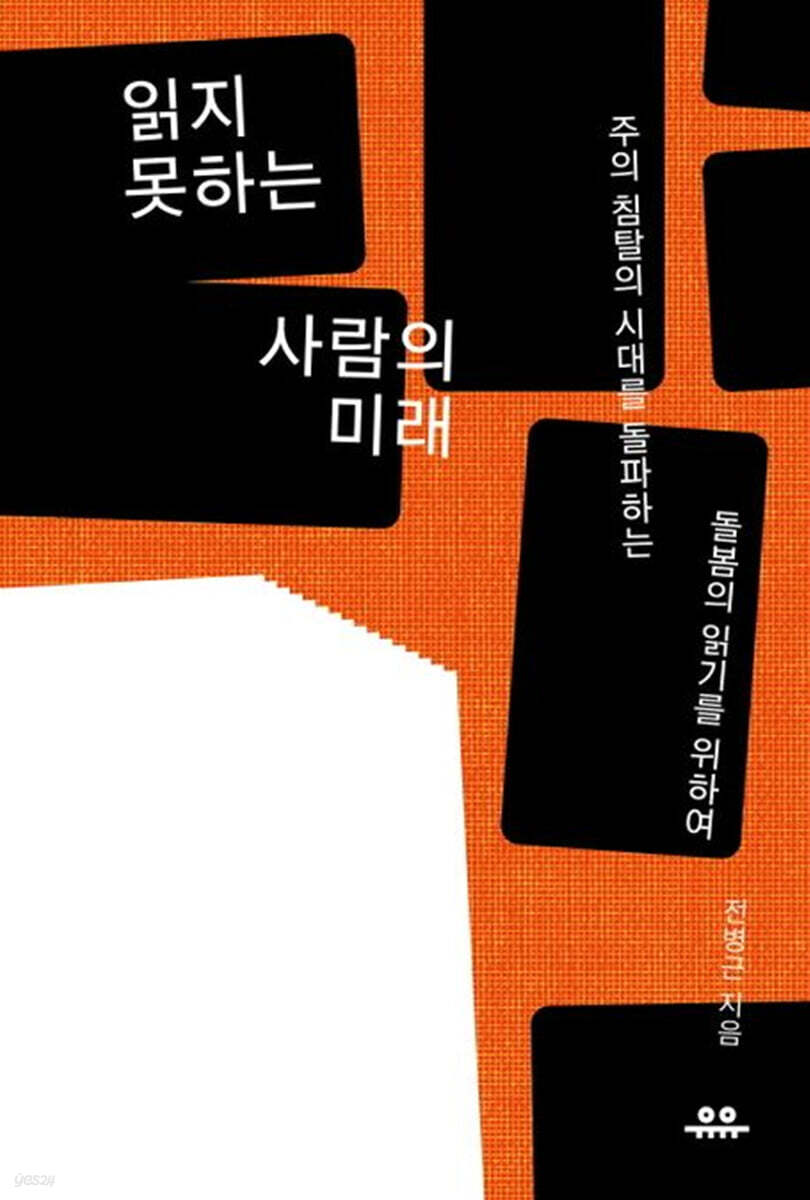
The future of those who cannot read
 |
Description
Book Introduction
In an age of attentional encroachment brought on by technological advancements, how can we reclaim our lost attention, exercise it autonomously, and live a good life as individuals capable of independent thought? This book addresses the question of why we need to read in the age of artificial intelligence, proposing "careful reading" as a new possibility and role for reading.
- You can preview some of the book's contents.
Preview
index
Introduction: Why We Need to Read Books in the Age of AI
Part 1
1 Humans began to walk the human path with technology.
2 Attention is a limited resource
3 AI is comparable to fire in human history.
4. The initiative is not taken away, but given.
5 Icarus' Wings of 'Technology'
6 The inefficient act of reading
Part 2
7 How Reading Changed Humans
8 AI wants to read every book in the world.
9. You should read long texts slowly and deeply.
10 The path to true knowledge is always a long detour.
11 Reading of care that goes beyond the self and pays attention to the world
12 Rethinking Life and Death in the Age of Artificial Intelligence
The words that come out: For care that reaches out like a miracle
Part 1
1 Humans began to walk the human path with technology.
2 Attention is a limited resource
3 AI is comparable to fire in human history.
4. The initiative is not taken away, but given.
5 Icarus' Wings of 'Technology'
6 The inefficient act of reading
Part 2
7 How Reading Changed Humans
8 AI wants to read every book in the world.
9. You should read long texts slowly and deeply.
10 The path to true knowledge is always a long detour.
11 Reading of care that goes beyond the self and pays attention to the world
12 Rethinking Life and Death in the Age of Artificial Intelligence
The words that come out: For care that reaches out like a miracle
Publisher's Review
Why read books in the age of artificial intelligence?
We need 'reading with care'
These days, with so many distractions and things to keep us busy, we are truly living in an era of "attention invasion."
Our attention is threatened by the advent of screens, social media, and visual media that instantly steal our attention.
Rather than focusing our attention on what we want, we give up trying to think between the convenient and easy choices technology provides.
To avoid giving up attention, the foundation of a meaningful life, we need the strength to think for ourselves and not be swept away by the waves of technology.
Reading books has long been championed as an efficient means of acquiring reliable, high-quality information and knowledge.
But with the advent of new cutting-edge technologies like AI, that role has become blurred.
The question, "Why should I read a book when it's all there on YouTube or Google?" is a familiar one.
"The Future of People Who Can't Read" proposes another possibility and role for reading: "reading for care."
‘Reading for Care’ refers to developing an eye for care by reading long, well-structured texts, namely books.
Rather than passively consuming information through a screen, we actively exercise our attention, thereby transcending the ego and looking around, reflecting, and observing others and the world with eyes of curiosity and affection.
This is also the most human act, as it cannot be relied on or replaced by any existing technology.
From the ancient myth of the Kura to the 2024 Nobel Prize in Physics for Geoffrey Hinton
Reading the desirable relationship between humans and technology
The most up-to-date and reliable bird's-eye view for Koreans
This book faithfully explores how human life, technology, and reading are intertwined.
Mr. Jeon Byeong-geun, a former journalist who currently runs Book Club Origin, describes himself as “interested in the fate of humanity in the digital age.”
This can be seen from his past actions.
In this day and age of explosive technological development, we have translated books such as Yuval Harari's "21 Lessons for the 21st Century," which ponders a good human life; Marion Wolff's "Back to Books," which emphasizes why we must read books despite the threat of digital devices; and Naomi Barron's "Reading Again," which examines various reading environments from paper books to screens, and these have been loved by many readers.
Through the interview collections 『The Expression of Knowledge』, 『The Ultimate Humanities』, and 『What Book Are You Reading These Days』, which contain conversations about a life of reading and thinking, I have been contemplating what a human life in the age of artificial intelligence is.
Furthermore, living up to his title of "knowledge curator," the teacher quickly captures and introduces academic research results, the latest trends, and foreign news related to his interests in digital technology and human life.
At the same time, we also select and quote from foreign books that are worth referencing.
From the ancient Kura myth, which teaches us that it is human nature to be unable to escape worry, anxiety, and worrying, to a discussion by 2024 Nobel Prize winner in Physics and "AI Godfather" Geoffrey Hinton about the unpredictable developments of AI and the real threats it poses, this book offers a wide range of reading material.
AI, which is comparable to fire in human history, is rapidly developing into new aspects.
In these times, when it's difficult to even fathom what technology will enable and how, if you want to live as a human being who actively exercises attention, the foundation of a human life, without surrendering it to technology, and contemplates what constitutes a good life, this book will be helpful.
We need 'reading with care'
These days, with so many distractions and things to keep us busy, we are truly living in an era of "attention invasion."
Our attention is threatened by the advent of screens, social media, and visual media that instantly steal our attention.
Rather than focusing our attention on what we want, we give up trying to think between the convenient and easy choices technology provides.
To avoid giving up attention, the foundation of a meaningful life, we need the strength to think for ourselves and not be swept away by the waves of technology.
Reading books has long been championed as an efficient means of acquiring reliable, high-quality information and knowledge.
But with the advent of new cutting-edge technologies like AI, that role has become blurred.
The question, "Why should I read a book when it's all there on YouTube or Google?" is a familiar one.
"The Future of People Who Can't Read" proposes another possibility and role for reading: "reading for care."
‘Reading for Care’ refers to developing an eye for care by reading long, well-structured texts, namely books.
Rather than passively consuming information through a screen, we actively exercise our attention, thereby transcending the ego and looking around, reflecting, and observing others and the world with eyes of curiosity and affection.
This is also the most human act, as it cannot be relied on or replaced by any existing technology.
From the ancient myth of the Kura to the 2024 Nobel Prize in Physics for Geoffrey Hinton
Reading the desirable relationship between humans and technology
The most up-to-date and reliable bird's-eye view for Koreans
This book faithfully explores how human life, technology, and reading are intertwined.
Mr. Jeon Byeong-geun, a former journalist who currently runs Book Club Origin, describes himself as “interested in the fate of humanity in the digital age.”
This can be seen from his past actions.
In this day and age of explosive technological development, we have translated books such as Yuval Harari's "21 Lessons for the 21st Century," which ponders a good human life; Marion Wolff's "Back to Books," which emphasizes why we must read books despite the threat of digital devices; and Naomi Barron's "Reading Again," which examines various reading environments from paper books to screens, and these have been loved by many readers.
Through the interview collections 『The Expression of Knowledge』, 『The Ultimate Humanities』, and 『What Book Are You Reading These Days』, which contain conversations about a life of reading and thinking, I have been contemplating what a human life in the age of artificial intelligence is.
Furthermore, living up to his title of "knowledge curator," the teacher quickly captures and introduces academic research results, the latest trends, and foreign news related to his interests in digital technology and human life.
At the same time, we also select and quote from foreign books that are worth referencing.
From the ancient Kura myth, which teaches us that it is human nature to be unable to escape worry, anxiety, and worrying, to a discussion by 2024 Nobel Prize winner in Physics and "AI Godfather" Geoffrey Hinton about the unpredictable developments of AI and the real threats it poses, this book offers a wide range of reading material.
AI, which is comparable to fire in human history, is rapidly developing into new aspects.
In these times, when it's difficult to even fathom what technology will enable and how, if you want to live as a human being who actively exercises attention, the foundation of a human life, without surrendering it to technology, and contemplates what constitutes a good life, this book will be helpful.
GOODS SPECIFICS
- Date of issue: November 4, 2024
- Format: Paperback book binding method guide
- Page count, weight, size: 260 pages | 236g | 128*188*12mm
- ISBN13: 9791167701053
- ISBN10: 1167701054
You may also like
카테고리
korean


korean

![GQ KOREA Mark (Monthly): December [2025]](http://librairie.coreenne.fr/cdn/shop/files/8ef265dbbfbf186523ed75ba7319009d.jpg?v=1765340328&width=3840)


