

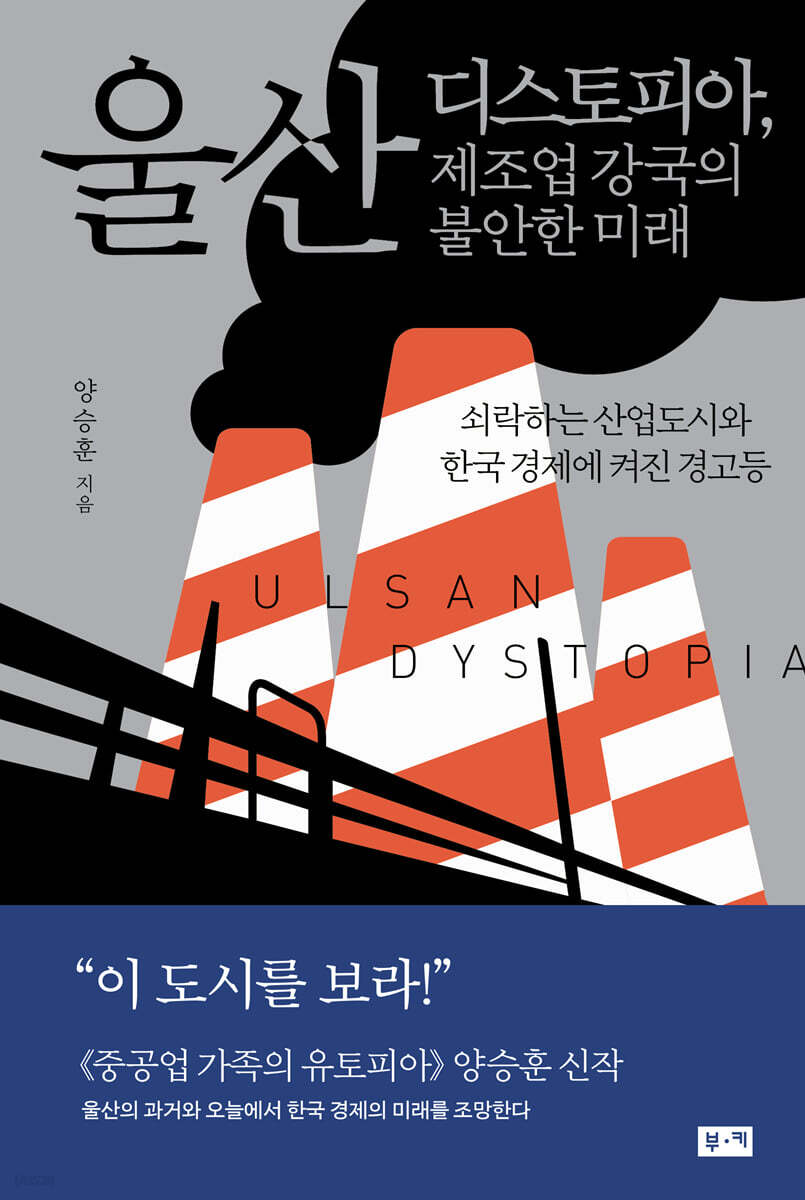
Ulsan's Dystopia: The Uncertain Future of a Manufacturing Powerhouse
 |
Description
Book Introduction
- A word from MD
-
Ulsan's Dilemma: The Future of a Manufacturing PowerhouseUlsan, an industrial capital, a wealthy city, and a city of middle-class workers.
A dark shadow hangs over this place.
People are leaving Ulsan.
There is a severe outflow of women and youth.
A masterpiece analyzing the dilemmas facing Ulsan, including subcontracting and outsourcing, industrial patriarchy, and the stranded megacity theory, and the future of manufacturing in South Korea.
April 9, 2024. Social and Political PD Son Min-gyu
This is a comprehensive report on Ulsan, a representative industrial city.
A sharp look at the reality of manufacturing and the future of South Korea, which has lost its growth engine!
A city with the nicknames 'Korea's industrial capital, the wealthiest city with the highest GDP in the country, and a city for middle-class workers.'
Ulsan has been the most developed industrial city in East Asia over the past 60 years.
"Ulsan Dystopia: The Unstable Future of a Manufacturing Powerhouse" is a bold project that begins with the dilemma Ulsan faces amidst the manufacturing crisis and then controversially examines the future of Korea Corporation, facing the perfect storm of the Fourth Industrial Revolution and the climate crisis.
A new work by Yang Seung-hoon, who received attention as an "industrial sociologist from a shipyard" in 2019 for his work "Utopia of a Heavy Industry Family" and won the Korean Sociological Association Academic Award and the Korean Publication Culture Award in the liberal arts category, is his first in five years.
The topic has expanded to Ulsan, manufacturing, and the Republic of Korea, and I hope this will open the door to a fierce debate.
A sharp look at the reality of manufacturing and the future of South Korea, which has lost its growth engine!
A city with the nicknames 'Korea's industrial capital, the wealthiest city with the highest GDP in the country, and a city for middle-class workers.'
Ulsan has been the most developed industrial city in East Asia over the past 60 years.
"Ulsan Dystopia: The Unstable Future of a Manufacturing Powerhouse" is a bold project that begins with the dilemma Ulsan faces amidst the manufacturing crisis and then controversially examines the future of Korea Corporation, facing the perfect storm of the Fourth Industrial Revolution and the climate crisis.
A new work by Yang Seung-hoon, who received attention as an "industrial sociologist from a shipyard" in 2019 for his work "Utopia of a Heavy Industry Family" and won the Korean Sociological Association Academic Award and the Korean Publication Culture Award in the liberal arts category, is his first in five years.
The topic has expanded to Ulsan, manufacturing, and the Republic of Korea, and I hope this will open the door to a fierce debate.
- You can preview some of the book's contents.
Preview
index
Prologue: Where is the Industrial City of Ulsan Heading?
Part 1: How Ulsan Became an Industrial Capital
Chapter 1: Ulsan, the Industrial City, Stands at a Crossroads
Chapter 2: Miracle Ulsan, 60 Years of Ulsan Industry
Part 2: The Heartbeat of South Korea's Manufacturing Industry is Dying
Chapter 3: The Special Characteristics of the Korean Economy and Manufacturing
Chapter 4: Ulsan's Regression from a Center of Manufacturing Development to a Peripheral Production Base
Chapter 5: Why Ulsan Workers Disappeared from the Public Eye
Chapter 6: The Engineer's Factory That Doesn't Hire Full-Time Employees
Chapter 7: The Collapse of the Productivity Alliance: Ulsan Survives Through Subcontracting
Part 3: The Shadow of Industrial Patriarchy and the Dream of the Middle Class
Chapter 8: The Production City Where Young People Leave
Chapter 9: Women Avoiding the Production City
Chapter 10: Should the Dream of a Middle-Class Working Class Society Be Abandoned?
Part 4: Industrial Cities and the Future of Korea
Chapter 11: Detroit and Pittsburgh: A Tale of Two Cities
Chapter 12: RE100 and the Future of the Smokestack Industry
Chapter 13: Megacities: What's the Problem?
Chapter 14: Production Cities and the Future of South Korea
Epilogue: Again, for the dream of an industrial city, Ulsan
Appendix: Research Methodology and Participants
Acknowledgements
Part 1: How Ulsan Became an Industrial Capital
Chapter 1: Ulsan, the Industrial City, Stands at a Crossroads
Chapter 2: Miracle Ulsan, 60 Years of Ulsan Industry
Part 2: The Heartbeat of South Korea's Manufacturing Industry is Dying
Chapter 3: The Special Characteristics of the Korean Economy and Manufacturing
Chapter 4: Ulsan's Regression from a Center of Manufacturing Development to a Peripheral Production Base
Chapter 5: Why Ulsan Workers Disappeared from the Public Eye
Chapter 6: The Engineer's Factory That Doesn't Hire Full-Time Employees
Chapter 7: The Collapse of the Productivity Alliance: Ulsan Survives Through Subcontracting
Part 3: The Shadow of Industrial Patriarchy and the Dream of the Middle Class
Chapter 8: The Production City Where Young People Leave
Chapter 9: Women Avoiding the Production City
Chapter 10: Should the Dream of a Middle-Class Working Class Society Be Abandoned?
Part 4: Industrial Cities and the Future of Korea
Chapter 11: Detroit and Pittsburgh: A Tale of Two Cities
Chapter 12: RE100 and the Future of the Smokestack Industry
Chapter 13: Megacities: What's the Problem?
Chapter 14: Production Cities and the Future of South Korea
Epilogue: Again, for the dream of an industrial city, Ulsan
Appendix: Research Methodology and Participants
Acknowledgements
Detailed image

Into the book
The question facing Ulsan ultimately contains anxiety about how far the export-led industry centered on heavy chemical industries, which was formed in the 1970s, will go.
Innovation and technology economics researchers often say that we need to break away from the "catch-up economy."
To put it simply, Korean manufacturing began as a production subcontracting base for Japan, disassembling and assembling received parts and finished products, imitating them, and growing by copying and improving blueprints under the guidance of engineers who had studied in the United States and Europe.
Moreover, rather than increasing the skill level of workers, the world's highest manufacturing productivity was achieved by increasing productivity with equipment such as robots and NC lathes from Germany and Japan.
Meanwhile, Europe's equipment and workforce were aging, the United States was neglecting manufacturing, and Japan was struggling to invest in facilities.
--- p.9
Ulsan is often described as the industrial capital of South Korea, the wealthiest city in the country in terms of gross regional domestic product (GRDP), and a city of middle-class workers.
Ulsan has firmly established itself as a hub for the so-called "three major industries" of automobiles, shipbuilding, and petrochemicals, each of which has reached world-class levels.
It is also called the axis of manufacturing in the southeastern region (Busan, Ulsan, and Gyeongnam) and the center of the southeast coastal industrial area that runs from Pohang along the east coast, through the south coast, and all the way to Yeosu.
But how will Ulsan be remembered in 2030, a few years from now? Will the terms "wealthy city," "workers' city," and "industrial capital" still be relevant then?
--- p.20
According to official government records, the beginning of Ulsan as an industrial city can be said to be in 1962.
While South Korea went from being one of the world's poorest countries to a member of the "30-50 Club" (with a GDP per capita of $30,000 and a population of 50 million) boasting the world's top 10 trading nations in just 60 years since industrialization, Ulsan grew into one of the most developed industrial cities in East Asia over the next 60 years.
--- p.45
In this way, Ulsan was designed by Ikeda as an industrial city and oil reserve base for the Pacific War during the Japanese colonial period.
Ulsan was classified into five keywords: ‘industrial port, fishing port, contact port, trade port, and airport.’
By linking these five keywords, we can see that Ulsan's role as a 'logistics base' for Japan's Pacific War was emphasized.
--- p.48
Here, a third perspective on Hyundai Heavy Industries' success emerges.
In other words, this is the view that success was achieved by many people both inside and outside of heavy industry.
This is the achievement of those who traveled all the way to Scotland to learn shipbuilding techniques, and then went to Japan to learn drawing and design techniques, constantly asking and re-asking questions to Japanese engineers.
This means that there was a lot of hard work by engineers who combined European and Japanese shipbuilding techniques to create their own unique Hyundai Heavy Industries-style shipbuilding technology.
There was also the dedication of workers who worked on sites where even the necessary scaffolding, essential for high-altitude work, was not properly constructed, relying on ropes.
Another driving force behind Hyundai Heavy Industries' success was the young people of the 1970s and 1990s, who had to find work due to food shortages and explosive population growth.
--- p.64
Considering all these points, it is impossible not to describe Ulsan's history as a miracle.
There was coincidence and inevitability, and the efforts of both the planner and the executor.
It started out as a base for oil reserves during the Japanese colonial period, and was designated as an industrial center by the military government and businessmen to build an oil refinery with the capital.
A sharp-eyed government technical official chose Ulsan as a strategic location for heavy chemical industry.
But there was Hyundai in the 1970s, led by venture capitalist Chung Ju-yung, who actually put it into practice, and there were engineers who lost sleep and copied drawings and technologies with keen eyes.
Ultimately, there were the workers in Ulsan who built ships and manufactured cars, taking risks for low wages and under poor safety conditions.
Like the spirit bomb in the manga "Dragon Ball," everyone's sincerity came together to create a miracle in Ulsan, a city of workers and a wealthy neighborhood.
--- p.69
Korea is a country supported by manufacturing.
This is evident in the country's image and figures. According to OECD data, as of 2020, South Korea earned 27.1 percent of its gross national product (GDP) from manufacturing, with Ireland (36.6 percent) being the only country with a higher manufacturing share of GDP than South Korea.
This characteristic is even more pronounced in terms of employment. 1 According to the World Bank's data on employment rates by industry, as of 2019, manufacturing accounted for 25 percent of total employment in Korea.
According to the International Labor Organization (ILO), among OECD countries, only Germany (27 percent) and Italy (26 percent) have a higher proportion of manufacturing employment than Korea.
--- p.74
In fact, during the recession, many industrial cities around the world experienced decline.
Most industrial cities in advanced capitalist countries, such as Manchester and Liverpool in Northern England, Glasgow in Scotland, and the Rust Belt in the northern United States, declined in the midst of the crisis and were unable to easily regain their former glory.
Why would this be? Why do industrial cities like Imabari and Kitakyushu in Japan operate factories employing only migrant workers and the elderly? If Ulsan's status within the manufacturing industry shifts and many regular production workers retire, leaving the city with no more permanent positions, what fate awaits Ulsan's three major industrial sites and the city itself? Furthermore, with industrial cities being reduced to subcontracting production bases, will South Korea, a manufacturing nation dependent on export manufacturing, face any problems?
--- p.85
The "brains" of Ulsan's three major industries, namely the research institutes and engineering centers responsible for planning functions, have mostly relocated to the metropolitan area, and the rest are waiting to be relocated to Seoul.
To get a better brain.
Now, Ulsan is falling from an industrial city to a production base.
Even when building a new 'body', that is, a factory that performs the execution function, the metropolitan area is considered as the location.
--- p.88
The United States completely separated engineers from production workers and made them into people who put the company's management policies into practice on the ground.
Engineers independently conduct experiments on production methods, including automation, robot installation, and route design.
Therefore, the work done by college graduate engineers and high school graduate production workers does not overlap.
In Germany, a significant proportion of engineers are trained through apprenticeships, similar to production workers.
Also, many people in production jobs go on to college to study engineering and become engineers.
Ultimately, there are many instances of sharing field experience and engineering knowledge, and many tasks are often carried out through consultation.
While Japan and Germany have developed systems and policies to reduce the gap between production workers and engineers, the United States stands on the opposite side.
The Korean production method, similar to that of Japan or Germany, initially had many high school graduate engineers and a history of workplaces where there was a lot of collaboration between production workers and engineers.
However, as labor-management relations have become hostile since 1987, management has been applying American-style management methods.
We have pushed for the introduction of automation and robots and have tried to reduce, where possible, worker intervention based on skill in production sites.
--- p.95
The 'working middle class' that our fathers fought for is now in danger of ending in a single generation.
Because the doors to regular production jobs, which are the ticket to becoming a working-class middle class, are closing.
This 'employment cliff' occurred because the demand for skilled labor decreased.
This is because a production method that does not rely on the skills of production workers has taken hold.
To question the regeneration of the industrial city of Ulsan, to question the hiring of new regular production workers, and to question Hyundai Motor Company's production methods, which create a situation where regular production workers are no longer needed, we must ask.
--- p.150
By examining the cases of Hyundai Motor Company, Hyundai Heavy Industries, and POSCO together, we can understand the historical trajectory through which labor-management relations were formed.
A productivity alliance is possible when labor-management relations are based on trust.
POSCO's productivity alliance suggests that labor-management relations can affect not only workers' wages and welfare, but also the very formation of workers' skills from a productivity perspective.
Trust in labor-management relations depends on how historically labor-management disputes and conflicts are resolved.
The productivity alliance is not just a labor-management relations issue.
Looking more broadly, it is also affected by the way the state provides incentives or enforces labor-management relations.
--- p.187
Ulsan, which is being reduced to a production base, is not sustainable.
First of all, since the three industries that create the most added value hardly hire regular workers, young people no longer visit Ulsan's factories.
The younger generation, who experienced the high wages and welfare benefits of their fathers' generation, find it difficult to tolerate the current irregular, subcontracted labor.
When the economy, which relies on male breadwinners for working-class families based on regular employment, fails to function, women also leave the area.
As the local population declines, especially the youth population, the city's vitality is bound to decline.
--- p.191
The term industrial patriarchy is unfamiliar and can be defined as a concept somewhat different from conventional patriarchy.
Industrial patriarchy refers to the patriarchy created by the unequal gender division of labor in an area dominated by a specific industry.
On the one hand, the traditional patriarchal system is collapsing with the 'dual-income model' created by women's increased education and participation in the white-collar and professional labor markets.
In comparison, the patriarchy that has historically accumulated in industrial districts created through the spatial division of labor and the national spatial planning explained above can be called industrial patriarchy.
--- p.206
Since 1998, the standard for household economy in Korean society has rapidly shifted from a 'single-income' (one-male breadwinner) to a 'dual-income' household.
Strictly speaking, it wouldn't be an exaggeration to say that the single-income male breadwinner economy briefly floated as a fantasy from the Great Labor Struggle of 1987 to the IMF crisis of 1998. There's a narrative that the lifetime job disappeared after the IMF crisis and women entered society in search of work.
But even before that, women had been working in various light industry jobs, such as door-to-door salespeople and sewing machine operators, both full-time and part-time, starting with the "Yakult ladies."
(…) In terms of the concept of labor sociology, the labor experience of most Korean women after liberation was to continue to hover around various service industries, the informal economy, and external labor markets near light industry.
--- p.255
Britain's working class was torn apart by the intense 'class war' between employers and employees in the 1970s and 1980s and the weakening competitiveness of British manufacturing.
British workers succeeded in locking down their skills to their own know-how, but failed to 'evolve' in line with industrial development.
Moreover, as the center of industry shifted from manufacturing production to engineering and biotechnology in London and the financial industry in The City, its status within the country declined.
The machinery, shipbuilding, and steel industries of northern England and Scotland all suffered and gradually shrank.
Ultimately, the working-class middle-class model collapsed.
--- p.281
The climate crisis presents an opportunity for Ulsan's three major industries, but it does not offer prospects for industrial advancement or new business development.
Eco-friendly electric vehicles and the hydrogen economy offer opportunities for Hyundai Motor Company, but Ulsan's auto parts ecosystem is weak and lacks clear solutions.
The 50,000 jobs in the auto parts industry are likely to be at risk soon.
IMO regulations requiring a decarbonization transition provide the shipbuilding industry with opportunities to secure new vessel orders.
However, the problem of wage gap between primary and secondary contractors due to the entrenched dual structure of the labor market and wage decline during recessions has not been resolved, and quality jobs have not been created.
The transition to precision chemicals, necessary for an eco-friendly automobile ecosystem to address the climate crisis, is also being hindered by policy capacity and the conservative nature of the existing petrochemical industry.
--- p.345
Even if the Southeast Megacity Project, aimed at balanced regional development, is relaunched, opening up opportunities for regional politics across metropolitan areas, or if the Haeoreum Alliance is implemented as a project for an industrial city federation, Ulsan still faces challenges in its industrial structure.
How should Ulsan secure its competitiveness as an industrial city engaged in manufacturing?
How can we create quality jobs and protect and nurture a talented workforce?
How should the government view Ulsan and Korea's manufacturing industry, and what position should Ulsan maintain?
--- p.367
For the industrial city of Ulsan to adopt a high-tech strategy, it is necessary to break away from existing dogmas.
First, those who write economic reviews approach Korea's industrial problems from the perspective of cost reduction.
They argue that companies are leaving the country because of unions that paralyze production while driving up costs too much.
In doing so, they often bring up the Hyundai Motor Company and Hyundai Heavy Industries unions in Ulsan.
It is clear that companies are constantly facing challenges if production costs rise but productivity does not improve accordingly.
But the decision by large corporations like SK Hynix and their subcontracting clusters to move their factories to the metropolitan area, paying premiums to hire highly educated engineers and bearing high real estate costs, proves that this isn't just a matter of cost.
Rather, the problem is that there is a lack of good talent.
--- p.376
The point is that the state has taken the naturally established spatial division of labor one step further through policy.
The total number of factories in the metropolitan area was lifted, allowing factories to be located near the capital region. LG Display (then LG Philips) established operations in Paju, and SK Hynix established operations from Icheon to Cheongju.
Samsung built factories from Suwon to Cheonan.
At this time, the term 'Cheonan Demarcation Line' appeared in the media.
They say that talented people do not come south of Cheonan.
--- p.394
How can we revive the dream of Ulsan as a new industrial city? First, we need a strong consensus on Ulsan's value as a manufacturing cluster.
The most effective way to achieve the Fourth Industrial Revolution, through advanced manufacturing and the integration of AI and ICT, is to start in Ulsan.
Because it has the most advanced manufacturing capabilities in the machinery field, and because it is home to experts with 50 years of accumulated experience and embodied skills.
If the southeastern region suffered as Geoje struggled during the shipbuilding industry restructuring process, then if Ulsan's employment collapses and its manufacturing competitiveness disappears, the manufacturing industry not only in the southeastern region but across the country could be shaken.
This is true not only in employment but also at the supply and value chain level of the industrial ecosystem.
We cannot discuss manufacturing while neglecting Ulsan.
Second, we must recognize that this is a situation that cannot be unilaterally led by the state, local governments, large corporations, or labor unions.
Ultimately, negotiations must begin at the local level, with a clear understanding of the issues and a recognition of each party's interests, and gradually work to resolve them, starting with the bare minimum.
Innovation and technology economics researchers often say that we need to break away from the "catch-up economy."
To put it simply, Korean manufacturing began as a production subcontracting base for Japan, disassembling and assembling received parts and finished products, imitating them, and growing by copying and improving blueprints under the guidance of engineers who had studied in the United States and Europe.
Moreover, rather than increasing the skill level of workers, the world's highest manufacturing productivity was achieved by increasing productivity with equipment such as robots and NC lathes from Germany and Japan.
Meanwhile, Europe's equipment and workforce were aging, the United States was neglecting manufacturing, and Japan was struggling to invest in facilities.
--- p.9
Ulsan is often described as the industrial capital of South Korea, the wealthiest city in the country in terms of gross regional domestic product (GRDP), and a city of middle-class workers.
Ulsan has firmly established itself as a hub for the so-called "three major industries" of automobiles, shipbuilding, and petrochemicals, each of which has reached world-class levels.
It is also called the axis of manufacturing in the southeastern region (Busan, Ulsan, and Gyeongnam) and the center of the southeast coastal industrial area that runs from Pohang along the east coast, through the south coast, and all the way to Yeosu.
But how will Ulsan be remembered in 2030, a few years from now? Will the terms "wealthy city," "workers' city," and "industrial capital" still be relevant then?
--- p.20
According to official government records, the beginning of Ulsan as an industrial city can be said to be in 1962.
While South Korea went from being one of the world's poorest countries to a member of the "30-50 Club" (with a GDP per capita of $30,000 and a population of 50 million) boasting the world's top 10 trading nations in just 60 years since industrialization, Ulsan grew into one of the most developed industrial cities in East Asia over the next 60 years.
--- p.45
In this way, Ulsan was designed by Ikeda as an industrial city and oil reserve base for the Pacific War during the Japanese colonial period.
Ulsan was classified into five keywords: ‘industrial port, fishing port, contact port, trade port, and airport.’
By linking these five keywords, we can see that Ulsan's role as a 'logistics base' for Japan's Pacific War was emphasized.
--- p.48
Here, a third perspective on Hyundai Heavy Industries' success emerges.
In other words, this is the view that success was achieved by many people both inside and outside of heavy industry.
This is the achievement of those who traveled all the way to Scotland to learn shipbuilding techniques, and then went to Japan to learn drawing and design techniques, constantly asking and re-asking questions to Japanese engineers.
This means that there was a lot of hard work by engineers who combined European and Japanese shipbuilding techniques to create their own unique Hyundai Heavy Industries-style shipbuilding technology.
There was also the dedication of workers who worked on sites where even the necessary scaffolding, essential for high-altitude work, was not properly constructed, relying on ropes.
Another driving force behind Hyundai Heavy Industries' success was the young people of the 1970s and 1990s, who had to find work due to food shortages and explosive population growth.
--- p.64
Considering all these points, it is impossible not to describe Ulsan's history as a miracle.
There was coincidence and inevitability, and the efforts of both the planner and the executor.
It started out as a base for oil reserves during the Japanese colonial period, and was designated as an industrial center by the military government and businessmen to build an oil refinery with the capital.
A sharp-eyed government technical official chose Ulsan as a strategic location for heavy chemical industry.
But there was Hyundai in the 1970s, led by venture capitalist Chung Ju-yung, who actually put it into practice, and there were engineers who lost sleep and copied drawings and technologies with keen eyes.
Ultimately, there were the workers in Ulsan who built ships and manufactured cars, taking risks for low wages and under poor safety conditions.
Like the spirit bomb in the manga "Dragon Ball," everyone's sincerity came together to create a miracle in Ulsan, a city of workers and a wealthy neighborhood.
--- p.69
Korea is a country supported by manufacturing.
This is evident in the country's image and figures. According to OECD data, as of 2020, South Korea earned 27.1 percent of its gross national product (GDP) from manufacturing, with Ireland (36.6 percent) being the only country with a higher manufacturing share of GDP than South Korea.
This characteristic is even more pronounced in terms of employment. 1 According to the World Bank's data on employment rates by industry, as of 2019, manufacturing accounted for 25 percent of total employment in Korea.
According to the International Labor Organization (ILO), among OECD countries, only Germany (27 percent) and Italy (26 percent) have a higher proportion of manufacturing employment than Korea.
--- p.74
In fact, during the recession, many industrial cities around the world experienced decline.
Most industrial cities in advanced capitalist countries, such as Manchester and Liverpool in Northern England, Glasgow in Scotland, and the Rust Belt in the northern United States, declined in the midst of the crisis and were unable to easily regain their former glory.
Why would this be? Why do industrial cities like Imabari and Kitakyushu in Japan operate factories employing only migrant workers and the elderly? If Ulsan's status within the manufacturing industry shifts and many regular production workers retire, leaving the city with no more permanent positions, what fate awaits Ulsan's three major industrial sites and the city itself? Furthermore, with industrial cities being reduced to subcontracting production bases, will South Korea, a manufacturing nation dependent on export manufacturing, face any problems?
--- p.85
The "brains" of Ulsan's three major industries, namely the research institutes and engineering centers responsible for planning functions, have mostly relocated to the metropolitan area, and the rest are waiting to be relocated to Seoul.
To get a better brain.
Now, Ulsan is falling from an industrial city to a production base.
Even when building a new 'body', that is, a factory that performs the execution function, the metropolitan area is considered as the location.
--- p.88
The United States completely separated engineers from production workers and made them into people who put the company's management policies into practice on the ground.
Engineers independently conduct experiments on production methods, including automation, robot installation, and route design.
Therefore, the work done by college graduate engineers and high school graduate production workers does not overlap.
In Germany, a significant proportion of engineers are trained through apprenticeships, similar to production workers.
Also, many people in production jobs go on to college to study engineering and become engineers.
Ultimately, there are many instances of sharing field experience and engineering knowledge, and many tasks are often carried out through consultation.
While Japan and Germany have developed systems and policies to reduce the gap between production workers and engineers, the United States stands on the opposite side.
The Korean production method, similar to that of Japan or Germany, initially had many high school graduate engineers and a history of workplaces where there was a lot of collaboration between production workers and engineers.
However, as labor-management relations have become hostile since 1987, management has been applying American-style management methods.
We have pushed for the introduction of automation and robots and have tried to reduce, where possible, worker intervention based on skill in production sites.
--- p.95
The 'working middle class' that our fathers fought for is now in danger of ending in a single generation.
Because the doors to regular production jobs, which are the ticket to becoming a working-class middle class, are closing.
This 'employment cliff' occurred because the demand for skilled labor decreased.
This is because a production method that does not rely on the skills of production workers has taken hold.
To question the regeneration of the industrial city of Ulsan, to question the hiring of new regular production workers, and to question Hyundai Motor Company's production methods, which create a situation where regular production workers are no longer needed, we must ask.
--- p.150
By examining the cases of Hyundai Motor Company, Hyundai Heavy Industries, and POSCO together, we can understand the historical trajectory through which labor-management relations were formed.
A productivity alliance is possible when labor-management relations are based on trust.
POSCO's productivity alliance suggests that labor-management relations can affect not only workers' wages and welfare, but also the very formation of workers' skills from a productivity perspective.
Trust in labor-management relations depends on how historically labor-management disputes and conflicts are resolved.
The productivity alliance is not just a labor-management relations issue.
Looking more broadly, it is also affected by the way the state provides incentives or enforces labor-management relations.
--- p.187
Ulsan, which is being reduced to a production base, is not sustainable.
First of all, since the three industries that create the most added value hardly hire regular workers, young people no longer visit Ulsan's factories.
The younger generation, who experienced the high wages and welfare benefits of their fathers' generation, find it difficult to tolerate the current irregular, subcontracted labor.
When the economy, which relies on male breadwinners for working-class families based on regular employment, fails to function, women also leave the area.
As the local population declines, especially the youth population, the city's vitality is bound to decline.
--- p.191
The term industrial patriarchy is unfamiliar and can be defined as a concept somewhat different from conventional patriarchy.
Industrial patriarchy refers to the patriarchy created by the unequal gender division of labor in an area dominated by a specific industry.
On the one hand, the traditional patriarchal system is collapsing with the 'dual-income model' created by women's increased education and participation in the white-collar and professional labor markets.
In comparison, the patriarchy that has historically accumulated in industrial districts created through the spatial division of labor and the national spatial planning explained above can be called industrial patriarchy.
--- p.206
Since 1998, the standard for household economy in Korean society has rapidly shifted from a 'single-income' (one-male breadwinner) to a 'dual-income' household.
Strictly speaking, it wouldn't be an exaggeration to say that the single-income male breadwinner economy briefly floated as a fantasy from the Great Labor Struggle of 1987 to the IMF crisis of 1998. There's a narrative that the lifetime job disappeared after the IMF crisis and women entered society in search of work.
But even before that, women had been working in various light industry jobs, such as door-to-door salespeople and sewing machine operators, both full-time and part-time, starting with the "Yakult ladies."
(…) In terms of the concept of labor sociology, the labor experience of most Korean women after liberation was to continue to hover around various service industries, the informal economy, and external labor markets near light industry.
--- p.255
Britain's working class was torn apart by the intense 'class war' between employers and employees in the 1970s and 1980s and the weakening competitiveness of British manufacturing.
British workers succeeded in locking down their skills to their own know-how, but failed to 'evolve' in line with industrial development.
Moreover, as the center of industry shifted from manufacturing production to engineering and biotechnology in London and the financial industry in The City, its status within the country declined.
The machinery, shipbuilding, and steel industries of northern England and Scotland all suffered and gradually shrank.
Ultimately, the working-class middle-class model collapsed.
--- p.281
The climate crisis presents an opportunity for Ulsan's three major industries, but it does not offer prospects for industrial advancement or new business development.
Eco-friendly electric vehicles and the hydrogen economy offer opportunities for Hyundai Motor Company, but Ulsan's auto parts ecosystem is weak and lacks clear solutions.
The 50,000 jobs in the auto parts industry are likely to be at risk soon.
IMO regulations requiring a decarbonization transition provide the shipbuilding industry with opportunities to secure new vessel orders.
However, the problem of wage gap between primary and secondary contractors due to the entrenched dual structure of the labor market and wage decline during recessions has not been resolved, and quality jobs have not been created.
The transition to precision chemicals, necessary for an eco-friendly automobile ecosystem to address the climate crisis, is also being hindered by policy capacity and the conservative nature of the existing petrochemical industry.
--- p.345
Even if the Southeast Megacity Project, aimed at balanced regional development, is relaunched, opening up opportunities for regional politics across metropolitan areas, or if the Haeoreum Alliance is implemented as a project for an industrial city federation, Ulsan still faces challenges in its industrial structure.
How should Ulsan secure its competitiveness as an industrial city engaged in manufacturing?
How can we create quality jobs and protect and nurture a talented workforce?
How should the government view Ulsan and Korea's manufacturing industry, and what position should Ulsan maintain?
--- p.367
For the industrial city of Ulsan to adopt a high-tech strategy, it is necessary to break away from existing dogmas.
First, those who write economic reviews approach Korea's industrial problems from the perspective of cost reduction.
They argue that companies are leaving the country because of unions that paralyze production while driving up costs too much.
In doing so, they often bring up the Hyundai Motor Company and Hyundai Heavy Industries unions in Ulsan.
It is clear that companies are constantly facing challenges if production costs rise but productivity does not improve accordingly.
But the decision by large corporations like SK Hynix and their subcontracting clusters to move their factories to the metropolitan area, paying premiums to hire highly educated engineers and bearing high real estate costs, proves that this isn't just a matter of cost.
Rather, the problem is that there is a lack of good talent.
--- p.376
The point is that the state has taken the naturally established spatial division of labor one step further through policy.
The total number of factories in the metropolitan area was lifted, allowing factories to be located near the capital region. LG Display (then LG Philips) established operations in Paju, and SK Hynix established operations from Icheon to Cheongju.
Samsung built factories from Suwon to Cheonan.
At this time, the term 'Cheonan Demarcation Line' appeared in the media.
They say that talented people do not come south of Cheonan.
--- p.394
How can we revive the dream of Ulsan as a new industrial city? First, we need a strong consensus on Ulsan's value as a manufacturing cluster.
The most effective way to achieve the Fourth Industrial Revolution, through advanced manufacturing and the integration of AI and ICT, is to start in Ulsan.
Because it has the most advanced manufacturing capabilities in the machinery field, and because it is home to experts with 50 years of accumulated experience and embodied skills.
If the southeastern region suffered as Geoje struggled during the shipbuilding industry restructuring process, then if Ulsan's employment collapses and its manufacturing competitiveness disappears, the manufacturing industry not only in the southeastern region but across the country could be shaken.
This is true not only in employment but also at the supply and value chain level of the industrial ecosystem.
We cannot discuss manufacturing while neglecting Ulsan.
Second, we must recognize that this is a situation that cannot be unilaterally led by the state, local governments, large corporations, or labor unions.
Ultimately, negotiations must begin at the local level, with a clear understanding of the issues and a recognition of each party's interests, and gradually work to resolve them, starting with the bare minimum.
--- p.410
Publisher's Review
“Look at this city”
Why South Korea's Growth Engine Is Dying
Ulsan, an industrial city located on the southeastern coast of the Korean Peninsula, has been called "South Korea's industrial capital" and "middle-class working-class city."
Ulsan has been the most developed industrial city in East Asia over the past 60 years.
But the city is showing clear signs of decline.
Ulsan, with a population of 1.15 million, is still the wealthiest city in the country in terms of gross regional domestic product (GRDP) and the third-largest metropolitan city in terms of exports, following Gyeonggi Province and South Chungcheong Province. However, the city's vitality has been declining for a long time.
Ulsan has become an aging city centered on middle-aged workers and retirees, with few new young jobs being created.
Local universities are losing their power as a source of talent to support Ulsan's three major industries: automobiles, shipbuilding, and heavy chemicals. Research institutes and engineering centers, key drivers of technological innovation, have long since moved to the metropolitan area north of Cheonan.
Also, young people and women are leaving the city, and the population is declining.
The perfect storm of the Fourth Industrial Revolution, the climate crisis, and the Green New Deal is upon us. Ulsan, with its traditional manufacturing industry, must find solutions. The interests of the local government, local residents, large corporations, subcontractors, and parts suppliers all differ.
The climate crisis presents an opportunity for Ulsan's three major industries, but it does not offer prospects for industrial advancement or new business development.
Eco-friendly electric vehicles and the hydrogen economy offer opportunities for Hyundai Motor Company, but Ulsan's auto parts ecosystem is weak and lacks clear solutions.
The 50,000 jobs in the auto parts industry are likely to be at risk soon.
IMO regulations requiring a decarbonization transition provide the shipbuilding industry with opportunities to secure new vessel orders.
However, the problem of wage gap between primary and secondary contractors due to the entrenched dual structure of the labor market and wage decline during recessions has not been resolved, and quality jobs have not been created.
The transition to precision chemicals, necessary for an eco-friendly automobile ecosystem to address the climate crisis, is also being hindered by policy capacity and the conservative nature of the existing petrochemical industry.
-Page 345
"Ulsan Dystopia: The Unstable Future of a Manufacturing Powerhouse" is a book that examines the past and present of Ulsan, the "industrial capital of Korea," and explores its future.
The purpose of this in-depth analysis of Ulsan's industrial structure, labor market, and social relations is to examine and synthesize the nature of the crisis facing the Korean economy, which has grown primarily through manufacturing and exports, and to seek alternative solutions.
Therefore, this book is a comprehensive report on Ulsan, a representative industrial city, and at the same time, a reflection on the reality of manufacturing, which is considered a "declining industry" in the era of the Fourth Industrial Revolution, and the future of South Korea, which has lost its growth engine.
Author Yang Seung-hoon published "Utopia of a Heavy Industry Family," a sociological analysis of the industrial city of Geoje and the shipbuilding industry, based on his observations from five years of working at a shipyard in 2019.
With this book, he gained attention as an "industrial sociologist from a shipyard" with experience in the industrial field, and the following year, he won the Korean Sociological Association Academic Award and the Korean Publication Culture Award in the liberal arts category.
This book, published after five years, expands the discussion from Geoje to Ulsan, and from Ulsan to the Republic of Korea.
This is not simply a matter of spatial and geographical expansion.
The purpose of this book is to confront, rather than be dodge, the perplexing questions that Korea, a manufacturing nation, currently faces.
Miracle Ulsan,
The 'good' times, filled with everyone's sincerity and effort
Part 1 of the book looks back on Ulsan's 60-year industrial history, examining how it has rapidly emerged as an industrial capital.
The military government that came to power through the May 16, 1961 military coup announced a five-year economic development plan on January 13, 1962, and designated Ulsan as a special industrial zone on the 27th of the same month.
In February, the groundbreaking ceremony for the Ulsan Industrial Center was held.
In June, Ulsan-gun announced the promotion of Ulsan-eup, Bangeojin-eup, Daehyeon-myeon, Hasang-myeon, Duwang-ri, Cheongnyang-myeon, Mugeori and Daun-ri, Beomseo-myeon, and Songjeong-ri and Hwabong-ri, Nongso-myeon to Ulsan City.
Afterwards, Hyundai Motor Company and Hyundai Heavy Industries, which will be discussed later, entered the market and formed what are now Ulsan's three major industries.
A simple understanding of this narrative could make the formation of the industrial city of Ulsan seem like an achievement of Park Chung-hee and the Hyundai Group.
However, the modern industrial city of Ulsan was born amidst accumulated path dependence and various twists and turns since the Japanese colonial period or even before.
If we trace back the history of the industrial city of Ulsan, we encounter a man named Ikeda Suketada and the plan of imperial Japan to build a large-scale supply base.
The pioneer who brought all these elements together to envision the industrial city of Ulsan was a man named Ikeda Suketada.
Ikeda was a person who carried out development projects in the Busan area in the 1920s and 1930s.
Despite his unremarkable background as a former military police sergeant, he quickly expanded the scale of his business through his connections with the Oriental Development Company and the political and military circles.
(…) In December 1942, the Ulsan Development Plan was finally approved by the Japanese Government-General of Korea.
On May 11, 1943, a groundbreaking ceremony was held at what is now Hakseong Park.
In this way, Ulsan was designed by Ikeda as an industrial city and oil reserve base for the Pacific War during the Japanese colonial period.
Ulsan was classified into five keywords: ‘industrial port, fishing port, contact port, trade port, and airport.’
By linking these five keywords, we can see that Ulsan's role as a 'logistics base' for Japan's Pacific War was emphasized.
(…) Ikeda Suketada's industrial city plan was halted at 70 percent completion when Japan surrendered on August 15, 1945.
However, the traces of the oil reserve base and refinery that the Japanese had envisioned ultimately had a major impact on the path of the industrial city of Ulsan.
- Page 48
With the enactment and promulgation of the Korea Petroleum Corporation Act in 1962, the restoration project of the Ulsan Oil Refinery began in earnest.
Then, in the 1970s, the establishment of Hyundai Heavy Industries' shipyard took place. It is a well-known anecdote that Chairman Chung Ju-yung first secured an order for two oil tankers from Greece's Livanos in December 1970, followed by the development of the site (April 1971) and the groundbreaking ceremony for the shipyard (March 1972).
Hyundai Motor Company's Ulsan plant was completed later, in 1975.
Ulsan's three major export-oriented industries experienced a great boom in the 1990s.
The shipbuilding industry entered a decade-long boom supercycle, and Hyundai Motor Company rose to become one of the top five global companies in terms of production volume in the 2000s.
Ulsan held the top spot in per capita GRDP in Korea for nearly 20 years until it was overtaken by Seoul in 2017.
It was the golden age of Ulsan.
Considering all these points, it is impossible not to describe Ulsan's history as a miracle.
There was coincidence and inevitability, and the efforts of both the planner and the executor.
It started out as a base for oil reserves during the Japanese colonial period, and was designated as an industrial center by the military government and businessmen to build an oil refinery with the capital.
A sharp-eyed government technical official chose Ulsan as a strategic location for heavy chemical industry.
But there was Hyundai in the 1970s, led by venture capitalist Chung Ju-yung, who actually put it into practice, and there were engineers who lost sleep and copied drawings and technologies with keen eyes.
Ultimately, there were the workers in Ulsan who built ships and manufactured cars, taking risks for low wages and under poor safety conditions.
Like the spirit bomb in the manga "Dragon Ball," everyone's sincerity came together to create a miracle in Ulsan, a city of workers and a wealthy neighborhood.
- Page 68
The advent of the knowledge-based economy era,
Is it okay to lower the flag of a manufacturing powerhouse?
Ulsan's crisis was not apparent on the surface, but it began to form internally amidst the boom.
The petrochemical industry saw its profits fluctuate with each shift in the international supply and demand cycle, the automobile industry was embroiled in disputes of various magnitude, including the labor-management conflict surrounding mass layoffs in 1998, and the shipbuilding industry, whose boom had ended, faced restructuring in the 2010s.
Around this time, a sense of crisis about the manufacturing industry as a whole spread throughout our society.
Part 2 of this book is an in-depth analysis of the manufacturing crisis facing Ulsan and the Korean economy.
Is the diagnosis that "the manufacturing era is coming to an end, and we must transition to a knowledge-based economy" truly appropriate and valid? Is it now time for Korea to lower its banner as a manufacturing powerhouse? Even if it allows industrial cities like Ulsan to decline, can Korea navigate the "perfect storm" of the climate crisis and the Fourth Industrial Revolution and find a new path forward? Addressing these weighty questions, the author first revisits the importance and role of manufacturing in Korea.
Korea is a country supported by manufacturing.
Not only is South Korea one of the world's top five manufacturing powerhouses, but manufacturing accounts for 27.1 percent of its GDP (as of 2020). Only Ireland has a higher manufacturing share of GDP than South Korea.
From an employment perspective, Korea's manufacturing sector accounts for 25 percent of total employment, ranking third among OECD countries after Germany (27 percent) and Italy (26 percent) (as of 2019).
People living in new cities in the metropolitan area, such as Seoul, Bundang, or Ilsan, may ask where the factories are, but in reality, Jicheon is an industrial zone.
If you take the Gyeongbu Expressway south from Seoul, you will find an industrial belt that begins in Suwon and Pyeongtaek.
If you drive down the western trunk road, which is notorious for being a chronically congested section of the metropolitan area, Doksan, Soha, Siheung, and Anyang are all industrial complex areas.
If you take Subway Line 4 and go south past Pyeongchon Bay, you will soon reach the industrial complex area that extends to Gunpo Industrial Complex or Banwol National Industrial Complex in Ansan.
What if you take Line 1, the Gyeongin Line? Just outside Seoul, you'll find a massive industrial complex in Bucheon. Arriving in Incheon, you'll spot workers from the Namdong Industrial Complex and Bupyeong GM Daewoo Motors, clad in overalls, rushing to and from work.
- Page 74
More importantly, technological innovation cannot be separated from the industrial field.
The author warns against the futility of discussing technological innovation while neglecting the manufacturing industry, which has been the driving force of Korea's growth.
This can be seen by looking at the repeated discourse of 'non-catch-up innovation' whenever the issue of 'manufacturing crisis' arises.
This discourse can be summarized as follows:
“Since the early days of industrialization, South Korea has caught up with the technology of advanced manufacturing countries at the time, such as the United States, Germany, and Japan, by copying blueprints or by learning the principles by disassembling and reassembling finished products through reverse engineering.
However, because Korea's manufacturing industry lacks basic design capabilities or original technologies, it still operates only by squeezing subcontractors for materials, parts, and equipment (also known as sub-contractors) for mass production, and thus faces limitations in innovation.
If things continue this way, we will be caught in the middle of a low-cost competition from developing countries, including China, while failing to catch up with the core technologies of advanced manufacturing countries that create high added value.
Therefore, the advice follows that you should change from a 'fast-follower' to a 'first mover' by having a creative 'first question' and developing a basic design."
However, the author points out that this discourse, which at first glance seems reasonable like Confucius's words, 'change from a follower to a leader,' is less realistic than expected.
In short, economic geography is not taken into consideration at all.
When it comes to manufacturing competitiveness or innovation, we fail to consider the production process, the network of industries and companies, and the importance of manufacturing to the local community.
In fact, major manufacturing companies such as Samsung Electronics, Hyundai Motor Company, POSCO, and Hyundai Heavy Industries have already established themselves as the "first leaders" in the global market, with the "first questions."
Of course, basic design can also be performed.
Even among the companies that provide small and medium-sized businesses to the first pioneers, the capabilities of their first-tier suppliers are gradually reaching world-class levels.
Research and development is also world-class.
South Korea's ratio of R&D investment to GDP is also number one in the world.
In an economy dominated by large manufacturing companies, their competitiveness itself is not a problem, so the direction of raising the issue is often wrong.
- Page 80
If Korea, the country with the highest R&D investment rate, has been parroting the discourse of innovation and leadership for nearly 20 years and is still stuck in a crisis, it must now begin to understand the problem from its internal structure.
Ulsan-Manufacturing-Republic of Korea can only be diagnosed comprehensively when understood within a network of interconnected organic relationships, like cells-tissues-human bodies.
This is the starting point for examining Ulsan's industrial connections with the manufacturing industry and the Korean economy as a whole, as well as its spatial and geographical division of labor.
Ulsan's dilemma,
The breakdown of spatial division of labor and the productive alliance
Digging deep into the industrial landscape, the author reveals several reasons for the crisis facing Ulsan and the Korean manufacturing industry, but he broadly summarizes them as "the spatial division of labor and the collapse of the productivity alliance."
However, as the 1990s progressed, a geographic separation of conception and implementation occurred at two levels.
First, because of hostile labor-management relations, large manufacturing companies began to create systems that did not rely on workers' skills to maintain production and productivity even during strikes and various disputes.
As I will explain in detail in Chapter 5, as labor-management relations have become increasingly hostile since 1987, companies have adopted a production method in which engineers do not share their daily lives with workers on the job site, rather than workers and engineers collaborating on the job site.
(…) Hyundai Motor Company gradually promoted automation by maximizing the introduction of IT-based process management technology and NC machining machines and introduced robots.
Although workers were less likely to take on repetitive tasks, making it easier for individuals, their importance in the workplace gradually diminished.
This is what is called 'skilled, frugal innovation'.
- Page 101
'Spatial division of labor' is observed in several cities in England, which were centers of the Industrial Revolution.
For example, in Manchester, England, which was the mecca of the modern textile and machine industries, the factories and design studios were originally located together, but in the mid-20th century, the headquarters and design studios were separated and moved to London, the center of finance and politics.
The Manchester factory gradually declined during the recession of the 1970s and 1980s and the hard-line union policies of Margaret Thatcher's era, and the headquarters moved production bases to Asia, Africa, and India, where labor costs were lower.
Engineers working in London spread out a map of the world and drew up various plans with only the best profits in mind, but the parent plant, Manchester, disappeared from their sight.
A similar incident occurred in Ulsan after a time lag.
Moreover, at its root lies deep-rooted mutual distrust between labor and management.
In short, the 'productivity alliance' among businesspeople, bureaucrats, engineers, workers, and local residents that had been the driving force behind Miracle Ulsan has collapsed.
In comparison, Hyundai Motor Company, and more broadly, Korean manufacturers, have a Type II production system.
Extreme distrust between labor and management forced innovation based on engineering to the exclusion of production workers.
In short, modularization, automation, and the introduction of information and communication technologies were introduced as means to exclude workers.
Innovation in production technology has been driven by reducing labor costs through modularization and using cheap subcontractors, and by increasing monotonous work communication rather than improving worker skills through automation.
- Page 161
Several high-intensity labor-management confrontations caused great trauma to both sides and ultimately led to the formation of collusive labor-management relations.
This collusion gave the unions of Ulsan's major companies higher wages, better benefits, and more stable jobs, but it also cost them new jobs for future generations of children. While the companies reduced disputes, they also began to actively exclude workers from their role as partners in improving productivity.
The reason why unions at large corporations have begun to lose public trust is not unrelated to this.
Even when Ulsan workers waged the Great Labor Struggle in 1987, or even during the Goliath Struggle in 1991, there were allies supporting the workers throughout society, even when the company, the government, and conservative media criticized them.
However, as the 2000s progressed, there was little solidarity shown towards the strikes of workers at major Ulsan companies, including Hyundai Motor Company.
- Page 126
As a result, in the 2000s, Ulsan's labor and management busily searched for ways to survive from their own perspectives, but what remained as a result was the collapse of the productivity alliance and a fierce fight for survival.
Ulsan is following the same path of decline that Manchester, England, went through.
Pittsburgh and Detroit,
From the climate crisis to the Southeast Megacity project
So, is there no other path for Ulsan and Korean manufacturing? Is it doomed to follow the same path of decline as cities like Manchester and Glasgow in the UK and Malmö in Sweden, facing the triple whammy of spatial division of labor, a breakdown in the productivity alliance, and population decline? The author examines several exemplary cases from overseas.
The cases of Detroit, once the world's largest automobile city, and Pittsburgh, a city renowned as a steel city until the 1970s, are interesting.
Detroit, home to three automakers—GM (General Motors), Ford, and Chrysler—peaked in the 1950s with a population of 1.5 million, but began to struggle against Japanese automakers in the 1970s and declined, culminating in GM's bankruptcy in 2009.
As Pittsburgh lost its steel industry hegemony to Japan (Nippon Steel) and Korea (POSCO), in 1985, companies, city government, and universities joined together to submit a report titled "Strategy 21" for industrial diversification, adopting a plan to develop the city into a corporate headquarters, finance, health care, education, and advanced research and development center.
Thanks to this, we have succeeded in attracting jobs in the service industry and high-tech sectors instead of manufacturing jobs.
But after nearly 40 years of urban revitalization, Pittsburgh's population has declined, racial segregation and income disparity have worsened citywide, and the "working-middle-class" model has failed to disintegrate.
On the other hand, Detroit has preserved its workers' existing jobs to the point where the production job ratio still exceeds 20 percent.
However, due to the decline in tax revenue, urban redevelopment and proper restructuring failed, and the city center became a slum.
The cases of Detroit and Pittsburgh have two major implications for Ulsan.
First, if the crisis in the main manufacturing industry is not actively addressed from a transformational perspective, the city itself could decline.
Detroit, facing financial problems as its position as an automobile manufacturing base weakened, was unable to actively pursue urban transformation, resulting in slums and population outflow.
Another point is that even as cities become more developed, manufacturing jobs that can foster a solid middle class remain important.
(…) In Ulsan, where the three major industries are still strong, an alternative must be found within Ulsan’s current position.
In other words, we must consider the dynamism created by the world's number one shipyard, the world's largest mass-production automobile plant, and the still-robust petrochemical complex.
-Page 304
Beyond the past examples of overseas industrial cities, the author broadly examines the impact of emerging global environmental changes, such as RE100, the hydrogen economy, and the climate crisis, on Ulsan's three major industries and the Korean economy as a whole.
From the perspective of balanced national development, the "Southeastern Megacity Plan," which aims to connect and integrate the three metropolitan areas of Busan, Ulsan, and Gyeongnam to address the concentration of population in the metropolitan area, is also being carefully considered for its necessity.
Part 4 of this book examines the challenges facing Korea's industrial cities, the future of our manufacturing industry, and even the future vision of the Republic of Korea, transcending time and space.
If Manchester's one-sided decline and Detroit and Pittsburgh's low-road strategy of gaining one but losing the other are the same, the author proposes a "high-road strategy" for Ulsan and other Korean industrial cities.
The recent US manufacturing revitalization policy offers many implications.
In the United States, where the share of manufacturing employment fell from 22 percent in 1979 to 9 percent in 2019, layoffs were frequent and skilled workers left the workforce, leading to lower productivity.
However, companies have tried to solve this problem by increasing investment in production technology such as automated equipment rather than training workers.
As a result, American manufacturing lost its competitiveness, and the Midwestern Rust Belt, home to industrial cities, was devastated by worker layoffs and factory closures.
Since the financial crisis, the United States has shifted its focus to a strategy of revitalizing manufacturing and linking it to the performance of advanced industries.
Following the 2008 global financial crisis, the Obama administration, the Democratic Party, and academia in the United States implemented various policies aimed at 'Remaking America, Revitalization of the US manufacturing.'
Reshoring, which brings back factories that have moved overseas to Korea by offering various benefits, has also begun.
Because we rediscovered the importance of manufacturing.
Manufacturing is a stable industry that provides high wages to the greatest number of people and allows minorities and low-income people to dream of social mobility.
(…) Furthermore, the innovation expected from advanced industries cannot be understood without considering the research and development and production processes of manufacturing.
- Page 373
Ulsan's Gojinro strategy is based on a thorough reevaluation of Ulsan's current industrial and technological capabilities to establish a sustainable manufacturing cluster.
The Gojinro strategy essentially calls for the restoration of the productivity alliance.
This is because it is an industrial strategy based on a social consensus that guarantees workers high wages and welfare benefits, and guarantees companies productivity and innovative capabilities.
This requires a role for regions and governments that goes beyond the level of capital and labor.
The government and local governments must reexamine the problem of spatial division of labor, such as the separation of planning and implementation, and of research and production, from the perspective of balanced national development and the revitalization of the manufacturing industry, and find support measures.
To achieve this, it is essential to establish a political governance system that goes beyond short-term interests and allows all stakeholders, including the government, local governments, large corporations, and labor unions, to discuss the nation's future and industrial prospects together.
Amidst the global transitions of the 21st century climate crisis and the Fourth Industrial Revolution, and the unprecedented reproductive crisis in Korean society, characterized by low birth rates, an aging population, and regional extinction, I hope to foster open discussion on the transformation of manufacturing, energy, and national land planning for the benefit of the next generation.
- Page 417
The dreams of the working middle class and the shadow of industrial patriarchy,
A diagnosis of a city or country where young people are losing hope
Because this book is so broad in subject matter and brimming with sharp debates, the press release primarily focused on discussions in industrial sociology and labor sociology. However, "Ulsan Dystopia: The Unstable Future of a Manufacturing Powerhouse" also offers much to think about when read with a focus on topics unique to traditional sociology, such as gender, the ladder of social mobility, and the extinction of local regions.
This book serves as a good example in that it clearly highlights the specificity of social conflicts arising from specific histories, paths, and conflicts between living, breathing stakeholders.
As an example, let's examine the problem of "industrial patriarchy," which the book points out as one reason for Ulsan's decline and a shadow of the past era of high growth.
Industrial patriarchy refers to the patriarchy created by the unequal gender division of labor in an area dominated by a specific industry.
Ulsan is a city that has realized the dream of a "working middle class," where even a single production worker can raise a middle-class family.
However, while Ulsan has preserved the jobs of industrial patriarchs, paradoxically, the jobs their children could enter have disappeared, and the female employment rate has hovered around the lowest level in the country for the past decade.
Compared to Daegu and Gyeongbuk, which are known for their strong conservative sentiments by the standards of general patriarchy, Ulsan has been more indifferent to women's entry into the labor market.
In a Korean society that achieved rapid growth in a short period of time, centered around numerous industrial complexes, and experienced rapid changes in the family and society, the author's discussion of industrial patriarchy provides a realistic understanding of gender and class conflicts.
What about college?
Despite its favorable environment, home to three world-class industries, Ulsan's universities, which could have served as models for industry-academia-research cooperation, are now confined to the limitations of regional universities due to a local labor market that does not hire full-time employees and the fact that most R&D research institutes are located beyond the Cheonan Demarcation Line.
This case stands in stark contrast to Silicon Valley, where state government support and venture capital, combined with university-based funding, have driven the growth of cutting-edge industries. Even within a small country, accessible by KTX in just two hours, the disappearance of local communities is still ongoing.
A city where young people cannot settle down and women leave, if we expand the meaning a bit further, can also be a diagnosis of today's Korea.
How long will we tolerate the reality that everyone has struggled to achieve despite the hardships they've endured? The author, whose father was a welder in Ulsan in his youth and who himself worked in a shipyard after graduating from college, poses the question to readers: "Is it okay to give up on the dream of a society where even ordinary workers can become middle-class?"
We anticipate a great deal of reader interest in this problematic work, which delves deeply into the realities and challenges of South Korea, mired in the swamp of individual survival, starting from the industrial city of Ulsan.
Why South Korea's Growth Engine Is Dying
Ulsan, an industrial city located on the southeastern coast of the Korean Peninsula, has been called "South Korea's industrial capital" and "middle-class working-class city."
Ulsan has been the most developed industrial city in East Asia over the past 60 years.
But the city is showing clear signs of decline.
Ulsan, with a population of 1.15 million, is still the wealthiest city in the country in terms of gross regional domestic product (GRDP) and the third-largest metropolitan city in terms of exports, following Gyeonggi Province and South Chungcheong Province. However, the city's vitality has been declining for a long time.
Ulsan has become an aging city centered on middle-aged workers and retirees, with few new young jobs being created.
Local universities are losing their power as a source of talent to support Ulsan's three major industries: automobiles, shipbuilding, and heavy chemicals. Research institutes and engineering centers, key drivers of technological innovation, have long since moved to the metropolitan area north of Cheonan.
Also, young people and women are leaving the city, and the population is declining.
The perfect storm of the Fourth Industrial Revolution, the climate crisis, and the Green New Deal is upon us. Ulsan, with its traditional manufacturing industry, must find solutions. The interests of the local government, local residents, large corporations, subcontractors, and parts suppliers all differ.
The climate crisis presents an opportunity for Ulsan's three major industries, but it does not offer prospects for industrial advancement or new business development.
Eco-friendly electric vehicles and the hydrogen economy offer opportunities for Hyundai Motor Company, but Ulsan's auto parts ecosystem is weak and lacks clear solutions.
The 50,000 jobs in the auto parts industry are likely to be at risk soon.
IMO regulations requiring a decarbonization transition provide the shipbuilding industry with opportunities to secure new vessel orders.
However, the problem of wage gap between primary and secondary contractors due to the entrenched dual structure of the labor market and wage decline during recessions has not been resolved, and quality jobs have not been created.
The transition to precision chemicals, necessary for an eco-friendly automobile ecosystem to address the climate crisis, is also being hindered by policy capacity and the conservative nature of the existing petrochemical industry.
-Page 345
"Ulsan Dystopia: The Unstable Future of a Manufacturing Powerhouse" is a book that examines the past and present of Ulsan, the "industrial capital of Korea," and explores its future.
The purpose of this in-depth analysis of Ulsan's industrial structure, labor market, and social relations is to examine and synthesize the nature of the crisis facing the Korean economy, which has grown primarily through manufacturing and exports, and to seek alternative solutions.
Therefore, this book is a comprehensive report on Ulsan, a representative industrial city, and at the same time, a reflection on the reality of manufacturing, which is considered a "declining industry" in the era of the Fourth Industrial Revolution, and the future of South Korea, which has lost its growth engine.
Author Yang Seung-hoon published "Utopia of a Heavy Industry Family," a sociological analysis of the industrial city of Geoje and the shipbuilding industry, based on his observations from five years of working at a shipyard in 2019.
With this book, he gained attention as an "industrial sociologist from a shipyard" with experience in the industrial field, and the following year, he won the Korean Sociological Association Academic Award and the Korean Publication Culture Award in the liberal arts category.
This book, published after five years, expands the discussion from Geoje to Ulsan, and from Ulsan to the Republic of Korea.
This is not simply a matter of spatial and geographical expansion.
The purpose of this book is to confront, rather than be dodge, the perplexing questions that Korea, a manufacturing nation, currently faces.
Miracle Ulsan,
The 'good' times, filled with everyone's sincerity and effort
Part 1 of the book looks back on Ulsan's 60-year industrial history, examining how it has rapidly emerged as an industrial capital.
The military government that came to power through the May 16, 1961 military coup announced a five-year economic development plan on January 13, 1962, and designated Ulsan as a special industrial zone on the 27th of the same month.
In February, the groundbreaking ceremony for the Ulsan Industrial Center was held.
In June, Ulsan-gun announced the promotion of Ulsan-eup, Bangeojin-eup, Daehyeon-myeon, Hasang-myeon, Duwang-ri, Cheongnyang-myeon, Mugeori and Daun-ri, Beomseo-myeon, and Songjeong-ri and Hwabong-ri, Nongso-myeon to Ulsan City.
Afterwards, Hyundai Motor Company and Hyundai Heavy Industries, which will be discussed later, entered the market and formed what are now Ulsan's three major industries.
A simple understanding of this narrative could make the formation of the industrial city of Ulsan seem like an achievement of Park Chung-hee and the Hyundai Group.
However, the modern industrial city of Ulsan was born amidst accumulated path dependence and various twists and turns since the Japanese colonial period or even before.
If we trace back the history of the industrial city of Ulsan, we encounter a man named Ikeda Suketada and the plan of imperial Japan to build a large-scale supply base.
The pioneer who brought all these elements together to envision the industrial city of Ulsan was a man named Ikeda Suketada.
Ikeda was a person who carried out development projects in the Busan area in the 1920s and 1930s.
Despite his unremarkable background as a former military police sergeant, he quickly expanded the scale of his business through his connections with the Oriental Development Company and the political and military circles.
(…) In December 1942, the Ulsan Development Plan was finally approved by the Japanese Government-General of Korea.
On May 11, 1943, a groundbreaking ceremony was held at what is now Hakseong Park.
In this way, Ulsan was designed by Ikeda as an industrial city and oil reserve base for the Pacific War during the Japanese colonial period.
Ulsan was classified into five keywords: ‘industrial port, fishing port, contact port, trade port, and airport.’
By linking these five keywords, we can see that Ulsan's role as a 'logistics base' for Japan's Pacific War was emphasized.
(…) Ikeda Suketada's industrial city plan was halted at 70 percent completion when Japan surrendered on August 15, 1945.
However, the traces of the oil reserve base and refinery that the Japanese had envisioned ultimately had a major impact on the path of the industrial city of Ulsan.
- Page 48
With the enactment and promulgation of the Korea Petroleum Corporation Act in 1962, the restoration project of the Ulsan Oil Refinery began in earnest.
Then, in the 1970s, the establishment of Hyundai Heavy Industries' shipyard took place. It is a well-known anecdote that Chairman Chung Ju-yung first secured an order for two oil tankers from Greece's Livanos in December 1970, followed by the development of the site (April 1971) and the groundbreaking ceremony for the shipyard (March 1972).
Hyundai Motor Company's Ulsan plant was completed later, in 1975.
Ulsan's three major export-oriented industries experienced a great boom in the 1990s.
The shipbuilding industry entered a decade-long boom supercycle, and Hyundai Motor Company rose to become one of the top five global companies in terms of production volume in the 2000s.
Ulsan held the top spot in per capita GRDP in Korea for nearly 20 years until it was overtaken by Seoul in 2017.
It was the golden age of Ulsan.
Considering all these points, it is impossible not to describe Ulsan's history as a miracle.
There was coincidence and inevitability, and the efforts of both the planner and the executor.
It started out as a base for oil reserves during the Japanese colonial period, and was designated as an industrial center by the military government and businessmen to build an oil refinery with the capital.
A sharp-eyed government technical official chose Ulsan as a strategic location for heavy chemical industry.
But there was Hyundai in the 1970s, led by venture capitalist Chung Ju-yung, who actually put it into practice, and there were engineers who lost sleep and copied drawings and technologies with keen eyes.
Ultimately, there were the workers in Ulsan who built ships and manufactured cars, taking risks for low wages and under poor safety conditions.
Like the spirit bomb in the manga "Dragon Ball," everyone's sincerity came together to create a miracle in Ulsan, a city of workers and a wealthy neighborhood.
- Page 68
The advent of the knowledge-based economy era,
Is it okay to lower the flag of a manufacturing powerhouse?
Ulsan's crisis was not apparent on the surface, but it began to form internally amidst the boom.
The petrochemical industry saw its profits fluctuate with each shift in the international supply and demand cycle, the automobile industry was embroiled in disputes of various magnitude, including the labor-management conflict surrounding mass layoffs in 1998, and the shipbuilding industry, whose boom had ended, faced restructuring in the 2010s.
Around this time, a sense of crisis about the manufacturing industry as a whole spread throughout our society.
Part 2 of this book is an in-depth analysis of the manufacturing crisis facing Ulsan and the Korean economy.
Is the diagnosis that "the manufacturing era is coming to an end, and we must transition to a knowledge-based economy" truly appropriate and valid? Is it now time for Korea to lower its banner as a manufacturing powerhouse? Even if it allows industrial cities like Ulsan to decline, can Korea navigate the "perfect storm" of the climate crisis and the Fourth Industrial Revolution and find a new path forward? Addressing these weighty questions, the author first revisits the importance and role of manufacturing in Korea.
Korea is a country supported by manufacturing.
Not only is South Korea one of the world's top five manufacturing powerhouses, but manufacturing accounts for 27.1 percent of its GDP (as of 2020). Only Ireland has a higher manufacturing share of GDP than South Korea.
From an employment perspective, Korea's manufacturing sector accounts for 25 percent of total employment, ranking third among OECD countries after Germany (27 percent) and Italy (26 percent) (as of 2019).
People living in new cities in the metropolitan area, such as Seoul, Bundang, or Ilsan, may ask where the factories are, but in reality, Jicheon is an industrial zone.
If you take the Gyeongbu Expressway south from Seoul, you will find an industrial belt that begins in Suwon and Pyeongtaek.
If you drive down the western trunk road, which is notorious for being a chronically congested section of the metropolitan area, Doksan, Soha, Siheung, and Anyang are all industrial complex areas.
If you take Subway Line 4 and go south past Pyeongchon Bay, you will soon reach the industrial complex area that extends to Gunpo Industrial Complex or Banwol National Industrial Complex in Ansan.
What if you take Line 1, the Gyeongin Line? Just outside Seoul, you'll find a massive industrial complex in Bucheon. Arriving in Incheon, you'll spot workers from the Namdong Industrial Complex and Bupyeong GM Daewoo Motors, clad in overalls, rushing to and from work.
- Page 74
More importantly, technological innovation cannot be separated from the industrial field.
The author warns against the futility of discussing technological innovation while neglecting the manufacturing industry, which has been the driving force of Korea's growth.
This can be seen by looking at the repeated discourse of 'non-catch-up innovation' whenever the issue of 'manufacturing crisis' arises.
This discourse can be summarized as follows:
“Since the early days of industrialization, South Korea has caught up with the technology of advanced manufacturing countries at the time, such as the United States, Germany, and Japan, by copying blueprints or by learning the principles by disassembling and reassembling finished products through reverse engineering.
However, because Korea's manufacturing industry lacks basic design capabilities or original technologies, it still operates only by squeezing subcontractors for materials, parts, and equipment (also known as sub-contractors) for mass production, and thus faces limitations in innovation.
If things continue this way, we will be caught in the middle of a low-cost competition from developing countries, including China, while failing to catch up with the core technologies of advanced manufacturing countries that create high added value.
Therefore, the advice follows that you should change from a 'fast-follower' to a 'first mover' by having a creative 'first question' and developing a basic design."
However, the author points out that this discourse, which at first glance seems reasonable like Confucius's words, 'change from a follower to a leader,' is less realistic than expected.
In short, economic geography is not taken into consideration at all.
When it comes to manufacturing competitiveness or innovation, we fail to consider the production process, the network of industries and companies, and the importance of manufacturing to the local community.
In fact, major manufacturing companies such as Samsung Electronics, Hyundai Motor Company, POSCO, and Hyundai Heavy Industries have already established themselves as the "first leaders" in the global market, with the "first questions."
Of course, basic design can also be performed.
Even among the companies that provide small and medium-sized businesses to the first pioneers, the capabilities of their first-tier suppliers are gradually reaching world-class levels.
Research and development is also world-class.
South Korea's ratio of R&D investment to GDP is also number one in the world.
In an economy dominated by large manufacturing companies, their competitiveness itself is not a problem, so the direction of raising the issue is often wrong.
- Page 80
If Korea, the country with the highest R&D investment rate, has been parroting the discourse of innovation and leadership for nearly 20 years and is still stuck in a crisis, it must now begin to understand the problem from its internal structure.
Ulsan-Manufacturing-Republic of Korea can only be diagnosed comprehensively when understood within a network of interconnected organic relationships, like cells-tissues-human bodies.
This is the starting point for examining Ulsan's industrial connections with the manufacturing industry and the Korean economy as a whole, as well as its spatial and geographical division of labor.
Ulsan's dilemma,
The breakdown of spatial division of labor and the productive alliance
Digging deep into the industrial landscape, the author reveals several reasons for the crisis facing Ulsan and the Korean manufacturing industry, but he broadly summarizes them as "the spatial division of labor and the collapse of the productivity alliance."
However, as the 1990s progressed, a geographic separation of conception and implementation occurred at two levels.
First, because of hostile labor-management relations, large manufacturing companies began to create systems that did not rely on workers' skills to maintain production and productivity even during strikes and various disputes.
As I will explain in detail in Chapter 5, as labor-management relations have become increasingly hostile since 1987, companies have adopted a production method in which engineers do not share their daily lives with workers on the job site, rather than workers and engineers collaborating on the job site.
(…) Hyundai Motor Company gradually promoted automation by maximizing the introduction of IT-based process management technology and NC machining machines and introduced robots.
Although workers were less likely to take on repetitive tasks, making it easier for individuals, their importance in the workplace gradually diminished.
This is what is called 'skilled, frugal innovation'.
- Page 101
'Spatial division of labor' is observed in several cities in England, which were centers of the Industrial Revolution.
For example, in Manchester, England, which was the mecca of the modern textile and machine industries, the factories and design studios were originally located together, but in the mid-20th century, the headquarters and design studios were separated and moved to London, the center of finance and politics.
The Manchester factory gradually declined during the recession of the 1970s and 1980s and the hard-line union policies of Margaret Thatcher's era, and the headquarters moved production bases to Asia, Africa, and India, where labor costs were lower.
Engineers working in London spread out a map of the world and drew up various plans with only the best profits in mind, but the parent plant, Manchester, disappeared from their sight.
A similar incident occurred in Ulsan after a time lag.
Moreover, at its root lies deep-rooted mutual distrust between labor and management.
In short, the 'productivity alliance' among businesspeople, bureaucrats, engineers, workers, and local residents that had been the driving force behind Miracle Ulsan has collapsed.
In comparison, Hyundai Motor Company, and more broadly, Korean manufacturers, have a Type II production system.
Extreme distrust between labor and management forced innovation based on engineering to the exclusion of production workers.
In short, modularization, automation, and the introduction of information and communication technologies were introduced as means to exclude workers.
Innovation in production technology has been driven by reducing labor costs through modularization and using cheap subcontractors, and by increasing monotonous work communication rather than improving worker skills through automation.
- Page 161
Several high-intensity labor-management confrontations caused great trauma to both sides and ultimately led to the formation of collusive labor-management relations.
This collusion gave the unions of Ulsan's major companies higher wages, better benefits, and more stable jobs, but it also cost them new jobs for future generations of children. While the companies reduced disputes, they also began to actively exclude workers from their role as partners in improving productivity.
The reason why unions at large corporations have begun to lose public trust is not unrelated to this.
Even when Ulsan workers waged the Great Labor Struggle in 1987, or even during the Goliath Struggle in 1991, there were allies supporting the workers throughout society, even when the company, the government, and conservative media criticized them.
However, as the 2000s progressed, there was little solidarity shown towards the strikes of workers at major Ulsan companies, including Hyundai Motor Company.
- Page 126
As a result, in the 2000s, Ulsan's labor and management busily searched for ways to survive from their own perspectives, but what remained as a result was the collapse of the productivity alliance and a fierce fight for survival.
Ulsan is following the same path of decline that Manchester, England, went through.
Pittsburgh and Detroit,
From the climate crisis to the Southeast Megacity project
So, is there no other path for Ulsan and Korean manufacturing? Is it doomed to follow the same path of decline as cities like Manchester and Glasgow in the UK and Malmö in Sweden, facing the triple whammy of spatial division of labor, a breakdown in the productivity alliance, and population decline? The author examines several exemplary cases from overseas.
The cases of Detroit, once the world's largest automobile city, and Pittsburgh, a city renowned as a steel city until the 1970s, are interesting.
Detroit, home to three automakers—GM (General Motors), Ford, and Chrysler—peaked in the 1950s with a population of 1.5 million, but began to struggle against Japanese automakers in the 1970s and declined, culminating in GM's bankruptcy in 2009.
As Pittsburgh lost its steel industry hegemony to Japan (Nippon Steel) and Korea (POSCO), in 1985, companies, city government, and universities joined together to submit a report titled "Strategy 21" for industrial diversification, adopting a plan to develop the city into a corporate headquarters, finance, health care, education, and advanced research and development center.
Thanks to this, we have succeeded in attracting jobs in the service industry and high-tech sectors instead of manufacturing jobs.
But after nearly 40 years of urban revitalization, Pittsburgh's population has declined, racial segregation and income disparity have worsened citywide, and the "working-middle-class" model has failed to disintegrate.
On the other hand, Detroit has preserved its workers' existing jobs to the point where the production job ratio still exceeds 20 percent.
However, due to the decline in tax revenue, urban redevelopment and proper restructuring failed, and the city center became a slum.
The cases of Detroit and Pittsburgh have two major implications for Ulsan.
First, if the crisis in the main manufacturing industry is not actively addressed from a transformational perspective, the city itself could decline.
Detroit, facing financial problems as its position as an automobile manufacturing base weakened, was unable to actively pursue urban transformation, resulting in slums and population outflow.
Another point is that even as cities become more developed, manufacturing jobs that can foster a solid middle class remain important.
(…) In Ulsan, where the three major industries are still strong, an alternative must be found within Ulsan’s current position.
In other words, we must consider the dynamism created by the world's number one shipyard, the world's largest mass-production automobile plant, and the still-robust petrochemical complex.
-Page 304
Beyond the past examples of overseas industrial cities, the author broadly examines the impact of emerging global environmental changes, such as RE100, the hydrogen economy, and the climate crisis, on Ulsan's three major industries and the Korean economy as a whole.
From the perspective of balanced national development, the "Southeastern Megacity Plan," which aims to connect and integrate the three metropolitan areas of Busan, Ulsan, and Gyeongnam to address the concentration of population in the metropolitan area, is also being carefully considered for its necessity.
Part 4 of this book examines the challenges facing Korea's industrial cities, the future of our manufacturing industry, and even the future vision of the Republic of Korea, transcending time and space.
If Manchester's one-sided decline and Detroit and Pittsburgh's low-road strategy of gaining one but losing the other are the same, the author proposes a "high-road strategy" for Ulsan and other Korean industrial cities.
The recent US manufacturing revitalization policy offers many implications.
In the United States, where the share of manufacturing employment fell from 22 percent in 1979 to 9 percent in 2019, layoffs were frequent and skilled workers left the workforce, leading to lower productivity.
However, companies have tried to solve this problem by increasing investment in production technology such as automated equipment rather than training workers.
As a result, American manufacturing lost its competitiveness, and the Midwestern Rust Belt, home to industrial cities, was devastated by worker layoffs and factory closures.
Since the financial crisis, the United States has shifted its focus to a strategy of revitalizing manufacturing and linking it to the performance of advanced industries.
Following the 2008 global financial crisis, the Obama administration, the Democratic Party, and academia in the United States implemented various policies aimed at 'Remaking America, Revitalization of the US manufacturing.'
Reshoring, which brings back factories that have moved overseas to Korea by offering various benefits, has also begun.
Because we rediscovered the importance of manufacturing.
Manufacturing is a stable industry that provides high wages to the greatest number of people and allows minorities and low-income people to dream of social mobility.
(…) Furthermore, the innovation expected from advanced industries cannot be understood without considering the research and development and production processes of manufacturing.
- Page 373
Ulsan's Gojinro strategy is based on a thorough reevaluation of Ulsan's current industrial and technological capabilities to establish a sustainable manufacturing cluster.
The Gojinro strategy essentially calls for the restoration of the productivity alliance.
This is because it is an industrial strategy based on a social consensus that guarantees workers high wages and welfare benefits, and guarantees companies productivity and innovative capabilities.
This requires a role for regions and governments that goes beyond the level of capital and labor.
The government and local governments must reexamine the problem of spatial division of labor, such as the separation of planning and implementation, and of research and production, from the perspective of balanced national development and the revitalization of the manufacturing industry, and find support measures.
To achieve this, it is essential to establish a political governance system that goes beyond short-term interests and allows all stakeholders, including the government, local governments, large corporations, and labor unions, to discuss the nation's future and industrial prospects together.
Amidst the global transitions of the 21st century climate crisis and the Fourth Industrial Revolution, and the unprecedented reproductive crisis in Korean society, characterized by low birth rates, an aging population, and regional extinction, I hope to foster open discussion on the transformation of manufacturing, energy, and national land planning for the benefit of the next generation.
- Page 417
The dreams of the working middle class and the shadow of industrial patriarchy,
A diagnosis of a city or country where young people are losing hope
Because this book is so broad in subject matter and brimming with sharp debates, the press release primarily focused on discussions in industrial sociology and labor sociology. However, "Ulsan Dystopia: The Unstable Future of a Manufacturing Powerhouse" also offers much to think about when read with a focus on topics unique to traditional sociology, such as gender, the ladder of social mobility, and the extinction of local regions.
This book serves as a good example in that it clearly highlights the specificity of social conflicts arising from specific histories, paths, and conflicts between living, breathing stakeholders.
As an example, let's examine the problem of "industrial patriarchy," which the book points out as one reason for Ulsan's decline and a shadow of the past era of high growth.
Industrial patriarchy refers to the patriarchy created by the unequal gender division of labor in an area dominated by a specific industry.
Ulsan is a city that has realized the dream of a "working middle class," where even a single production worker can raise a middle-class family.
However, while Ulsan has preserved the jobs of industrial patriarchs, paradoxically, the jobs their children could enter have disappeared, and the female employment rate has hovered around the lowest level in the country for the past decade.
Compared to Daegu and Gyeongbuk, which are known for their strong conservative sentiments by the standards of general patriarchy, Ulsan has been more indifferent to women's entry into the labor market.
In a Korean society that achieved rapid growth in a short period of time, centered around numerous industrial complexes, and experienced rapid changes in the family and society, the author's discussion of industrial patriarchy provides a realistic understanding of gender and class conflicts.
What about college?
Despite its favorable environment, home to three world-class industries, Ulsan's universities, which could have served as models for industry-academia-research cooperation, are now confined to the limitations of regional universities due to a local labor market that does not hire full-time employees and the fact that most R&D research institutes are located beyond the Cheonan Demarcation Line.
This case stands in stark contrast to Silicon Valley, where state government support and venture capital, combined with university-based funding, have driven the growth of cutting-edge industries. Even within a small country, accessible by KTX in just two hours, the disappearance of local communities is still ongoing.
A city where young people cannot settle down and women leave, if we expand the meaning a bit further, can also be a diagnosis of today's Korea.
How long will we tolerate the reality that everyone has struggled to achieve despite the hardships they've endured? The author, whose father was a welder in Ulsan in his youth and who himself worked in a shipyard after graduating from college, poses the question to readers: "Is it okay to give up on the dream of a society where even ordinary workers can become middle-class?"
We anticipate a great deal of reader interest in this problematic work, which delves deeply into the realities and challenges of South Korea, mired in the swamp of individual survival, starting from the industrial city of Ulsan.
GOODS SPECIFICS
- Date of issue: March 28, 2024
- Page count, weight, size: 432 pages | 592g | 147*219*20mm
- ISBN13: 9791193528051
You may also like
카테고리
korean


korean

![GQ KOREA Mark (Monthly): December [2025]](http://librairie.coreenne.fr/cdn/shop/files/8ef265dbbfbf186523ed75ba7319009d.jpg?v=1765340328&width=3840)


