

Awkward Art Story 2
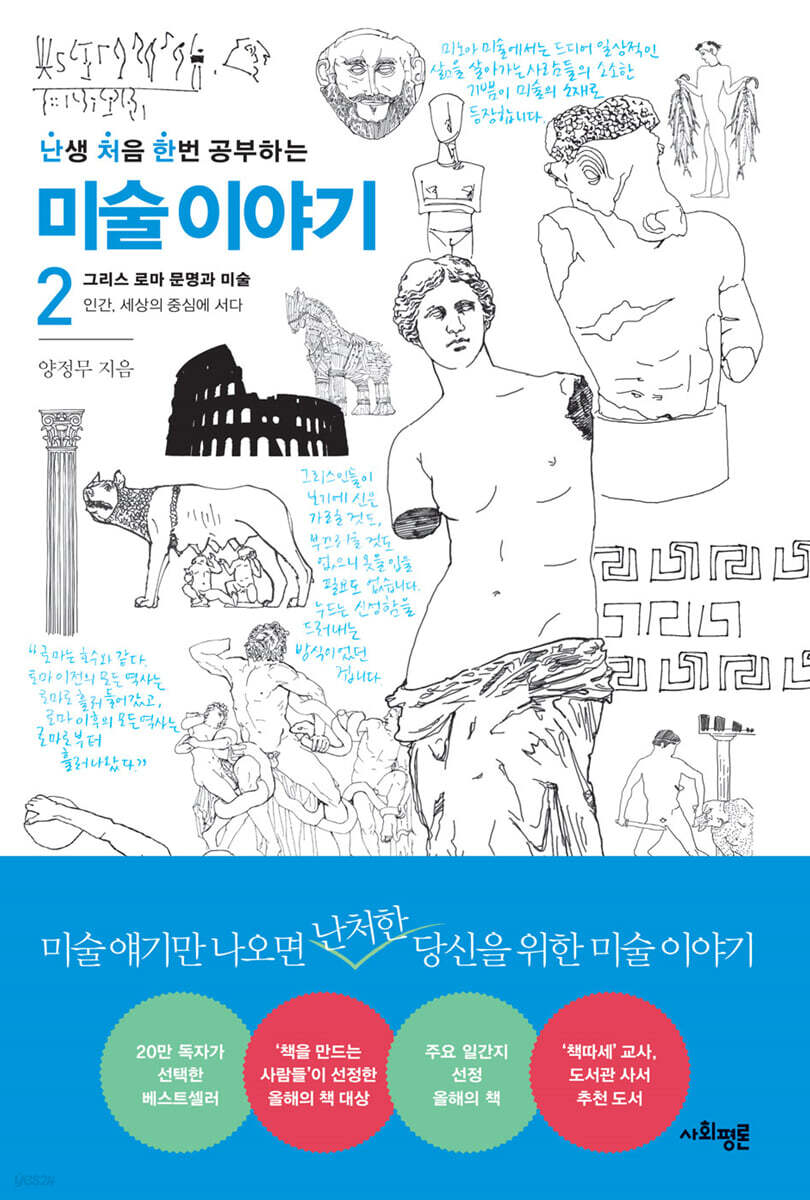 |
Description
Book Introduction
Everything about art history, easy to read and learn properly! Studying art with a long and storied history is not an easy task. Even the most trendy contemporary art pieces are steeped in 40,000 years of human history, making it difficult to understand individual pieces without a knowledge of art history. Moreover, many people gave up on reading existing art history books that were difficult to read after not even getting past ten pages. However, 『Art Story』 is written in a colloquial, one-on-one lecture format, so you can enjoy it comfortably, as if you were listening to an interesting story. Additionally, the illustrations are arranged to follow the reader's gaze without the need to flip through the pages to find pictures, the carefully selected photos and illustrations of works of art of collectible value, and the appropriate questions that prompt answers to any questions that may arise in the mind, adding to the pleasure of reading. That doesn't mean the book is of low quality. Professor Yang Jeong-mu, the author of the book and an authority in the field of art history, has packed a vast amount of information and diverse perspectives into one book. It covers essential basic art knowledge, as well as the latest theories leading the academic world, and includes as much new information and theories as possible, from famous works of art to Korean art that we can easily see around us. All this vast knowledge becomes naturally understandable as you follow the author's lectures, who is also a popular public speaker. At some point, readers will feel as if they are traveling through the world of art with a friendly and knowledgeable guide. |
- You can preview some of the book's contents.
Preview
index
Greek and Roman Civilization and Art: Humans at the Center of the World
Art to me - Light came from the East
01 In search of Western roots
02 Crete, the coexistence of simple life and myth
03 Troy and Mycenae: A Genealogy of Civilizations Leading to Greece
II Greek Art - "I am the center of the world"
01 Cities that gave birth to immortal classics
02 Greek Pottery: Discovering Human Emotions
03 Why are Greek statues naked?
04 Hero's Body and Living Bronze Statue
05 The Parthenon, a temple of humanity and for humanity
06 Descendants of Hellas Spread Throughout the World
III Roman Art - How a Strong Nation Is Made
01 From the Tiber River to the Land of Noblesse Oblige
02 SPQR, Even if it fails, it doesn't collapse
03 Imperial Vision: "Hurry up slowly"
04 Wherever I go, the road is right there.
05 Quiet Destruction and Vast Resurrection
Art to me - Light came from the East
01 In search of Western roots
02 Crete, the coexistence of simple life and myth
03 Troy and Mycenae: A Genealogy of Civilizations Leading to Greece
II Greek Art - "I am the center of the world"
01 Cities that gave birth to immortal classics
02 Greek Pottery: Discovering Human Emotions
03 Why are Greek statues naked?
04 Hero's Body and Living Bronze Statue
05 The Parthenon, a temple of humanity and for humanity
06 Descendants of Hellas Spread Throughout the World
III Roman Art - How a Strong Nation Is Made
01 From the Tiber River to the Land of Noblesse Oblige
02 SPQR, Even if it fails, it doesn't collapse
03 Imperial Vision: "Hurry up slowly"
04 Wherever I go, the road is right there.
05 Quiet Destruction and Vast Resurrection
Detailed image

Into the book
I said that Crete was a stepping stone to civilization, and there's a hint there.
Crete was an island in the middle of the Mediterranean where diverse cultures met.
In today's terms, it was a hotspot.
Many ships and people passed by the sea off Crete and stopped there.
---From "Crete, the Coexistence of Small Life and Myths" in Part 1, Chapter 2
In terms of scale, it cannot match the massive ruins of Egypt and Mesopotamia, and given its use of the principle of frontality, it is clear that the Minoan civilization was in a position to learn from them.
But I can say that the emotions contained within it are unique.
Life after death or those in power
It was not the solemn ceremonies of the past, but the small joys of people living their daily lives that finally became the subject of art.
---From "Chapter 1, Part 2, 'Cities that gave birth to immortal classics'"
In this way, Greece has a tremendous sense of pride in its “I move my country!” and the energy that comes from it is tremendous.
Perhaps it was this democracy that enabled Greece, once a mere confederation of small city-states, to achieve great things and demonstrate the spirit, courage, and confidence in knowledge.
---From "Chapter 1, Part 2, 'Cities that gave birth to immortal classics'"
The Parthenon is a masterpiece that makes us reflect on the meaning of studying art history.
Anyone who sees the Parthenon can vaguely feel that it is beautiful, as it was built by the best craftsmen and artists of the time, using all their skills.
However, without any knowledge of art history, it is impossible to know what beauty is or why we feel beauty.
---From "Part 2, Chapter 5, 'The Parthenon, a temple of humanity, for humanity'"
So, I wonder if it is really true that the Roman Empire fell in 476.
Although the Roman state system may have disappeared, it can be said that Rome was reborn as a great cultural sphere encompassing all of Europe by introducing and recognizing the religion called Christianity.
Although he was unable to command a powerful army or build great aqueducts and roads, he was resurrected with a softer power.
Crete was an island in the middle of the Mediterranean where diverse cultures met.
In today's terms, it was a hotspot.
Many ships and people passed by the sea off Crete and stopped there.
---From "Crete, the Coexistence of Small Life and Myths" in Part 1, Chapter 2
In terms of scale, it cannot match the massive ruins of Egypt and Mesopotamia, and given its use of the principle of frontality, it is clear that the Minoan civilization was in a position to learn from them.
But I can say that the emotions contained within it are unique.
Life after death or those in power
It was not the solemn ceremonies of the past, but the small joys of people living their daily lives that finally became the subject of art.
---From "Chapter 1, Part 2, 'Cities that gave birth to immortal classics'"
In this way, Greece has a tremendous sense of pride in its “I move my country!” and the energy that comes from it is tremendous.
Perhaps it was this democracy that enabled Greece, once a mere confederation of small city-states, to achieve great things and demonstrate the spirit, courage, and confidence in knowledge.
---From "Chapter 1, Part 2, 'Cities that gave birth to immortal classics'"
The Parthenon is a masterpiece that makes us reflect on the meaning of studying art history.
Anyone who sees the Parthenon can vaguely feel that it is beautiful, as it was built by the best craftsmen and artists of the time, using all their skills.
However, without any knowledge of art history, it is impossible to know what beauty is or why we feel beauty.
---From "Part 2, Chapter 5, 'The Parthenon, a temple of humanity, for humanity'"
So, I wonder if it is really true that the Roman Empire fell in 476.
Although the Roman state system may have disappeared, it can be said that Rome was reborn as a great cultural sphere encompassing all of Europe by introducing and recognizing the religion called Christianity.
Although he was unable to command a powerful army or build great aqueducts and roads, he was resurrected with a softer power.
---From "Part 3, Chapter 5, 'Quiet Destruction and Vast Resurrection'"
Publisher's Review
★ Learning about the glory, frustration, and challenges of humanity through art history, the 'flower of the humanities'
…read the flow of history, politics, economics, and art as a single picture, a single piece.
★ One-on-one art lectures that are as easy to read as listening.
… An author with authority in the field of art history conveys the fun, emotion, and depth of art through colloquial sentences, pointed questions and answers, vivid photographs, and abundant illustrations.
★ A world where humans are the main characters: Greek and Roman civilization and art
…From Aegean art, which linked the Orient and Greece, to Greek art, which became the root of the Western world, and Roman art, which built a great empire, we examine the human form that stood at the center of the world through Greco-Roman civilization.
A secret lesson for those who feel awkward whenever art is mentioned.
『The story of studying art for the first time in my life』!
In these times when we're so busy trying to make a living, why should we even read art history?
Recently, large-scale art exhibitions and invitational exhibitions of famous foreign artists have been held frequently in Korea, and the response from visitors has been enthusiastic.
Public interest in art is growing, with artworks being sold for hundreds of millions of won at domestic art auctions.
However, there are many people who want to study art properly but are unsure of where to start or how to approach it.
There are still many who view art as the exclusive domain of the wealthy.
For these people, the book "Art Stories for the First Time in Your Life" has been published, which covers not only how to properly appreciate art, but also the history, politics, economics, and artistic trends contained in art in an easy, fun, and profound way.
When we visit so-called developed countries, we make it a must to visit the country's representative museums and art galleries, such as the British Museum in England, the Louvre in France, and the Metropolitan Museum of Art in the United States.
Countries that have led world history are full of art galleries and museums, and the social elite are passionate about art.
Why do they invest in art galleries, support artists, and collect art? Why are simple stones, bowls, or even a child's scribbles labeled "art" and commanded astronomical prices?
This book answers this by saying that art is a window that shows the past and contains answers that lead to the future.
Art critic John Ruskin said, “A great nation writes its autobiography in three volumes.
One volume is about action, one volume is about writing, and the other volume is about art.
“Neither of the books can be understood without first reading the other two, but of them, Art is the most reliable.”
To see art is to confront the era that gave birth to it head-on, and it is also a path to gaining insight that will lead the future.
That is why art is called the 'flower of the humanities', which is the essence of all academic disciplines such as history, politics, economics, and art.
『Art Stories』, planned as a total of eight volumes, will examine all aspects of art that have accompanied humans, starting with Volume 1, Primitive, Egyptian, and Mesopotamian civilization and art, and Volume 2, Greek and Roman civilization and art, and continuing through medieval Christianity, the Renaissance, modern, and contemporary art.
Everything about art history, easy to read and learn properly!
Studying art with a long and storied history is not an easy task.
Even the most trendy contemporary art pieces are steeped in 40,000 years of human history, making it difficult to understand individual pieces without a knowledge of art history.
Moreover, many people gave up on reading existing art history books that were difficult to read after not even getting past ten pages.
However, 『Art Story』 is written in a colloquial, one-on-one lecture format, so you can enjoy it comfortably, as if you were listening to an interesting story.
Additionally, the illustrations are arranged to follow the reader's gaze without the need to flip through the pages to find pictures, the carefully selected photos and illustrations of works of art of collectible value, and the appropriate questions that prompt answers to any questions that may arise in the mind, adding to the pleasure of reading.
That doesn't mean the book is of low quality.
Professor Yang Jeong-mu, the author of the book and an authority in the field of art history, has packed a vast amount of information and diverse perspectives into one book.
It covers essential basic art knowledge, as well as the latest theories leading the academic world, and includes as much new information and theories as possible, from famous works of art to Korean art that we can easily see around us.
All this vast knowledge becomes naturally understandable as you follow the author's lectures, who is also a popular public speaker.
At some point, readers will feel as if they are traveling through the world of art with a friendly and knowledgeable guide.
Art Stories, Volume 2: Humans, Standing at the Center of the World
Volume 2 of "Studying Art for the First Time in My Life" examines the process by which Greco-Roman civilization and art, which have formed the spiritual foundation of Western society to this day, grew and blossomed.
Early human civilization began in the East.
Part 1, “Light Came from the East,” examines how the light of civilization that arose in the Orient, including Mesopotamia and Egypt, was transmitted to the Greek region.
The Aegean civilization, which succeeded the Orient and Greece, left behind unique works of art that not only demonstrated the mysterious harmony between the two, but also revealed a unique liveliness and joy of life.
Through Aegean art, we can glimpse the moment when the first chapter of European history was written.
Part 2, 'I am the center of the world', deals with Greek art.
How did ancient Greek civilization, often called the root of Western civilization, captivate Westerners for thousands of years? It wasn't until Greece that humans truly emerged as the world's leading powers.
We will learn how Greek art depicted humans at the center of the world through the Parthenon, the Venus de Milo, and the Kouros and Kore sculptures.
Knowing Greek art can give us an idea of the roots of Western civilization and art.
Part 3, "How a Strong Nation is Built," reveals the secrets of how the ancient Romans were able to build a vast and powerful empire.
The secret to Rome's rise from a small village to a great empire that ruled the world was its unique ability to integrate and a spirit of tolerance.
Let's take a look at Roman art, which was as grand as the empire itself and as robust as its members, including portrait sculptures that captured the spirit of the Roman Republic and the Pantheon, which stands out for its ability to fuse.
…read the flow of history, politics, economics, and art as a single picture, a single piece.
★ One-on-one art lectures that are as easy to read as listening.
… An author with authority in the field of art history conveys the fun, emotion, and depth of art through colloquial sentences, pointed questions and answers, vivid photographs, and abundant illustrations.
★ A world where humans are the main characters: Greek and Roman civilization and art
…From Aegean art, which linked the Orient and Greece, to Greek art, which became the root of the Western world, and Roman art, which built a great empire, we examine the human form that stood at the center of the world through Greco-Roman civilization.
A secret lesson for those who feel awkward whenever art is mentioned.
『The story of studying art for the first time in my life』!
In these times when we're so busy trying to make a living, why should we even read art history?
Recently, large-scale art exhibitions and invitational exhibitions of famous foreign artists have been held frequently in Korea, and the response from visitors has been enthusiastic.
Public interest in art is growing, with artworks being sold for hundreds of millions of won at domestic art auctions.
However, there are many people who want to study art properly but are unsure of where to start or how to approach it.
There are still many who view art as the exclusive domain of the wealthy.
For these people, the book "Art Stories for the First Time in Your Life" has been published, which covers not only how to properly appreciate art, but also the history, politics, economics, and artistic trends contained in art in an easy, fun, and profound way.
When we visit so-called developed countries, we make it a must to visit the country's representative museums and art galleries, such as the British Museum in England, the Louvre in France, and the Metropolitan Museum of Art in the United States.
Countries that have led world history are full of art galleries and museums, and the social elite are passionate about art.
Why do they invest in art galleries, support artists, and collect art? Why are simple stones, bowls, or even a child's scribbles labeled "art" and commanded astronomical prices?
This book answers this by saying that art is a window that shows the past and contains answers that lead to the future.
Art critic John Ruskin said, “A great nation writes its autobiography in three volumes.
One volume is about action, one volume is about writing, and the other volume is about art.
“Neither of the books can be understood without first reading the other two, but of them, Art is the most reliable.”
To see art is to confront the era that gave birth to it head-on, and it is also a path to gaining insight that will lead the future.
That is why art is called the 'flower of the humanities', which is the essence of all academic disciplines such as history, politics, economics, and art.
『Art Stories』, planned as a total of eight volumes, will examine all aspects of art that have accompanied humans, starting with Volume 1, Primitive, Egyptian, and Mesopotamian civilization and art, and Volume 2, Greek and Roman civilization and art, and continuing through medieval Christianity, the Renaissance, modern, and contemporary art.
Everything about art history, easy to read and learn properly!
Studying art with a long and storied history is not an easy task.
Even the most trendy contemporary art pieces are steeped in 40,000 years of human history, making it difficult to understand individual pieces without a knowledge of art history.
Moreover, many people gave up on reading existing art history books that were difficult to read after not even getting past ten pages.
However, 『Art Story』 is written in a colloquial, one-on-one lecture format, so you can enjoy it comfortably, as if you were listening to an interesting story.
Additionally, the illustrations are arranged to follow the reader's gaze without the need to flip through the pages to find pictures, the carefully selected photos and illustrations of works of art of collectible value, and the appropriate questions that prompt answers to any questions that may arise in the mind, adding to the pleasure of reading.
That doesn't mean the book is of low quality.
Professor Yang Jeong-mu, the author of the book and an authority in the field of art history, has packed a vast amount of information and diverse perspectives into one book.
It covers essential basic art knowledge, as well as the latest theories leading the academic world, and includes as much new information and theories as possible, from famous works of art to Korean art that we can easily see around us.
All this vast knowledge becomes naturally understandable as you follow the author's lectures, who is also a popular public speaker.
At some point, readers will feel as if they are traveling through the world of art with a friendly and knowledgeable guide.
Art Stories, Volume 2: Humans, Standing at the Center of the World
Volume 2 of "Studying Art for the First Time in My Life" examines the process by which Greco-Roman civilization and art, which have formed the spiritual foundation of Western society to this day, grew and blossomed.
Early human civilization began in the East.
Part 1, “Light Came from the East,” examines how the light of civilization that arose in the Orient, including Mesopotamia and Egypt, was transmitted to the Greek region.
The Aegean civilization, which succeeded the Orient and Greece, left behind unique works of art that not only demonstrated the mysterious harmony between the two, but also revealed a unique liveliness and joy of life.
Through Aegean art, we can glimpse the moment when the first chapter of European history was written.
Part 2, 'I am the center of the world', deals with Greek art.
How did ancient Greek civilization, often called the root of Western civilization, captivate Westerners for thousands of years? It wasn't until Greece that humans truly emerged as the world's leading powers.
We will learn how Greek art depicted humans at the center of the world through the Parthenon, the Venus de Milo, and the Kouros and Kore sculptures.
Knowing Greek art can give us an idea of the roots of Western civilization and art.
Part 3, "How a Strong Nation is Built," reveals the secrets of how the ancient Romans were able to build a vast and powerful empire.
The secret to Rome's rise from a small village to a great empire that ruled the world was its unique ability to integrate and a spirit of tolerance.
Let's take a look at Roman art, which was as grand as the empire itself and as robust as its members, including portrait sculptures that captured the spirit of the Roman Republic and the Pantheon, which stands out for its ability to fuse.
GOODS SPECIFICS
- Date of issue: May 9, 2016
- Page count, weight, size: 544 pages | 830g | 154*225*35mm
- ISBN13: 9788964358306
- ISBN10: 8964358309
You may also like
카테고리
korean


korean

![GQ KOREA Mark (Monthly): December [2025]](http://librairie.coreenne.fr/cdn/shop/files/8ef265dbbfbf186523ed75ba7319009d.jpg?v=1765340328&width=3840)


