

grass
 |
Description
Book Introduction
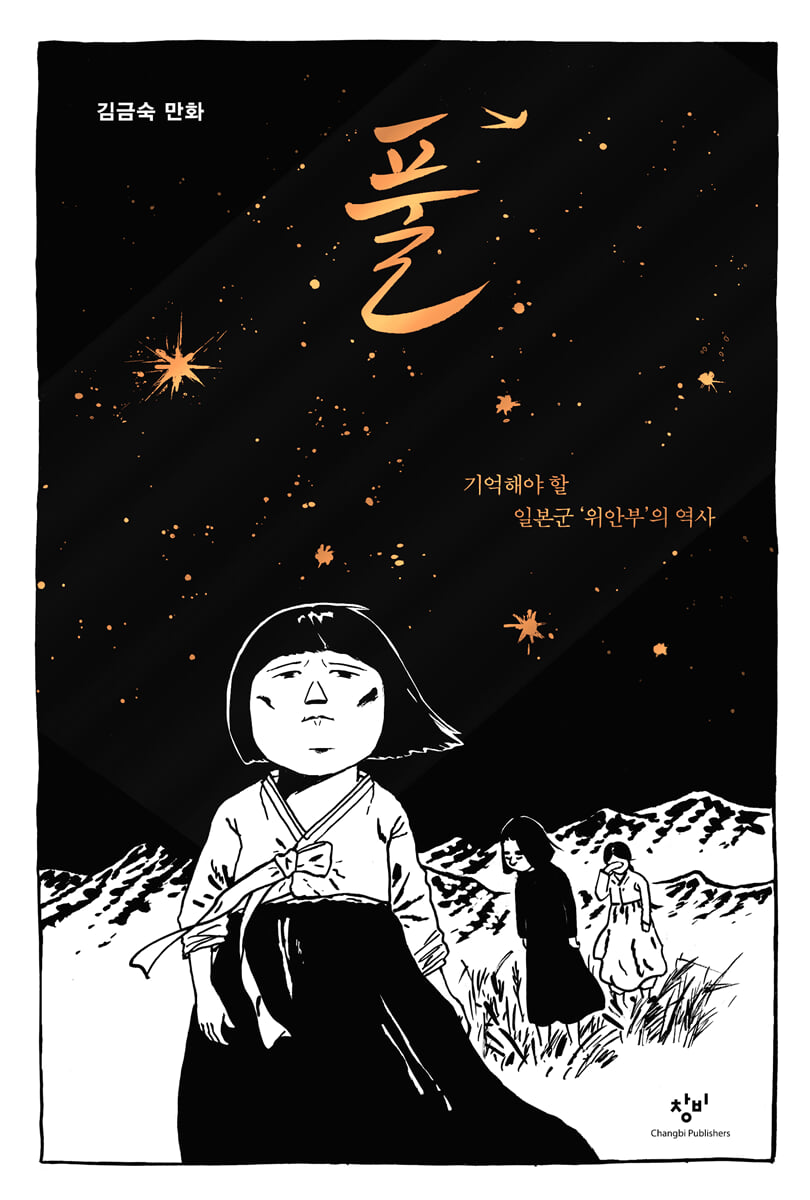
Like grass that rises again even after being blown away by the wind and trampled on
The Story of the "Comfort Women" Victims Who Struggled Against the Violence and Trauma of War
* Korea's first Harvey Award winner, the 'Academy Award of the comics world' *
* Published in 35 languages, this work brought the story of the Japanese military's "comfort women" to the world's attention. *
* Representative works of cartoonist Kim Geum-suk, who has been highlighted by the New York Times, the Guardian, and the Washington Post *
A cartoon depicting the life of grandmother Lee Ok-seon, a victim of the Japanese military's 'comfort women'.
This work received international attention, including being the first Korean to win the Harvey Award, the most prestigious award in the international comics world, and being nominated for three Eisner Awards, and making the world aware of the reality of 'comfort women'.
"Grass" goes beyond the conventional view of 'comfort women' victims as passive, portraying them as active and present beings who oppose war and live as peace activists and human rights activists with a strong will to live.
It was selected as the best graphic novel by leading media outlets around the world, including the New York Times, the Guardian, and the Washington Post, and won the Krause Essay Award in the US, the Big Arthur Book Best Graphic Novel Award, the Cartoonist Studio Best Published Cartoon Award, the Special Jury Prize at the Humanity Cartoon Award in France, the Antipas Award for Best International Cartoon in Spain, and the Treviso Comics Festival Best Foreign Cartoon Award in Italy.
This revised edition refines the work, which was out of print since its first publication in 2017, and adds an “Author’s Note” to be published in 2024.
Kim Geum-sook, who has established herself as a cartoonist who has gained recognition not only in Korea but also around the world, has been drawing works that calmly capture the universality and pain of the times through various personal stories, such as “Grass,” the lives of families separated by the Korean War, the life of Korea’s first female Bolshevik, and a youth with a developmental disability.
The Story of the "Comfort Women" Victims Who Struggled Against the Violence and Trauma of War
* Korea's first Harvey Award winner, the 'Academy Award of the comics world' *
* Published in 35 languages, this work brought the story of the Japanese military's "comfort women" to the world's attention. *
* Representative works of cartoonist Kim Geum-suk, who has been highlighted by the New York Times, the Guardian, and the Washington Post *
A cartoon depicting the life of grandmother Lee Ok-seon, a victim of the Japanese military's 'comfort women'.
This work received international attention, including being the first Korean to win the Harvey Award, the most prestigious award in the international comics world, and being nominated for three Eisner Awards, and making the world aware of the reality of 'comfort women'.
"Grass" goes beyond the conventional view of 'comfort women' victims as passive, portraying them as active and present beings who oppose war and live as peace activists and human rights activists with a strong will to live.
It was selected as the best graphic novel by leading media outlets around the world, including the New York Times, the Guardian, and the Washington Post, and won the Krause Essay Award in the US, the Big Arthur Book Best Graphic Novel Award, the Cartoonist Studio Best Published Cartoon Award, the Special Jury Prize at the Humanity Cartoon Award in France, the Antipas Award for Best International Cartoon in Spain, and the Treviso Comics Festival Best Foreign Cartoon Award in Italy.
This revised edition refines the work, which was out of print since its first publication in 2017, and adds an “Author’s Note” to be published in 2024.
Kim Geum-sook, who has established herself as a cartoonist who has gained recognition not only in Korea but also around the world, has been drawing works that calmly capture the universality and pain of the times through various personal stories, such as “Grass,” the lives of families separated by the Korean War, the life of Korea’s first female Bolshevik, and a youth with a developmental disability.
- You can preview some of the book's contents.
Preview
index
Author's Note
Prologue: The Road Home
Chapter 1: The Girl Who Wants to Go to School
Chapter 2 Persimmons and Alsatang
Chapter 3: Going as an Adopted Daughter
Chapter 4: Busan Udon Restaurant
Chapter 5: Ulsan Bars
Chapter 6: Yanji East Airport
Chapter 7: Purity
Chapter 8 That Person
Chapter 9: To the city of Yanji
Chapter 10 Sister Mija
Chapter 11: A Japanese Soldier
Chapter 12: Liberation and Abandoned Women
Chapter 13: The First Marriage
Chapter 14 My Son
Chapter 15: Return
Epilogue: In Search of Grandmother Lee Ok-seon's Footsteps
Reference book
Prologue: The Road Home
Chapter 1: The Girl Who Wants to Go to School
Chapter 2 Persimmons and Alsatang
Chapter 3: Going as an Adopted Daughter
Chapter 4: Busan Udon Restaurant
Chapter 5: Ulsan Bars
Chapter 6: Yanji East Airport
Chapter 7: Purity
Chapter 8 That Person
Chapter 9: To the city of Yanji
Chapter 10 Sister Mija
Chapter 11: A Japanese Soldier
Chapter 12: Liberation and Abandoned Women
Chapter 13: The First Marriage
Chapter 14 My Son
Chapter 15: Return
Epilogue: In Search of Grandmother Lee Ok-seon's Footsteps
Reference book
Detailed image

Publisher's Review
“War makes men inhuman.”
The Truth Behind the "Comfort Women" History That Resonated Around the World
To cover her story, author Kim Geum-suk visits the House of Sharing in Gwangju, Gyeonggi Province, where the victims of Japanese military "comfort women" live together.
After several visits, the author meets grandmother Lee Ok-seon and begins interviewing her.
But my grandmother said, “Japan is bad.
He only repeats, “Abe must apologize,” and rarely tells us anything.
As the conversation grows tiresome, the grandmother finally manages to tell the story of her life.
Grandmother Lee Ok-seon was born in Bosu-dong, Busan, as the eldest daughter of five siblings.
Okseon, who was full of enthusiasm for learning, wished to go to school like other children, but her family, who were busy just making ends meet, could not afford to send her to school, and so she was eventually sent away as an adopted daughter to have one less mouth to feed.
One day, sixteen-year-old Ok-seon, who had left home after being told she would be sent to school and was working as a maid in various houses, was caught on the street by strangers while running an errand for her master.
That's how he became a 'comfort woman'.
The reality of the life of a 'comfort woman' as testified by Oksun is vivid and cruel.
However, the scenes that bring up the grandmother's suffering are drawn with images of trees and wind using thick ink like a sumi-e painting, instead of direct description.
Author Kim Geum-suk believes that simply reproducing the reality of violence can inflict further pain on the victims, and that it fails to properly convey the brutality and inhumanity to readers.
As the review of the book, “The scenes that stop the heart more than any comic” (New York Times), says, “Grass”’s powerful illustrations vividly convey the cruelty of history to readers without specifically describing the reality of the “comfort women.”
A cry to those who ask why Japan should apologize
History doesn't disappear even after the victims pass away.
"The Grass" was exported to 35 countries and made the world aware of the truth about the history of Japanese military "comfort women."
In Japan, a Japanese edition was successfully published through crowdfunding in 2020, led by civic activists, demonstrating solidarity at the civil society level and shedding light on the future of Japan-Korea relations.
The broad appeal of "Grass" may be due to the fact that the "comfort women" issue transcends the boundaries between Korea and Japan and is a broader women's issue and human rights issue.
In the “Author’s Note” accompanying the revised edition, author Kim Geum-sook says, “I never thought that people with different skin colors than mine, who spoke a language I didn’t know, and especially young women, would shed tears and thank me,” and that “sexual violence is a terrible thing that leaves deep scars on victims, transcending time, age, race, and social class.”
The final scene of "Grass" shows Grandma Lee Ok-seon, enraged by the December 2015 agreement between South Korea and Japan on the issue of Japanese military "comfort women" that excluded the victims, vowing to fight to the end.
In 2024, when the revised edition was published, he is still firmly holding down the House of Sharing at the age of ninety-seven.
Despite being in poor health, such as receiving dialysis, he actively participates in related events and speaks out, saying, “We will not die until we apologize.”
Like grass that rises again after being trampled, the voices of East Asian women who overcame the damage of war crimes and became witnesses to history resonate deeply with readers.
Author's Note
I never dreamed that "Grass" would be translated into 35 languages around the world, win numerous international awards, and be recommended as a book in many countries.
I honestly didn't expect it to resonate so deeply in Central and South America, on the other side of the world, a 30-hour flight from South Korea.
I never thought that people with different skin colors than mine, who spoke a language I didn't know, and who were young women, would thank me with tears in their eyes.
When they said, “This story is my story,” I felt something warm welling up deep in my heart.
The countless readers who loved "Grass" sympathized with it far more than I expected and understood my intentions more deeply than I did.
Like silence, pictures are text, so on pages with only pictures, readers read the pictures with their hearts.
I can't forget the look in their eyes.
I am sure that the twinkling stars in those eyes will guide me as I continue my work.
I will continue to record life through comics as if it were my destiny.
As time goes by, I hope to be able to create works that are based on the preciousness and love for humans and all living things.
The Truth Behind the "Comfort Women" History That Resonated Around the World
To cover her story, author Kim Geum-suk visits the House of Sharing in Gwangju, Gyeonggi Province, where the victims of Japanese military "comfort women" live together.
After several visits, the author meets grandmother Lee Ok-seon and begins interviewing her.
But my grandmother said, “Japan is bad.
He only repeats, “Abe must apologize,” and rarely tells us anything.
As the conversation grows tiresome, the grandmother finally manages to tell the story of her life.
Grandmother Lee Ok-seon was born in Bosu-dong, Busan, as the eldest daughter of five siblings.
Okseon, who was full of enthusiasm for learning, wished to go to school like other children, but her family, who were busy just making ends meet, could not afford to send her to school, and so she was eventually sent away as an adopted daughter to have one less mouth to feed.
One day, sixteen-year-old Ok-seon, who had left home after being told she would be sent to school and was working as a maid in various houses, was caught on the street by strangers while running an errand for her master.
That's how he became a 'comfort woman'.
The reality of the life of a 'comfort woman' as testified by Oksun is vivid and cruel.
However, the scenes that bring up the grandmother's suffering are drawn with images of trees and wind using thick ink like a sumi-e painting, instead of direct description.
Author Kim Geum-suk believes that simply reproducing the reality of violence can inflict further pain on the victims, and that it fails to properly convey the brutality and inhumanity to readers.
As the review of the book, “The scenes that stop the heart more than any comic” (New York Times), says, “Grass”’s powerful illustrations vividly convey the cruelty of history to readers without specifically describing the reality of the “comfort women.”
A cry to those who ask why Japan should apologize
History doesn't disappear even after the victims pass away.
"The Grass" was exported to 35 countries and made the world aware of the truth about the history of Japanese military "comfort women."
In Japan, a Japanese edition was successfully published through crowdfunding in 2020, led by civic activists, demonstrating solidarity at the civil society level and shedding light on the future of Japan-Korea relations.
The broad appeal of "Grass" may be due to the fact that the "comfort women" issue transcends the boundaries between Korea and Japan and is a broader women's issue and human rights issue.
In the “Author’s Note” accompanying the revised edition, author Kim Geum-sook says, “I never thought that people with different skin colors than mine, who spoke a language I didn’t know, and especially young women, would shed tears and thank me,” and that “sexual violence is a terrible thing that leaves deep scars on victims, transcending time, age, race, and social class.”
The final scene of "Grass" shows Grandma Lee Ok-seon, enraged by the December 2015 agreement between South Korea and Japan on the issue of Japanese military "comfort women" that excluded the victims, vowing to fight to the end.
In 2024, when the revised edition was published, he is still firmly holding down the House of Sharing at the age of ninety-seven.
Despite being in poor health, such as receiving dialysis, he actively participates in related events and speaks out, saying, “We will not die until we apologize.”
Like grass that rises again after being trampled, the voices of East Asian women who overcame the damage of war crimes and became witnesses to history resonate deeply with readers.
Author's Note
I never dreamed that "Grass" would be translated into 35 languages around the world, win numerous international awards, and be recommended as a book in many countries.
I honestly didn't expect it to resonate so deeply in Central and South America, on the other side of the world, a 30-hour flight from South Korea.
I never thought that people with different skin colors than mine, who spoke a language I didn't know, and who were young women, would thank me with tears in their eyes.
When they said, “This story is my story,” I felt something warm welling up deep in my heart.
The countless readers who loved "Grass" sympathized with it far more than I expected and understood my intentions more deeply than I did.
Like silence, pictures are text, so on pages with only pictures, readers read the pictures with their hearts.
I can't forget the look in their eyes.
I am sure that the twinkling stars in those eyes will guide me as I continue my work.
I will continue to record life through comics as if it were my destiny.
As time goes by, I hope to be able to create works that are based on the preciousness and love for humans and all living things.
GOODS SPECIFICS
- Date of issue: February 23, 2024
- Page count, weight, size: 484 pages | 844g | 150*222*30mm
- ISBN13: 9788936480165
- ISBN10: 8936480162
You may also like
카테고리
korean


korean

![GQ KOREA Mark (Monthly): December [2025]](http://librairie.coreenne.fr/cdn/shop/files/8ef265dbbfbf186523ed75ba7319009d.jpg?v=1765340328&width=3840)


