

Awkward Art Story 4
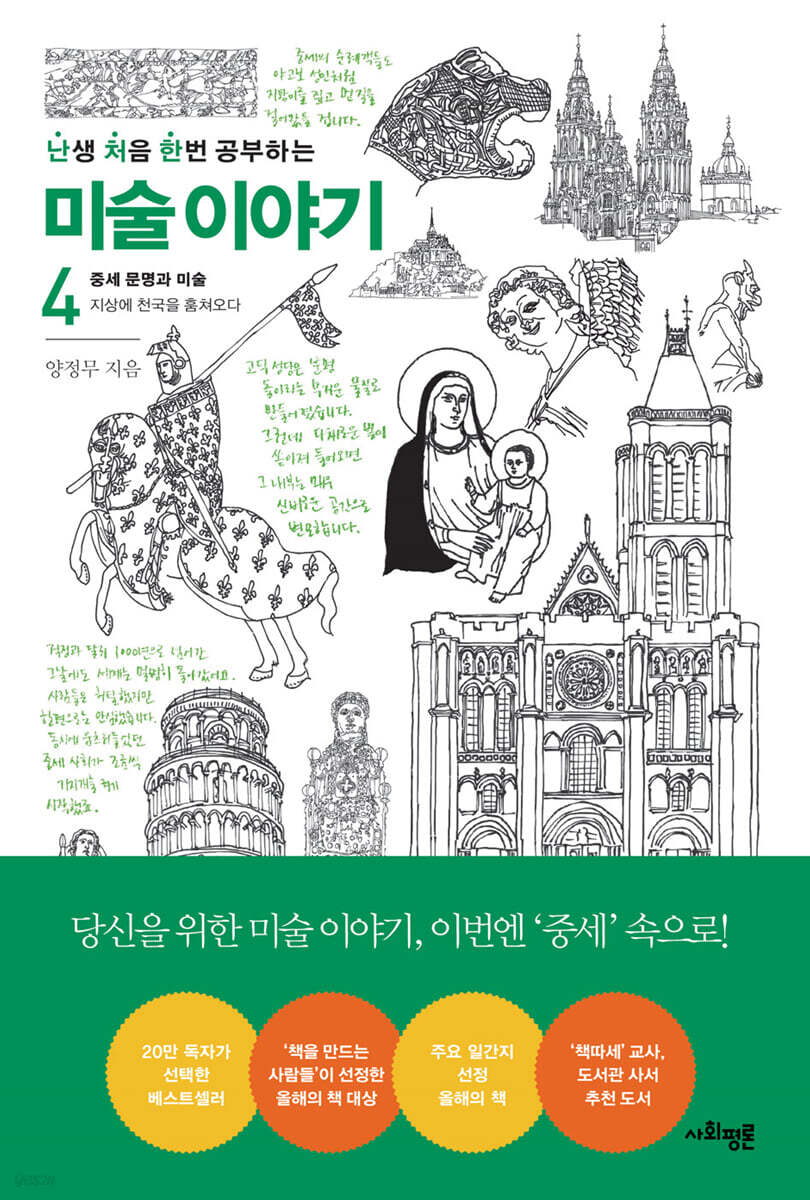 |
Description
Book Introduction
This book covers not only how to properly appreciate works of art, but also the history, politics, economics, and artistic trends contained in art in an easy, fun, and in-depth way.
You can enjoy it comfortably as if you were listening to an interesting story in a one-on-one lecture format.
The illustrations are arranged to follow the flow of the reader's gaze, eliminating the need to flip through the pages to find the illustrations.
Carefully selected photos and illustrations of works of art worthy of collection, along with appropriate questions that will help you resolve any questions that arise in your mind, add to the pleasure of reading.
That doesn't mean the book is of low quality.
Professor Yang Jeong-mu, the author of the book and an authority in the field of art history, has packed a vast amount of information and diverse perspectives into one book.
It covers the most basic art knowledge you need to know, as well as the latest theories leading the academic world, and includes as much information and theories as possible, from famous works of art to Korean art that we can easily see around us.
All this vast knowledge becomes naturally understandable as you follow the author's lectures, who is also a popular public speaker.
Readers will find themselves traveling through the world of art with a friendly and knowledgeable guide.
Volume 4 tells the story of how the European Middle Ages, commonly known as the Dark Ages, was in fact a time when brilliant art of light flourished.
You can enjoy it comfortably as if you were listening to an interesting story in a one-on-one lecture format.
The illustrations are arranged to follow the flow of the reader's gaze, eliminating the need to flip through the pages to find the illustrations.
Carefully selected photos and illustrations of works of art worthy of collection, along with appropriate questions that will help you resolve any questions that arise in your mind, add to the pleasure of reading.
That doesn't mean the book is of low quality.
Professor Yang Jeong-mu, the author of the book and an authority in the field of art history, has packed a vast amount of information and diverse perspectives into one book.
It covers the most basic art knowledge you need to know, as well as the latest theories leading the academic world, and includes as much information and theories as possible, from famous works of art to Korean art that we can easily see around us.
All this vast knowledge becomes naturally understandable as you follow the author's lectures, who is also a popular public speaker.
Readers will find themselves traveling through the world of art with a friendly and knowledgeable guide.
Volume 4 tells the story of how the European Middle Ages, commonly known as the Dark Ages, was in fact a time when brilliant art of light flourished.
- You can preview some of the book's contents.
Preview
index
I Romanesque Art - A Pilgrimage in Search of God
01 Europe moving to the center of the world
02 The Age of Religious Passion
03 Romanesque Born on the Road
04 The struggle for power on earth and in heaven
II Norman Art - The Pirate Who Became a Crusader
01 The Age of the Vikings
02 Norman history begins
03 The Age of the Crusades
III Gothic Art - Competing in Praise
01 A heavenly space recreated on earth
02 Higher, brighter, and more perfect
03 The Bible Written in Light: Windows and Stained Glass
04 Gothic sculptures engraving stories of the sky
05 Medieval Art Around Us
01 Europe moving to the center of the world
02 The Age of Religious Passion
03 Romanesque Born on the Road
04 The struggle for power on earth and in heaven
II Norman Art - The Pirate Who Became a Crusader
01 The Age of the Vikings
02 Norman history begins
03 The Age of the Crusades
III Gothic Art - Competing in Praise
01 A heavenly space recreated on earth
02 Higher, brighter, and more perfect
03 The Bible Written in Light: Windows and Stained Glass
04 Gothic sculptures engraving stories of the sky
05 Medieval Art Around Us
Detailed image

Into the book
This period, which lasted for 300 years starting in 1000 AD, is a strange and distant era for us.
But thanks to the art of this era still vividly alive in Europe, we can get one step closer to the Middle Ages.
In Europe, the Middle Ages are not a distant past confined to museums, but a living, breathing tradition that still exists today.
Ultimately, this book is a curious artistic journey that explores how such traditions are created.
As a result, Charlemagne comes up with two solutions.
That was feudalism and Christianity.
If feudalism was a form of systematic control over the entire society, that is, hardware, then Christianity served as software to win the hearts of each and every person.
But thanks to the art of this era still vividly alive in Europe, we can get one step closer to the Middle Ages.
In Europe, the Middle Ages are not a distant past confined to museums, but a living, breathing tradition that still exists today.
Ultimately, this book is a curious artistic journey that explores how such traditions are created.
As a result, Charlemagne comes up with two solutions.
That was feudalism and Christianity.
If feudalism was a form of systematic control over the entire society, that is, hardware, then Christianity served as software to win the hearts of each and every person.
---From the text
Publisher's Review
★ Art history, the 'flower of humanities'!
Read the history of politics, religion, economics, and art through contemporary paintings, sculptures, and architecture.
★ One-on-one art lectures that are as easy to read as listening!
It delivers the fun, knowledge, and emotion of art through sharp questions and answers, vivid photos, and rich illustrations.
★ Europe's 'medieval civilization', full of splendid light and religious faith
The "Middle Ages," which laid the foundation for Europe, are often misunderstood! Through contemporary art, we reveal the splendid true face of Western medieval civilization, often perceived as distant and dark.
One-on-one tutoring for those who feel awkward when it comes to art!
'I'm busy just trying to make a living, so why should I read art history?'
In our country, the number of people enjoying art is increasing.
Large-scale art exhibitions and invitational exhibitions by famous foreign artists are frequently held, and the response from visitors is also enthusiastic.
Artworks often appear at domestic art auctions and are sold for prices exceeding hundreds of millions of won.
For a more meaningful trip, for healing, or for investment… .
The reasons why people become interested in art vary.
However, despite this growing interest, many people still complain that they have no idea where to start or how to approach studying art.
Many people give up on studying art because they think it is a pastime enjoyed only by those with free time.
For these people, the 3rd and 4th volumes of "Art Stories to Study for the First Time in Your Life" have been published, which cover not only how to properly appreciate works of art, but also the history, politics, economics, and artistic trends contained in art in an easy, fun, and profound way.
Why do Britain, France, and the United States invest in art?
When we visit so-called developed countries, we make it a must to visit the country's representative museums and art galleries, such as the British Museum in England, the Louvre in France, and the Metropolitan Museum of Art in the United States.
Countries that have played a pivotal role in world history are full of art galleries and museums, and the social elite are passionate about art.
Why do they invest in art galleries, support artists, and collect art? Why are simple stones, bowls, or even a child's scribbles labeled "art" and commanded astronomical prices?
This book answers this by saying that art is a window that shows the past and contains the ‘answers that lead the future.’
Art critic John Ruskin said, “A great nation writes its autobiography in three volumes.
One volume is about action, one volume is about writing, and the other volume is about art.
“Neither of the books can be understood without first reading the other two, but of them, Art is the most reliable.”
To truly appreciate art is to confront the era that gave birth to it head-on, and it is the path to gaining insight that will lead the future.
That is why art is called the 'flower of the humanities', which is the essence of all academic disciplines such as history, politics, economics, and art.
Everything about art history, easy to read and learn properly!
Art, as fascinating as it is, is actually not easy to study properly.
First of all, because art has a very long history.
Even the most trendy contemporary art pieces contain 40,000 years of history, making it often difficult to understand them without a knowledge of art history.
Moreover, the barriers to entry are high.
For many people, 'art books = difficult books'.
Because of the unfamiliar terminology and unfriendly explanations, I often gave up on reading the book before I could even get past ten pages.
However, the 『Embarrassing Art Story』 series can be enjoyed comfortably as if listening to an interesting story in a one-on-one lecture format.
The illustrations are arranged to follow the flow of the reader's gaze, eliminating the need to flip through the pages to find the illustrations.
Carefully selected photos and illustrations of works of art worthy of collection, along with appropriate questions that will help you resolve any questions that arise in your mind, add to the pleasure of reading.
That doesn't mean the book is of low quality.
Professor Yang Jeong-mu, the author of the book and an authority in the field of art history, has packed a vast amount of information and diverse perspectives into one book.
It covers the most basic art knowledge you need to know, as well as the latest theories leading the academic world, and includes as much information and theories as possible, from famous works of art to Korean art that we can easily see around us.
All this vast knowledge becomes naturally understandable as you follow the author's lectures, who is also a popular public speaker.
Readers will find themselves traveling through the world of art with a friendly and knowledgeable guide.
The 『Embarrassing Art Story』 series, which will be completed in eight volumes, will cover ‘Early Christian Civilization and Art’ in Volume 3 and ‘Medieval Civilization and Art’ in Volume 4.
Renaissance, modern, and contemporary art will be published in sequence thereafter.
"The Embarrassing Story of Art" Volume 4: Stealing Heaven on Earth
Volume 4 of "The Story of Art I Learned for the First Time in My Life" tells the story of how the European Middle Ages, commonly known as the Dark Ages, was actually a time when brilliant art flourished.
After the fall of the Roman Empire, Europe, which had been in chaos, began to find stability with Christianity and feudalism as its cornerstones.
Europeans, including the Normans, descendants of the Vikings, were born again as devout Christians, and their faith soon led to a desire to recreate the heavenly kingdom on earth.
Eventually, they succeeded in stealing the image of heaven by building a Gothic cathedral filled with splendid lights and resonating with the sound of a 'symphony of angels'.
Part 1, “Pilgrimage to Find God,” examines medieval Romanesque art, focusing on the pilgrimage craze that began around 1000 AD.
By following the life-threatening pilgrimages of medieval people, we can glimpse the profound faith of those who embarked on these journeys, the medieval cities that their journeys fostered, and the new art style called Romanesque.
Part 2, 'The Pirate Who Became a Crusader' vividly depicts the transformation of the Vikings, who were once a symbol of barbarism, into faithful and courageous crusaders.
The descendants of the Vikings, known as Normans, enthusiastically built numerous churches after coming into contact with Christianity.
The Normans built magnificent and unique structures in the lands they conquered in England, demonstrating the power of their new rulers, and thanks to this, England was able to emerge as a leader in the new art in 'rural Europe'.
The protagonist of Part 3, 'Competing in Praise', is the Gothic cathedral, which can be said to be the pinnacle of medieval civilization.
On June 11, 1144, a new building, the likes of which had never existed before, was unveiled to the world.
The main character, the Cathedral of Saint-Denis, is composed of a high ceiling, pillars that seem to lightly rise toward the sky, and stained glass windows delicately crafted with colored glass.
The interior of the Gothic cathedral was very bright and airy, and the stone ceiling's acoustics gave it a sense of grandeur and sacredness at the same time.
Additionally, the lifelike sculptures that decorated the cathedral also served to sow the seeds of Renaissance art that followed.
Read the history of politics, religion, economics, and art through contemporary paintings, sculptures, and architecture.
★ One-on-one art lectures that are as easy to read as listening!
It delivers the fun, knowledge, and emotion of art through sharp questions and answers, vivid photos, and rich illustrations.
★ Europe's 'medieval civilization', full of splendid light and religious faith
The "Middle Ages," which laid the foundation for Europe, are often misunderstood! Through contemporary art, we reveal the splendid true face of Western medieval civilization, often perceived as distant and dark.
One-on-one tutoring for those who feel awkward when it comes to art!
'I'm busy just trying to make a living, so why should I read art history?'
In our country, the number of people enjoying art is increasing.
Large-scale art exhibitions and invitational exhibitions by famous foreign artists are frequently held, and the response from visitors is also enthusiastic.
Artworks often appear at domestic art auctions and are sold for prices exceeding hundreds of millions of won.
For a more meaningful trip, for healing, or for investment… .
The reasons why people become interested in art vary.
However, despite this growing interest, many people still complain that they have no idea where to start or how to approach studying art.
Many people give up on studying art because they think it is a pastime enjoyed only by those with free time.
For these people, the 3rd and 4th volumes of "Art Stories to Study for the First Time in Your Life" have been published, which cover not only how to properly appreciate works of art, but also the history, politics, economics, and artistic trends contained in art in an easy, fun, and profound way.
Why do Britain, France, and the United States invest in art?
When we visit so-called developed countries, we make it a must to visit the country's representative museums and art galleries, such as the British Museum in England, the Louvre in France, and the Metropolitan Museum of Art in the United States.
Countries that have played a pivotal role in world history are full of art galleries and museums, and the social elite are passionate about art.
Why do they invest in art galleries, support artists, and collect art? Why are simple stones, bowls, or even a child's scribbles labeled "art" and commanded astronomical prices?
This book answers this by saying that art is a window that shows the past and contains the ‘answers that lead the future.’
Art critic John Ruskin said, “A great nation writes its autobiography in three volumes.
One volume is about action, one volume is about writing, and the other volume is about art.
“Neither of the books can be understood without first reading the other two, but of them, Art is the most reliable.”
To truly appreciate art is to confront the era that gave birth to it head-on, and it is the path to gaining insight that will lead the future.
That is why art is called the 'flower of the humanities', which is the essence of all academic disciplines such as history, politics, economics, and art.
Everything about art history, easy to read and learn properly!
Art, as fascinating as it is, is actually not easy to study properly.
First of all, because art has a very long history.
Even the most trendy contemporary art pieces contain 40,000 years of history, making it often difficult to understand them without a knowledge of art history.
Moreover, the barriers to entry are high.
For many people, 'art books = difficult books'.
Because of the unfamiliar terminology and unfriendly explanations, I often gave up on reading the book before I could even get past ten pages.
However, the 『Embarrassing Art Story』 series can be enjoyed comfortably as if listening to an interesting story in a one-on-one lecture format.
The illustrations are arranged to follow the flow of the reader's gaze, eliminating the need to flip through the pages to find the illustrations.
Carefully selected photos and illustrations of works of art worthy of collection, along with appropriate questions that will help you resolve any questions that arise in your mind, add to the pleasure of reading.
That doesn't mean the book is of low quality.
Professor Yang Jeong-mu, the author of the book and an authority in the field of art history, has packed a vast amount of information and diverse perspectives into one book.
It covers the most basic art knowledge you need to know, as well as the latest theories leading the academic world, and includes as much information and theories as possible, from famous works of art to Korean art that we can easily see around us.
All this vast knowledge becomes naturally understandable as you follow the author's lectures, who is also a popular public speaker.
Readers will find themselves traveling through the world of art with a friendly and knowledgeable guide.
The 『Embarrassing Art Story』 series, which will be completed in eight volumes, will cover ‘Early Christian Civilization and Art’ in Volume 3 and ‘Medieval Civilization and Art’ in Volume 4.
Renaissance, modern, and contemporary art will be published in sequence thereafter.
"The Embarrassing Story of Art" Volume 4: Stealing Heaven on Earth
Volume 4 of "The Story of Art I Learned for the First Time in My Life" tells the story of how the European Middle Ages, commonly known as the Dark Ages, was actually a time when brilliant art flourished.
After the fall of the Roman Empire, Europe, which had been in chaos, began to find stability with Christianity and feudalism as its cornerstones.
Europeans, including the Normans, descendants of the Vikings, were born again as devout Christians, and their faith soon led to a desire to recreate the heavenly kingdom on earth.
Eventually, they succeeded in stealing the image of heaven by building a Gothic cathedral filled with splendid lights and resonating with the sound of a 'symphony of angels'.
Part 1, “Pilgrimage to Find God,” examines medieval Romanesque art, focusing on the pilgrimage craze that began around 1000 AD.
By following the life-threatening pilgrimages of medieval people, we can glimpse the profound faith of those who embarked on these journeys, the medieval cities that their journeys fostered, and the new art style called Romanesque.
Part 2, 'The Pirate Who Became a Crusader' vividly depicts the transformation of the Vikings, who were once a symbol of barbarism, into faithful and courageous crusaders.
The descendants of the Vikings, known as Normans, enthusiastically built numerous churches after coming into contact with Christianity.
The Normans built magnificent and unique structures in the lands they conquered in England, demonstrating the power of their new rulers, and thanks to this, England was able to emerge as a leader in the new art in 'rural Europe'.
The protagonist of Part 3, 'Competing in Praise', is the Gothic cathedral, which can be said to be the pinnacle of medieval civilization.
On June 11, 1144, a new building, the likes of which had never existed before, was unveiled to the world.
The main character, the Cathedral of Saint-Denis, is composed of a high ceiling, pillars that seem to lightly rise toward the sky, and stained glass windows delicately crafted with colored glass.
The interior of the Gothic cathedral was very bright and airy, and the stone ceiling's acoustics gave it a sense of grandeur and sacredness at the same time.
Additionally, the lifelike sculptures that decorated the cathedral also served to sow the seeds of Renaissance art that followed.
GOODS SPECIFICS
- Date of publication: June 29, 2017
- Page count, weight, size: 416 pages | 588g | 154*225*30mm
- ISBN13: 9788964359419
- ISBN10: 8964359410
You may also like
카테고리
korean


korean

![GQ KOREA Mark (Monthly): December [2025]](http://librairie.coreenne.fr/cdn/shop/files/8ef265dbbfbf186523ed75ba7319009d.jpg?v=1765340328&width=3840)


