

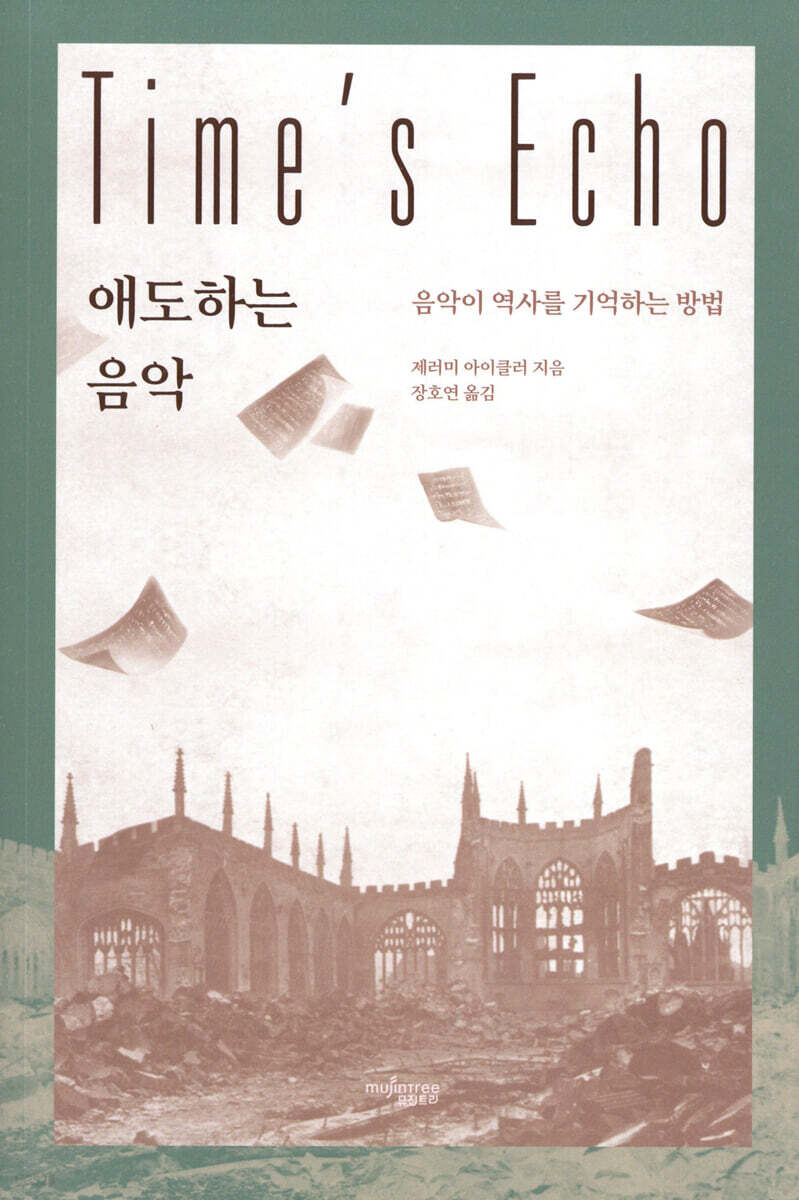
mournful music
 |
Description
Book Introduction
Music of Mourning - History, loss, and the memory of an era heard by human ears.
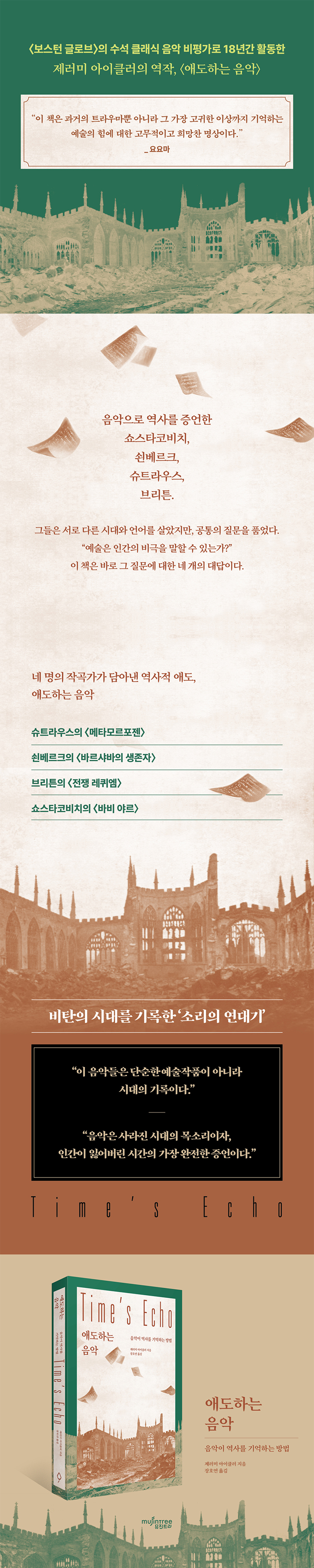
At the heart of Time's Echo, written by historian and music critic Jeremy Eichler, are four musicians.
Shostakovich, Schoenberg, Strauss, and Britten are the ones who testified to history through music.
Although they lived in different times and spoke different languages, they had common questions.
“Can art speak of human tragedy?” This book is four answers to that very question.
Shostakovich responded with silence, Schoenberg with dissonance, Strauss with classical reverberations, and Britten with a chorus of reconciliation.
And all of those answers ultimately come down to one conclusion.
“Music is the final form of memory, the only art by which human beings can remain human.”
The author traverses hundreds of years of musical history, from classical to contemporary, exploring how music remembers human wounds.
And I think about the attitude of remembrance for the tragedy.
This book is not simply a music critique, but rather a thought-provoking intellectual narrative addressing the fundamental question, “What is music?” and a “humanities of listening.” It explores historical scars, human emotions, and the ethics of art.
At the heart of Time's Echo, written by historian and music critic Jeremy Eichler, are four musicians.
Shostakovich, Schoenberg, Strauss, and Britten are the ones who testified to history through music.
Although they lived in different times and spoke different languages, they had common questions.
“Can art speak of human tragedy?” This book is four answers to that very question.
Shostakovich responded with silence, Schoenberg with dissonance, Strauss with classical reverberations, and Britten with a chorus of reconciliation.
And all of those answers ultimately come down to one conclusion.
“Music is the final form of memory, the only art by which human beings can remain human.”
The author traverses hundreds of years of musical history, from classical to contemporary, exploring how music remembers human wounds.
And I think about the attitude of remembrance for the tragedy.
This book is not simply a music critique, but rather a thought-provoking intellectual narrative addressing the fundamental question, “What is music?” and a “humanities of listening.” It explores historical scars, human emotions, and the ethics of art.
- You can preview some of the book's contents.
Preview
index
Prologue: In the Shade of an Oak Tree 011
Part 1
Chapter 1.
Liberate Music 037
Chapter 2.
Dancing in the Thorns 074
Chapter 3.
Torn Half 106
Chapter 4.
Beneath the Waves 141
Chapter 5.
Liberation of Memory 182
Chapter 6.
Moses of Albuquerque 226
Part 2
Chapter 7.
263 on the other coast
Chapter 8.
Angel of History 291
Chapter 9.
Light of the Last Moment 329
Chapter 10.
Monument 384
Coda: Listening to Lost Time 409
Acknowledgments 420
Week 426
Search 480
Translator's Note 489
Part 1
Chapter 1.
Liberate Music 037
Chapter 2.
Dancing in the Thorns 074
Chapter 3.
Torn Half 106
Chapter 4.
Beneath the Waves 141
Chapter 5.
Liberation of Memory 182
Chapter 6.
Moses of Albuquerque 226
Part 2
Chapter 7.
263 on the other coast
Chapter 8.
Angel of History 291
Chapter 9.
Light of the Last Moment 329
Chapter 10.
Monument 384
Coda: Listening to Lost Time 409
Acknowledgments 420
Week 426
Search 480
Translator's Note 489
Detailed image
Into the book
This book begins with two questions.
First, long after the moral and existential rupture epitomized by Auschwitz, now that the world is cluttered with all manner of digital devices, and historical knowledge has been replaced by information about history, how can we still recognize, honor, remember, and feel our connection to the past—in other words, how can we embrace the presence of the past? The second question is closely related to this.
In a world where art and music are often marginalized or relegated to the margins, how can we return these works to history? --- p.20
Ultimately, by gathering these shells, sounds, and stories that remain today, we hope to show a new way of knowing the past, a new way of listening to history.
This is not a passive process for the listener.
As composer Paul Hindemith said, “Music…is just meaningless noise unless it touches the receptive mind.” In this sense, this book also advocates for what I call deep listening.
The idea is to listen to music as an echo of time.
--- p.29
There was one person who penetrated the depths of Britten's music, and that was Shostakovich.
If Strauss and Schoenberg are united in their role in creating modern German culture, Britten and Shostakovich also had much in common in their lives and art.
Both men enjoyed immense power at the heart of their countries' musical cultures, yet they considered themselves outsiders.
--- p.32
Was "Metamorphosen" truly Strauss's chosen penance? Did this work, or any other musical work, cleanse him of his sins? Perhaps for Strauss himself, it did.
But didn't the hidden lyrics of the piece say this?
“No one knows himself / Far from his inner being.” Looking at it from a distance today, it seems out of balance.
Strauss's pro-Nazi gestures were clear, and until the very end he acquiesced to the regime's use of his image and music, thereby legitimizing it. To say that the confession contained in Metamorphoses expresses much abstractly would be an understatement.
And it was too late.
--- p.174
In such a world, beautiful art was a kind of opium for the masses, captivating them and blinding them to the ugly truth about corruption, rule, oppression, and moral decay.
So Schoenberg's atonal revolution was a kind of corrective, with music turning its attention to the harsh dissonances of modern times.
It corrected the art of manufacturing deceptive beauty into an art of conveying existential truth, allowing us to see the truth about life, about human suffering, about history, and about the possibility of a darker future.
--- p.220
Indeed, to truly experience a musical monument like "Survivor of Warsaw" requires a different listening style.
We do not listen to enjoy, but to witness the testimony of music.
In this case, we hear the testimony of the survivors, the testimony of the composer, and the testimony of the group that was to be killed.
There is a trauma of history that this art carries.
But to remember it, we must align our listening with the act of witnessing.
--- p.248p
Listen! This is the essential command and ethical obligation of all musical monuments, including Schoenberg's "Warsaw Survivor."
This also connects to the secret power that music exerts as a medium of memory.
Given the fleeting nature of sound, using it for memory might seem fragile compared to perpetuating memories in a more solid and permanent medium like stone.
But stone monuments often fail to command our full attention, our dedicated witness, as music does.
--- p.250
One hundred years after his birth and twenty-three years after his death, the composer and his wife's ashes came to Vienna from Los Angeles at the request of the Vienna City Council.
They were buried not in the Jewish quarter of the cemetery, but next to those whom Schoenberg had initially considered his spiritual fathers.
The three links in the great German tradition, in which he showed unwavering faith, the gods who never lost: Beethoven, Schubert and Brahms.
Schoenberg's brother-in-law, violinist Rudolf Kolisch, spoke at the grave.
“He belongs here.
“I finally got home.” --- p.258
According to Britten himself, the entire War Requiem was nothing less than “an attempt to correct or resolve the world’s wrongs or sufferings through dreams.”
This is a permanent dream, a dream that exists every time a piece is performed with sincerity and an audience listens with sincerity, and it is also a portable dream.
While you'll have to travel to Coventry to see the Angel of Hutton, the Angel of Britain comes to you through War Requiem.
It passes over a single long moment with music.
We are pushed forward by progress as we look back to the past, awakening the memory of the dead and asking us (to borrow Owen's phrase) to “love a greater love.”
All we have to do is listen.
--- p.326
Britten and Shostakovich shared the idea that art had a greater mission in society.
They intuitively knew that people longed for music that had a sense of the times but also reached a wider audience, music that had the power to change the way listeners viewed the world and themselves in it, music that had a deep compassion at the core of its ethical outlook.
--- p.386
Years later, a special tombstone was erected at Shostakovich's grave.
I know of no stone monument that more clearly evokes an entire era.
Below Shostakovich's name, four notes are inscribed between his year of birth (1906) and his year of death (1975).
D, E flat, C, B, these are the composer's initials and his motto.
His lily soars beyond time and space.
It is as if the final form of Shostakovich's transformation is contained in these four notes.
His life has now become his art, and the history of a nation has become its memory.
And the memory became music.
--- p.408
First, long after the moral and existential rupture epitomized by Auschwitz, now that the world is cluttered with all manner of digital devices, and historical knowledge has been replaced by information about history, how can we still recognize, honor, remember, and feel our connection to the past—in other words, how can we embrace the presence of the past? The second question is closely related to this.
In a world where art and music are often marginalized or relegated to the margins, how can we return these works to history? --- p.20
Ultimately, by gathering these shells, sounds, and stories that remain today, we hope to show a new way of knowing the past, a new way of listening to history.
This is not a passive process for the listener.
As composer Paul Hindemith said, “Music…is just meaningless noise unless it touches the receptive mind.” In this sense, this book also advocates for what I call deep listening.
The idea is to listen to music as an echo of time.
--- p.29
There was one person who penetrated the depths of Britten's music, and that was Shostakovich.
If Strauss and Schoenberg are united in their role in creating modern German culture, Britten and Shostakovich also had much in common in their lives and art.
Both men enjoyed immense power at the heart of their countries' musical cultures, yet they considered themselves outsiders.
--- p.32
Was "Metamorphosen" truly Strauss's chosen penance? Did this work, or any other musical work, cleanse him of his sins? Perhaps for Strauss himself, it did.
But didn't the hidden lyrics of the piece say this?
“No one knows himself / Far from his inner being.” Looking at it from a distance today, it seems out of balance.
Strauss's pro-Nazi gestures were clear, and until the very end he acquiesced to the regime's use of his image and music, thereby legitimizing it. To say that the confession contained in Metamorphoses expresses much abstractly would be an understatement.
And it was too late.
--- p.174
In such a world, beautiful art was a kind of opium for the masses, captivating them and blinding them to the ugly truth about corruption, rule, oppression, and moral decay.
So Schoenberg's atonal revolution was a kind of corrective, with music turning its attention to the harsh dissonances of modern times.
It corrected the art of manufacturing deceptive beauty into an art of conveying existential truth, allowing us to see the truth about life, about human suffering, about history, and about the possibility of a darker future.
--- p.220
Indeed, to truly experience a musical monument like "Survivor of Warsaw" requires a different listening style.
We do not listen to enjoy, but to witness the testimony of music.
In this case, we hear the testimony of the survivors, the testimony of the composer, and the testimony of the group that was to be killed.
There is a trauma of history that this art carries.
But to remember it, we must align our listening with the act of witnessing.
--- p.248p
Listen! This is the essential command and ethical obligation of all musical monuments, including Schoenberg's "Warsaw Survivor."
This also connects to the secret power that music exerts as a medium of memory.
Given the fleeting nature of sound, using it for memory might seem fragile compared to perpetuating memories in a more solid and permanent medium like stone.
But stone monuments often fail to command our full attention, our dedicated witness, as music does.
--- p.250
One hundred years after his birth and twenty-three years after his death, the composer and his wife's ashes came to Vienna from Los Angeles at the request of the Vienna City Council.
They were buried not in the Jewish quarter of the cemetery, but next to those whom Schoenberg had initially considered his spiritual fathers.
The three links in the great German tradition, in which he showed unwavering faith, the gods who never lost: Beethoven, Schubert and Brahms.
Schoenberg's brother-in-law, violinist Rudolf Kolisch, spoke at the grave.
“He belongs here.
“I finally got home.” --- p.258
According to Britten himself, the entire War Requiem was nothing less than “an attempt to correct or resolve the world’s wrongs or sufferings through dreams.”
This is a permanent dream, a dream that exists every time a piece is performed with sincerity and an audience listens with sincerity, and it is also a portable dream.
While you'll have to travel to Coventry to see the Angel of Hutton, the Angel of Britain comes to you through War Requiem.
It passes over a single long moment with music.
We are pushed forward by progress as we look back to the past, awakening the memory of the dead and asking us (to borrow Owen's phrase) to “love a greater love.”
All we have to do is listen.
--- p.326
Britten and Shostakovich shared the idea that art had a greater mission in society.
They intuitively knew that people longed for music that had a sense of the times but also reached a wider audience, music that had the power to change the way listeners viewed the world and themselves in it, music that had a deep compassion at the core of its ethical outlook.
--- p.386
Years later, a special tombstone was erected at Shostakovich's grave.
I know of no stone monument that more clearly evokes an entire era.
Below Shostakovich's name, four notes are inscribed between his year of birth (1906) and his year of death (1975).
D, E flat, C, B, these are the composer's initials and his motto.
His lily soars beyond time and space.
It is as if the final form of Shostakovich's transformation is contained in these four notes.
His life has now become his art, and the history of a nation has become its memory.
And the memory became music.
--- p.408
--- p.408
Publisher's Review
Shostakovich, Schoenberg, Strauss, Britten. The aesthetics of mourning as seen through the works of four composers.
Music is a light and abstract art, but every note is rooted in history and the earth.
Jeremy Eichler, one of the greatest music writers, captures this duality brilliantly in Music of Mourning.
This book traces the lives of four composers who are at the forefront of European classical music, breaking through the dark heart of the 20th century.
The war-scarred monuments they each created are remarkable in themselves, but they are also noteworthy in that they look back on the past while also turning our heads toward our own times, opening our perspectives to the world in which the music was created.
World War II was a global disaster, from Asia to Europe.
And it cracked the tightly woven fabric of humanity.
Somewhere in the midst of this darkness was the Holocaust.
Just as traumatic experiences haunt an individual's memories for a lifetime, this incident continues to stir up the historical memory of Western society.
Theodor Adorno, a German Jewish philosopher, critic, and musical sage, said, “The idea that culture will be revived after Auschwitz is an illusion and meaningless.
But since the world has endured its own end, art must become its unconscious chronicler.”
Based on this reasoning, the author focuses on music in particular among the arts and examines its role as an “unconscious chronicle.”
The music that witnessed history and conveyed that memory to the post-Genocide world is the subject of this book.
Sounds of Lost Time - A Historical Lament by Four Composers
This book features four pieces of music that cut through some of the darkest history of the 20th century West.
These are Strauss's "Metamorphosen," Schoenberg's "Warsaw Survivor," Britten's "War Requiem," and Shostakovich's "Babi Yar" symphony.
Although they are all masterpieces that will remain in the history of music, they are not easy to accept as they deal with death in a comprehensive way.
Through these songs, through the lives of those who created them, and through individual moments in the sociocultural history of music, the author offers a new perspective on the wartime past.
In the midst of war and madness, how did these songs represent human memory, mourning, and weaving history and emotion? The music of these musicians, who testified to history through music, speaks in different languages, yet all bear witness to the same truth.
Music is the final form of memory, the way humans remain human.
Let's take a brief look at the four musicians who are the main characters in this book.
* Shostakovich, who had to live under the Stalinist regime in the Soviet Union, is a symbolic figure who showed how art can preserve human dignity even under surveillance and fear.
He composed 'music of silence' amid the violence of history.
His Symphony No. 5 (1937) was ostensibly interpreted as a 'hymn to socialist heroism', but in reality it was a work filled with the irony and sorrow of an oppressed age.
The audience heard “joy in sorrow,” and power heard “music of loyalty.”
His music, which operates with a double meaning, is like a diary recording the suffocating silence of a totalitarian era.
* Schoenberg, from Austria, is the founder of the dissolution of tonality, that is, dissonance and twelve-tone technique, and is a figure who created a revolutionary turning point in the history of music.
His works from the 1930s, such as Moses und Aron and String Quartet No. 2, were not mere formal experiments, but musical representations of war, exile, and the silence of God.
As Hitler's persecution of the Jews began, Schoenberg fled to the United States, an experience expressed in his music as a sense of the collapse of 'a tonality (order).'
In this book, the author calls him “the philosopher of dissonance.”
In his music, dissonance was not chaos, but ethical awakening.
He had the awareness of the times that “beauty alone cannot save humanity.”
* Strauss is a figure who left behind a complex evaluation as he lived through the Nazi era.
He made certain compromises with the system, but at the same time tried not to lose human dignity and the purity of art.
His later masterpiece, Metamorphosen (1945), is read as music of mourning and repentance for the ruined German culture immediately following the fall of the Nazis.
The deep sadness flowing beneath the classical form was a funeral march played by an era for itself.
* Britain's Briton was a pacifist representing the war generation.
His masterpiece, War Requiem (1962), was a chorus of reconciliation sung by the dead and the living, enemies and allies.
This book reads Britten's music as a “form of mourning and reconciliation.”
His music was not simply an expression of sorrow, but a form of ethical remembrance, a symbol of the belief that human beings can only recover by remembering one another.
Through their music, the author restores the topography of mourning hidden within the history of music, and through its notes and melodies, he revisits the inner workings of history, namely, the question, "How do humans remember what they have lost?"
Music in History - A Chronicle of Sound Documenting an Age of Sorrow
In an age where debates over which history should be commemorated and which should be reinterpreted intensify, the author points out that music preserves the past in the form of intense emotional experiences.
As a historian who values precision and intuitively feels the fervent heat of music, he presents four dramatically different works born from the same impulse in a lucid and moving chronicle.
Music has always existed alongside the shadows of the times.
Having experienced two world wars in the 20th century, humans left behind music as a language of sorrow.
Strauss's "Metamorphosen" is a dirge dedicated to German culture, and Shostakovich's symphonies are not mere works of art but records of the times.
This book examines the social background and philosophical context in which these songs were created, proving that music is the oldest form of human memory.
The Aesthetics of Mourning: Human Artistic Ways to Endure Grief
《Mourning Music》 is a humanistic attempt to read music as the ‘language of sorrow.’
However, it does not stop at just the feeling of tragedy.
The mourning this book deals with is art as an ethical sensibility.
The author believes that, among all arts, music functions as a 'form that allows humans to endure' sadness without romanticizing it.
From that perspective, he persuasively demonstrates, moving between the languages of psychoanalysis, theology, and aesthetics, that “mourning is not a state of static sadness, but a movement toward art.”
Empathizing with the ways in which Sebald, Benjamin, and Adorno view disappearing things and premature loss, he develops a variety of experiments in which music and history fascinate each other.
The author speaks of how music, at the intersection of history and art, remembers the wounds of an era, but ultimately, this is read as speaking of humanity.
Because to mourn is to remember, and to listen is to become human again.
As the original title of this book, 'Time's Echo', suggests, "music is the voice of a vanished era and the most complete testimony to the time humans have lost."
As the author states in the preface that he used a critic's ear and a historian's tools in writing this book, the book is as rich in historical narrative as it is in music.
The writing, meticulously researched and filled with deep emotion, adds to the pleasure of exploration.
This is an inspiring book, full of sharp critical observations and a philosophical weight that explores the dark shadows that have plagued human life and art.
I recommend that you read all the notes at the end of the text.
Music is a light and abstract art, but every note is rooted in history and the earth.
Jeremy Eichler, one of the greatest music writers, captures this duality brilliantly in Music of Mourning.
This book traces the lives of four composers who are at the forefront of European classical music, breaking through the dark heart of the 20th century.
The war-scarred monuments they each created are remarkable in themselves, but they are also noteworthy in that they look back on the past while also turning our heads toward our own times, opening our perspectives to the world in which the music was created.
World War II was a global disaster, from Asia to Europe.
And it cracked the tightly woven fabric of humanity.
Somewhere in the midst of this darkness was the Holocaust.
Just as traumatic experiences haunt an individual's memories for a lifetime, this incident continues to stir up the historical memory of Western society.
Theodor Adorno, a German Jewish philosopher, critic, and musical sage, said, “The idea that culture will be revived after Auschwitz is an illusion and meaningless.
But since the world has endured its own end, art must become its unconscious chronicler.”
Based on this reasoning, the author focuses on music in particular among the arts and examines its role as an “unconscious chronicle.”
The music that witnessed history and conveyed that memory to the post-Genocide world is the subject of this book.
Sounds of Lost Time - A Historical Lament by Four Composers
This book features four pieces of music that cut through some of the darkest history of the 20th century West.
These are Strauss's "Metamorphosen," Schoenberg's "Warsaw Survivor," Britten's "War Requiem," and Shostakovich's "Babi Yar" symphony.
Although they are all masterpieces that will remain in the history of music, they are not easy to accept as they deal with death in a comprehensive way.
Through these songs, through the lives of those who created them, and through individual moments in the sociocultural history of music, the author offers a new perspective on the wartime past.
In the midst of war and madness, how did these songs represent human memory, mourning, and weaving history and emotion? The music of these musicians, who testified to history through music, speaks in different languages, yet all bear witness to the same truth.
Music is the final form of memory, the way humans remain human.
Let's take a brief look at the four musicians who are the main characters in this book.
* Shostakovich, who had to live under the Stalinist regime in the Soviet Union, is a symbolic figure who showed how art can preserve human dignity even under surveillance and fear.
He composed 'music of silence' amid the violence of history.
His Symphony No. 5 (1937) was ostensibly interpreted as a 'hymn to socialist heroism', but in reality it was a work filled with the irony and sorrow of an oppressed age.
The audience heard “joy in sorrow,” and power heard “music of loyalty.”
His music, which operates with a double meaning, is like a diary recording the suffocating silence of a totalitarian era.
* Schoenberg, from Austria, is the founder of the dissolution of tonality, that is, dissonance and twelve-tone technique, and is a figure who created a revolutionary turning point in the history of music.
His works from the 1930s, such as Moses und Aron and String Quartet No. 2, were not mere formal experiments, but musical representations of war, exile, and the silence of God.
As Hitler's persecution of the Jews began, Schoenberg fled to the United States, an experience expressed in his music as a sense of the collapse of 'a tonality (order).'
In this book, the author calls him “the philosopher of dissonance.”
In his music, dissonance was not chaos, but ethical awakening.
He had the awareness of the times that “beauty alone cannot save humanity.”
* Strauss is a figure who left behind a complex evaluation as he lived through the Nazi era.
He made certain compromises with the system, but at the same time tried not to lose human dignity and the purity of art.
His later masterpiece, Metamorphosen (1945), is read as music of mourning and repentance for the ruined German culture immediately following the fall of the Nazis.
The deep sadness flowing beneath the classical form was a funeral march played by an era for itself.
* Britain's Briton was a pacifist representing the war generation.
His masterpiece, War Requiem (1962), was a chorus of reconciliation sung by the dead and the living, enemies and allies.
This book reads Britten's music as a “form of mourning and reconciliation.”
His music was not simply an expression of sorrow, but a form of ethical remembrance, a symbol of the belief that human beings can only recover by remembering one another.
Through their music, the author restores the topography of mourning hidden within the history of music, and through its notes and melodies, he revisits the inner workings of history, namely, the question, "How do humans remember what they have lost?"
Music in History - A Chronicle of Sound Documenting an Age of Sorrow
In an age where debates over which history should be commemorated and which should be reinterpreted intensify, the author points out that music preserves the past in the form of intense emotional experiences.
As a historian who values precision and intuitively feels the fervent heat of music, he presents four dramatically different works born from the same impulse in a lucid and moving chronicle.
Music has always existed alongside the shadows of the times.
Having experienced two world wars in the 20th century, humans left behind music as a language of sorrow.
Strauss's "Metamorphosen" is a dirge dedicated to German culture, and Shostakovich's symphonies are not mere works of art but records of the times.
This book examines the social background and philosophical context in which these songs were created, proving that music is the oldest form of human memory.
The Aesthetics of Mourning: Human Artistic Ways to Endure Grief
《Mourning Music》 is a humanistic attempt to read music as the ‘language of sorrow.’
However, it does not stop at just the feeling of tragedy.
The mourning this book deals with is art as an ethical sensibility.
The author believes that, among all arts, music functions as a 'form that allows humans to endure' sadness without romanticizing it.
From that perspective, he persuasively demonstrates, moving between the languages of psychoanalysis, theology, and aesthetics, that “mourning is not a state of static sadness, but a movement toward art.”
Empathizing with the ways in which Sebald, Benjamin, and Adorno view disappearing things and premature loss, he develops a variety of experiments in which music and history fascinate each other.
The author speaks of how music, at the intersection of history and art, remembers the wounds of an era, but ultimately, this is read as speaking of humanity.
Because to mourn is to remember, and to listen is to become human again.
As the original title of this book, 'Time's Echo', suggests, "music is the voice of a vanished era and the most complete testimony to the time humans have lost."
As the author states in the preface that he used a critic's ear and a historian's tools in writing this book, the book is as rich in historical narrative as it is in music.
The writing, meticulously researched and filled with deep emotion, adds to the pleasure of exploration.
This is an inspiring book, full of sharp critical observations and a philosophical weight that explores the dark shadows that have plagued human life and art.
I recommend that you read all the notes at the end of the text.
GOODS SPECIFICS
- Date of issue: November 18, 2025
- Page count, weight, size: 492 pages | 598g | 140*210*25mm
- ISBN13: 9791161111544
You may also like
카테고리
korean


korean

![GQ KOREA Mark (Monthly): December [2025]](http://librairie.coreenne.fr/cdn/shop/files/8ef265dbbfbf186523ed75ba7319009d.jpg?v=1765340328&width=3840)


