

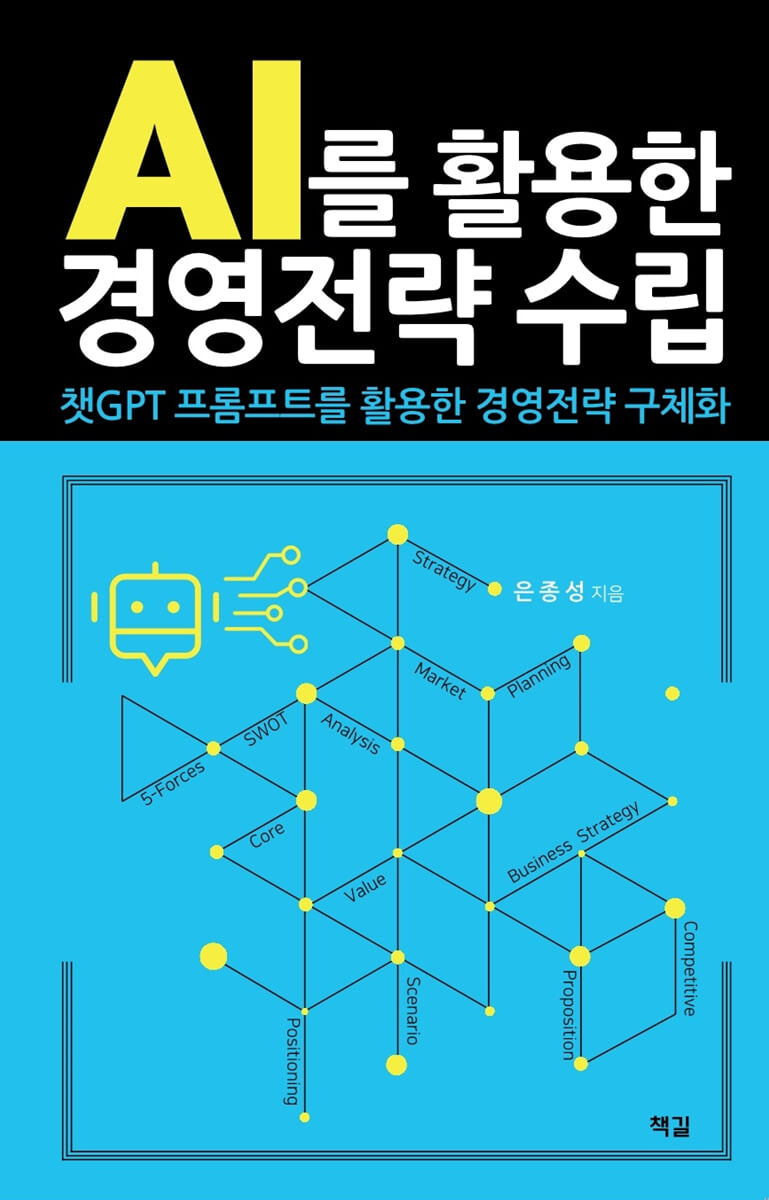
Establishing business strategies using AI
 |
Description
Book Introduction
A practical management strategy guide
This book doesn't simply list ways to use AI.
Based on prompts and cases used in actual consulting settings, the process of establishing a management strategy is presented in a practical manner.
It is structured in a way that the answers obtained using ChatGPT are structured into a strategic framework, so that readers can immediately apply them to their work.
It helps you approach everything from theory to implementation, including writing management strategies, business models, and business plans.
Problem Solving and Questioning Using ChatGPT
Effective strategy development begins with asking the right questions.
This book delves into how to define problems and design structured questions using ChatGPT.
It explains specifically what questions to ask depending on the problem situation and how to practically use the answers obtained through these.
It contains useful content for readers who want to expand their strategic thinking through questions.
Deriving strategies through learning from various frameworks and cases
It covers various frameworks necessary for establishing management strategies, such as external environment analysis, industrial structure evaluation, market attractiveness analysis, and customer persona derivation.
Each framework is explained with specific prompts and real-world examples so that you can apply it right away in practice.
Through this, readers can systematically learn the key tools necessary for the strategy development process.
Increased productivity through collaboration with AI tools
Generative AI tools are not simply question-and-answer tools.
This book presents ways to leverage AI as a strategic collaborator and clearly identifies its strengths and weaknesses.
This book provides specific guidance on how individuals and organizations can leverage AI to maximize productivity and efficiency. It will serve as an essential guide for practitioners preparing for the AI era.
A practical guide to business strategies that anyone can use.
This book is intended for anyone interested in business strategy, business models, business plans, and marketing strategy development.
It is structured so that it can be utilized by a variety of readers, including corporate decision makers, practitioners, and startup founders.
It helps anyone easily understand and utilize it, with prompts and clear explanations designed to help them apply theory to practice.
This book doesn't simply list ways to use AI.
Based on prompts and cases used in actual consulting settings, the process of establishing a management strategy is presented in a practical manner.
It is structured in a way that the answers obtained using ChatGPT are structured into a strategic framework, so that readers can immediately apply them to their work.
It helps you approach everything from theory to implementation, including writing management strategies, business models, and business plans.
Problem Solving and Questioning Using ChatGPT
Effective strategy development begins with asking the right questions.
This book delves into how to define problems and design structured questions using ChatGPT.
It explains specifically what questions to ask depending on the problem situation and how to practically use the answers obtained through these.
It contains useful content for readers who want to expand their strategic thinking through questions.
Deriving strategies through learning from various frameworks and cases
It covers various frameworks necessary for establishing management strategies, such as external environment analysis, industrial structure evaluation, market attractiveness analysis, and customer persona derivation.
Each framework is explained with specific prompts and real-world examples so that you can apply it right away in practice.
Through this, readers can systematically learn the key tools necessary for the strategy development process.
Increased productivity through collaboration with AI tools
Generative AI tools are not simply question-and-answer tools.
This book presents ways to leverage AI as a strategic collaborator and clearly identifies its strengths and weaknesses.
This book provides specific guidance on how individuals and organizations can leverage AI to maximize productivity and efficiency. It will serve as an essential guide for practitioners preparing for the AI era.
A practical guide to business strategies that anyone can use.
This book is intended for anyone interested in business strategy, business models, business plans, and marketing strategy development.
It is structured so that it can be utilized by a variety of readers, including corporate decision makers, practitioners, and startup founders.
It helps anyone easily understand and utilize it, with prompts and clear explanations designed to help them apply theory to practice.
- You can preview some of the book's contents.
Preview
index
Starting text… … … 5
Chapter 1.
Understanding Management Strategy and AI Utilization… … … 16
What is business strategy? … … … 18
The Impact of the External Environment on Business / Digital Transformation and Business Model Expansion / Business Unit-Level Management Strategy? Defining the Problem Comes Before Asking Questions… … … 28
Defining the Problem Before Asking Questions / Problem-Solving Process Using ChatGPT / Effective Prompt Utilization Methods / Structured Questions Using Markdown… … … 34
What is Markup? / What is Markdown? / How to Ask Structured Questions
Chapter 2. Utilizing GPTs / External Environment Analysis… … … 42
Basic data collection methods using search engines, etc.… … … 44
Are Surveys Reliable? / What Data Do I Need? / Quantitative vs. Qualitative Research / Why Basic Information Is Needed / Creating Your Own GPTs with Data… … … 57
GPT Instructions Components / Contextual information such as roles, context, situations, instructions, and tone / Create and use your own GPTs Macro-environmental analysis / 3C analysis / Customer situation analysis… … … 68
Contextual information about the company (brand) / Analysis of the external environment and market conditions / Analysis of customer situations (5W1H)
Chapter 3.
Industry Structure / Competitors / Market Attractiveness… … … 88
How to define industries and markets?… … … 90
How to Define a Market? / Product-Market Fit / Market Attractiveness? Industry Analysis (5-Forces) and Competitor Analysis… … … 96
5-Forces Model / Industry Environment Analysis Prompt / Competitor Analysis Using SWOT Analysis / Market Attractiveness Analysis Using Fermi Estimation… … … 107
How to Estimate Market Size? / Prompts for Market Attractiveness Analysis / Market Viability and Growth Analysis Using the Fermi Estimation
Chapter 4.
Persona Development / Purchase Journey Analysis… … … 114
How do we define a customer?… … … 116
Distinguishing between Users and Customers / Business Types (B2C, B2B, B2G) / Limited Resources / Looking at Customers in Detail, Personas… … … 124
Persona: The Mask of Personality / Prompts for Deriving Personas / Verifying Personas Using Search Data, etc. Analyzing the Persona Purchase Journey… … … 133
Buyer Journey Analysis / Buyer Journey Prompt Design / Is This an Important Issue for Customers?
Chapter 5. PSST / Implementing the Value Chain Hypothesis… … … 140
What problem will be solved?… … … 142
Is this issue important to customers? / Marketability and growth potential? / What's needed to improve the quality of the issue? Establishing a hypothesis from a PSST perspective... 149
Problem-Solution-Scale Up-Team / Why Problem Recognition Matters / Team Building and Collaboration Strategies / Hypothesis Development from a Value Chain Perspective… … … 158
Understanding and Analyzing Value Chains / Prompt Design for Deriving Value Chains / Business Expansion Strategies Using Vertical Integration
Chapter 6.
How to test a hypothesis?… … … 168
Defining the core content of the strategic hypothesis… … … 170
The Limitations of a Strategy Without Hypotheses / What Direction Does a Company (Brand) Pursue? / Questions for Testing Management Strategy Hypotheses / Methods for Testing Management Strategy Hypotheses… … … 177
Ask questions about the "problem," not the solution / Ask questions that are "concrete," not abstract / Use generative AI to verify hypotheses / Use AI to derive interview and observation items... ... ... 184
Generating interview items using generative AI / Nonverbal expressions such as facial expressions, gestures, attitudes, and speech
Chapter 7.
Structuring it into a business model… … … 192
Business Model Realization Methodology… … … 194
Why a Business Model Perspective Is Necessary / Questions for Developing a Business Model / Where to Focus? / 5BM-Innovation Ways: Business Model Lean Canvas and Business Model Canvas… … … 204
Lean Canvas: Focusing on Customer Problems / Lean Canvas Prompt Structure / Matching Lean Canvas and Business Model Establishment Questions / What is the Business Model Canvas? Restructuring the Value Chain Using Benchmarking… 221
Differentiation Leads to Homogenization and Obsolescence / Analyzing Competitors' Business Models / Integration and Expansion from a Value Chain Perspective
Chapter 8.
Marketing Strategy Development and Implementation Plan… … … 228
The fundamentals of marketing are selection and focus… … … 230
Marketing activities must align with the company's strategy. / Who will be told what story? / How will the target audience be determined? How will they be perceived? ... ... ... 242
Strategy Canvas for Deriving a Positioning Map / Making the Positioning Map Real / The 4Ps as a Marketing Execution System / How to Implement Marketing from the 4Ps of a Corporate Perspective to the 4Cs of a Customer Perspective?… … … 263
Communication from a Branding Perspective / Integrated Communication, Triple Media Strategy / Consumer Behavior and the Marketing Funnel Chapter 9.
Business Feasibility / Stakeholders / One-Page Strategy… … … 280
What is a business feasibility study?… … … 282
What is Technical Analysis? / What is Market Analysis? / What is Economic Analysis? / Setting a Budget for Implementation / Preparing an Estimated Profit and Loss Statement / Identifying Stakeholders… … … 295
What is a Stakeholder? / Prompt Design for Stakeholder Identification / What is a Stakeholder Management Plan One-Page Strategy?… … … 303
The Concept and Need for a One-Page Strategy Book / One-Page Strategy Book Prompt Design: Why is Risk Management Necessary?… … … 309
What is Risk? / Scenario Planning for Uncertainty (Concluding Article)… … … 314
Chapter 1.
Understanding Management Strategy and AI Utilization… … … 16
What is business strategy? … … … 18
The Impact of the External Environment on Business / Digital Transformation and Business Model Expansion / Business Unit-Level Management Strategy? Defining the Problem Comes Before Asking Questions… … … 28
Defining the Problem Before Asking Questions / Problem-Solving Process Using ChatGPT / Effective Prompt Utilization Methods / Structured Questions Using Markdown… … … 34
What is Markup? / What is Markdown? / How to Ask Structured Questions
Chapter 2. Utilizing GPTs / External Environment Analysis… … … 42
Basic data collection methods using search engines, etc.… … … 44
Are Surveys Reliable? / What Data Do I Need? / Quantitative vs. Qualitative Research / Why Basic Information Is Needed / Creating Your Own GPTs with Data… … … 57
GPT Instructions Components / Contextual information such as roles, context, situations, instructions, and tone / Create and use your own GPTs Macro-environmental analysis / 3C analysis / Customer situation analysis… … … 68
Contextual information about the company (brand) / Analysis of the external environment and market conditions / Analysis of customer situations (5W1H)
Chapter 3.
Industry Structure / Competitors / Market Attractiveness… … … 88
How to define industries and markets?… … … 90
How to Define a Market? / Product-Market Fit / Market Attractiveness? Industry Analysis (5-Forces) and Competitor Analysis… … … 96
5-Forces Model / Industry Environment Analysis Prompt / Competitor Analysis Using SWOT Analysis / Market Attractiveness Analysis Using Fermi Estimation… … … 107
How to Estimate Market Size? / Prompts for Market Attractiveness Analysis / Market Viability and Growth Analysis Using the Fermi Estimation
Chapter 4.
Persona Development / Purchase Journey Analysis… … … 114
How do we define a customer?… … … 116
Distinguishing between Users and Customers / Business Types (B2C, B2B, B2G) / Limited Resources / Looking at Customers in Detail, Personas… … … 124
Persona: The Mask of Personality / Prompts for Deriving Personas / Verifying Personas Using Search Data, etc. Analyzing the Persona Purchase Journey… … … 133
Buyer Journey Analysis / Buyer Journey Prompt Design / Is This an Important Issue for Customers?
Chapter 5. PSST / Implementing the Value Chain Hypothesis… … … 140
What problem will be solved?… … … 142
Is this issue important to customers? / Marketability and growth potential? / What's needed to improve the quality of the issue? Establishing a hypothesis from a PSST perspective... 149
Problem-Solution-Scale Up-Team / Why Problem Recognition Matters / Team Building and Collaboration Strategies / Hypothesis Development from a Value Chain Perspective… … … 158
Understanding and Analyzing Value Chains / Prompt Design for Deriving Value Chains / Business Expansion Strategies Using Vertical Integration
Chapter 6.
How to test a hypothesis?… … … 168
Defining the core content of the strategic hypothesis… … … 170
The Limitations of a Strategy Without Hypotheses / What Direction Does a Company (Brand) Pursue? / Questions for Testing Management Strategy Hypotheses / Methods for Testing Management Strategy Hypotheses… … … 177
Ask questions about the "problem," not the solution / Ask questions that are "concrete," not abstract / Use generative AI to verify hypotheses / Use AI to derive interview and observation items... ... ... 184
Generating interview items using generative AI / Nonverbal expressions such as facial expressions, gestures, attitudes, and speech
Chapter 7.
Structuring it into a business model… … … 192
Business Model Realization Methodology… … … 194
Why a Business Model Perspective Is Necessary / Questions for Developing a Business Model / Where to Focus? / 5BM-Innovation Ways: Business Model Lean Canvas and Business Model Canvas… … … 204
Lean Canvas: Focusing on Customer Problems / Lean Canvas Prompt Structure / Matching Lean Canvas and Business Model Establishment Questions / What is the Business Model Canvas? Restructuring the Value Chain Using Benchmarking… 221
Differentiation Leads to Homogenization and Obsolescence / Analyzing Competitors' Business Models / Integration and Expansion from a Value Chain Perspective
Chapter 8.
Marketing Strategy Development and Implementation Plan… … … 228
The fundamentals of marketing are selection and focus… … … 230
Marketing activities must align with the company's strategy. / Who will be told what story? / How will the target audience be determined? How will they be perceived? ... ... ... 242
Strategy Canvas for Deriving a Positioning Map / Making the Positioning Map Real / The 4Ps as a Marketing Execution System / How to Implement Marketing from the 4Ps of a Corporate Perspective to the 4Cs of a Customer Perspective?… … … 263
Communication from a Branding Perspective / Integrated Communication, Triple Media Strategy / Consumer Behavior and the Marketing Funnel Chapter 9.
Business Feasibility / Stakeholders / One-Page Strategy… … … 280
What is a business feasibility study?… … … 282
What is Technical Analysis? / What is Market Analysis? / What is Economic Analysis? / Setting a Budget for Implementation / Preparing an Estimated Profit and Loss Statement / Identifying Stakeholders… … … 295
What is a Stakeholder? / Prompt Design for Stakeholder Identification / What is a Stakeholder Management Plan One-Page Strategy?… … … 303
The Concept and Need for a One-Page Strategy Book / One-Page Strategy Book Prompt Design: Why is Risk Management Necessary?… … … 309
What is Risk? / Scenario Planning for Uncertainty (Concluding Article)… … … 314
Detailed image

Into the book
Generative AI will evolve from a "copilot" that requires human instruction and judgment, to an "AI agent" that requires only human instruction, and finally to an "autonomous AI agent" that does not require human instruction or judgment.
But even AI agents are just the beginning.
Ultimately, the most important thing to maximize the potential of generative AI at this point is the ability to ask questions.
Seniors with experience and expertise in questioning skills can leverage AI much more effectively in setting up hypotheses and providing context.
This is because seniors can accurately provide the necessary information to artificial intelligence based on their diverse practical experience and accumulated knowledge.
On the other hand, juniors who have just started their social life have the advantage of being able to display a variety of creativity as they do not have limited stereotypes.
In this way, seniors and juniors can leverage their respective strengths to collaborate with AI, producing richer and more creative results.
--- p.6
The reason we analyze external factors such as politics, economics, society, and technology to establish management strategies is because they are factors that our company cannot control, but inevitably affect our business.
When analyzing the external environment, it is important to remember that we are not simply identifying facts.
It is important to analyze how the external environment will affect our business. The perspectives for this analysis include analyzing political factors to determine "what the market rules are," economic factors to determine "how the value chain will change," social factors to determine "how the demand structure will change," and technological factors to determine "how the competitive landscape will change."
--- p.22
One of the reasons why generative AI like ChatGPT feels empty is because of the question.
While they say that "questions are important" to effectively utilize generative AI, they do not discuss the "problem definition" and "hypothesis setting" necessary for asking questions.
Seeking solutions without clearly identifying the problem is like sailing without a destination.
Only when the problem is defined accurately and specifically can the solution become clear.
--- p.29
The reason why Markdown is effective when using generative AI is because of its conciseness and structured expression.
Generative AI prefers clear and intuitive input to understand questions and commands and generate appropriate responses.
Markdown is an efficient tool that can meet these needs.
Asking generative AI questions like ChatGPT in Markdown is effective.
Markdown allows for structured information delivery, improved readability, clear expression of code and data formats, and utilization of various media.
This will allow for more effective communication with generative artificial intelligence.
--- p.36
Using prompts effectively is key to maximizing the capabilities of generative AI.
A properly constructed prompt provides clear instructions to the AI, which can then produce the desired results.
Additionally, prompts play a crucial role in expanding the range of topics covered by AI and exploring new possibilities.
Ultimately, prompts make interactions with AI richer and more productive, taking human-machine communication to a new level.
There are many different approaches to prompting, but the core concepts are role-based prompts, step-by-step prompts, chain prompts, and contextual prompts.
But even AI agents are just the beginning.
Ultimately, the most important thing to maximize the potential of generative AI at this point is the ability to ask questions.
Seniors with experience and expertise in questioning skills can leverage AI much more effectively in setting up hypotheses and providing context.
This is because seniors can accurately provide the necessary information to artificial intelligence based on their diverse practical experience and accumulated knowledge.
On the other hand, juniors who have just started their social life have the advantage of being able to display a variety of creativity as they do not have limited stereotypes.
In this way, seniors and juniors can leverage their respective strengths to collaborate with AI, producing richer and more creative results.
--- p.6
The reason we analyze external factors such as politics, economics, society, and technology to establish management strategies is because they are factors that our company cannot control, but inevitably affect our business.
When analyzing the external environment, it is important to remember that we are not simply identifying facts.
It is important to analyze how the external environment will affect our business. The perspectives for this analysis include analyzing political factors to determine "what the market rules are," economic factors to determine "how the value chain will change," social factors to determine "how the demand structure will change," and technological factors to determine "how the competitive landscape will change."
--- p.22
One of the reasons why generative AI like ChatGPT feels empty is because of the question.
While they say that "questions are important" to effectively utilize generative AI, they do not discuss the "problem definition" and "hypothesis setting" necessary for asking questions.
Seeking solutions without clearly identifying the problem is like sailing without a destination.
Only when the problem is defined accurately and specifically can the solution become clear.
--- p.29
The reason why Markdown is effective when using generative AI is because of its conciseness and structured expression.
Generative AI prefers clear and intuitive input to understand questions and commands and generate appropriate responses.
Markdown is an efficient tool that can meet these needs.
Asking generative AI questions like ChatGPT in Markdown is effective.
Markdown allows for structured information delivery, improved readability, clear expression of code and data formats, and utilization of various media.
This will allow for more effective communication with generative artificial intelligence.
--- p.36
Using prompts effectively is key to maximizing the capabilities of generative AI.
A properly constructed prompt provides clear instructions to the AI, which can then produce the desired results.
Additionally, prompts play a crucial role in expanding the range of topics covered by AI and exploring new possibilities.
Ultimately, prompts make interactions with AI richer and more productive, taking human-machine communication to a new level.
There are many different approaches to prompting, but the core concepts are role-based prompts, step-by-step prompts, chain prompts, and contextual prompts.
--- p.58
Publisher's Review
Management strategies that can be applied directly to practice
This book goes beyond mere theoretical and technical explanations; it provides practical tools and examples that can be applied directly in real-world business settings.
Writing prompts and solving problems using ChatGPT feels like receiving direct consulting.
This is a must-read for practitioners who want to expand their strategic thinking.
A must-read for practitioners preparing for the AI era.
As AI moves beyond mere tools to become collaborators, this book demonstrates how to develop and execute business strategies using ChatGPT.
Structured questioning and various frameworks provide a clear path even in complex business environments.
It is highly recommended for practitioners who are involved in establishing business strategies, specifying business models, and writing business plans.
A book that stands out for its concrete and practical approach.
The most important thing when establishing a management strategy is the ability to actually execute it.
This book helps you effectively resolve issues that arise during strategy development and implementation through a concrete framework and practical examples. I believe it is an essential guide for all managers and practitioners considering AI utilization.
A practical guide to navigating complex business environments
This book does not simply list AI technologies or cover only management strategy theories.
It explains the entire process, from business environment analysis to hypothesis setting and strategy execution, with actual consulting cases.
This is the best book for readers who want to systematically solve complex business problems.
A book that effectively explores the intersection of AI and management.
Few books clearly explain how to concretize business strategies using generative AI like ChatGPT.
Through a structure that bridges theory and practice and real-world examples, readers can learn how to practically utilize AI.
This is a must-read for anyone looking to incorporate AI into their business strategy.
This book goes beyond mere theoretical and technical explanations; it provides practical tools and examples that can be applied directly in real-world business settings.
Writing prompts and solving problems using ChatGPT feels like receiving direct consulting.
This is a must-read for practitioners who want to expand their strategic thinking.
A must-read for practitioners preparing for the AI era.
As AI moves beyond mere tools to become collaborators, this book demonstrates how to develop and execute business strategies using ChatGPT.
Structured questioning and various frameworks provide a clear path even in complex business environments.
It is highly recommended for practitioners who are involved in establishing business strategies, specifying business models, and writing business plans.
A book that stands out for its concrete and practical approach.
The most important thing when establishing a management strategy is the ability to actually execute it.
This book helps you effectively resolve issues that arise during strategy development and implementation through a concrete framework and practical examples. I believe it is an essential guide for all managers and practitioners considering AI utilization.
A practical guide to navigating complex business environments
This book does not simply list AI technologies or cover only management strategy theories.
It explains the entire process, from business environment analysis to hypothesis setting and strategy execution, with actual consulting cases.
This is the best book for readers who want to systematically solve complex business problems.
A book that effectively explores the intersection of AI and management.
Few books clearly explain how to concretize business strategies using generative AI like ChatGPT.
Through a structure that bridges theory and practice and real-world examples, readers can learn how to practically utilize AI.
This is a must-read for anyone looking to incorporate AI into their business strategy.
GOODS SPECIFICS
- Date of issue: February 1, 2025
- Page count, weight, size: 320 pages | 148*225*25mm
- ISBN13: 9791198442574
- ISBN10: 1198442573
You may also like
카테고리
korean


korean

![GQ KOREA Mark (Monthly): December [2025]](http://librairie.coreenne.fr/cdn/shop/files/8ef265dbbfbf186523ed75ba7319009d.jpg?v=1765340328&width=3840)


