

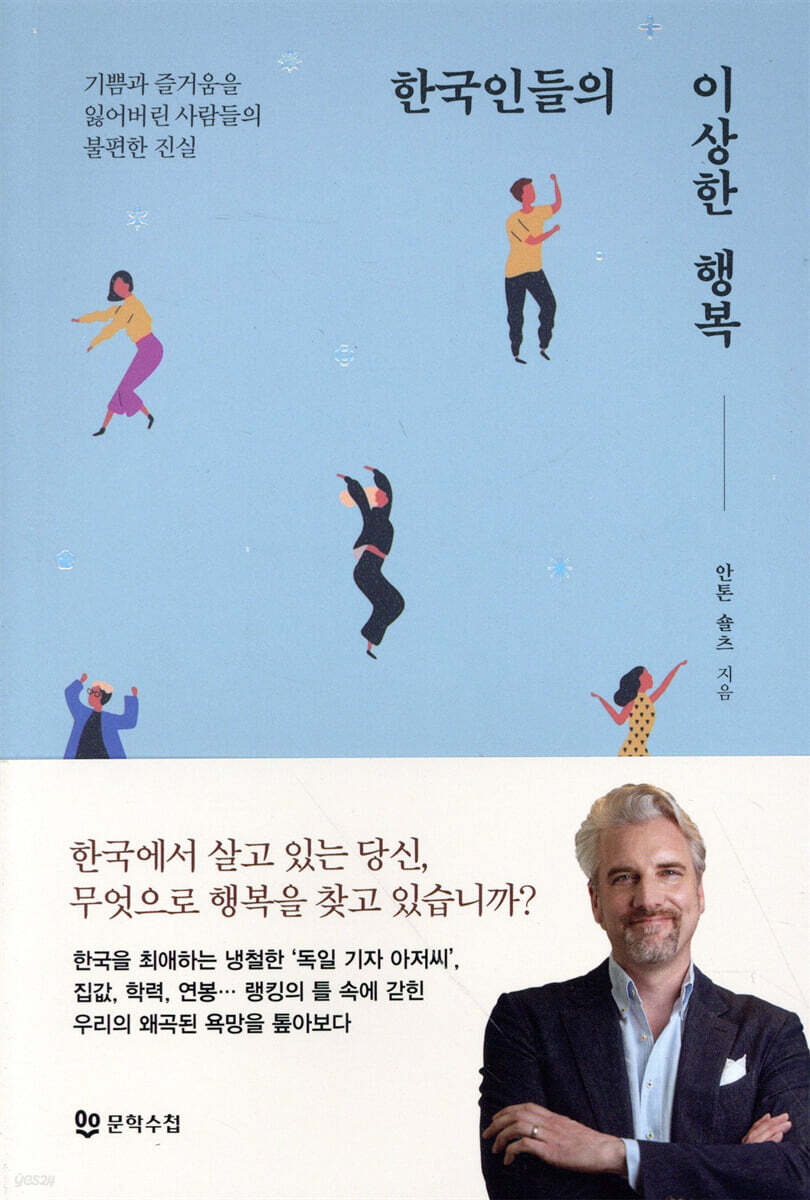
The strange happiness of Koreans
 |
Description
Book Introduction
You, who live in South Korea, an emerging advanced country with the lowest 'happiness index', What do you find happiness in? Experienced in various fields of society as a journalist, businessman, professor, and parent A 2022 report on the Republic of Korea, written with sincerity, sharpness, and bluntness by a German reporter. There have been quite a few authors who, as foreign sociologists or journalists, have broadened our horizons by writing humanities books and essays on the characteristics of Korean society and its people. However, Anton Scholz, the author of “The Strange Happiness of Koreans,” is in a unique position compared to existing authors. Having developed a connection with Korea through Taekwondo during his youth, he became fascinated by Buddhism and Zen philosophy and began to immerse himself in Korean culture. Since then, he has experienced various aspects of Korean society as a person with various professions for over 20 years. As a journalist working as a producer and freelance reporter for the German public broadcaster ARD, as a business consultant running a media company and acting as a bridge between foreign and Korean companies, I have observed the field in various fields in Korea from a three-dimensional and multifaceted perspective, from the perspective of a self-employed person, as an educator working as a professor in the German language education department at a domestic university, and as a married parent raising a child. He can be said to be an intellectual who has experienced the dark side of Korean society in a more colorful and deeper way than the average Korean. Although he has lived in Korea for a long time, the society and people of the Republic of Korea still arouse his questions and curiosity. The author, who came to Korea in 1994 out of pure curiosity and a sense of adventure, has enjoyed a variety of experiences and found happiness in his own way, and still lives in pursuit of happiness, feels deep love and empathy for Koreans, but sometimes witnesses things that are utterly incomprehensible and puzzling. In his eyes, Korea is “a role model that many developing countries dream of” (p. 9) and “a place where dynamism breathes every day without a moment of boredom” (p. 263), but it is also a society in which “there are too many tangible and intangible regulations, and the range of choices that individuals can make for their growth from childhood is narrow” (pp. 11-12), resulting in too many “people who think they are unhappy” (p. 8). It's a strange place, where the country is growing richer and more fashionable, yet the suicide rate is rising and the "happiness index" is at the bottom. The author writes this book with the hope that more people will live positive lives, sharing the story of how he found happiness in Korea, and “a heartfelt message to this country and its people who have guided me and given me such amazing experiences, love, and opportunities” (p. 10). This book contains the author's exploration and advice on how to be happy in the Korean society in which we live. The author goes a step further and presents ideas on how we can change our society to achieve a happier life for individuals. It is a spicy, bitter, and venomous message that may feel uncomfortable and cold from a Korean perspective. But his writing, which knows the Korean people better than anyone else, is filled with broad understanding, affection, and support. Through this book, readers will be able to contemplate their own true happiness and reflect on the society of the Republic of Korea. |
- You can preview some of the book's contents.
Preview
index
Prologue_6 Bittersweet Love Letters to Koreans Dreaming of Happiness
Chapter 1.
The art of work-life balance
1.
There is no such thing as a fair savannah 16
2.
The Obsession Called Work-Life Balance 22
3.
30 to really get things done
4.
Hell for the "Golden Spoon" 37
5.
First, I will be honest with myself 43
6.
50 for those of you who want to eliminate childbirth from your life options
7.
Srabal, Our Common Problem 54
Chapter 2.
Why You Should Dream of Travel and Adventure
1.
The Nomad Within Us 62
2.
Happiness Encountered on an Untraveled Road 68
3.
Journey, Crossing the Crossroads 75
4.
Traveling Alone 84
5.
The explorer's spirit that exists somewhere within me 89
6.
Another Adventure of the Senses, Food 96
7.
The Power of Cooking: 104
Chapter 3.
The happiness of buying a house, the happiness of living in a house
1.
home or house, where you currently reside 110
2.
The Fantasy House Called Seoul 115
3.
Colorless and odorless space without 'me' 119
4.
Why I Couldn't Give Up My Yard 126
5.
132 Virtues That Those Who Stay Home Should Practice
6.
The Tragedy of the Rootless 138
Chapter 4.
Happiness Trapped in Education, Ranking, and Sequence
1.
Children Forced to Succeed 146
2.
The Education Industry's Dilemma 154
3.
Educational Methods in a Test-Oriented Society 159
4.
How to Use German Universities 166
5.
The fragrance of true education emanating from Seowon 171
6.
A Culture of Debate Essential to a Nation of Ranks and Sequences 177
7.
Parents are life's teachers who awaken the best values. 187
Chapter 5.
To you, Koreans who dream of a happy society
1.
196 Things to Consider Before Erasing Someone
2.
History to Remember and Learn 205
3.
Rights and Obligations of Finger Jurisdiction 211
4.
Korean Self-Perception 221
5.
The Side Effects of Han Misuse in the 21st Century 228
6.
The desire to be caught up in the attention of others 236
7.
A Society Where People Can Be Trusted 241
8.
The Power of Situational Awareness 246
9.
A Society That Knows How to Grow with Dilemmas as its Driving Force 254
Epilogue_It's Up to You 261
Chapter 1.
The art of work-life balance
1.
There is no such thing as a fair savannah 16
2.
The Obsession Called Work-Life Balance 22
3.
30 to really get things done
4.
Hell for the "Golden Spoon" 37
5.
First, I will be honest with myself 43
6.
50 for those of you who want to eliminate childbirth from your life options
7.
Srabal, Our Common Problem 54
Chapter 2.
Why You Should Dream of Travel and Adventure
1.
The Nomad Within Us 62
2.
Happiness Encountered on an Untraveled Road 68
3.
Journey, Crossing the Crossroads 75
4.
Traveling Alone 84
5.
The explorer's spirit that exists somewhere within me 89
6.
Another Adventure of the Senses, Food 96
7.
The Power of Cooking: 104
Chapter 3.
The happiness of buying a house, the happiness of living in a house
1.
home or house, where you currently reside 110
2.
The Fantasy House Called Seoul 115
3.
Colorless and odorless space without 'me' 119
4.
Why I Couldn't Give Up My Yard 126
5.
132 Virtues That Those Who Stay Home Should Practice
6.
The Tragedy of the Rootless 138
Chapter 4.
Happiness Trapped in Education, Ranking, and Sequence
1.
Children Forced to Succeed 146
2.
The Education Industry's Dilemma 154
3.
Educational Methods in a Test-Oriented Society 159
4.
How to Use German Universities 166
5.
The fragrance of true education emanating from Seowon 171
6.
A Culture of Debate Essential to a Nation of Ranks and Sequences 177
7.
Parents are life's teachers who awaken the best values. 187
Chapter 5.
To you, Koreans who dream of a happy society
1.
196 Things to Consider Before Erasing Someone
2.
History to Remember and Learn 205
3.
Rights and Obligations of Finger Jurisdiction 211
4.
Korean Self-Perception 221
5.
The Side Effects of Han Misuse in the 21st Century 228
6.
The desire to be caught up in the attention of others 236
7.
A Society Where People Can Be Trusted 241
8.
The Power of Situational Awareness 246
9.
A Society That Knows How to Grow with Dilemmas as its Driving Force 254
Epilogue_It's Up to You 261
Into the book
You'll find out when you pack your bags for a trip.
Packing a bare minimum of things allows me to gauge what I need most and what I value most as a person.
Even if you leave with only the things you really need and will use, you may realize that there are still things you don't use and that are unnecessary.
---From "Happiness Encountered on a Road Not Taken"
When you move frequently, your home becomes nothing more than a 'temporary space'.
Is it because of this culture? I often see people who don't immediately remove the interior wrapping or protective film after purchasing a car.
Some people buy a car and leave it there for a long time.
I asked why, and they said it was because they could sell it again later.
The reason why white tea is especially preferred is because it is the best-selling tea.
---From "home or house, where you live now"
Before building a house in Gwangju, I went to a model house that showed a townhouse complex.
The person who welcomed our family explained everything to us and told us what options we had.
And he added that there were no options for the complex that would be built next door.
The reason is that people don't want to choose.
The point is that the choice itself is annoying.
---From "A Colorless and Odorless Space Without 'I'"
Korean people are sensitive to trends.
If you go to a crowded downtown area, you can see this year's fashion trends, and if you go to a restaurant that has become popular through social media, there will be long lines.
The mentality of 'others are doing it, so I should do it too' has been a driving force for social development, but it has also led to the formation of standardized and individualistic standards.
The standard for success and happiness has become how much of an economic advantage one has over others.
Isn't the reason why people are so obsessed with real estate because they think, 'Other people have made as much money from their homes, so I should try it too'?
---From "The Tragedy of the Rootless"
Unfortunately, in Korea, I often see people's rigid postures during discussions.
For them, there are only two opinions on any topic of discussion.
Your own opinions and your wrong opinions.
Some friends advise me to never bring up politics because it can make the relationship awkward.
As someone who enjoys talking with friends who have different political views, this was a strange statement.
Rather, I learned a lot through those conversations.
---From "A Debate Culture Essential to a Country of Rankings and Sequences"
'Han' is a feeling of resentment, sadness, and hardening.
Rather than responding violently to someone, that feeling must be expressed as positive energy to create a future different from the present, and only then can it be called 'sublimation.'
Isn't this the uniquely Korean "aesthetics of Han" that distinguishes it from other countries and peoples? However, the Han I see among Koreans is closer to self-pity.
Even without using the word "Han," I am concerned that the mindset of shifting responsibility to others and defining oneself as a victim has become somewhat widespread.
---From "The Side Effects of Han Misuse in the 21st Century"
Actually, when I'm sad and lonely, the person who can comfort me doesn't need as many followers as the number of followers.
But people are sensitive to those numbers.
In a relationship where we cannot fully see each other, we are only increasing the feeling of emptiness.
Our real lives cannot be captured on social media.
In reality, I am the person staring blankly at my virtual self outside the phone screen.
---From "The Desire to Be Trapped in Other People's Attention"
He wakes up every morning and goes to work. He could buy a plane ticket and leave at any moment if he wanted to.
If you really want to travel, you can put it into action.
Some may ask how this is possible when you have family and work to do.
But that too is his choice.
He chose to lead a stable life by working and raising his family.
Our lives and daily lives are the result of the choices we make.
There is no cosmic force at work in our choices.
In reality, we live our lives making choices every day.
---From "The Power of Situational Awareness"
In the dilemma posed by the COVID-19 virus, the South Korean government chose to protect the health of its citizens over individual human rights.
I can't be sure what's right.
But in this situation, we must do our best to think and choose.
What decisions did you make and what opinions did you agree with in these difficult issues? You were the one who had to make all those decisions and choices.
---From "A Society That Knows How to Grow with Dilemmas as the Driving Force"
When someone tells me, “Life is so hard,” I say, “Look at the bigger picture.
“Your life may not be that hard,” he says.
The man shakes his head.
I think that such empty talk is not helpful to me right now.
But I think that kind of perception is no different from 'the blind men touching the elephant'.
If a person is only conscious of the unhappiness he feels now and says that his entire life is difficult, then he will never know real life.
Packing a bare minimum of things allows me to gauge what I need most and what I value most as a person.
Even if you leave with only the things you really need and will use, you may realize that there are still things you don't use and that are unnecessary.
---From "Happiness Encountered on a Road Not Taken"
When you move frequently, your home becomes nothing more than a 'temporary space'.
Is it because of this culture? I often see people who don't immediately remove the interior wrapping or protective film after purchasing a car.
Some people buy a car and leave it there for a long time.
I asked why, and they said it was because they could sell it again later.
The reason why white tea is especially preferred is because it is the best-selling tea.
---From "home or house, where you live now"
Before building a house in Gwangju, I went to a model house that showed a townhouse complex.
The person who welcomed our family explained everything to us and told us what options we had.
And he added that there were no options for the complex that would be built next door.
The reason is that people don't want to choose.
The point is that the choice itself is annoying.
---From "A Colorless and Odorless Space Without 'I'"
Korean people are sensitive to trends.
If you go to a crowded downtown area, you can see this year's fashion trends, and if you go to a restaurant that has become popular through social media, there will be long lines.
The mentality of 'others are doing it, so I should do it too' has been a driving force for social development, but it has also led to the formation of standardized and individualistic standards.
The standard for success and happiness has become how much of an economic advantage one has over others.
Isn't the reason why people are so obsessed with real estate because they think, 'Other people have made as much money from their homes, so I should try it too'?
---From "The Tragedy of the Rootless"
Unfortunately, in Korea, I often see people's rigid postures during discussions.
For them, there are only two opinions on any topic of discussion.
Your own opinions and your wrong opinions.
Some friends advise me to never bring up politics because it can make the relationship awkward.
As someone who enjoys talking with friends who have different political views, this was a strange statement.
Rather, I learned a lot through those conversations.
---From "A Debate Culture Essential to a Country of Rankings and Sequences"
'Han' is a feeling of resentment, sadness, and hardening.
Rather than responding violently to someone, that feeling must be expressed as positive energy to create a future different from the present, and only then can it be called 'sublimation.'
Isn't this the uniquely Korean "aesthetics of Han" that distinguishes it from other countries and peoples? However, the Han I see among Koreans is closer to self-pity.
Even without using the word "Han," I am concerned that the mindset of shifting responsibility to others and defining oneself as a victim has become somewhat widespread.
---From "The Side Effects of Han Misuse in the 21st Century"
Actually, when I'm sad and lonely, the person who can comfort me doesn't need as many followers as the number of followers.
But people are sensitive to those numbers.
In a relationship where we cannot fully see each other, we are only increasing the feeling of emptiness.
Our real lives cannot be captured on social media.
In reality, I am the person staring blankly at my virtual self outside the phone screen.
---From "The Desire to Be Trapped in Other People's Attention"
He wakes up every morning and goes to work. He could buy a plane ticket and leave at any moment if he wanted to.
If you really want to travel, you can put it into action.
Some may ask how this is possible when you have family and work to do.
But that too is his choice.
He chose to lead a stable life by working and raising his family.
Our lives and daily lives are the result of the choices we make.
There is no cosmic force at work in our choices.
In reality, we live our lives making choices every day.
---From "The Power of Situational Awareness"
In the dilemma posed by the COVID-19 virus, the South Korean government chose to protect the health of its citizens over individual human rights.
I can't be sure what's right.
But in this situation, we must do our best to think and choose.
What decisions did you make and what opinions did you agree with in these difficult issues? You were the one who had to make all those decisions and choices.
---From "A Society That Knows How to Grow with Dilemmas as the Driving Force"
When someone tells me, “Life is so hard,” I say, “Look at the bigger picture.
“Your life may not be that hard,” he says.
The man shakes his head.
I think that such empty talk is not helpful to me right now.
But I think that kind of perception is no different from 'the blind men touching the elephant'.
If a person is only conscious of the unhappiness he feels now and says that his entire life is difficult, then he will never know real life.
---From "It's Up to You"
Publisher's Review
“Now is the time to correct our definition of happiness!”
Korean society and Korean people can never be happy no matter how hard they work or how well they build up their resumes.
A sharp rebuke to the "illusion of happiness" built within the framework of hierarchy: education, salary, housing price...
What can make us happy? By the standards of the average person, graduating from a prestigious university, landing a job at a renowned conglomerate with a high salary, living in Seoul in your own name with an apartment whose value rises every year, and occasionally taking vacations to enviable resorts—is that a happy life? At first glance, it sounds like a life of unparalleled satisfaction.
However, the author asserts that if the subject of happiness is not 'me' but 'me as reflected in others', then even if I am economically abundant, I cannot live a positive life.
The author breaks down each material element that can make us feel happy and explores its properties.
The criteria used in our society to compare or evaluate individuals with others, such as real estate, annual salary, and educational background, each have their own chapter in this book.
The author argues that these elements have lost their original meaning in Korean society and have become a means of flaunting privilege and possessiveness.
Above all, the biggest social ill of Korean society and the biggest obstacle blocking individual happiness, as seen by the author, is “a mindset accustomed to hierarchy” (p. 181).
Although it is said that Korean people's perception has changed a lot from the past, what is still latent in our consciousness is the 'hierarchy culture'.
The author points out that “there are few countries as sensitive to rankings and hierarchy as Korea” (p. 178), and emphasizes that “confirming one’s position and looking down on those below from a high position and enjoying relative satisfaction” (p. 181) has nothing to do with the essence of happiness.
The illusion of hierarchy has turned a home, which should “completely contain the narrative of my life” (p. 109), into a “useful means of increasing wealth” (p. 138), education, which should lead to the growth of one’s personality from birth to death, into “a means of beating others in the competition for college entrance and employment” (p. 145), and a job, which should be the realization of another self, into a means of making money.
The author uses his sharp and penetrating gaze to challenge our absurd prejudices and ways of thinking, while also sharing his own insights into how to achieve happiness through the life he has lived.
The method he presents is neither special nor extraordinary.
Just as “some people feel energized when they go to an unfamiliar place, and others feel joy just by eating delicious food” (page 33), he advises us to realize that each person’s point of happiness is different, to break free from the prejudices of others and society, to truly understand the characteristics and essence of our own existence, and to move forward toward the future with a sense of challenge and responsibility.
At first glance, it may seem like an ordinary statement, but the message conveyed by the author, who, despite the concerns and dissuasion of those around him, steadfastly chose the non-mainstream field of study, Korean Studies, which was a cause for concern even in Germany in the 1990s, where “choice of study was free and respected” (p. 33), and has pioneered his life to date, resonates deeply.
Break free from the errors of outdated thinking and customs that shackle our daily lives as we dream of happiness.
Changing the paradigm of happiness will open up a new life for me and a new Republic of Korea.
In order to change individual lives and society, there must be a certain level of support from institutions and laws.
However, what the author attaches great importance to in this book is the will and awakening of each individual.
Just as the improvement of black human rights in the United States began with the awakening of an individual named Rosa Parks, who refused to give up her seat to a white person on the bus on her way home from work despite being required to do so under the "segregation laws" before the power of conscious citizens united, we are urged to think and act proactively in order to find our own happiness.
Rather than simply pursuing one's own interests, we must also actively fight against social prejudice and absurdity.
While chapters 1-4 were specific discussions on specific fields such as career, travel, home, and education, the author examines Korean society from a broader perspective in the final chapter 5 and discusses the responsibilities we must have as members of a society where the diverse happiness of individuals is respected.
In the internet space where words of conflict and hatred are increasingly rampant, he urges us to “accept the premise that not everyone will always agree with my opinion” (p. 204), that the real “me” is not the staged “me” of social media, but “the person who is staring blankly at the virtual me outside the cell phone screen” (p. 240), and not to fall into the trap of self-pity by defining ourselves as “victims of the system, victims of our parents’ desires, victims of patriarchy” (p. 234).
The author reminds us that barely surviving each month on a small salary is an unsatisfactory but personal choice to live a stable daily life.
He emphasizes that “recognizing that you are the subject of your own life, that you make your own choices and decisions, and that the responsibility for them is also yours is the first step toward leading yourself and your life in a better direction” (p. 250).
A home that rediscovers its meaning as a sanctuary where I build my narrative, not as "real estate," education that becomes a guide for forming a lifelong character and intellect, not as "academic qualifications," a job that becomes the embodiment of another self, not as "salary," and travel that becomes a simple rest, not as a simple rest, but as a simple adventure that awakens my senses.
In addition, the author hopes that by uniting the power to change Korean society with a sense of community, Koreans and Korean society will become a brighter and happier place than they are now.
“You can see it if you look at it differently.
“How can we change our lives and be content and happy?” (p. 270)
Korean society and Korean people can never be happy no matter how hard they work or how well they build up their resumes.
A sharp rebuke to the "illusion of happiness" built within the framework of hierarchy: education, salary, housing price...
What can make us happy? By the standards of the average person, graduating from a prestigious university, landing a job at a renowned conglomerate with a high salary, living in Seoul in your own name with an apartment whose value rises every year, and occasionally taking vacations to enviable resorts—is that a happy life? At first glance, it sounds like a life of unparalleled satisfaction.
However, the author asserts that if the subject of happiness is not 'me' but 'me as reflected in others', then even if I am economically abundant, I cannot live a positive life.
The author breaks down each material element that can make us feel happy and explores its properties.
The criteria used in our society to compare or evaluate individuals with others, such as real estate, annual salary, and educational background, each have their own chapter in this book.
The author argues that these elements have lost their original meaning in Korean society and have become a means of flaunting privilege and possessiveness.
Above all, the biggest social ill of Korean society and the biggest obstacle blocking individual happiness, as seen by the author, is “a mindset accustomed to hierarchy” (p. 181).
Although it is said that Korean people's perception has changed a lot from the past, what is still latent in our consciousness is the 'hierarchy culture'.
The author points out that “there are few countries as sensitive to rankings and hierarchy as Korea” (p. 178), and emphasizes that “confirming one’s position and looking down on those below from a high position and enjoying relative satisfaction” (p. 181) has nothing to do with the essence of happiness.
The illusion of hierarchy has turned a home, which should “completely contain the narrative of my life” (p. 109), into a “useful means of increasing wealth” (p. 138), education, which should lead to the growth of one’s personality from birth to death, into “a means of beating others in the competition for college entrance and employment” (p. 145), and a job, which should be the realization of another self, into a means of making money.
The author uses his sharp and penetrating gaze to challenge our absurd prejudices and ways of thinking, while also sharing his own insights into how to achieve happiness through the life he has lived.
The method he presents is neither special nor extraordinary.
Just as “some people feel energized when they go to an unfamiliar place, and others feel joy just by eating delicious food” (page 33), he advises us to realize that each person’s point of happiness is different, to break free from the prejudices of others and society, to truly understand the characteristics and essence of our own existence, and to move forward toward the future with a sense of challenge and responsibility.
At first glance, it may seem like an ordinary statement, but the message conveyed by the author, who, despite the concerns and dissuasion of those around him, steadfastly chose the non-mainstream field of study, Korean Studies, which was a cause for concern even in Germany in the 1990s, where “choice of study was free and respected” (p. 33), and has pioneered his life to date, resonates deeply.
Break free from the errors of outdated thinking and customs that shackle our daily lives as we dream of happiness.
Changing the paradigm of happiness will open up a new life for me and a new Republic of Korea.
In order to change individual lives and society, there must be a certain level of support from institutions and laws.
However, what the author attaches great importance to in this book is the will and awakening of each individual.
Just as the improvement of black human rights in the United States began with the awakening of an individual named Rosa Parks, who refused to give up her seat to a white person on the bus on her way home from work despite being required to do so under the "segregation laws" before the power of conscious citizens united, we are urged to think and act proactively in order to find our own happiness.
Rather than simply pursuing one's own interests, we must also actively fight against social prejudice and absurdity.
While chapters 1-4 were specific discussions on specific fields such as career, travel, home, and education, the author examines Korean society from a broader perspective in the final chapter 5 and discusses the responsibilities we must have as members of a society where the diverse happiness of individuals is respected.
In the internet space where words of conflict and hatred are increasingly rampant, he urges us to “accept the premise that not everyone will always agree with my opinion” (p. 204), that the real “me” is not the staged “me” of social media, but “the person who is staring blankly at the virtual me outside the cell phone screen” (p. 240), and not to fall into the trap of self-pity by defining ourselves as “victims of the system, victims of our parents’ desires, victims of patriarchy” (p. 234).
The author reminds us that barely surviving each month on a small salary is an unsatisfactory but personal choice to live a stable daily life.
He emphasizes that “recognizing that you are the subject of your own life, that you make your own choices and decisions, and that the responsibility for them is also yours is the first step toward leading yourself and your life in a better direction” (p. 250).
A home that rediscovers its meaning as a sanctuary where I build my narrative, not as "real estate," education that becomes a guide for forming a lifelong character and intellect, not as "academic qualifications," a job that becomes the embodiment of another self, not as "salary," and travel that becomes a simple rest, not as a simple rest, but as a simple adventure that awakens my senses.
In addition, the author hopes that by uniting the power to change Korean society with a sense of community, Koreans and Korean society will become a brighter and happier place than they are now.
“You can see it if you look at it differently.
“How can we change our lives and be content and happy?” (p. 270)
GOODS SPECIFICS
- Publication date: April 22, 2022
- Page count, weight, size: 272 pages | 296g | 128*190*20mm
- ISBN13: 9788983928993
- ISBN10: 8983928999
You may also like
카테고리
korean


korean

![GQ KOREA Mark (Monthly): December [2025]](http://librairie.coreenne.fr/cdn/shop/files/8ef265dbbfbf186523ed75ba7319009d.jpg?v=1765340328&width=3840)


