

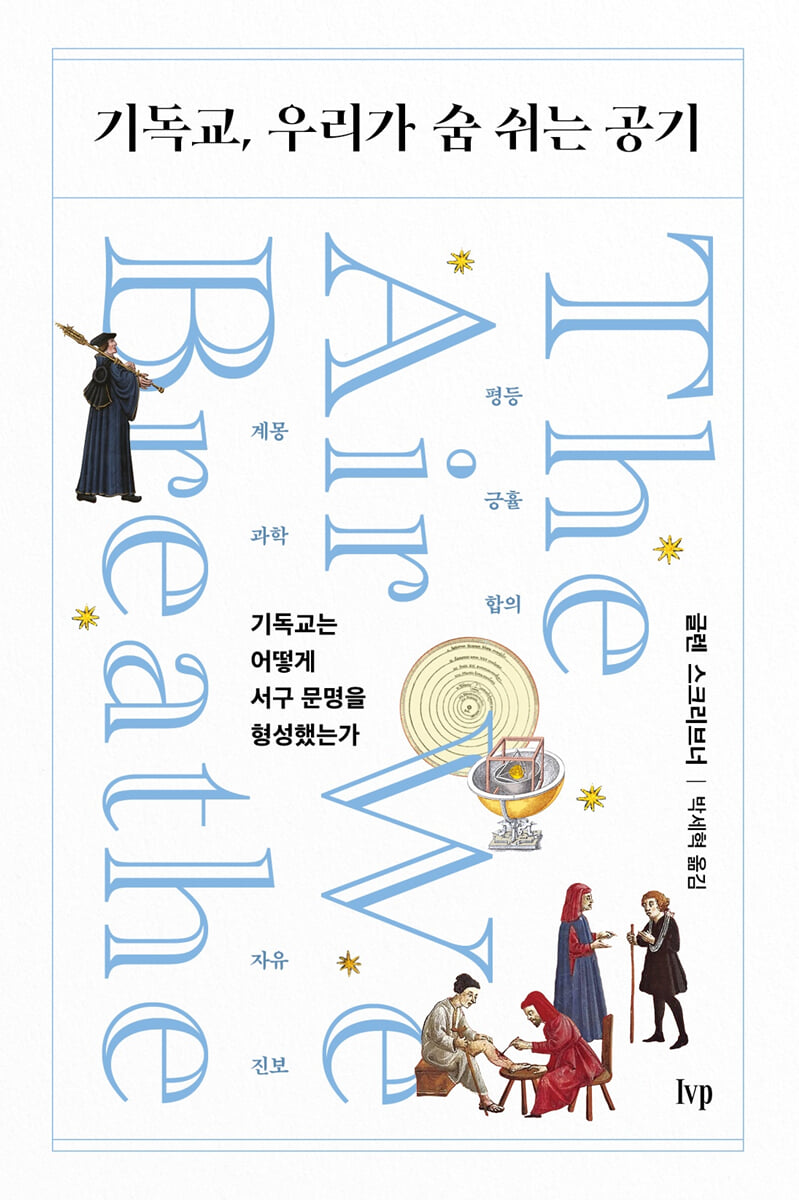
Christianity, the air we breathe
 |
Description
Book Introduction
An in-depth look at core values rooted in the modern world!
How were the values of freedom, compassion, human rights, and equality formed?
Many people in Western society today diagnose that the church is dying.
Christianity is seen as outdated, narrow-minded, and responsible for many of society's problems.
Because of this situation, some people leave the church, and those outside view Christianity with skepticism.
But what if the Christian message is the very source of the values modern society prides itself on and holds dear? In this book, Glenn Scrivener calmly unpacks, within historical context, how Jesus' teachings fundamentally transformed the ancient world, how they advanced our understanding of life, value, and meaning, and how Christianity is misunderstood by modern society.
He argues that the unique values of Christianity have permeated our culture as naturally as the air we breathe.
How were the values of freedom, compassion, human rights, and equality formed?
Many people in Western society today diagnose that the church is dying.
Christianity is seen as outdated, narrow-minded, and responsible for many of society's problems.
Because of this situation, some people leave the church, and those outside view Christianity with skepticism.
But what if the Christian message is the very source of the values modern society prides itself on and holds dear? In this book, Glenn Scrivener calmly unpacks, within historical context, how Jesus' teachings fundamentally transformed the ancient world, how they advanced our understanding of life, value, and meaning, and how Christianity is misunderstood by modern society.
He argues that the unique values of Christianity have permeated our culture as naturally as the air we breathe.
- You can preview some of the book's contents.
Preview
index
introduction
1.
The Night Before Christmas: The Tremors That Shake History Begin
2 Equality: How did we come to live in a world where equality is a given?
3 Compassion: Why Don't We Give Up on the Weak?
4 Agreement: Is justice possible with empathy rather than the sword?
5 Enlightenment: Would the 1,000 Years of Darkness Have Ended Without Christianity?
6 Science: Where did the beliefs that inspired scientific inquiry come from?
7 Freedom: Did all societies take slavery for granted?
8 Progress: Why do we dream of a better world?
9 A Kingdom Without a King: Want a Kingdom but Don't Need God?
10 Choose Your Miracle: How This Outrageous Story Changed History
Reviews
1.
The Night Before Christmas: The Tremors That Shake History Begin
2 Equality: How did we come to live in a world where equality is a given?
3 Compassion: Why Don't We Give Up on the Weak?
4 Agreement: Is justice possible with empathy rather than the sword?
5 Enlightenment: Would the 1,000 Years of Darkness Have Ended Without Christianity?
6 Science: Where did the beliefs that inspired scientific inquiry come from?
7 Freedom: Did all societies take slavery for granted?
8 Progress: Why do we dream of a better world?
9 A Kingdom Without a King: Want a Kingdom but Don't Need God?
10 Choose Your Miracle: How This Outrageous Story Changed History
Reviews
Detailed image

Into the book
In this chapter we try to see things from the Roman perspective.
In particular, we want to see the cross the way they saw it.
Our strange values make it nearly impossible to do so.
When we hear words like rape and violence, inequality and cruelty, slavery and death by torture, our modern sensibilities begin to be triggered.
We have a hard time accepting these things as a 'given reality'.
Moreover, it is clearly difficult to regard these things as 'what should be done'.
But the Romans took all this for granted.
And when they stood at the foot of the cross, they looked down from the level of the cesspool upon the whole structure of the terrible reality that towered above.
The cross came from a violent power on high to crush the contemptible and maintain the 'righteous' order of the empire, and indeed of the universe.
To look upon a person sacrificed on the cross meant to see the lowest of the low.
--- From "Chapter 1: The Night Before Christmas"
Of course, Christians only complicate matters by claiming that the divine Son of God, described in the New Testament as “the Word” who created the world, became human (John 1:1-14).
Celsus remarks with horror that the Christian God “has abandoned the whole universe and the heavenly realm to dwell only with us.”
If it is arrogant to think that God specially blesses humans, how preposterous must it be to think that He became human? To Celsus, it was absurd.
But for Christians, this is the truth that makes everything understandable.
If (in the universal sense of the word) 'humans' were established to 'rule', then the true king would naturally appear as a human being.
He naturally enters history, into the center of the stage, in this way.
It is precisely the place that He prepared for Himself “in the beginning.”
To become human is precisely what this God would do.
And He did so to govern His own world and lead His creatures home.
--- From "Chapter 2 Equality"
In the ancient world, sexual relations between boys and girls were not merely tolerated.
It was praised by writers such as Juvenal, Petronius, Horace, Straton, Lucian, and Philostratus.
The word they used was 'boy love', that is, love for children.
Christians abhorred this practice and called it by another name, 'child destruction.'
What the classical world called love, Christians called abuse, “and by this they understood all sexual contact with children as a depraved act.” During the reign of the Christian emperor Justinian, juvenile love was outlawed and abuse could be prosecuted long after it had occurred.
The church, which proclaims the sermon, and the state, which governs by law, work together to play a decisive role in preventing the sexual objectification of children.
--- From "Chapter 4 Agreement"
Whether your cherished views are about Christianity, freedom, democracy, a workers' paradise, or an Islamic caliphate, it is wrong to impose your views on others.
But the reason this is wrong is because we have a sense of what is right.
We believe that there is a fundamental difference between words and violence.
We believe that the way to expand influence is through persuasion, not force.
Where did we get this idea? It was Jesus who taught us to "put your sword back in its place" (Matthew 26:52), and it was Paul who exhorted Christians to use "the sword of the Spirit, which is the word of God" (Ephesians 6:17).
The Inquisition, wickedly, used harsh means to coerce.
But if we believe that we must use gentle means, the best argument for this is the unique foundation of Christianity.
--- From "Chapter 5 Enlightenment"
The abolition of slavery was not a movement of the Enlightenment.
Rowan Williams, former Archbishop of Canterbury, said:
“If we had left the abolition of slavery to the enlightened secularists of the eighteenth century, we would still be waiting for the solution.” But this Christian movement has been so completely successful that we share its vision as if it were a given.
Now we are all born free.
The fact that we have won hard-won victories in political and legal battles and military conflicts like the American Civil War means that we have come to take freedom for granted as our birthright.
Yesterday's victory has become today's common sense.
And now we look back on earlier times, puzzled by the fact that life might have been different.
--- From "Chapter 7 Freedom"
Heinrich Himmler clearly stated that we are “only a part of this world.”
Joseph Goebbels clearly acknowledged that Jews were also human beings, but added that fleas were also animals.
If the strong prey on the weak in the wild, why shouldn't they do the same in society? And why shouldn't the domination of a master race over a slave race be seen as a norm, even a virtue? If virtue is equated with "sacrifice that benefits one's own group in competition with other groups," then "fascism is the ultimate ideology of virtue, and devotion to human rights is the ultimate form of selfishness."
--- From "Chapter 8 Progress"
Christ presents himself not as a moral policeman but as a spiritual healer.
He came not to accuse, but to declare innocence.
We just have to admit that we need it.
This is the core of the Christian faith.
That is, acknowledging our sins and knowing Christ's forgiveness.
This is surprising news to those who know themselves to be like Edward Colston, a being of little good and much evil, and so depraved that he deserves to be condemned.
The doctor will see us.
He will forgive us, and after forgiving us, He will teach us how to forgive others.
In particular, we want to see the cross the way they saw it.
Our strange values make it nearly impossible to do so.
When we hear words like rape and violence, inequality and cruelty, slavery and death by torture, our modern sensibilities begin to be triggered.
We have a hard time accepting these things as a 'given reality'.
Moreover, it is clearly difficult to regard these things as 'what should be done'.
But the Romans took all this for granted.
And when they stood at the foot of the cross, they looked down from the level of the cesspool upon the whole structure of the terrible reality that towered above.
The cross came from a violent power on high to crush the contemptible and maintain the 'righteous' order of the empire, and indeed of the universe.
To look upon a person sacrificed on the cross meant to see the lowest of the low.
--- From "Chapter 1: The Night Before Christmas"
Of course, Christians only complicate matters by claiming that the divine Son of God, described in the New Testament as “the Word” who created the world, became human (John 1:1-14).
Celsus remarks with horror that the Christian God “has abandoned the whole universe and the heavenly realm to dwell only with us.”
If it is arrogant to think that God specially blesses humans, how preposterous must it be to think that He became human? To Celsus, it was absurd.
But for Christians, this is the truth that makes everything understandable.
If (in the universal sense of the word) 'humans' were established to 'rule', then the true king would naturally appear as a human being.
He naturally enters history, into the center of the stage, in this way.
It is precisely the place that He prepared for Himself “in the beginning.”
To become human is precisely what this God would do.
And He did so to govern His own world and lead His creatures home.
--- From "Chapter 2 Equality"
In the ancient world, sexual relations between boys and girls were not merely tolerated.
It was praised by writers such as Juvenal, Petronius, Horace, Straton, Lucian, and Philostratus.
The word they used was 'boy love', that is, love for children.
Christians abhorred this practice and called it by another name, 'child destruction.'
What the classical world called love, Christians called abuse, “and by this they understood all sexual contact with children as a depraved act.” During the reign of the Christian emperor Justinian, juvenile love was outlawed and abuse could be prosecuted long after it had occurred.
The church, which proclaims the sermon, and the state, which governs by law, work together to play a decisive role in preventing the sexual objectification of children.
--- From "Chapter 4 Agreement"
Whether your cherished views are about Christianity, freedom, democracy, a workers' paradise, or an Islamic caliphate, it is wrong to impose your views on others.
But the reason this is wrong is because we have a sense of what is right.
We believe that there is a fundamental difference between words and violence.
We believe that the way to expand influence is through persuasion, not force.
Where did we get this idea? It was Jesus who taught us to "put your sword back in its place" (Matthew 26:52), and it was Paul who exhorted Christians to use "the sword of the Spirit, which is the word of God" (Ephesians 6:17).
The Inquisition, wickedly, used harsh means to coerce.
But if we believe that we must use gentle means, the best argument for this is the unique foundation of Christianity.
--- From "Chapter 5 Enlightenment"
The abolition of slavery was not a movement of the Enlightenment.
Rowan Williams, former Archbishop of Canterbury, said:
“If we had left the abolition of slavery to the enlightened secularists of the eighteenth century, we would still be waiting for the solution.” But this Christian movement has been so completely successful that we share its vision as if it were a given.
Now we are all born free.
The fact that we have won hard-won victories in political and legal battles and military conflicts like the American Civil War means that we have come to take freedom for granted as our birthright.
Yesterday's victory has become today's common sense.
And now we look back on earlier times, puzzled by the fact that life might have been different.
--- From "Chapter 7 Freedom"
Heinrich Himmler clearly stated that we are “only a part of this world.”
Joseph Goebbels clearly acknowledged that Jews were also human beings, but added that fleas were also animals.
If the strong prey on the weak in the wild, why shouldn't they do the same in society? And why shouldn't the domination of a master race over a slave race be seen as a norm, even a virtue? If virtue is equated with "sacrifice that benefits one's own group in competition with other groups," then "fascism is the ultimate ideology of virtue, and devotion to human rights is the ultimate form of selfishness."
--- From "Chapter 8 Progress"
Christ presents himself not as a moral policeman but as a spiritual healer.
He came not to accuse, but to declare innocence.
We just have to admit that we need it.
This is the core of the Christian faith.
That is, acknowledging our sins and knowing Christ's forgiveness.
This is surprising news to those who know themselves to be like Edward Colston, a being of little good and much evil, and so depraved that he deserves to be condemned.
The doctor will see us.
He will forgive us, and after forgiving us, He will teach us how to forgive others.
--- From "Chapter 9: The Kingdom Without a King"
Publisher's Review
Is modern society truly post-Christian?
Christianity has permeated our culture like air.
Many people believe that modern society is based on freedom, equality, human rights, justice, and scientific rationality.
I believe that over the years, humanity has naturally accumulated these positive values as it has progressed.
On the other hand, Christianity is sometimes viewed as oppressive, outdated, and unscientific.
There was a time when Christian values served as the basis for important judgments, but now people believe that modern society is no longer under the influence of Christianity and that Christianity should not be the basis for judgments on important matters.
Rather, I am thankful that we have come to regard the positive values that humanity has accumulated throughout history as an important basis for judgment.
But evangelical pastor Glenn Scrivener urges modern people to seriously reconsider the origins of the moral values that humanity so proudly boasts.
Are the seven core values that have shaped Western civilization—equality, compassion, consensus, enlightenment, science, freedom, and progress—virtues that humanity naturally acquired? Drawing on historical context and the arguments of various authors, the author argues that these beliefs and institutions did not arise spontaneously.
The values that we depend on and that have shaped us, like the air we breathe, are said to 'resemble Christianity.'
And the reason, he explains, is that those values originated from Christianity.
What legacy has Christianity left to modern Western civilization?
The moral earthquake brought about by the Christian Revolution
This book demonstrates the unique values and achievements of Christianity, which go against the natural properties of humanity and society and the natural flow of the secular world, from the ancient world to the present day.
Why has the cross, once a symbol of shame, torture, and extreme violence, undergone such a revolutionary transformation? Why do we feel it is "blasphemous" when we perceive the value of equality being threatened? It's because we stand on the foundation of Christianity, which defies human nature and natural selection.
In the ancient Greek world, it was not at all unusual to kill slaves or abandon children with physical defects.
Since the first century, Christianity has instilled in our moral code the idea that we must protect and nurture the weak.
During the 1,000-year period of the Middle Ages, once called the "Dark Ages," monasteries produced an enormous number of books and various academic disciplines flourished.
Also, cathedrals were built, and universities and parliaments were established.
The abolition of slavery was a tremendous moral achievement led by dedicated Christians who held to the Christian conviction that “man is made in the image of God.”
At the same time, the author frankly confesses, as many have pointed out, the crimes of the Inquisition committed in the name of Christianity and the errors of supporting the scientific community's geocentric theory.
In an age of science and rationality, is Christianity still worth following?
TGC (The Gospel Coalition) & Christianity Today's 2022 Book of the Year in Evangelism and Apologetics!
The author criticizes that modern society, built on modernity, has attempted to discard traces of Christianity from the seven core values that formed Western civilization, thereby cutting off the very roots from which those values grew.
As Charles Spurgeon warned, Western society has tried to be only half-Christian, but has ended up producing a miserable mass of religious people.
I believed that if the "restrictions" of Christianity were removed, humanity would become more free, but I painfully realized that what had taken its place was finger-pointing and preachy condemnation directed at one another behind a mask of anonymity.
It sharply points out that this was an attempt to secretly bring in the values Jesus advocated without mentioning Jesus himself.
In this book, the author draws on the writings of prominent non-Christian historians such as Larry Siedentop, Tom Holland, Rodney Stark, and Joseph Henrik to compellingly demonstrate that Christian history has broadly shaped our moral values.
The Jesus revolution that began with Jesus in the first century expanded and expanded into small parts of culture.
Amazingly, the kingdom's victory was achieved through Jesus' sacrifice.
That story, which sounds absurd, changed history and led it in a better direction.
Whether believer or skeptic, readers of this book will discover the precious value that the Jesus Revolution brought to history.
Main Readers
Christians who want to know about the positive role of Christianity in our society
ㆍA person who went to church in the past but left Christianity due to disappointment
Non-Christians interested in Christianity
Christianity has permeated our culture like air.
Many people believe that modern society is based on freedom, equality, human rights, justice, and scientific rationality.
I believe that over the years, humanity has naturally accumulated these positive values as it has progressed.
On the other hand, Christianity is sometimes viewed as oppressive, outdated, and unscientific.
There was a time when Christian values served as the basis for important judgments, but now people believe that modern society is no longer under the influence of Christianity and that Christianity should not be the basis for judgments on important matters.
Rather, I am thankful that we have come to regard the positive values that humanity has accumulated throughout history as an important basis for judgment.
But evangelical pastor Glenn Scrivener urges modern people to seriously reconsider the origins of the moral values that humanity so proudly boasts.
Are the seven core values that have shaped Western civilization—equality, compassion, consensus, enlightenment, science, freedom, and progress—virtues that humanity naturally acquired? Drawing on historical context and the arguments of various authors, the author argues that these beliefs and institutions did not arise spontaneously.
The values that we depend on and that have shaped us, like the air we breathe, are said to 'resemble Christianity.'
And the reason, he explains, is that those values originated from Christianity.
What legacy has Christianity left to modern Western civilization?
The moral earthquake brought about by the Christian Revolution
This book demonstrates the unique values and achievements of Christianity, which go against the natural properties of humanity and society and the natural flow of the secular world, from the ancient world to the present day.
Why has the cross, once a symbol of shame, torture, and extreme violence, undergone such a revolutionary transformation? Why do we feel it is "blasphemous" when we perceive the value of equality being threatened? It's because we stand on the foundation of Christianity, which defies human nature and natural selection.
In the ancient Greek world, it was not at all unusual to kill slaves or abandon children with physical defects.
Since the first century, Christianity has instilled in our moral code the idea that we must protect and nurture the weak.
During the 1,000-year period of the Middle Ages, once called the "Dark Ages," monasteries produced an enormous number of books and various academic disciplines flourished.
Also, cathedrals were built, and universities and parliaments were established.
The abolition of slavery was a tremendous moral achievement led by dedicated Christians who held to the Christian conviction that “man is made in the image of God.”
At the same time, the author frankly confesses, as many have pointed out, the crimes of the Inquisition committed in the name of Christianity and the errors of supporting the scientific community's geocentric theory.
In an age of science and rationality, is Christianity still worth following?
TGC (The Gospel Coalition) & Christianity Today's 2022 Book of the Year in Evangelism and Apologetics!
The author criticizes that modern society, built on modernity, has attempted to discard traces of Christianity from the seven core values that formed Western civilization, thereby cutting off the very roots from which those values grew.
As Charles Spurgeon warned, Western society has tried to be only half-Christian, but has ended up producing a miserable mass of religious people.
I believed that if the "restrictions" of Christianity were removed, humanity would become more free, but I painfully realized that what had taken its place was finger-pointing and preachy condemnation directed at one another behind a mask of anonymity.
It sharply points out that this was an attempt to secretly bring in the values Jesus advocated without mentioning Jesus himself.
In this book, the author draws on the writings of prominent non-Christian historians such as Larry Siedentop, Tom Holland, Rodney Stark, and Joseph Henrik to compellingly demonstrate that Christian history has broadly shaped our moral values.
The Jesus revolution that began with Jesus in the first century expanded and expanded into small parts of culture.
Amazingly, the kingdom's victory was achieved through Jesus' sacrifice.
That story, which sounds absurd, changed history and led it in a better direction.
Whether believer or skeptic, readers of this book will discover the precious value that the Jesus Revolution brought to history.
Main Readers
Christians who want to know about the positive role of Christianity in our society
ㆍA person who went to church in the past but left Christianity due to disappointment
Non-Christians interested in Christianity
GOODS SPECIFICS
- Date of issue: August 31, 2025
- Page count, weight, size: 286 pages | 376g | 141*210*15mm
- ISBN13: 9788932823706
- ISBN10: 8932823707
You may also like
카테고리
korean


korean

![GQ KOREA Mark (Monthly): December [2025]](http://librairie.coreenne.fr/cdn/shop/files/8ef265dbbfbf186523ed75ba7319009d.jpg?v=1765340328&width=3840)


