

pencil sketch
 |
Description
Book Introduction
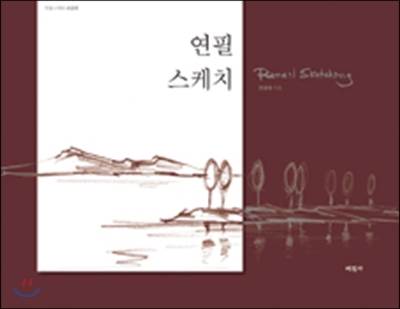
This book introduces a beginner's course in pencil sketching that allows you to easily draw natural and man-made objects around us that you want to capture in your eyes.
It introduces the tools and materials needed for sketching, the most important beginner stage of drawing, and covers basic principles and expressive techniques.
It was also written to be a reference for many people, from beginners just starting out with drawing to architects and landscape designers who need professional-level bird's-eye views.
Using pencils, the most readily available and easy-to-learn drawing material, you can learn various brush techniques, a wide range of light and shade, and expressive methods step by step by following the know-how in this book.
It introduces the tools and materials needed for sketching, the most important beginner stage of drawing, and covers basic principles and expressive techniques.
It was also written to be a reference for many people, from beginners just starting out with drawing to architects and landscape designers who need professional-level bird's-eye views.
Using pencils, the most readily available and easy-to-learn drawing material, you can learn various brush techniques, a wide range of light and shade, and expressive methods step by step by following the know-how in this book.
index
Sketching tools and materials
Basic line practice
Topographic representation
Light and shade
The light and shade of the tree
The shape of the tree
leaves and stems of trees
tree branches
Perspective
Foreground, middle ground, and background
Sky and clouds
Water and its reflection
rock
shadow
perspective drawing
building
Basic line practice
Topographic representation
Light and shade
The light and shade of the tree
The shape of the tree
leaves and stems of trees
tree branches
Perspective
Foreground, middle ground, and background
Sky and clouds
Water and its reflection
rock
shadow
perspective drawing
building
Detailed image

Into the book
I don't think there's anything that surpasses the pencil when it comes to expressive drawing materials.
Pencils are a material that everyone has access to, and since we are already familiar with using them for writing, it would not be difficult to change from writing to drawing.
This book is organized sequentially so that even beginners who are trying sketching for the first time will not find it difficult.
Anyone can sketch by starting with line drawing practice and gradually drawing parts of the scenery they see around them.
With a little courage added to that, it won't be long before you'll be able to express yourself freely.
--- From the preface
Traditionally, several pencils have been recommended for learning.
Usually, 5B or 6B is used for dark areas, HB is used for mid-tone areas, and 2H or 4H is used for bright and delicate areas.
In this way, you can express light and shade depending on the hardness of the pencil, but instead of changing pencils, you can express a wide range of areas from dark to very light by simply adjusting the strength with which you hold a single pencil.
Applying light pressure produces thin, bright lines, while applying heavy pressure produces thick, dark strokes.
Combining different pencils and varying pressure allows for an incredibly wide range of shades.
Pencils are a material that everyone has access to, and since we are already familiar with using them for writing, it would not be difficult to change from writing to drawing.
This book is organized sequentially so that even beginners who are trying sketching for the first time will not find it difficult.
Anyone can sketch by starting with line drawing practice and gradually drawing parts of the scenery they see around them.
With a little courage added to that, it won't be long before you'll be able to express yourself freely.
--- From the preface
Traditionally, several pencils have been recommended for learning.
Usually, 5B or 6B is used for dark areas, HB is used for mid-tone areas, and 2H or 4H is used for bright and delicate areas.
In this way, you can express light and shade depending on the hardness of the pencil, but instead of changing pencils, you can express a wide range of areas from dark to very light by simply adjusting the strength with which you hold a single pencil.
Applying light pressure produces thin, bright lines, while applying heavy pressure produces thick, dark strokes.
Combining different pencils and varying pressure allows for an incredibly wide range of shades.
--- From the text
Publisher's Review
Introduction to Landscape Sketching with Pencil
- Introduction to sketching tools and materials, basic principles, and expression techniques
-Various basic shapes and expressions of leaves, stems, and branches according to tree type
-Description of natural objects such as the sky, clouds, water, and rocks
-Light and shadow that enhance the realism of objects
-Landscape sketches for architects and landscape designers
Pencil, the most common and easiest drawing material to learn.
With just this one pencil, you can create a picture of any quality.
If you practice enough to be able to freely use various brush techniques, a wide range of light and shade expressions, and changes in pencil grip strength and direction, you can create a myriad of expressions using only single-color materials such as pencil and charcoal.
This book contains exactly that know-how.
The structure of this book is sequential so that even beginners who are trying sketching for the first time will not find it difficult.
The first part introduces the basic knowledge you need to know to sketch a landscape, such as basic materials and tools, line drawing methods, and expressions of light and shade.
Next, it helps you draw everything from a single tree to a complex landscape with buildings, categorizing them by topic, such as tree shape, leaves and trunk, branches, perspective, sky, clouds, water, rocks, shadows, and building expression.
By following the various landscape sketches introduced in the book one by one, you can naturally learn the basic principles of sketching and develop the ability to understand the shape, composition, and space of natural and artificial objects.
If you add repeated practice and the habit of carefully observing the surrounding scenery to this, you will ultimately be able to freely draw the landscape you want.
- Introduction to sketching tools and materials, basic principles, and expression techniques
-Various basic shapes and expressions of leaves, stems, and branches according to tree type
-Description of natural objects such as the sky, clouds, water, and rocks
-Light and shadow that enhance the realism of objects
-Landscape sketches for architects and landscape designers
Pencil, the most common and easiest drawing material to learn.
With just this one pencil, you can create a picture of any quality.
If you practice enough to be able to freely use various brush techniques, a wide range of light and shade expressions, and changes in pencil grip strength and direction, you can create a myriad of expressions using only single-color materials such as pencil and charcoal.
This book contains exactly that know-how.
The structure of this book is sequential so that even beginners who are trying sketching for the first time will not find it difficult.
The first part introduces the basic knowledge you need to know to sketch a landscape, such as basic materials and tools, line drawing methods, and expressions of light and shade.
Next, it helps you draw everything from a single tree to a complex landscape with buildings, categorizing them by topic, such as tree shape, leaves and trunk, branches, perspective, sky, clouds, water, rocks, shadows, and building expression.
By following the various landscape sketches introduced in the book one by one, you can naturally learn the basic principles of sketching and develop the ability to understand the shape, composition, and space of natural and artificial objects.
If you add repeated practice and the habit of carefully observing the surrounding scenery to this, you will ultimately be able to freely draw the landscape you want.
GOODS SPECIFICS
- Date of publication: August 30, 2012
- Format: Springbook book binding method guide
- Page count, weight, size: 120 pages | 210*297*20mm
- ISBN13: 9788940804322
- ISBN10: 8940804325
You may also like
카테고리
korean


korean

![GQ KOREA Mark (Monthly): December [2025]](http://librairie.coreenne.fr/cdn/shop/files/8ef265dbbfbf186523ed75ba7319009d.jpg?v=1765340328&width=3840)


