

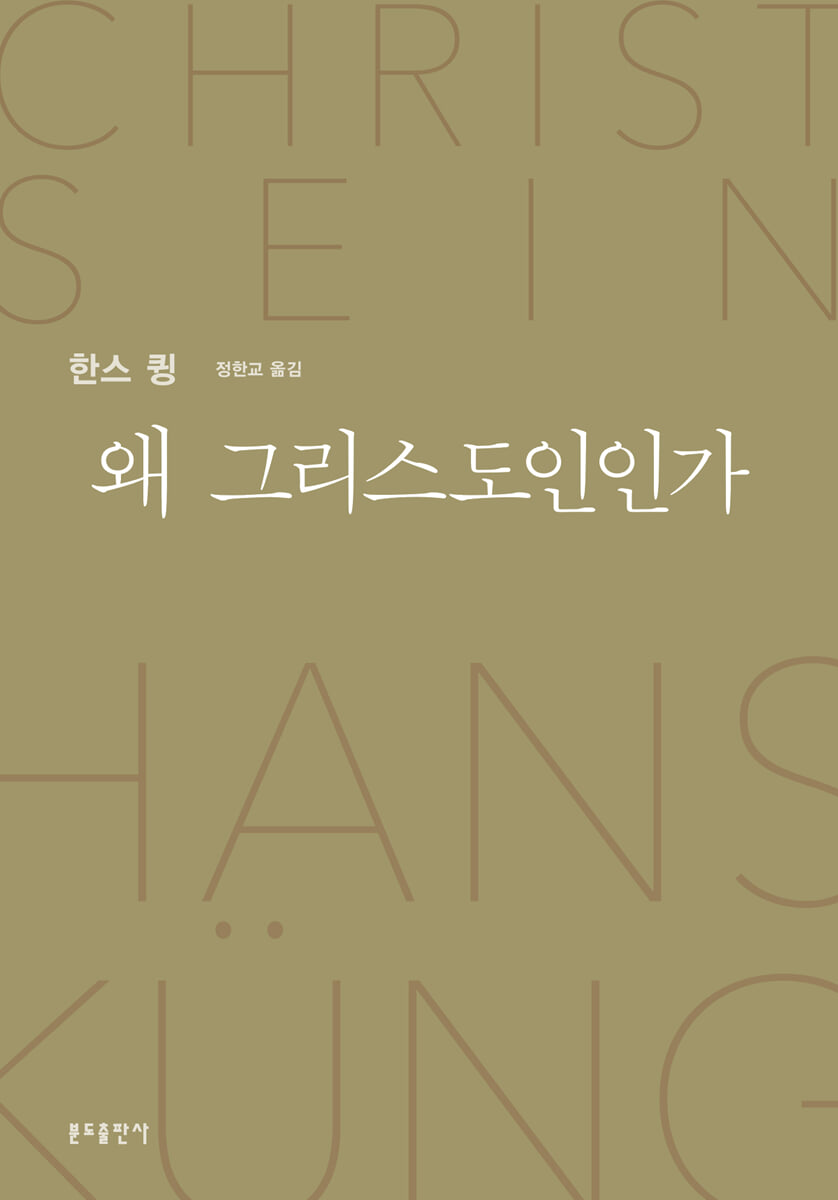
Why Christians
 |
Description
Book Introduction
This book is a condensed version of 『Christian Existence』Christ sein, and is a culmination of Hans Küng's extensive research.
The author is convinced that Christian existence is human existence.
We want to know who Jesus is and to reveal to us today that the historical life Jesus lived is the true path of Christianity and the path of humanity.
It will be an excellent guide for those who want to know exactly what Christianity and Christians are.
The author is convinced that Christian existence is human existence.
We want to know who Jesus is and to reveal to us today that the historical life Jesus lived is the true path of Christianity and the path of humanity.
It will be an excellent guide for those who want to know exactly what Christianity and Christians are.
- You can preview some of the book's contents.
Preview
index
To Korean readers
While putting out the thumbnail
Part 1 Identification
Chapter 1: Today's Horizon
1.
Let's go back to being human
secularization
Opening of the Church
2 Don't give up hope
Humanity through development?
Humanity through revolution?
Chapter 2 Another Dimension
1.
Pursuit of God
Transcendent?
The Future of Religion
2.
The reality of God
home
reality
Chapter 3: Characteristics of Christianity
1.
Christ
Dangerous Memories
Clearly define the concept
2.
True Christ
It's not a myth
The time and place are clear
Uncertainties
It's not just electricity
It is a testimony of faith
Part 2 Design
Chapter 1 Social Context
1.
organization?
Correction agreement system
Neither a priest nor a theologian
Not on the side of the ruling party
A thorough change
2.
revolution?
revolutionary movement
The Liberator's Hope
Not a revolutionary
Nonviolent revolution
3.
Escape?
apolitical thoroughgoingism
monk system
I'm not a monk
Not just a select few, but everyone
4.
compromise?
pious person
moral compromise
Not a follower of the law
Honest self-criticism
5.
Challenges facing all directions
Chapter 2 God's Work
1.
core
Kingdom of God
Apocalyptic Horizon
Between present and future
God is ahead
2.
miracle?
Actual events
A declaration, not evidence
3.
Highest norm
Natural law and revealed law
God's will, not the law
The Meaning of the Sermon on the Mount
Chapter 3: The Work of Man
1.
Treating people with respect
Change of consciousness
What is God's will?
Relativization of tradition, system, and hierarchy
2.
action
God and man at the same time
Someone who needs me right now
The enemy capital
Very thorough
3.
tie
One side of the ugly ones
What poverty?
Friends of the losers
The Right to Grace
Chapter 4 Dispute
1.
This or that
Without a title or position
delegate
2.
God's fight
A revolution of the priests?
A natural title?
3.
last
The Last Supper
The Way of Suffering
why?
In vain?
Chapter 5: A New Life
1.
new start
Problems and difficulties
Things to be clear about in advance
Ultimate Reality
2.
Final scale
righteous person
Honorifics
representative
measure
3.
Ultimate identification
Value transfer
Beyond fanaticism and stubbornness
By faith alone
Same thing, different
Part 3: Practice
Chapter 1: The Practice of the Church
1.
Decision for Faith
Each person's decision
Criticism of the Church
2.
Decision for the church?
Why stay
Practical Appeal
Against resignation
Chapter 2: People and Christians
1.
The Standard of Christian Behavior
human behavioral norms
Christian Code of Conduct
Concrete people, not abstract principles
Characteristics of Christian ethics
A fundamental example
2.
Liberation to freedom
Personal integrity or social justice?
Ultimately, it doesn't matter
What ultimately matters
3.
Some stimuli
Freedom of Claiming Rights
Freedom from power struggles
Freedom from income
Freedom to serve
4.
A human being who is transcended as a Christian
In lieu of a review
While putting out the thumbnail
Part 1 Identification
Chapter 1: Today's Horizon
1.
Let's go back to being human
secularization
Opening of the Church
2 Don't give up hope
Humanity through development?
Humanity through revolution?
Chapter 2 Another Dimension
1.
Pursuit of God
Transcendent?
The Future of Religion
2.
The reality of God
home
reality
Chapter 3: Characteristics of Christianity
1.
Christ
Dangerous Memories
Clearly define the concept
2.
True Christ
It's not a myth
The time and place are clear
Uncertainties
It's not just electricity
It is a testimony of faith
Part 2 Design
Chapter 1 Social Context
1.
organization?
Correction agreement system
Neither a priest nor a theologian
Not on the side of the ruling party
A thorough change
2.
revolution?
revolutionary movement
The Liberator's Hope
Not a revolutionary
Nonviolent revolution
3.
Escape?
apolitical thoroughgoingism
monk system
I'm not a monk
Not just a select few, but everyone
4.
compromise?
pious person
moral compromise
Not a follower of the law
Honest self-criticism
5.
Challenges facing all directions
Chapter 2 God's Work
1.
core
Kingdom of God
Apocalyptic Horizon
Between present and future
God is ahead
2.
miracle?
Actual events
A declaration, not evidence
3.
Highest norm
Natural law and revealed law
God's will, not the law
The Meaning of the Sermon on the Mount
Chapter 3: The Work of Man
1.
Treating people with respect
Change of consciousness
What is God's will?
Relativization of tradition, system, and hierarchy
2.
action
God and man at the same time
Someone who needs me right now
The enemy capital
Very thorough
3.
tie
One side of the ugly ones
What poverty?
Friends of the losers
The Right to Grace
Chapter 4 Dispute
1.
This or that
Without a title or position
delegate
2.
God's fight
A revolution of the priests?
A natural title?
3.
last
The Last Supper
The Way of Suffering
why?
In vain?
Chapter 5: A New Life
1.
new start
Problems and difficulties
Things to be clear about in advance
Ultimate Reality
2.
Final scale
righteous person
Honorifics
representative
measure
3.
Ultimate identification
Value transfer
Beyond fanaticism and stubbornness
By faith alone
Same thing, different
Part 3: Practice
Chapter 1: The Practice of the Church
1.
Decision for Faith
Each person's decision
Criticism of the Church
2.
Decision for the church?
Why stay
Practical Appeal
Against resignation
Chapter 2: People and Christians
1.
The Standard of Christian Behavior
human behavioral norms
Christian Code of Conduct
Concrete people, not abstract principles
Characteristics of Christian ethics
A fundamental example
2.
Liberation to freedom
Personal integrity or social justice?
Ultimately, it doesn't matter
What ultimately matters
3.
Some stimuli
Freedom of Claiming Rights
Freedom from power struggles
Freedom from income
Freedom to serve
4.
A human being who is transcended as a Christian
In lieu of a review
Into the book
Since Christianity raised the great question of seeking the origin and destiny of humanity, the world, and the whole of history within the human system of interpretation of humanity itself, this crucial question of where humanity comes from and where it is going has not been dormant but has fundamentally influenced all ages.
Even in the modern secular era, this pressing problem continues unabated.
There may be no continuity in the answers, but the continuity of the problem remains.
However, despite all the achievements made by modern secular science, it is showing its powerlessness in answering this crucial question.
To pure reason, this problem seems too burdensome.
--- p.57
Therefore, the common denominator of love for God and love for neighbor is the abandonment of selfishness and the will to dedicate oneself.
Only when I no longer live for myself can I open myself completely to God and open myself without limits to others whom God recognizes as no different from myself.
Of course, in love, God is not reduced to human relationships.
I am personally responsible to God.
No one can take responsibility for this.
But God meets me in another person—not exclusively in me, but first in another person, since I myself am a human being—and there He expects my devotion.
God calls me not from afar above the clouds, nor only directly in my conscience, but above all through my neighbors—a call that never remains silent, but that echoes toward me day after day in the midst of my worldly life.
--- p.224~225
What ultimately matters in human life: whether we are healthy or sick, able to work or not, strong or weak in our ability to execute, lucky or successful, sinful or innocent, we will maintain that trust, which the New Testament everywhere calls faith, not just at the end but throughout our entire lives.
Therefore, those who offer the Te Deum to the one true God and not to many false gods can dare to make the last verse of this hymn a promise to themselves, anytime and anywhere: “Lord, I have trusted in you; I will never be put to shame.”
Even in the modern secular era, this pressing problem continues unabated.
There may be no continuity in the answers, but the continuity of the problem remains.
However, despite all the achievements made by modern secular science, it is showing its powerlessness in answering this crucial question.
To pure reason, this problem seems too burdensome.
--- p.57
Therefore, the common denominator of love for God and love for neighbor is the abandonment of selfishness and the will to dedicate oneself.
Only when I no longer live for myself can I open myself completely to God and open myself without limits to others whom God recognizes as no different from myself.
Of course, in love, God is not reduced to human relationships.
I am personally responsible to God.
No one can take responsibility for this.
But God meets me in another person—not exclusively in me, but first in another person, since I myself am a human being—and there He expects my devotion.
God calls me not from afar above the clouds, nor only directly in my conscience, but above all through my neighbors—a call that never remains silent, but that echoes toward me day after day in the midst of my worldly life.
--- p.224~225
What ultimately matters in human life: whether we are healthy or sick, able to work or not, strong or weak in our ability to execute, lucky or successful, sinful or innocent, we will maintain that trust, which the New Testament everywhere calls faith, not just at the end but throughout our entire lives.
Therefore, those who offer the Te Deum to the one true God and not to many false gods can dare to make the last verse of this hymn a promise to themselves, anytime and anywhere: “Lord, I have trusted in you; I will never be put to shame.”
--- p.438~439
Publisher's Review
What exactly is a Christian?
Anyway, for those who want to know honestly
Why be a Christian? To be truly human!
This simple question is a fundamental one that shakes a person's entire life, faith, and thinking.
In this book, Hans Küng answers this question head-on.
It is not a simple doctrinal explanation or theological argument.
He discovers the possibility of 'true humanity' in the life and teachings of Jesus.
Becoming a Christian is not simply a matter of having a religious identity, but rather a decision to live as a truly human being.
Jesus proclaimed and personally realized the Kingdom of God in the deepest dimensions of humanity (love, freedom, justice, suffering, and death).
To those who ask why he is a Christian, Hans Küng says:
“By following Jesus Christ, people can truly live, act, work, and die in today’s world as human beings—relying on God and helping others in times of happiness and unhappiness, in life and in death” (pp. 461-462).
What is the core of Jesus?
Jesus is not just a great religious founder or scholar.
He proclaimed the kingdom of God, practiced God's will of love, and completed the cross and resurrection.
The essence of Jesus is right here.
He showed the love of the living God by speaking of freedom instead of laws that bind people, of inclusion instead of exclusion, and of forgiveness instead of retaliation.
He did not turn away from the weak human beings, but rather lived as a human being more thoroughly than anyone else, thereby opening the way to true humanity.
The center of the Christian faith is Jesus Christ.
Hans Küng emphasizes that remembering and following Jesus is the perfection and transcendence of humanity, that is, the 'sublation' of human existence.
He does not force blind faith.
I believe that faith is not simply about following the teachings of the church, but must be subject to rational thought and historical verification.
A Reference Book for Modern Christian Existence
Modern people constantly ask and doubt about God, death, truth, etc.
This is not because faith has disappeared, but because we are concerned about something more specific.
Hans Küng says that becoming a Christian is more than just a matter of religious belief or acceptance of doctrine; it is a way to live as a true human being.
This book is not simply a reaffirmation of doctrine or tradition, but rather a confessional work by the author, containing insights discovered through a long journey of faith, reflection, and inner struggle.
His interest is focused less on the questions of Christian doctrine than on the practical existence of Christ in the light of the figure and destiny of Jesus Christ himself.
He never claims to be a model Christian.
I wrote this book simply because I believe that being a Christian is a particularly good thing.
Since its first publication in Korea in 1982, this book has received enthusiastic attention from readers.
The question, “Why a Christian?” remains as relevant today as it was 40 years ago, even at the turn of the century.
Perhaps it is a question that has been raised continuously for two thousand years, a question that should have been raised, but to which the answer is still incomplete.
In the new edition published in 2025, the elegant writing style of Jeong Han-gyo, who has created and translated numerous religious books for Bundo Publishing Company over a long period of time, was maintained, but expressions that were out of sync with the changed spelling and notation, and unclear meanings were newly refined.
This problematic work by Hans Küng, now a classic, is sure to provide a refreshing shock to today's readers.
Anyway, for those who want to know honestly
Why be a Christian? To be truly human!
This simple question is a fundamental one that shakes a person's entire life, faith, and thinking.
In this book, Hans Küng answers this question head-on.
It is not a simple doctrinal explanation or theological argument.
He discovers the possibility of 'true humanity' in the life and teachings of Jesus.
Becoming a Christian is not simply a matter of having a religious identity, but rather a decision to live as a truly human being.
Jesus proclaimed and personally realized the Kingdom of God in the deepest dimensions of humanity (love, freedom, justice, suffering, and death).
To those who ask why he is a Christian, Hans Küng says:
“By following Jesus Christ, people can truly live, act, work, and die in today’s world as human beings—relying on God and helping others in times of happiness and unhappiness, in life and in death” (pp. 461-462).
What is the core of Jesus?
Jesus is not just a great religious founder or scholar.
He proclaimed the kingdom of God, practiced God's will of love, and completed the cross and resurrection.
The essence of Jesus is right here.
He showed the love of the living God by speaking of freedom instead of laws that bind people, of inclusion instead of exclusion, and of forgiveness instead of retaliation.
He did not turn away from the weak human beings, but rather lived as a human being more thoroughly than anyone else, thereby opening the way to true humanity.
The center of the Christian faith is Jesus Christ.
Hans Küng emphasizes that remembering and following Jesus is the perfection and transcendence of humanity, that is, the 'sublation' of human existence.
He does not force blind faith.
I believe that faith is not simply about following the teachings of the church, but must be subject to rational thought and historical verification.
A Reference Book for Modern Christian Existence
Modern people constantly ask and doubt about God, death, truth, etc.
This is not because faith has disappeared, but because we are concerned about something more specific.
Hans Küng says that becoming a Christian is more than just a matter of religious belief or acceptance of doctrine; it is a way to live as a true human being.
This book is not simply a reaffirmation of doctrine or tradition, but rather a confessional work by the author, containing insights discovered through a long journey of faith, reflection, and inner struggle.
His interest is focused less on the questions of Christian doctrine than on the practical existence of Christ in the light of the figure and destiny of Jesus Christ himself.
He never claims to be a model Christian.
I wrote this book simply because I believe that being a Christian is a particularly good thing.
Since its first publication in Korea in 1982, this book has received enthusiastic attention from readers.
The question, “Why a Christian?” remains as relevant today as it was 40 years ago, even at the turn of the century.
Perhaps it is a question that has been raised continuously for two thousand years, a question that should have been raised, but to which the answer is still incomplete.
In the new edition published in 2025, the elegant writing style of Jeong Han-gyo, who has created and translated numerous religious books for Bundo Publishing Company over a long period of time, was maintained, but expressions that were out of sync with the changed spelling and notation, and unclear meanings were newly refined.
This problematic work by Hans Küng, now a classic, is sure to provide a refreshing shock to today's readers.
GOODS SPECIFICS
- Date of issue: August 14, 2025
- Page count, weight, size: 468 pages | 150*215*30mm
- ISBN13: 9788941925118
- ISBN10: 8941925118
You may also like
카테고리
korean


korean

![GQ KOREA Mark (Monthly): December [2025]](http://librairie.coreenne.fr/cdn/shop/files/8ef265dbbfbf186523ed75ba7319009d.jpg?v=1765340328&width=3840)


