

Exploring Curriculum Restructuring and Project-Based Learning
 |
Description
Book Introduction
The flower of curriculum restructuring: practice project-based learning!
What's the most important thing for a teacher? It's definitely "classes."
The biggest reason we stand in front of students as teachers is to teach.
Teachers can get closer to what they consider good classes by reconstructing the curriculum rather than teaching based on textbooks.
This book provides a variety of curriculum reconstruction teaching approaches that maximize teachers' autonomy and imagination.
Additionally, we share our experience and know-how in 'project classes', which we believe are the most effective in achieving achievement standards through voluntary participation of students.
The project class examples introduced in this book were planned and implemented jointly by teachers of the same grade and by teachers through a teacher learning community called 'Chamjoheun Research Group.'
Project classes are not separate from the curriculum, but are conducted within the curriculum. To assist grade level research teachers who actually design and organize the grade level curriculum, textbook units and hours are indicated, and evaluations are organized and presented by achievement criteria.
Additionally, this book provides practical project-based lessons for teachers who have planned project-based classes but do not know how to begin, along with practical project-based lesson implementation methods and textbook-related units and hours, so that they can be utilized in actual classes.
Through this book, I hope to enhance teachers' professionalism and, based on curriculum literacy, collaborate with fellow teachers to implement project-based classes, thereby achieving the desired quality of teaching.
What's the most important thing for a teacher? It's definitely "classes."
The biggest reason we stand in front of students as teachers is to teach.
Teachers can get closer to what they consider good classes by reconstructing the curriculum rather than teaching based on textbooks.
This book provides a variety of curriculum reconstruction teaching approaches that maximize teachers' autonomy and imagination.
Additionally, we share our experience and know-how in 'project classes', which we believe are the most effective in achieving achievement standards through voluntary participation of students.
The project class examples introduced in this book were planned and implemented jointly by teachers of the same grade and by teachers through a teacher learning community called 'Chamjoheun Research Group.'
Project classes are not separate from the curriculum, but are conducted within the curriculum. To assist grade level research teachers who actually design and organize the grade level curriculum, textbook units and hours are indicated, and evaluations are organized and presented by achievement criteria.
Additionally, this book provides practical project-based lessons for teachers who have planned project-based classes but do not know how to begin, along with practical project-based lesson implementation methods and textbook-related units and hours, so that they can be utilized in actual classes.
Through this book, I hope to enhance teachers' professionalism and, based on curriculum literacy, collaborate with fellow teachers to implement project-based classes, thereby achieving the desired quality of teaching.
- You can preview some of the book's contents.
Preview
index
│Prologue│ The Flower of Curriculum Restructuring is Project-Based Learning
Part 1.
Project-Based Teaching Strategies: Implemented Together by Teachers
01.
Project Implementation Strategy: Drawing the Big Picture
02.
[Project Class Level 0] Building the Foundation of Project Class Culture and Basic Learning Skills
03.
[Project Lesson Step 1] Opening the Project: The Beginning of a Project Lesson
04.
[Project Class Step 2] The Base Camp for Project Classes: Basic Knowledge is Key
05.
[Project Lesson Stage 3] Developing the Core of Project Lessons: Exploratory Activities
06.
[Project Lesson Step 4] Completing the Project Lesson and Providing Feedback
07.
[Project Class Step 5] Beginning and Ending Project Classes, and Revealing the Results
08.
[Project Lesson 6] Project Closing: Reflect and Share
[Project Class Talk! Talk?] Project Class, Targeting Constructivism and Written Assessments
Part 2.
A truly wonderful twelve-year-old, growing through project-based classes.
00.
Are you curious about 'how project classes were implemented'?
01.
New Farming Direct Talk: Cultivating Ecological Sensitivity
02.
Namdaegu Cultural Heritage Exploration Team: Learn, Feel, and See Culture
03.
Our people are amazing: pride in our history and nation.
04.
A Hundred-Year Promise: The Constitution and Awakening Life
05.
Sonagi Literary Award: Fostering Literary Sensitivity
06.
One Night, Two Days: The True Taste of a One-Night, Two-Day Trip Made by Me
[Project Class Talk! Talk?] The name "Project Class" isn't important.
Part 3.
Project Class Recipe: Adding Everyday Life to Your Class
00.
If you're wondering 'How should I plan a project class?'
01.
Fifth Grade: Meeting Friends, Classrooms, and Projects
02.
New Farming Direct Talk Season 2: Living in Harmony with Nature
03.
Jincheon's Starry Night Story: Classroom Camping Project
04.
School of Musical: Blossoming Your Artistic Sensibility
05.
Dream Playground: Grade School Sports Day Project
Epilogue Project Classes Embody Children's Excellence
Part 1.
Project-Based Teaching Strategies: Implemented Together by Teachers
01.
Project Implementation Strategy: Drawing the Big Picture
02.
[Project Class Level 0] Building the Foundation of Project Class Culture and Basic Learning Skills
03.
[Project Lesson Step 1] Opening the Project: The Beginning of a Project Lesson
04.
[Project Class Step 2] The Base Camp for Project Classes: Basic Knowledge is Key
05.
[Project Lesson Stage 3] Developing the Core of Project Lessons: Exploratory Activities
06.
[Project Lesson Step 4] Completing the Project Lesson and Providing Feedback
07.
[Project Class Step 5] Beginning and Ending Project Classes, and Revealing the Results
08.
[Project Lesson 6] Project Closing: Reflect and Share
[Project Class Talk! Talk?] Project Class, Targeting Constructivism and Written Assessments
Part 2.
A truly wonderful twelve-year-old, growing through project-based classes.
00.
Are you curious about 'how project classes were implemented'?
01.
New Farming Direct Talk: Cultivating Ecological Sensitivity
02.
Namdaegu Cultural Heritage Exploration Team: Learn, Feel, and See Culture
03.
Our people are amazing: pride in our history and nation.
04.
A Hundred-Year Promise: The Constitution and Awakening Life
05.
Sonagi Literary Award: Fostering Literary Sensitivity
06.
One Night, Two Days: The True Taste of a One-Night, Two-Day Trip Made by Me
[Project Class Talk! Talk?] The name "Project Class" isn't important.
Part 3.
Project Class Recipe: Adding Everyday Life to Your Class
00.
If you're wondering 'How should I plan a project class?'
01.
Fifth Grade: Meeting Friends, Classrooms, and Projects
02.
New Farming Direct Talk Season 2: Living in Harmony with Nature
03.
Jincheon's Starry Night Story: Classroom Camping Project
04.
School of Musical: Blossoming Your Artistic Sensibility
05.
Dream Playground: Grade School Sports Day Project
Epilogue Project Classes Embody Children's Excellence
Detailed image
Into the book
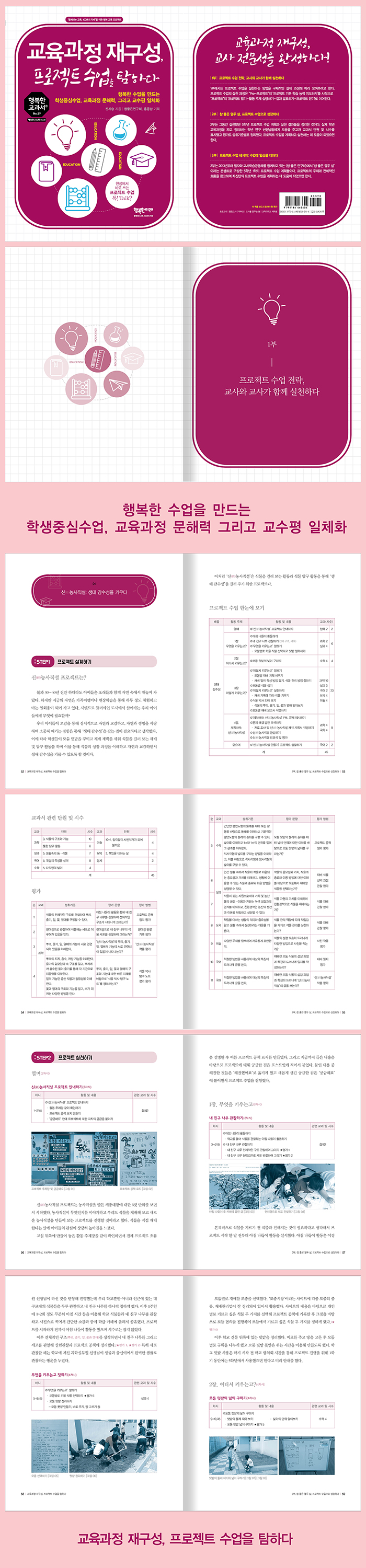
“I’ve planned a project class, but I’m not sure how to get started.”
What's the best way to get started with project-based learning? It's to learn the actual process of implementing project-based learning, step by step.
In other words, rather than looking at project classes from afar in a vague manner, we examine the specific aspects of project classes one by one in detail.
---「Part 1.
From “Project-Based Teaching Strategies: Implemented Together by Teachers”
In Part 1, we will show you how to implement project-based learning through specific, practical steps.
The practical process of project classes begins with ‘Teaching basic project learning skills’ in ‘Pre-Project’ and continues with ‘Opening the project - Implementing the activity topic - Presenting the results - Closing the project’ in ‘Project’.
---「Part 1.
From “Project-Based Teaching Strategies: Implemented Together by Teachers”
[New Farming Direct Talk] Project classes will allow students to create group gardens, develop cultivation plans, and engage in cultivation and exploration activities to grow plants. Through these activities, they will be able to understand the growth process of plants and develop ecological sensitivity while communicating with nature.
---「Part 2.
From "A truly wonderful twelve years old, growing through project classes"
[A Hundred Years' Promise] Project class is a project that explores the meaning and role of the Constitution through the process of reading and interpreting the Constitution, understands the meaning of a country governed by the rule of law and the norms of our society, and explores why the rights and obligations of oneself and others, as well as human rights, are important.
---「Part 2.
From "A truly wonderful twelve years old, growing through project classes"
[This is the first time in 5th grade] The project class is a project to experience a ‘life with encounters’ through activities in which 5th graders put their heads together and think about how to spend the year with new friends, classrooms, and projects.
---「Part 3.
From Project Class Recipe: Adding Everyday Life to Class
A good class, as we believe, is ultimately a class that helps students 'grow'.
To foster student growth, we dream of classes that reflect students' interests and concerns, are connected to their lives, and allow for active participation and interaction among all students while taking into account their level differences.
I hope that project-based classes can be a useful tool for conducting such good classes.
And I hope that our children will grow even more through project classes.
What's the best way to get started with project-based learning? It's to learn the actual process of implementing project-based learning, step by step.
In other words, rather than looking at project classes from afar in a vague manner, we examine the specific aspects of project classes one by one in detail.
---「Part 1.
From “Project-Based Teaching Strategies: Implemented Together by Teachers”
In Part 1, we will show you how to implement project-based learning through specific, practical steps.
The practical process of project classes begins with ‘Teaching basic project learning skills’ in ‘Pre-Project’ and continues with ‘Opening the project - Implementing the activity topic - Presenting the results - Closing the project’ in ‘Project’.
---「Part 1.
From “Project-Based Teaching Strategies: Implemented Together by Teachers”
[New Farming Direct Talk] Project classes will allow students to create group gardens, develop cultivation plans, and engage in cultivation and exploration activities to grow plants. Through these activities, they will be able to understand the growth process of plants and develop ecological sensitivity while communicating with nature.
---「Part 2.
From "A truly wonderful twelve years old, growing through project classes"
[A Hundred Years' Promise] Project class is a project that explores the meaning and role of the Constitution through the process of reading and interpreting the Constitution, understands the meaning of a country governed by the rule of law and the norms of our society, and explores why the rights and obligations of oneself and others, as well as human rights, are important.
---「Part 2.
From "A truly wonderful twelve years old, growing through project classes"
[This is the first time in 5th grade] The project class is a project to experience a ‘life with encounters’ through activities in which 5th graders put their heads together and think about how to spend the year with new friends, classrooms, and projects.
---「Part 3.
From Project Class Recipe: Adding Everyday Life to Class
A good class, as we believe, is ultimately a class that helps students 'grow'.
To foster student growth, we dream of classes that reflect students' interests and concerns, are connected to their lives, and allow for active participation and interaction among all students while taking into account their level differences.
I hope that project-based classes can be a useful tool for conducting such good classes.
And I hope that our children will grow even more through project classes.
---From the "Epilogue"
Publisher's Review
Restructuring the curriculum and exploring project-based classes.
Curriculum literacy is a curriculum reconstruction class that freely creates classes by exercising imagination based on achievement standards and demonstrating teacher expertise.
The author says that 'project classes' are the flower of these curriculum reconstruction classes.
Teachers can fully demonstrate their expertise in curriculum literacy by creating and implementing project-based classes.
This is because students can not only achieve achievement standards but also develop various future capabilities through the experience of planning independently and solving problems with friends.
This book encourages readers to practice project-based learning themselves.
Project Class, [Practice] Strategy Revealed.
'I'm planning a project class, but I don't know where to start.'
If you look around, there are many teachers who have project lesson plans but are hesitant to get started.
Many project books provide instructions on how to do this and that, but teachers don't have a clear picture of the class scene in their heads.
This book reveals practical strategies to address these concerns for teachers.
Based on the results of planning and implementing project classes with peers and teachers from the Chamjohan Research Association for many years, this book demonstrates how to implement project classes through specific, practical processes.
What a wonderful twelve-year-old, [growing] through project classes.
Teachers believe that a good class is one that ultimately helps students 'grow'.
The author hopes that project-based learning will be a useful tool for such good classes, and that our children will grow further through project-based learning.
With this in mind, the author introduces a case study of a 5th grade project class that was planned and implemented with fellow students and members of the teacher-learning community called 'Chamjoheun Research Group'.
Through this book, readers can directly witness students grow through project-based classes.
Restructuring the curriculum and [improving] teacher professionalism.
This book is largely divided into three parts.
In Part 1, we will show you how to implement project-based learning through specific, practical steps.
The practical process of project classes begins with ‘Teaching basic project learning skills’ in the [Pre-Project] course and continues with ‘Opening the project - Implementing the activity topic - Presenting the results - Closing the project’ in the [Project] course.
Part 2 is a summary of the 5th grade project lesson plans and implementation results that have been implemented so far.
It was intended to assist grade level research teachers who plan and organize actual grade level curricula.
We have marked the textbook units and hours so that they can be used immediately in the field, and organized the evaluations by achievement criteria to help plan and implement project classes.
Part 3 introduces the 5th grade first semester project lesson plans conceived under the concept of “A Very Good Twelve Years Old” by the Chamjoeun Research Group, which has been working with the author and the teacher-learning community since 2013.
It provides ideas for planning your own project lessons by referring to the project's topic and overall flow.
Curriculum literacy is a curriculum reconstruction class that freely creates classes by exercising imagination based on achievement standards and demonstrating teacher expertise.
The author says that 'project classes' are the flower of these curriculum reconstruction classes.
Teachers can fully demonstrate their expertise in curriculum literacy by creating and implementing project-based classes.
This is because students can not only achieve achievement standards but also develop various future capabilities through the experience of planning independently and solving problems with friends.
This book encourages readers to practice project-based learning themselves.
Project Class, [Practice] Strategy Revealed.
'I'm planning a project class, but I don't know where to start.'
If you look around, there are many teachers who have project lesson plans but are hesitant to get started.
Many project books provide instructions on how to do this and that, but teachers don't have a clear picture of the class scene in their heads.
This book reveals practical strategies to address these concerns for teachers.
Based on the results of planning and implementing project classes with peers and teachers from the Chamjohan Research Association for many years, this book demonstrates how to implement project classes through specific, practical processes.
What a wonderful twelve-year-old, [growing] through project classes.
Teachers believe that a good class is one that ultimately helps students 'grow'.
The author hopes that project-based learning will be a useful tool for such good classes, and that our children will grow further through project-based learning.
With this in mind, the author introduces a case study of a 5th grade project class that was planned and implemented with fellow students and members of the teacher-learning community called 'Chamjoheun Research Group'.
Through this book, readers can directly witness students grow through project-based classes.
Restructuring the curriculum and [improving] teacher professionalism.
This book is largely divided into three parts.
In Part 1, we will show you how to implement project-based learning through specific, practical steps.
The practical process of project classes begins with ‘Teaching basic project learning skills’ in the [Pre-Project] course and continues with ‘Opening the project - Implementing the activity topic - Presenting the results - Closing the project’ in the [Project] course.
Part 2 is a summary of the 5th grade project lesson plans and implementation results that have been implemented so far.
It was intended to assist grade level research teachers who plan and organize actual grade level curricula.
We have marked the textbook units and hours so that they can be used immediately in the field, and organized the evaluations by achievement criteria to help plan and implement project classes.
Part 3 introduces the 5th grade first semester project lesson plans conceived under the concept of “A Very Good Twelve Years Old” by the Chamjoeun Research Group, which has been working with the author and the teacher-learning community since 2013.
It provides ideas for planning your own project lessons by referring to the project's topic and overall flow.
GOODS SPECIFICS
- Publication date: March 27, 2022
- Page count, weight, size: 204 pages | 432g | 170*225*20mm
- ISBN13: 9791186463604
- ISBN10: 1186463600
You may also like
카테고리
korean


korean

![GQ KOREA Mark (Monthly): December [2025]](http://librairie.coreenne.fr/cdn/shop/files/8ef265dbbfbf186523ed75ba7319009d.jpg?v=1765340328&width=3840)


