

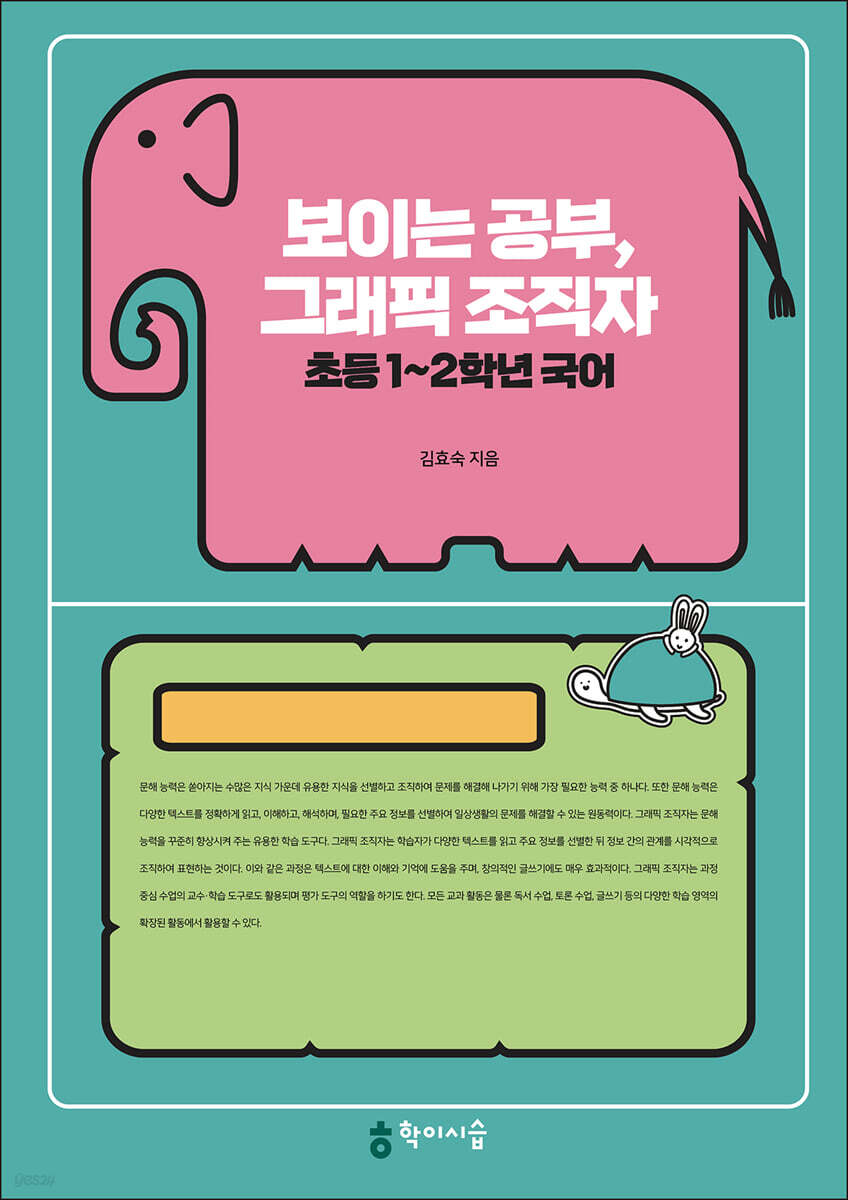
Visible Study, Graphic Organizer Elementary 1st and 2nd Grade Korean Language
 |
Description
Book Introduction
Graphic organizers are visual representations of the structure of various texts or the thought processes that occur when reading a text.
This book helps students select key information from texts at the level of Korean language textbooks for first and second graders and visually organize and express the relationships between the information.
We'll explain in detail what graphic organizers are, why they're useful, and who, when, and how they can be used.
This book helps students select key information from texts at the level of Korean language textbooks for first and second graders and visually organize and express the relationships between the information.
We'll explain in detail what graphic organizers are, why they're useful, and who, when, and how they can be used.
- You can preview some of the book's contents.
Preview
index
introduction
01 Understanding Graphic Organizers
What is a graphic organizer?
What are the advantages of graphic organizers?
When do you use graphic organizers?
Who Needs a Graphic Organizer?
How are graphic organizers created?
How do I use graphic organizers?
02 Linking and Utilizing the Elementary Korean Language Curriculum and Graphic Organizers
1st semester, 1st year (A)
1st semester, 1st year (me)
1st year, 2nd semester (A)
1st year, 2nd semester (me)
2nd year, 1st semester (A)
2nd year, 1st semester (me)
2nd semester, 2nd year (A)
2nd semester, 2nd year (me)
03 Graphic organizer according to the structure of the text
Recall
Imagine in advance
Curious question
Think of it brightly
A thought that comes to mind
vocabulary
Word game
Word bundle
Word chain game
Similar words
Flashcards
Create a story with words
Writing by collecting words
Sequential/cyclical
Beginning, middle, and end
A story in three scenes
A story in four scenes
The order in which things happened
In the order of what happened
Circular structure
Story Map
Who · What
Who, where, what happened
Summary of the story
This happened to me too
Main content and details
Group similar things together
Thought Net
What's new
Introduce
Explain in detail
Guess
Character's personality
Personality of the two characters
Character's actions and feelings
Character changes
What happened and what I feel
Similarities and differences
Reaction activity
Imagine the backstory
A word I want to say
memorable scene
If I were you
Two scenes that come to mind
My thoughts after reading
Scenes of four emotions
Expressing my feelings through a letter
01 Understanding Graphic Organizers
What is a graphic organizer?
What are the advantages of graphic organizers?
When do you use graphic organizers?
Who Needs a Graphic Organizer?
How are graphic organizers created?
How do I use graphic organizers?
02 Linking and Utilizing the Elementary Korean Language Curriculum and Graphic Organizers
1st semester, 1st year (A)
1st semester, 1st year (me)
1st year, 2nd semester (A)
1st year, 2nd semester (me)
2nd year, 1st semester (A)
2nd year, 1st semester (me)
2nd semester, 2nd year (A)
2nd semester, 2nd year (me)
03 Graphic organizer according to the structure of the text
Recall
Imagine in advance
Curious question
Think of it brightly
A thought that comes to mind
vocabulary
Word game
Word bundle
Word chain game
Similar words
Flashcards
Create a story with words
Writing by collecting words
Sequential/cyclical
Beginning, middle, and end
A story in three scenes
A story in four scenes
The order in which things happened
In the order of what happened
Circular structure
Story Map
Who · What
Who, where, what happened
Summary of the story
This happened to me too
Main content and details
Group similar things together
Thought Net
What's new
Introduce
Explain in detail
Guess
Character's personality
Personality of the two characters
Character's actions and feelings
Character changes
What happened and what I feel
Similarities and differences
Reaction activity
Imagine the backstory
A word I want to say
memorable scene
If I were you
Two scenes that come to mind
My thoughts after reading
Scenes of four emotions
Expressing my feelings through a letter
Publisher's Review
What is a graphic organizer?
A graphic organizer is a visual representation of the structure of various texts or the thought processes that occur when reading a text, and is a diagrammatic representation of the text's core.
This book contains 40 graphic organizers that help readers read texts at the level of a first- or second-grade Korean language textbook, select key information, and visually organize and express the relationships between the information.
We'll explain in detail what graphic organizers are, why they're useful, and who, when, and how they can be used.
Literacy: A Core Competency for Future Talent! Developing Graphic Organizers
Literacy is one of the most essential skills for solving problems by selecting and organizing useful knowledge from the vast amount of information available.
Moreover, literacy is the driving force that enables us to accurately read, understand, and interpret various texts, and to select the key information we need to solve problems in daily life.
Graphic organizers are a useful learning tool that can help you continuously improve your literacy skills.
It also stimulates learners' interest and motivation, fostering an active learning attitude.
It is very effective in improving not only reading skills but also writing skills, and improves self-management skills by utilizing metacognitive strategies.
Learners who struggle with literacy, learners of foreign languages, average learners, and gifted learners can all benefit from graphic organizers.
Teaching, learning, and assessment tools that can be used immediately in the field
Graphic organizers are also used as teaching and learning tools in process-centered classes and serve as assessment tools.
It can be used in all academic activities as well as extended activities in various learning areas such as reading classes, discussion classes, and writing.
To enable direct use in educational settings by linking it to the content of the curriculum, the contents of the 2015 revised elementary school Korean language textbooks for grades 1 and 2 were presented as examples, and the related parts were organized and presented in a table.
It can be used immediately in various learning environments both at school and outside of school.
A graphic organizer is a visual representation of the structure of various texts or the thought processes that occur when reading a text, and is a diagrammatic representation of the text's core.
This book contains 40 graphic organizers that help readers read texts at the level of a first- or second-grade Korean language textbook, select key information, and visually organize and express the relationships between the information.
We'll explain in detail what graphic organizers are, why they're useful, and who, when, and how they can be used.
Literacy: A Core Competency for Future Talent! Developing Graphic Organizers
Literacy is one of the most essential skills for solving problems by selecting and organizing useful knowledge from the vast amount of information available.
Moreover, literacy is the driving force that enables us to accurately read, understand, and interpret various texts, and to select the key information we need to solve problems in daily life.
Graphic organizers are a useful learning tool that can help you continuously improve your literacy skills.
It also stimulates learners' interest and motivation, fostering an active learning attitude.
It is very effective in improving not only reading skills but also writing skills, and improves self-management skills by utilizing metacognitive strategies.
Learners who struggle with literacy, learners of foreign languages, average learners, and gifted learners can all benefit from graphic organizers.
Teaching, learning, and assessment tools that can be used immediately in the field
Graphic organizers are also used as teaching and learning tools in process-centered classes and serve as assessment tools.
It can be used in all academic activities as well as extended activities in various learning areas such as reading classes, discussion classes, and writing.
To enable direct use in educational settings by linking it to the content of the curriculum, the contents of the 2015 revised elementary school Korean language textbooks for grades 1 and 2 were presented as examples, and the related parts were organized and presented in a table.
It can be used immediately in various learning environments both at school and outside of school.
GOODS SPECIFICS
- Date of issue: August 20, 2021
- Page count, weight, size: 126 pages | 210*297*20mm
- ISBN13: 9791128894596
- ISBN10: 1128894599
You may also like
카테고리
korean


korean

![GQ KOREA Mark (Monthly): December [2025]](http://librairie.coreenne.fr/cdn/shop/files/8ef265dbbfbf186523ed75ba7319009d.jpg?v=1765340328&width=3840)


