

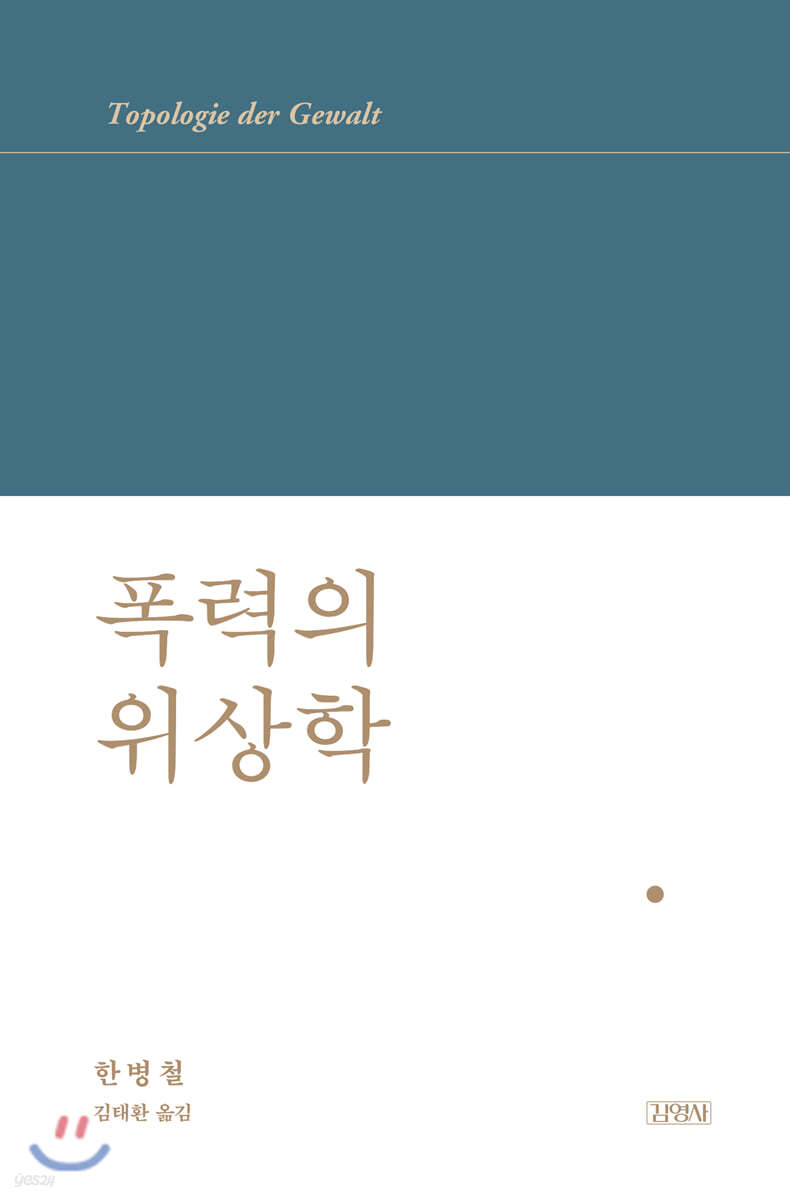
Topology of Violence
 |
Description
Book Introduction
A sharp analysis of the invisible violence in our society.
A book that contains the logic of violence underlying the reasoning developed in "The Fatigued Society"
A book that analyzes the violence that dominates the world today, from the structure, history, politics, psychology, and even the violence of systems that make it difficult to identify perpetrators.
From a sovereign society to a modern disciplinary society, and then to today's performance-based society, this book examines the topological transformation of violence, which has evolved along with the societal changes, and provides a keen insight into the violence of this era, which is increasingly internalized and psychologicalized.
It sharply analyzes the invisible violence of our society, showing how freedom devolves into violence within the neoliberal system, how the violence of affirmation breeds depression and burnout, and how narcissism leads to the destruction of community.
A book that contains the logic of violence underlying the reasoning developed in "The Fatigued Society"
A book that analyzes the violence that dominates the world today, from the structure, history, politics, psychology, and even the violence of systems that make it difficult to identify perpetrators.
From a sovereign society to a modern disciplinary society, and then to today's performance-based society, this book examines the topological transformation of violence, which has evolved along with the societal changes, and provides a keen insight into the violence of this era, which is increasingly internalized and psychologicalized.
It sharply analyzes the invisible violence of our society, showing how freedom devolves into violence within the neoliberal system, how the violence of affirmation breeds depression and burnout, and how narcissism leads to the destruction of community.
- You can preview some of the book's contents.
Preview
index
introduction
Part 1: Macrophysics of Violence
1.
Topology of Violence
2.
Archaeology of Violence
3.
The psychology of violence
4.
politics of violence
5.
The macro logic of violence
Part 2: Microphysics of Violence
1.
violence of the system
2.
Microphysics of Power
3.
The violence of positivity
4.
The violence of transparency
5.
Media is mass-age
6.
rhizomatic violence
7.
The violence of globalization
8.
Homo Liber
main
Translator's Note
Part 1: Macrophysics of Violence
1.
Topology of Violence
2.
Archaeology of Violence
3.
The psychology of violence
4.
politics of violence
5.
The macro logic of violence
Part 2: Microphysics of Violence
1.
violence of the system
2.
Microphysics of Power
3.
The violence of positivity
4.
The violence of transparency
5.
Media is mass-age
6.
rhizomatic violence
7.
The violence of globalization
8.
Homo Liber
main
Translator's Note
Into the book
Psychological internalization is a central issue in the topological shift in violence that has occurred in modern times.
Violence occurs in the form of inner conflict of the soul.
Destructive tensions are resolved internally rather than released outwardly.
The front is formed within the self, not outside it.
...
Conscience is the place where the transmission of violence takes place.
...
Aggression directed at others is redirected into aggression directed at oneself.
In proportion as man tolerates aggression towards others, his conscience becomes more strict and exerts greater coercive power.
--- p.19
When life is stripped bare like a coin and loses all narrative content, a frenzied health cult arises.
As society becomes atomized and communalism erodes, the only thing left is my body, and so the urgency to maintain this body's health at all costs arises.
In the place of ideal values, only the exhibition value and health value of the ego that craves attention remain.
A bare life destroys all teleology, all 'for's sake' that would answer the question of why one should be healthy.
Health becomes a self-sufficient value, losing all content and falling into the void of purposeless purposiveness.
--- p.36~37
Because the compensation structure is disrupted, performance-driven individuals are increasingly pressured to achieve greater results.
Loss of connection with others is a transcendental condition that creates the possibility of a compensation crisis.
Another cause of the compensation crisis can be found in today's production relations.
As a result of the work that has been done and completed, the final work, Werk, is no longer possible.
Today's production relations are precisely what prevents completion.
Humans work towards the open side.
The format of a complete story with a beginning and an end is disappearing.
--- p.47
The negativity of the superego limits the freedom of the ego.
On the other hand, self-planning toward the ideal self is interpreted as an act of freedom.
However, in front of the unattainable ideal self, the ego recognizes itself as a flawed being and a failure, and pours out self-reproach.
Self-aggression arises from the gap between the real self and the ideal self.
The ego makes itself the object of struggle and wages war against itself.
A society of positivity that believes itself to be free from all compulsion by others is entangled in a destructive self-compulsion and cannot escape it.
Mental illnesses such as burnout syndrome and depression, which have emerged as major diseases of the 21st century, all exhibit self-aggressive characteristics.
The ego inflicts violence on itself and exploits itself.
In place of the violence from others, self-generated violence takes over.
This violence is more lethal than the violence of others because the victim mistakenly believes he or she is free.
--- p.61~62
That is, the task of configuring the typist differently, of reconfiguring the typist so that it does not trigger destructive immune resistance, is necessary.
Wouldn't it be possible to have a relationship with the other in which I accept and affirm the other's differences, the other's very being, So-Sein?
Another way to say affirmation of this is Freundlichkeit.
Friendship does not mean simply leaving the other person in a passive and indifferent attitude, but rather connecting with the other person through an attitude of active engagement.
The feeling of friendship awakens only when we meet others, strangers.
...
The politics of friendship is more open than the politics of tolerance.
--- p.78
Democracy is communicative at its core.
Minorities can also influence the decision-making process by speaking out.
Dictatorship prohibits speech.
Dictatorship is just a matter of accepting and reducing.
--- p.83
Friendship is in some ways a sign of the political.
Because the community itself is “something friendly.”
Aristotle understands friendship as a very fundamental, existential problem.
Friendship is a “free decision to live together,” and in that sense, it can be said to be the foundation of a nation, a prerequisite for its establishment.
In a strong sense, what is political is not the will to exercise ruling power, but the decision to live together.
Human life is not politicized by being entrusted to an unconditional power that determines life and death.
The decision to live together politicizes human existence.
Power and violence lack the true spirit of political community, the determination to live together.
Power, although it presupposes community, is ultimately a phenomenon of the self.
That is, it is self-centered.
Togetherness is not what power seeks.
--- p.95
Today, politics itself has been positivized and reduced to a state where there is no possibility of sovereign action.
Work is positive in that the forces and compulsions that make us do it can never be questioned or surpassed.
The positivity of work perpetuates the normal state.
In politics, which has become a thing, there is no transcendent horizon that goes beyond what is simply possible.
After capital has absorbed all transcendence and all externality, politics too remains quietly within the internal space of capital.
As politics becomes more positive, political parties and ideologies also lose their importance day by day.
The void in politics is filled with spectacles produced by the media.
Politicians, too, occupy a space of depoliticized spectacle.
It is not their political actions but their humanity that becomes the subject of media production.
--- p.100
Power bends the subject until he bends himself.
Violence, on the other hand, bends the typist and eventually breaks him.
--- p.105
The idea that power is founded on violence is wrong.
Violence has a different orientation from power.
Therefore, it is quite possible for violent incidents to occur that are completely unrelated to the process of power.
For example, murder motivated by hatred is violence that aims nothing more than to eliminate the existence of the other.
There is no intention here to gain dominion over the typist.
If we examine violence only from the perspective of power, its true nature is not revealed.
--- p.111
Power is the relationship that binds the self and the other.
Power operates symbolically.
That is, it has the sym-ballein function of creating relationships and bringing them together.
Of course, power can also take demonic forms.
Demonized power appears as an oppressive, destructive, divisive, and excluding force.
But to view power solely in terms of its evil nature is to overlook the symbolic nature of power's productive function.
Violence, unlike power, is not a symbolic medium.
Violence is inherently diabolical.
That is, violence is divisive dia-ballein.
Power has a symbolic dimension, so it actually produces many symbols, and it is through the use of such symbols that it becomes eloquent.
On the other hand, violence, because of its evil nature, represents a poverty of symbolism, a poverty of language.
--- p.112
He has the same periphery as the space he dominates, that is, the space he occupies.
This topology of power explains why a complete loss of power feels like a complete loss of space.
--- p.113
Sartre's words, 'Hell is other people', are only possible in the immunological age.
Today, heterogeneity is increasingly being replaced by consumable differences that do not trigger an immune response.
These differences do not have the unfamiliar thorns that cause fierce immune resistance.
Foreigners are also positively identified as exotic and, unlike immunological other people, do not elicit an immune response.
Contrary to the macrologic of violence, the micrologic of violence does not follow the immunological model.
The micro-logic of violence is the logic of the same thing.
--- p.117~118
Systemic violence is exercised without any hostility or dominance.
The perpetrators of violence are neither the individuals in power nor the ruling class.
The system itself is the subject of violence.
There is no agent responsible for oppression or exploitation.
--- p.128
Here too, the difference between exploiter and exploited disappears.
Not only the weak but also the strong suffer from burnout syndrome.
The victims are at the same time accomplices of the system.
The victims are indistinguishable from the perpetrators who keep the system running smoothly.
Violence has a self-relational character in that it leads to self-exploitation and the identification of perpetrator and victim.
--- p.129
Today's war is a war against oneself.
Because the negativity of hostility has disappeared, war becomes self-relational.
He who destroys is destroyed.
He who strikes gets hit.
The one who wins is also the one who loses.
This war is completely invisible and unclear because it pretends to be peace.
It is a war that no one can win.
Not a one-sided victory, but only the total collapse, the total exhaustion, will end a war without an enemy.
The entire system will burst due to overheating.
What is at work here is a bursting violence.
Implosive violence is distinguished from explosive violence, which expands and conquers new spaces, like imperialist violence or classical war violence.
Explosive violence exerts pressure outward.
In explosive violence, on the other hand, since there is no outside, the pressure is applied inward.
Explosive violence creates destructive tensions and compulsions within, which lead to a system-wide strain.
Climate and environmental disasters are also symptomatic of the system's overheating.
A performance-driven entity that has reached a state of exhaustion is a pathological precursor to the impending collapse of the system.
--- p.144
Far more threatening than the terror of others is the terror of one's own self, the terror of immanence.
There can be no effective defense against such terrorism, which has no negativity.
--- p.147
The persistent demand for transparency is based on the idea of a world, or rather, a human being, without any form of negativity.
The machine is completely transparent.
Transparent communication would be a type of communication between machines that is not possible for humans.
The obsession with total transparency homogenizes humans into functional elements of a system.
Herein lies the violence of transparency.
The entire personality of a human being also contains aspects that are to some extent inaccessible and impenetrable.
It would be violence to completely expose a human being and shine an excessive light on him.
Peter Handke writes:
“I live by what others don’t know about me.”
--- p.153~154
As is well known, computers do not know how to hesitate.
Computers become autistic calculators because they lack the dimension of typing.
Reason, too, is linked to negativity in its most essential sense.
Without negativity, reasoning would be no different from calculation.
Violence occurs in the form of inner conflict of the soul.
Destructive tensions are resolved internally rather than released outwardly.
The front is formed within the self, not outside it.
...
Conscience is the place where the transmission of violence takes place.
...
Aggression directed at others is redirected into aggression directed at oneself.
In proportion as man tolerates aggression towards others, his conscience becomes more strict and exerts greater coercive power.
--- p.19
When life is stripped bare like a coin and loses all narrative content, a frenzied health cult arises.
As society becomes atomized and communalism erodes, the only thing left is my body, and so the urgency to maintain this body's health at all costs arises.
In the place of ideal values, only the exhibition value and health value of the ego that craves attention remain.
A bare life destroys all teleology, all 'for's sake' that would answer the question of why one should be healthy.
Health becomes a self-sufficient value, losing all content and falling into the void of purposeless purposiveness.
--- p.36~37
Because the compensation structure is disrupted, performance-driven individuals are increasingly pressured to achieve greater results.
Loss of connection with others is a transcendental condition that creates the possibility of a compensation crisis.
Another cause of the compensation crisis can be found in today's production relations.
As a result of the work that has been done and completed, the final work, Werk, is no longer possible.
Today's production relations are precisely what prevents completion.
Humans work towards the open side.
The format of a complete story with a beginning and an end is disappearing.
--- p.47
The negativity of the superego limits the freedom of the ego.
On the other hand, self-planning toward the ideal self is interpreted as an act of freedom.
However, in front of the unattainable ideal self, the ego recognizes itself as a flawed being and a failure, and pours out self-reproach.
Self-aggression arises from the gap between the real self and the ideal self.
The ego makes itself the object of struggle and wages war against itself.
A society of positivity that believes itself to be free from all compulsion by others is entangled in a destructive self-compulsion and cannot escape it.
Mental illnesses such as burnout syndrome and depression, which have emerged as major diseases of the 21st century, all exhibit self-aggressive characteristics.
The ego inflicts violence on itself and exploits itself.
In place of the violence from others, self-generated violence takes over.
This violence is more lethal than the violence of others because the victim mistakenly believes he or she is free.
--- p.61~62
That is, the task of configuring the typist differently, of reconfiguring the typist so that it does not trigger destructive immune resistance, is necessary.
Wouldn't it be possible to have a relationship with the other in which I accept and affirm the other's differences, the other's very being, So-Sein?
Another way to say affirmation of this is Freundlichkeit.
Friendship does not mean simply leaving the other person in a passive and indifferent attitude, but rather connecting with the other person through an attitude of active engagement.
The feeling of friendship awakens only when we meet others, strangers.
...
The politics of friendship is more open than the politics of tolerance.
--- p.78
Democracy is communicative at its core.
Minorities can also influence the decision-making process by speaking out.
Dictatorship prohibits speech.
Dictatorship is just a matter of accepting and reducing.
--- p.83
Friendship is in some ways a sign of the political.
Because the community itself is “something friendly.”
Aristotle understands friendship as a very fundamental, existential problem.
Friendship is a “free decision to live together,” and in that sense, it can be said to be the foundation of a nation, a prerequisite for its establishment.
In a strong sense, what is political is not the will to exercise ruling power, but the decision to live together.
Human life is not politicized by being entrusted to an unconditional power that determines life and death.
The decision to live together politicizes human existence.
Power and violence lack the true spirit of political community, the determination to live together.
Power, although it presupposes community, is ultimately a phenomenon of the self.
That is, it is self-centered.
Togetherness is not what power seeks.
--- p.95
Today, politics itself has been positivized and reduced to a state where there is no possibility of sovereign action.
Work is positive in that the forces and compulsions that make us do it can never be questioned or surpassed.
The positivity of work perpetuates the normal state.
In politics, which has become a thing, there is no transcendent horizon that goes beyond what is simply possible.
After capital has absorbed all transcendence and all externality, politics too remains quietly within the internal space of capital.
As politics becomes more positive, political parties and ideologies also lose their importance day by day.
The void in politics is filled with spectacles produced by the media.
Politicians, too, occupy a space of depoliticized spectacle.
It is not their political actions but their humanity that becomes the subject of media production.
--- p.100
Power bends the subject until he bends himself.
Violence, on the other hand, bends the typist and eventually breaks him.
--- p.105
The idea that power is founded on violence is wrong.
Violence has a different orientation from power.
Therefore, it is quite possible for violent incidents to occur that are completely unrelated to the process of power.
For example, murder motivated by hatred is violence that aims nothing more than to eliminate the existence of the other.
There is no intention here to gain dominion over the typist.
If we examine violence only from the perspective of power, its true nature is not revealed.
--- p.111
Power is the relationship that binds the self and the other.
Power operates symbolically.
That is, it has the sym-ballein function of creating relationships and bringing them together.
Of course, power can also take demonic forms.
Demonized power appears as an oppressive, destructive, divisive, and excluding force.
But to view power solely in terms of its evil nature is to overlook the symbolic nature of power's productive function.
Violence, unlike power, is not a symbolic medium.
Violence is inherently diabolical.
That is, violence is divisive dia-ballein.
Power has a symbolic dimension, so it actually produces many symbols, and it is through the use of such symbols that it becomes eloquent.
On the other hand, violence, because of its evil nature, represents a poverty of symbolism, a poverty of language.
--- p.112
He has the same periphery as the space he dominates, that is, the space he occupies.
This topology of power explains why a complete loss of power feels like a complete loss of space.
--- p.113
Sartre's words, 'Hell is other people', are only possible in the immunological age.
Today, heterogeneity is increasingly being replaced by consumable differences that do not trigger an immune response.
These differences do not have the unfamiliar thorns that cause fierce immune resistance.
Foreigners are also positively identified as exotic and, unlike immunological other people, do not elicit an immune response.
Contrary to the macrologic of violence, the micrologic of violence does not follow the immunological model.
The micro-logic of violence is the logic of the same thing.
--- p.117~118
Systemic violence is exercised without any hostility or dominance.
The perpetrators of violence are neither the individuals in power nor the ruling class.
The system itself is the subject of violence.
There is no agent responsible for oppression or exploitation.
--- p.128
Here too, the difference between exploiter and exploited disappears.
Not only the weak but also the strong suffer from burnout syndrome.
The victims are at the same time accomplices of the system.
The victims are indistinguishable from the perpetrators who keep the system running smoothly.
Violence has a self-relational character in that it leads to self-exploitation and the identification of perpetrator and victim.
--- p.129
Today's war is a war against oneself.
Because the negativity of hostility has disappeared, war becomes self-relational.
He who destroys is destroyed.
He who strikes gets hit.
The one who wins is also the one who loses.
This war is completely invisible and unclear because it pretends to be peace.
It is a war that no one can win.
Not a one-sided victory, but only the total collapse, the total exhaustion, will end a war without an enemy.
The entire system will burst due to overheating.
What is at work here is a bursting violence.
Implosive violence is distinguished from explosive violence, which expands and conquers new spaces, like imperialist violence or classical war violence.
Explosive violence exerts pressure outward.
In explosive violence, on the other hand, since there is no outside, the pressure is applied inward.
Explosive violence creates destructive tensions and compulsions within, which lead to a system-wide strain.
Climate and environmental disasters are also symptomatic of the system's overheating.
A performance-driven entity that has reached a state of exhaustion is a pathological precursor to the impending collapse of the system.
--- p.144
Far more threatening than the terror of others is the terror of one's own self, the terror of immanence.
There can be no effective defense against such terrorism, which has no negativity.
--- p.147
The persistent demand for transparency is based on the idea of a world, or rather, a human being, without any form of negativity.
The machine is completely transparent.
Transparent communication would be a type of communication between machines that is not possible for humans.
The obsession with total transparency homogenizes humans into functional elements of a system.
Herein lies the violence of transparency.
The entire personality of a human being also contains aspects that are to some extent inaccessible and impenetrable.
It would be violence to completely expose a human being and shine an excessive light on him.
Peter Handke writes:
“I live by what others don’t know about me.”
--- p.153~154
As is well known, computers do not know how to hesitate.
Computers become autistic calculators because they lack the dimension of typing.
Reason, too, is linked to negativity in its most essential sense.
Without negativity, reasoning would be no different from calculation.
--- p.181
Publisher's Review
A sharp analysis of the invisible violence in our society.
A book that contains the logic of violence underlying the reasoning developed in "The Fatigued Society"
It has been ten years since the publication of 『Fatigue Society』 (originally published in 2010, Korean edition published in 2012) by Professor Han Byeong-cheol, a philosopher living in Germany.
"The Burnout Society" sharply analyzed the pathological reality they were experiencing by labeling the advanced industrial society of the late 20th century as a performance society and the people of this world as "performance subjects," and it caused a reaction that could be called a syndrome in all of European and Korean society.
The Han Byung-Chul syndrome continues to this day in Spanish-speaking countries and around the world, and he is called “the world’s most widely read living German philosopher.”
The recently published 『Topology of Violence』 (German edition published in 2013) is a book that contains the logic of violence underlying the thinking developed in 『The Burnout Society』.
This paper delves into the thesis that ‘fatigue is violence’ presented in the last chapter of ‘The Fatigue Society’.
This paper examines the topological transformation of violence, which has evolved along with the social changes from a sovereign society to a modern disciplinary society and then to today's performance-based society, and shows that today's violence is increasingly internalized and psychologicalized.
It sharply analyzes the invisible violence of our society, showing how freedom devolves into violence within the neoliberal system, how the violence of affirmation breeds depression and burnout, and how narcissism leads to the destruction of community.
The subject of achievement liberates himself and turns himself into a project.
However, the transformation from subject to project does not eliminate violence.
In place of external coercion by others, self-coercion disguised as freedom takes over.
These developments are closely related to capitalist production relations.
When the level of production reaches a certain level, self-exploitation begins to be much more effective and yield greater results than exploitation of others.
Because self-exploitation is accompanied by a feeling of freedom.
A performance-based society is a society of self-exploitation.
The achiever exploits himself until he burns out.
The self-aggression that occurs at this time often escalates to suicidal violence.
This reveals that the project is a bullet aimed at itself by the subject of the achievement.
Pages 20-21
The structure, history, politics, psychology, and even the violence of a system that makes it difficult to identify the perpetrators
Reflections on the violence that dominates today's world
He first introduces the topological transformation of violence.
As the social structure changes, the nature of violence also changes.
From the bloody violence found in primordial sacrificial rituals, the violence of jealous and vengeful mythological gods, to the violence of the sovereign who orders beheadings, the violence of merciless torture, and then to the bloodless violence of the gas chambers, the viral violence of terrorism, and the verbal violence that hurts feelings.
Violence that was once blatant and bloody gradually lost its legitimacy and became something that had to be hidden as much as possible.
According to the author's analysis, all this violence is still a 'violence of negativity' that grows out of the tension between self and other, inside and outside, friend and enemy.
Part 1, 'Macrophysics of Violence', mainly deals with the violence of negativity.
He approaches his own concept of violence by examining the discussions of Freud, Benjamin, Carl Schmitt, Richard Sennett, René Girard, Agamben, Deleuze and Guattari, Foucault, Bourdieu, and Heidegger.
Thus, in Part 2, “The Microphysics of Violence,” we examine from various angles the violence operating within free individuals in today’s neoliberal world.
The subject internalizes the demands of the system and fully complies with them.
In the effort to reach the ideal self, we join the ranks of overproduction, overcommunication, overattention, and overactivity.
Driven by the need for survival and the pursuit of efficiency, we become both perpetrators and victims, trapped in self-exploitation, the breakdown of boundaries, depression, and burnout.
What makes this violence of positivity more lethal than the violence of negativity is that it has no warning and no clear enemy.
Ultimately, the system will inevitably collapse and burn down, and “the exhausted performance-based entity is a pathological sign of the imminent collapse of the system.”
Violence is an external force that attacks me, subdues me, and takes away my freedom.
Violence invades me without my permission.
However, not all external influences are violent.
The moment I acknowledge that action and associate it with my actions, that is, the moment I establish a certain relationship between that action and myself, it no longer has the character of violence.
I act freely in relation to that action.
I affirm it as my own content.
Page 103
We are both perpetrators and victims of violence, caught in the trap of self-exploitation.
How can one wake up from this fatal paralysis?
In an era where previously hidden violence is being revealed and accusations of violence are pouring in, a welcome welcome to the discussion on violence.
In these times when the world is facing an extraordinary crisis due to the coronavirus pandemic, when targeted attacks against certain individuals are heating up the media and social media, when physical violence and hate crimes against the vulnerable are frequent, and when the entire United States is in turmoil over the 'Floyd incident', it seems that (according to the author's diagram) the world is still dominated by the 'violence of negativity'.
Relatively, the 'violence of positivity' seems to be disappearing from sight.
But in this age of infectious disease, has the microphysical violence we inflict on ourselves truly diminished? Isn't the violence of positivity still operating in various ways? To overcome these difficult times, aren't we unknowingly diving into even more intense self-exploitation? Furthermore, perhaps even what appears to be the violence of negativity actually overlaps with layers of the violence of positivity? What if all the hyper-communication, hyper-activity, and hyper-production ultimately lead to the violence of negativity directed at others? And after the pandemic subsides to a certain degree, will the post-COVID-19 society truly be any different from before? Like a pendulum swinging from one end to the other, as if trying to make up for the current negative growth, won't the actors of the performance-based society hastily return to the extremes of capitalism and continue their self-exploitation? Perhaps this is precisely the "normalcy" so many dream of in these extraordinary times?
If, contrary to the claims of optimists, violence is not diminishing even in this enlightened world, if violence operates in a different way than before, and if efforts to find an exit from this violence are justified, then this book, which delves into the macro and micro structures of violence, is an urgent text that must be read now.
In an era where previously hidden violence is being exposed and accusations of violence are on the rise, I hope this book, which contains extraordinary reflections on violence, will serve as a catalyst for productive discussion.
A book that contains the logic of violence underlying the reasoning developed in "The Fatigued Society"
It has been ten years since the publication of 『Fatigue Society』 (originally published in 2010, Korean edition published in 2012) by Professor Han Byeong-cheol, a philosopher living in Germany.
"The Burnout Society" sharply analyzed the pathological reality they were experiencing by labeling the advanced industrial society of the late 20th century as a performance society and the people of this world as "performance subjects," and it caused a reaction that could be called a syndrome in all of European and Korean society.
The Han Byung-Chul syndrome continues to this day in Spanish-speaking countries and around the world, and he is called “the world’s most widely read living German philosopher.”
The recently published 『Topology of Violence』 (German edition published in 2013) is a book that contains the logic of violence underlying the thinking developed in 『The Burnout Society』.
This paper delves into the thesis that ‘fatigue is violence’ presented in the last chapter of ‘The Fatigue Society’.
This paper examines the topological transformation of violence, which has evolved along with the social changes from a sovereign society to a modern disciplinary society and then to today's performance-based society, and shows that today's violence is increasingly internalized and psychologicalized.
It sharply analyzes the invisible violence of our society, showing how freedom devolves into violence within the neoliberal system, how the violence of affirmation breeds depression and burnout, and how narcissism leads to the destruction of community.
The subject of achievement liberates himself and turns himself into a project.
However, the transformation from subject to project does not eliminate violence.
In place of external coercion by others, self-coercion disguised as freedom takes over.
These developments are closely related to capitalist production relations.
When the level of production reaches a certain level, self-exploitation begins to be much more effective and yield greater results than exploitation of others.
Because self-exploitation is accompanied by a feeling of freedom.
A performance-based society is a society of self-exploitation.
The achiever exploits himself until he burns out.
The self-aggression that occurs at this time often escalates to suicidal violence.
This reveals that the project is a bullet aimed at itself by the subject of the achievement.
Pages 20-21
The structure, history, politics, psychology, and even the violence of a system that makes it difficult to identify the perpetrators
Reflections on the violence that dominates today's world
He first introduces the topological transformation of violence.
As the social structure changes, the nature of violence also changes.
From the bloody violence found in primordial sacrificial rituals, the violence of jealous and vengeful mythological gods, to the violence of the sovereign who orders beheadings, the violence of merciless torture, and then to the bloodless violence of the gas chambers, the viral violence of terrorism, and the verbal violence that hurts feelings.
Violence that was once blatant and bloody gradually lost its legitimacy and became something that had to be hidden as much as possible.
According to the author's analysis, all this violence is still a 'violence of negativity' that grows out of the tension between self and other, inside and outside, friend and enemy.
Part 1, 'Macrophysics of Violence', mainly deals with the violence of negativity.
He approaches his own concept of violence by examining the discussions of Freud, Benjamin, Carl Schmitt, Richard Sennett, René Girard, Agamben, Deleuze and Guattari, Foucault, Bourdieu, and Heidegger.
Thus, in Part 2, “The Microphysics of Violence,” we examine from various angles the violence operating within free individuals in today’s neoliberal world.
The subject internalizes the demands of the system and fully complies with them.
In the effort to reach the ideal self, we join the ranks of overproduction, overcommunication, overattention, and overactivity.
Driven by the need for survival and the pursuit of efficiency, we become both perpetrators and victims, trapped in self-exploitation, the breakdown of boundaries, depression, and burnout.
What makes this violence of positivity more lethal than the violence of negativity is that it has no warning and no clear enemy.
Ultimately, the system will inevitably collapse and burn down, and “the exhausted performance-based entity is a pathological sign of the imminent collapse of the system.”
Violence is an external force that attacks me, subdues me, and takes away my freedom.
Violence invades me without my permission.
However, not all external influences are violent.
The moment I acknowledge that action and associate it with my actions, that is, the moment I establish a certain relationship between that action and myself, it no longer has the character of violence.
I act freely in relation to that action.
I affirm it as my own content.
Page 103
We are both perpetrators and victims of violence, caught in the trap of self-exploitation.
How can one wake up from this fatal paralysis?
In an era where previously hidden violence is being revealed and accusations of violence are pouring in, a welcome welcome to the discussion on violence.
In these times when the world is facing an extraordinary crisis due to the coronavirus pandemic, when targeted attacks against certain individuals are heating up the media and social media, when physical violence and hate crimes against the vulnerable are frequent, and when the entire United States is in turmoil over the 'Floyd incident', it seems that (according to the author's diagram) the world is still dominated by the 'violence of negativity'.
Relatively, the 'violence of positivity' seems to be disappearing from sight.
But in this age of infectious disease, has the microphysical violence we inflict on ourselves truly diminished? Isn't the violence of positivity still operating in various ways? To overcome these difficult times, aren't we unknowingly diving into even more intense self-exploitation? Furthermore, perhaps even what appears to be the violence of negativity actually overlaps with layers of the violence of positivity? What if all the hyper-communication, hyper-activity, and hyper-production ultimately lead to the violence of negativity directed at others? And after the pandemic subsides to a certain degree, will the post-COVID-19 society truly be any different from before? Like a pendulum swinging from one end to the other, as if trying to make up for the current negative growth, won't the actors of the performance-based society hastily return to the extremes of capitalism and continue their self-exploitation? Perhaps this is precisely the "normalcy" so many dream of in these extraordinary times?
If, contrary to the claims of optimists, violence is not diminishing even in this enlightened world, if violence operates in a different way than before, and if efforts to find an exit from this violence are justified, then this book, which delves into the macro and micro structures of violence, is an urgent text that must be read now.
In an era where previously hidden violence is being exposed and accusations of violence are on the rise, I hope this book, which contains extraordinary reflections on violence, will serve as a catalyst for productive discussion.
GOODS SPECIFICS
- Date of issue: June 10, 2020
- Format: Hardcover book binding method guide
- Page count, weight, size: 232 pages | 322g | 124*190*20mm
- ISBN13: 9788934995487
- ISBN10: 8934995483
You may also like
카테고리
korean


korean

![GQ KOREA Mark (Monthly): December [2025]](http://librairie.coreenne.fr/cdn/shop/files/8ef265dbbfbf186523ed75ba7319009d.jpg?v=1765340328&width=3840)


