

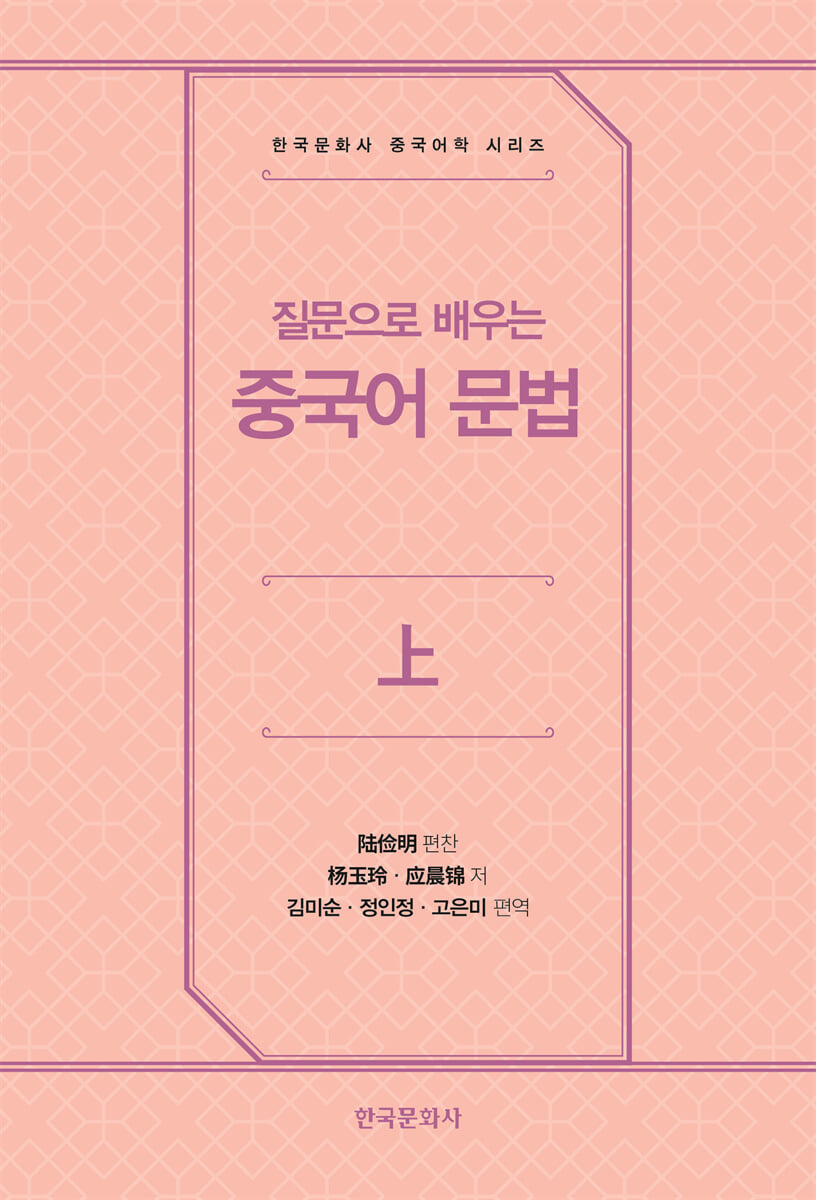
Learning Chinese Grammar Through Questions Part 1
 |
Description
Book Introduction
The core of Chinese language education is teaching Chinese language and characters, and its purpose is to help Chinese learners acquire Chinese language properly.
Therefore, Chinese teachers must have extensive knowledge of Chinese language and Chinese characters to teach Chinese well.
However, Chinese language teachers, unlike teachers of other subjects, have a very diverse range of majors.
While this is an advantage because Chinese language education is an interdisciplinary discipline, teachers may lack knowledge of Chinese linguistics and thus may be unable to answer questions that arise during the Chinese language teaching and learning process.
Even though I am a teacher who majored in Chinese literature and have extensive knowledge of Chinese linguistics, I have limitations in acquiring the knowledge necessary for teaching Chinese because Chinese literature is a discipline for native Chinese speakers.
Therefore, we compiled this series to help Chinese language teachers, regardless of their major, acquire the Chinese linguistic knowledge necessary for teaching Chinese.
Therefore, Chinese teachers must have extensive knowledge of Chinese language and Chinese characters to teach Chinese well.
However, Chinese language teachers, unlike teachers of other subjects, have a very diverse range of majors.
While this is an advantage because Chinese language education is an interdisciplinary discipline, teachers may lack knowledge of Chinese linguistics and thus may be unable to answer questions that arise during the Chinese language teaching and learning process.
Even though I am a teacher who majored in Chinese literature and have extensive knowledge of Chinese linguistics, I have limitations in acquiring the knowledge necessary for teaching Chinese because Chinese literature is a discipline for native Chinese speakers.
Therefore, we compiled this series to help Chinese language teachers, regardless of their major, acquire the Chinese linguistic knowledge necessary for teaching Chinese.
- You can preview some of the book's contents.
Preview
index
Preface to the series
introduction
Translator's Note
CHAPTER 1 Grammar and Grammar Units
1.
Modern Chinese Grammar
2.
Grammatical units of modern Chinese
CHAPTER 2 Parts of Speech
I.
Overview of Modern Chinese Parts of Speech
1.
What is a part of speech?
2.
Why do we need to classify parts of speech?
3.
What is the basis for classifying parts of speech?
4.
Is it possible to classify parts of speech according to meaning?
5.
How many parts of speech can words be classified into?
6.
What is reality? What is fiction?
7.
What is a noun? What is a verb?
II.
noun
1.
Nouns and their grammatical functions
2.
Types of nouns
III.
verb
1.
Verbs and Grammar Functions
2.
Neungwon verbs and Neungwon verb education
3.
Transitive and intransitive verbs
4.
Continuous and non-continuous verbs
5.
Frequent and non-frequent verbs
6.
Noun-object verbs and verb-object verbs
7.
Verb conjugation and verb conjugation training
8.
Verb sentence formation requirements
9.
Verb education
IV.
adjective
1.
Adjectives and Grammatical Functions
2.
Classification of adjectives
3.
Adjective nesting
4.
Adjective Error Analysis
5.
Adjective training
V.
State history
1.
Status Verbs and Grammatical Functions
2.
Error analysis of status
3.
Status education
VI.
Distinguishing agent
1.
Distinguishing words and grammar functions
2.
Error analysis of distinguishers
3.
Distinguished Service Education
VII.
adverb
1.
Adverbs and Grammatical Functions
2.
Types of adverbs
3.
Distinguishing between synonyms of adverbs
4.
Adverb Case Study
5.
Adverb education
VIII.
investigation
1.
Investigator
2.
Orthographic numeration
3.
Approximate number expression
4.
Use of investigation
IX.
Both companies
1.
Quantity and type
2.
Myeongnyangsa Temple
3.
Dongryangsa Temple
4.
Siryangsa
5.
Overlapping of two companies
6.
Error analysis of both companies
7.
Both companies' training
X.
alternative
1.
Alternatives and grammatical functions, types
2.
personal substitute
3.
Demonstrative substitute
4.
Interrogative pronouns
5.
Error analysis of alternatives
6.
Alternative history education
XI.
preposition
1.
Prepositions and Grammatical Functions
2.
Examples of preposition usage
3.
Analysis of common prepositions
4.
Analysis of Preposition Errors
5.
Preposition education
XII.
conjunction
1.
Conjunctions and Types
2.
Analysis of commercial conjunctions
3.
Analysis of errors in conjunctions
XIII.
inspection
1.
Investigation and Type
2.
structural investigation
3.
Dynamic survey
4.
inspection '?'
XIV.
Onomatopoeia, exclamation, and interjection
1.
Fisherman
2.
interjection
3.
Uiseongsa Temple
XV.
double part of speech
1.
What is a double part of speech?
2.
Compound parts of speech and homonyms: In '方便', '方便群?', is '方便' a compound part of speech?
3.
In '花', '花', is '花' a double part of speech?
4.
What words are there in common double parts of speech?
5.
In ‘going to Xiangguang’, ‘having become Xiangguang’, is ‘香港’ a double part of speech?
CHAPTER 3 Gu
I.
Type of sphere
II.
Types of basic phrases
1.
What are modifiers? What are the structural characteristics of modifiers?
2.
What are complex modifiers? How many types of complex modifiers are there?
3.
What is a sulmokgoo? What are its structural characteristics?
4.
What is a sulbogu? What are its structural characteristics?
5.
How many types of alcohol can be divided into?
6.
What is a shamanic instrument? What are its structural characteristics?
7.
What is a Union Territory? What are its structural characteristics?
8.
Are 'effort' and 'effort' the same structure?
9.
Are '仔看' and '看仔' the same structure?
10.
Are '浙江杭州' and '州杭州' the same structure?
11.
Is 'Rain today' a modifier or a spell?
III.
Other ball types
1.
What is a quantifier? What is its grammatical function?
2.
What is a defense device? What should I keep in mind when training on a defense device?
3.
What is a prepositional phrase?
4.
What is the consonant '的'? What should we pay attention to when teaching the consonant '的'?
5.
Why are the meanings of '吃?的人' and '吃?的' the same, but '吃?的地方' and '吃?的' different?
6.
What is a homotopy?
7.
Why is '『Hero』影' the correct expression, but '影『Hero』' the incorrect expression?
8.
Are the meanings of 'Queen Yi?Baek' and 'Queen Yi?Baek' the same?
9.
Why does '小明哥哥' have a double meaning?
10.
What is a metaphor?
11.
What are multiverb phrases? How many types are there?
12.
How many types of joints are there?
13.
Is 'Go to the West' a United Region?
14.
Is '着看' a modifier?
15.
What are humiliation phrases? How many types of humiliation phrases are there?
16.
Are '他' and '希望他' the same?
17.
What is a chain reaction?
18.
What are complex multi-verb phrases? How many types of complex multi-verb phrases can we classify?
IV.
Layered analysis of complex structures
1.
complex
2.
Stratification analysis method
V.
phenomenon of the middle
1.
What is the phenomenon of the middle? What causes the occurrence of the middle?
2.
What are the factors that cause the phenomenon of syntactic confusion?
3.
How can the structure of the sentence be resolved?
introduction
Translator's Note
CHAPTER 1 Grammar and Grammar Units
1.
Modern Chinese Grammar
2.
Grammatical units of modern Chinese
CHAPTER 2 Parts of Speech
I.
Overview of Modern Chinese Parts of Speech
1.
What is a part of speech?
2.
Why do we need to classify parts of speech?
3.
What is the basis for classifying parts of speech?
4.
Is it possible to classify parts of speech according to meaning?
5.
How many parts of speech can words be classified into?
6.
What is reality? What is fiction?
7.
What is a noun? What is a verb?
II.
noun
1.
Nouns and their grammatical functions
2.
Types of nouns
III.
verb
1.
Verbs and Grammar Functions
2.
Neungwon verbs and Neungwon verb education
3.
Transitive and intransitive verbs
4.
Continuous and non-continuous verbs
5.
Frequent and non-frequent verbs
6.
Noun-object verbs and verb-object verbs
7.
Verb conjugation and verb conjugation training
8.
Verb sentence formation requirements
9.
Verb education
IV.
adjective
1.
Adjectives and Grammatical Functions
2.
Classification of adjectives
3.
Adjective nesting
4.
Adjective Error Analysis
5.
Adjective training
V.
State history
1.
Status Verbs and Grammatical Functions
2.
Error analysis of status
3.
Status education
VI.
Distinguishing agent
1.
Distinguishing words and grammar functions
2.
Error analysis of distinguishers
3.
Distinguished Service Education
VII.
adverb
1.
Adverbs and Grammatical Functions
2.
Types of adverbs
3.
Distinguishing between synonyms of adverbs
4.
Adverb Case Study
5.
Adverb education
VIII.
investigation
1.
Investigator
2.
Orthographic numeration
3.
Approximate number expression
4.
Use of investigation
IX.
Both companies
1.
Quantity and type
2.
Myeongnyangsa Temple
3.
Dongryangsa Temple
4.
Siryangsa
5.
Overlapping of two companies
6.
Error analysis of both companies
7.
Both companies' training
X.
alternative
1.
Alternatives and grammatical functions, types
2.
personal substitute
3.
Demonstrative substitute
4.
Interrogative pronouns
5.
Error analysis of alternatives
6.
Alternative history education
XI.
preposition
1.
Prepositions and Grammatical Functions
2.
Examples of preposition usage
3.
Analysis of common prepositions
4.
Analysis of Preposition Errors
5.
Preposition education
XII.
conjunction
1.
Conjunctions and Types
2.
Analysis of commercial conjunctions
3.
Analysis of errors in conjunctions
XIII.
inspection
1.
Investigation and Type
2.
structural investigation
3.
Dynamic survey
4.
inspection '?'
XIV.
Onomatopoeia, exclamation, and interjection
1.
Fisherman
2.
interjection
3.
Uiseongsa Temple
XV.
double part of speech
1.
What is a double part of speech?
2.
Compound parts of speech and homonyms: In '方便', '方便群?', is '方便' a compound part of speech?
3.
In '花', '花', is '花' a double part of speech?
4.
What words are there in common double parts of speech?
5.
In ‘going to Xiangguang’, ‘having become Xiangguang’, is ‘香港’ a double part of speech?
CHAPTER 3 Gu
I.
Type of sphere
II.
Types of basic phrases
1.
What are modifiers? What are the structural characteristics of modifiers?
2.
What are complex modifiers? How many types of complex modifiers are there?
3.
What is a sulmokgoo? What are its structural characteristics?
4.
What is a sulbogu? What are its structural characteristics?
5.
How many types of alcohol can be divided into?
6.
What is a shamanic instrument? What are its structural characteristics?
7.
What is a Union Territory? What are its structural characteristics?
8.
Are 'effort' and 'effort' the same structure?
9.
Are '仔看' and '看仔' the same structure?
10.
Are '浙江杭州' and '州杭州' the same structure?
11.
Is 'Rain today' a modifier or a spell?
III.
Other ball types
1.
What is a quantifier? What is its grammatical function?
2.
What is a defense device? What should I keep in mind when training on a defense device?
3.
What is a prepositional phrase?
4.
What is the consonant '的'? What should we pay attention to when teaching the consonant '的'?
5.
Why are the meanings of '吃?的人' and '吃?的' the same, but '吃?的地方' and '吃?的' different?
6.
What is a homotopy?
7.
Why is '『Hero』影' the correct expression, but '影『Hero』' the incorrect expression?
8.
Are the meanings of 'Queen Yi?Baek' and 'Queen Yi?Baek' the same?
9.
Why does '小明哥哥' have a double meaning?
10.
What is a metaphor?
11.
What are multiverb phrases? How many types are there?
12.
How many types of joints are there?
13.
Is 'Go to the West' a United Region?
14.
Is '着看' a modifier?
15.
What are humiliation phrases? How many types of humiliation phrases are there?
16.
Are '他' and '希望他' the same?
17.
What is a chain reaction?
18.
What are complex multi-verb phrases? How many types of complex multi-verb phrases can we classify?
IV.
Layered analysis of complex structures
1.
complex
2.
Stratification analysis method
V.
phenomenon of the middle
1.
What is the phenomenon of the middle? What causes the occurrence of the middle?
2.
What are the factors that cause the phenomenon of syntactic confusion?
3.
How can the structure of the sentence be resolved?
Publisher's Review
The importance of grammar in foreign language education cannot be overemphasized.
If words are likened to a person's flesh and blood, then grammar is the skeleton.
If the skeleton is not strong, no matter how healthy the blood and flesh are, a person cannot move freely.
Therefore, foreign language teachers place great importance on grammar education, and regardless of school of thought, they teach grammar either explicitly or implicitly.
However, grammar is complex and abstract, so many foreign language teachers find teaching grammar burdensome.
I wrote 『?代???法答?』 to reduce unnecessary errors made by Chinese learners by explaining grammar in a non-complicated and abstract way.
This book mainly reflects the following principles:
First, the principle of practicality.
This is evident in two aspects: the selection and focus of the content, and the editing style. This book does not cover all aspects of modern Chinese grammar, but rather addresses the more difficult topics in Chinese language education.
In other words, we focused on grammatical phenomena that learners often make mistakes in or avoid using because they find them difficult to understand.
For example, we have explained in detail from a practical perspective why learners often make erroneous statements such as “I need to make friends”, “I have finished my work”, “I know the matter”, “I am a beautiful princess”, “I am sick, I am happy”, “I am 40 years old”, “I am the best”.
I have not briefly explained or mentioned any grammatical phenomena that foreign language learners do not make mistakes.
Next, we provide specific explanations of the selected grammatical phenomena, and suggest solutions to problems that often arise in Chinese language education. This is one of the differences from general grammar textbooks.
By specifically explaining grammatical phenomena and rules within the framework of a grammatical system, we aim to assist in teaching and learning Chinese.
Second, the principle of systematicity.
This book first briefly explains specific grammatical items, and then designs several questions to cover the related grammatical phenomena in detail.
For example, in the case of verbs, after explaining the grammatical functions and classification of verbs, we addressed the problems that frequently arise in Chinese language education in the subclassification of verb types.
This approach helps readers understand the modern Chinese grammar system and, furthermore, become familiar with specific grammatical phenomena, which can be effectively applied in Chinese language education.
If the grammar system is a silver thread, then the problems that arise in Chinese language education are each pearl, so the two are organically connected to form a complete whole.
Without the silver thread, countless grammar problems would be like scattered pearls, unable to be made into a beautiful necklace.
Third, the principle of segmentation.
This book explains grammar in great detail so that even beginners can understand it.
For example, other grammar books do not explain in detail the difference between '能' and '?'.
As another example, it mentions adjective doubling and verb doubling, but does not explain which adjectives or verbs can be doubling and which cannot.
But this book goes into detail about these.
Grammar rules are explained in detail, and attention is paid to explaining meaning and usage in addition to grammatical form, taking into account all three aspects of 'grammar, meaning, and usage'.
The explanations are so detailed that they might seem like a dictionary, but we have taken the trouble to explain all the difficult points or key contents of Chinese language education in detail to increase practicality.
Of course, humans have limited memory, so if there are too many and too complex rules, it can be difficult to remember.
So when explaining grammar rules, I tried to find the right balance between brevity and complexity.
I'll leave it up to the readers to decide whether the balance is appropriate.
This part is also what differentiates this book from other grammar books.
Fourth, the principle of contrast and the principle of error analysis.
This book mainly proceeds with three types of contrasts.
The first is interlingual contrast, and the second is intralingual contrast, that is, comparing similar or easily confused grammatical phenomena within Chinese.
And the third is a comparison of the learner's error sentences and the appropriate sentences (correct sentences).
Through this, we aimed to prevent as much as possible errors due to negative transfer from the mother tongue and errors due to overgeneralization in Chinese language education.
On the occasion of the publication of this book, I would like to express my deepest gratitude to my advisor, Professor ??Ming, Mr. Shen Pu-na of Peking University Press, and the editor, Mr. Li Ling.
This book was created thanks to the unique insight of Professor and Professor Shim.
? The professor emphasized the importance of basic research in Chinese language education and encouraged me, so I was able to do my best despite my "insignificant" talents.
Moreover, thanks to the professor's dedication to nurturing his students, we were able to gain this valuable opportunity, and thanks to the professor's "private review," we were able to further enhance the quality of this book.
I would like to take this opportunity to express my sincere gratitude to the professor.
If the unique vision of Professor and Mr. Shen made the creation of this book possible, it was Mr. Li Ling's responsible attitude and outstanding Chinese language skills that made this book so fruitful.
And, I would like to give special thanks to the teachers who have helped me on numerous occasions.
Their valuable opinions and suggestions have made this book even more enlightening.
I would like to take this opportunity to express my gratitude to everyone.
I hope this book will help those interested in learning Chinese to experience and enjoy the joy of grammar education.
This book was originally written for educational purposes, and we aim to continuously reflect insights from the educational field.
I believe there may be some shortcomings due to limitations in my experience and my lack of in-depth knowledge of some grammatical phenomena and prior research.
To improve the book, I ask for your criticism and opinions.
If words are likened to a person's flesh and blood, then grammar is the skeleton.
If the skeleton is not strong, no matter how healthy the blood and flesh are, a person cannot move freely.
Therefore, foreign language teachers place great importance on grammar education, and regardless of school of thought, they teach grammar either explicitly or implicitly.
However, grammar is complex and abstract, so many foreign language teachers find teaching grammar burdensome.
I wrote 『?代???法答?』 to reduce unnecessary errors made by Chinese learners by explaining grammar in a non-complicated and abstract way.
This book mainly reflects the following principles:
First, the principle of practicality.
This is evident in two aspects: the selection and focus of the content, and the editing style. This book does not cover all aspects of modern Chinese grammar, but rather addresses the more difficult topics in Chinese language education.
In other words, we focused on grammatical phenomena that learners often make mistakes in or avoid using because they find them difficult to understand.
For example, we have explained in detail from a practical perspective why learners often make erroneous statements such as “I need to make friends”, “I have finished my work”, “I know the matter”, “I am a beautiful princess”, “I am sick, I am happy”, “I am 40 years old”, “I am the best”.
I have not briefly explained or mentioned any grammatical phenomena that foreign language learners do not make mistakes.
Next, we provide specific explanations of the selected grammatical phenomena, and suggest solutions to problems that often arise in Chinese language education. This is one of the differences from general grammar textbooks.
By specifically explaining grammatical phenomena and rules within the framework of a grammatical system, we aim to assist in teaching and learning Chinese.
Second, the principle of systematicity.
This book first briefly explains specific grammatical items, and then designs several questions to cover the related grammatical phenomena in detail.
For example, in the case of verbs, after explaining the grammatical functions and classification of verbs, we addressed the problems that frequently arise in Chinese language education in the subclassification of verb types.
This approach helps readers understand the modern Chinese grammar system and, furthermore, become familiar with specific grammatical phenomena, which can be effectively applied in Chinese language education.
If the grammar system is a silver thread, then the problems that arise in Chinese language education are each pearl, so the two are organically connected to form a complete whole.
Without the silver thread, countless grammar problems would be like scattered pearls, unable to be made into a beautiful necklace.
Third, the principle of segmentation.
This book explains grammar in great detail so that even beginners can understand it.
For example, other grammar books do not explain in detail the difference between '能' and '?'.
As another example, it mentions adjective doubling and verb doubling, but does not explain which adjectives or verbs can be doubling and which cannot.
But this book goes into detail about these.
Grammar rules are explained in detail, and attention is paid to explaining meaning and usage in addition to grammatical form, taking into account all three aspects of 'grammar, meaning, and usage'.
The explanations are so detailed that they might seem like a dictionary, but we have taken the trouble to explain all the difficult points or key contents of Chinese language education in detail to increase practicality.
Of course, humans have limited memory, so if there are too many and too complex rules, it can be difficult to remember.
So when explaining grammar rules, I tried to find the right balance between brevity and complexity.
I'll leave it up to the readers to decide whether the balance is appropriate.
This part is also what differentiates this book from other grammar books.
Fourth, the principle of contrast and the principle of error analysis.
This book mainly proceeds with three types of contrasts.
The first is interlingual contrast, and the second is intralingual contrast, that is, comparing similar or easily confused grammatical phenomena within Chinese.
And the third is a comparison of the learner's error sentences and the appropriate sentences (correct sentences).
Through this, we aimed to prevent as much as possible errors due to negative transfer from the mother tongue and errors due to overgeneralization in Chinese language education.
On the occasion of the publication of this book, I would like to express my deepest gratitude to my advisor, Professor ??Ming, Mr. Shen Pu-na of Peking University Press, and the editor, Mr. Li Ling.
This book was created thanks to the unique insight of Professor and Professor Shim.
? The professor emphasized the importance of basic research in Chinese language education and encouraged me, so I was able to do my best despite my "insignificant" talents.
Moreover, thanks to the professor's dedication to nurturing his students, we were able to gain this valuable opportunity, and thanks to the professor's "private review," we were able to further enhance the quality of this book.
I would like to take this opportunity to express my sincere gratitude to the professor.
If the unique vision of Professor and Mr. Shen made the creation of this book possible, it was Mr. Li Ling's responsible attitude and outstanding Chinese language skills that made this book so fruitful.
And, I would like to give special thanks to the teachers who have helped me on numerous occasions.
Their valuable opinions and suggestions have made this book even more enlightening.
I would like to take this opportunity to express my gratitude to everyone.
I hope this book will help those interested in learning Chinese to experience and enjoy the joy of grammar education.
This book was originally written for educational purposes, and we aim to continuously reflect insights from the educational field.
I believe there may be some shortcomings due to limitations in my experience and my lack of in-depth knowledge of some grammatical phenomena and prior research.
To improve the book, I ask for your criticism and opinions.
GOODS SPECIFICS
- Date of issue: September 9, 2025
- Page count, weight, size: 382 pages | 153*225*18mm
- ISBN13: 9791169193245
You may also like
카테고리
korean


korean

![GQ KOREA Mark (Monthly): December [2025]](http://librairie.coreenne.fr/cdn/shop/files/8ef265dbbfbf186523ed75ba7319009d.jpg?v=1765340328&width=3840)


