

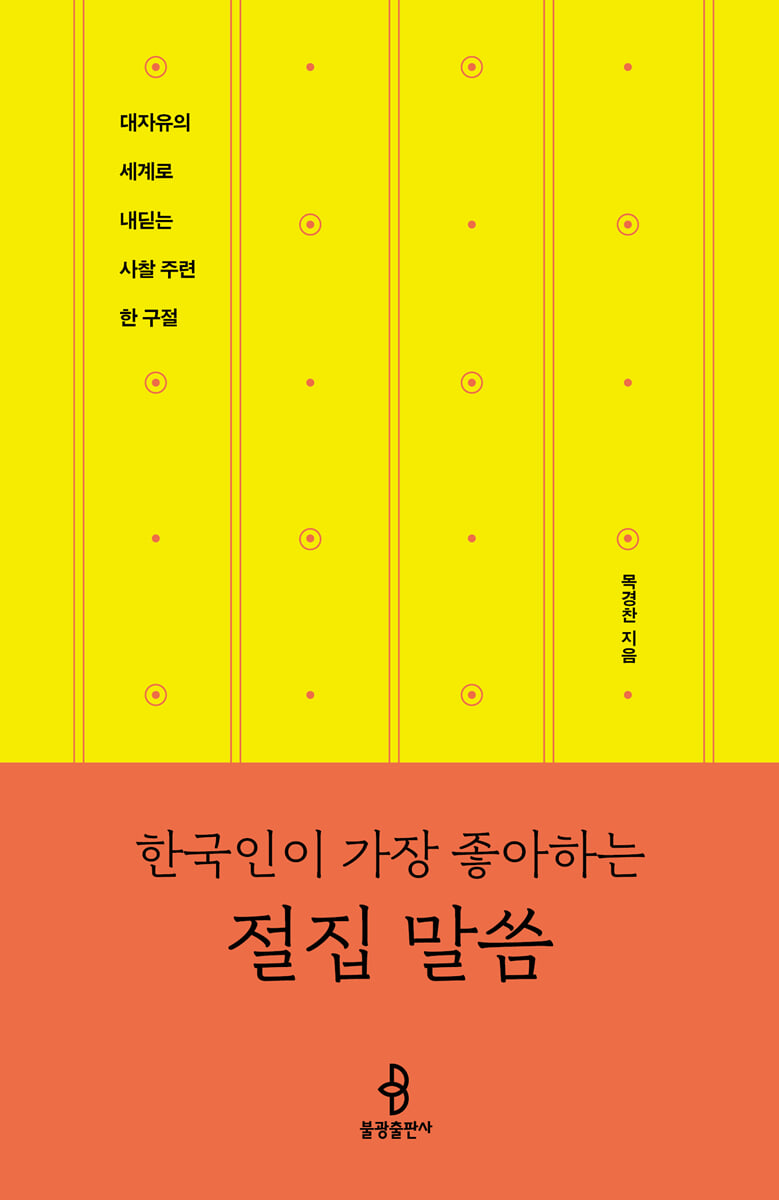
Koreans' favorite temple
 |
Description
Book Introduction
“There are many words that shake the heart,
“There are few words that capture the heart!”
A thousand years of wisdom that illuminates the dizzy mind,
Life's best-known sayings contained in temple pillars
We now live in an age overflowing with ‘words’.
Countless words and writings pour out and disappear every day, and people are constantly exposed to them.
But among all those words, it is difficult to find ones worth listening to.
In a society where everyone is obsessed with speaking, people spit out words without considering the listener, and the number of people who listen is gradually decreasing.
Sometimes, advice leaves a deep mark on someone's life.
Certainly, the number of words and writings has increased, but the number of strong words that support the heart and deep sentences that hold on to life is decreasing.
So how can we learn to listen and speak properly again? Where are the words we truly need to listen to?
"Koreans' Favorite Temple Words" begins with this very question and presents a new interpretation of the "pillar connection" engraved on the temple pillars.
This book selects only passages with long-standing insights from among the various Buddhist scriptures from temples across the country.
The practice of the Zhu Lien, which has calmed the minds of many practitioners, offers timeless wisdom to us living in today's chaotic world.
For those who are wandering, wondering 'Where should the center of my heart be?', this book will gift them time to reflect, away from the noise of everyday life, and face themselves.
“There are few words that capture the heart!”
A thousand years of wisdom that illuminates the dizzy mind,
Life's best-known sayings contained in temple pillars
We now live in an age overflowing with ‘words’.
Countless words and writings pour out and disappear every day, and people are constantly exposed to them.
But among all those words, it is difficult to find ones worth listening to.
In a society where everyone is obsessed with speaking, people spit out words without considering the listener, and the number of people who listen is gradually decreasing.
Sometimes, advice leaves a deep mark on someone's life.
Certainly, the number of words and writings has increased, but the number of strong words that support the heart and deep sentences that hold on to life is decreasing.
So how can we learn to listen and speak properly again? Where are the words we truly need to listen to?
"Koreans' Favorite Temple Words" begins with this very question and presents a new interpretation of the "pillar connection" engraved on the temple pillars.
This book selects only passages with long-standing insights from among the various Buddhist scriptures from temples across the country.
The practice of the Zhu Lien, which has calmed the minds of many practitioners, offers timeless wisdom to us living in today's chaotic world.
For those who are wandering, wondering 'Where should the center of my heart be?', this book will gift them time to reflect, away from the noise of everyday life, and face themselves.
- You can preview some of the book's contents.
Preview
index
ㆍEntering.
Even a single passing phrase has merit.
Chapter 1.
The first gate of the mountain temple, the threshold of the Buddha's world
- When you enter this door, do not have any knowledge.
- We must be harmonious and disciplined.
- The things you covet and accumulate become dust overnight.
- Always now
- From heart to heart
- Praise the prudence of the defense that fills the air
- There are many types of care and each has its own appearance.
- O venerable ones, please help us to make the Buddha land auspicious.
- The gods defend the Buddha with supernatural powers and wondrous abilities.
- The Four Heavenly Kings, who travel the world, inflicting punishment and disaster.
- Indra, taking pity on living beings
- Go to Bodhi Doryang and ascend to the Vajra Throne.
- Repent for past, present, and future mistakes
- The sutras are the teachings that come from the heart.
- Everything is created by the mind alone.
- The sound of the bell spreads throughout the world
- All worries disappear when you hear the bell.
- My heart is already in the Western Paradise
- The sound of the temple bell purifies the body and mind.
- Transform into a new path for you and me
Chapter 2.
A temple centered on Buddha
- The true sarira is still preserved as is.
- The merits of the Jinshin sarira are passed down.
- Showing Nirvana through expedient means
- Don't look at your fingers, look at the moon.
- Find the Geumgang Stairs while walking along the Geumgang Stairs
- There is no one like Buddha in the sky above or below the sky.
- All Buddhas are great heroes.
- A thousand moons rise over a thousand rivers
- Even if you try to catch the moon reflected in the water
- Always sit on the seat of the Bodhi tree
- All Buddhas have the same merits.
- All adults attend the Dharma assembly
- Depending on the relationship, it can be blue or yellow
- Like a lotus flower, like the sky in the world
- The Buddha attained enlightenment a long time ago.
- Even if I drink all the sea water and catch the wind
- The west wind shakes the forest and geese cry.
- The Buddha's body radiates great light widely.
- The clarity is so great that the light is bright
- The world of Avatamsaka Sutra is now everywhere
- Where is Amitabha Buddha?
Amitabha, the Buddha of infinite life and infinite light
- If you pray to Amitabha Buddha even once, you will go to paradise.
- How many times have you seen a crane's head red?
- Achieve boundless merit in an instant
- The basis of all practice is letting go of thoughts.
- The three worlds are like a gourd in a well.
- May I and others attain enlightenment at the same time.
- Medicine Buddha in the full moon world of the Pure Land of the East
- Welcoming rebirth as a member of the Twelve
- Maitreya Bodhisattva, the one-lifetime Bodhisattva
- Maitreya Buddha coming 5.67 billion years later
- Maitreya Bodhisattva, who came to the human world for a moment today
- Just as a thousand suns illuminate the three thousand great thousand worlds
- A thousand Buddhas appear for the sake of sentient beings.
Chapter 3.
A temple centered on the Bodhisattva
- Avalokitesvara Bodhisattva on Mount Potala
- It is decorated with a crown and wears white clothes.
- When you call on Avalokitesvara Bodhisattva, she sprinkles sweet dew.
- Namsun-dongja listens to the sermon of Avalokitesvara Bodhisattva
- Avalokitesvara Bodhisattva is right next to you.
- … Bodhisattva Avalokitesvara Bodhisattva Avalokitesvara…
- The power of Ksitigarbha Bodhisattva cannot be expressed in words.
- The vow of Ksitigarbha Bodhisattva never ends.
- Open the gates of hell with a stone
- Approach Ksitigarbha Bodhisattva and he will respond.
- When will the teachings of Ksitigarbha Bodhisattva end?
- The King of Hell looks upon humanity with a bright light.
- Manjushri Bodhisattva, the foremost of the Bodhisattvas with great wisdom
- Manjusri Bodhisattva, the Great Earthly Being, Samantabhadra Bodhisattva
- Jeon Sam Sam Hu Sam Sam
- A face that doesn't show anger is a true offering.
Chapter 4.
A temple where the Buddha's teachings breathe
- News that spreads throughout the three thousand great thousand worlds
- He still preaches at Yeongchuksan Mountain
- Sixteen Arhats attend the Buddha.
- As the moon reflects on a thousand rivers
- Returning with an empty boat full of moonlight
- How can Venerable Kasyapa convey this?
- Arahan is a field of blessings
- Repaying Buddha's grace by spreading the Dharma
- I dedicate the merits of the scriptures to you.
- There are eight thousand Tripitaka Koreana according to the basis of living beings.
- Six thousand volumes of sutras are here.
- The original angle is right here where life and death occur.
- What does the investigation from the west mean?
- Cheongsan is always a spring of fear.
Chapter 5.
A temple where the faith of this land lives
- Chilseong extends life
- Like the moon reflected in the river, I am moved by fate
- Emperor Jamidae, who commands many saints
- The supernatural powers of Venerable Naban are rare in the world.
- Riding on clouds and cranes to save sentient beings
- I will become a mountain god and watch over this temple.
- The Dragon King sends down rain clouds
Chapter 6.
Ask and answer questions on the spot
- This is the place where Buddha is chosen.
- To enter the Buddha's emptiness
- I would rather give up my life than break the precepts.
- If you learn the Tao, it will be like the first time
- The strong brain cannot hide its sound.
- How could the Dharma have been preached before?
- Even if I become a cow, there is no place to pierce my nostrils.
- Smile when you give her flowers
- It's strangely there in the midst of emptiness
- Who am I?
- Wherever a man goes, his hometown is his hometown.
- Snowflakes in the hearth fire, dew in the sun.
- The sky is a blanket, the ground is a bed, and the mountain is a pillow
- Don't waste this life.
Faith is the first of virtues and the mother of virtues.
Even a single passing phrase has merit.
Chapter 1.
The first gate of the mountain temple, the threshold of the Buddha's world
- When you enter this door, do not have any knowledge.
- We must be harmonious and disciplined.
- The things you covet and accumulate become dust overnight.
- Always now
- From heart to heart
- Praise the prudence of the defense that fills the air
- There are many types of care and each has its own appearance.
- O venerable ones, please help us to make the Buddha land auspicious.
- The gods defend the Buddha with supernatural powers and wondrous abilities.
- The Four Heavenly Kings, who travel the world, inflicting punishment and disaster.
- Indra, taking pity on living beings
- Go to Bodhi Doryang and ascend to the Vajra Throne.
- Repent for past, present, and future mistakes
- The sutras are the teachings that come from the heart.
- Everything is created by the mind alone.
- The sound of the bell spreads throughout the world
- All worries disappear when you hear the bell.
- My heart is already in the Western Paradise
- The sound of the temple bell purifies the body and mind.
- Transform into a new path for you and me
Chapter 2.
A temple centered on Buddha
- The true sarira is still preserved as is.
- The merits of the Jinshin sarira are passed down.
- Showing Nirvana through expedient means
- Don't look at your fingers, look at the moon.
- Find the Geumgang Stairs while walking along the Geumgang Stairs
- There is no one like Buddha in the sky above or below the sky.
- All Buddhas are great heroes.
- A thousand moons rise over a thousand rivers
- Even if you try to catch the moon reflected in the water
- Always sit on the seat of the Bodhi tree
- All Buddhas have the same merits.
- All adults attend the Dharma assembly
- Depending on the relationship, it can be blue or yellow
- Like a lotus flower, like the sky in the world
- The Buddha attained enlightenment a long time ago.
- Even if I drink all the sea water and catch the wind
- The west wind shakes the forest and geese cry.
- The Buddha's body radiates great light widely.
- The clarity is so great that the light is bright
- The world of Avatamsaka Sutra is now everywhere
- Where is Amitabha Buddha?
Amitabha, the Buddha of infinite life and infinite light
- If you pray to Amitabha Buddha even once, you will go to paradise.
- How many times have you seen a crane's head red?
- Achieve boundless merit in an instant
- The basis of all practice is letting go of thoughts.
- The three worlds are like a gourd in a well.
- May I and others attain enlightenment at the same time.
- Medicine Buddha in the full moon world of the Pure Land of the East
- Welcoming rebirth as a member of the Twelve
- Maitreya Bodhisattva, the one-lifetime Bodhisattva
- Maitreya Buddha coming 5.67 billion years later
- Maitreya Bodhisattva, who came to the human world for a moment today
- Just as a thousand suns illuminate the three thousand great thousand worlds
- A thousand Buddhas appear for the sake of sentient beings.
Chapter 3.
A temple centered on the Bodhisattva
- Avalokitesvara Bodhisattva on Mount Potala
- It is decorated with a crown and wears white clothes.
- When you call on Avalokitesvara Bodhisattva, she sprinkles sweet dew.
- Namsun-dongja listens to the sermon of Avalokitesvara Bodhisattva
- Avalokitesvara Bodhisattva is right next to you.
- … Bodhisattva Avalokitesvara Bodhisattva Avalokitesvara…
- The power of Ksitigarbha Bodhisattva cannot be expressed in words.
- The vow of Ksitigarbha Bodhisattva never ends.
- Open the gates of hell with a stone
- Approach Ksitigarbha Bodhisattva and he will respond.
- When will the teachings of Ksitigarbha Bodhisattva end?
- The King of Hell looks upon humanity with a bright light.
- Manjushri Bodhisattva, the foremost of the Bodhisattvas with great wisdom
- Manjusri Bodhisattva, the Great Earthly Being, Samantabhadra Bodhisattva
- Jeon Sam Sam Hu Sam Sam
- A face that doesn't show anger is a true offering.
Chapter 4.
A temple where the Buddha's teachings breathe
- News that spreads throughout the three thousand great thousand worlds
- He still preaches at Yeongchuksan Mountain
- Sixteen Arhats attend the Buddha.
- As the moon reflects on a thousand rivers
- Returning with an empty boat full of moonlight
- How can Venerable Kasyapa convey this?
- Arahan is a field of blessings
- Repaying Buddha's grace by spreading the Dharma
- I dedicate the merits of the scriptures to you.
- There are eight thousand Tripitaka Koreana according to the basis of living beings.
- Six thousand volumes of sutras are here.
- The original angle is right here where life and death occur.
- What does the investigation from the west mean?
- Cheongsan is always a spring of fear.
Chapter 5.
A temple where the faith of this land lives
- Chilseong extends life
- Like the moon reflected in the river, I am moved by fate
- Emperor Jamidae, who commands many saints
- The supernatural powers of Venerable Naban are rare in the world.
- Riding on clouds and cranes to save sentient beings
- I will become a mountain god and watch over this temple.
- The Dragon King sends down rain clouds
Chapter 6.
Ask and answer questions on the spot
- This is the place where Buddha is chosen.
- To enter the Buddha's emptiness
- I would rather give up my life than break the precepts.
- If you learn the Tao, it will be like the first time
- The strong brain cannot hide its sound.
- How could the Dharma have been preached before?
- Even if I become a cow, there is no place to pierce my nostrils.
- Smile when you give her flowers
- It's strangely there in the midst of emptiness
- Who am I?
- Wherever a man goes, his hometown is his hometown.
- Snowflakes in the hearth fire, dew in the sun.
- The sky is a blanket, the ground is a bed, and the mountain is a pillow
- Don't waste this life.
Faith is the first of virtues and the mother of virtues.
Detailed image

Into the book
One's own knowledge or opinion is called 'knowledge'.
If you are full of knowledge, it is not easy to accept other teachings.
If you want to attain the great path of Buddha's teachings, you must empty yourself.
If you are full of the idea that you know everything, what will come in?
When you empty yourself and become empty, you are filled with great teachings.
--- p.21
The Gate of Liberation is the last gate of the mountain temple, and is also called the Gate of the Two.
'Fire' is the place where all discrimination has disappeared, the place where all the troubles caused by delusion have disappeared, and it is the realm of enlightenment.
It is called liberation because it frees one from all delusions and ignorance.
When you enter this gate, you enter the world of the non-duality of the Dharma, the world of enlightenment, the land of the Buddha, the Pure Land of Buddha.
--- p.46
If you do not allow your thoughts about the past, present, or future to be tainted by foolishness, lies, and jealousy, and if you immediately and forever cut off all your past evil deeds and eliminate them from your nature, then this is repentance.
Repentance is not only regretting past mistakes, but also avoiding future mistakes.
Realizing one's true nature through this kind of repentance is 'true repentance.'
--- p.50
Although belief is important, it is problematic to believe unconditionally and assume something is true.
Because blind faith breeds foolishness.
The old master emphasizes great doubt along with great faith.
(…) It is the same when encountering the Buddha’s teachings.
I thought it was the Buddha's teachings, but as I studied it, I realized it might not be the Buddha's teachings.
This is why, based on the premise of faith, we need to ask ourselves questions like 'why' and 'really'.
--- p.56
The path of Buddhist practice that we walk is initially a practice for myself, but naturally changes into a practice for you and me.
It is the practice of walking the path of a bodhisattva.
Bodhisattva is a shortened form of Bodhisattva.
Barley is ‘enlightenment’, and salt is ‘being’ and ‘beings’.
Therefore, a bodhisattva is a ‘sentient being with enlightenment’, a ‘being seeking enlightenment’, and a ‘one who seeks enlightenment [self-benefit] and strives to save other beings [benefit others].’
--- p.69
In fact, the truth itself cannot be defined by form, language, or anything else, so the Dharmakaya cannot appear in form.
So, he shows himself in the form of an incarnation, with compassion for all living beings.
So the Buddha who appears in appearance is not true.
It just appeared as a predestined connection for rebirth.
The body and the incarnation are like the moon reflected in a thousand rivers.
Just as a thousand miles are blue when there are no clouds, if our minds are free of delusions and afflictions, it is pure Dharmakaya.
--- p.92~93
A unique lotus flower blooms at Janggyeonggak in Haeinsa Temple.
The threshold leading into the central passage of the Sudarajjang is slightly rounded, and the rounded shape of the threshold and the roof tiles blend with the sunlight, creating a lotus flower of light and shadow on the floor of the central passage.
The worshipper naturally steps on the lotus flower and enters the Buddha's land.
At this time, the lotus flower symbolizes the Buddha's country.
Just as we are born into paradise through a lotus flower, we enter the Buddha's land through a lotus flower.
This is the teaching that this is the Buddha's land, paradise.
If you are full of knowledge, it is not easy to accept other teachings.
If you want to attain the great path of Buddha's teachings, you must empty yourself.
If you are full of the idea that you know everything, what will come in?
When you empty yourself and become empty, you are filled with great teachings.
--- p.21
The Gate of Liberation is the last gate of the mountain temple, and is also called the Gate of the Two.
'Fire' is the place where all discrimination has disappeared, the place where all the troubles caused by delusion have disappeared, and it is the realm of enlightenment.
It is called liberation because it frees one from all delusions and ignorance.
When you enter this gate, you enter the world of the non-duality of the Dharma, the world of enlightenment, the land of the Buddha, the Pure Land of Buddha.
--- p.46
If you do not allow your thoughts about the past, present, or future to be tainted by foolishness, lies, and jealousy, and if you immediately and forever cut off all your past evil deeds and eliminate them from your nature, then this is repentance.
Repentance is not only regretting past mistakes, but also avoiding future mistakes.
Realizing one's true nature through this kind of repentance is 'true repentance.'
--- p.50
Although belief is important, it is problematic to believe unconditionally and assume something is true.
Because blind faith breeds foolishness.
The old master emphasizes great doubt along with great faith.
(…) It is the same when encountering the Buddha’s teachings.
I thought it was the Buddha's teachings, but as I studied it, I realized it might not be the Buddha's teachings.
This is why, based on the premise of faith, we need to ask ourselves questions like 'why' and 'really'.
--- p.56
The path of Buddhist practice that we walk is initially a practice for myself, but naturally changes into a practice for you and me.
It is the practice of walking the path of a bodhisattva.
Bodhisattva is a shortened form of Bodhisattva.
Barley is ‘enlightenment’, and salt is ‘being’ and ‘beings’.
Therefore, a bodhisattva is a ‘sentient being with enlightenment’, a ‘being seeking enlightenment’, and a ‘one who seeks enlightenment [self-benefit] and strives to save other beings [benefit others].’
--- p.69
In fact, the truth itself cannot be defined by form, language, or anything else, so the Dharmakaya cannot appear in form.
So, he shows himself in the form of an incarnation, with compassion for all living beings.
So the Buddha who appears in appearance is not true.
It just appeared as a predestined connection for rebirth.
The body and the incarnation are like the moon reflected in a thousand rivers.
Just as a thousand miles are blue when there are no clouds, if our minds are free of delusions and afflictions, it is pure Dharmakaya.
--- p.92~93
A unique lotus flower blooms at Janggyeonggak in Haeinsa Temple.
The threshold leading into the central passage of the Sudarajjang is slightly rounded, and the rounded shape of the threshold and the roof tiles blend with the sunlight, creating a lotus flower of light and shadow on the floor of the central passage.
The worshipper naturally steps on the lotus flower and enters the Buddha's land.
At this time, the lotus flower symbolizes the Buddha's country.
Just as we are born into paradise through a lotus flower, we enter the Buddha's land through a lotus flower.
This is the teaching that this is the Buddha's land, paradise.
--- p.236~237
Publisher's Review
An era where thoughts have stopped,
Awakening the thoughts that sleep within us
New classic 'Julyeon'
“It’s been in the same place for a long time,
“There is a reason to wait and see!”
In this fast-changing and easily forgotten modern world, those burdened by this rapid pace of change have at some point begun to seek unwavering standards of living within the "classics." On social media, passages from Confucius, Schopenhauer, and Nietzsche have been circulated as short, aphoristic quotes, and even movements to restore balance in daily life by copying passages from the classics have emerged.
Classics, once considered outdated texts, are now a steadfast support system, teaching people living in complex modern times the path to deep thought and reflection.
In this context, 『Koreans' Favorite Temple Sayings』 illuminates the traditional language of 'Julyeon' as a new classic.
For hundreds of years, the Juyeon, which has hung on the pillars of temples and supported the minds of practitioners, has consistently asked fundamental questions such as, "Who am I?" and "How should I live?"
This book opens the floodgates of thought, allowing us to re-establish the center of our minds that has been disturbed in the process of looking into the wisdom contained in these short passages.
In a world where it's easy to get lost, Ju-ryun guides us through time, helping us face ourselves, organize our inner selves, and determine the direction we should take.
So how does this book convey those ancient words of wisdom to us today?
The moment you turn the page, it unfolds
A temple in my hand!
"Koreans' Favorite Temple Sayings" does not simply introduce beautiful sentences or interpret their meanings.
This book is organized according to the spatial structure of an actual temple, starting from the first gate of the mountain temple, 'Iljumun', to the 'Cheonwangmun' guarded by the Four Heavenly Kings, and the central main hall, 'Daeungjeon', and then to 'Gwaneumjeon' or 'Ksitigarbhajeon', and finally to 'Daebang', the public training center, with various content arranged in a series of exercises according to the flow of the temple.
When explaining each of the main characters, he also pointed out the symbolism of the building and its social and cultural context, leading us to understand the meaning of each character more deeply.
Above all, the passages in this book demonstrate the various possibilities for use as guidelines for restoring balance in our daily lives.
Reading a simple, core scripture in the morning to set the mood for the day, or writing it down before bed to memorize its meaning, provides time to face oneself and refine one's inner self.
If we share and converse with family and friends about sentences that resonate with us, we may be able to practice proper speaking and listening, skills we have forgotten in this noisy world.
In this way, "Koreans' Favorite Temple Sayings" will serve as a solid pillar for those who, in today's world where words have become lighter, wish to revisit the language that organizes their inner selves and maintain their own center.
Awakening the thoughts that sleep within us
New classic 'Julyeon'
“It’s been in the same place for a long time,
“There is a reason to wait and see!”
In this fast-changing and easily forgotten modern world, those burdened by this rapid pace of change have at some point begun to seek unwavering standards of living within the "classics." On social media, passages from Confucius, Schopenhauer, and Nietzsche have been circulated as short, aphoristic quotes, and even movements to restore balance in daily life by copying passages from the classics have emerged.
Classics, once considered outdated texts, are now a steadfast support system, teaching people living in complex modern times the path to deep thought and reflection.
In this context, 『Koreans' Favorite Temple Sayings』 illuminates the traditional language of 'Julyeon' as a new classic.
For hundreds of years, the Juyeon, which has hung on the pillars of temples and supported the minds of practitioners, has consistently asked fundamental questions such as, "Who am I?" and "How should I live?"
This book opens the floodgates of thought, allowing us to re-establish the center of our minds that has been disturbed in the process of looking into the wisdom contained in these short passages.
In a world where it's easy to get lost, Ju-ryun guides us through time, helping us face ourselves, organize our inner selves, and determine the direction we should take.
So how does this book convey those ancient words of wisdom to us today?
The moment you turn the page, it unfolds
A temple in my hand!
"Koreans' Favorite Temple Sayings" does not simply introduce beautiful sentences or interpret their meanings.
This book is organized according to the spatial structure of an actual temple, starting from the first gate of the mountain temple, 'Iljumun', to the 'Cheonwangmun' guarded by the Four Heavenly Kings, and the central main hall, 'Daeungjeon', and then to 'Gwaneumjeon' or 'Ksitigarbhajeon', and finally to 'Daebang', the public training center, with various content arranged in a series of exercises according to the flow of the temple.
When explaining each of the main characters, he also pointed out the symbolism of the building and its social and cultural context, leading us to understand the meaning of each character more deeply.
Above all, the passages in this book demonstrate the various possibilities for use as guidelines for restoring balance in our daily lives.
Reading a simple, core scripture in the morning to set the mood for the day, or writing it down before bed to memorize its meaning, provides time to face oneself and refine one's inner self.
If we share and converse with family and friends about sentences that resonate with us, we may be able to practice proper speaking and listening, skills we have forgotten in this noisy world.
In this way, "Koreans' Favorite Temple Sayings" will serve as a solid pillar for those who, in today's world where words have become lighter, wish to revisit the language that organizes their inner selves and maintain their own center.
GOODS SPECIFICS
- Date of issue: July 28, 2025
- Page count, weight, size: 304 pages | 366g | 131*200*19mm
- ISBN13: 9791172611842
- ISBN10: 117261184X
You may also like
카테고리
korean


korean

![GQ KOREA Mark (Monthly): December [2025]](http://librairie.coreenne.fr/cdn/shop/files/8ef265dbbfbf186523ed75ba7319009d.jpg?v=1765340328&width=3840)


