

The Birth of a Class
 |
Description
Book Introduction
This book introduces to the world the special aspects of school life that everyone experiences, in a serious yet lighthearted way.
The author's own structuring, while unfolding the story of the classroom not from a methodological perspective but as a life story, transforms the vague place called the classroom into a space where everyone can come together.
The most notable feature of this book is that it clearly shows how children grow up.
The author's own structuring, while unfolding the story of the classroom not from a methodological perspective but as a life story, transforms the vague place called the classroom into a space where everyone can come together.
The most notable feature of this book is that it clearly shows how children grow up.
- You can preview some of the book's contents.
Preview
index
Prologue: The Birth of a Class
Part 1.
Encounter: The Beginning of Everything
1.
The moment of first meeting and acceptance
2.
The Month of March: The Month to Do Everything
Part 2.
Us: The Foundation of the Class
1.
The warmth of the word 'we'
2.
Meaning of communication: respect, do your best
Part 3.
Language: The teacher's language
1.
Teacher, please speak clearly
2.
Sorry and Regret: Let's Distinguish Between Sorry and Regret
3.
Human Rights and Respect: Let's Think Respect, Not Rights
4.
Freedom and Autonomy: What We Need Is Autonomy
5.
Command and Persuasion: Building Relationships Through Persuasion
6.
Will and Compassion: Keeping Promises is a Compassionate Heart
7.
Bad and Fit: Let's act appropriately for the situation.
8.
Fear and Strictness: Strictness Brings Growth
Part 4.
Courage: Education Without Cowardice
1.
The opposite of courage is thoughtlessness.
2.
Learn through class!
3.
The essence of 'play' is risk and creativity.
4.
Reflecting on myself through courage
Part 5.
Time: The Aesthetics of Waiting
1.
Waiting, a series of moments
2.
Happiness and satisfaction are divided by waiting.
3.
Learn to live efficiently
4.
Ability is about consistency
5.
Children's Depression vs. Children's Survival
Part 6.
Class: Class meets class
1.
Class life deepens with lessons
2.
[Class Life and Class Project 1] Friends and Courage
3.
[Classroom Life and Class Project 2] Developing a Sense of the "Now"
4.
[Classroom Life and Class Project 3] Now and the Best: Two Sides of the Same Coin
5.
[Class Life and Class Project 4] Failure is also a lesson.
6.
[Classroom Life and Class Project 5] Courage for Collaborative Teaching
|Epilogue|A grateful heart: Thank you, thank you, thank you
Part 1.
Encounter: The Beginning of Everything
1.
The moment of first meeting and acceptance
2.
The Month of March: The Month to Do Everything
Part 2.
Us: The Foundation of the Class
1.
The warmth of the word 'we'
2.
Meaning of communication: respect, do your best
Part 3.
Language: The teacher's language
1.
Teacher, please speak clearly
2.
Sorry and Regret: Let's Distinguish Between Sorry and Regret
3.
Human Rights and Respect: Let's Think Respect, Not Rights
4.
Freedom and Autonomy: What We Need Is Autonomy
5.
Command and Persuasion: Building Relationships Through Persuasion
6.
Will and Compassion: Keeping Promises is a Compassionate Heart
7.
Bad and Fit: Let's act appropriately for the situation.
8.
Fear and Strictness: Strictness Brings Growth
Part 4.
Courage: Education Without Cowardice
1.
The opposite of courage is thoughtlessness.
2.
Learn through class!
3.
The essence of 'play' is risk and creativity.
4.
Reflecting on myself through courage
Part 5.
Time: The Aesthetics of Waiting
1.
Waiting, a series of moments
2.
Happiness and satisfaction are divided by waiting.
3.
Learn to live efficiently
4.
Ability is about consistency
5.
Children's Depression vs. Children's Survival
Part 6.
Class: Class meets class
1.
Class life deepens with lessons
2.
[Class Life and Class Project 1] Friends and Courage
3.
[Classroom Life and Class Project 2] Developing a Sense of the "Now"
4.
[Classroom Life and Class Project 3] Now and the Best: Two Sides of the Same Coin
5.
[Class Life and Class Project 4] Failure is also a lesson.
6.
[Classroom Life and Class Project 5] Courage for Collaborative Teaching
|Epilogue|A grateful heart: Thank you, thank you, thank you
Detailed image
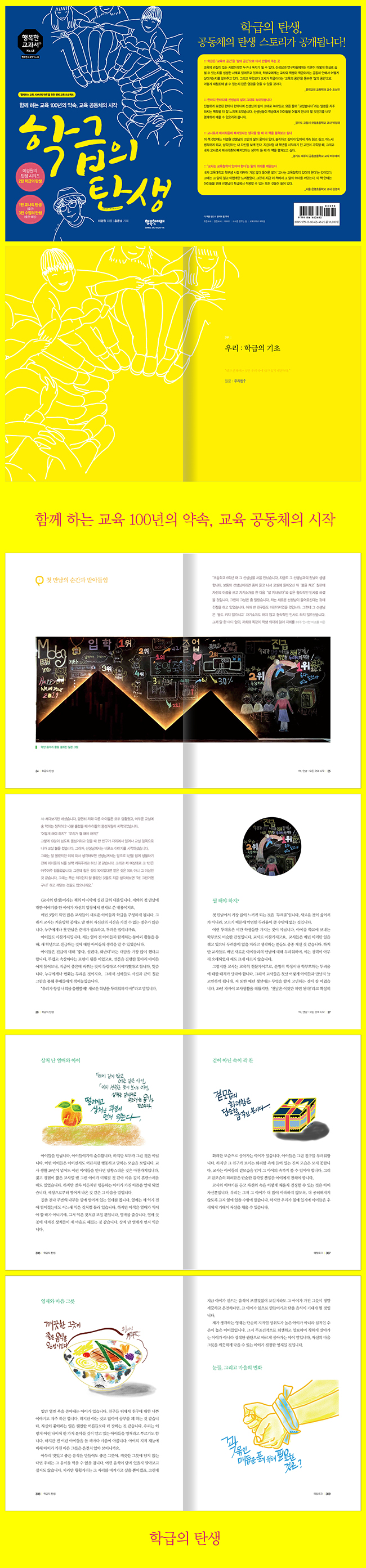
Into the book
If we slightly peel back the thick-looking skin of unfamiliarity, we will find countless warm and soft emotions and imaginary entities waiting for us, hidden within.
And there might be something hidden there, something we all know so well: hope.
---From "Prologue?: The Birth of a Class"
The change in my thinking that I discovered that way was ‘acceptance.’
It doesn't matter what kind of children I meet.
It doesn't matter how these guys were last year.
I just thought, 'Let's accept things as they are!'
If you're afraid of first meetings, embrace that fear.
When I thought about it that way, I felt at ease and even a sense of freedom welled up in me.
---「Part 1.
From "Encounter: The Beginning of Everything"
The classroom should be a space where the teacher's life and the children's life are intertwined, not a simple place where the teacher and the children are separated and tied together by a system.
A place can exist anywhere, but space only exists when the meaning of a community called 'us' is formed.
---「Part 1.
From "Encounter: The Beginning of Everything"
The same goes for school.
Every citizen of our country has the right to go to school and receive an education.
However, the right to education does not mean the right to do whatever one wants with the teachers and schools responsible for education.
You have no right to infringe upon the educational rights of your friends who come to school to exercise the same rights as you.
The important thing is to look at others with respect, no matter the situation.
Even if you don't go as far as to show consideration.
Otherwise, we would be exercising our rights and committing violence against other beings.
---「Part 3.
From "Speech: The Teacher's Language"
"I think it takes courage for a teacher to say that he knows what he knows and to say that he doesn't know what he doesn't know.
I hope you all live courageous lives.
I hope you become a truly courageous person who doesn't pretend to know when you don't, or who doesn't pretend not to know when you do."
---「Part 4.
From “Courage: Education Without Cowardice”
One of the key points of the 'Me, You and Us' class is introducing yourself.
And that class is the 'Now I'm Talking~' class.
In a typical sized class, you would introduce yourself at the beginning of the year.
At this time, classes are often conducted primarily as play-based classes, with the hope of making friends.
It's about memorizing names or sharing what you like and are good at through play.
I, too, have been doing these activities every year because I believe they are meaningful.
But there were also some regrets.
Because beyond just getting to know each other, we want each child to know who they are, to think more about their current needs, and what it means to be with us.
And there might be something hidden there, something we all know so well: hope.
---From "Prologue?: The Birth of a Class"
The change in my thinking that I discovered that way was ‘acceptance.’
It doesn't matter what kind of children I meet.
It doesn't matter how these guys were last year.
I just thought, 'Let's accept things as they are!'
If you're afraid of first meetings, embrace that fear.
When I thought about it that way, I felt at ease and even a sense of freedom welled up in me.
---「Part 1.
From "Encounter: The Beginning of Everything"
The classroom should be a space where the teacher's life and the children's life are intertwined, not a simple place where the teacher and the children are separated and tied together by a system.
A place can exist anywhere, but space only exists when the meaning of a community called 'us' is formed.
---「Part 1.
From "Encounter: The Beginning of Everything"
The same goes for school.
Every citizen of our country has the right to go to school and receive an education.
However, the right to education does not mean the right to do whatever one wants with the teachers and schools responsible for education.
You have no right to infringe upon the educational rights of your friends who come to school to exercise the same rights as you.
The important thing is to look at others with respect, no matter the situation.
Even if you don't go as far as to show consideration.
Otherwise, we would be exercising our rights and committing violence against other beings.
---「Part 3.
From "Speech: The Teacher's Language"
"I think it takes courage for a teacher to say that he knows what he knows and to say that he doesn't know what he doesn't know.
I hope you all live courageous lives.
I hope you become a truly courageous person who doesn't pretend to know when you don't, or who doesn't pretend not to know when you do."
---「Part 4.
From “Courage: Education Without Cowardice”
One of the key points of the 'Me, You and Us' class is introducing yourself.
And that class is the 'Now I'm Talking~' class.
In a typical sized class, you would introduce yourself at the beginning of the year.
At this time, classes are often conducted primarily as play-based classes, with the hope of making friends.
It's about memorizing names or sharing what you like and are good at through play.
I, too, have been doing these activities every year because I believe they are meaningful.
But there were also some regrets.
Because beyond just getting to know each other, we want each child to know who they are, to think more about their current needs, and what it means to be with us.
---「Part 6.
Class: From “Class and Class Encounter”
Class: From “Class and Class Encounter”
Publisher's Review
[Class Life] The Beginning of an Educational Community
“Is a manual what we need in our lives?”
When you do something for the first time, you encounter unfamiliarity.
If you can't properly overcome the feeling of unfamiliarity, you may experience fear.
The same goes for children.
When children first enter school or move up to a new grade, they often feel a mixture of unfamiliarity and fear.
Teachers are no exception.
Meeting a new grade or class is a difficult moment for anyone.
In times like these, what we often look for when we think we can easily get help may be a 'manual'.
If you find a special manual, that alone will give you peace of mind.
And as these manuals become more common, they become institutionalized.
However, if you proceed according to the manual, problems will start to arise.
When something happens that isn't covered in the manual, you're left wondering how to deal with it.
Can human life really be completely solved through manuals and institutional systems?
“Isn’t philosophy what we need in our lives?”
No matter how detailed the manual is, you can't solve everything with just the manual.
I don't think you can build friendships with just a manual.
Even in friendships, if you don't react more sensitively to the momentary events and deal with them with your own philosophy, every moment will be difficult.
The same goes for life in the classroom.
I don't think that a classroom is a place that is particularly run by manuals.
I think that while a manual is sometimes necessary, it should have a philosophical root within it.
So, rather than using the terms ‘classroom management’ or ‘classroom operation,’ I think it would be better to say ‘living in the classroom,’ or ‘classroom life.’
This book discusses the philosophy necessary for 'classroom life', which was the most central aspect of living with children.
This is not a 'special philosophy' of a 'special teacher', but a philosophy that is necessary for living in a classroom, for situations that anyone can encounter.
Philosophy is also needed to live in the classroom and have deeper encounters with children.
The birth of a community called a class
As our society becomes more specialized and fragmented, human life seems to become lonelier.
I believe that in times like these, we need to emphasize “we” even more in education.
If we can think about what it means to live together as a class, I hope that it will become a great foundation for forming a 'community' in our society.
Education is not just about imparting and receiving knowledge from textbooks.
Education is a valuable resource that empowers us to determine the direction our society will take.
I believe that when 'community' is at the core of education, we can also achieve the 'democratic citizenship education' we desire.
I dream of a day when every school and class across the country lives as “us.”
A story about a teacher and children living in a classroom
This book introduces to the world the special aspects of school life that everyone experiences, in a serious yet lighthearted manner.
The author's own structuring, while unfolding the story of the classroom not from a methodological perspective but as a life story, transforms the vague place called the classroom into a space where everyone can come together.
The most notable feature of this book is that it clearly shows how children grow up.
The first step in [community] and democratic citizenship education is ‘school’ and ‘class.’
There has been a heated discussion recently about democratic citizenship education.
The world is responding to the idea that one of the ultimate goals of education is to enable people to become democratic citizens.
However, I do not believe that democratic citizens are created solely through special educational programs.
It can only be effective if democratic situations and decision-making are based on one's overall life.
In that sense, the various stories introduced in this book are helpful for democratic citizenship education.
This is a warm, yet detailed piece that tells us what words we should use to become a community, why we must have courage, and what time means to us.
The meaning of togetherness is fully reflected throughout the book, making it a great help to readers considering democratic citizenship education.
The [birth] of the teacher, the [birth] of the class, and the [birth] of the lesson
This book states that teachers are beings who communicate with the world through ‘classes.’
What our society demands of teachers is teaching.
However, the author argues that classes alone cannot fully fulfill the educational needs of teachers.
[Lee Kyung-won's Birth Series] The first installment, "The Birth of a Teacher," presented the meaning of living as a "teacher," while the second installment, "The Birth of a Class," explores what a "class" is like, and the final third installment, "The Birth of a Class," attempts to discuss how all of this manifests as a "class."
I am confident and hopeful that the author's efforts, although they may require a long period of time and effort, will play an important role in our education.
“Is a manual what we need in our lives?”
When you do something for the first time, you encounter unfamiliarity.
If you can't properly overcome the feeling of unfamiliarity, you may experience fear.
The same goes for children.
When children first enter school or move up to a new grade, they often feel a mixture of unfamiliarity and fear.
Teachers are no exception.
Meeting a new grade or class is a difficult moment for anyone.
In times like these, what we often look for when we think we can easily get help may be a 'manual'.
If you find a special manual, that alone will give you peace of mind.
And as these manuals become more common, they become institutionalized.
However, if you proceed according to the manual, problems will start to arise.
When something happens that isn't covered in the manual, you're left wondering how to deal with it.
Can human life really be completely solved through manuals and institutional systems?
“Isn’t philosophy what we need in our lives?”
No matter how detailed the manual is, you can't solve everything with just the manual.
I don't think you can build friendships with just a manual.
Even in friendships, if you don't react more sensitively to the momentary events and deal with them with your own philosophy, every moment will be difficult.
The same goes for life in the classroom.
I don't think that a classroom is a place that is particularly run by manuals.
I think that while a manual is sometimes necessary, it should have a philosophical root within it.
So, rather than using the terms ‘classroom management’ or ‘classroom operation,’ I think it would be better to say ‘living in the classroom,’ or ‘classroom life.’
This book discusses the philosophy necessary for 'classroom life', which was the most central aspect of living with children.
This is not a 'special philosophy' of a 'special teacher', but a philosophy that is necessary for living in a classroom, for situations that anyone can encounter.
Philosophy is also needed to live in the classroom and have deeper encounters with children.
The birth of a community called a class
As our society becomes more specialized and fragmented, human life seems to become lonelier.
I believe that in times like these, we need to emphasize “we” even more in education.
If we can think about what it means to live together as a class, I hope that it will become a great foundation for forming a 'community' in our society.
Education is not just about imparting and receiving knowledge from textbooks.
Education is a valuable resource that empowers us to determine the direction our society will take.
I believe that when 'community' is at the core of education, we can also achieve the 'democratic citizenship education' we desire.
I dream of a day when every school and class across the country lives as “us.”
A story about a teacher and children living in a classroom
This book introduces to the world the special aspects of school life that everyone experiences, in a serious yet lighthearted manner.
The author's own structuring, while unfolding the story of the classroom not from a methodological perspective but as a life story, transforms the vague place called the classroom into a space where everyone can come together.
The most notable feature of this book is that it clearly shows how children grow up.
The first step in [community] and democratic citizenship education is ‘school’ and ‘class.’
There has been a heated discussion recently about democratic citizenship education.
The world is responding to the idea that one of the ultimate goals of education is to enable people to become democratic citizens.
However, I do not believe that democratic citizens are created solely through special educational programs.
It can only be effective if democratic situations and decision-making are based on one's overall life.
In that sense, the various stories introduced in this book are helpful for democratic citizenship education.
This is a warm, yet detailed piece that tells us what words we should use to become a community, why we must have courage, and what time means to us.
The meaning of togetherness is fully reflected throughout the book, making it a great help to readers considering democratic citizenship education.
The [birth] of the teacher, the [birth] of the class, and the [birth] of the lesson
This book states that teachers are beings who communicate with the world through ‘classes.’
What our society demands of teachers is teaching.
However, the author argues that classes alone cannot fully fulfill the educational needs of teachers.
[Lee Kyung-won's Birth Series] The first installment, "The Birth of a Teacher," presented the meaning of living as a "teacher," while the second installment, "The Birth of a Class," explores what a "class" is like, and the final third installment, "The Birth of a Class," attempts to discuss how all of this manifests as a "class."
I am confident and hopeful that the author's efforts, although they may require a long period of time and effort, will play an important role in our education.
GOODS SPECIFICS
- Date of issue: March 27, 2020
- Page count, weight, size: 312 pages | 630g | 170*225*30mm
- ISBN13: 9791186463482
- ISBN10: 1186463481
You may also like
카테고리
korean


korean

![GQ KOREA Mark (Monthly): December [2025]](http://librairie.coreenne.fr/cdn/shop/files/8ef265dbbfbf186523ed75ba7319009d.jpg?v=1765340328&width=3840)


