

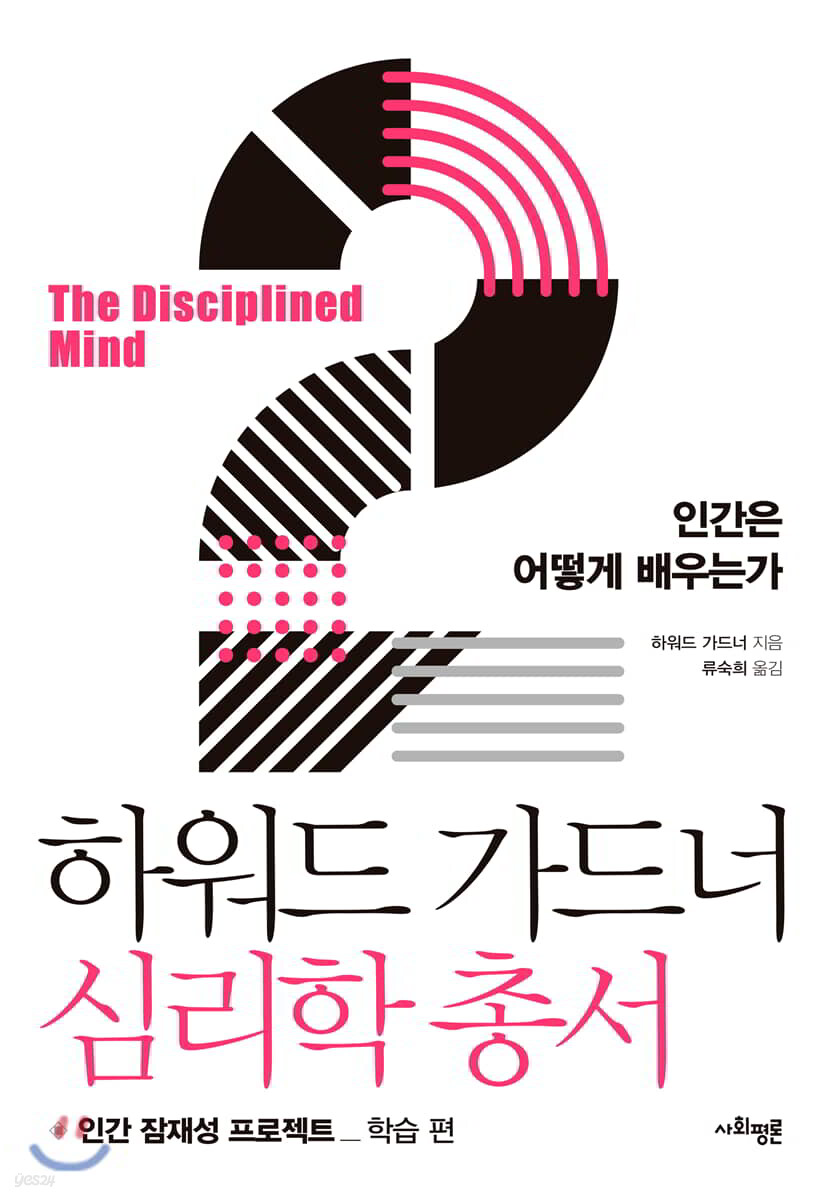
Howard Gardner's Psychology Series 2 - How We Learn
 |
Description
Book Introduction
"Howard Gardner Psychology Series 2: Learning - How Humans Learn" is the second volume of the "Howard Gardner Psychology Series," which compiles 30 years of research by Howard Gardner, the founder of the theory of multiple intelligences.
The Howard Gardner Psychology Series, which consists of three parts: Intelligence, Learning, Talent, Awakening, Practice, and Creativity, is a revised edition that systematically collects Gardner's writings and publishes them with consistent book covers and text editing.
Now, readers can gain a comprehensive and fundamental understanding of Gardnerian psychology, previously known only as the theory of multiple intelligences, through a more systematic reading experience through the six-volume series.
Gardner, who has been exploring the principles of learning to restore human potential and value for over 30 years, says in this book that we must learn and understand the world through truth, beauty, and goodness, and that education is the process of training the mind for that very 'understanding.'
In an age where education in modern society is becoming increasingly functional and the essential meaning of learning is fading, "How Humans Learn" awakens us to the true power and meaning of learning.
The Howard Gardner Psychology Series, which consists of three parts: Intelligence, Learning, Talent, Awakening, Practice, and Creativity, is a revised edition that systematically collects Gardner's writings and publishes them with consistent book covers and text editing.
Now, readers can gain a comprehensive and fundamental understanding of Gardnerian psychology, previously known only as the theory of multiple intelligences, through a more systematic reading experience through the six-volume series.
Gardner, who has been exploring the principles of learning to restore human potential and value for over 30 years, says in this book that we must learn and understand the world through truth, beauty, and goodness, and that education is the process of training the mind for that very 'understanding.'
In an age where education in modern society is becoming increasingly functional and the essential meaning of learning is fading, "How Humans Learn" awakens us to the true power and meaning of learning.
- You can preview some of the book's contents.
Preview
index
- Words of gratitude
Chapter 1: Education for All
There is good education for everyone.
Elements of a good education
About this book
Before reading this book
Chapter 2: What Doesn't Change in Education
Transmission of roles and values
The emergence of scholarship
Education of Truth, Goodness, and Beauty
The school's troubles continue
Chapter 3: Changing Education
Conservatism of educational institutions
A new trend for change
Crossroads in Education
Chapter 4: The Potential and Limitations of Brain Research
scientific knowledge and value judgments
The Age-Old Debate: Behaviorism vs. Trait Theory
Cognitive Revolution: A Direction for Education
From mind research to brain research
Seven Studies for Education
Limitations of brain research
Chapter 5: Culture Matters
The world's best kindergarten
Learning in Culture
Insights from Cultural Studies
Applying a cultural perspective
Finding other effective schools
Suzuki Learning and the Spectrum Classroom
Confucian Tradition and American Key Schools
Education around the world
School Vision
Chapter 6: Education for Understanding
The emergence of practical universities
false start
Education for 'understanding'
The difficulty of 'understanding'
Things that hinder 'understanding'
Academic thinking is important
Four Ways to Understand
Other factors that help with 'understanding'
Chapter 7 For Successful Education
Three riddles
From riddle to concept
Beyond Academics
To scientists and mathematicians, patterns are
What is beauty to an artist?
What is an explanation to a historian?
Which discipline should I choose?
Chapter 8: Exploring Three Cases
Three icebergs
Darwin's theory of evolution
Mozart's music
Holocaust
Qualities of a cultured person
Chapter 9: Understanding with Multiple Intelligences
Why Multiple Intelligences?
A starting point for a rich topic
Use analogies and metaphors
Expressing core ideas in a 'model language'
unresolved issues
The Art of Teaching
The Limits and Potential of Education for Understanding
Chapter 10: Educational Pathways for Understanding
Two scenarios
Choosing an Effective Education Path
The Role and Challenges of Interdisciplinary Curriculum
National-led and regional-led systems
Multiple paths
One path with diversity
Leadership Challenges
Achievements and Lessons Learned
Three helpful elements
The role of the company
Finding the right environment
Concluding Chapter 11
100 Years of Education and 100 Years of World History
My vision
A world worth striving for
Connect
- Review | A Tale of Two Cabins
- Translator's Note
- Appendix | A Trio of Conflicting Wills_Mozart, "The Marriage of Figaro"
- main
- Search
Chapter 1: Education for All
There is good education for everyone.
Elements of a good education
About this book
Before reading this book
Chapter 2: What Doesn't Change in Education
Transmission of roles and values
The emergence of scholarship
Education of Truth, Goodness, and Beauty
The school's troubles continue
Chapter 3: Changing Education
Conservatism of educational institutions
A new trend for change
Crossroads in Education
Chapter 4: The Potential and Limitations of Brain Research
scientific knowledge and value judgments
The Age-Old Debate: Behaviorism vs. Trait Theory
Cognitive Revolution: A Direction for Education
From mind research to brain research
Seven Studies for Education
Limitations of brain research
Chapter 5: Culture Matters
The world's best kindergarten
Learning in Culture
Insights from Cultural Studies
Applying a cultural perspective
Finding other effective schools
Suzuki Learning and the Spectrum Classroom
Confucian Tradition and American Key Schools
Education around the world
School Vision
Chapter 6: Education for Understanding
The emergence of practical universities
false start
Education for 'understanding'
The difficulty of 'understanding'
Things that hinder 'understanding'
Academic thinking is important
Four Ways to Understand
Other factors that help with 'understanding'
Chapter 7 For Successful Education
Three riddles
From riddle to concept
Beyond Academics
To scientists and mathematicians, patterns are
What is beauty to an artist?
What is an explanation to a historian?
Which discipline should I choose?
Chapter 8: Exploring Three Cases
Three icebergs
Darwin's theory of evolution
Mozart's music
Holocaust
Qualities of a cultured person
Chapter 9: Understanding with Multiple Intelligences
Why Multiple Intelligences?
A starting point for a rich topic
Use analogies and metaphors
Expressing core ideas in a 'model language'
unresolved issues
The Art of Teaching
The Limits and Potential of Education for Understanding
Chapter 10: Educational Pathways for Understanding
Two scenarios
Choosing an Effective Education Path
The Role and Challenges of Interdisciplinary Curriculum
National-led and regional-led systems
Multiple paths
One path with diversity
Leadership Challenges
Achievements and Lessons Learned
Three helpful elements
The role of the company
Finding the right environment
Concluding Chapter 11
100 Years of Education and 100 Years of World History
My vision
A world worth striving for
Connect
- Review | A Tale of Two Cabins
- Translator's Note
- Appendix | A Trio of Conflicting Wills_Mozart, "The Marriage of Figaro"
- main
- Search
Into the book
First sentence: As a psychologist with a deep interest in education, I am delighted to see growing global interest in educational issues.
As far as I know (and this is an estimate of the truth), we have only been to this planet once (if it were in the pre-cloning era).
Let's make the most of the fleeting presence we have.
I hope many will use this opportunity to build on what our culture has built around truth, beauty, and goodness.
I believe that the education for 'understanding' described here will bring rewards not only to individuals but also to the communities in which we must live.
--- From "Chapter 1: Education for All"
It is also important not to take authoritative claims from neuroscience or cognitive science at face value.
We take it for granted today that “for a child’s brain to develop properly, it needs constant stimulation from birth until the age of three.”
Although overstimulation can have adverse effects, stimulating a toddler's brain is certainly better than neglecting it.
However, it is important to remember that most of the studies cited to support these claims involved low-level mammals and were often conducted in unnatural environments, such as psychologists' laboratories.
It's also important to realize that you can't tell what's possible unless you test a wide spectrum of environments.
In a given area, technological prosthetics could render all past claims about human potential meaningless.
--- From “Chapter 4: Possibilities and Limitations of Brain Research”
Education cannot prepare every student with all kinds of lenses.
Indeed, if we were to try to make every young person a historian, a biologist, or a classical music composer, this attempt would obviously fail.
Our goal should not be to shorten the graduate training, but rather to give students access to the 'intellectual heart' or 'experimental soul' of the academic system.
Education is successful when it allows students to see the world through a variety of lenses.
As far as I know (and this is an estimate of the truth), we have only been to this planet once (if it were in the pre-cloning era).
Let's make the most of the fleeting presence we have.
I hope many will use this opportunity to build on what our culture has built around truth, beauty, and goodness.
I believe that the education for 'understanding' described here will bring rewards not only to individuals but also to the communities in which we must live.
--- From "Chapter 1: Education for All"
It is also important not to take authoritative claims from neuroscience or cognitive science at face value.
We take it for granted today that “for a child’s brain to develop properly, it needs constant stimulation from birth until the age of three.”
Although overstimulation can have adverse effects, stimulating a toddler's brain is certainly better than neglecting it.
However, it is important to remember that most of the studies cited to support these claims involved low-level mammals and were often conducted in unnatural environments, such as psychologists' laboratories.
It's also important to realize that you can't tell what's possible unless you test a wide spectrum of environments.
In a given area, technological prosthetics could render all past claims about human potential meaningless.
--- From “Chapter 4: Possibilities and Limitations of Brain Research”
Education cannot prepare every student with all kinds of lenses.
Indeed, if we were to try to make every young person a historian, a biologist, or a classical music composer, this attempt would obviously fail.
Our goal should not be to shorten the graduate training, but rather to give students access to the 'intellectual heart' or 'experimental soul' of the academic system.
Education is successful when it allows students to see the world through a variety of lenses.
--- From “Chapter 7 For Successful Education”
Publisher's Review
“Education is successful when students are able to see the world through a variety of lenses.”
Based on the revolutionary theory of ‘multiple intelligences’
A new framework for education for teachers and parents around the world
Howard Gardner, who presented a new vision for talent development to CEOs and businesspeople,
His innovative multiple intelligence education begins again with the "Howard Gardner Psychology Series."
A completely new framework for human potential
A revised edition that systematically collects Gardner's research results and publishes them with a consistent book cover and text editing.
"Howard Gardner's Psychology Series" (6 volumes) published!
Howard Gardner's Psychology Series 1: Intelligence - What is Intelligence?
Howard Gardner's Psychology Series 2: Learning - How Humans Learn
Howard Gardner's Psychology Series 3: Talent - How Creativity Is Created
Howard Gardner's Psychology Series 4: Awakening - The Science of Mind Change
Howard Gardner's Psychology Series 5: Practical Edition - 5 Mindsets for Preparing for the Future
Howard Gardner's Psychology Series 6: Creativity - Chinese Education, American Education
"Howard Gardner's Psychology Series" is a masterpiece that compiles the results of 30 years of research by Howard Gardner, the founder of the theory of multiple intelligences, to restore human potential and value.
His research on intelligence and the mind, which began with the Harvard Human Potential Project, provided teachers and parents around the world with a new framework for understanding children's true potential beyond the single concept of intelligence called IQ, and also provided a new vision for corporate management and talent development.
Through the "Howard Gardner Psychology Series," we will explore the core writings of his vast system of thought, from theory to practice.
The Human Potential Project, launched at Harvard
In 1979, the Bernard van Rijer Foundation in the Netherlands, which strives to uncover the causes of the miserable lives of underprivileged children, prepared an innovative project in collaboration with the Harvard Graduate School of Education to help underprivileged children and adolescents realize their potential.
Howard Gardner's "What Is Intelligence?" was the first book published under the auspices of the Human Potential Project, and from this research, Howard Gardner began to ask lifelong questions that would lead him to become a world-renowned scholar.
"What is intelligence? What is the mind? And how should we educate it?" Howard Gardner systematically explored all of humanity's inner potential, not only extending the psychological meaning of ordinary words we've routinely understood, from intelligence to mind, but also revealing through his unique theory of multiple intelligences that human abilities are not a single intelligence system but rather the workings of various intelligences and minds.
And it brings about fundamental educational innovation to awaken the diverse potential abilities of such human beings.
From Theory to Practice by Howard Gardner, the founder of the theory of multiple intelligences
Gardner's educational psychology theories have had a tremendous impact on the educational world of many countries, and research institutes and organizations based on his theories have been established and are operating in many parts of the world, including Korea.
As the director of Project Zero at Harvard University, which analyzes the development of human artistic and creative abilities, he has been conducting research on human mental abilities for nearly 30 years and has consistently published research results on intelligence, creativity, leadership, educational methodology, and brain development.
Considered one of the greatest educational theorists since John Dewey, he has published over 20 books and hundreds of papers.
In recognition of his research achievements, he received a MacArthur Fellowship in 1981, the first Grawemeyer Award in the field of education in the United States in 1990, and a Guggenheim Fellowship in 2000.
In 2017, he received the Mensa Foundation Lifetime Achievement Award, and he is also at the forefront of putting intelligence into practice for the common good through the Good Work Project, which strives to educate good workers and citizens.
His leadership theory also gained recognition in the business community, and he was selected as a 'management guru by the Wall Street Journal.'
Howard Gardner's Psychology Series 2: Learning - How Humans Learn
Howard Gardner criticizes the modern education system, which is increasingly focused on functional aspects, and argues that by training the mind with the academic way of thinking and value system that humanity has accumulated, we can advance to true learning that allows us to gain rich understanding and properly put that understanding into practice.
It explores academic cases that offer a deeper understanding from cognitive science and cultural perspectives, and presents methods for approaching the essence of education: truth, beauty, and goodness.
This is a masterpiece of cognitive science that sharply explores the interrelationships between human intelligence, culture, and learning. From the development of psychology to brain science and the cognitive revolution, it is a must-read for our time that awakens us to the true power and meaning of learning through the past, present, and future of education.
“Learn.
Therefore, it exists.”
A Deep Exploration of Another Human Nature: True Learning
Humans realize their own value and potential through learning.
So, what and how should we learn to maximize our value and potential? First, Gardner suggests truth, beauty, and morality as elements of a good education.
These elements, which may seem a bit outdated, are in fact things that have been consciously or unconsciously taught to our descendants since the beginning of human civilization.
Truth, which deals with the question of right and wrong, is a concept that goes beyond simple factual relationships and includes even academic truth, and all academic disciplines have developed through human desire to pursue truth.
This book uses the theory of evolution as an example to address the question of truth, arguing that only by correctly understanding the academic thought system that humans have developed can we fully understand modern society.
The question of beauty is explained using Mozart's "The Marriage of Figaro" as an example.
He argues that understanding art, such as Mozart's music, can not only provide creative inspiration but also enhance one's understanding of other cultures.
Finally, in the realm of goodness, Gardner addresses World War II and the Holocaust, arguing that these historical events not only allow us to think about human nature in a broader sense than science and art can, but also to understand the nature of the various types of conflicts that occur in modern society.
The reason Gardner deals with the three elements of truth, beauty, and goodness is because these elements motivate people to learn and 'understand' the world.
He says that education is a process of constantly questioning and exploring for this very 'understanding'.
The reason we highlight the examples of evolution, Mozart's music, and the Holocaust is because these examples can constantly raise questions about truth, beauty, and goodness.
Gardner says that successful education and true learning are about producing people who possess high academic standards but can think critically and creatively, who have a broad knowledge of culture and can discuss new discoveries and alternatives, and who are willing to take risks for what they believe is right.
From the development of psychology to brain science and the cognitive revolution
A classic of our time that awakens us to the power and meaning of true learning through the past, present, and future of education.
As society changes, learning methods and theories have also constantly changed.
In the past, education was primarily an external act carried out according to personal and social needs.
In the process, the activities occurring in an individual's mind or brain were considered unknown, like a sealed black box.
However, with the advancement of brain science and cognitive science, the secrets of brain function that occur during the learning process are being revealed, and the mysteries of the human mind are also being revealed one by one.
However, according to Gardner, brain research itself is merely a study of the physical tissue called the brain, and a neurological and psychological approach is needed to understand the brain psychologically and educationally.
The most important thing in the human learning process is to choose and decide what to teach, how to teach it, and why to learn and teach it.
This is a question of value judgment with significant consequences.
Even if we look into the neural networks in the brain down to the last synapse, it will never explain such values.
For this reason, Gardner does not overlook the importance of cultural influences, even though he believes that what is in the mind is ultimately a product of the brain's workings.
And by exploring educational methods from around the world, such as the educational methods of Reggio Emilia, Italy, and Confucian education in the East, we examine the paths of education that humanity has developed one by one through cultural studies, one of the most important elements of education.
Through this process, Gardner presents effective learning and forms of learning along with essential questions about learning.
This kind of research process not only resonates deeply in modern society, where the value of learning is distorted and the essential meaning of learning is fading, but also awakens modern people who pursue only fragmented knowledge rather than deep understanding to the true meaning of learning.
Until now, Howard Gardner has been introduced in Korea mainly in the field of education, focusing on the theory of multiple intelligences.
Even his theory of multiple intelligences was distorted and used as an intelligence testing tool in Korea.
However, Gardner has not limited himself to the field of education, but has been researching this field with an interest in the correlation between human intelligence, culture, and learning, as well as the expression of human potential and creativity.
In this context, Gardner's book can be said to be the first book that systematically approaches the thoughts of world-renowned scholar Howard Gardner from a broad perspective, moving beyond the educational perspective.
Based on the revolutionary theory of ‘multiple intelligences’
A new framework for education for teachers and parents around the world
Howard Gardner, who presented a new vision for talent development to CEOs and businesspeople,
His innovative multiple intelligence education begins again with the "Howard Gardner Psychology Series."
A completely new framework for human potential
A revised edition that systematically collects Gardner's research results and publishes them with a consistent book cover and text editing.
"Howard Gardner's Psychology Series" (6 volumes) published!
Howard Gardner's Psychology Series 1: Intelligence - What is Intelligence?
Howard Gardner's Psychology Series 2: Learning - How Humans Learn
Howard Gardner's Psychology Series 3: Talent - How Creativity Is Created
Howard Gardner's Psychology Series 4: Awakening - The Science of Mind Change
Howard Gardner's Psychology Series 5: Practical Edition - 5 Mindsets for Preparing for the Future
Howard Gardner's Psychology Series 6: Creativity - Chinese Education, American Education
"Howard Gardner's Psychology Series" is a masterpiece that compiles the results of 30 years of research by Howard Gardner, the founder of the theory of multiple intelligences, to restore human potential and value.
His research on intelligence and the mind, which began with the Harvard Human Potential Project, provided teachers and parents around the world with a new framework for understanding children's true potential beyond the single concept of intelligence called IQ, and also provided a new vision for corporate management and talent development.
Through the "Howard Gardner Psychology Series," we will explore the core writings of his vast system of thought, from theory to practice.
The Human Potential Project, launched at Harvard
In 1979, the Bernard van Rijer Foundation in the Netherlands, which strives to uncover the causes of the miserable lives of underprivileged children, prepared an innovative project in collaboration with the Harvard Graduate School of Education to help underprivileged children and adolescents realize their potential.
Howard Gardner's "What Is Intelligence?" was the first book published under the auspices of the Human Potential Project, and from this research, Howard Gardner began to ask lifelong questions that would lead him to become a world-renowned scholar.
"What is intelligence? What is the mind? And how should we educate it?" Howard Gardner systematically explored all of humanity's inner potential, not only extending the psychological meaning of ordinary words we've routinely understood, from intelligence to mind, but also revealing through his unique theory of multiple intelligences that human abilities are not a single intelligence system but rather the workings of various intelligences and minds.
And it brings about fundamental educational innovation to awaken the diverse potential abilities of such human beings.
From Theory to Practice by Howard Gardner, the founder of the theory of multiple intelligences
Gardner's educational psychology theories have had a tremendous impact on the educational world of many countries, and research institutes and organizations based on his theories have been established and are operating in many parts of the world, including Korea.
As the director of Project Zero at Harvard University, which analyzes the development of human artistic and creative abilities, he has been conducting research on human mental abilities for nearly 30 years and has consistently published research results on intelligence, creativity, leadership, educational methodology, and brain development.
Considered one of the greatest educational theorists since John Dewey, he has published over 20 books and hundreds of papers.
In recognition of his research achievements, he received a MacArthur Fellowship in 1981, the first Grawemeyer Award in the field of education in the United States in 1990, and a Guggenheim Fellowship in 2000.
In 2017, he received the Mensa Foundation Lifetime Achievement Award, and he is also at the forefront of putting intelligence into practice for the common good through the Good Work Project, which strives to educate good workers and citizens.
His leadership theory also gained recognition in the business community, and he was selected as a 'management guru by the Wall Street Journal.'
Howard Gardner's Psychology Series 2: Learning - How Humans Learn
Howard Gardner criticizes the modern education system, which is increasingly focused on functional aspects, and argues that by training the mind with the academic way of thinking and value system that humanity has accumulated, we can advance to true learning that allows us to gain rich understanding and properly put that understanding into practice.
It explores academic cases that offer a deeper understanding from cognitive science and cultural perspectives, and presents methods for approaching the essence of education: truth, beauty, and goodness.
This is a masterpiece of cognitive science that sharply explores the interrelationships between human intelligence, culture, and learning. From the development of psychology to brain science and the cognitive revolution, it is a must-read for our time that awakens us to the true power and meaning of learning through the past, present, and future of education.
“Learn.
Therefore, it exists.”
A Deep Exploration of Another Human Nature: True Learning
Humans realize their own value and potential through learning.
So, what and how should we learn to maximize our value and potential? First, Gardner suggests truth, beauty, and morality as elements of a good education.
These elements, which may seem a bit outdated, are in fact things that have been consciously or unconsciously taught to our descendants since the beginning of human civilization.
Truth, which deals with the question of right and wrong, is a concept that goes beyond simple factual relationships and includes even academic truth, and all academic disciplines have developed through human desire to pursue truth.
This book uses the theory of evolution as an example to address the question of truth, arguing that only by correctly understanding the academic thought system that humans have developed can we fully understand modern society.
The question of beauty is explained using Mozart's "The Marriage of Figaro" as an example.
He argues that understanding art, such as Mozart's music, can not only provide creative inspiration but also enhance one's understanding of other cultures.
Finally, in the realm of goodness, Gardner addresses World War II and the Holocaust, arguing that these historical events not only allow us to think about human nature in a broader sense than science and art can, but also to understand the nature of the various types of conflicts that occur in modern society.
The reason Gardner deals with the three elements of truth, beauty, and goodness is because these elements motivate people to learn and 'understand' the world.
He says that education is a process of constantly questioning and exploring for this very 'understanding'.
The reason we highlight the examples of evolution, Mozart's music, and the Holocaust is because these examples can constantly raise questions about truth, beauty, and goodness.
Gardner says that successful education and true learning are about producing people who possess high academic standards but can think critically and creatively, who have a broad knowledge of culture and can discuss new discoveries and alternatives, and who are willing to take risks for what they believe is right.
From the development of psychology to brain science and the cognitive revolution
A classic of our time that awakens us to the power and meaning of true learning through the past, present, and future of education.
As society changes, learning methods and theories have also constantly changed.
In the past, education was primarily an external act carried out according to personal and social needs.
In the process, the activities occurring in an individual's mind or brain were considered unknown, like a sealed black box.
However, with the advancement of brain science and cognitive science, the secrets of brain function that occur during the learning process are being revealed, and the mysteries of the human mind are also being revealed one by one.
However, according to Gardner, brain research itself is merely a study of the physical tissue called the brain, and a neurological and psychological approach is needed to understand the brain psychologically and educationally.
The most important thing in the human learning process is to choose and decide what to teach, how to teach it, and why to learn and teach it.
This is a question of value judgment with significant consequences.
Even if we look into the neural networks in the brain down to the last synapse, it will never explain such values.
For this reason, Gardner does not overlook the importance of cultural influences, even though he believes that what is in the mind is ultimately a product of the brain's workings.
And by exploring educational methods from around the world, such as the educational methods of Reggio Emilia, Italy, and Confucian education in the East, we examine the paths of education that humanity has developed one by one through cultural studies, one of the most important elements of education.
Through this process, Gardner presents effective learning and forms of learning along with essential questions about learning.
This kind of research process not only resonates deeply in modern society, where the value of learning is distorted and the essential meaning of learning is fading, but also awakens modern people who pursue only fragmented knowledge rather than deep understanding to the true meaning of learning.
Until now, Howard Gardner has been introduced in Korea mainly in the field of education, focusing on the theory of multiple intelligences.
Even his theory of multiple intelligences was distorted and used as an intelligence testing tool in Korea.
However, Gardner has not limited himself to the field of education, but has been researching this field with an interest in the correlation between human intelligence, culture, and learning, as well as the expression of human potential and creativity.
In this context, Gardner's book can be said to be the first book that systematically approaches the thoughts of world-renowned scholar Howard Gardner from a broad perspective, moving beyond the educational perspective.
GOODS SPECIFICS
- Date of publication: June 27, 2019
- Page count, weight, size: 468 pages | 651g | 148*215*30mm
- ISBN13: 9791162730478
- ISBN10: 1162730471
You may also like
카테고리
korean


korean

![GQ KOREA Mark (Monthly): December [2025]](http://librairie.coreenne.fr/cdn/shop/files/8ef265dbbfbf186523ed75ba7319009d.jpg?v=1765340328&width=3840)


